Last Updated on September 10, 2025 by Team TBH
Patagonia’s 2011 “Don’t Buy This Jacket” campaign represents one of the most counterintuitive and successful marketing strategies in modern business history. This paradoxical approach to advertising, which explicitly discouraged consumption on the biggest shopping day of the year, not only reinforced the company’s environmental values but also generated substantial business growth, with sales increasing by 30% to $543 million in 2012. The campaign challenged conventional marketing wisdom by demonstrating that authentic brand messaging aligned with genuine corporate values could create deeper customer loyalty and drive commercial success even when explicitly discouraging immediate purchases. This case study examines how Patagonia transformed anti-consumption messaging into a powerful brand differentiator, sustainable competitive advantage, and catalyst for long-term business growth while advancing environmental consciousness in the retail industry.
Campaign Background and Strategic Context
Corporate Mission and Environmental Philosophy
Patagonia’s “Don’t Buy This Jacket” campaign emerged from the company’s deep-rooted environmental philosophy and authentic commitment to sustainability. Founded in 1973 by Yvon Chouinard, a passionate mountaineer and environmentalist, Patagonia had established itself as more than just an outdoor apparel retailer. The company’s mission statement, “We’re in business to save our home planet,” reflects its core values of quality, integrity, environmentalism, justice, and being unfettered by convention. This philosophical foundation provided the authentic basis for what would become one of the most discussed marketing campaigns of the decade.

The campaign was strategically positioned within Patagonia’s broader Common Threads Initiative, launched in 2005 as a comprehensive approach to reducing environmental impact through conscious consumption. This initiative encompassed five key principles: reduce, repair, reuse, recycle, and reimagine. The program encouraged customers to buy only what they needed, repair damaged items, donate or resell unwanted clothing, and participate in Patagonia’s take-back recycling program. By 2011, the company had already established credibility in environmental stewardship, having taken back 45 tons of clothing for recycling and converted 34 tons into new garments over twelve years.
Market Context and Timing
The decision to launch this campaign during the 2011 holiday season was strategically significant, occurring during the aftermath of the Great Recession when consumer behavior was shifting toward more value-conscious purchasing decisions. Consumers had become more frugal and less inclined toward impulse buying, instead seeking products that offered long-term value and durability. Patagonia recognized this trend as an opportunity to position their high-quality, long-lasting products as alternatives to fast fashion and disposable consumer goods.
The timing on Black Friday was particularly provocative, as this day represents the pinnacle of American consumer culture and retail marketing intensity. By choosing to run their anti-consumption message on the most consumption-focused day of the year, Patagonia created maximum contrast and ensured their message would stand out in the crowded retail marketplace. The company deliberately positioned itself as “the only retailer in the country asking people to buy less on Black Friday“, creating a unique market position that would generate significant media attention and consumer discussion.
Campaign Strategy and Execution
Advertisement Design and Messaging
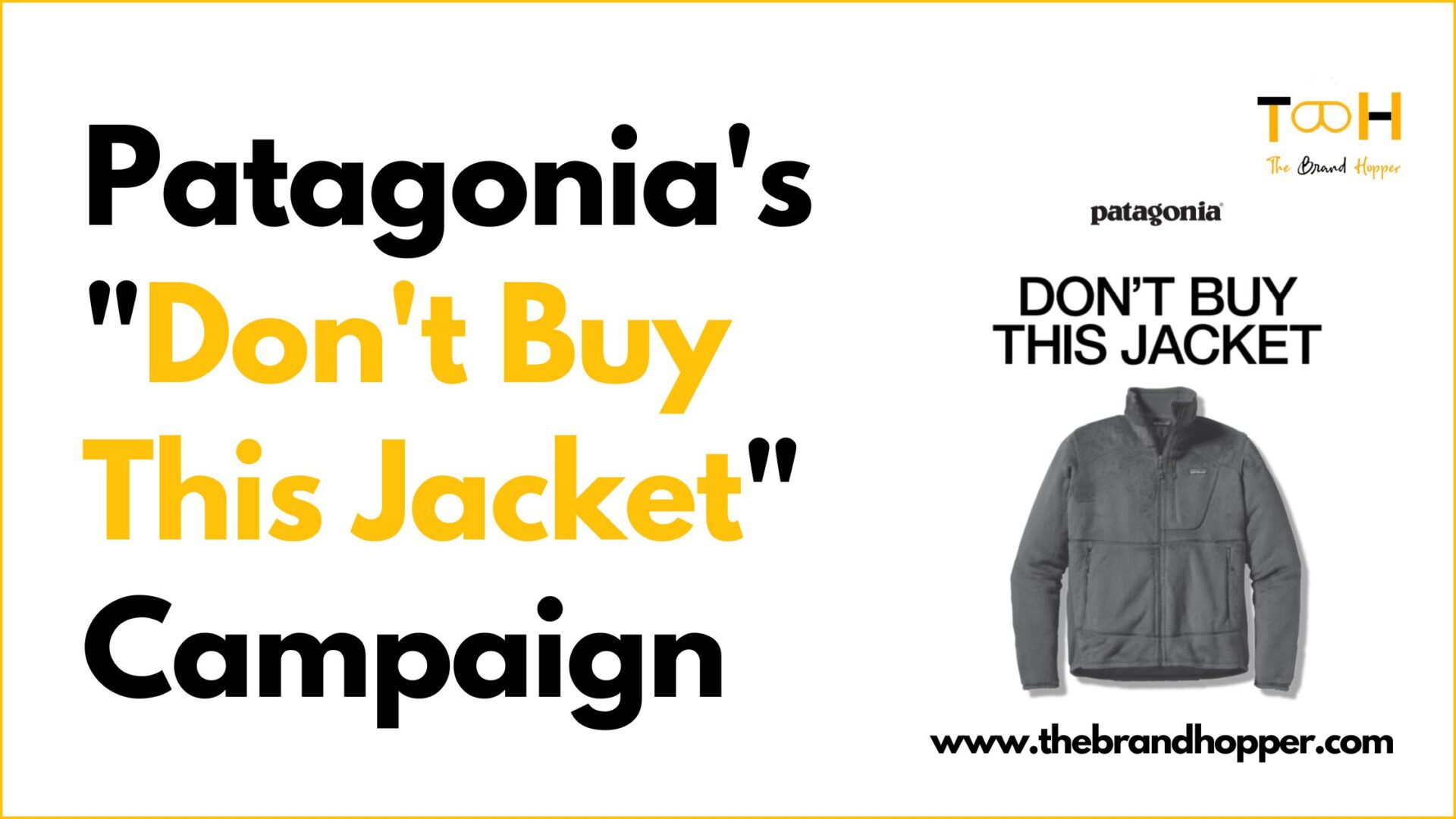
The centerpiece of the campaign was a full-page advertisement in The New York Times featuring Patagonia’s best-selling R2 fleece jacket with the bold headline “Don’t Buy This Jacket”. The advertisement was carefully designed to educate consumers about the environmental costs of production while challenging them to reconsider their purchasing habits. The copy detailed the environmental impact of manufacturing the jacket, including greenhouse gas emissions several times the garment’s weight, significant freshwater consumption, and substantial waste generation.
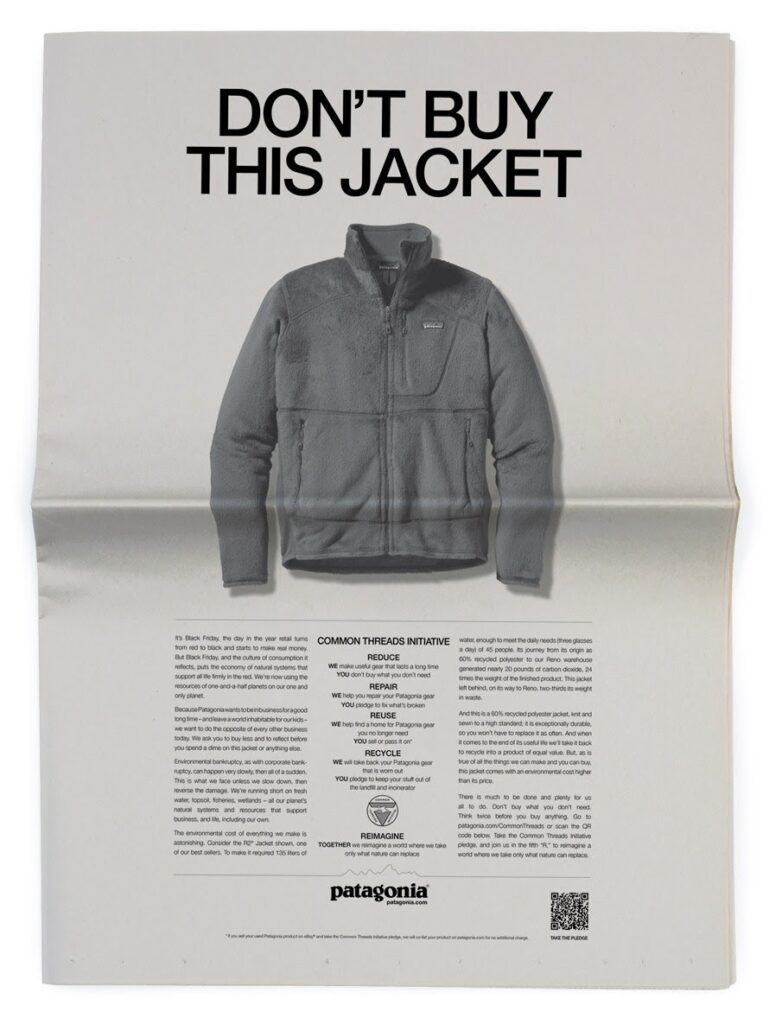
The messaging extended beyond simple environmental statistics to include actionable guidance for consumers. The advertisement included explicit messages such as “You don’t buy what you don’t need” and “Think twice before you buy anything”. This educational approach transformed the advertisement from a simple product promotion into a comprehensive sustainability lesson, positioning Patagonia as a thought leader in environmental responsibility rather than merely another retailer seeking holiday sales.
Multi-Channel Implementation
The campaign extended beyond the print advertisement to include coordinated digital and direct marketing efforts. Patagonia sent emails to subscribers describing the environmental impact of producing their best-selling jacket, reinforcing the print message through direct customer communication. The company also leveraged their partnership with eBay to promote their second-hand marketplace, providing consumers with alternatives to purchasing new products. This multi-channel approach ensured consistent messaging across all customer touchpoints while providing practical alternatives for environmentally conscious consumers.
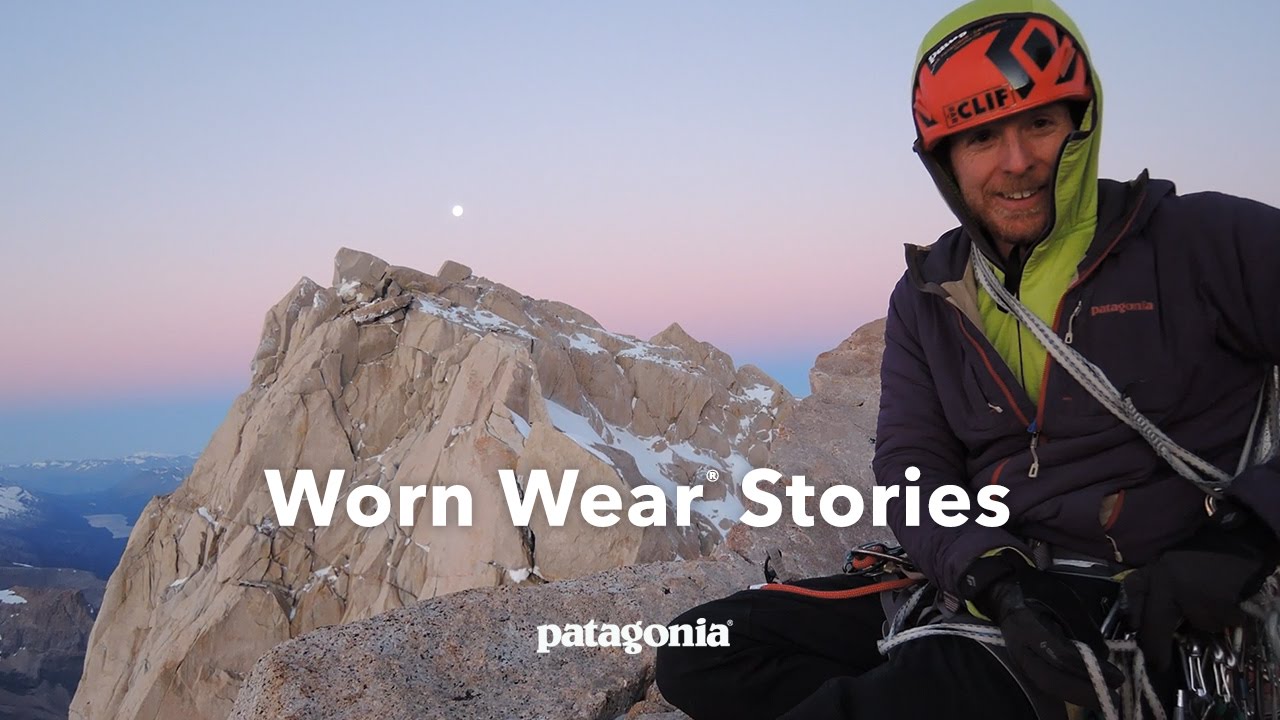
The integration with Patagonia’s “Worn Wear” program was particularly effective, as it offered customers tangible ways to participate in sustainable consumption practices. The Worn Wear initiative showcased thousands of videos and pictures from customers worldwide who proudly displayed their worn, patched-up Patagonia garments, creating a community of brand advocates who valued longevity over novelty. This user-generated content campaign reinforced the anti-consumption message while building emotional connections between customers and their Patagonia products.
Results and Business Impact
Financial Performance and Sales Growth
Despite the overtly anti-consumption message, the campaign generated remarkable financial results that exceeded all expectations. In 2012, which included approximately nine months of the “buy less” marketing strategy, Patagonia’s sales increased almost one-third to $543 million, while the company simultaneously opened 14 new stores. The following year saw continued growth with revenue increasing another 6% to $575 million. In total, the campaign contributed to generating $158 million in new apparel sales over two years, demonstrating that authentic messaging could drive commercial success even when explicitly discouraging purchases.
By 2017, Patagonia had reached $1 billion in annual sales, representing sustained growth that could be partially attributed to the brand loyalty and market positioning established through the “Don’t Buy This Jacket” campaign. The company’s valuation grew to approximately $3 billion, reflecting investor confidence in Patagonia’s unique business model and sustainable competitive advantages. These financial results validated the strategic decision to prioritize brand authenticity and environmental messaging over traditional promotional tactics.
Brand Recognition and Media Impact
The campaign generated extensive media coverage and industry recognition that amplified its reach far beyond the initial New York Times placement. AdWeek named it “the ad of the day” for its bold and unconventional approach, while numerous business publications analyzed the strategy as a case study in authentic brand marketing. The widespread media attention provided Patagonia with millions of dollars worth of earned media coverage, significantly expanding the campaign’s impact without additional marketing investment.
The campaign’s success in generating organic social media discussions and word-of-mouth marketing demonstrated the power of provocative, authentic messaging in the digital age. Consumer discussions about the campaign’s meaning and Patagonia’s motivations extended the brand’s reach into new market segments and reinforced its position as an industry leader in corporate social responsibility. In many ways, it also highlighted how something as simple as jackets with your brand can become powerful storytelling tools when tied to a company’s values. This earned media coverage proved particularly valuable in establishing Patagonia’s credibility with environmentally conscious consumers who were skeptical of traditional corporate marketing messages.
Analysis of Success Factors
Authenticity and Brand Alignment
The campaign’s success fundamentally relied on Patagonia’s authentic commitment to environmental stewardship, which provided credibility for their anti-consumption message. Unlike companies that engage in “greenwashing” or superficial environmental marketing, Patagonia had established a track record of genuine environmental action through initiatives such as donating 1% of sales to environmental causes (over $100 million since 1985), achieving B-Corporation certification, and powering their headquarters with solar energy. This authentic foundation meant that consumers viewed the “Don’t Buy This Jacket” message as genuine rather than manipulative.
The alignment between the campaign message and Patagonia’s business model was crucial to its credibility. The company’s focus on producing high-quality, durable products that were designed to last aligned perfectly with their anti-consumption messaging. Patagonia’s lifetime warranty on products, free repair services, and take-back recycling programs demonstrated that they were genuinely committed to reducing consumption rather than simply using environmental messaging as a marketing tactic. This consistency between messaging and business practices created trust with consumers who were increasingly skeptical of corporate environmental claims.
Provocative Messaging and Market Differentiation
The paradoxical nature of asking customers not to buy products generated curiosity and sparked widespread discussion, helping Patagonia stand out in the crowded retail marketplace. During Black Friday, when consumers are overwhelmed with promotional messages encouraging immediate purchases, Patagonia’s anti-consumption stance created a distinctive market position that captured attention and generated memorable brand experiences. This differentiation was particularly valuable in the outdoor apparel market, where many competitors make similar claims about quality and environmental responsibility.
The educational component of the messaging transformed the advertisement from a traditional sales pitch into a sustainability lesson, positioning Patagonia as a thought leader rather than merely another retailer. By transparently sharing information about the environmental costs of their own products, Patagonia demonstrated a level of honesty and transparency that was rare in corporate marketing. This educational approach helped consumers understand the broader environmental implications of their purchasing decisions while reinforcing Patagonia’s expertise and authority in sustainability matters.
Target Audience Alignment and Values-Based Marketing
The campaign resonated particularly strongly with Patagonia’s core customer base of environmentally conscious outdoor enthusiasts who shared the company’s values regarding environmental protection and sustainable consumption. Research conducted on the campaign found that participants’ environmental concern, perceived intrinsic brand motivation, and perceived extrinsic brand motivation were important predictors of positive responses to the anti-consumption message. This suggests that the campaign was most effective with consumers who were already predisposed to value environmental responsibility and authentic corporate behavior.
The timing of the campaign coincided with growing consumer interest in sustainability and corporate social responsibility, particularly among younger demographics who prioritized brand values over traditional factors such as price and convenience. As consumers became more conscious of the environmental and social impacts of their purchasing decisions, Patagonia’s transparent approach to discussing these issues helped build trust and loyalty among values-driven customers. This alignment between campaign messaging and evolving consumer values created a sustainable competitive advantage that extended far beyond the immediate campaign period.
Strategic Implications and Business Model Innovation
Circular Economy and Sustainable Business Practices
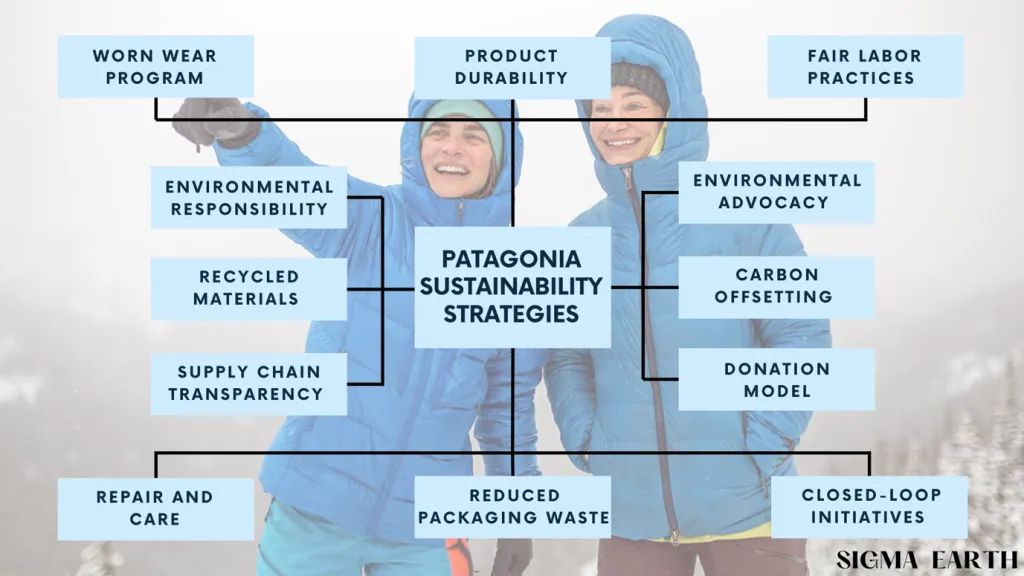
The “Don’t Buy This Jacket” campaign served as a catalyst for expanding Patagonia’s circular economy initiatives and sustainable business practices. The campaign highlighted the importance of product longevity and encouraged customers to participate in repair, reuse, and recycling programs that extended product lifecycles. These initiatives not only supported environmental goals but also created new revenue streams through services such as repairs, trade-in programs, and second-hand sales.
Patagonia’s Worn Wear program, which was closely integrated with the campaign messaging, demonstrated how companies could profit from promoting product longevity rather than planned obsolescence. The program allowed customers to trade in used Patagonia items for store credit while the company resold these items at reduced prices, creating value for both customers and the company. This approach generated estimated sales of 120,000 repurposed items, demonstrating the commercial viability of circular business models.
Stakeholder Capitalism and Purpose-Driven Business
The campaign exemplified Patagonia’s evolution toward stakeholder capitalism, where the company balanced profit maximization with environmental and social responsibility. This approach culminated in 2022 when founder Yvon Chouinard transferred ownership of the company to the Patagonia Purpose Trust and Holdfast Collective, ensuring that all profits would be directed toward environmental causes. This ownership structure represented the ultimate expression of the values that underpinned the “Don’t Buy This Jacket” campaign.
The success of the campaign validated the viability of purpose-driven business models that prioritize long-term value creation over short-term profit maximization. By demonstrating that authentic environmental messaging could drive commercial success, Patagonia provided a roadmap for other companies seeking to integrate social and environmental responsibility into their core business strategies. This approach has influenced numerous other brands to adopt similar values-based marketing strategies, though few have achieved Patagonia’s level of authenticity and consistency.
Industry Impact and Competitive Response
Influence on Sustainable Marketing Practices
The success of Patagonia’s “Don’t Buy This Jacket” campaign influenced numerous other companies to adopt similar anti-consumption or sustainability-focused marketing strategies. REI’s #OptOutside campaign, which encouraged customers to spend Black Friday outdoors rather than shopping, directly followed Patagonia’s example of using counter-cultural messaging to reinforce brand values. Other outdoor and lifestyle brands began incorporating sustainability messaging into their marketing communications, though few achieved Patagonia’s level of authenticity and consumer trust.

The campaign also contributed to broader industry discussions about the environmental impact of fast fashion and overconsumption. By transparently discussing the environmental costs of their own products, Patagonia helped establish new standards for corporate transparency and environmental accountability in the apparel industry. This influence extended beyond marketing communications to impact product design, supply chain management, and corporate sustainability reporting practices across the industry.
Competitive Positioning and Market Leadership
The campaign solidified Patagonia’s position as the leading sustainable brand in the outdoor apparel market, creating significant competitive advantages that were difficult for competitors to replicate. The combination of authentic environmental commitment, transparent business practices, and consistent messaging created a unique market position that distinguished Patagonia from both traditional outdoor brands and newer sustainable fashion companies. This leadership position provided Patagonia with pricing power and customer loyalty that supported continued growth despite premium pricing strategies.
Competitors attempting to replicate Patagonia’s success with similar anti-consumption messaging often lacked the authentic foundation of environmental commitment that made the original campaign credible. This highlighted the importance of alignment between marketing messaging and genuine corporate values, demonstrating that effective sustainability marketing requires fundamental changes to business practices rather than superficial communication adjustments. The difficulty of replicating Patagonia’s approach provided the company with sustainable competitive advantages that continued to benefit the business long after the initial campaign.
Lessons Learned and Strategic Implications
Authenticity as Competitive Advantage
The primary lesson from Patagonia’s campaign is that authentic brand messaging aligned with genuine corporate values can create sustainable competitive advantages that transcend traditional marketing tactics. The campaign succeeded because it reflected Patagonia’s genuine commitment to environmental responsibility rather than serving as a superficial marketing gimmick. This authenticity created trust with consumers who were increasingly skeptical of corporate environmental claims and seeking brands that demonstrated genuine commitment to social and environmental responsibility.
Companies seeking to replicate this success must ensure that their marketing messaging accurately reflects their actual business practices and corporate values. The campaign demonstrated that consumers are sophisticated enough to distinguish between authentic sustainability commitments and “greenwashing” attempts, making genuine corporate transformation essential for effective values-based marketing. This requirement for authenticity creates barriers to entry that protect companies like Patagonia from competitive imitation while rewarding genuine commitment to sustainability.
Long-Term Value Creation and Stakeholder Capitalism
The campaign illustrated how companies can create long-term value by prioritizing stakeholder interests alongside shareholder returns. Patagonia’s focus on environmental protection and customer education generated sustainable competitive advantages that supported continued growth and profitability over multiple years. This approach challenged traditional business assumptions about the trade-offs between profitability and social responsibility, demonstrating that authentic commitment to broader stakeholder interests could enhance rather than compromise financial performance.
The success of this stakeholder-oriented approach influenced Patagonia’s eventual transition to a unique ownership structure that prioritizes environmental impact over profit maximization. This evolution represents the logical extension of the values that underpinned the “Don’t Buy This Jacket” campaign, demonstrating how authentic commitment to social and environmental responsibility can transform entire business models and create new forms of value creation that benefit multiple stakeholders simultaneously.
Conclusion
Patagonia’s “Don’t Buy This Jacket” campaign represents a watershed moment in marketing history, demonstrating that authentic, values-based messaging can generate significant commercial success while advancing important social and environmental goals. The campaign’s paradoxical approach of discouraging consumption during the peak shopping season succeeded because it was grounded in genuine corporate commitment to environmental responsibility and aligned with evolving consumer values regarding sustainability and corporate transparency. The resulting 30% sales increase and sustained business growth validated the strategic decision to prioritize brand authenticity over traditional promotional tactics.
The campaign’s broader impact extends far beyond Patagonia’s immediate business results, influencing industry practices, competitive strategies, and academic understanding of consumer behavior and sustainable marketing. By demonstrating the commercial viability of anti-consumption messaging, Patagonia helped establish new paradigms for corporate social responsibility and stakeholder capitalism that continue to influence business practices across multiple industries. The campaign’s success provides a roadmap for companies seeking to integrate environmental and social responsibility into their core business strategies while maintaining commercial viability and competitive advantage.
Future marketing practitioners can learn from Patagonia’s example that successful sustainability marketing requires fundamental alignment between messaging and business practices, authentic commitment to stated values, and long-term perspective on value creation. The campaign demonstrates that consumers will reward genuine corporate authenticity with loyalty and advocacy that provide sustainable competitive advantages, but only when marketing communications accurately reflect actual corporate behavior and values. As consumer consciousness regarding environmental and social issues continues to evolve, Patagonia’s approach provides a proven framework for building successful, sustainable businesses that create value for all stakeholders while advancing critical social and environmental objectives.
Also Read: Marketing Strategies and Brand Campaigns of Patagonia
To read more content like this, subscribe to our newsletter