
Last Updated on June 26, 2025 by Team TBH
Pacaso is a real estate startup (founded 2020) that pioneered a new model for owning vacation homes. Founded by former Zillow executives Spencer Rascoff and Austin Allison, Pacaso targets the large U.S. vacation-home market (estimated at $1.3 trillion) by letting groups of buyers co-own high-end properties.
Its platform creates a dedicated LLC for each home, sells fractional shares (typically 1/8–1/2) to up to eight owners, and then professionally manages the home – furnishing it, scheduling stays, and handling maintenance – through an app-based system. This approach “makes luxury vacation homes accessible, fully utilized, and hassle-free”.
By mid-2024 Pacaso reported nearly $1 billion in transactions and over 1,500 co-owners in about 40 markets worldwide, signaling strong early traction for the brand.
Founding Story of Pacaso
Pacaso’s concept was hatched in late 2019 and quietly built into 2020.
The company (initially codenamed “Niner Homes”) officially launched in October 2020 with roughly $17 million in Series A funding led by Maveron and others. Phoenix was among the first markets served.
Within six months, Pacaso’s novel “fractional ownership” idea attracted massive interest.
In March 2021 Pacaso closed a $75 million Series B round (led by Greycroft, Global Founders, and others) at a $1.0 billion valuation, instantly making it a unicorn.
Pacaso’s rapid rise (from launch to $1B valuation in less than a year) reflected surging demand from affluent buyers who wanted a smarter way to afford second homes. By September 2021 a $125 million Series C (led by SoftBank Vision Fund 2, Fifth Wall, Gaingels, etc.) propelled the valuation to about $1.5 billion. (In total, by late 2021 Pacaso had raised roughly $215 million in equity, plus about $250 million in debt financing to acquire homes.)
Founders of Pacaso
Pacaso’s founders brought strong industry credentials.
Spencer Rascoff was a co-founder and former CEO of Zillow (leading it through a successful IPO).

Austin Allison founded the proptech company DotLoop and sold it to Zillow in 2015.

Both had later roles at Zillow. Together they leveraged their real estate tech experience to create Pacaso. Their reputations helped convince top-tier investors (Maveron, SoftBank, Fifth Wall, etc.) to back the venture early. (Pacaso’s in-house management team also grew rapidly: from ~30 people in early 2021 to ~120 by late 2021.)
Business Model of Pacaso
Pacaso’s co-ownership platform works like this (see bullet points below):
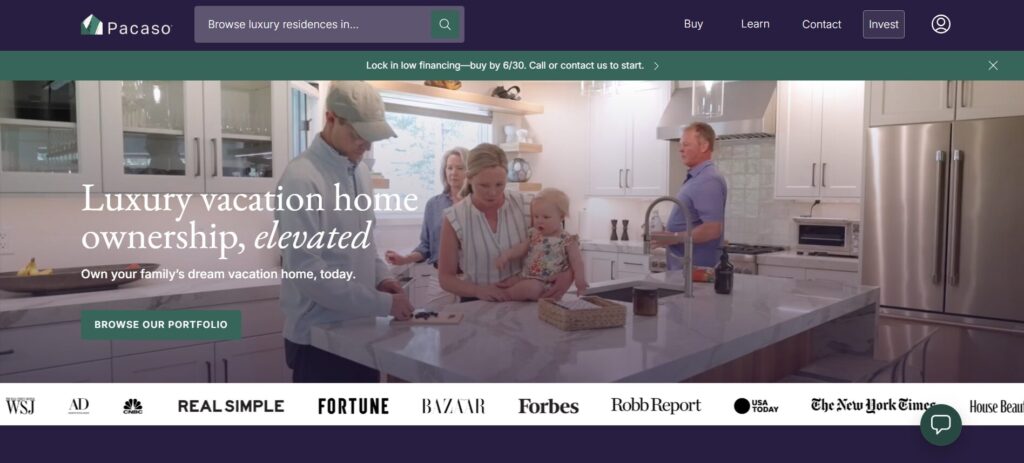
Acquire a luxury home: Pacaso (often via real estate agents) purchases a desirable second home in a resort area. It sets up a multi-member LLC for the property.
Sell fractional shares: Up to 8 buyers each purchase a share of that LLC (typically 1/8 or 1/4 of the home). Each share entitles the owner to an equivalent fraction of the home’s usage (e.g. ~45 days per year for an 1/8 share). The initial owner-owners fully equitably; Pacaso temporarily holds any remaining share until more buyers join.
Professional management: Pacaso then serves as the managing partner for the home. It furnishes the house, handles all maintenance, pays utilities and insurance, and provides concierge services. Owners do not need to manage the property themselves. (Pacaso prohibits short-term rentals; owners simply use their share or coordinate swaps with co-owners.) Scheduling is handled by Pacaso’s proprietary SmartStay™ system (an online/mobile calendar) so that owners can book stays fairly and easily.
Secondary resale: After a holding period (typically 12 months), any owner can list their share for sale through Pacaso’s platform. Pacaso facilitates the resale process (often using its own network of partner brokers), ensuring buyers pay market prices. Unlike traditional resort timeshares, Pacaso owners truly own equity in the property and benefit from any appreciation.
Pacaso’s model is often summarized as “traditional home ownership, shared by a few, managed by experts.” By pooling resources, Pacaso claims its co-owned homes are occupied nearly year-round (vs. ~90% idle in the old model), making better use of housing stock.
Revenue Streams of Pacaso
Pacaso generates revenue through multiple channels:
-
Sales (Transaction) Fees: Pacaso charges a one-time service fee (about 12% of the share purchase price) on each co-ownership sale.
-
Monthly Management Fees: Each owner pays a recurring fee (around $100 per month) for Pacaso’s ongoing property management and owner support.
-
Financing Fees: Pacaso offers mortgage financing to co-owners (often up to ~70% of the purchase price) and earns origination fees on those loans. (For example, Pacaso’s literature notes it will finance up to 70% LTV and collect a fee at closing.)
-
Renovation/Design Fees: Before or during co-ownership, Pacaso may upgrade a home’s interior or amenities to enhance its value – charging fees that are often built into the share price.
-
Resale Commissions: When an owner resells a share through Pacaso’s platform, Pacaso can earn an agent’s commission on that sale.
In short, Pacaso monetizes the transaction (brokerage) and the ongoing management of each co-owned property. The combination of up-front fees, recurring fees, and financing income provides diversified cash flow.
Funding and Investment History of Pacaso
Pacaso’s aggressive growth was fueled by large venture rounds and debt capital. After the $17M Series A in 2020, Pacaso quickly raised $75M in Series B (March 2021) at a roughly $1.0B pre-money valuation.
In September 2021 a $125M Series C led by SoftBank Vision Fund 2 (with participation from Fifth Wall, Gaingels and earlier backers) closed at a $1.5B valuation. By late 2021, total equity raised was about $215M. (Pacaso also arranged roughly $250M of debt financing in 2020 to acquire homes upfront.)
In 2024 Pacaso opened its capital more broadly: it filed a Regulation A+ “crowdfunding” offering, aiming to raise roughly $75M from accredited and non-accredited investors. This new round – led by its existing venture backers – plans to further fuel expansion.
Funding Rounds of Pacaso
| Date | Round | Amount Raised | Lead Investors (Series) | Implied Valuation |
|---|---|---|---|---|
| Oct 2020 | Series A | $17 million | Maveron; Crosscut VC; Global Founders Capital | – |
| Mar 2021 | Series B | $75 million | Greycroft; Global Founders; Acrew; 75&Sunny | $1.0 billion |
| Sept 2021 | Series C | $125 million | SoftBank Vision Fund 2; Fifth Wall; Gaingels; others | $1.5 billion |
Table: Major Pacaso funding rounds (sources: company announcements and Crunchbase News).
Competitor Analysis of Pacaso
Several other firms offer fractional or shared ownership of vacation homes. Key players include:
| Company | Co-Ownership Model | Primary Markets / Focus | Ownership Stakes & Pricing |
|---|---|---|---|
| Pacaso | Buys luxury homes and creates a co-ownership LLC; sells ⅛–½ shares to buyers. Fully managed (maintenance, scheduling via app). | US and Europe (high-end resort areas e.g. Napa, Aspen, London, Paris) | Typically ultra-luxury: ~$500k+ for 1/8 share (mid-$200k to $3M range). |
| Plum Co-Ownership | Online platform that matches co-buyers. Does not own homes. Groups of 2–12 co-owners choose a home together via the tech platform. Owners decide terms as a group. | Primarily US nationwide (any vacation locale). Focus on flexibility and affordability. | Entry-level: ~$50k–$100k per share (because buyers can co-buy any home); shares and scheduling are group-determined. |
| Kocomo | A private real-estate fund that buys vacation homes in Mexico/US and sells fractional shares. Usually up to ~6 owners per home, each share gives ~6 weeks/year usage. Owners can swap weeks or even rent out. | Mexico (e.g. Cabo), Southern California, Florida, Vail (CO) – popular vacation destinations. | Shares from ~$100k to $732k (e.g. ~$98.7k for 2-bed MX city apt up to $732k for Miami waterfront); all shares yield ~6 weeks annual use. |
| August Collection | Equity “membership” model in a portfolio of luxury second homes across Europe. Buyers purchase a 1/21 stake in the company (giving access to ~30+ homes in 7 countries). | Europe: major luxury cities (Paris, Rome, London, Barcelona, Cannes, etc.). High-end multi-home strategy. | Approximately €400k per share (1/21 of portfolio). Owners get a floating schedule of weeks in many homes (~3–5 stays/year). |
| International Property Shares (IPS) | A UK-based fractional home ownership company. Owners buy 1/6 or 1/8 stakes in single vacation properties (often charming village homes). Managed by co-owners in rotation. | UK and Europe, focusing on “authentic” European vacation properties (villas, pied-à-terres). | Lower-priced market: about €58,000 for a 1/6 share. Each owner has a fixed usage schedule; management may be partly by co-owners. |
Table: Competitors in luxury second-home co-ownership.
Competitive Advantage of Pacaso
Pacaso’s differentiators center on service, scale and brand. The company’s leadership pedigree and financing have enabled aggressive growth: backers include SoftBank, Maveron, Fifth Wall and others.
Its curated focus on ultra-luxury markets appeals to high-net-worth buyers seeking a turnkey experience. Unlike pure technology platforms, Pacaso owns and vets each property, ensuring a consistently high standard of home and service.
Owners benefit from Pacaso’s full-service management – including furniture, concierge support, and strict rules against short-term rentals – so they “own” without the hassle. The proprietary SmartStay® scheduling system (and supporting mobile app) further streamlines usage for multiple owners.
These elements allow Pacaso to charge premium prices: for example, its shares have historically commanded a >10% resale premium over purchase prices as market demand grows. In short, Pacaso’s combination of exclusive listings, white-glove management, and strong capital backing gives it an edge over smaller fractional operators.
Additional Strategic Insights
Pacaso continues to execute aggressive geographic and product expansion. Having saturated many U.S. resort markets, it launched in Europe in 2024 – selling out its first Paris property and quickly adding London listings. Crunchbase News notes Pacaso plans further expansion into Spain, Mexico and the Caribbean. The company also forms partnerships with traditional brokerages; for example, Pacaso now works with real estate agents nationwide to source homes and buyers. Pacaso even received a legislative boost in Utah in 2023 when the state passed SB271 (championed by Pacaso) to pre-empt local fractional-ownership bans.
On the technology front, Pacaso has built an end-to-end digital infrastructure. Beyond SmartStay scheduling, it operates an online marketplace where buyers can find available homes, complete purchases, and later list share resales. Pacaso also publishes market data (e.g. second-home trend reports) and offers flexible payment options, even accepting cryptocurrency for share purchases on some deals. Internally, the platform aggregates occupancy data and pricing information from its co-owned homes to refine future acquisitions and improve scheduling algorithms.
Pacaso has navigated significant regulatory challenges. Some jurisdictions (notably in California wine-country) have moved to restrict or ban Pacaso-style co-ownership of single-family homes. For example, Sonoma County (Jan 2022) and St. Helena (2021–2024 lawsuit) passed ordinances limiting fractional uses. Napa and Santa Barbara likewise enacted strict controls on vacation-property sharing. In response, Pacaso argued its model is distinct from hotel-like timeshares, and it even sued St. Helena in 2021 to protect its existing homes. That suit was settled in Feb 2024: Pacaso kept its four St. Helena homes but agreed not to add new ones. Meanwhile, other jurisdictions have crafted specific rules for co-owned homes. In Park City, Utah, for instance, Pacaso supported new regulations (SB271) that prevent cities from blocking co-owned vacation homes. These legal outcomes illustrate how Pacaso’s national growth must adapt to local zoning and housing policies.
Finally, market adoption trends favor Pacaso’s model. Surveys indicate a rising interest in non-traditional homeownership: about 40% of U.S. respondents said they would consider buying a vacation home, and home-price pressures are pushing would-be buyers toward shared solutions. Pacaso’s own research corroborates this: co-ownership closings in its top counties jumped ~21% from 2022 to 2023. The company points to cost savings and convenience – notably among younger or unmarried buyers pooling funds – as driving growth. As second-home prices climb, Pacaso claims co-ownership not only makes homes affordable but also reduces environmental and economic waste by keeping high-value houses occupied more often. These strategic dynamics suggest Pacaso is positioning itself at the forefront of a broad shift in how people access luxury vacation properties.
Also Read: Flyhomes : Founders, Business Model, Funding, Competitors
To read more content like this, subscribe to our newsletter