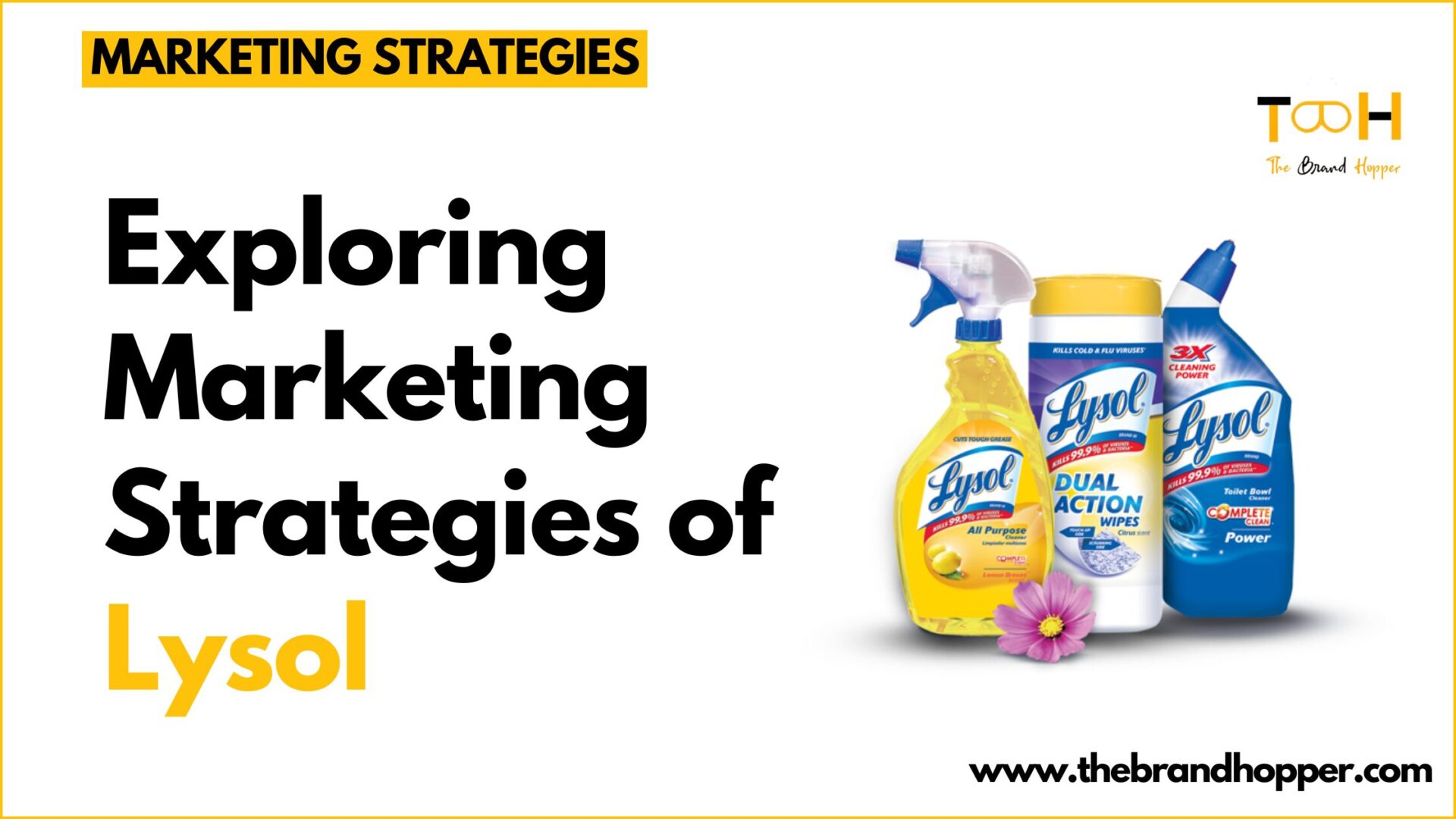
Lysol is a globally recognized brand in household and hygiene products, known for its disinfectants that kill 99.9% of germs. With a history dating back to 1889 when it was first introduced to help combat a cholera epidemic, Lysol has spent over a century building trust as a guardian of public health.
Today, Lysol is part of Reckitt’s portfolio of “Powerbrands” and remains a market leader in disinfecting sprays, wipes, cleaners, and other sanitization products. The brand has become a staple in more than half of U.S. households, symbolizing safety and cleanliness in everyday life.
This longevity is rooted in Lysol’s unwavering mission: helping individuals and families maintain healthy homes by protecting them from illness-causing germs. As the company proudly states, it has been “Helping Protect Your Family For Over 100 Years,” combining scientific strength with a heartfelt purpose.
Throughout its history, Lysol’s marketing approach has evolved to keep the brand relevant and trusted across generations and geographies. Early on, Lysol was advertised as a tool to fight pandemics like the 1918 Spanish flu, establishing credibility in times of crisis.
Over the decades, the brand expanded its product lines and tailored its messaging to resonate with contemporary consumer concerns. In recent years, Lysol’s prominence surged during the COVID-19 pandemic, when its products were in unprecedented demand and its name became synonymous with protection against the virus.
But behind this top-of-mind awareness lies a tapestry of savvy marketing strategies that Lysol has employed. These strategies range from data-driven inclusive marketing and digital engagement with young consumers, to strategic partnerships that extend the brand’s trust into new arenas, to emotionally charged campaigns that connect with consumers’ values.
Lysol also leverages product innovation and differentiates itself in a crowded market by educating consumers on new hygiene solutions. Equally important, the brand actively partakes in public health initiatives and cause-related programs, reinforcing its “strength and heart” – delivering effective germ-kill while genuinely caring for communities.
In this comprehensive overview, we will delve into key marketing strategies that Lysol uses to maintain its global brand leadership.
These include: (1) embracing inclusive marketing to reach diverse audiences, (2) engaging consumers through digital and influencer channels, (3) forming strategic partnerships to build trust and extend reach, (4) utilizing emotional storytelling in campaigns, (5) driving innovation and product differentiation in marketing, (6) advocating public health education, and (7) executing cause marketing and community programs.
Each strategy demonstrates a unique facet of Lysol’s marketing mix, yet all work in concert to uphold Lysol’s brand promise of protection.
By examining these approaches, we gain insight into how Lysol stays both professional and relatable in its marketing – balancing a formal, science-backed image with the accessibility of a global consumer brand.
The result is a marketing playbook that not only sells cleaning products, but also sells peace of mind.
Marketing Strategies of Lysol
1. Embracing Inclusive Marketing and Consumer Insights
One of Lysol’s cornerstone strategies is its inclusive marketing approach – ensuring that its advertising and products resonate with the broad diversity of consumers it serves.
In fact, Lysol has been recognized as a leader in culturally inclusive branding, winning the top ranking for Ad Effectiveness among diverse audiences two years in a row.
By authentically engaging multicultural consumers, Lysol has seen tangible business benefits: inclusive 15- and 30-second ads led to higher purchase intent, brand trust, and affinity across diverse demographics.
Gary Osifchin, Chief Marketing Officer for Reckitt’s U.S. Hygiene division, explains that inclusive marketing isn’t a side project for Lysol – it’s embedded in the brand’s operating model because reaching all consumer segments is core to achieving its goals.
In practice, this means Lysol intentionally creates campaigns that make people of all backgrounds feel seen and valued, rather than using a one-size-fits-all message.
A key to Lysol’s success in inclusive marketing is its commitment to customer intimacy and identity-based research.
The Lysol marketing team invests heavily in qualitative research, spending time with underrepresented consumers to understand their needs, preferences, and cultural nuances.
Osifchin describes a rigorous process of gathering insights through in-home visits, focus groups, and ongoing conversations with diverse consumers.
These insights directly inform Lysol’s product development and messaging.
For example, when Lysol launched its “Brand New Day” line of disinfectant products with new fragrances, it specifically aimed to appeal to African-American and Hispanic consumers.
The team asked themselves, “Are we actually delivering a better fragrance experience… among the target consumers…?” and could confidently answer yes – because the scents were developed based on cultural insight and then tested with those communities before launch.
By grounding decisions in real consumer voices, Lysol avoids tone-deaf campaigns and instead creates marketing that genuinely resonates.
Lysol’s inclusive strategy also involves authentic representation in its content.
The brand consciously features people of different ethnicities and backgrounds in its ads and partnerships, reflecting the diversity of its customer base.
This authenticity builds trust: consumers feel the brand is “for people like them,” not an opportunistic advertiser.
Notably, Lysol’s inclusive ads have struck the right tone and avoided the pitfalls other brands have faced, precisely because Lysol does the homework to get it right.
Osifchin notes that brands often face backlash for culturally insensitive ads when they haven’t put in the work to know their audience.
Lysol’s approach – insight first, creative second – ensures its campaigns hit the mark and even drive incremental growth from segments that might otherwise be overlooked.
In summary, by prioritizing multicultural marketing through research and inclusion, Lysol expands its reach, strengthens brand loyalty among diverse groups, and upholds its reputation as a brand that cares about all families.
This strategy exemplifies how understanding and celebrating consumers’ identities can be both the right thing to do and a smart business move.
2. Digital Engagement and Influencer Marketing
Lysol has progressively embraced digital and social media marketing, recognizing that today’s consumers – especially younger generations – spend much of their time online.
A prime example is Lysol’s recent foray into TikTok and influencer marketing, a notable shift from its traditional advertising tactics.
In launching its new Lysol Air Sanitizer product, the brand opted for a creative product placement strategy on TikTok, working with content creators to integrate the product into everyday scenarios.
Instead of overt commercials or how-to demos, Lysol had popular TikTok influencers casually showcase the air sanitizer in their daily routines – like an accessory in a bedroom makeover or part of a cleaning snippet – to spark curiosity.
“It’s really about inserting the products into everyday moments that influencers can bring to life, which is very different from how we typically talk about our products,” explained Benoit Veryser, VP of Marketing for Lysol.
By leveraging influencer creativity, Lysol is able to generate buzz and peer-to-peer credibility among Gen Z and millennial audiences in a way that traditional ads cannot match.
This approach not only extends Lysol’s reach to the millions on platforms like TikTok and Instagram, but also keeps the brand relevant and “in the conversation” on emerging trends.
An important aspect of Lysol’s social strategy is maintaining authenticity.
The brand deliberately avoids heavy-handed or overly scripted influencer content that would feel like an ad.
Instead, the goal is to have an organic presence – for example, an influencer might be doing a room tour or a day-in-the-life vlog and naturally use Lysol Air Sanitizer when discussing home air quality.
This subtle integration ensures the audience sees the product solving a real problem, not being forcefully sold.
“The objective is to get influencers to consider the product without having to do all kinds of cleaning activities all the time,” notes Lysol’s marketing team, highlighting the intent to make the promotion “not in-your-face.”
Alongside these TikTok placements, Lysol rolled out 15-second video ads on Instagram and consciously avoided less visual platforms like Twitter (now X), focusing its spend where visual storytelling thrives.
This indicates a savvy allocation of resources to channels that best fit the campaign’s content style – in this case, short-form video for maximum impact.
Beyond online videos, Lysol has also combined digital marketing with experiential events and data capture.
In the fall of its Air Sanitizer launch, Lysol organized an immersive in-person event playfully dubbed an “Air-oake” – a karaoke experience where attendees could sing and literally see via special effects how germs spread in the air.
At these events, QR codes were placed strategically, allowing consumers to scan and access Lysol’s website or follow its social accounts.
This not only let people test the product firsthand (spraying Lysol in a room after karaoke to demonstrate its effect), but also helped Lysol collect first-party data from interested consumers for retargeting or follow-up.
Crucially, Lysol’s invited influencers were present to capture content at the event and share it with their followers, amplifying the campaign’s reach.
The integration of live experience with social sharing created a buzz that blurred the line between online and offline engagement.
As marketing commentators observed, Lysol’s adept use of TikTok and Instagram for this campaign shows the brand understands where and how to connect with today’s consumers.
By focusing on visual, interactive storytelling and meeting younger audiences on their turf, Lysol modernized its image while reinforcing its product’s relevance.
This digital-forward strategy – a mix of influencer partnerships, creative content, and engaging experiences – has become essential for Lysol to remain culturally resonant and top-of-mind in a crowded media landscape.
3. Strategic Partnerships and Co-Branding Initiatives
Another pillar of Lysol’s marketing success is its use of strategic partnerships to extend brand trust beyond the household.
When people see the Lysol name in new contexts – such as hotels, airlines, or schools – it reinforces the perception that Lysol is the gold standard for cleanliness and safety.
A standout example is Lysol’s partnership with Hilton in 2020 to co-launch the Hilton CleanStay program at Hilton hotels worldwide.
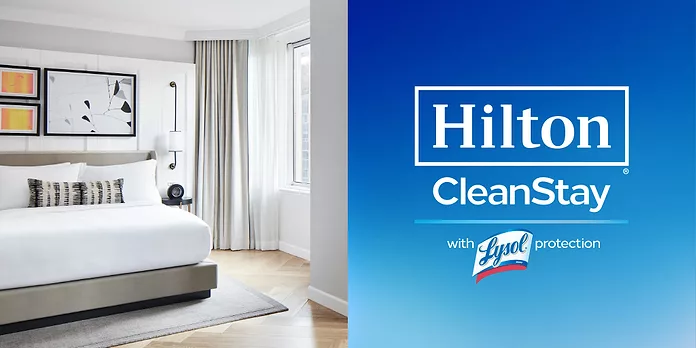
In a first for the hospitality industry, Hilton collaborated with Reckitt (Lysol’s parent company) and medical experts to develop heightened cleaning protocols for the pandemic era.
As part of this program, Hilton’s hotel rooms received a CleanStay Room Seal “with Lysol protection” placed over the door after cleaning.
This seal indicated to guests that no one had entered the room since it was disinfected with Lysol products – a small touch that provided huge peace of mind during COVID-19.
By visibly co-branding Hilton’s safety initiative with Lysol, both brands benefited: Hilton gained consumer trust by leveraging Lysol’s reputation as a germ-kill expert, and Lysol gained prominent exposure and endorsement in a setting beyond its normal retail presence.
Essentially, Lysol became a “silent partner” in Hilton’s promise of cleanliness, turning an abstract brand promise into a tangible reassurance for guests.
Similar partnership strategies were rolled out in other travel sectors. Delta Air Lines, for instance, teamed up with Lysol to enhance its “Delta CareStandard” cleaning protocols for airplanes and airports.
Announced in mid-2020, this partnership tapped into Lysol’s 130+ years of germ-killing expertise to bolster Delta’s sanitization of high-touch areas (like cabin interiors and lavatories) and to co-develop new disinfection solutions for air travel.
Lysol provided not only products (disinfectant sprays and wipes for use on planes) but also microbiologists and hygiene experts to advise Delta’s cleanliness team on best practices.
The messaging around this collaboration emphasized that Delta and Lysol were combining strengths – Delta’s safety rigor with Lysol’s scientific know-how – to make flying safer for the public.
As one Delta executive put it, “there’s no finish line for cleanliness,” highlighting that continuous innovation with partners like Lysol is needed to meet customer expectations.
For Lysol, being visibly present in airports and airplanes (through signage or mentions in announcements) not only marketed the brand to travelers, but also positioned Lysol as an authority in germ protection on a global stage.
Likewise, other travel players joined the trend: Amtrak trains and various hotel chains formed similar alliances with Lysol or its sister brand Dettol in other regions.
This wave of partnerships during the pandemic underscored how much brand equity Lysol has in the realm of hygiene – it became the go-to partner to instill consumer confidence.
These co-branding initiatives serve a dual purpose. First, they amplify Lysol’s brand visibility and credibility.
When consumers see “Lysol Protected” seals or hear about Lysol-backed cleaning in travel, it reinforces Lysol’s standing as the “#1 trusted brand” for disinfection.
Second, they fulfill a genuine business need in partner industries, creating a win-win scenario.
Hotels and airlines, hit hard by pandemic fears, could leverage Lysol’s brand trust to entice customers back, while Lysol opened new distribution channels (e.g. bulk sales to partners) and deepened its association with safety.
Even as the pandemic subsides, these partnerships have a lasting impact: they’ve set new consumer expectations that cleanliness protocols should involve known, reputable products.
In marketing terms, Lysol managed to turn its brand into a co-branded promise – a sort of ingredient brand for safety.
By strategically aligning with other companies in moments when hygiene was paramount, Lysol demonstrated marketing agility and strengthened its brand’s omnipresence in consumers’ daily journeys.
This strategy showcases the power of partnerships in marketing: by lending its name and expertise, Lysol ingrained itself in consumer experiences far beyond the cleaning aisle.
4. Emotional Storytelling in Campaigns
While science and efficacy are at Lysol’s core, the brand also recognizes the power of emotional storytelling to connect with consumers.
Lysol’s marketing often appeals to family values, love, and protection – positioning its products not just as cleaners, but as enablers of a healthier, happier home.
One of the most celebrated examples of this is the “Protect Like A Mother” campaign.

Launched in 2017 around Mother’s Day, this campaign was an emotionally charged tribute to the protective instinct of mothers, cleverly intertwining that theme with Lysol’s germ-fighting role.
The signature ad film depicted mothers from the animal kingdom – a lioness defending her cubs, a mother orangutan cradling her baby – alongside human moms caring for their children.
The visuals and narration drove home a poignant message: “No one protects like a mother. It’s what you do. It’s what we do.”
By stating that the only protection stronger than Lysol is a mother’s love, the campaign positioned Lysol as the next-best ally for moms in guarding their families.
This resonated deeply with the brand’s target audience (parents, especially mothers) on an emotional level that transcended product features.
Lysol wasn’t just talking about killing germs; it was celebrating the heroism of everyday moms and aligning itself with that fierce, loving energy.
The “Protect Like A Mother” campaign wasn’t limited to TV commercials.
Lysol extended the storytelling into an experiential marketing event – a pop-up exhibit in New York City’s Brooklyn Bridge Park that literally brought to life the theme.
The exhibit featured larger-than-life statues of animals (like a 24-foot orangutan and a giant octopus) showcasing how these creatures protect their young.
Each installation included educational storyboards and interactive elements for families, effectively turning marketing into a museum-like experience.
With the involvement of a wildlife expert (Dave Salmoni) as a partner, the exhibit lent an educational credence while still tugging at heartstrings.
Families who visited could marvel at mother nature’s protectors and naturally draw the connection to how human mothers protect their kids – with Lysol quietly present as a sponsor of the event and the solution to “protect from germs.”
The timing, just ahead of Mother’s Day, further amplified the emotional impact and earned media coverage, as it tied into a cultural moment of appreciating moms.
From a results perspective, this emotionally driven strategy paid off: the campaign boosted Lysol’s sales across key markets, helping reverse declines and drive growth in the U.S., UK, and Germany.
More importantly, it refreshed Lysol’s brand image with an uplifting, value-driven narrative that differentiated it from the often clinical tone of cleaning product ads.
By tapping into universal emotions like love, protection, and the safety of family, Lysol effectively humanizes its brand.
Consumers don’t just see Lysol as a chemical in a can; they see a brand that understands their deepest concerns – keeping loved ones safe – and shares those priorities.
This emotional connection fosters brand affinity that can be more enduring than any claim of efficacy.
It’s worth noting that Lysol’s brand voice in such campaigns remains sincere and formal yet compassionate, maintaining professionalism (reinforcing that it’s a 100+ year expert in germ-kill) while also showing heart.
The balance of “strength and heart” that Lysol espouses is clearly exemplified in campaigns like Protect Like A Mother.
This strategy of emotional storytelling has since become part of Lysol’s playbook – whether it’s highlighting parents going the extra mile to keep kids healthy, or communities coming together – the brand uses narrative-driven marketing to make its message memorable.
In sum, Lysol’s emotional campaigns create a powerful halo effect: they elevate the brand from a functional product to a symbol of care and protection, which can strongly influence consumer preference and loyalty.
5. Innovation and Product Differentiation in Marketing
In the competitive cleaning products market, Lysol continuously seeks to innovate and differentiate its offerings, not just in R&D but in how those innovations are messaged to consumers.
A recent case in point is Lysol’s introduction of the Lysol Air Sanitizer, a product that breaks new ground by targeting airborne germs.
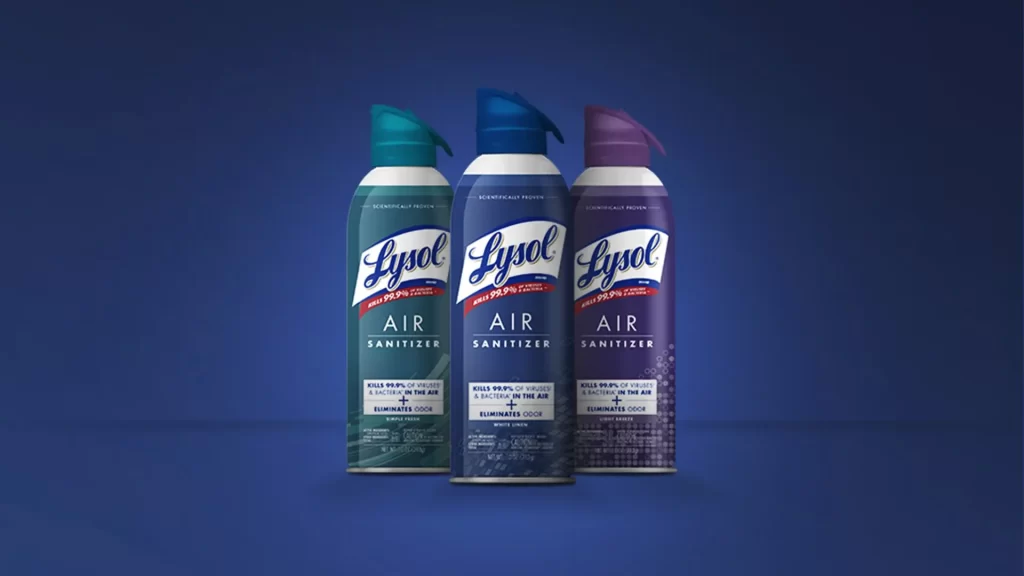
Recognizing rising consumer awareness that viruses and bacteria aren’t only on surfaces but also linger in the air, Lysol developed this spray to sanitize the air itself – and importantly obtained EPA approval as the first product of its kind to claim killing 99.9% of airborne germs.
The marketing strategy around this launch was carefully crafted to position Lysol as a pioneer in a new category, while drawing a sharp contrast with adjacent product categories like air fresheners.
The campaign’s theme, “Scent Can’t Sanitize,” boldly underscored that while traditional air fresheners may mask odors, they do nothing to eliminate harmful germs – a direct challenge to competitors in the home fragrance aisle.
https://www.youtube.com/watch?v=E6lWNd5DbNs
This slogan, often presented in bold text or visuals, educated consumers that pleasant scents are not equivalent to cleanliness, thereby creating a need for Lysol’s new solution.
By framing the narrative this way, Lysol turned a product feature (germ-killing in the air) into a compelling consumer insight: the air in your home might smell nice but still be full of invisible threats, and only a sanitizing spray can truly protect you.
The marketing execution for Lysol Air Sanitizer heavily used visual storytelling and demonstration, much like classic cleaning ads but updated for modern sensibilities.
Video spots depicted relatable scenarios – a child’s cough in a living room, or a dog shaking off water – that suddenly visualize droplets and particles spreading through the air in slow motion.
These particles, representing germs, are shown proliferating until the Lysol Air Sanitizer is sprayed, at which point the “germs” dramatically disappear from the scene.
Such imagery made the invisible visible, helping consumers grasp the product’s purpose on an emotional level (seeing the cloud of germs is naturally unsettling) and a rational level (Lysol literally wiping them out).
The campaign also smartly integrated an immersive “karaoke” activation (the Air-aoke event) where people saw via UV lights or animations how singing could fill a room with respiratory droplets.
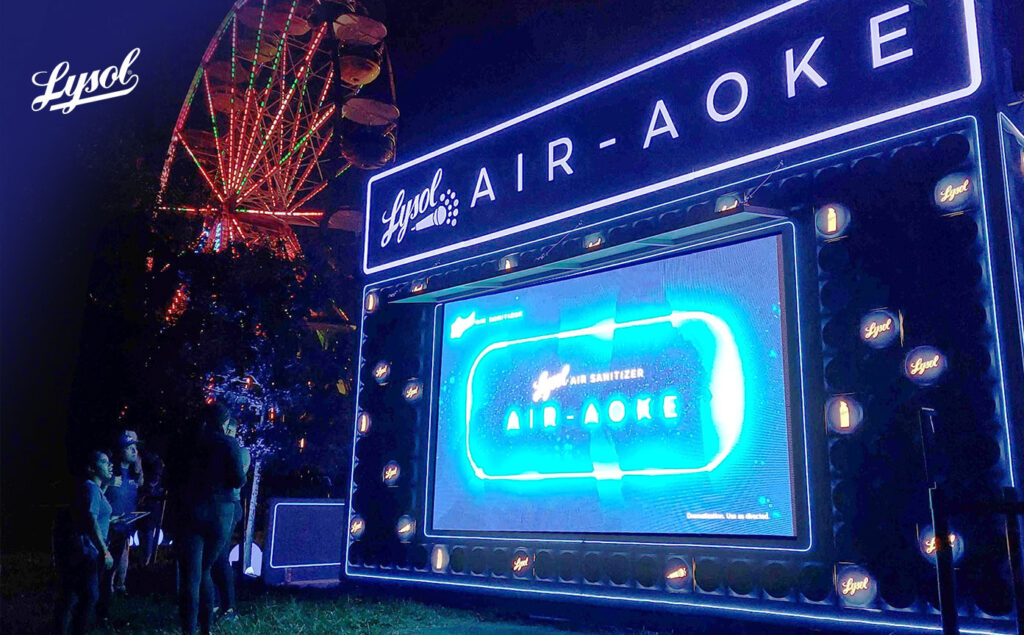
This not only attracted media attention for its creativity, but etched the problem-solution dynamic in participants’ minds: many germs in the air, but Lysol can fix it.
Meanwhile, on digital platforms and in stores, Lysol emphasized that Air Sanitizer is “the future of air care” – combining the odor elimination of air fresheners with the germ-killing of disinfectants.
In doing so, Lysol carved out a new niche and positioned itself as an innovator responding to post-pandemic consumer needs.
Another element of Lysol’s innovation marketing is educating consumers on proper usage to build trust in the product’s effectiveness.
For example, Lysol’s product page and ads for Air Sanitizer include a simple three-step instruction (close the room, spray towards ceiling for 30 seconds, then ventilate) to ensure users get the promised results.
By providing clear guidance, Lysol preempts any skepticism about “does this really work?” – it shows the brand’s confidence and helps consumers use the spray correctly for maximum benefit.
This educational angle is part of differentiating the product as well; it subtly says this is not just an aerosol freshener, it’s almost a device or a process for sanitization.
Market research cited by Lysol predicted significant growth in the cleaning category driven by product innovation and new formats like sprays for different applications.
Lysol is evidently riding that wave, ensuring it leads rather than follows trends.
Additionally, Lysol’s campaign kept an eye on competitors: when Clorox introduced a new brand platform “Start Clean” emphasizing holistic cleanliness, Lysol’s aggressive push with Air Sanitizer and the “Scent Can’t Sanitize” counter-message was a way to stay ahead in the messaging war.
Overall, Lysol’s strategy of highlighting innovation is two-fold: create products that fill emerging needs, and craft marketing that makes those needs salient to consumers.
This way, the brand reinforces its image as the cutting-edge authority in hygiene (not just resting on legacy products) and continues to attract consumers with solutions they hadn’t even realized they required.
By marketing innovation effectively, Lysol not only expands its product line’s success but also cements its broader brand promise of being one step ahead in the quest for a healthier home.
6. Public Health Advocacy and Education
Lysol’s marketing extends beyond selling products – it also encompasses public health advocacy and consumer education, which in turn bolsters the brand’s authority and goodwill.
This strategy became especially visible during the COVID-19 pandemic, when Lysol took on a proactive role in disseminating accurate information about the virus and hygiene practices.
For example, Lysol created online resources for the public, detailing facts about COVID-19 transmission and listing which of its products were approved to kill the SARS-CoV-2 virus on surfaces.
By providing such information on its website and via social media, Lysol positioned itself as a knowledgeable ally for consumers navigating the crisis.
It wasn’t just about saying “buy Lysol,” but rather “here’s how to stay safe, and by the way, these Lysol products can help.”
This educational stance helped reinforce consumer trust at a time of uncertainty – people could rely on Lysol not only for cleaning, but for guidance grounded in science.
The brand’s century-long emphasis on scientific efficacy gave it credibility to speak on these matters.
Indeed, Lysol actively participated in broader public health campaigns, lending its marketing channels and funds to important causes.
In 2020, Lysol made headlines by donating $2 million to the CDC Foundation’s “All of Us: Combat Coronavirus” campaign, a crowdfunding effort to support on-the-ground COVID-19 response initiatives.
This contribution, which was structured as a matching fund to encourage others to donate, was highlighted in press releases and media, effectively aligning Lysol with the fight against the pandemic in the public’s mind.
The donation specifically aimed to support needs like aiding schools and children during the crisis, fitting with Lysol’s brand image of protecting families.
Additionally, Lysol joined forces with the Ad Council and the COVID Collaborative in 2021 to promote vaccine awareness during a pivotal phase of the pandemic recovery.
Lysol produced a public service announcement titled “Come On Over” as part of the Ad Council’s “It’s Up To You” vaccine education campaign.
The PSA, which ran on national TV and online, emotionally depicted families reuniting safely thanks to vaccines, and directed viewers to get credible information from health authorities.
By participating in this initiative, Lysol used its trusted voice to encourage vaccination (without overstepping into health advice beyond its expertise), showing that the brand genuinely cares about public well-being.
The President of the Ad Council praised Lysol as “a brand deeply trusted by consumers” that can help inspire people to seek reliable vaccine facts.
Such partnerships served a dual role: advancing critical public health goals while also reinforcing Lysol’s identity as a socially responsible and caring brand.
Lysol’s public health marketing isn’t limited to global crises; it also engages in ongoing education around everyday health habits.
A creative illustration is Lysol’s award-winning #HealthyHabits6Step campaign on TikTok in 2020.
Recognizing that important hygiene advice (like mask-wearing, handwashing, etc.) wasn’t reaching younger audiences effectively, Lysol turned those tips into a catchy music video challenge.
Partnering with popular creators and a fast-paced rapper, Lysol launched a TikTok dance where each move corresponded to a healthy habit (e.g. mimicking hand-washing, coughing into elbow).
The result was viral: millions of users engaged, creating over 800,000 videos and amassing 4.2 billion views for the hashtag challenge.
Not only did this spread critical health information in a fun way, it also gave Lysol an enormous boost in brand preference and awareness among a younger demographic.
By making public health education entertaining, Lysol proved that it could cut through information fatigue and drive behavior change, all while subtly enhancing its brand equity.
Such efforts showcase Lysol’s understanding that an educated consumer is a safer consumer – and likely a loyal one too.
In summary, Lysol’s involvement in public health campaigns and educational content serves both altruistic and strategic purposes.
It helps communities by leveraging Lysol’s resources and reach for the greater good, and it solidifies Lysol’s role not just as a product on the shelf, but as a trusted guardian of public health that people can turn to for reliable information and support.
7. Cause Marketing and Community Programs
In line with its brand mission, Lysol actively engages in cause marketing and community outreach programs, particularly those focused on health, hygiene, and the well-being of children.
These initiatives are not direct sales pitches, but they significantly enhance Lysol’s brand image and loyalty by demonstrating the company’s values in action.
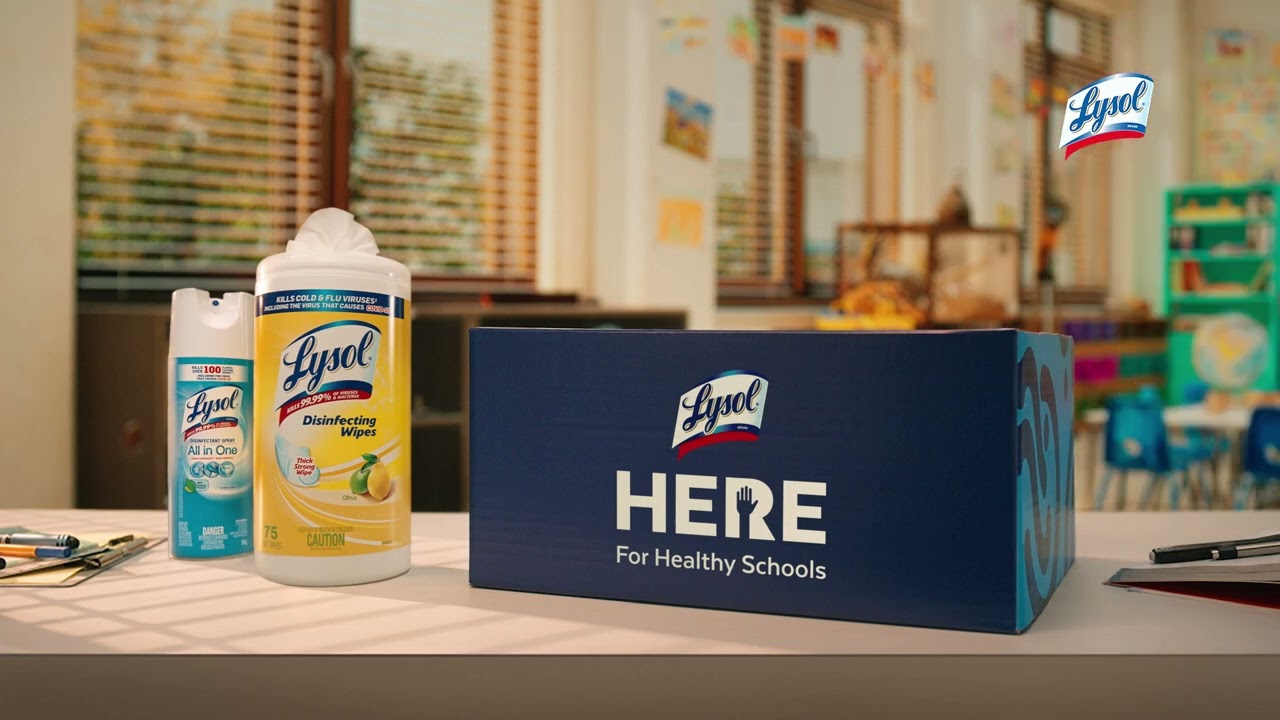
A prime example is Lysol’s HERE for Healthy Schools program, a long-term, purpose-driven campaign started in 2019 with the goal of reducing the spread of germs in schools and curbing student absenteeism.
Schools, as any parent or teacher knows, are hotbeds for colds, flu, and now COVID – illnesses that can rapidly circulate and cause children to miss class.
Lysol identified this social issue and positioned itself as part of the solution.
Through HERE for Healthy Schools, Lysol provides schools with resources such as educational materials on hygiene, lesson plans for teaching kids about germs, and donations of disinfecting products like wipes and sprays for classrooms.
This initiative is a clear win-win: schools get much-needed support to keep classrooms cleaner and students healthier, and Lysol ingrains itself as the champion of healthier learning environments.
By consistently running this program each year (even prior to the pandemic), Lysol has built equity as a brand that doesn’t just talk about protecting families, but actually invests in protection where it’s needed most.
The effort also aligns perfectly with the brand’s target consumers (parents and teachers), creating a positive feedback loop – those consumers see Lysol doing good for their kids’ schools, which in turn can influence their preference for Lysol at home.
Over the years, Lysol has evolved the HERE for Healthy Schools program to keep it engaging and impactful.
In 2024, for instance, Lysol entered its sixth year of the program by teaming up with a children’s creativity lab to produce “Lysol MiniLabs” science kits that were donated to Title I (under-resourced) schools.
These MiniLab kits were co-designed with input from teachers and students to ensure they were fun and educational, teaching kids about germs and hygiene through hands-on experiments.
Each kit, themed around topics like “Germs in the Classroom,” provided lesson plans and materials for 30 students, helping to instill healthy habits in an interactive way.
By innovating within its cause program, Lysol kept the initiative fresh and media-worthy, which led to press coverage and social media buzz around the back-to-school season.
The partnership with a science education organization also lent credibility and novelty – it wasn’t just Lysol handing out brochures, but actually contributing to STEM learning and curiosity among kids.
Moreover, Lysol’s cause marketing extends to providing tangible help during crises: earlier in the pandemic, Lysol worked with the CDC Foundation to create “Welcome Back Packs” for schools, which were filled with posters, stickers, and guidelines to promote healthy behaviors when schools reopened.
This showed agility in addressing current needs under the broader umbrella of the Healthy Schools mission.
The impact of these community-focused strategies goes beyond immediate goodwill.
They help cultivate the next generation of Lysol users by educating children on the importance of hygiene and subtly introducing the brand as a helpful friend in that context.
Parents and educators, seeing Lysol’s contributions, are likely to feel a sense of gratitude and positive association with the brand.
It effectively transforms Lysol from a faceless company into a community partner.
Furthermore, cause marketing initiatives often garner free publicity and strengthen stakeholder relationships (e.g., with school districts, PTAs, health officials), which can open doors for future collaborations or preferred vendor status.
Lysol’s sustained commitment (year after year since 2019) also signals authenticity – this is not a one-off PR stunt, but a genuine mission.
As Benoit Veryser, Lysol’s marketing VP, noted, the brand is “steadfast in our mission to cultivate a clean environment for consumers and their families, whether in the classroom or at home.”
That consistency reinforces trust.
In essence, Lysol’s cause marketing and community programs demonstrate that the brand’s purpose goes hand-in-hand with its marketing.
By investing in healthier communities, Lysol not only lives its values but also differentiates itself in a crowded marketplace as a brand with a heart.
This strategy solidifies customer loyalty and brand respect, which are invaluable assets that translate to long-term business success.
Conclusion
Lysol’s marketing strategies reveal a brand that skillfully blends science, insight, creativity, and compassion to maintain its leadership in the global hygiene market.
From the inclusive marketing that ensures diverse consumers feel seen in Lysol’s campaigns, to the digital and influencer outreach that keeps the brand relevant with younger audiences, Lysol demonstrates an ability to adapt to changing media and cultural landscapes.
Its strategic partnerships – whether co-branding with a hotel chain or teaming up with airlines – extend the brand’s trust into new arenas and show marketing ingenuity during critical times.
Meanwhile, Lysol’s emotional storytelling (like the Protect Like A Mother campaign) and commitment to innovation (launching new solutions with compelling differentiation) illustrate how the brand stays fresh and connects on deeper levels than just product features.
Equally important are Lysol’s efforts in public health education and cause marketing, which highlight the brand’s formal sense of responsibility and purpose beyond profit.
Together, these strategies create a holistic marketing mix that has kept Lysol not only commercially successful but also culturally significant for well over a century.
By balancing a professional, fact-based image with a relatable, global human touch, Lysol’s marketing continues to build on its legacy – proving that a brand devoted to protecting people can, in turn, earn people’s enduring trust and loyalty.
Also Read: A Deep Dive into the Marketing Strategies of Pantene
To read more content like this, subscribe to our newsletter