
Last Updated on October 31, 2025 by Team TBH
Introduction
Ridgeline is an enterprise cloud platform for investment management firms, offering a unified front-to-back software solution tailored to asset managers’ needs.
Founded in 2017 by Dave Duffield – the legendary software entrepreneur behind PeopleSoft and Workday – Ridgeline set out to modernize an industry long plagued by fragmented legacy systems.
Headquartered in Incline Village, Nevada with offices in Lake Tahoe, Reno, New York, and the Bay Area, the company has grown rapidly to over 400 employees while adhering to a people-first culture.
This article provides a comprehensive brand story and business analysis of Ridgeline, examining its founding, leadership, business model, revenue streams, funding history, competitive landscape, and product offerings.

Founding Story of Ridgeline
Dave Duffield’s decision to launch Ridgeline stemmed from both personal restlessness and a clear market opportunity.
After stepping back from his role at Workday, the then-octogenarian billionaire found retirement unsatisfying – he became “bored silly” and eager for a new challenge
Recognizing that the investment management sector’s technology was outdated and fragmented, Duffield saw parallels to the enterprise software gaps he had successfully addressed before.
In 2017, on the shores of Lake Tahoe, he founded Ridgeline with the vision of applying his proven formula of innovative enterprise software to the world of asset management.
From the outset, Duffield’s approach with Ridgeline was to “start with a clean sheet of paper”, assembling a deep bench of domain experts and technologists who shared a set of core values.
The founding team – many of them veterans of financial software companies and Duffield’s prior ventures – focused on solving the industry’s unique operational challenges with a bold, long-term perspective.
As Duffield advised early on, they “started with the hard stuff,” investing in scalable architecture, robust security, and a unified data model before anything else.
This deliberate, engineering-first philosophy meant Ridgeline spent its first few years building out a comprehensive platform rather than rushing a product to market.
An important element of Ridgeline’s founding strategy was its design partner program. Instead of developing in isolation, Ridgeline partnered with a select group of forward-thinking asset management firms to collaboratively shape the product.
By 2021, the startup had engaged 16 early adopter firms (ranging from $1B to $100B in assets under management) as part of its customer community.
These partners provided continuous feedback, participated in alpha testing, and even ran parallel operations on Ridgeline alongside their legacy systems.
In late 2021, Ridgeline achieved a pivotal milestone by deploying its platform at a $1B AUM asset manager, operating in parallel with the client’s old systems and paving the way for a full cutover in early 2022.
This collaborative launch process validated Ridgeline’s solutions in real-world settings and demonstrated the company’s commitment to building with the customer, for the customer.
By founding Ridgeline, Duffield aimed not just to build another software product, but to transform an entire industry’s technology stack. The brand story of Ridgeline’s early years is one of patient innovation and close partnership with industry pioneers.
Duffield’s presence (and personal funding, as discussed later) gave Ridgeline the freedom to focus on quality and scale. The result was that by the mid-2020s, Ridgeline emerged from its quiet build period with a robust platform ready to tackle the entrenched “ice age” of investment management software – very much in line with Duffield’s history of industry-changing enterprises.
Founders of Ridgeline
Dave Duffield, Ridgeline’s founder, chairman, and spiritual leader, is a well-known figure in enterprise software.

By the time he started Ridgeline in his late seventies, Duffield had already founded or co-founded five other companies, including two hugely successful public software firms: PeopleSoft (founded 1987) and Workday (founded 2005).
His track record for identifying underserved business domains and delivering innovative solutions lent immediate credibility to Ridgeline’s mission.
Duffield’s philosophy has always emphasized strong core values and treating employees well – a belief that “happy employees lead to happy customers”.
He carried this people-centric culture into Ridgeline, which prides itself on being a “people-first company” even as it pursues cutting-edge innovation.
As Ridgeline grew past its initial development phase, Duffield strategically expanded the leadership team, blending family, former colleagues, and industry experts. In 2020, Dave Blair, a veteran of SS&C Advent (a leading investment software provider), joined Ridgeline and eventually became Duffield’s co-CEO in 2023.

Blair brought 28 years of domain experience from Advent and a product-focused mindset, which complemented Duffield’s visionary leadership.
Duffield’s move to install Blair as co-chief executive – and later as sole CEO by 2024 – was a deliberate step to ensure Ridgeline had day-to-day leadership with deep investment tech expertise.
“Dave Blair has the engineering mindset and a vision for the future of investment management software that our company needs,” Duffield noted upon naming him co-CEO.
This transition allowed Duffield to step back from operational management and focus on guiding strategy as Chairman, much as he did at Workday in its later years.
Another notable member of the founding circle is Mike Duffield, Dave’s son, who joined Ridgeline to lead go-to-market (sales and marketing) efforts.

Mike had previously helped build Workday’s early sales organization and founded a successful Workday consulting firm, bringing valuable early-stage sales leadership. “My son Mike is one of the best early-stage sales leaders in the software business,” Dave Duffield remarked, underscoring the importance of having trusted talent to drive Ridgeline’s growth phase.
Along with Blair and Mike Duffield, Ridgeline’s leadership and board include several alumni of PeopleSoft and Workday (such as CTO Jon Ruggiero and board member Robynne S. Daly) as well as prominent figures like former CIA director George Tenet, reflecting a blend of tech industry and strategic oversight.
This strong leadership bench shares the founder’s vision of marrying bold innovation with operational excellence.
In summary, Ridgeline’s founder Dave Duffield provides the company’s inspirational backbone and long-term vision, drawing on his decades of experience in enterprise software. The founding team he assembled – combining seasoned enterprise technologists and investment operations experts – is a key asset in Ridgeline’s story. Their credibility and shared values have not only shaped Ridgeline’s brand (as a trustworthy, expert partner) but also instilled confidence in clients willing to bet on a startup to run their mission-critical systems.
Business Model of Ridgeline
Ridgeline operates on a Software-as-a-Service (SaaS) business model, delivering its investment management platform via the cloud to asset management firms.
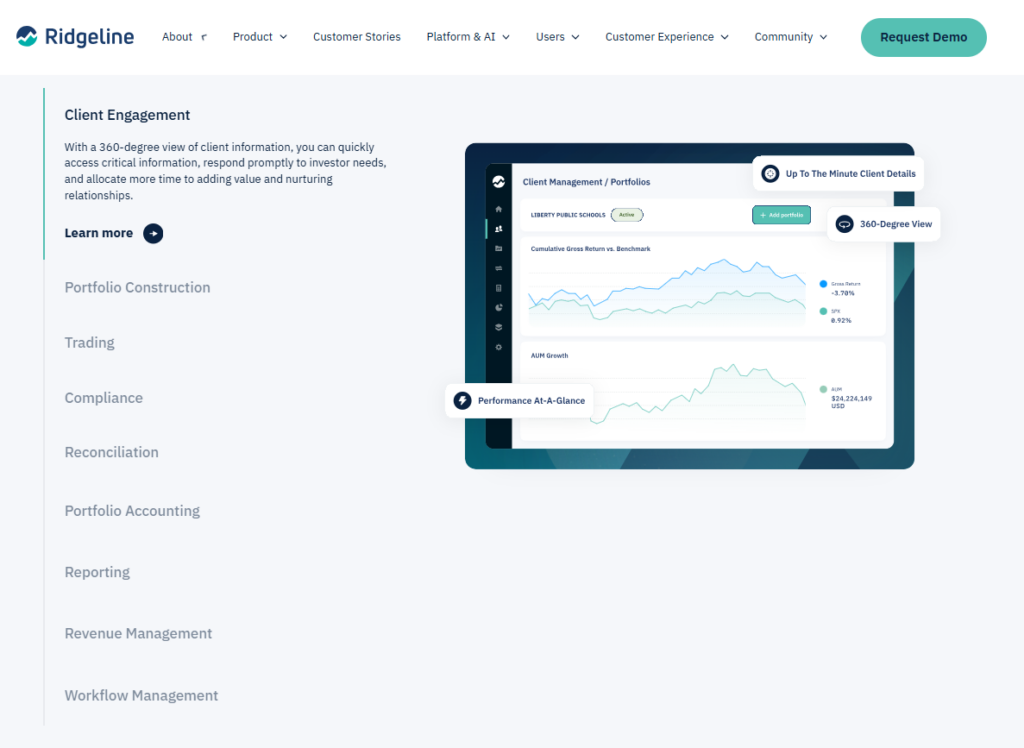
At its core, Ridgeline offers a single integrated system that covers the full investment lifecycle – front, middle, and back office – as opposed to the patchwork of specialized tools many firms historically use.
By bringing together portfolio management, trading, compliance, accounting, client servicing and more on one platform with one real-time dataset, Ridgeline enables investment firms to replace numerous separate systems with a unified solution.
This unified architecture is central to Ridgeline’s value proposition and drives its business model: customers subscribe to Ridgeline to simplify their operations, eliminate data silos, and gain agility through a modern cloud system.
Target Customers
Ridgeline is designed for investment managers, including asset management companies, wealth management firms, registered investment advisors (RIAs), and other buy-side financial institutions.
Its early adopters have ranged from smaller independent asset managers (~$1 billion AUM) to sizable institutional managers (up to $100+ billion AUM).
Common to these customers is a desire to modernize legacy IT infrastructure and support growth.
Ridgeline’s marketing and sales efforts focus on forward-thinking firms – often mid-sized investment managers – that are constrained by antiquated software like Advent’s Axys/APX, Eze, or in-house systems and want an enterprise-class solution without having to build one themselves.
The company highlights that it works with firms across asset classes (equities, fixed income, etc.) and both institutional and high-net-worth client bases, indicating a broad applicability within investment management.
Value Proposition
Ridgeline’s business model delivers value by streamlining complex workflows and reducing operational overhead for its clients. Because all core functions (from trading to reporting) share a single source of truth, firms can automate processes that previously required manual data reconciliation between systems.
In fact, Ridgeline reports that a client transitioning to its platform can “replace an average of 9 separate systems” that they were using before.
This consolidation not only reduces software licensing and integration costs, but also mitigates operational risk (fewer data handoffs and errors) and improves agility (e.g. changes are reflected instantly across the organization).
Ridgeline’s cloud-native design further means that clients benefit from continuous updates (no more disruptive version upgrades) and elastic scaling.
The platform is delivered via the public cloud (built on AWS infrastructure) and Ridgeline manages all maintenance, allowing clients to focus on their business rather than IT concerns.
Go-to-Market and Sales
Ridgeline employs a direct enterprise sales approach, given its niche vertical focus and high-touch product.
Sales cycles in the investment management software space are typically lengthy, involving proof-of-concept demos, security reviews, and conversion of historical data.
To encourage adoption, Ridgeline initially used the design partner model (as noted in the founding story) – essentially a form of co-development and early commitment from customers.
As the product matured, the company began onboarding clients in a more standard SaaS sales process, often highlighting success stories of firms that have switched.
Implementation projects are handled by Ridgeline’s consulting services team and partners, who help migrate data from legacy systems and configure the platform to each client’s needs.
Notably, Ridgeline has proven it can deploy a client in as fast as 9 months (as in the case of Congress Asset Management) despite the breadth of the system – a timeline that is competitive with or better than industry norms for full stack replacements.
In summary, Ridgeline’s business model centers on delivering a comprehensive, cloud-based investment management platform via subscription, targeting firms that seek to modernize and unify their technology stack. By providing end-to-end functionality and managing the IT burden in the cloud, Ridgeline enables customers to “grow by automating complexity… at scale – without added headcount or risk”. This resonates as a compelling business case: a modern SaaS solution replacing multiple aging systems, improving efficiency, and allowing investment managers to focus on investment performance rather than operational plumbing.
Revenue Streams of Ridgeline
Recurring Subscription Fees
Ridgeline generates revenue primarily through recurring subscription fees for its cloud platform. As an enterprise SaaS provider, it typically enters multi-year contracts with client firms, who pay annual or quarterly fees to access Ridgeline’s suite of applications.
These subscription fees often scale based on factors such as the size of the client (e.g. assets under management or number of accounts supported), the scope of modules used, and the number of users.
By bundling front, middle, and back office functionality, Ridgeline is able to command a premium price comparable to the aggregate cost of the multiple systems it replaces – but with the promise of greater value and simplicity.
The all-in-one nature of the product encourages clients to standardize on Ridgeline for a broad swath of their operations, which in turn drives a high recurring revenue per customer.
Services and Support Revenue
In addition to pure software subscription revenue, Ridgeline likely earns services and support revenue.
This includes fees for implementation consulting, data migration, and training when new clients onboard, as well as premium support plans or custom enhancements.
However, these services are typically a one-time or time-bound source of income and are often not the main focus (many SaaS companies price implementation just to cover cost, aiming to make most profit on the recurring subscription).
Ridgeline’s “Customer Experience” offerings – such as Customer Success Management and alliances with third-party service partners – are primarily geared toward maximizing customer value rather than being large profit centers on their own.
Nonetheless, they do contribute some revenue and help reduce churn, thereby protecting subscription revenue streams.
Add-on Modules or Data Services
Another potential revenue stream in Ridgeline’s model could be add-on modules or data services.
For example, Ridgeline integrates third-party market data and could conceivably resell data feeds or offer value-added analytics for an extra fee.
Its recently launched AI features might also be packaged in tiers (though as of 2025, Ridgeline has been enabling AI capabilities for all clients as part of the platform).
If the company develops a marketplace or ecosystem (for instance, plug-ins or partnerships with custodians and brokers), referral fees or revenue-sharing could emerge, but these are speculative and not a core part of the model yet.
Ridgeline’s revenue traction thus far underscores the viability of its subscription approach. By mid-2024, Ridgeline reportedly reached over $100 million in annual recurring revenue, reflecting the successful onboarding of multiple investment firms onto the platform.
This is a remarkable achievement for a company still in its early commercialization stage and speaks to the sizable contracts it is winning.
In industry terms, each client likely represents significant annual contract value given the mission-critical nature of the software.
As more firms cut over their entire investment operations to Ridgeline, the subscription revenue base is expected to grow substantially through expansions (existing clients adding more assets or users) and new client acquisitions.
To summarize, Ridgeline’s revenue streams are dominated by SaaS subscription fees from investment management firms using its cloud platform. These recurring revenues are supported by ancillary services revenue from implementation and support. The company’s ability to drive rapid revenue growth in 2023–2025 indicates strong market acceptance – firms are willing to pay for an integrated solution that can replace numerous legacy systems. Ridgeline’s focus on customer success and continuous improvement (e.g., frequent feature releases) further helps protect and expand these revenue streams by keeping clients engaged and growing on the platform.
Funding and Funding Rounds of Ridgeline
One of the unique aspects of Ridgeline’s story is its funding strategy. Unlike many Silicon Valley startups that go through multiple venture capital rounds, Ridgeline was primarily self-funded by Dave Duffield for most of its early years.
As a billionaire with a track record of successful exits, Duffield provided the capital to hire top talent and develop the product without seeking outside investment.
This gave Ridgeline a significant advantage: the company could pursue a long-term vision (spending several years in R&D and product refinement) without the short-term pressure of VC milestones or early revenue targets.
Duffield’s personal investment in Ridgeline is substantial – while not publicly disclosed, it likely ran into the tens (if not hundreds) of millions of dollars over 2017–2024, given the company’s headcount of ~400 and intensive development efforts.
For its first eight years, Ridgeline did not take any external funding, essentially operating in stealth mode funded by the founder. This changed in spring 2025, when Ridgeline opened its doors to outside investors for the first time.
The company invited a select group of external investors to participate in a funding round, marking the initial dilution of Duffield’s sole ownership. Details of this round (often analogous to a Series A, though unconventional given the stage) have not been fully disclosed as of 2025.
The amount raised and the investors involved remain private, but the move itself signals Ridgeline’s transition from an internally-funded project to a venture poised for larger scale growth and governance.
Allowing outside capital likely serves a few purposes: bringing in strategic partners or institutional investors who can aid in an eventual IPO, providing liquidity or diversification for Duffield’s investment, and injecting funds to accelerate expansion (such as hiring, international offices, or increased marketing).
Below is a summary of Ridgeline’s known funding timeline:
| Year | Funding Round | Amount | Investors |
|---|---|---|---|
| 2017 | Founder Seed (Self-funded) | Not disclosed | Dave Duffield (personal capital) |
| 2025 | First External Round (Series A) | Not disclosed | Select outside investors (undisclosed) |
Table: Ridgeline Funding History. The company was primarily funded by founder Dave Duffield until 2025, when it raised its first round of outside capital.
It’s worth noting that Ridgeline’s effective funding goes beyond cash – the backing by Duffield also meant access to his network, credibility, and patience. Few startups could remain private and un-funded externally for so long while building such a complex product. By 2024, speculation began to mount that Ridgeline was positioning for an eventual initial public offering (IPO). In an October 2024 interview, Duffield openly spoke about aiming for a rare “IPO hat trick,” hoping to take Ridgeline public as his third IPO success (after PeopleSoft and Workday)ridgelineapps.com. This hints that the 2025 funding round could have been a pre-IPO strategic round, perhaps setting the stage for an IPO in the coming years once the company’s revenue and customer base are sufficiently scaled.
Competitors of Ridgeline
Ridgeline enters a competitive landscape that i s both crowded and yet lacking a one-to-one comparable rival. In fact, the company often states that “no one does exactly what Ridgeline does” in providing a single front-to-back, cloud-native platform for investment managers. However, prospective clients considering Ridgeline are usually weighing it against a mix of incumbent software vendors and platforms that handle pieces of the investment management process. The competition can be understood as follows:
Legacy Investment Software Suites (Front & Back Office)
Many asset managers have historically used separate products for different functions – for example, SS&C Advent for portfolio accounting and reporting, and Eze or Moxy (also now owned by SS&C) for trade order management.
These systems (Advent APX, Axys; Eze OMS; Advent Moxy OMS) have been around for decades and are on-premises or hosted solutions.
Ridgeline is often positioned as a modern replacement for such software, consolidating their functionality into one platform.
State Street’s Charles River Development (CRD) is another major incumbent in this category – CRD offers an investment management solution (especially for trading and compliance) that many large firms use, but it often requires integration with separate accounting systems. Ridgeline has won over clients who previously ran CRD alongside other tools by offering a unified alternative.
Specialized Cloud Platforms
In recent years, some cloud-native competitors have emerged focusing on parts of the investment workflow.
Clearwater Analytics (CWAN), for instance, provides a cloud-based investment accounting and reporting platform popular with insurance companies and asset managers, particularly for fixed income portfolios.
Enfusion (ENFN) is a newer SaaS platform originally tailored to hedge funds for portfolio management and order/execution management.
Both Clearwater and Enfusion address slices of what Ridgeline covers, but not the full front-to-back spectrum. Clients moving to Ridgeline have often been using one of these for certain functions and still needed other systems – which Ridgeline then replaces with its all-in-one approach.
Ridgeline’s competitive edge here is offering broader functionality (trading, compliance, CRM, etc., in addition to just accounting or portfolio analytics) on a single data model.
Integrated Front-to-Back Solutions
A few competitors do claim to offer end-to-end investment management platforms.
SimCorp Dimension, a long-established solution from Denmark, provides front, middle, and back office modules for large asset managers and pension funds. It’s a comprehensive system but traditionally deployed on-premises (though now also cloud-enabled) and often considered expensive and complex to implement.
BlackRock’s Aladdin is another well-known platform – originally a risk and portfolio management system used internally by BlackRock, it has evolved to include modules like Aladdin Accounting and is offered to other institutions.
While BlackRock doesn’t overtly market Aladdin as a full front-to-back SaaS in the way Ridgeline does, in practice it covers many of the same bases for very large firms.
The difference is that Aladdin is typically adopted by the largest global asset managers and comes with BlackRock’s services attached, whereas Ridgeline is targeting a broader market with a pure software play.
Additionally, custodial banks have launched solutions like State Street Alpha (which bundles CRD with middle/back office services) and BNY Mellon’s OMNI, which are more service-platform combos than pure software products.
These can be viewed as indirect competitors when firms consider outsourcing vs. using Ridgeline in-house.
In-house and Bespoke Systems
Some investment firms, especially larger ones, have built their own bespoke systems or heavily customized combinations of vendor products. While not “competitors” in a commercial sense, these in-house solutions compete for mindshare when a firm is deciding whether to buy vs. build.
Ridgeline’s challenge (and opportunity) here is to convince such firms that a modern off-the-shelf cloud platform can meet their needs with less cost and maintenance burden than maintaining custom systems.
Ridgeline’s competitive strategy emphasizes its fresh start and technological advantages over incumbents. Many of its competitors in the investment tech space have either old architectures (Advent, CRD, SimCorp) or narrower scopes (Clearwater, Enfusion). Ridgeline pitches itself as purpose-built for the investment management industry in the modern era, combining what would normally require multiple products into one seamless platform. For example, a client like Congress Asset Management was able to eliminate “several disparate pieces of software” when they went live on Ridgeline. This resonates strongly with firms frustrated by integration headaches among their legacy tools.
Products and Services of Ridgeline
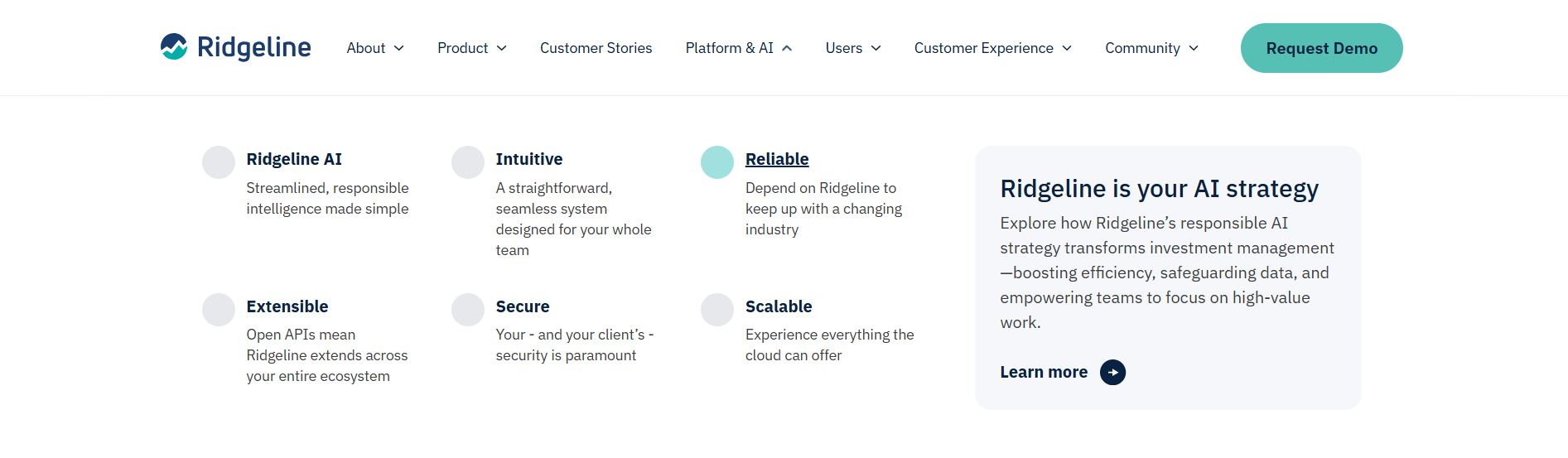
Ridgeline offers a comprehensive suite of products as part of its single cloud platform, covering virtually every essential function of an investment management firm. The platform is modular in concept (with different functional areas), yet all modules share the same data and user interface, providing a seamless experience.
Below is an overview of Ridgeline’s key products and services:
| Module / Feature | Description & Capabilities |
|---|---|
| Client Engagement (CRM) | A front-office relationship management tool integrating client data, interactions, and service workflows. It provides a 360° view of each investor, including up-to-date holdings, performance vs. benchmarks, meeting notes, and correspondence. Ridgeline’s unified data means client details tie directly to portfolio data and transactions. The platform supports one-time client onboarding – enter a client once and the data propagates across trading, compliance, accounts, etc., eliminating duplicate data entry. It can also connect to external CRM systems (e.g., Salesforce) via a connector. |
| Trading (OMS) | A full-featured Order Management System for portfolio trading across asset classes. Ridgeline’s trading module is fully integrated with compliance, accounting, and client records, allowing traders to operate with real-time positions and restrictions. It supports trade order creation, execution management, allocations, and electronic connectivity to brokers. Because it’s cloud-based, traders benefit from rapid processing and the ability to trade from anywhere (with proper security). “Imagine trading without limits,” as Ridgeline’s site suggests, highlighting the removal of legacy tech constraints. All trades feed immediately into the rest of the platform (e.g., affecting portfolio positions and triggering any post-trade compliance checks). |
| Portfolio Management | Tools for portfolio managers to model, analyze, and monitor investments. This includes portfolio modeling (what-if scenarios, rebalancing), performance analytics, and exposure reporting. Ridgeline is built to handle high volumes of accounts and complex strategies so that firms can scale up personalized portfolios or multi-asset strategies without bogging down operations. The portfolio management module draws on the single source of data for accurate, timely information on holdings, cash, and exposures. It likely includes dashboards and analytics that portfolio managers and CIOs use for decision-making. |
| Compliance | An integrated compliance engine that monitors investment guidelines, regulatory rules, and internal policies. Ridgeline’s compliance is embedded throughout the trade lifecycle: it performs pre-trade checks (blocking or warning on trades that would breach rules) and post-trade surveillance. Having compliance woven into one platform is a boon – as Ridgeline notes, compliance impacts every part of the business, so their engine is robust and spans all modules. It allows compliance officers to set rules that automatically evaluate against the unified data (for instance, concentration limits, prohibited securities lists, wash sale rules, etc.). The compliance module can escalate issues, automate approvals, and generate audit trails, simplifying what is often a complex, manual area for firms. |
| Accounting & Billing | A back-office investment accounting system that maintains the books and records for portfolios. This includes calculating positions, valuations, accruals, and performance on a daily (or real-time) basis. Ridgeline’s accounting ensures accurate, consistent data everywhere in the platform – it effectively provides the single book of record feeding all other functions (client reports, regulatory reports, etc.). It can handle multi-currency accounting, various security types, corporate actions, and reconciliation with custodians. Additionally, billing functionality is integrated: firms can set up fee schedules and have Ridgeline automatically calculate management fees/commissions and generate invoices based on the portfolio data. This integration of accounting and revenue tracking is another advantage over using separate systems for billing. |
| Reporting & Analytics | A flexible reporting system that allows users to slice and dice data and produce reports for clients, regulators, or internal oversight. Ridgeline’s reporting tool is designed to be intuitive so that non-technical users (relationship managers, executives) can retrieve information on demand. Because all data is in one place, reports can cover the full client relationship: performance, asset allocation, transactions, compliance status, etc. The system supports customized report templates for client statements or factsheets and on-screen analytics for internal use. Ridgeline emphasizes empowering anyone at the firm to “view, analyze, and report on data – exactly how they want to see it”. This likely includes dashboards and the ability to drill down into details via the UI. |
| Data Integration (APIs) | The platform provides robust data management and integration capabilities. Ridgeline can ingest data from external sources like market data providers, index benchmarks, or custodial bank files through its data module. It ensures data uniformity across front and back office. The system’s open APIs allow firms to connect external tools or client portals easily. For example, if a firm uses a separate risk analytics engine or a client-facing mobile app, Ridgeline’s APIs would let those systems pull or push data to the Ridgeline core. This openness prevents vendor lock-in and enables Ridgeline to serve as the central hub in a firm’s information architecture. |
| AI and Automation | As discussed, Ridgeline has introduced innovative AI features and agents. These AI capabilities act as a layer across the platform: e.g., natural language query for data (ask the system a question and get an answer), AI-generated commentary for reports, and intelligent workflow automation. The two AI agents launched in 2025 – one for client management and one for trade compliance – deserve mention. The client management agent reads unstructured inputs (like emails or call notes) to identify actionable items and prepare next steps automatically. The compliance agent automatically processes routine compliance violations and flags high-risk cases for human review. All AI actions are auditable and require human sign-off at critical points, reflecting Ridgeline’s “responsible AI” stance. These AI-driven services amplify what a firm’s team can accomplish and are a unique part of Ridgeline’s offering. |
| Implementation & Support | Beyond the software modules, Ridgeline provides professional services to ensure customer success. This includes implementation consulting (project managing the onboarding, data conversion from legacy systems, and configuration of the platform to each firm’s needs). Post go-live, Ridgeline’s support team offers ongoing assistance with any issues and regularly engages to provide best practice guidance (through a dedicated Customer Success Manager for each client). The company also partners with third-party consultants and technology firms (alliances) to extend its reach and provide specialized services if needed. Training resources and possibly a Ridgeline Academy for user education are part of the service wrapper as well. While not a “product” per se, this service layer is crucial for an enterprise solution and is a key part of Ridgeline’s value proposition – ensuring that clients realize the full benefits of the software. |
Ridgeline’s product strategy is clearly about breadth and integration. By offering all these capabilities natively, Ridgeline spares clients the effort of knitting together different systems.
The platform’s design ensures that a single action triggers updates everywhere: for example, entering a trade will instantly update compliance limits, adjust portfolio positions in accounting, and be available for client reporting – no separate batch processes needed.
This real-time cohesion is particularly attractive in an industry where timely data is critical.
Moreover, Ridgeline continues to enhance its product.
The company’s roadmap (as gleaned from press releases and leadership interviews) includes adding more AI agents, expanding support for additional asset classes and global market specifics, and constantly refining the user experience.
Ridgeline also highlights that its platform is extensible; clients have the flexibility to adopt the whole suite or incrementally implement modules (though the real power is when all are used together). As of 2025, many of Ridgeline’s customers have indeed embraced the full front-to-back use of the system, indicating strong confidence in the platform’s breadth.
In summary, Ridgeline provides a holistic solution: from a portfolio manager creating an order, to a trader executing it, to an operations analyst reconciling accounts, to a client service rep sending a quarterly report – all these roles interact with one integrated platform.
This comprehensive product offering, combined with Ridgeline’s support services, fulfills the company’s brand promise of giving investment managers a “competitive advantage with modern technology purpose-built for the industry”. It essentially delivers a complete operating system for investment management firms in the cloud era.
Conclusion
Ridgeline’s brand story and business trajectory paint the picture of a case study in industry disruption. In less than a decade, what began as Dave Duffield’s post-retirement project has matured into a formidable enterprise platform, one poised to redefine how investment management firms run their operations.
The founding story – an octogenarian visionary tackling a tech problem others overlooked – gives Ridgeline a compelling heritage of innovation and determination.
Under Duffield’s guidance and with a hand-picked team of experts, Ridgeline built a solution that addresses real pain points: fragmented systems, outdated software, manual workflows, and scalability challenges in the investment world.
From a business analysis perspective, Ridgeline exemplifies a modern SaaS challenger: it leverages a subscription model, prioritizes customer-centric development, and benefits from enormous upfront investment that allowed it to reach technical excellence before seeking scale.
The company’s self-funded roots freed it to take the long view, and now with external funding and an eye toward an IPO, Ridgeline is entering a new phase of growth with strong momentum.
Its revenue growth north of $100 million by 2024 and a client base managing over $400 billion in assets on the platform attest to a product-market fit that is resonating in the industry.
Ridgeline faces competition, but it has carved out a competitive advantage moat through unified technology, cloud delivery, and relentless innovation (especially in AI).
Clients who have adopted Ridgeline report immeasurable value and efficiency gains, while those still on the sidelines hear increasing testimonials of success.
The company’s challenge will be to maintain its high standard of execution as it scales: ensuring implementations continue to be on-time, supporting a growing global client base, and fending off responses from incumbents (some of whom will attempt to modernize or market themselves as “almost as good as Ridgeline”).
In the end, Ridgeline’s journey underscores how innovation, when guided by experience and executed with purpose, can create outsized impact.
The firm’s story is still unfolding, but it has already changed the narrative for investment management technology from one of stagnation to one of possibility.
With a strong brand, robust business model, and visionary leadership, Ridgeline is on the cusp of an exciting new chapter – one that the investment management community will be watching closely as the company heads toward its envisioned future at the summit of the industry.
Also Read: Salesforce: Redefining Landscape of Cloud-Based Solutions
To read more content like this, subscribe to our newsletter