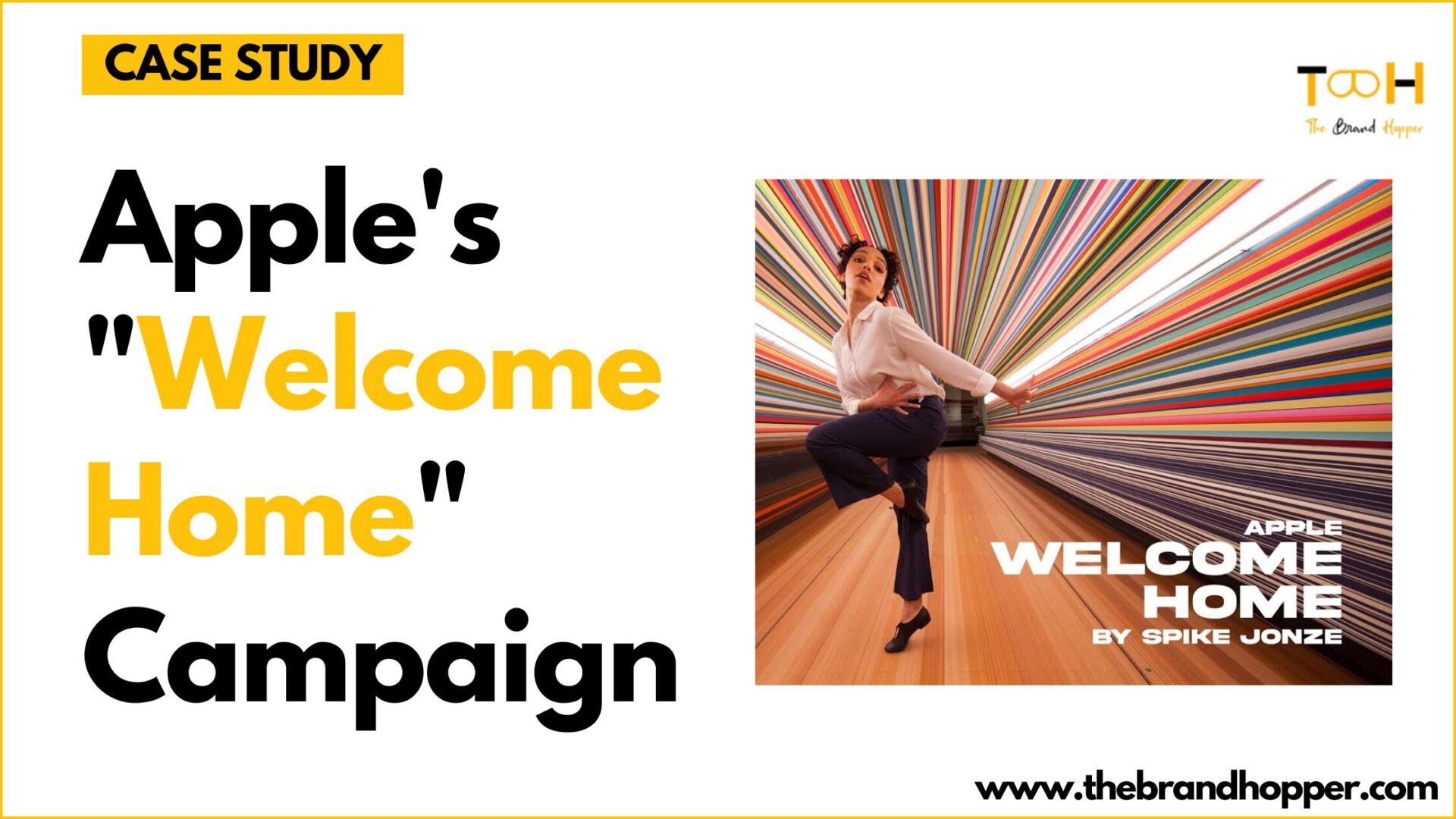
Apple’s 2018 “Welcome Home” campaign – a four-minute spot for the new HomePod speaker – represents a landmark in the brand’s advertising. Instead of a typical product demo, Apple enlisted Oscar-winning director Spike Jonze to create a surreal, cinematic story. The ad stars a tired city worker who says “Hey Siri, play me something I’d like” upon entering her apartment. To the song “’Til It’s Over” by Anderson .Paak (streamable on Apple Music), her drab apartment magically expands and transforms into a vibrant, morphing dance space. The creative message is that great music (via HomePod) can re-architect your space and mood, literally making a small room feel larger.
Apple has always emphasized audio quality and design for HomePod (calling it “highest-fidelity” and saying it “totally rocks the house”newsweek.com), and “Welcome Home” artistically visualized that idea. The campaign implicitly positions HomePod as not just a gadget, but as a lifestyle experience. Wallpaper* magazine notes the spot ties directly into Apple’s ecosystem: a HomePod responds to Siri and plays an Apple Music track to trigger the fantasy, showing how HomePod brings joy and creativity into the homewallpaper.com. In short, the spot sells a feeling – the joy of music transforming everyday life – rather than focusing on specs.

Market Context and Brand Strategy
When HomePod debuted in early 2018, Apple was entering a smart-speaker market dominated by Amazon and Google. It shipped about 600,000 units in Q1 2018 (roughly 6% share), far behind competitors with 40%+ shares. Apple’s strategy was not to compete on price or ubiquity, but on premium experience. The HomePod was pricey ($349) and tightly integrated with Apple’s ecosystem (it only works fully with iOS/Mac and Siri), so Apple’s marketing aimed to reach audio enthusiasts and loyal Apple users.
The “Welcome Home” campaign aligned with Apple’s brand image of creativity and design excellence. Advertising experts note that Apple has increasingly favored “art-led” narrative ads – from the “Shot on iPhone” galleries to customer-story shorts – and HomePod’s campaign followed suit. Rather than a voiceover listing specs, “Welcome Home” uses storytelling and emotion to reinforce brand values: innovation, creativity, and lifestyle. In other words, it treats the product as part of a cultural experience.
Creative Concept and Narrative
The core idea – inspired by music’s power to uplift – was devised by TBWA\Media Arts Lab (Apple’s agency) and Spike Jonze. As one creative explained, they asked: “What if great music actually expanded a place as a person dances through a home?”. Jonze turned this into a whimsical narrative. The ad opens with the protagonist trudging home on a rainy city night, visibly stressed. As soon as she asks Siri for music and the drums kick in, her grey apartment explodes into color. Walls tilt, floors slide, rooms lengthen and contract in time with her movements, and even furniture elastically stretches. By the climax, every surface is a spectrum of neon, and the woman dances exuberantly, eventually twirling with a mirror image of herself. The transformation never drops the beat: every shift was built on exact timing with Anderson .Paak’s song.
This narrative turns the feature (HomePod’s sound) into a character. According to Fast Company, the ad’s implicit message is clear: the HomePod “re-architects the acoustics of your room to create a perfect high-fidelity sound experience”fastcompany.com. In other words, the product’s “magic” is shown literally expanding the room. The choice of a strong storytelling arc – from despair to joy – also breaks typical ad formulas. Notably, the commercial ends with a quietly hopeful note rather than a big “smile”, signaling emotional authenticity. Marketing analysts praise this five-part story structure (exposition, conflict, climax, etc.) as unusually rich for an ad, helping viewers connect deeply with the contentbusinessesgrow.com.
Production and Execution
Executing this vision required meticulous production design and choreography. Jonze’s team built almost the entire set as a giant mechanical stage. The Brooklyn studio apartment was fully recreated with real moving parts – no CGI was used for the main expansion effects. For example, hinged walls could be pulled open, the ceiling could rise, furniture was mounted on tracks, and even a bicycle swung on wires. Every set-piece was wired to respond to the music. Off-camera stagehands pulled levers and motors, all in time with the “Til It’s Over” soundtrack. The apartment itself became an element of choreography: Twigs’s every gesture triggered a built effect (walls spreading, lights flickering, rooms elongating). The only digital effects were when FKA Twigs briefly dances with herself (a mirror image effect done in post-production). The end result is a seamless music video – it looks and feels like a dreamscape made real.
Jonze’s signature film techniques further elevated the spot. The camera glides fluidly around Twigs, using wide angles, rack-focus shifts, and saturated lighting to draw viewers into the dance. The tight integration of music was deliberate: Apple essentially made a mini-music video, knowing that its audience (tech and music fans) would appreciate a cinematic piece. As one marketing expert quipped, smart marketers don’t interrupt content – they become content. Apple’s long-form ad proved they trusted viewers to watch an entire mini-movie. In practice, the ad was cut into shorter spots for TV and social media, but the six-minute original went viral on YouTube.
Media Deployment and Reception
Apple rolled out the “Welcome Home” ad primarily online (YouTube and Apple’s channels) and in select TV spots. The multi-platform push ensured wide exposure: even late-night shows and award shows aired clips. The buzz was immediate. Within days, the video had tens of millions of views. Industry outlets quickly hailed the spot. Adweek called it an “instant classic” and listed it among the year’s top ads. Not surprisingly, the campaign swept major awards: at the 2018 Cannes Lions, “Welcome Home” earned a Grand Prix in the Entertainment Lions (Music) category – one of Apple’s two top Cannes prizes that year.
Critics praised the campaign’s artistry and emotional pull. The ad also won a Grand Prix for music at Cannes, shared with a Jay-Z video, highlighting its creative meit. In short, the marketing result was not measured by HomePod sales alone but by brand lift: the campaign reinforced Apple’s image as an innovator that marries technology with art. It generated conversation across social and mainstream media, which in turn drove interest in HomePod amid its stiff competition.
Key Takeaways
-
Emotional branding: Apple shifted focus from specs to storytelling. By showing the emotional “before and after” of listening to music, the campaign made the HomePod about experience and mood. This aligns with Apple’s long-term strategy of selling a lifestyle, not just hardware.
-
Integrated ecosystem: The spot cleverly plugs into Apple’s ecosystem (she asks Siri on HomePod; the soundtrack is on Apple Music). This cross-promotion bolsters the HomePod’s role as part of the Apple family of devices and services.
-
Creative differentiation: The use of a high-profile director (Spike Jonze) and a known musician (Anderson .Paak), plus a visually rich narrative, set Apple apart. In a market where rivals often focus on assistants or price, Apple highlighted design and quality in a standout way.
-
Viral potential: By creating a “mini-movie” rather than a short jingle, Apple earned organic shares. Viewers treated it as entertainment. This confirms that content value can be as important as ad spend.
-
Production craft: Behind-the-scenes excellence matters. The practical effects created genuine awe. Apple’s investment in such elaborate execution underscored the brand’s commitment to premium experiences.
Overall, the “Welcome Home” campaign exemplifies how Apple blends product marketing with creative filmmaking to reinforce its brand values. It demonstrates that even in a crowded tech market, compelling storytelling and design can cut through the noise.
Also Read: A Case Study on Apple: “Get a Mac” Brand Campaign
Also Read: A Case Study on Apple’s “Shot on iPhone” Brand Campaign
To read more content like this, subscribe to our newsletter