In the late 2010s, the insurance technology (“insurtech”) sector was defined by a singular, deafening narrative: disintermediation. The prevailing wisdom among Silicon Valley disruptors was that the future of insurance lay in removing the middleman. Startups like Lemonade, Hippo, and Kin burst onto the scene with a mission to sell directly to consumers (DTC), arguing that independent agents were relics of a bygone era—inefficient, expensive, and unnecessary in a digital-first world.
Enter Openly.
Founded in 2017 in Boston, Massachusetts, Openly took a radically different—and at the time, contrarian—stance. While competitors were spending millions on Super Bowl ads to bypass agents, Openly quietly built a premium homeowners insurance platform designed exclusively for them. Their thesis was simple yet profound: insurance for high-value assets is complex, and when consumers are insuring their most valuable asset (their home), they want the advice of a trusted professional, not just a chatbot.
Openly positioned itself not as a disruptor of the agent, but as their ultimate enabler. By combining advanced pricing algorithms, next-generation technology, and a premium product that outperformed standard policies, Openly aimed to “re-engineer” the insurance experience from the backend out.
As of late 2025, Openly’s bet has paid off. While many direct-to-consumer insurtechs have struggled with high customer acquisition costs (CAC) and unprofitable loss ratios, Openly has scaled efficiently across over 24 states, creating a cult-like following among independent agents. This is the story of how two industry insiders built a company that modernized home insurance by embracing, rather than erasing, the human element.
Founding Story of Openly: The “Greenfield” Opportunity
The genesis of Openly can be traced back to a realization that the insurance industry suffered from a “bifurcated” problem. On one side, legacy carriers (like Travelers or Chubb) had excellent products and deep data but relied on mainframe technology from the 1980s that made them slow and cumbersome to work with. On the other side, new insurtech entrants had sleek, modern interfaces but often sold “stripped-down” policies with standardized coverage that didn’t suit complex homeowner needs.
Ty Harris and Matt Wielbut met with a shared frustration. They saw that independent agents—who control over 50% of the U.S. home insurance market—were being neglected. Legacy carriers offered them clunky portals that took 30 minutes to generate a quote, while new insurtechs were actively trying to put them out of business.
The founders identified a “greenfield” opportunity: What if you built a modern, tech-forward carrier that sold strictly through independent agents?
They theorized that if they could reduce the quoting time from 30 minutes to 15 seconds while offering a policy with broader coverage than the industry standard, agents would naturally funnel their best business to Openly. This strategy would solve the two biggest problems in insurtech:
-
Customer Acquisition Cost (CAC): Instead of spending millions on Google Ads to find customers one by one, Openly could acquire thousands of customers at once by partnering with agencies.
-
Risk Selection: Agents, knowing their local markets and clients, act as a frontline underwriter, often bringing better risks than a blind internet algorithm.
In 2017, they launched Openly. They didn’t start by building a glossy app for consumers; they started by building an actuarial engine for agents. They spent their early days not in marketing meetings, but in regulatory filings, ensuring they could offer a specialized policy form (based on the HO-5 standard) rather than the basic HO-3 form used by most competitors.
The Founders of Openly
Openly’s “secret sauce” is deeply rooted in the complementary expertise of its two founders, who represent the perfect marriage of traditional actuarial rigor and modern technological agility.
Ty Harris – Co-Founder & CEO

Ty Harris is the “insurance insider.” Before founding Openly, he spent 12 years at Liberty Mutual, one of the largest global insurers. His rise there was meteoric, eventually serving as the Chief Product & Underwriting Officer for Personal Lines. In this role, he managed a multi-billion dollar P&L and understood the mathematical heart of insurance: pricing, risk segmentation, and regulation.
-
Philosophy: Harris believed that “insurance is a data problem, not a marketing problem.” He understood that flashy websites don’t pay claims—accurate pricing does. His actuarial background ensured that Openly prioritized underwriting profitability from Day 1, avoiding the “growth at all costs” trap that doomed other insurtechs.
Matt Wielbut – Co-Founder & CTO

Matt Wielbut brings the technical and entrepreneurial edge. A former Vice President of Engineering at Goldman Sachs, Wielbut had also founded his own insurtech/agency startup before Openly. He understood the frustration of agents viscerally because he had been in their shoes, wrestling with terrible carrier portals.
-
Philosophy: Wielbut’s goal was to build an insurance stack “from the metal up.” He refused to use legacy policy admin systems (like Guidewire or Duck Creek) that power most insurers. Instead, he led the build of a proprietary cloud-native platform (using Go and Vue.js) that allows Openly to deploy code updates daily—something legacy carriers might do once a year.
Business Model of Openly
Openly operates on a B2B2C (Business-to-Business-to-Consumer) model. This is the core differentiator that defines every aspect of their operation.
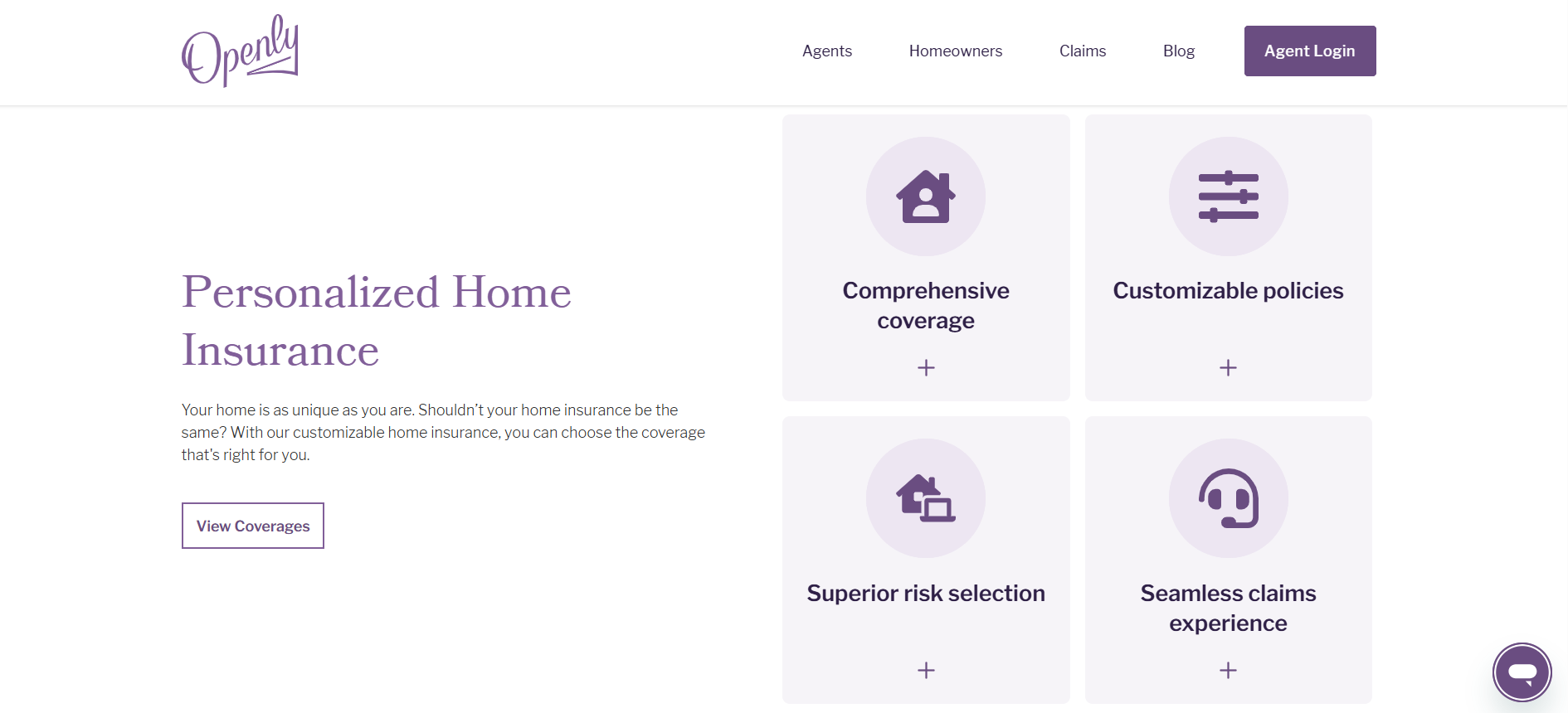
The “Agent-First” Strategy
Openly does not sell directly to homeowners. If you go to Openly.com as a consumer, you are directed to “Find an Agent.” This limitation is their greatest strength.
-
Trust & Loyalty: By promising never to compete with their agents (unlike carriers who have both agent and direct channels), Openly earns fierce loyalty. Agents know Openly won’t try to cross-sell their clients behind their backs.
-
Distribution Leverage: There are over 40,000 independent insurance agencies in the U.S. By plugging into this network, Openly gains a massive, distributed sales force without carrying the overhead of thousands of internal sales reps.
The Economic Efficiency
-
Low CAC: Openly’s cost to acquire a customer is significantly lower than direct-to-consumer rivals. While a company like Lemonade might pay hundreds of dollars in ads to sign up one policyholder, Openly spends its marketing budget on signing up agencies, who then bring hundreds of policyholders over years.
-
Better Retention: Customers who buy through agents tend to be “stickier.” They retain their policies longer than price-shoppers who buy from a website, increasing the Lifetime Value (LTV) of Openly’s book of business.
Target Customer: The “Mass Affluent”
Openly targets a specific demographic: the “mass affluent” homeowner. These are customers with homes valued between $400k and $3M—people who have complex needs (pools, high-value jewelry, finished basements) and value coverage over the absolute lowest price. This segment is less price-sensitive and more profitable than the bottom-tier market.
Technology & Data Infrastructure
While they champion the human agent, Openly is a technology company at its core. Their “algorithm advantage” allows them to price risk more granularly than competitors.
The “Three-Question Quote”
The hallmark of Openly’s tech is the speed of its quoting engine. A traditional carrier requires an agent to answer 40-60 questions (Roof year? Plumbing type? Distance to hydrant?) to get a price.
Openly pulls this data instantly from dozens of third-party sources (municipal records, satellite imagery, credit bureaus, CLUE reports).
- The Result: An agent only needs to enter Name, Date of Birth, and Address.
- Speed: A bindable quote is generated in 15 seconds. This efficiency creates a “path of least resistance,” encouraging agents to quote Openly first.
Modern Tech Stack
Unlike legacy carriers running on COBOL mainframes, Openly’s infrastructure is cloud-native, hosted on Google Cloud Platform (GCP).
- Backend: Written in Go (Golang), a language known for high performance and concurrency, allowing their rating engine to process millions of variables in milliseconds.
- Frontend: Built with Vue.js, providing a consumer-grade user experience (UX) for agents that feels more like using Amazon or Apple than a traditional insurance portal.
- Deployment: They utilize continuous integration/continuous deployment (CI/CD), meaning they can tweak their pricing algorithms or launch in a new state in days, not months.
Products & Services of Openly
Openly’s product philosophy is “Premium Standard.” They stripped away the “gotchas” and confusing exclusions found in typical policies to create a contract that agents can recommend with confidence.
The Core Offering: Enhanced Homeowners Policy
Most insurers sell an HO-3 policy, which covers the home on an “open perils” basis but personal belongings on a “named perils” basis (only covering specific listed events like fire or theft). Openly sells a policy that approximates the HO-5 standard—the highest quality of protection available.
Key Product Differentiators
| Feature | Standard Competitor Policy (HO-3) | Openly Premium Policy | Why It Matters |
| Personal Property | Named Perils (Only covers listed events like fire/theft). | Open Perils (Covers everything unless specifically excluded). | If you accidentally drop your expensive TV, Openly likely covers it. A standard policy won’t. |
| Replacement Cost | Capped. Usually pays up to 120% of the dwelling limit. | Guaranteed Replacement Cost (up to $5M). | If a wildfire spikes labor/material costs, Openly pays the full rebuild cost, even if it exceeds the policy limit. |
| Claims Settlement | Actual Cash Value (Depreciated value for old items). | Replacement Cost (New for Old). | You get the money to buy a new sofa, not what your old one was worth at a garage sale. |
| Buried Service Lines | Usually an expensive add-on. | Included (Standard). | Covers costly repairs to underground water/sewer pipes, a common issue for homeowners. |
| Dog Breeds | Restricted. (No Pit Bulls, Rottweilers, etc.) | No Breed Restrictions. | Openly looks at the dog’s history, not the breed. Essential for many families. |
Additional Services
- Landlord Insurance: For customers renting out properties, offering the same short quoting flow.
- Vacation Home Coverage: Specialized coverage for secondary residences.
- Concierge Claims: A claims process designed to be empathetic and fast, leveraging digital uploads for instant payouts on smaller claims.
Market Landscape & Competitors of Openly
Openly occupies a unique “Goldilocks” zone in the market: more modern than the legacy carriers, but more robust and agent-friendly than the direct-to-consumer insurtechs.
Competitive Matrix
| Competitor Type | Key Players | Openly’s Advantage | Openly’s Disadvantage |
| DTC Insurtechs | Lemonade, Hippo, Kin | Agent Loyalty. Agents steer profitable business to Openly. Openly also offers broader coverage (HO-5 vs. standard). | Brand Awareness. Consumers don’t know the “Openly” brand name like they know Lemonade. |
| Legacy Carriers | Travelers, Safeco, Hartford | Speed & Tech. Openly quotes in 15 seconds vs. 15 minutes. No legacy tech debt. | Scale & Bundling. Legacy carriers can easily bundle Auto + Home + Umbrella. Openly is still rolling out Auto. |
| E&S Carriers | Lloyd’s Syndicates | Admitted Status. Openly is an “admitted” carrier, meaning it is state-regulated and backed by guaranty funds, offering more security than E&S. | Risk Appetite. E&S carriers can take “bad” risks (coastal wind, brushfire zones) that Openly might decline. |
The “Bundling” Challenge
Historically, Openly’s main weakness was the inability to bundle Auto insurance (a key retention tool). However, in 2024/2025, Openly began piloting and rolling out auto coverage in select states, directly attacking the last stronghold of the legacy carriers.
Funding, Valuation & Financial Trajectory of Openly
Openly’s fundraising history reflects investor confidence in its unit economics. Unlike peers who raised money on “growth hype,” Openly raised money on “underwriting discipline.”
As of early 2025, Openly has raised approximately $430 Million in total funding (Equity + Debt).
Funding Rounds Chronology
| Round | Date | Amount | Key Investors | Context |
| Seed | Nov 2019 | $7.7M | Gradient Ventures (Google) | Validation of the tech stack by Google’s AI fund. |
| Series A | June 2020 | $15M | Obvious Ventures | Focus on scaling the initial agent network. |
| Series B | Dec 2020 | $40M | Advance Venture Partners | Rapid expansion during the pandemic; remote-first shift. |
| Series C | June 2022 | $75M | MTech Capital, Gradient, Obvious | Expansion into 15+ states. Valuation spiked as other insurtechs crashed. |
| Series D | Sept 2023 | $100M | Eden Global Partners | A massive “up-round” during a tech recession, proving Openly’s outlier status. |
| Series E / Growth | Jan 2025 | $193M | Eden Global, Allianz X | Comprised of $123M equity + $70M debt. |
Financial Performance (2024-2025 Snapshot):
-
State Footprint: Active in 24+ states (including recent expansions into CT, VA, DE), covering over 60% of the US population.
-
Premium Growth: Openly reported 80% Year-Over-Year growth in Gross Written Premium (GWP) in 2023, and continues to double-digit growth through 2025.
-
Valuation: While private, the substantial Series D and E rounds suggest a “Unicorn” valuation (over $1 Billion), likely significantly higher given the $193M injection in 2025.
Conclusion
Openly’s brand story is a masterclass in zigging when the market zags. When the world screamed “death to the agent,” Openly doubled down on them. When the market demanded “cheap policies fast,” Openly built “premium policies efficiently.”
Today, Openly stands as the premier example of Insurtech 2.0: a wave of companies that respects the complexity of the insurance value chain rather than trying to break it. They have successfully bridged the gap between the speed of Silicon Valley and the stability of the Hartford insurance hub.
For the independent agent, Openly is a lifeline—a tool that allows them to compete with direct writers. For the homeowner, it is a promise of genuine protection, backed by guaranteed replacement cost. And for the industry, it is proof that technology’s best use case isn’t always replacing humans—sometimes, it’s giving them superpowers.
As they expand into Auto insurance and deepen their footprint across all 50 states, Openly is not just participating in the market; they are reshaping the standard of what a modern, premium insurance carrier looks like.
Key Statistics Summary
| Metric | Detail |
| Founded | 2017 (Boston, MA) |
| Founders | Ty Harris (CEO), Matt Wielbut (CTO) |
| Total Funding | ~$368 Million |
| Valuation | ~$1.1 Billion (Unicorn) |
| Key Investors | Eden Global, Allianz X, Google’s Gradient Ventures |
| Distribution | 100% Independent Agents |
| Core Product | Premium HO-5 Homeowners Insurance |
| Written Premium | ~$301M (2023) |
Also Read: Who are Chubb’s Top Competitors in Insurance Industry?
Also Read: Top Allianz Competitors: A Comprehensive Industry Analysis
To read more content like this, subscribe to our newsletter