In the fragmented world of global business, language has historically been the highest barrier to entry. For decades, the translation industry was a siloed landscape of slow-moving agencies, clunky desktop software, and disjointed email threads. Then came Smartcat.
Smartcat is not merely a translation tool; it is an all-in-one enterprise language AI platform that has fundamentally re-engineered how the world communicates. By fusing advanced Artificial Intelligence with a vast marketplace of human expertise and a cloud-native workflow, Smartcat has created a category of its own: Connected Translation.
Today, Smartcat powers the globalization strategies of over 1,000 enterprise customers, including 20% of the Fortune 500. It stands at the intersection of the $60 billion language services market and the booming generative AI economy. Unlike traditional tools that force companies to choose between speed (machine translation) and quality (human translation), Smartcat offers a third way: an AI-driven, human-verified continuous delivery loop. This brand story explores how a spin-off project evolved into a disruptive market leader, redefining the economics of the language industry.
Founding Story of Smartcat
The Genesis: A Problem of Fragmentation
The story of Smartcat begins not in a Silicon Valley garage, but within the walls of ABBYY, a global leader in optical character recognition (OCR) and linguistic software. In the early 2010s, the translation industry was plagued by inefficiency. “Computer-Assisted Translation” (CAT) tools were expensive, desktop-based licenses that locked translators into specific devices. Agencies (Language Service Providers or LSPs) operated as opaque middlemen, adding markup and delay to every word translated.
Ivan Smolnikov, then CEO of ABBYY Language Solutions (a subsidiary of the ABBYY Group), witnessed this friction firsthand. He realized that the industry didn’t just need better software; it needed a platform. He envisioned a cloud-based ecosystem where everyone—enterprises, agencies, and freelancers—could collaborate in real-time.
The Incubation (2012–2015)
Smolnikov initiated Smartcat as an internal R&D project within ABBYY LS in 2012. The goal was to build a tool that would allow ABBYY’s own project managers to handle complex, multilingual projects without the administrative nightmare of spreadsheets and email chains.
The beta version proved revolutionary. It allowed multiple translators to work on the same document simultaneously—a feature that desktop tools like Trados could not offer. Recognizing that this technology had potential far beyond ABBYY’s internal needs, Smolnikov made a bold decision.
The Spin-Off (2016)
In 2016, Smolnikov orchestrated a spin-off. Smartcat became an independent US-based entity, separating entirely from ABBYY. This was a critical strategic move. To become a neutral platform for the entire industry, Smartcat could not be owned by a language service provider (which would be viewed as a competitor by other agencies).
The spin-off was funded by an initial seed round and a clear vision: to make translation as simple as a utility. The company established its headquarters in Boston, Massachusetts, and immediately began disrupting the pricing models of the industry by offering its core software for free to freelancers, aggregating the supply side of the market before monetizing the demand side.
Founders of Smartcat
Ivan Smolnikov (Founder & CEO)

Ivan Smolnikov is the architect behind Smartcat’s vision and technology. A physicist by training, Smolnikov possesses a rare combination of deep technical understanding and astute business strategy.
-
Background: Before Smartcat, he co-founded ABBYY Language Solutions in 2004 and grew it into one of the top 50 language service providers globally.
-
Philosophy: Smolnikov has consistently argued against the “black box” model of traditional agencies. He believes in transparency and automation. His “Connected Translation” manifesto posits that technology should not replace humans but should eliminate the administrative friction between them.
-
Leadership Style: Known for being product-obsessed, Smolnikov pivoted the company early on to embrace AI, positioning Smartcat as an “AI-first” company long before the current generative AI hype cycle.
Business Model of Smartcat
Smartcat’s business model is a unique hybrid that defies standard SaaS categorization. It combines SaaS (Software as a Service) with a Fintech-enabled Marketplace.
1) The “Unlimited Seats” Disruption
Most competitors (like Smartling or Trados) charge per user license (“seat”). This discourages collaboration; companies limit access to save money. Smartcat flipped this model.
-
The Strategy: Smartcat offers unlimited seats for free.
-
The Logic: Translation is a collaborative process involving marketing managers, developers, product owners, and legal teams. By removing seat limits, Smartcat entrenched itself deeply within customer organizations, creating high switching costs and network effects.
2) The Marketplace & Fintech Layer
If the software is accessible, how does Smartcat make money? The answer lies in the marketplace.
Smartcat connects enterprises with over 500,000 freelancers and agencies. When a company hires a translator through Smartcat, the platform facilitates the payment.
-
The Problem Solved: Paying 50 freelancers in 20 different countries is a nightmare for accounts payable departments (involving varying tax laws, currencies, and payment methods).
-
The Smartcat Solution: The enterprise pays one invoice to Smartcat. Smartcat then automatically distributes payments to all freelancers in their local currencies.
-
Monetization: Smartcat charges a percentage service fee on these transactions (typically roughly 5-10% markup on the vendor payment or a subscription fee that lowers this percentage).
3) The AI Loop
With the rise of Generative AI, the business model evolved. Smartcat now charges for Smartwords—a consumption-based model for AI translation. Customers pay for the volume of content processed by Smartcat’s AI engines, which is significantly cheaper than human translation but more premium than raw Google Translate APIs because of the integrated quality estimation and workflow.
Revenue Streams of Smartcat
Smartcat has diversified its income into three primary pillars, ensuring resilience against market shifts.
A. Enterprise Subscriptions (SaaS)
While the basic seat model is open, enterprises pay for advanced features.
- Features: Single Sign-On (SSO), advanced API access, custom workflows, dedicated success managers, and enhanced security (SOC 2 compliance).
- Structure: Annual recurring revenue (ARR) contracts.
B. Marketplace Commission (Fintech)
This is the transactional engine of the company.
- Mechanism: Smartcat acts as the merchant of record.
- Revenue: A service fee added to the payments made to freelancers. For example, if a company pays a translator $100, the total cost might be $110, with Smartcat retaining the difference as a processing and platform fee.
C. AI Consumption (Smartwords)
The newest and fastest-growing stream.
- Mechanism: Customers purchase “Smartwords” balances.
- Value: These credits are used to power the “AI Agents,” which perform instant translation, OCR (Optical Character Recognition), and multimedia transcription.
- Upsell: As companies translate more content (blogs, support tickets, internal docs), their consumption of Smartwords increases, driving expansion revenue.
Funding of Smartcat
Smartcat has successfully navigated the venture capital landscape, raising approximately $70 million to date. The company has moved from an R&D spin-off to a Series C growth-stage company.
Funding Rounds Analysis
| Round | Date | Amount | Lead Investor | Key Participants | Purpose of Funds |
| Seed | Aug 2016 | $2.8 Million | RedSeed | Ilya Shirokov (ex-DST) | Spin-off from ABBYY; establishing US HQ; initial product development. |
| Series A | Jun 2018 | $7.0 Million | Matrix Partners | FJ Labs, Marbruck | Scaling the marketplace; expanding into the US market. |
| Series B | Aug 2020 | $14.6 Million | Left Lane Capital | Matrix Partners | Expanding the “Connected Translation” platform; enhancing payment automation. |
| Series C | Sep 2024 | $43 Million | Left Lane Capital | Matrix, Marbruck | Accelerating AI Agents development; global sales expansion; video/dubbing AI. |
Total Funding: ~$70 Million
Analysis of Recent Funding (Series C):
The $43 million raised in September 2024 is significant. In a venture climate where capital is scarce, this raise validates Smartcat’s pivot to AI. While many SaaS companies struggled in 2024, Smartcat demonstrated that its “AI + Human” model is generating real ROI for enterprises, allowing them to secure a growth round led by Left Lane Capital, a firm known for backing high-growth internet and consumer technology businesses.
Competitors of Smartcat
The translation technology landscape is crowded. Smartcat competes on multiple fronts: against legacy software, modern SaaS proxies, and freelance marketplaces.
Tier 1: Legacy & Desktop Giants
Trados (RWS): The “Microsoft Word” of translation.
-
-
Smartcat’s Advantage: Trados is expensive, complex, and largely desktop-based. Smartcat is cloud-native and collaborative.
-
memoQ: A strong desktop/server tool favored by power-user translators.
-
-
Smartcat’s Advantage: memoQ lacks the integrated marketplace and payment automation.
-
Tier 2: Cloud SaaS Competitors
Smartling: A direct enterprise competitor. Strong on “Translation Proxy” technology for websites.
-
-
Smartcat’s Advantage: Smartling operates more like a tech-enabled agency (black box). Smartcat is transparent—clients can see and choose their translators. Smartcat also allows unlimited users, whereas Smartling is often more restricted.
-
Phrase (formerly Memsource/Phrase): A strong European competitor.
-
-
Smartcat’s Advantage: Phrase is a fantastic developer tool but lacks the deep “Fintech/Marketplace” integration that handles vendor payments.
-
Tier 3: Developer-Centric Platforms
Crowdin / Lokalise: These platforms focus heavily on software localization (apps, games, code).
-
-
Smartcat’s Advantage: While Crowdin/Lokalise are great for developers, Smartcat appeals more to the entire enterprise—marketing, legal, and HR—because of its document-handling capabilities and AI content generation features.
-
Tier 4: Marketplaces
Upwork / Fiverr: Generalist marketplaces.
-
-
Smartcat’s Advantage: Smartcat is vertical-specific. Its marketplace is integrated into the CAT tool. You don’t just “hire a guy”; the guy works inside your platform, on your translation memory, with your glossaries.
-
Competitive Advantage of Smartcat
Smartcat’s “moat” is built on three pillars that reinforce each other. This is often described as a Flywheel Effect.
1) The “Connected Translation” Loop
Most competitors sell a tool or a service. Smartcat sells the connection.
-
The Flywheel: The free software attracts freelancers (Supply). The extensive supply attracts enterprises (Demand). The enterprises bring more content, which trains the AI (Data).
-
Result: Smartcat has the largest vetted marketplace of linguists (500,000+) directly inside the software. A company can click “Assign” and have a human working on their AI-translated text in minutes.
2) Payment Automation (The Fintech Edge)
This is Smartcat’s “killer app” for operations teams.
- The Pain: Onboarding 100 translators requires 100 NDAs, 100 tax forms, and 100 bank transfers.
- The Advantage: Smartcat handles the compliance. The client pays Smartcat; Smartcat pays the world. This legal and financial shield is a massive differentiator that pure software companies (like Lokalise) do not offer.
3) Adaptive AI (AI that Learns)
Smartcat isn’t just a wrapper for ChatGPT. It uses an adaptive engine.
-
How it works: When a human translator corrects a sentence in Smartcat, the AI remembers that correction. The next time a similar sentence appears, the AI applies the human’s style and terminology.
-
Result: Translation quality improves over time automatically, specifically tuned to the brand’s voice.
Products & Services of Smartcat
Smartcat has evolved from a tool to an ecosystem. As of late 2025, their product suite consists of AI Agents, the Core Platform, and the Marketplace.
A. AI Agents (The New Frontier)
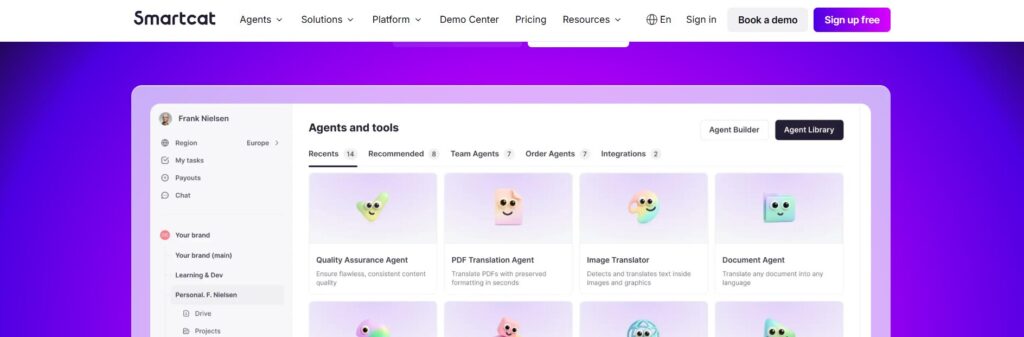
Launched and refined aggressively between 2023 and 2025, “AI Agents” are specialized bots designed for specific content workflows. They go beyond simple translation.
| Agent Name | Function | Use Case |
| Website Translator | Automatically scrapes, translates, and publishes web pages. | converting a .com site to .de, .fr, .es instantly. |
| Media Agent | AI Dubbing and Subtitling. | Turning a CEO’s English town hall video into a Spanish-dubbed video with lip-sync. |
| Course Localizer | Translates SCORM/e-learning files. | L&D teams localizing training modules for global staff. |
| Software Agent | Connects to Git/Figma to translate UI strings. | App developers localizing iOS/Android apps continuously. |
| Document Agent | Handles complex formatting (PDF, PPTX, InDesign). | Marketing decks that need to retain perfect layout after translation. |
B. The Core Platform (TMS & CAT)
- Editor: A dual-column interface where source text meets target text. It supports real-time multiplayer editing (like Google Docs).
- Translation Memory (TM): A database that stores every sentence ever translated. If you translate “Welcome to our store” once, you never pay to translate it again.
- Glossaries: Enforced terminology ensures that “Brand X” is never translated literally.
C. The Marketplace
-
Linguist Discovery: AI matching algorithms suggest the best translator based on the content topic (e.g., matching a medical document with a translator who has a background in biology).
-
Smartcat Payment Network: The infrastructure that processes payouts to over 160 countries.
D. Integrations
Smartcat integrates with over 80 external platforms, including:
- CMS: WordPress, Drupal, Contentful, Adobe Experience Manager.
- Code Repositories: GitHub, GitLab, Bitbucket.
- Design: Figma, Adobe Creative Cloud.
- Support: Zendesk, Salesforce.
Detailed Analysis: Smartcat Today (2025 Status)
1) Financial Health & Valuation
Following the $43M Series C in September 2024, Smartcat is in a hyper-growth phase. While they do not publicly disclose revenue, industry estimates place their Annual Recurring Revenue (ARR) in the $50M – $75M range. Their valuation is likely approaching the “Soonicorn” (soon to be Unicorn) status, estimated between $400M and $600M based on typical SaaS multiples for AI-integrated platforms.
2) The Shift to “Generative Language AI”
The most significant shift in Smartcat’s brand story occurred in the last 24 months. They successfully pivoted from “Translation Management” to “Language AI.”
- Old Brand Story: “We connect you to translators.”
- New Brand Story: “We are your AI translation team; humans are the editors.”
This pivot was risky but successful. By embedding GPT-4 and other Large Language Models (LLMs) deeply into their workflow, they allow enterprises to translate millions of words for a fraction of the cost, reserving human budget only for critical “high-impact” content.
3) Challenges
Despite its success, Smartcat faces risks:
- Commoditization of Translation: As AI gets better, the perceived value of translation drops. Smartcat must prove that its workflow is valuable, not just the raw translation.
- Platform Dependency: They rely on underlying LLMs (OpenAI, Google, etc.).
- Market Saturation: Competitors like Smartling and Phrase are also aggressively integrating AI.
Conclusion
Smartcat’s brand story is one of visionary adaptation. What started as an internal tool to fix a broken administrative process in Russia has evolved into a US-headquartered global powerhouse reshaping the language economy.
By rejecting the industry standard of “per-seat” pricing and “black-box” agencies, Smartcat democratized access to translation technology. Its masterstroke was the integration of Fintech with SaaS—solving the payment problem that plagued the gig economy of translation.
Today, Smartcat stands as the Operating System for Global Content. It successfully bridged the gap between the chaotic world of freelance human translation and the lightning-fast world of Generative AI. For a modern enterprise, Smartcat offers a compelling promise: the ability to speak every language in the world, instantly, without the bureaucratic weight of the past. As global business becomes increasingly digital and content-heavy, Smartcat’s “Connected Translation” model is positioned not just to participate in the market, but to define its future.
Also Read: Openly – Founders, Business Model, Funding & Competitors
To read more content like this, subscribe to our newsletter