Every brand has a story, and sometimes, that story needs a new chapter. Perhaps your startup launched in a hurry, with a logo designed on a free tool and a name chosen in a caffeine-fueled haze. Or maybe your small business has evolved, its original identity no longer reflecting its true spirit, its expanded services, or its new vision.
The whisper starts subtly. “We’ve outgrown this.” “This doesn’t feel like us anymore.“
For many small businesses and startups, the idea of rebranding conjures images of astronomical agency fees, massive design overhauls, and months of disruptive work. It sounds like a luxury reserved for multinational corporations with bottomless budgets.
This belief, however, is a myth.
This is the story of The Phoenix Project: a testament to the power of transformation, proving that a compelling rebrand is not only achievable on a budget, but can be a powerful catalyst for growth. It’s about igniting your brand’s true potential without setting your bank account on fire.
1) The Ash and the Spark (Why Rebrand? And When?)
Before we talk about rebirth, let’s understand the “ash”—the reasons why a brand might need to shed its old skin. Rebranding isn’t just about a new logo; it’s about aligning your external identity with your internal reality.
1.1) When the Whisper Becomes a Roar: Signs You Need a Rebrand
| Sign of Need | Description | Example |
| Outdated Appearance | Your visual identity looks old, generic, or unprofessional compared to competitors. | A website that screams “early 2000s” in 2024. |
| Shifting Vision/Mission | Your core values, products, or target audience have fundamentally changed. | A photography studio that started with weddings now specializes in corporate headshots. |
| Lack of Differentiation | You blend in with competitors; customers can’t tell you apart. | Two coffee shops in the same block with nearly identical logos and color palettes. |
| Negative Perceptions | An old name or logo carries unintended negative connotations. | A brand name that sounds similar to a disgraced public figure. |
| Expansion/New Markets | You’re moving into new geographical areas or offering new services that the old brand doesn’t cover. | A local bakery wanting to launch a national online gourmet cookie delivery service. |
The “spark” is recognizing that these challenges aren’t roadblocks, but opportunities. An intelligent rebrand is an investment, not an expense. It’s about clarity, connection, and courage.
2) The Blueprint of Rebirth (Strategic Foundations)
A phoenix doesn’t just spontaneously combust and reappear; there’s an inherent, powerful process. For a budget rebrand, the most critical phase is the strategic foundation. Without it, you’re just changing paint colors.
2.1) The Brand Discovery Phase (Your North Star)
This is where you define who you are now.
- Why do you exist? (Purpose): Beyond making money, what problem do you solve?
- What do you believe? (Values): What principles guide your actions?
- Who are you talking to? (Audience): Who is your ideal customer today?
- What makes you different? (Differentiation): Your unique selling proposition.
- What is your story? (Narrative): The emotional core you want to convey.
Budget Hack: Don’t hire an expensive agency for discovery. Facilitate internal workshops with your team. Use free tools like Miro for digital whiteboarding. Interview your best customers. Their insights are gold.

2.2) Identifying Your Rebranding Scope: Incremental vs. Radical
Not every rebrand requires blowing everything up.
| Scope | Description | Examples | Budget Impact |
| Incremental (Evolutionary) | Minor tweaks to refresh an existing identity. Often called a “refresh.” | Slight color palette update, font change, minor logo refinement, updated messaging. | Low: Focus on digital assets, minimal physical changes. |
| Radical (Revolutionary) | A complete overhaul of name, logo, visuals, and messaging. | New company name, entirely new visual identity, complete website redesign. | Moderate: Requires more design and content work, but can still be optimized. |
For small businesses, an incremental rebrand is often the most budget-friendly and effective approach, building on existing equity rather than starting from scratch.
3) Weaving the New Feathers (DIY Design & Content)
This is where the magic of “on a budget” truly shines. You don’t need a massive design team; you need smart tools and a clear vision.
3.1) Visual Identity: Smart & Scrappy
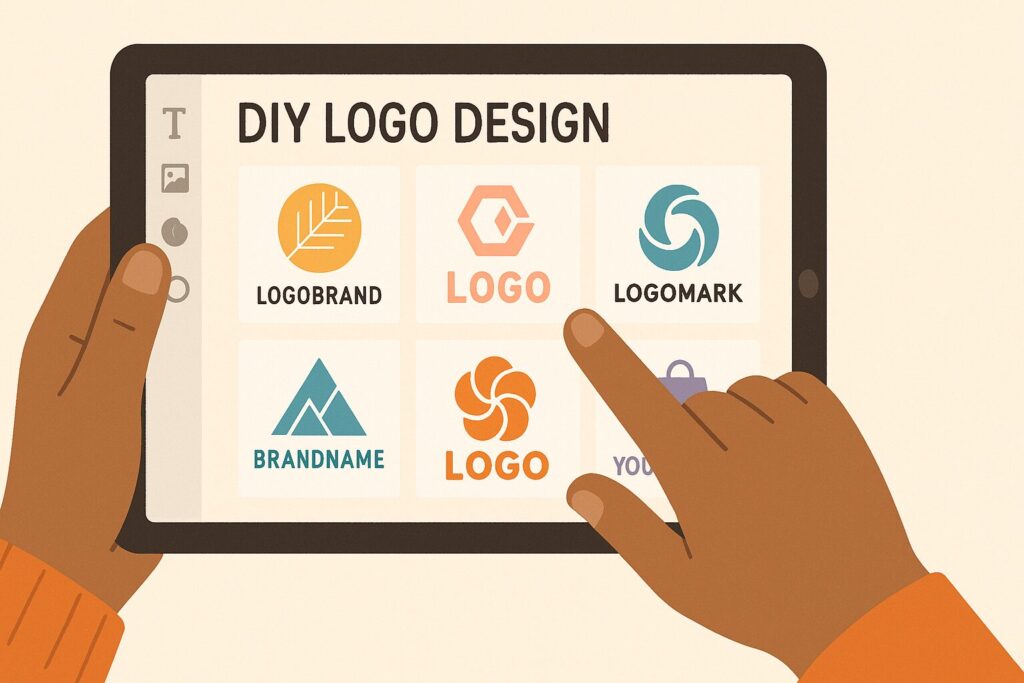
3.1.a) The Logo (Your New Face):
- Start with your “why”: Your brand discovery phase should inform the style.
- DIY Tools: Canva, Adobe Express, Looka, Hatchful (Shopify). These tools offer templates and easy-to-use interfaces.
- Freelance Talent: If your budget allows for a small investment, platforms like Fiverr or Upwork can connect you with talented designers for a fraction of agency costs. Be super clear with your brief!
- Vector Formats: Always get your final logo in vector formats (SVG, AI, EPS) for scalability.
3.1.b) Color Palette (Your Mood):
- Use tools like Coolors.co or Adobe Color to generate harmonious palettes.
- Choose 1-2 primary colors, 1-2 secondary colors, and an accent color.
- Consider the psychology of colors and what emotions they evoke.
3.1.c) Typography (Your Voice):
- Select 2-3 fonts: one for headlines, one for body text, one for accents.
- Look for free Google Fonts that align with your brand’s personality (e.g., elegant, playful, serious).
3.1.d) Imagery & Iconography (Your Storytellers):
- Stock Photos: Use free platforms like Unsplash, Pexels, or Pixabay. Ensure consistency in style and tone.
- DIY Photography: Use your smartphone for high-quality photos of your team, products, or workspace. Consistency is key!
- Icon Sets: Flaticon.com offers free icons.
3.1.e) Messaging & Voice: What You Say and How You Say It
Your words are just as powerful as your visuals.
Review Core Messaging:
- Website copy (Homepage, About Us, Services)
- Social media bios
- Email signatures
- Marketing materials (brochures, flyers)
Craft Your Brand Voice: Is it authoritative, friendly, quirky, professional? Write down 3-5 adjectives.
Budget Hack: Rewrite your own copy! Use tools like Hemingway Editor or Grammarly to refine your writing. Test new taglines with a small focus group (friends, family, loyal customers).
4) The Flight Plan (Phased Implementation & Rollout)
A budget rebrand thrives on a well-orchestrated rollout. You can’t change everything overnight, and you shouldn’t try.
4.1) The Phased Approach (Minimizing Disruption, Maximizing Impact)
| Phase | Description | Key Assets to Update | Budget Impact |
| Phase 1: Digital First | Start with your most visible and easily changeable digital touchpoints. | Website (logo, colors, fonts, hero images), Social Media profiles, Email Signatures, Google Business Profile. | Low: Primarily design and content changes on existing platforms. |
| Phase 2: Core Materials | Update essential marketing and operational assets. | Business Cards, Letterheads, Invoices, Digital Brochures, Key Presentations. | Medium: Printing costs, but can be done in small batches. |
| Phase 3: Physical & Long-Term | Gradual update of physical assets that are expensive or have a long shelf life. | Store Signage, Product Packaging, Uniforms, Vehicle Wraps. | Variable: Spread costs over time; only replace as needed. |
Budget Hack: Don’t discard old branded items immediately. Use them up before ordering new ones (e.g., old pens, notepads). This saves money and reduces waste.

4.2) Communicating Your Rebirth: Tell Your Story!
A rebrand is not a secret. It’s an opportunity to re-engage your audience and explain why you’ve changed.
- Website Announcement: A dedicated blog post or homepage banner.
- Email Campaign: Announce the new look, explain the “why,” and highlight the benefits to customers.
- Social Media Campaign: Tease the change, reveal the new look, and share behind-the-scenes content.
- Press Release (if applicable): Focus on the “new and improved” aspects, not just a logo change.
5) The Sustained Flight (Maintaining Your New Brand)
The rebrand isn’t over when the new logo is live. It’s a continuous journey of brand stewardship.
5.1) Internal Alignment: Your Team as Brand Ambassadors
Your team must understand and embody the new brand.
- Brand Guidelines (Mini Version): Create a simple document outlining logo usage, colors (with hex codes), fonts, and brand voice.
- Internal Training: Discuss the “why” behind the rebrand and how it impacts their roles.
5.2) Monitoring & Adapting
- Feedback: Listen to what customers are saying about the new brand.
- Analytics: Track website traffic, social media engagement, and conversion rates post-rebrand.
- Flexibility: A budget rebrand teaches agility. Be prepared to make minor adjustments based on real-world feedback.
Epilogue: The Sky is Not the Limit
The Phoenix Project proves that rebranding on a budget is not just possible; it’s a testament to entrepreneurial ingenuity. It’s about leveraging creativity, strategic thinking, and accessible tools to craft an identity that truly resonates.
You don’t need millions to tell a million-dollar story. You need clarity, conviction, and the courage to transform. Your brand deserves to soar. Give it the wings it needs.
Also Read: Retargeting vs. Remarketing: Understanding the Key Differences
To read more content like this, subscribe to our newsletter