Moveworks is a pioneering enterprise AI platform that automates employee support and workflow tasks across an organization. Founded in 2016, the Mountain View-based startup has built an “agentic AI” assistant that understands natural language and can plan and execute actions autonomously.
The platform integrates with enterprise tools like Slack, Teams, ServiceNow and Salesforce to resolve routine IT, HR, and other support requests without human intervention. Moveworks has rapidly gained traction: by late 2024 it surpassed $100 million in annual recurring revenue, serving over 350 large enterprises and 5+ million end-users worldwide.
Its customer roster includes Broadcom, Toyota, Palo Alto Networks, and hundreds of other Fortune 500 firms, reflecting strong market adoption.
Founding Story of Moveworks
The idea for Moveworks grew from the founders’ own frustration with slow, manual support processes in large companies.
In early 2016, Bhavin Shah (CEO) and his co-founders recognized that employees’ questions and ticket requests often involved repeatable tasks (like password resets, account access, or software provisioning) that could be automated with AI.
They set out to build a conversational AI platform that could not only answer questions but also take action across back-end systems. Early on, they developed a proprietary natural language understanding (NLU) engine to decipher employee requests.
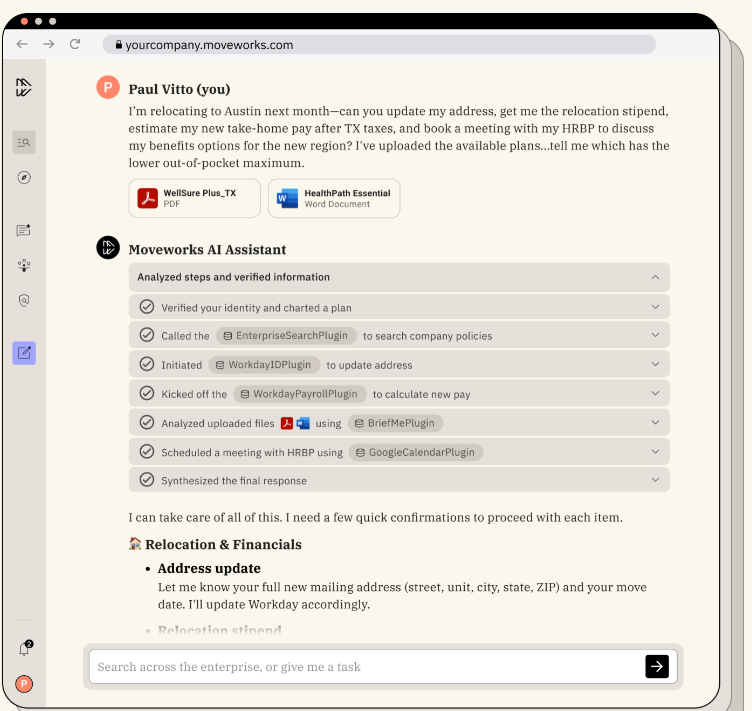
As Shah explained, Moveworks uses “advanced deep learning techniques” and integrations with enterprise tools so that when an employee asks for help, the AI assistant can “go and complete the task or retrieve the right piece of information” automatically.
Importantly, the system learns continuously from each interaction; with each new customer and query, the network effect makes the AI smarter for all users.
Moveworks emerged from stealth in 2019 after raising an initial $30 million Series A round led by Lightspeed Venture Partners and Bain Capital. The debut coincided with a release of their first AI solution for autonomous IT support, which CIOs at companies like Autodesk, Broadcom, and Nutanix began endorsing.
In short order, the startup proved the concept: by late 2024 Moveworks claimed it had resolved 25–35% of daily tickets autonomously at many customers, with plans to hit 75% resolution of routine issues.
This vision – of shifting employees from navigating software silos to simply asking an AI assistant to get work done – has driven Moveworks’ growth and led to its reputation as a platform that “gets work done” for enterprises.
Founders of Moveworks
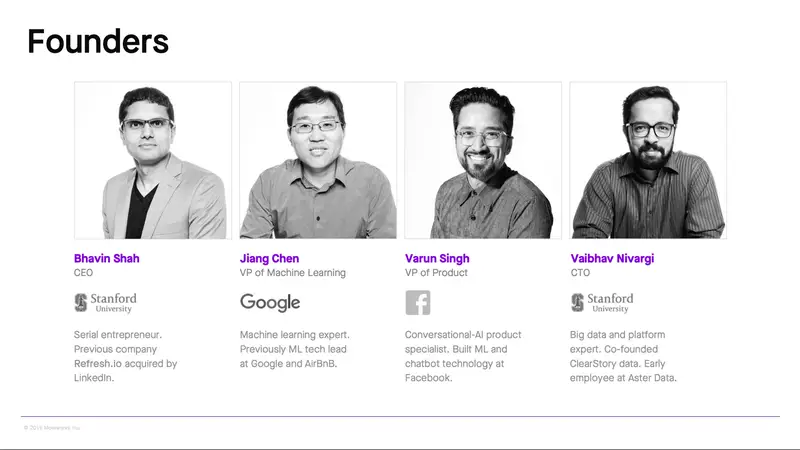
Moveworks was founded by four experienced tech entrepreneurs, each bringing AI and enterprise expertise.
Bhavin Shah (CEO) led the company; he previously co-founded Refresh.io (acquired by LinkedIn in 2015) and holds advanced degrees from Stanford University.
Vaibhav Nivargi (CTO) co-founded ClearStory Data, a business analytics platform, and leads Moveworks’ overall technology strategy.
Varun Singh (President of Product) was a product lead at Meta (Facebook) overseeing new consumer features.
Jiang Chen (VP of Machine Learning) brought expertise from Google, Yahoo, and Airbnb, heading the development of the AI engine.
Their combined backgrounds in machine learning and enterprise software guided Moveworks’ approach. As TechCrunch notes, Shah and his co-founders built Moveworks to “transform every interaction between employees and IT” with an AI that learns to automate tasks.
Business Model of Moveworks
Moveworks operates on a B2B SaaS model, selling its AI support platform to large enterprises on a subscription basis. Customers typically enter multi-year licensing contracts (often with an annual recurring revenue structure) in exchange for access to the AI platform, integrations, and support. The company provides an ROI assessment and flexible pricing packages tailored to enterprise scale.
This recurring model is evidenced by Moveworks’ growth: by September 2024 the company had surpassed $100 million ARR. Its revenue comes primarily from license fees for the platform, though it also likely includes implementation and professional services (such as customizing integrations and training the AI on a customer’s data). Moveworks emphasizes reducing overall support costs for clients – in effect delivering value by freeing help-desk staff from routine tickets.
In practice, sales are usually made through Moveworks’ enterprise sales team and partner channels, targeting IT, HR, and operations leaders.
Revenue Streams of Moveworks
The lion’s share of Moveworks’ revenue is recurring subscription fees from enterprise customers. As a cloud-native platform, Moveworks charges companies for access to its agentic AI assistant and associated modules (often based on company size or usage metrics, although pricing details are custom per customer).
Additionally, revenue comes from professional services and support – for example, fees to deploy the platform, integrate with on-premises systems, and configure custom “AI agents” for specialized tasks.
Moveworks also offers an AI Agent Marketplace (a catalog of pre-built solution packs) and developer platform, suggesting it may generate licensing revenue from custom AI agents developed on its platform.
Overall, its business model aligns with enterprise software norms: upfront contract and implementation fees plus ongoing maintenance and support revenues. The steady growth in ARR (one of the first GenAI startups to reach $100M ARR) indicates the strength and stickiness of this subscription-based revenue stream.
Funding and Funding Rounds of Moveworks
| Round | Date | Amount | Lead Investors | Post-Money Valuation |
|---|---|---|---|---|
| Seed | n/a | Undisclosed | Founders’ initial funding | – |
| Series A | Apr 2019 | $30 million | Lightspeed Venture Partners; Bain Capital Ventures | n/a |
| Series B | Nov 2019 | $75 million | Iconiq Capital; Kleiner Perkins; Sapphire Ventures | n/a (≈$1B at that time) |
| Series C | June 2021 | $200 million | Tiger Global; Alkeon Capital | ~$2.1 billion post-money |
| Total | 2019–2021 | $315 million | (Including previous rounds) | $2.1B (2021 valuation) |
Moveworks officially raised $30M in Series A (Lightspeed and Bain), $75M in Series B (Iconiq, Kleiner, Sapphire), and $200M in Series C (Tiger Global, Alkeon). By mid-2021 Moveworks’ total funding reached $315M, valuing it at about $2.1 billion. Key backers included leading VCs like Lightspeed, Tiger Global, Bain, Sapphire Ventures, ICONIQ Growth and Kleiner Perkins. These rounds funded product expansion beyond IT support into HR, finance and broader employee services, as well as global scaling.
Competitors of Moveworks
Moveworks operates in a competitive landscape of enterprise AI and IT automation. Key rivals include:
1) Aisera
An AI service platform for IT and HR support, often cited as a direct competitor with a focus on internal helpdesk automation. Aisera offers agentic AI workflows for IT, HR, finance, etc., and has similar enterprise features.
2) Kore.ai
Provides conversational AI and virtual assistants for business workflows. Kore.ai’s platform allows companies to build chatbots for HR, IT, and customer service functions.
IBM’s AI chatbot solution for enterprises. Watson Assistant enables companies to deploy virtual agents across various domains (customer support, IT services, etc.).
4) Microsoft Power Virtual Agents / Teams Copilot

Microsoft’s suite of AI assistants integrated into Office 365 and Teams. These tools use large language models to help employees find information and automate tasks within the Microsoft ecosystem.
5) Zendesk (Answer Bot) and Freshworks (Freddy AI)

Established support software vendors that have added generative AI capabilities to their IT service and customer support offerings. For example, Zendesk’s Answer Bot and Freshservice’s Freddy AI help automate ticket triage and responses.
6) ServiceNow Now Assist (and similar platforms)

In-house AI assistants from major ITSM vendors. Notably, ServiceNow’s own AI chatbot “Now Assist” directly competes with Moveworks’ assistant, as both aim to automate enterprise support via chat. (This competition led to ServiceNow’s acquisition of Moveworks in 2025 to combine the technologies.)
These competitors vary in focus – some emphasize broader digital employee experience, others specialize in customer-facing AI bots – but all aim at similar pain points: reducing manual ticket handling and enabling self-service for employees. In practice, enterprises often choose between these platforms based on existing infrastructure, ease of integration, and specific AI capabilities.
Competitive Advantage of Moveworks
Moveworks’ key advantages lie in its advanced AI technology and comprehensive platform. First, its “agentic AI” architecture enables true autonomy: the system not only understands intent but plans multi-step actions across systems without human prompts. This is more sophisticated than a simple keyword-matching chatbot. For example, the platform uses deep NLU and probabilistic models trained on over 100 million real-world support scenarios, allowing it to resolve queries in a context-aware way.
It also employs a collective learning approach: by learning from tickets across hundreds of customers, Moveworks’ AI rapidly improves its accuracy even when an individual customer has limited data. This means a new client benefits from the broader knowledge accumulated across the network, a “network effect” that boosts performance.
Second, Moveworks supports global enterprise needs: its AI can handle requests in 100+ languages and integrates securely with thousands of on-prem and cloud applications. It provides built-in connectors for identity management, knowledge bases, email systems and ITSM tools, enabling it to do things like automatically reset passwords or provision accounts once it understands a request.
This broad reach is a differentiator: where narrower solutions may only cover a few use cases, Moveworks spans IT support, HR inquiries, facilities management, and more – unifying them into a single conversational interface.
Finally, Moveworks’ track record and scale bolster its advantage. By late 2024 it had attracted hundreds of customers including major corporations like Broadcom, Toyota, and Palo Alto Networks. In head-to-head analyses, organizations have praised Moveworks for fast deployment and higher-resolution rates compared to alternatives.
Its platform reportedly achieved ~96% accuracy in ticket routing in one case (Equinix). Together, these elements – agentic autonomy, extensive integrations, collective intelligence and proven enterprise ROI – position Moveworks as a leading solution in the employee support automation market.
Products and Services of Moveworks
Moveworks offers a suite of products built on its core AI platform. The centerpiece is the Moveworks AI Assistant, a chatbot interface where employees can ask questions or submit requests in natural language. This assistant can find answers and complete tasks (such as opening service tickets, resetting passwords, or managing access) within seconds, reducing manual support work. It includes advanced features like semantic search and multi-language support, ensuring users across the company quickly get accurate information.
In addition to the assistant, the platform includes specialized modules:
-
Enterprise Search: A unified search layer that spans all connected apps and knowledge sources, using contextual AI to deliver precise results. Employees can instantly find policies or files without knowing which system to query.
-
Agent Studio: A development toolkit where administrators or developers can build custom AI “agents” for specific tasks or workflows, tailoring the system to unique business processes.
-
Knowledge Studio: Tools to curate and manage the organization’s knowledge base, allowing the AI to draw on up-to-date information from documentation and FAQs.
-
Employee Experience Insights: Analytics dashboards that surface trends in support issues and AI performance, helping IT and HR teams identify pain points and improve services.
-
Productivity Boost: Generative AI features (including “Quick GPT” and “Brief Me” summarizer) that assist employees with tasks like drafting messages or summaries, extending beyond simple Q&A.
-
Service Management Integration: Tight integrations with IT service management platforms (like ServiceNow) to automate ticket triage and resolution. For example, Moveworks can autonomously categorize and resolve L1 support tickets, giving agents more time to focus on complex work.
The table below summarizes Moveworks’ offerings:
| Product/Service | Description |
|---|---|
| AI Assistant (Core) | Conversational bot for employees to submit questions/requests. Automates tasks end-to-end (opens tickets, fetches info). |
| Enterprise Search | AI-driven search across all enterprise apps and documents. Delivers context-aware answers from knowledge bases. |
| Agent Studio | Development platform for creating custom AI agents. Lets teams build specialized conversational workflows. |
| Knowledge Studio | Tools for managing organizational knowledge (articles, FAQs). Ensures AI responses are grounded in current content. |
| Employee Experience Insights | Analytics and dashboards on support trends and AI usage. Highlights common issues and system performance. |
| Productivity Boost | Generative AI features (QuickGPT, summarizer) to help employees draft content and automate personal productivity. |
| Service Management & Automation | Deep integrations with ITSM tools. Automates ticket triage, provisioning, and L1 fixes (e.g. password resets) via chat. |
Table: Moveworks’ Product Suite – a unified “AI Assistant” platform with modules for search, custom agent building, knowledge management, analytics, and generative productivity tools.
These components work together on a single platform, enabling Moveworks to be deployed rapidly across different departments. The platform is offered as a SaaS solution, typically bundled with implementation services (such as AI training on company data and setting up integrations) to ensure successful deployment in an organization’s existing environment.
Conclusion
In just a few years, Moveworks has grown from a stealth AI startup into a well-funded leader in enterprise support automation. Its innovative “agentic AI assistant” enables organizations to eliminate mundane IT and HR tickets, significantly boosting productivity and user satisfaction. The company’s strong financial metrics (over $100M ARR by 2024) and backing by top VCs underscore its market traction. In March 2025, ServiceNow agreed to acquire Moveworks for $2.85 billion in cash and stock – a record deal highlighting Moveworks’ strategic value. This acquisition (expected to close in late 2025) reflects how Moveworks’ technology complements large enterprise platforms.
Looking ahead, Moveworks’ founders aim to continue advancing the platform’s capabilities, extending its agentic AI model to more use cases and deepening enterprise integrations. Its story – from founding vision to high-profile acquisition – illustrates the rapid ascent of AI-driven employee experience tools. With its comprehensive product suite and unique AI core, Moveworks exemplifies how next-generation automation can reshape enterprise support in the digital era.
Also Read: Accrete AI – Founders, Business Model, Funding & Competitors
Also Read: Glean – Founders, Business Model, Funding & Competitors
To read more content like this, subscribe to our newsletter