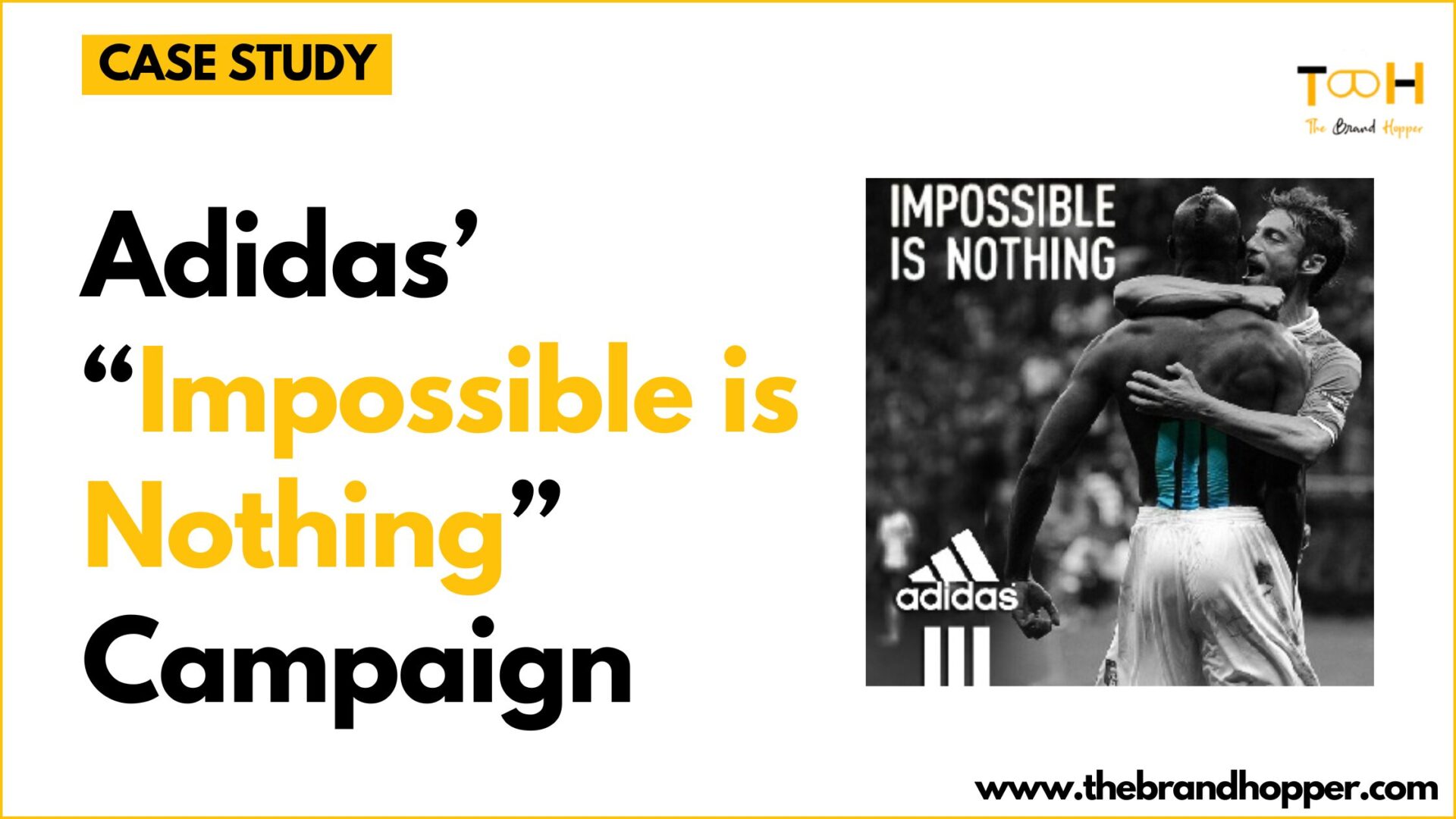
The “Impossible is Nothing” campaign is a landmark in Adidas’s branding history. Launched in 2004 and revived in 2021, the slogan encapsulates the brand’s inspirational ethos.
It was conceived to motivate athletes and consumers to push beyond their limits and to reassert Adidas’s competitive position, especially against rivals like Nike.
Drawing on the legendary Muhammad Ali’s mindset, the campaign used compelling storytelling and star athletes to communicate that attitude.
In this case study, we examine the campaign’s origins, strategy, execution, and impact, detailing how it evolved over time and cemented Adidas’s place as a cultural icon in sportswear.
Background and Origins
By the early 2000s, Adidas was fighting for market share. Nike’s “Just Do It” campaign dominated global sportswear marketing, and Adidas sought a distinctive message to inspire athletes and reclaim momentum.
The phrase “Impossible is nothing” traces to Muhammad Ali, whose 1974 “Rumble in the Jungle” preparation and custom Adidas boots symbolized overcoming doubt.
Adidas adopted Ali’s ethos, and in February 2004 (with a $50 million budget) it launched a year-long global campaign titled “Impossible Is Nothing,” created by the 180/TBWA agency network.
The objective was to shift from product-focused ads to an emotional, athlete-driven narrative, targeting 12–24 year-olds and Internet-savvy audiences.
The Iconic Slogan
Central to the campaign was a powerful mantra inspired by Ali’s philosophy: “Impossible is just a big word thrown around by small men… Impossible is nothing.” This text – crafted by copywriter Aimee Lehto and director Boyd Coyner – became the campaign’s signature message.
It positioned Adidas as a brand of resilience and potential, turning what others see as limits into motivation. Documentary-style films, print ads and digital content celebrated Adidas’s heritage (e.g. Ali wearing Adidas in 1974) and dramatized the idea that “nothing is unattainable”.
By anchoring the brand to this attitude, Adidas aimed to foster deep emotional connections rather than just tout product features.
2004 Launch and Execution
The initial 2004 Impossible Is Nothing campaign hit multiple channels. It featured celebrity athletes and legends in inspirational scenarios: Muhammad Ali (often with his daughter Laila), soccer star David Beckham, runner Haile Gebrselassie, NBA greats Tracy McGrady and Tim Duncan, tennis champion Justine Henin, and more.


A standout execution was the “Long Run” TV commercial, which digitally superimposed a young Cassius Clay jogging alongside these sports icons. This imaginative ad narrated the Ali-origin quote about impossible being “a dare” and culminated in athletes pushing through challenges. Its format — candid training and childhood clips with a powerful voice-over — became a template. Adidas also ran print posters and online viral clips under the same theme, ensuring consistent messaging worldwide.

The campaign resonated strongly. Soon after launch, Adidas reported an <11% increase in U.S. sales year-over-year. The brand also earned praise in advertising circles for its creativity and emotional impact.
Importantly, “Impossible is Nothing” became synonymous with Adidas, giving the brand a distinct identity and a message that “anything is achievable”.
After this surge, Adidas temporarily shifted to other global campaigns (for example, the 2011 “All In” campaign featuring Lionel Messi and others), but the Impossible slogan remained an iconic part of its heritage.
Evolving the Campaign
Over the next decade Adidas continued to evolve, but “Impossible is Nothing” remained a touchstone. The slogan even inspired commentary in marketing discussions, with some noting it as a more profound counterpart to Nike’s.
For example, a marketing post observed the tagline’s “greater, more impactful” tone compared to “Just Do It,” albeit with Nike’s simpler call-to-action having different strategic strengths.
Meanwhile, Adidas used social and product-driven campaigns, but “Impossible is Nothing” lay dormant as a central campaign brand tagline until 2021.
2021 Relaunch: Strategy and Objectives
In spring 2021, amid a world craving positivity, Adidas reintroduced “Impossible Is Nothing” in a major revival. This tied into Adidas’s broader five-year strategy (2021–2025) called “Own the Game,” focusing on digital growth, sustainability, women’s sports, and brand credibility.
The relaunch had two main goals: to inspire optimism by “seeing possibilities” again, and to reinforce Adidas’s core values of innovation, credibility, and sustainability. As Brian Grevy (Adidas Board Member) put it, “’Impossible is nothing’ is more than a campaign – it’s our attitude”.
Instead of flashy product ads, the campaign took a documentary-storytelling approach. Home-video style footage and archival clips were assembled with minimal editing to create authenticity. Each short film was built around a narrative of overcoming obstacles, narrated by friends or fellow athletes of the protagonist.
This format mirrored the original campaign’s personal feel and underscored the “shared attitude” of Adidas’s community.
Global Ambassadors and Storylines
The 2021 campaign centered on diverse world-class figures—not just athletes, but also artists and activists—who embody the slogan. Adidas enlisted stars like Beyoncé, Lionel Messi, Mohamed Salah, and Siya Kolisi (Springboks rugby captain), among others.

For example, one film splices home videos of Beyoncé as a child with footage from her career, illustrating her growing confidence (“finding her voice”). Others featured NBA player Damian Lillard, gamer Ninja, marathoner Peres Jepchirchir, and Cyrill Gutsch (founder of the Parley for the Oceans environmental initiative).
Each story highlighted themes of hope, inclusion, belonging and sustainability, weaving in how these figures overcame hurdles or pursued innovation. By covering sports as varied as football, basketball, volleyball, rugby, and gaming, Adidas reinforced that “impossible” applies to everyone.
The relaunch also deliberately addressed social issues. Many films celebrated underrepresented groups: e.g., Tiffany Abreu (Brazil’s first trans volleyball pro) on inclusivity, and Parley’s Gutsch on oceans and sustainability. This focus followed internal and public criticisms of Adidas’s inclusivity.
In fact, shortly before the campaign, employees had protested racism in the company’s policies. Adidas’s renewed emphasis on diversity and empowerment in marketing can be seen as both genuine outreach and a strategic response to those challenges.
Media & Activation
Adidas launched the campaign in over 50 countries, mainly via digital platforms and social media. The content rollout spanned Spring–Summer 2021, using short films and teasers on YouTube, Instagram, and its own website.
Many pieces debuted during high-profile moments—e.g., Beyoncé’s spot aired around the Oscars. Adidas also amplified the campaign with partner media, influencers, and traditional PR.
Notably, the campaign tied into broader brand programs: it showcased the Adizero running line (innovation focus) and concurrently ran the Members Week digital festival celebrating athletes like Messi and Ivy Park. This integrated approach helped Adidas link the Impossible message to specific products and community events.
Results and Impact
The revived “Impossible Is Nothing” campaign performed exceptionally by engagement metrics. According to Adidas’s 2021 annual report, the campaign generated over 1 billion social media views and more than 18 million engagements worldwide. Industry press echoed these figures, noting the campaign’s “over 1 billion social media views” footprint. Such numbers attest to the global reach and resonance of the message.
The campaign also boosted Adidas’s brand perception: surveys and social listening indicated increased association of Adidas with optimism, innovation, and social purpose (though detailed sales figures are less public, analysts noted positive brand momentum in 2021).
Qualitatively, the campaign strengthened Adidas’s cultural cachet. By highlighting diversity and authenticity, Adidas positioned itself as a socially conscious leader among sports brands. It earned media praise: for example, Forbes lauded the campaign as “a blueprint for authentic representation”, while fashion and sports media highlighted its star-powered appeal.
Though direct ROI data (e.g. sales uplift) is not fully disclosed, these strategic outcomes—increasing global brand engagement and aligning Adidas with powerful narratives—are widely viewed as successes.
Analysis and Lessons
Adidas’s “Impossible Is Nothing” case underscores several branding lessons.
First, coherence and consistency: by rallying around one core slogan (rooted in brand heritage) for years, Adidas built a strong identity. This slogan provided continuity between 2004 and 2021 despite changing themes.
Second, storytelling over product-push: instead of focusing on shoe features, the campaign sold an attitude. Both original and revived campaigns used real people and personal journeys to connect emotionally.
Third, adaptability: the 2021 relaunch modernized the formula to suit contemporary tastes (documentary style, digital media, social issues), showing how a classic idea can be refreshed.
Finally, broad inclusivity: by featuring athletes of various sports, genders, races, and backgrounds, Adidas expanded its audience. This inclusivity also helped address earlier brand criticisms, demonstrating that marketing campaigns can serve dual goals of sales and values alignment.
Challenges remain. Some critics argued that such inspirational campaigns risk becoming clichés or that lofty messaging may overshadow product strategy. Adidas has since introduced a new tagline (“You Got This” in 2024), indicating an ongoing evolution. Nonetheless, “Impossible is Nothing” helped Adidas reassert a bold brand voice and differentiate itself from competitors’ slogans.
Conclusion
The “Impossible Is Nothing” campaign — from its 2004 debut to the 2021 revival — played a pivotal role in Adidas’s global branding. By marrying a motivational message with real athlete stories, the campaign reinvigorated Adidas’s image and inspired consumers worldwide. Its success is reflected in measurable engagement and lasting cultural impact.
For marketers, Adidas’s case illustrates how a compelling narrative and consistent messaging, tied to brand values, can galvanize a brand’s identity across decades.
Also Read: Case Study Analysis: Puma’s “Forever Faster” Campaign
Also Read: A Case Study on Nike’s “Dream Crazy” Campaign
To read more content like this, subscribe to our newsletter