
Cosm is a Los Angeles-based experiential media and immersive technology startup that is redefining how audiences experience live sports, entertainment, art, and educational content. Launched in 2020, Cosm creates large-scale dome venues where guests are surrounded by massive wraparound LED screens, high-end spatial audio, and interactive effects that blend the physical and virtual worlds.
The company leverages a 75-year legacy of planetarium and simulation technology to deliver what it calls “Shared Reality” – immersive experiences that make viewers feel as if they are courtside at a game, front-row at a concert, or exploring an alien world.
With deep roots in computer graphics and dome design, Cosm has quickly positioned itself as a leader in the emerging “experience economy,” operating cutting-edge venues in the U.S. and planning a global expansion.
In just a few years, Cosm has built a brand that bridges the cosmos and the coliseum, reflecting its mission to bring the awe of the planetarium together with the thrill of live events. Backed by significant venture funding and partnerships with major sports leagues and media companies, Cosm is poised to scale its concept worldwide.
This article tells Cosm’s professional brand story and provides a business analysis, covering the startup’s founding, the vision of its founders, its innovative business model and revenue streams, funding history, competitive landscape, unique advantages, product offerings, and future outlook.
Founding Story of Cosm
Cosm was officially founded in 2020 through a series of strategic acquisitions orchestrated by Steve Winn’s Mirasol Capital. Winn’s team acquired Evans & Sutherland and its subsidiary Spitz, Inc. – venerable names in planetarium projection and dome design – along with a sports-focused VR startup, LiveLike VR. By fusing E&S’s 70+ years of dome technology with LiveLike’s expertise in streaming immersive sports, Cosm was born with a rich technological foundation. (E&S and Spitz alone had installed hundreds of domes worldwide, a global footprint now under Cosm’s umbrella.)
The idea behind Cosm predates the company’s formation. Steve Winn (a billionaire tech investor) had long been fascinated by planetariums and saw potential beyond stargazing. He imagined converting a planetarium dome into an LED arena for live events – essentially “rotating it on its side” and streaming sports in real time so that viewers feel present in the action. In 2019, Winn connected with Jeb Terry – a former NFL player turned media executive – who was seeking to apply emerging tech to sports fandom.
Together they developed the vision of Shared Reality: blending the awe of cosmic imagery with the adrenaline of the coliseum. A test in Utah (using a 65-foot demo dome at E&S’s facility) wowed visiting league and media executives, validating that people felt “a new form of experiential entertainment” when immersed in the dome.
Empowered by this feedback, Winn and Terry formally launched Cosm, equipped with proprietary tech and a clear mission to redefine how we experience content.
Founders of Cosm
Cosm’s vision is driven by its two co-founders: Stephen T. Winn and Jeb Terry Jr.
Winn, Cosm’s Executive Chairman, is a veteran tech entrepreneur best known for founding RealPage (a real estate software giant). After selling RealPage in 2021, the Dallas-based billionaire turned his focus to immersive tech, using his family office Mirasol Capital to bankroll Cosm’s launch. He was inspired by planetarium domes and imagined converting them into LED arenas for live sports – an idea he had the resources to pursue.

Terry, Cosm’s President and CEO, is a former NFL player-turned-tech executive. He co-founded a sports video startup (acquired by Fox Sports) and later led emerging tech at Fox Sports. Terry joined forces with Winn in 2019 and has since steered Cosm’s day-to-day operations and partnerships with leagues.

Together, Winn provides the strategic vision and capital, while Terry brings sports industry savvy and product execution. This combination of Winn’s business acumen and Terry’s sports-media expertise has shaped Cosm’s identity and growth trajectory.
Business Model of Cosm
Cosm’s business model revolves around operating immersive entertainment venues and controlling the content and technology that power them. The company develops and owns mid-sized venues (approximately 65,000 sq ft facilities with 60–87 ft diameter domes) in partnership with major real estate developments. These venues generate revenue through ticket sales for events and on-site food and beverage sales. By situating Cosm domes in high-traffic entertainment districts (e.g. next to stadiums or in large retail complexes), the company attracts fans already seeking communal experiences. Cosm aims to replicate this model in many cities, effectively creating a network of “immersive arenas” around the world.
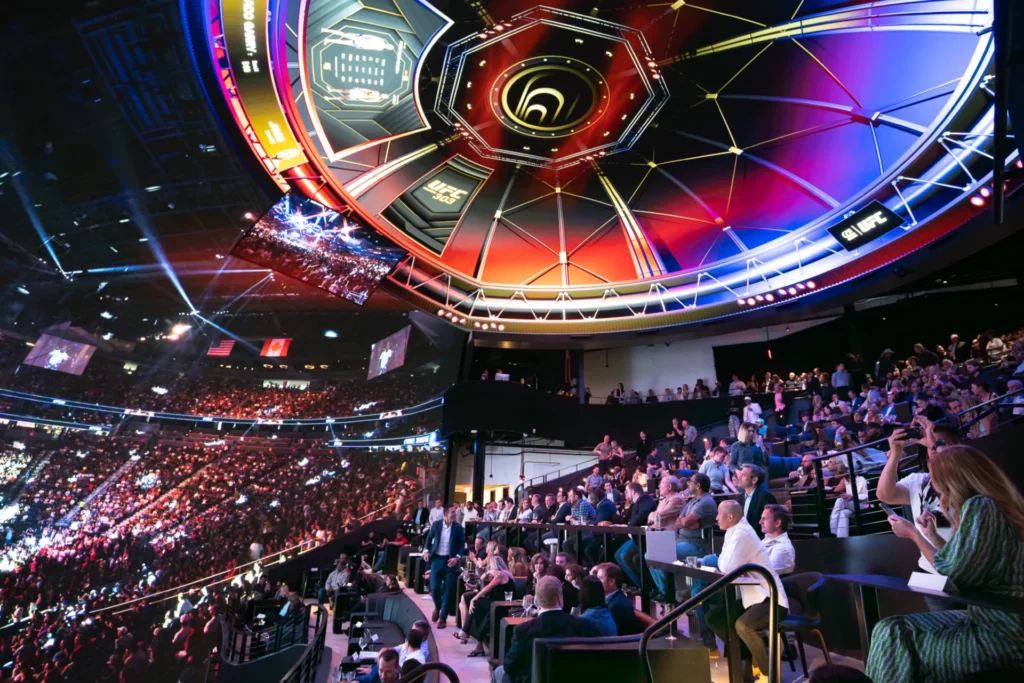
A vertically integrated approach gives Cosm an edge in executing this model. The company controls the entire technology stack in-house – it designs and manufactures the dome structures and projection systems (via its E&S and Spitz units) and develops the software driving the visuals.
This means Cosm isn’t dependent on outside vendors for its critical infrastructure. “We had to control the technology stack,” Steve Winn noted, highlighting that streaming live content in 10K resolution onto a dome with low latency required custom solutions. Even operations like content production and food service are kept in-house to ensure quality and consistency. This integration allows Cosm to maintain a high standard at its venues and to rapidly deploy its concept to new locations.
Equally important, Cosm has secured rich content partnerships to fill its domes with compelling programming. The company has official agreements with leagues and media partners – including the NBA, UFC, major TV networks, and others – to showcase live sports and events on its giant screens. Rather than simply airing a TV feed, Cosm uses its own specialized cameras and production team to present games from multiple angles (courtside, goal-line, etc.), giving attendees a perspective that even on-site fans might not get.
Live commentary and graphics are integrated to create a thrilling, cinematic viewing experience. Beyond sports, Cosm’s venues also feature immersive art and entertainment content (for example, visual concerts or digital art shows from Cosm’s creator program), ensuring there is always fresh content to draw in crowds.
By owning both the platform (venues/tech) and much of the content (through partnerships and in-house production), Cosm can deliver a one-of-a-kind experience and capture value on multiple fronts. This comprehensive model positions Cosm not just as a venue operator, but as a new kind of media company that delivers experiences, not just shows.
Revenue Streams of Cosm
Cosm enjoys multiple revenue streams thanks to its vertically integrated approach and diverse offerings. Key revenue sources include:
1) Ticket Sales and On-Site Spending: Cosm’s primary revenue comes from event ticket sales and the additional spend per visitor on food and beverages. Ticket prices range from affordable general admission (e.g. $10–$20 for standing room or bar access) to premium reserved seating that can exceed $100 for high-profile events. In-venue dining and drinks (operated by Cosm itself) significantly boost revenue, as fans treat the experience like a night out, ordering meals and cocktails during the show.
2) Media Content & Licensing: Cosm produces original immersive content and also acquires rights to live events, which it monetizes across channels. At its venues, this content (live sports, concerts, artistic shows) drives ticket sales. Beyond the venue, Cosm can license certain content or dome shows to other attractions (e.g. a science museum licensing a Cosm-produced planetarium show). Cosm has even powered live VR streams for global events, indicating future potential to monetize content beyond its venues. In time, Cosm could offer pay-per-view immersive experiences or a subscription service for remote viewers, leveraging its unique 360° content.
3) Enterprise Technology Deals: Through its Evans & Sutherland and Spitz divisions, Cosm generates B2B revenue by selling dome systems, software, and upgrades to planetariums, theme parks, and other clients. This legacy line of business provides steady income (via system sales and maintenance contracts) and extends Cosm’s influence globally. While smaller than the consumer-facing venue revenue, these technology sales capitalize on Cosm’s expertise and foster relationships that could support the company’s international venue rollout.
Funding and Funding Rounds of Cosm
From its inception, Cosm has attracted substantial investment to fuel its technology development and venue rollout. Below is an overview of Cosm’s funding history and key funding rounds:
| Date | Round | Amount Raised | Key Investors | Notes |
|---|---|---|---|---|
| 2020 | Seed Funding / Formation | Not disclosed | Mirasol Capital (Steve Winn’s family office) | Initial capital used to acquire E&S ($14.5 M) and LiveLike VR, forming Cosm’s core technology base. |
| July 2024 | Series B (Growth Round) | $250 million | Mirasol Capital (lead) and new investors including sports team owners (e.g. Marc Lasry) and funds like Baillie Gifford | Valued Cosm at $1 billion+ post-money. Proceeds used to scale venue operations, technology development, and global expansion plans. |
Cosm’s initial funding came largely from Steve Winn himself via Mirasol Capital. In effect, Winn incubated the company by purchasing core assets and investing in R&D during 2019–2021. This provided Cosm with a runway to develop its first venue and secure content partnerships without seeking early-stage VC funding.
By mid-2024, with the Los Angeles venue opening to the public, Cosm sought external capital to accelerate expansion. The $250+ million Series B round in July 2024 marked Cosm’s first major outside funding. This strategic round included high-profile backers from the sports world, such as NBA and NHL team owners, alongside institutional investors. The infusion gave Cosm a post-money valuation above $1 billion, officially making it a tech “unicorn”. According to the company, the new capital would “drive long-term growth” of its venues and media platform, funding additional locations and content initiatives.
With robust funding in place, Cosm is pressing ahead on its rollout. In late 2025, the company closed partnerships for new venues in Atlanta, Detroit, and Cleveland, indicating that further financing (potentially project-specific or another equity round) may be pursued to support this growth. Given Cosm’s ambitions to establish dozens of venues internationally, analysts expect the startup will continue raising capital in the coming years. For now, however, the 2024 round provides a strong financial foundation and brings influential partners to the table as Cosm expands.
Competitors of Cosm
As an innovator in immersive entertainment, Cosm faces competition both from traditional entertainment formats and a few specialized companies pursuing similar concepts. Notable competitors include:
1) MSG Sphere (Las Vegas)
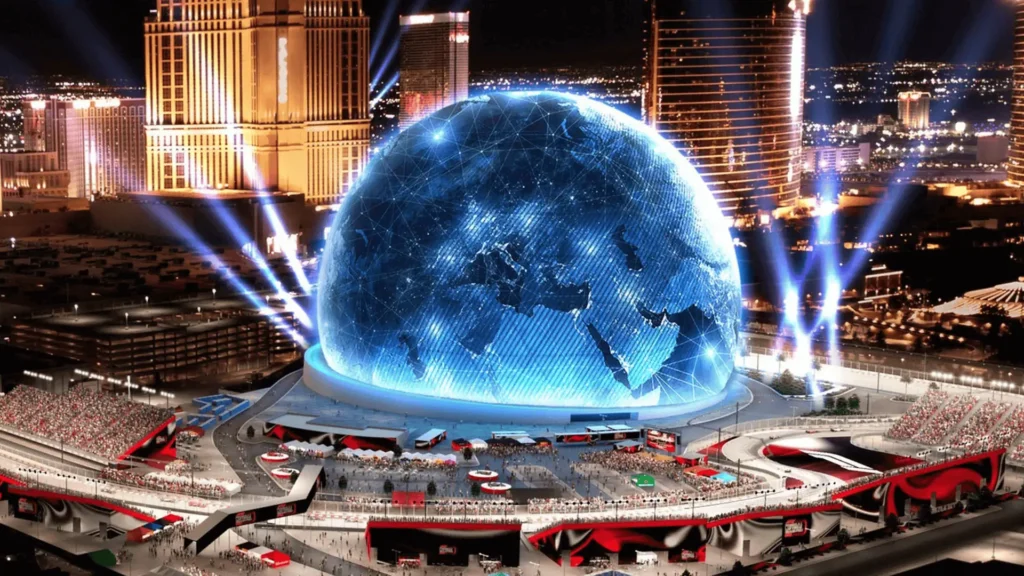
Opened in 2023, this is a gigantic dome venue (18,600 seats) built by Madison Square Garden Co. with a 160,000 sq ft interior LED screen. It delivers spectacular concerts (U2’s residency, etc.) and visuals, at a cost of $2.3 billion to build. Sphere shares Cosm’s immersive ambition but on a single-city scale, focused on live music and events in Las Vegas.
2) Illuminarium (Atlanta & Las Vegas)
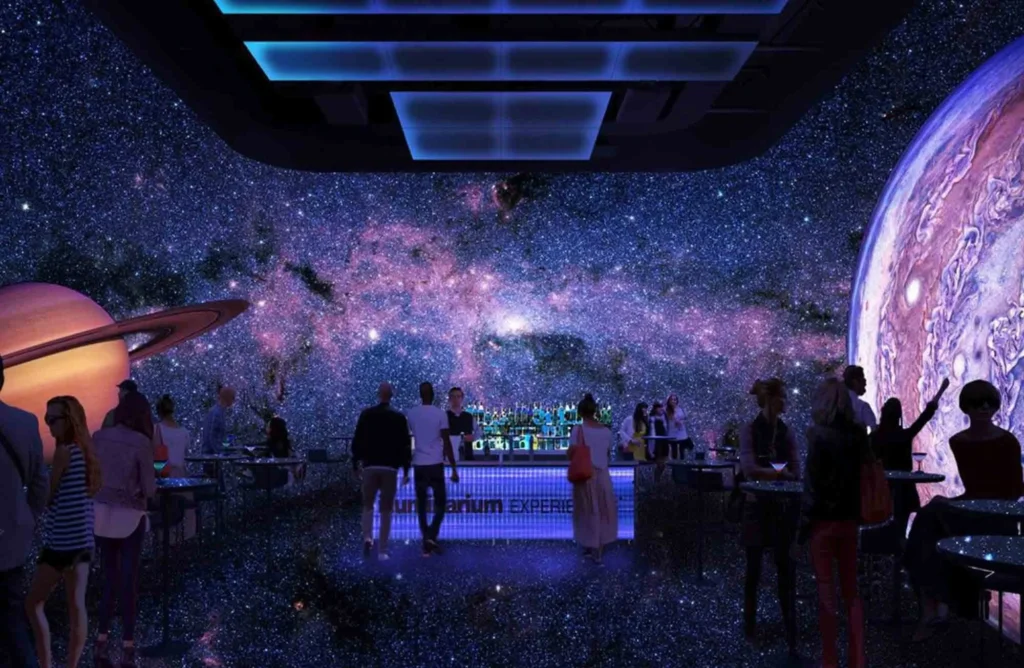
Launched in 2021 with over $100 million in funding, Illuminarium runs smaller immersive venues (~350 capacity) that use 360° wall projections, spatial audio, and sensory effects (like floor vibrations) to transport visitors to environments like a safari or outer space. It targets tourists and casual audiences with walk-through shows and an evening bar scene. Illuminarium proves demand for no-headset immersive attractions, though it emphasizes cinematic experiences over live sports.
Cosm’s advantage lies in blending the communal excitement of an arena with high-tech immersion, in a scalable mid-sized venue model. The MSG Sphere, while awe-inspiring, is essentially a one-off mega-venue; Cosm is aiming to establish a network of domes that can reach audiences in many markets. Illuminarium, on the other hand, offers immersive environments but not live sports – positioning Cosm in a niche where it has few direct rivals currently. Traditional options like cinemas or sports bars offer communal viewing but without Cosm’s immersion and interactivity, so they are more complementary than directly competitive. In fact, some planetariums and science centers could become Cosm’s partners or clients (using Cosm’s technology or content), rather than competitors.
Overall, Cosm is early to market with its particular blend of shared reality entertainment. Its competitive landscape may evolve as other players notice its success – for example, large cinema chains experimenting more with immersive screens, or theme park companies creating similar domed attractions. For now, Cosm’s main task is to continue delivering a stellar experience and scaling up before potential competitors catch up.
Competitive Advantage of Cosm
1) Proprietary Tech Integration: Cosm controls its entire tech stack (domes, software, cameras), enabling an experience that rivals struggle to replicate. Owning the technology allows for ultra-high-resolution, low-latency streams on massive domes – an engineering feat others would find hard to match
2) Exclusive Content Partnerships: Cosm’s early deals with top leagues and broadcasters (NBA, UFC, ESPN, etc.) give it a unique content pipeline. It was the first to secure NBA games for immersive viewing and has multi-year rights for marquee live sports. These partnerships mean Cosm venues offer premium live content fans can’t see in the same way elsewhere.
3) Engaging Social Experience: By combining a 360° visual spectacle with a communal, upscale venue setting, Cosm provides an experience that is both immersive and social. No headsets are needed – fans can cheer together and enjoy food and drinks while feeling like they’re at the event. This “arena-like” atmosphere with modern hospitality is a compelling draw that sets Cosm apart from solitary VR or basic sports bars.
Products and Services of Cosm
1) Cosm Venues (Shared Reality Domes): These are Cosm’s signature immersive theaters, featuring huge LED dome screens (87-foot diameter) where audiences experience content projected all around them. At Cosm’s venues (e.g. in Los Angeles and Dallas), fans can watch live sports, concerts, and cinematic presentations as if they are “inside” the action, all without VR headsets. Each venue also includes social spaces (bars, lounges) and offers food and beverage service, making it an all-in-one entertainment destination.
2) Technology Solutions (Fulldome Systems): Cosm continues to sell and license its dome and projection technology to other institutions. Through the Evans & Sutherland and Spitz divisions, the company provides planetarium software (like the Digistar system), dome design, and installation services for clients worldwide. This B2B arm not only generates revenue but also keeps Cosm at the cutting edge of immersive display innovation.
3) Content & Production: Cosm has an in-house studio that develops custom content for its domes and handles live production. It creates original immersive shows (often in collaboration with digital artists) and uses proprietary camera setups to produce live events with unique angles. Cosm’s team works with partners (leagues, studios) to ensure a steady flow of compelling content – from NBA and UFC games presented in 8K Shared Reality, to experiential art films. The company also has a mobile app and VR-capable platform (born from its LiveLike acquisition) that extends the experience beyond the venue, though the physical venues remain the primary focus.
Conclusion
Cosm’s rise from concept to immersive entertainment leader in a few short years highlights the growing convergence of technology and live experiences. By repurposing planetarium dome tech for mainstream entertainment and sports, Cosm has introduced a new category of venue that captures the imagination of fans and investors alike. The startup’s strong foundation – spanning advanced engineering, content rights, and significant funding – has enabled it to launch in the U.S. and set its sights on international markets. Upcoming venues in Atlanta and other cities will test how well Cosm’s model travels, but early results in Los Angeles and Dallas suggest a robust appetite for what Cosm offers.
With plans for dozens of locations by the end of the decade, Cosm aims to change the way people around the world gather to enjoy media. It is turning passive viewing into an active, collective experience. Challenges remain (from competition to the logistics of global expansion), but Cosm’s blend of technology innovation and entertainment savvy gives it a strong advantage as it moves forward. In an era where memorable experiences are highly valued, Cosm’s dome venues promise a thrilling new way to consume sports and entertainment – one that truly needs to be seen (and heard) to be believed.
Also Read: Lovevery – Founders, Business Model, Funding & Competitors
To read more content like this, subscribe to our newsletter