Folgers Coffee is one of America’s most enduring coffee brands, tracing its roots back to 1850 in San Francisco. Over the decades, Folgers grew from a local coffee mill into a national household name known for its rich, comforting blends. By the mid-20th century, under the guidance of Procter & Gamble, Folgers had become the number one coffee brand in the United States. Today, as part of the J.M. Smucker Company, Folgers leads a $10 billion at-home retail coffee market in the U.S. This widespread success can be attributed not only to the coffee itself but also to Folgers’ savvy and evolving marketing strategies.
From its classic red packaging and mountain sunrise logo to its famous jingle, Folgers has built a brand identity centered on familiarity and trust. Generations of consumers recognize Folgers as a comforting part of the morning routine, a brand that promises consistency in taste and experience. Instead of chasing every new coffee trend, Folgers has long leaned into what it does best: familiarity and reliability. This approach – emphasizing a dependable, medium-roast flavor “that feels like home” – helped Folgers cultivate strong customer loyalty over time.
Folgers’ marketing has also become the stuff of advertising legend. Its slogan “The best part of waking up is Folgers in your cup!”, introduced in 1984, is inextricably linked with the brand and instantly recognized by millions. Folgers’ commercials – from heartwarming holiday stories to upbeat musical spots – have embedded the brand in American pop culture and memory. By focusing on emotional storytelling and consistent messaging, Folgers has managed to stay relevant even as the coffee market evolved around it.
In the following sections, we explore the top marketing strategies that Folgers has employed to build and maintain its iconic status. These strategies range from leveraging nostalgia and jingles to embracing community values and modernizing the brand’s image. Each strategy is illustrated with examples from Folgers’ past and present campaigns, both local and national, showing how the brand has brewed success through marketing.
Marketing Strategies of Folgers
1. Emotional Storytelling and Nostalgic Advertising
One of Folgers’ signature marketing strategies is the use of emotional storytelling in its advertising, often evoking nostalgia, family, and the comfort of home. Rather than spotlighting product features or caffeine content, Folgers’ commercials center on feelings of togetherness and the simple joys associated with the morning coffee ritual. The brand effectively “sold comfort” – presenting a cup of coffee as a symbol of home and warmth. This emotional approach forged a strong bond with consumers by linking Folgers to cherished daily moments and memories.
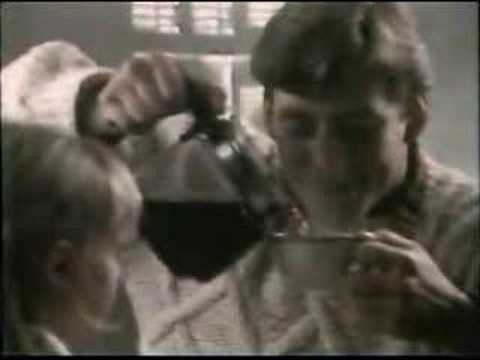
A classic example is the Folgers Christmas commercial “Peter Comes Home”. First aired in 1985, this heartwarming ad shows a young man (Peter) returning home on Christmas morning and waking his family by brewing a pot of Folgers coffee. The spot captured the “warm, fuzzy feeling of family and the holidays,” becoming an instant classic that ran every holiday season for over a decade. In fact, the “Peter Comes Home” commercial aired annually through 1998 (with brief revivals in the 2000s), becoming a beloved holiday tradition for many families. Advertising experts noted that the ad created a “timeless iconic moment” for the brand, reinforcing Folgers’ image as an integral part of family gatherings and morning routines. Campaigns like this demonstrate Folgers’ skill in using nostalgia and emotional resonance to keep the brand relevant across generations. Folgers’ own marketers acknowledge that nostalgia is a powerful asset – there’s “something to be said for nostalgia when it comes to product promotion”, as even attempts to modernize that ad in 2009 never quite replicated the emotional impact of the original.
By consistently delivering heartwarming narratives, Folgers built an emotional connection that few coffee brands can rival. Whether it’s a reunion at Christmas, a peaceful morning scene, or a gesture of hospitality, Folgers ads invite viewers to associate the brand with comfort, family, and the start of a good day. This storytelling strategy has kept Folgers “relevant across generations” and is often cited as a key pillar of its marketing success. Even in an era of high-tech coffee gadgets and gourmet beans, Folgers’ focus on sentimental themes – the experience of sharing a cup of coffee with loved ones – continues to strike a chord with its audience.
2. Iconic Jingle and Memorable Slogan
Perhaps no marketing asset is more synonymous with Folgers than its iconic jingle and slogan: “The best part of wakin’ up is Folgers in your cup!” Introduced in 1984, this catchy slogan was set to music and became a defining element of Folgers’ brand identity. Over the years, the Folgers jingle has become one of the most recognizable pieces of advertising in American culture. Virtually anyone who has watched television in the last few decades can hum the tune by heart – a testament to the jingle’s extraordinary reach and memorability. As People magazine noted, the song is so ingrained that “every American, whether they drink coffee or not,” knows it by heart. Folgers has used the jingle in almost every advertisement since 1984, creating instant brand recall whenever the first notes play.
One reason the jingle endured is that Folgers kept it fresh and engaging by updating its style. The core melody and words remained the same, but Folgers invited a variety of famous musicians across genres to reinterpret the jingle in their own styles. Over the years, the tune has been rearranged into country, gospel, jazz, R&B, folk, and even Celtic versions. Renowned artists like Aretha Franklin, Randy Travis, Bonnie Tyler, Paul Stanley, Richie Havens, and Rockapella have all put their unique spin on “The best part of waking up…” in Folgers commercials. Each rendition helped Folgers connect with different audiences – for instance, a soulful gospel version for church-going viewers or a country version for rural markets – while reinforcing the same consistent message. This audio branding strategy ensured the slogan stayed culturally relevant and appealing to multiple demographics without losing its core identity.
The Folgers jingle not only created brand recognition but also fostered a sense of affectionate nostalgia. Many consumers associate the tune with childhood memories or daily routines, which strengthens their emotional attachment to the brand. The power of this jingle-driven branding was underscored in 2021 when the rights to the Folgers jingle’s future royalties were auctioned and sold for over $90,000 – a testament to its enduring value. According to Folgers, the jingle encapsulates everything the brand stands for: “warmth, family, and the start of a good day,” qualities that “kept people loyal for decades”. By leveraging a simple, memorable melody, Folgers cemented its place in pop culture and in consumers’ morning rituals. The slogan’s longevity (over 35+ years) and continued use prove how effective a well-crafted jingle can be in building brand equity and keeping a heritage brand like Folgers top-of-mind.
3. Emphasizing Tradition, Heritage and Consistency
Another key strategy in Folgers’ marketing playbook is an emphasis on the brand’s long heritage and consistent quality. Folgers frequently highlights its history – over 170 years of coffee craftsmanship – to underscore that it is a time-tested, trusted brand. This sense of tradition reassures consumers that Folgers isn’t a fleeting trend but a legacy brand that has been part of American mornings for generations. In marketing communications, Folgers often weaves in its origin story (founded in Gold Rush-era San Francisco in 1850) and milestones, reinforcing an image of authenticity and endurance. For example, in 2025 Folgers even released a special 175th anniversary coffee can with vintage-inspired designs honoring its San Francisco roots – a nod to heritage that doubles as a marketing hook for collectors and longtime fans.
Consistency is a recurring theme in Folgers’ brand messaging. Folgers promises the same familiar taste and aroma, cup after cup, year after year. This reliability has been central to building consumer trust. As one analysis observed, Folgers’ success comes from “one simple truth: consistency,” with the brand delivering “the same smooth, medium-roast flavor people have trusted for generations.”. Instead of reinventing its core product or chasing “gourmet” fads, Folgers has “leaned into… familiarity and reliability,” maintaining its comforting flavor profile and avoiding “fleeting trends.”. This strategic choice to stand by its original blend and roast level – a medium roast that appeals to a broad audience – has been framed as a strength: Folgers is the coffee that “doesn’t need to change; some things are just right the way they are.”. Such messaging appears in campaigns reminding customers that even as boutique coffee shops and complex brews come and go, Folgers remains a dependable staple. By emphasizing consistency in quality and experience, Folgers taps into consumers’ desire for a reliable daily ritual in a changing world.
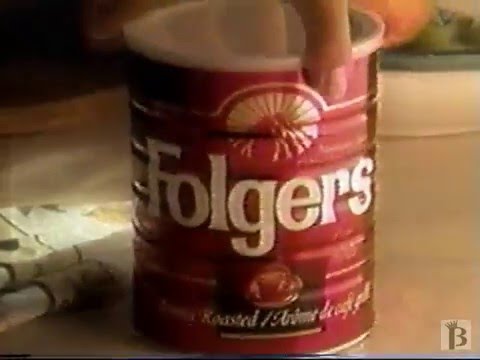
Folgers’ branding has likewise stayed consistent, which itself is a marketing asset. The brand’s signature red packaging and white Folgers logo (with color variations like green for decaf) have long dominated supermarket coffee aisles. This uniform look, coupled with the timeless slogan, makes Folgers instantly recognizable on the shelf. Marketing commentators note that Folgers’ “red packaging, recognizable logo, and timeless slogan have made it a permanent fixture in grocery aisles.”. By rarely deviating from its core brand imagery, Folgers reinforces recognition and nostalgia – shoppers often buy Folgers because it looks the same as the coffee their parents or grandparents bought. In short, Folgers has leveraged its heritage and consistency as a marketing strength: the brand stands for enduring quality, “familiarity and nostalgia”, and a morning routine that transcends generations. This strategy has helped keep long-time customers loyal while lending credibility to the brand in an era crowded with newer coffee options.
4. Community Engagement and Cause Marketing
Folgers’ marketing efforts have also extended beyond commercials and slogans to encompass community engagement and cause-related initiatives, particularly in the city that the company calls home. Folgers has deep roots in New Orleans – it has operated major roasting plants there for decades – and the brand proudly celebrates this heritage by investing in the local community. This community-centric approach doubles as a marketing strategy: it humanizes the brand and generates goodwill that Folgers can incorporate into its storytelling.
A shining example of this was Folgers’ response in the aftermath of Hurricane Katrina in 2005. Katrina devastated New Orleans, including Folgers’ facilities and employees’ homes. In the wake of the disaster, Folgers demonstrated a strong commitment to the city. The company was one of the first major businesses to resume operations in New Orleans just weeks after the storm, providing a much-needed sign of recovery for the community. Folgers also produced limited-edition commemorative coffee cans and donated the proceeds to Katrina relief efforts. In the months and years that followed, Folgers continued to give back: the brand and its parent company contributed over $1 million in relief funds and Folgers employees volunteered thousands of hours to rebuilding projects. Folgers even set up temporary housing on its plant grounds for displaced workers, truly living up to the ethos of treating employees and neighbors “like family”. These actions were not traditional advertising, but they spoke volumes about the brand’s values and became part of Folgers’ narrative.
Folgers actively highlights such community work in its marketing communications. In a 2022 campaign rollout, Folgers’ brand team emphasized the company’s “ever-present commitment to uplift its community”. They pointed out that Folgers is a leading employer in New Orleans, providing over 750 jobs, and that it “doesn’t just employ generations of families, it also gives back through volunteer and service work.”. The campaign messaging proudly recounted how Folgers employees collectively built nearly 80 homes for those in need since 2013 as part of ongoing volunteering programs. By integrating these facts into its brand story, Folgers positions itself as a company that cares about people and community, not just profits.
This strategy of cause marketing serves Folgers in multiple ways. It strengthens loyalty among consumers who value corporate social responsibility, and it differentiates Folgers in a market where many competitors are newer or more corporate without local roots. Moreover, Folgers’ community focus, especially its New Orleans identity, provides rich content for marketing campaigns. For instance, recent advertising has played up Folgers’ NOLA connection by featuring local New Orleans musicians and cultural elements, giving the brand an authentic, hometown flavor that competitors can’t easily replicate. In summary, Folgers’ engagement in community and charitable efforts has become both a moral cornerstone and a marketing advantage – demonstrating the brand’s heart and weaving a narrative that Folgers coffee is made by and for communities with genuine care.
5. Customer Engagement and User-Generated Content
Folgers has also recognized the power of involving its customers directly in its marketing. A notable strategy in recent years has been to spark user-generated content (UGC) and interactive campaigns, inviting consumers to participate in the Folgers story. These efforts keep the brand fresh and engaging, especially in the age of social media, by turning loyal customers into brand ambassadors and content creators.
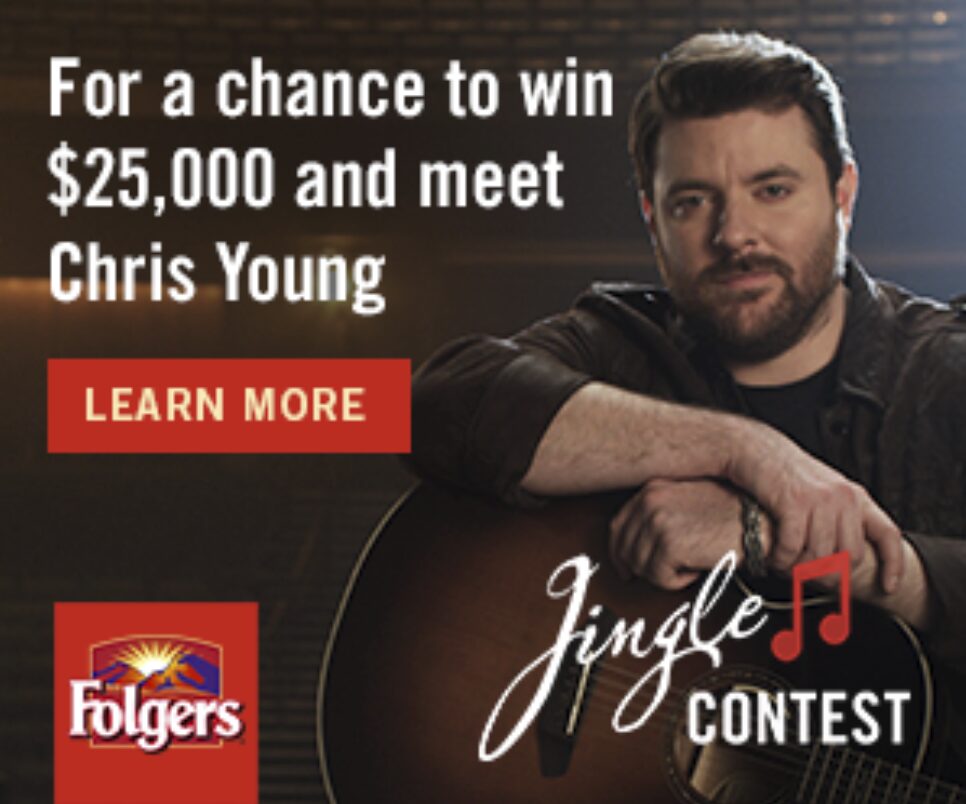
One prime example was the Folgers Jingle Contest, a UGC-driven campaign that revitalized the famous slogan through the voices of its fans. In 2017, Folgers launched a promotion asking fans to “record themselves singing the Folgers song and upload it online for a chance to win a cash prize.” The brand teamed up with country music star Chris Young to endorse the contest; he would mentor the finalists and meet the winners. The contest leveraged Folgers’ most iconic asset – the jingle – and tapped into the creativity of consumers to generate buzz. Folgers explicitly “capitalized on the strong heritage associated with its iconic ‘Best part of waking up…’ jingle” by encouraging people to reinterpret it. Participants across the country submitted videos of themselves performing the jingle in various musical styles and settings, effectively creating free advertising content that was fun, shareable, and authentic. The incentive (a $25,000 prize plus a mentoring session with Chris Young) drove enthusiastic participation.
This user-generated approach had multiple marketing benefits. It engaged younger audiences on digital platforms, as contestants and their friends shared videos on social media, spreading Folgers’ name organically. It also refreshed the jingle’s appeal – viewers saw it performed in rock, R&B, country, and more, showcasing the brand’s relevance beyond the original 1980s format. As a marketing analyst noted, Folgers’ campaign was a great example of working “with their customers and not just for them,” effectively “minimizing the content [the brand] has to create” while maximizing consumer engagement and word-of-mouth. In essence, Folgers crowdsourced its advertising, trusting fans to carry the tune (literally) and keep Folgers in the social media conversation.
Beyond the jingle contest, Folgers has employed other interactive tactics as well. The brand encourages sharing of personal Folgers stories and morning routines on social platforms, sometimes using hashtags (like #DamnRightItsFolgers in a recent pride-focused campaign). Such initiatives invite consumers to feel a sense of ownership and connection with the brand. By turning marketing into a two-way conversation – inviting consumers to create content, vote in contests, or share their Folgers moments – the company keeps its marketing fresh and customer-centric. This strategy not only yields a wealth of authentic content that Folgers can amplify, but also reinforces loyalty: participants feel like a part of the Folgers community. In the digital era, this kind of user engagement is crucial for legacy brands like Folgers to remain visible and relevant amid competition. The success of the jingle contest and similar UGC efforts shows Folgers’ willingness to innovate in marketing by handing over the microphone (quite literally) to its fans.
6. Brand Reinvention and Youthful Repositioning
While Folgers prides itself on tradition, the brand has not been afraid to reposition and reinvent its image when market dynamics shift. In recent years, Folgers faced a challenge: a new generation of coffee drinkers, influenced by craft coffee culture, didn’t necessarily perceive Folgers as their brand of choice. Competitors and many younger consumers had dismissed Folgers as “your grandma’s coffee,” associating it with an older era. Acknowledging this perception problem, Folgers undertook bold marketing steps to refresh its brand for a modern audience without losing its identity.
A major initiative in this vein was Folgers’ 2021–2022 rebranding campaign, which carried the tagline “Allow us to reintroduce ourselves” (informally known by the hashtag #DamnRightItsFolgers). This campaign was unabashedly edgy and aimed squarely at changing negative preconceptions. Folgers’ parent company’s Chief Marketing Officer noted that in a competitive coffee category, many had “labeled Folgers as their grandma’s coffee,” so the brand set out to “boldly… acknowledge any negative misperceptions and then loudly and proudly challenge them.” In other words, Folgers decided to confront the issue head-on in its messaging: yes, Folgers has a old-school reputation, but millions still love it – and it’s cooler than you think.
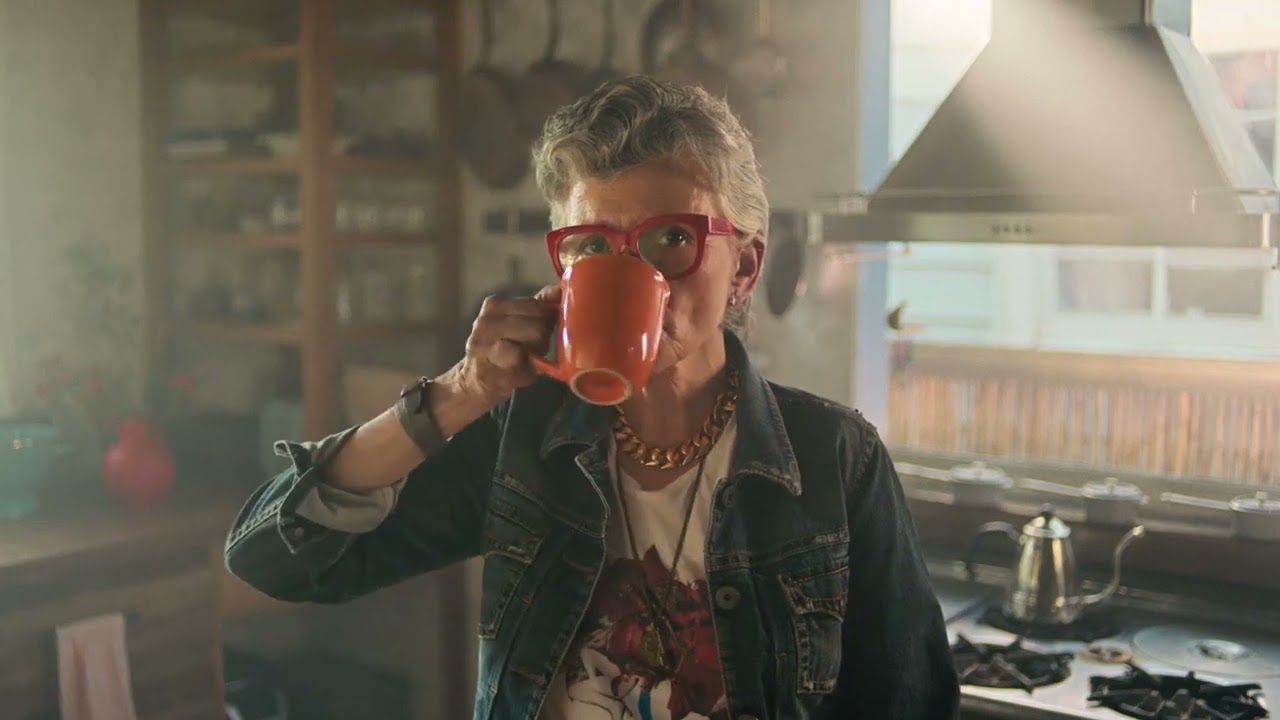
The resulting advertising broke from Folgers’ past tone. In place of the gentle jingle, the new ads were backed by Joan Jett & the Blackhearts’ rock anthem “Bad Reputation.” This punk-rock rebelliousness was deliberately chosen to “address people’s misperceptions about Folgers coffee head-on” with a swaggering, defiant attitude. The commercials featured dynamic, fast-cut visuals and diverse young Folgers drinkers confidently proclaiming their love for the brand. The slogan “Damn right it’s Folgers” became a rallying cry in the ads – transforming what might have been a defensive stance into one of pride and boldness. By using an iconic rock song about not caring what others think, Folgers sent a clear message: it’s unapologetic about its coffee and the 35 million people who drink it each year. This was a stark shift from Folgers’ historically sentimental advertising, signaling a new era in its marketing.
Crucially, Folgers also tied this reinvention to genuine brand qualities. The campaign highlighted Folgers’ “expert craft” and “deep roots in New Orleans” as points of pride. Commercials incorporated New Orleans culture (even featuring local jazz-funk musician Trombone Shorty on the track) to give the ads an authentic, youthful vibe grounded in the brand’s heritage. In essence, Folgers sought to reintroduce itself to younger coffee drinkers as a brand that is both authentic and unexpectedly cool. Early signals showed this strategy making an impact: during the COVID-19 pandemic, many millennials turned to Folgers for home brewing, and Folgers wants to keep them. The company’s CEO noted that millennials were indeed drinking Folgers, and that the focus was on “revamping the brand for a more modern image” to retain those new customers. Part of that plan involved promoting Folgers’ newer, upscale product lines (such as the 1850® sub-brand) as a way to meet modern preferences.
7. Product Innovation and Adaptation to Trends
While Folgers has built its brand on consistency, it has not completely stood still in the face of changing consumer tastes. Another strategy evident in Folgers’ marketing is the selective innovation of products and adaptation of its messaging to align with emerging coffee trends – all done in a way that stays true to Folgers’ core identity. The brand carefully expands its product range and tweaks its advertising to meet modern preferences, signaling that Folgers can satisfy contemporary coffee lovers as well as traditional ones.
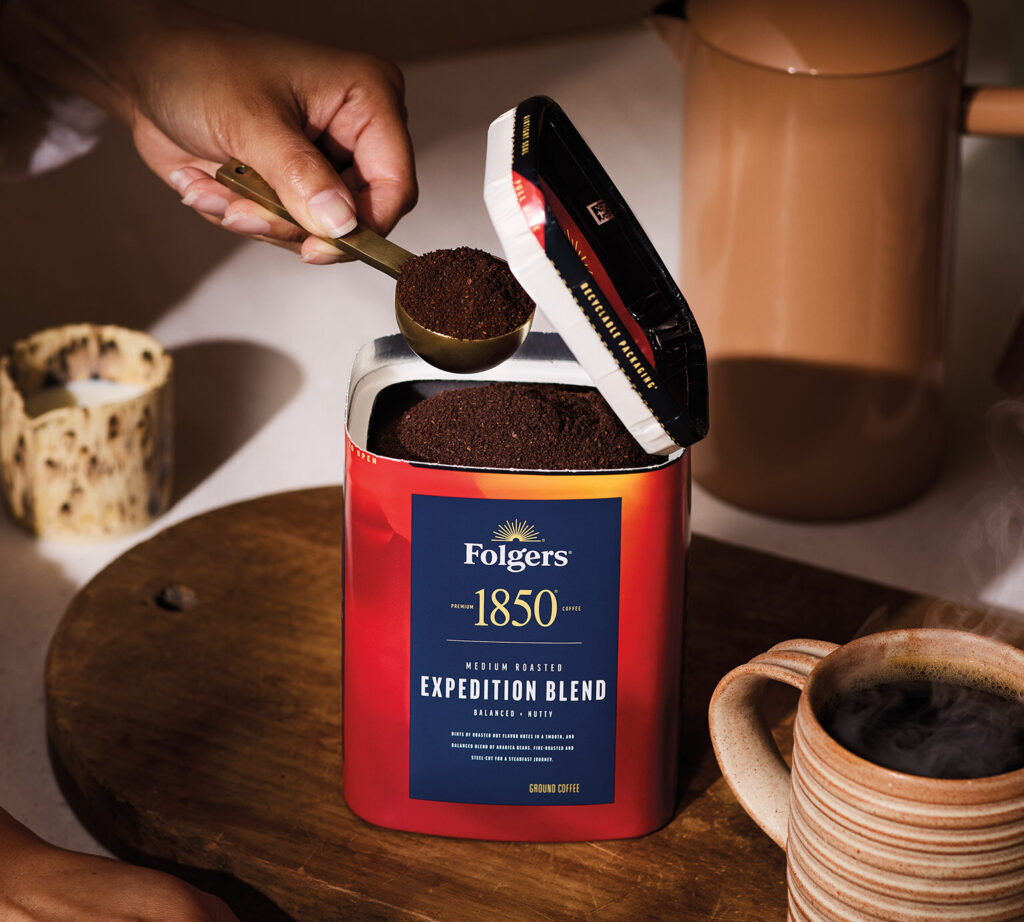
One facet of this strategy is broadening the product lineup to suit new tastes and consumption habits. Folgers has introduced varieties beyond its classic roast, such as Folgers Black Silk, a dark roast coffee aimed at those who prefer a bolder flavor. It has also embraced the single-serve brewing trend by offering Folgers in K-Cup® pods and instant single-serve packets for convenience. In 2018, Folgers launched a premium spin-off brand called 1850® (named after its founding year) to appeal to consumers interested in a more craft, upscale coffee experience. These moves are highlighted in Folgers’ marketing as evidence that the brand can provide “something for everyone” – from classic medium roast to dark, from ground coffee to pods. The underlying message is that you don’t need to go to an artisanal coffee shop or a rival brand; Folgers likely has a product to fit your taste and lifestyle, all while maintaining the Folgers hallmark of affordability and familiarity.
Folgers’ advertising has occasionally seized on specific trends or moments to keep the brand relevant. A historical example dates back to 1949, when Folgers ran ads encouraging consumers to try Folgers coffee served iced. Iced coffee was far from mainstream at the time, but Folgers presciently declared its coffee “damn good at any temperature – since before it was trendy. This early nod to a future trend positioned Folgers as ahead of the curve. More recently, during the COVID-19 pandemic when millions were suddenly working from home, Folgers adapted its classic jingle into a series of lighthearted commercials reflecting work-from-home life. These ads showed pajamas, video calls, and makeshift home offices – all with Folgers coffee helping people start their day – acknowledging the new normal for consumers. By tweaking its marketing to fit the context (in this case, a global event changing coffee routines), Folgers stayed relevant and present in consumers’ minds.
Folgers also isn’t shy about using comparative messaging when it innovates a product that can rival competitors. For instance, to promote Folgers Black Silk (the dark roast entry), the brand boldly set up a direct comparison with Starbucks. In 2022, Folgers conducted a nationwide blind taste test pitting Black Silk against Starbucks’ French Roast. The result – proudly advertised by Folgers – was that a significant majority (60% of tasters) preferred Folgers Black Silk over Starbucks. Folgers splashed this statistic in marketing materials with an assertive tone: “If you’ve never tried our dark roast, here’s your wake-up call.” By publicizing that its coffee can beat a famous premium brand in taste, Folgers aimed to sway skeptics and modern “coffee snobs” to give Folgers a second look. This approach harkens back to Folgers’ classic 1970s ad campaign in which TV commercials revealed that a high-end restaurant’s coffee had been secretly swapped with Folgers, and diners couldn’t tell the difference. Then and now, Folgers has used side-by-side comparisons to validate its quality in the face of fancier competitors – a clever tactic to turn a perceived weakness (being a mass-market brand) into a strength (“our taste holds up against anyone”).
In summary, Folgers’ product and marketing adaptations show a strategy of evolution, not revolution. The brand selectively innovates – adding new blends, new formats, or timely ad themes – to remain current, but always with a nod to its heritage and without alienating loyal customers. As one industry commentator observed, Folgers expands and adapts “just enough to meet modern tastes while staying true to its roots.” Whether it’s iced coffee in the 1940s, single-serve pods in the 2010s, or humorous work-from-home ads in 2020, Folgers demonstrates an ability to ride the waves of change and incorporate them into its marketing, all while reminding consumers that at its core, Folgers is still the same dependable coffee they’ve always known.
8. Broad Reach Marketing and Strategic Partnerships
To support all of the above strategies, Folgers has historically invested in broad reach marketing and strategic partnerships that keep the brand highly visible. This includes a heavy presence in traditional media, sponsorships, and collaborations that amplify Folgers’ message across different channels and audiences. While not a “strategy” in the thematic sense of the others, these tactics underpin Folgers’ marketing success by ensuring its campaigns reach as many coffee drinkers as possible.
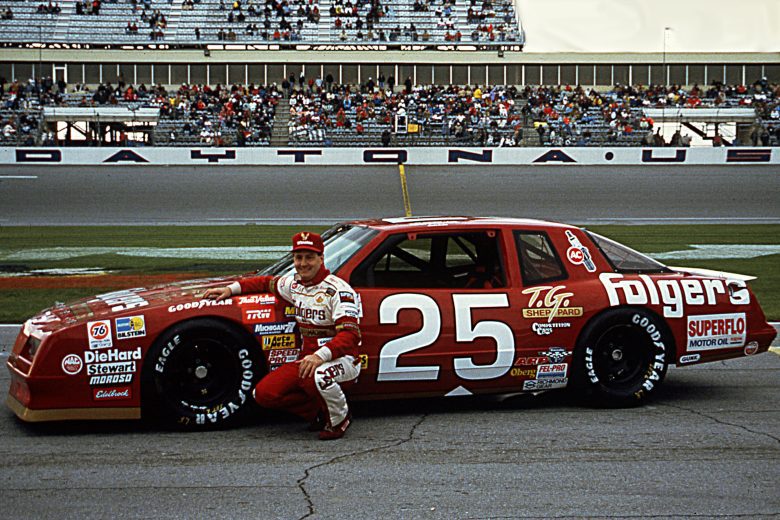
Throughout the latter half of the 20th century, Folgers was a ubiquitous advertiser on television and radio, saturating the airwaves with its jingle and ads. The sheer longevity and frequency of Folgers commercials – from the 1960s Mrs. Olson spots to decades of morning TV ads – meant that Folgers became deeply embedded in American culture. Folgers also didn’t shy away from non-traditional channels. In the mid-1980s, Folgers became a sponsor in NASCAR auto racing, emblazoning its name on a race car to reach the sport’s vast audience of fans. This sports sponsorship aligned Folgers with an image of energy and all-American values, and it extended the brand’s reach into an arena where coffee isn’t typically advertised but where millions of loyal fans watch (and presumably drink coffee during early race days).
Folgers has also engaged in collaborations with celebrities and influencers to give its marketing extra impact. We’ve seen how well-known musicians contributed to Folgers ads by performing the jingle (Aretha Franklin, Rockapella, etc.), effectively acting as ambassadors for the brand. In contests and campaigns, Folgers brought in talent like country singer Chris Young to lend credibility and excitement to consumer promotions. More recently, Folgers’ parent company orchestrated cross-brand marketing stunts – for example, pairing its peanut butter brand Jif with a famous rapper for a campaign – reflecting a corporate strategy to use pop culture to refresh legacy brands. Folgers’ use of Joan Jett’s “Bad Reputation” track in its edgy rebrand is another form of collaboration, leveraging the cultural cachet of a rock legend to reposition Folgers with a cool factor. Additionally, Folgers has partnered with other organizations when beneficial; for instance, it licensed its name to certain co-branded coffee products and has a long-running partnership providing Dunkin’ Donuts branded coffee for retail (through Smucker’s deal with Dunkin’), although those are separate brands in marketing.
Finally, Folgers ensures omni-channel presence for its campaigns. Traditional TV remains important (as evidenced by new Folgers commercials airing during major events), but Folgers also extends campaigns to digital, social media, and experiential marketing. The 2022 reintroduction campaign, for example, was rolled out across TV, online video, streaming audio, and social platforms, with #DamnRightItsFolgers fueling a social media push and even plans for on-the-ground events. By using a mix of channels, Folgers meets consumers wherever they are – whether it’s a morning radio jingle, a YouTube ad, a Facebook video, or an in-store display. Notably, Folgers’ very earliest expansion strategy in the 19th century involved elaborate in-store displays and sampling by a forward-thinking salesman, proving that the brand’s DNA has always included getting the product into people’s hands and sight through savvy placement.
In conclusion, Folgers’ broad reach tactics complement its core marketing strategies. High-frequency advertising and clever partnerships have served to amplify Folgers’ emotive storytelling, jingle, heritage messaging, and so on to the widest possible audience. This comprehensive approach to marketing – combining compelling content with expansive distribution and collaboration – is a major reason Folgers Coffee has remained not just a venerable brand, but a pervasive one, familiar to virtually every coffee drinker in America.
Conclusion
From its origin in the 19th century to its marketing reinventions in the 21st, Folgers has demonstrated a remarkable ability to connect with consumers through savvy, well-rounded marketing strategies. By focusing on emotional storytelling, Folgers made its coffee more than a product – it became a part of family rituals and cherished memories. Through an iconic jingle and slogan, Folgers achieved a level of brand recognition that most companies only dream of, embedding itself in pop culture and morning routines alike. The brand’s emphasis on heritage and consistency built deep trust, assuring customers that Folgers would always deliver the comforting taste they expect. At the same time, Folgers showed that it cares about communities and values, using cause marketing and local pride (especially its New Orleans roots) to add authenticity and goodwill to its image.
Folgers also evolved with the times: engaging fans via contests and user-generated content, boldly repositioning the brand’s tone to appeal to younger audiences, and adapting its products and messaging to align with modern trends (without losing its classic appeal). Supporting all these strategies was Folgers’ extensive use of mass media and partnerships to ensure its message reached Americans everywhere, from living rooms to racetracks.
Ultimately, Folgers’ marketing success can be attributed to a balance of tradition and innovation. The brand has stayed true to its core identity – warmth, reliability, familiarity – while finding creative ways to stay relevant in each new era. Whether it’s through a hummable jingle, a tear-inducing holiday ad, a viral social campaign, or simply the sight of that red coffee can in the pantry, Folgers has kept itself at the forefront of consumers’ minds. As a result, Folgers remains an iconic coffee brand that continues to **“wake up” generations of customers – and their brand loyalty – year after year.
Also Read: A Deep Dive into the Marketing Strategies of Smucker’s
To read more content like this, subscribe to our newsletter