In the invisible plumbing of the global economy, Adyen stands as a singular, monolithic force. Unlike the patched-together legacy systems of the early 2000s, Adyen built a “financial technology platform” from the ground up—a single codebase that acts as gateway, risk manager, and acquirer all at once. This “unified commerce” proposition made it the darling of Silicon Valley giants like Uber, Spotify, and eBay, who craved efficiency and global reach without the “spaghetti code” of multiple vendor integrations. By 2025, Adyen had cemented its reputation not just as a payments processor, but as a profit center for the world’s largest enterprises.
However, the golden era of undisputed dominance is evolving into a war of attrition. The payments landscape of late 2025 is defined by “The Great Convergence.” Pure-play tech companies like Stripe are moving aggressively upmarket into enterprise territory, while legacy banking giants like J.P. Morgan are successfully overhauling their tech stacks to look and feel like modern fintechs. The commoditization of payment processing means that “accepting payments” is no longer enough; the winners now compete on authorization rates, embedded finance (lending, issuing), and deep vertical integration.
Adyen currently faces a pincer movement. On one side, nimble “performance” competitors like Checkout.com and Nuvei are chipping away at specific high-growth verticals like gaming and crypto. On the other, massive consolidations—such as Global Payments’ move to acquire Worldpay—are creating “too big to fail” infrastructure behemoths that compete on sheer scale and pricing power. Simultaneously, the lines between “software” and “banking” are blurring, with rivals offering treasury management and payroll services that threaten to surround Adyen’s core offering.
This analysis explores Adyen’s most formidable competitors. It dissects their brand narratives, strategic maneuvers, and exactly how they attempt to dismantle Adyen’s “single platform” advantage.
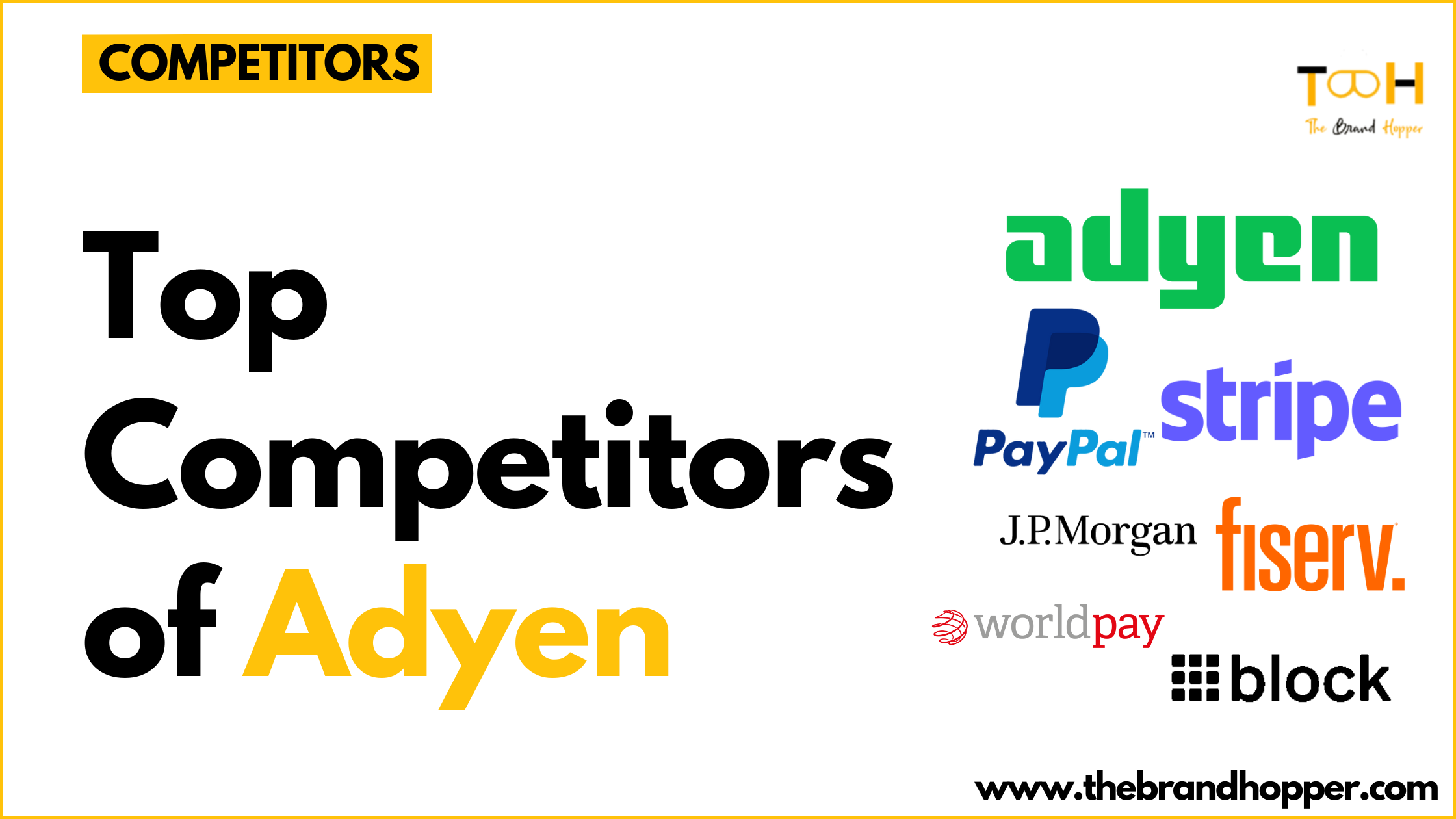
Top Competitors of Adyen
1. Stripe
Website – https://stripe.com/
Stripe is the yin to Adyen’s yang. While Adyen started with the Enterprise and moved slightly down, Stripe conquered the startup world with a few lines of code and is now storming the Enterprise castle. Based in San Francisco (and Dublin), Stripe is the standard-bearer for the “API economy,” powering the internet’s most complex business models, from Amazon to Shopify.
How They Compete with Adyen
Stripe competes through Developer Velocity and Ecosystem Breadth.
-
The “Suite” vs. The “Platform”: Adyen sells a unified payment pipe. Stripe sells an economic infrastructure suite. Stripe competes by offering adjacent products that Adyen is still building out, such as Stripe Tax, Stripe Atlas (incorporation), and Billing (subscriptions). For a SaaS platform, Stripe often feels like a more complete “business in a box” than Adyen’s payment-centric model.
-
Enterprise Agility: Historically, Adyen won on enterprise reliability. However, Stripe’s 2025 strategy has been “Enterprise agility,” winning over giants like Ford and Zara by proving they can iterate faster. Stripe competes by allowing massive companies to launch new business lines (like marketplaces) in weeks rather than months.
Recent Developments
In 2025, Stripe has aggressively expanded its “crypto-for-business” capabilities (stablecoin payouts), a sector Adyen has approached more cautiously. Furthermore, Stripe’s deep integration with AI agents for automated purchasing creates a future-looking “machine commerce” narrative that challenges Adyen’s more traditional human-consumer focus.
2. PayPal (Braintree)

Website – https://www.paypal.com/us/braintree
Braintree is the “developer” arm of the PayPal empire. Acquired over a decade ago, it remains the most direct technological equivalent to Adyen in terms of stack. It allows merchants to accept PayPal, Venmo, credit cards, and Apple Pay through a single integration.
How They Compete with Adyen
Braintree competes via Consumer Trust and the “PayPal Halo.”
-
The Wallet Factor: Braintree’s ace in the hole is the PayPal and Venmo buttons. While Adyen can process PayPal, Braintree is PayPal. They compete by offering tighter integration, better pricing on PayPal transactions, and higher conversion rates from the 400+ million users who trust the PayPal brand.
-
Price Aggression: As PayPal fights to maintain market share, Braintree is often used as a defensive weapon. They frequently undercut Adyen on processing fees for large merchants, leveraging the massive balance sheet of their parent company to win volume wars.
Recent Developments
PayPal’s “Fastlane” checkout experience, rolled out broadly in 2025, is a direct competitor to Adyen’s unified checkout. By recognizing guest shoppers across the entire PayPal network (not just Braintree merchants), they offer a conversion boost that Adyen, lacking a consumer-facing network, cannot mathematically match.
3. Checkout.com

Website – https://www.checkout.com/
If Adyen is the Dutch giant, Checkout.com is the British challenger snapping at its heels. Originally focused on the MENA and APAC regions, Checkout.com has built a reputation for “high performance” payments, catering specifically to digital-native merchants in high-volume sectors like crypto, gaming, and fintech.
How They Compete with Adyen
Checkout.com competes on Granular Data and Authorization Performance.
-
“Intelligent Acceptance”: Checkout.com markets itself not just as a pipe, but as a performance engine. They compete by giving merchants raw access to data (level 3 data) that Adyen sometimes abstracts away. They pitch to the CTO: “Adyen gives you a black box; we give you the schematics.” This appeals to sophisticated merchants who want to tweak every parameter to squeeze out an extra 0.1% of authorization rate.
-
Aggressive Innovation: Without the burden of legacy terminal infrastructure (unlike Adyen’s massive POS network), Checkout.com moves faster in digital-only innovations like network tokenization and crypto-fiat bridges.
Recent Developments
In 2025, Checkout.com adjusted its valuation and launched a massive push for profitability, shedding its “growth at all costs” skin. They are aggressively targeting Adyen’s “platform” customers with a new marketplace solution that claims superior split-payment flexibility.
4. Worldpay (Global Payments)

Website – https://www.worldpay.com/
Worldpay is the “Zombie that wouldn’t die”—and is now growing stronger. After being acquired by FIS and then spun out, Worldpay is currently in the process of a massive merger with Global Payments (announced 2025). This creates arguably the largest payment acquirer on the planet by volume.
How They Compete with Adyen
Worldpay competes via Sheer Scale and Banking Distribution.
-
Too Big to Ignore: For the world’s largest retailers (e.g., Walmart, Tesco), Worldpay’s scale offers a level of redundancy and cost-efficiency that is hard to beat. They compete by bundling services across geographies that even Adyen hasn’t fully penetrated.
-
The “Direct” Advantage: Worldpay has historically had some of the highest approval rates in the US and UK because they are the backend for so many transactions. They argue that their massive data lake of approvals helps them route transactions better than a “tech overlay” like Adyen.
Recent Developments
The mega-merger with Global Payments is the defining story of the industry in 2025-2026. This consolidation allows them to combine Global Payments’ software-led strategy (Zenoti, Active Network) with Worldpay’s e-commerce brawn, creating a “full stack” rival that can finally match Adyen’s omnichannel promise.
5. J.P. Morgan Payments
Website – https://www.jpmorgan.com/payments/solutions
The sleeping giant has awoken. J.P. Morgan is no longer just a bank; it is a top-tier fintech. By combining their treasury services, merchant acquiring (Chase Paymentech), and trade finance, they offer a “Total Payments” solution that Adyen cannot replicate because Adyen is not a bank (despite having banking licenses).
How They Compete with Adyen
J.P. Morgan competes on The “Money Movement” Ecosystem.
-
Treasury + Payments: Adyen processes the payment, but J.P. Morgan holds the money. They compete by saying, “Why move money from Adyen to your bank? We are the bank.” They offer instant liquidity and real-time treasury visibility that allows CFOs to use their cash minutes after a sale—something Adyen’s payout cycles struggle to match.
-
Liability Shield: For massive enterprises, the phrase “Nobody gets fired for hiring J.P. Morgan” still holds weight. In a volatile regulatory environment, the bank’s massive compliance fortress is a selling point against “fintechs” like Adyen.
Recent Developments
J.P. Morgan’s “biometric checkout” pilots and their deep investment in “embedded banking” for marketplaces in 2025 are directly targeting Adyen for Platforms. They are aggressively selling to the Gig Economy, offering instant driver payouts that bypass the card networks entirely.
6. Fiserv (Carat / Clover)

Website – https://www.fiserv.com/
Fiserv is the backbone of traditional banking technology, but its “Carat” brand is the spear tip aimed at Adyen. Carat is their omnichannel enterprise ecosystem, designed to unify their disparate acquisitions (First Data) into a coherent platform.
How They Compete with Adyen
Fiserv competes via POS Dominance and Distribution.
-
The Clover Army: Fiserv owns Clover, the ubiquitous white POS system seen in millions of cafes and stores. Adyen has to convince merchants to buy terminals; Fiserv already owns the counter. They compete by using Clover as a Trojan horse to upsell enterprise processing capabilities to franchise networks.
-
Legacy Connections: Fiserv has deep, decades-old integrations with legacy ERP systems in retail and petroleum. Adyen often struggles to displace these entrenched “spaghetti” connections. Fiserv competes by supporting the “messy” reality of legacy tech better than Adyen’s “modern-only” approach.
- 7. Nuvei

Website – https://www.nuvei.com/
Montreal-based Nuvei is the “special forces” of payments. Recently taken private by Advent International (late 2024), Nuvei operates with a mandate for aggressive flexibility. They go where others won’t: iGaming, sports betting, and complex crypto corridors.
How They Compete with Adyen
Nuvei competes on Flexibility and Risk Appetite.
-
The “Yes” Company: Adyen is known for being conservative; they will offboard merchants that introduce too much risk. Nuvei competes by being the partner for the “grey” economy—regulated gaming, CBD, and crypto. They build custom features that Adyen’s standardized platform would reject.
-
Crypto-Native: Nuvei has one of the most robust fiat-to-crypto on-ramps in the industry. For Web3 companies, Nuvei is often the default choice, offering features (like NFT checkout) that Adyen views as niche.
Recent Developments
Now a private company, Nuvei is aggressively acquiring regional players in LatAm and APAC to build a “local-global” network that rivals Adyen’s direct acquiring licenses, specifically targeting mid-market platforms that feel ignored by Adyen.
8. Block (Square / Cash App)

Website – https://block.xyz/
Adyen powers the “enterprises,” and Square powers the “coffee shops.” But those lines are blurring. Block (formerly Square) is moving upstream with “Square for Enterprise” and leveraging its Cash App consumer base to create a closed-loop economy.
How They Compete with Adyen
Block competes on Software-Led Verticals.
-
Vertical Software: Square doesn’t just process payments; it runs the restaurant (Square for Restaurants) or the salon (Square Appointments). Adyen integrates with these software providers; Square is the software. This vertical lock-in makes it impossible for Adyen to displace them in the hospitality and retail SME sectors.
-
Cash App Pay: Similar to PayPal, Block is pushing “Cash App Pay” as a payment method. By offering lower fees for merchants who accept Cash App, they bypass the card networks—a direct threat to Adyen’s interchange-based revenue model.
9. Mollie

Website – https://www.mollie.com/
Mollie is often called the “Adyen for everyone else.” Based in the Netherlands (like Adyen), Mollie focuses on the SME and mid-market segment in Europe that Adyen historically deemed too small to serve directly.
How They Compete with Adyen
Mollie competes via Simplicity and Local Love.
-
The “Apple” Experience: Mollie’s dashboard and API are renowned for their beauty and simplicity. They compete by offering an onboarding experience that takes minutes, capturing the high-growth European startups before they are big enough for Adyen’s sales team to notice.
-
Hyper-Localization: Mollie excels at the specific, quirky payment methods of Europe (iDEAL, Bancontact, Klarna) with deeper, more user-friendly integrations than Adyen’s sometimes generic global implementation.
10. Shift4
Website – https://www.shift4.com/en-GB
Shift4 is the king of hospitality. From stadiums to hotels to restaurants, Shift4 has built a fortress around venues. Under CEO Jared Isaacman, they have pivoted from a gateway to a full-stack end-to-end acquirer.
How They Compete with Adyen
Shift4 competes on Venue Domination (SkyTab).
-
The Stadium Stack: Shift4 dominates the major league sports vertical. They offer a solution that integrates ticketing (Ticketmaster), food and bev (POS), and mobile ordering. Adyen competes here, but Shift4’s specialized hardware and software for high-volume venues (like the Super Bowl) give them a tactical edge.
-
Cost-Killing: Shift4 is aggressive on pricing, often offering to pay switching costs or buying out contracts to get a merchant onto their “SkyTab” POS system.
11. Rapyd

Website – https://www.rapyd.net/
Rapyd positions itself as “Fintech-as-a-Service.” While Adyen focuses on cards and local payment methods for retail, Rapyd focuses on the complex mesh of cross-border payouts, wallets, and cash collection.
How They Compete with Adyen
Rapyd competes on Cross-Border Complexity.
-
The “Rest of World” Specialist: Adyen is strongest in North America and Europe. Rapyd shines in “hard” geographies like Southeast Asia and Latin America. They compete by allowing merchants to accept cash at a 7-Eleven in Mexico or pay a gig worker into a digital wallet in Indonesia—edge cases that Adyen covers but Rapyd specializes in.
Comparative Snapshot: Adyen vs. The Field
| Competitor | Primary Strength | Key “Hook” vs. Adyen | Target Customer |
| Stripe | Developer Experience | “Faster innovation, broader ecosystem” | Startups, SaaS, Tech-Forward Enterprise |
| PayPal (Braintree) | Consumer Network | “400M+ trusted users & higher conversion” | E-commerce, Subscription Services |
| Checkout.com | Performance | “We share the data Adyen hides” | Crypto, Gaming, High-Volume Digital |
| Worldpay | Global Scale | “Too big to fail reliability & bank roots” | Mega-Retailers, Supermarkets |
| J.P. Morgan | Banking + Tech | “Why leave the bank? We do it all.” | Fortune 500, Treasurers |
| Nuvei | Flexibility | “We say yes to complex verticals” | iGaming, Web3, Regulated Industries |
| Fiserv | Omnichannel POS | “We own the counter (Clover)” | Franchise Chains, Petroleum, Retail |
| Block (Square) | Vertical Software | “We run the whole store, not just payments” | Restaurants, Retail, SMEs |
| Mollie | Simplicity | “Easiest onboarding in Europe” | European SMEs & Mid-Market |
| Shift4 | Hospitality | “Specialized for stadiums & hotels” | Venues, Hotels, Restaurants |
Conclusion
Adyen remains the gold standard for “Unified Commerce,” offering a cleanliness of code and architectural purity that rivals still envy. However, the market has shifted from “can you process this payment?” to “can you help me run my business?”.
Competitors like Stripe and Block are answering this by becoming operating systems for business (software + finance). Rivals like J.P. Morgan are answering it by becoming the treasury vault (banking + payments). And disruptors like Checkout.com are answering it by becoming the performance tuners (data + AI).
In 2026, Adyen’s biggest threat is not a single company, but the bifurcation of the market: the “software-led” payments (Stripe/Square) eating the bottom and middle, and the “mega-bank” processors (JPM/Worldpay) locking down the top. To win, Adyen must successfully execute its new “Embedded Financial Products” strategy, proving it can be a bank for its merchants without losing the agility of a tech company.
Also Read: Who are PayPal’s Competitors in Financial Services Industry?
Also Read: Stripe – Success Story, Business Model, Revenue, Growth & Funding
To read more content like this, subscribe to our newsletter