As time passes, the distinction between AI and human creativity will continue to erode, and this trend was most obvious in 2026. One of the most telling signs of this shift is the explosive growth of AI video generators. These quickly evolving tools are capable of quickly transforming short written pieces, still images, or even early-stage concepts into high-quality, captivating video content.
Regardless of whether one is an educational innovator, content creator, brand marketer, or simply a trend follower in terms of new technology, one cannot afford to overlook how AI video generators will transform industries across the globe by 2026.
Let us take a closer look at the reasons why AI video generators have had such an impact in 2026, as well as what those impacts will be moving forward as they continue to proliferate on the web.
What is an AI video generator?
AI video generators and creates videos directly from the user (including but not limited to text, audio, pictures, and/or other multimedia) by utilizing AI. Automated video creation software allows for the automatic creation of a complete product through a single process and can be done without any (or very little) help from humans (e.g., writing scripts; creating a voice-over; rendering animations; designing transitions; creating music; adding subtitles; adjusting the majority of visual elements in a single process).
With the ability to utilize an online, automated system to create video content without the need for post-production professional skills, experience, or equipment (that can be extremely high in cost), all you need is an idea with a decent amount of time to allow for the automation process.
Due to this ease of use in creating video content through technology and process, the majority of AI-based video creation platforms have been built around a “zero barrier” philosophy to make video creation easier, more effective, and more available than ever before.
Why is everyone suddenly using them?
The increasing demand for fast, high-quality video content has grown significantly as more people turn to platforms like TikTok, Youtube Shorts and Intagram Reels. With a high-speed content creation flow, creators face more creative constraints than ever before, and AI video generators solve this pain.
For these reasons, many people are utilizing AI video generator to create work for themselves as a result of the immense demand for such tools. Listed below are a few reasons why users prefer to use AI video generators.
Unleashing Creativity
AI video generators offer surprising capabilities in thinking of new, more creative ways to determine visuals. Sometimes AI’s interpretations of vision far exceed the creator’s version, thus inspiring new ideas for content that may not have been thought about otherwise.
Rapid Generation
The time it takes to create a video has decreased compared to years ago when production times for videos usually took several hours to several days. Creators can generate large amounts of high-quality video content much quicker through the creative process, using fewer hours and less time for the final product.
Easy to Use
Because of the way these tools work, almost anyone can create professional-looking videos, regardless of professional or educational background in video design or editing. Therefore, creating videos has become easily accessible to all people.
Scalable Scalability
AI video generators can quickly create multiple video versions all at once, thereby creating flexibility in the format for social media and enabling the possibility to create videos in a variety of languages for different regions.
Significant Cost Advantage
Completely different costs associated with video production exist with traditional video production methods compared to using AI video generation — cost for filming equipment, talent for employee costs to create videos or the time it takes to capture that footage — the cost to produce an AI-generated video will be much less. Many platforms allow free trials, and paid platforms are still significantly cheaper than building out a production team or outsourcing that work.
AI tools are ultimately decreasing the threshold for creating videos by providing to many more everyday users what were once professional features/tools available only to professionals.
Are these tools really worthy of praise?
Let’s take a closer look at what these tools have accomplished that makes people exclaim, “Wait, is this really done by AI?”
1. Convert Text to Video in Seconds
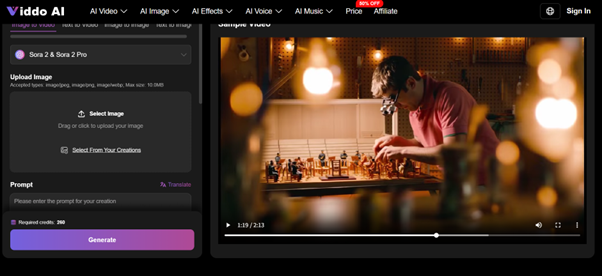
Kling, Sora, and Viddo AI are programs that can take a few words as input and turn them into an entire animation or short film, without human intervention. One such example would be if you typed into one of these programs “Tokyo at nighttime, raining, neon signs flashing in back alleys” – it would then create an atmospheric piece of film that looks like it belongs in a futuristic sci-fi movie.
2. Image and video transformation
Image to video such as Viddo AI can animate still photographs by simulating movement in the human eye (via blinks and smiles) and voice (via speaking). Additionally, many users upload static images to AI systems that automatically generate dynamic transitions and effects from those images. This is accomplished by the AI system producing a “motion version” (or dynamic version) of the original static image, from which the user can create a high-quality dynamic visual presentation.
3. Multiple AI templates
Our platform contains a large selection of integrated AI Templates which span numerous styles and use cases, plus one-button application for producing short videos, product demonstrations, and story-based content. In addition, the only thing users have to do to create professional quality content is choose the template they wish to use and input their materials. The rest of the workflow (layout/pacing/visual effects) is automatically handled by the system, creating a very low barrier to entry for creating high-quality content quickly and efficiently.
4. Multiple AI video models
The platform integrates various cutting-edge AI video models, covering mainstream solutions such as Sora 2, Veo3 / Veo3.1, Runway Gen-4, Kling 2.6, Wan 2.6, Hailuo 2.3, and Seedance 2.0 and supports different versions and speed modes. Creators can freely switch models according to their image quality needs, generation efficiency, and style preferences, achieving a flexible balance between realism, motion fluidity, and creative expression to meet the video generation needs of multiple scenarios and styles.
Real-world application cases
Small and medium-sized enterprises
Small and Medium Sized Enterprises are driving down the costs of producing content by removing the obstacles to creating video content by leveraging advances in technology and the power of AI.
With AI, small and medium-sized enterprises (SMEs) can create promotion videos such as brand intros, product feature demonstrations, and social media snippets without depending on outside service providers. Instead, SMEs are now able to create high-quality content consistently and rapidly through inputting their product information and writing the basic script themselves. This enables SMEs with limited budgets to consistently create high-quality content and compete in the marketplace quickly.
Independent creators
Independent creators have been able to “accelerate” the realization of their ideas by using AI video tools to generate usable video footage in a matter of minutes. As such, they can verify their ideas more quickly and spend less time performing repetitive technical tasks and hence, have more time to devote to the creative process.
YouTube creators are now able to produce content at a much higher rate than before. With the use of AI, there is no longer a need for entire days of editing for a 10-minute YouTube video, as many of the editing tasks (such as generating the opening and closing of the video, adding subtitles, and creating voiceovers) can now be done by an automated system based on your written script. This shift will greatly affect how content is created by YouTube channels that do not have an on-camera host or do not place a premium on their output.
Educators
The use of AI video generator in the education sector is improving classroom engagement. Previously non-interactive and dry content from textbooks can now become intuitive tutorial videos or dynamic animations on historical events. Teachers and trainers can generate lessons in the form of tutorials and animations using AI tools to create a customized curriculum to present to their students so they can learn and retain the material more effectively.
Do AI video generators still have certain limitations?
- Lack of Attentiveness to Detail: AI does not always understand the subtlety of emotion, context, or culture; this means some of the AI produce videos that look more stiff than they should.
- Stylized Homogenization: Without a clear direction for creating content, the outputs of various tools can be so similar that there is no way to differentiate them from one another.
- Limited Creative Expression: Although using templates and presets can help produce more efficient videos, human planning and intervention are necessary for creating longer stories or unique forms of creative expression.
Overall, AI video generator will still achieve acceptable results relative to their speed of content creation, idea validation or visual representation of a presentation.
Conclusion
Viddo AI is changing how videos are produced. It is not replacing creators but providing a more effective way to help individuals turn their thoughts into video. The ultimate goal in video creation will be to find the right balance between efficiency and creativity, by effectively using AI relative to human judgment and aesthetic value. This will result in the best possible video creation in the future.
To read more content like this, explore The Brand Hopper
Subscribe to our newsletter