Last Updated on June 19, 2025 by Team TBH
Anthropic is a San Francisco–based startup (incorporated as a public-benefit corporation) focused on building large language models (LLMs) with safety and alignment at their core.
Founded in 2021, Anthropic’s flagship AI assistant Claude is designed to be “helpful, harmless, and honest,” directly competing with OpenAI’s ChatGPT and Google’s Gemini. The company emphasizes a mission-driven approach: “At Anthropic, we build AI to serve humanity’s long-term well-being,” and aims to put “safety at the frontier” of AI research.
In practice, Anthropic offers AI products (via APIs and chat interfaces) to businesses and consumers, while rigorously testing models for safety and robustness. Its unique structure—a Delaware public-benefit corporation with a “Long-Term Benefit Trust”—underscores a commitment to developing powerful AI that benefits society.
Today (2025), Anthropic has grown into a leading AI player with thousands of employees and a reported annualized revenue run rate around $3 billion, reflecting explosive enterprise demand for its models.
Founding Story of Anthropic
Anthropic’s story began in late 2021 when a group of OpenAI researchers and executives, led by siblings Dario and Daniela Amodei, left OpenAI to form a new AI venture. These founders felt that the mission of ensuring AI safety required more dedicated focus than what they believed OpenAI was providing under its then leadership.
Together with five other AI experts from OpenAI (including Jack Clark, Sam McCandlish, Tom Brown, and others), they set out to create Anthropic as a public-benefit corporation—blending commercial goals with public interest.
The Amodei siblings and their colleagues believed that training and deploying AI should include “intentional pauses to consider the effects,” building tools with human benefit as their foundation. Their vision was encapsulated by Dario Amodei’s comments that AI must be “powerful” yet “never go rogue,” and that Anthropic would sprint to set global standards for safe, ethical AI.
Anthropic’s founding lore includes not rushing to release its earliest model (Claude 1) until rigorous safety testing was complete, underscoring their cautious approach.
In summary, Anthropic’s founding story is one of mission-driven entrepreneurs carving out a new path for trustworthy, reliable AI.
Founders of Anthropic
Dario Amodei (Co-founder & CEO)

A physicist-turned-AI researcher, Dario (born 1983) was formerly Vice President of Research at OpenAI. At Anthropic he leads product vision and technical strategy. Dario has a Ph.D. in physics from Princeton and is known for work on large language models (he co-authored the GPT-2 paper). Under his leadership, Anthropic has raised multi-billion-dollar funds and built Claude into a top-tier LLM.
Daniela Amodei (Co-founder & President)

Daniela (born mid-1980s) was previously Vice President of Safety and Policy at OpenAI. At Anthropic she oversees operations and policy. With a background at Stripe and in political campaigns before tech, Daniela focuses on aligning Anthropic’s business with its social mission. Both Amodei siblings were named among Time’s 100 most influential in AI (2023, 2025) for their roles at Anthropic.
Jack Clark (Co-founder & Head of Policy)

Jack is an AI policy expert and former editor of the Import AI newsletter. He was formerly OpenAI’s Policy Director. At Anthropic he leads AI safety research, governance, and external relations. Clark is recognized for his thought leadership on AI ethics and governance.
Sam McCandlish (Co-founder & Chief Scientist)

An AI researcher specializing in neural networks and language models, Sam was a senior researcher at OpenAI (involved in GPT and Codex research) before joining Anthropic. He heads much of Anthropic’s technical development of the Claude model family.
Tom Brown (Co-founder & Research Scientist)
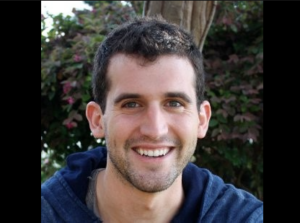
Tom was the lead author on OpenAI’s GPT-3 paper (2020) and helped train large language models there. At Anthropic he contributes to model architecture and training efforts.
(Other initial members included Jared Kaplan and Ben Mann, all former OpenAI colleagues. These co-founders brought together experience in model training, AI safety, and cloud deployments to realize Anthropic’s mission.)
Business Model of Anthropic
Anthropic’s business model centers on providing AI technology primarily as a software service. The core offering is its Claude series of LLMs, accessible via an API and integrations with cloud platforms.
Enterprises pay for access to Claude through usage-based cloud contracts or dedicated instances; for example, Claude is available through Amazon Web Services (AWS) Bedrock and Google Cloud’s Vertex AI. This enterprise focus means Anthropic largely earns revenue from businesses embedding Claude into customer support, coding tools, search, research, and other applications.
Anthropic also offers a consumer product: the Claude chatbot, which is free for basic use but offers a paid Claude Pro subscription (around $20/month) for priority access and higher performance (similar to ChatGPT’s subscription model).
In addition, Anthropic occasionally enters strategic partnerships or pilot programs (e.g., with governments or research institutions) where specialized Claude versions (such as “Claude Gov” for public agencies) are deployed under contract.
Overall, the company competes on reliable AI services with a safety guarantee: Claude is marketed as “helpful, harmless, and honest,” and Anthropic requires enterprises to adhere to its use policies.
Revenue Streams of Anthropic
Anthropic’s revenue is driven largely by enterprise contracts and cloud partnerships. As of 2025 its annualized revenue run-rate is reported at roughly $3 billion, a meteoric climb fueled by corporate and government demand. Major sources include:
-
Cloud Services (B2B): Large tech firms (Amazon, Google) and others pay for licenses or subscriptions to run Claude. For instance, after Amazon’s $4 billion investment, Claude was integrated into AWS, making it available to Amazon’s cloud customers. Google’s Cloud business similarly resells Claude on Vertex AI.
-
Enterprise Deals: Companies like financial and healthcare firms have begun embedding Claude to automate tasks. Anthropic cites corporate customers including WPP, BMW, Novo Nordisk, Zoom, Snowflake, and others who use Claude for coding assistance, document analysis, or customer service workflows. These large contracts (often multi-year) form a stable revenue base.
-
Subscriptions (Consumer/SMB): While a smaller slice, individual users and small businesses subscribe to Claude’s chat interface. The Claude Pro plan provides premium usage and is priced similarly to competitors’ offerings. This recurring revenue stream helps monetize the brand and drives user growth (in mid-2025 Claude had tens of millions of users globally, per third-party estimates).
-
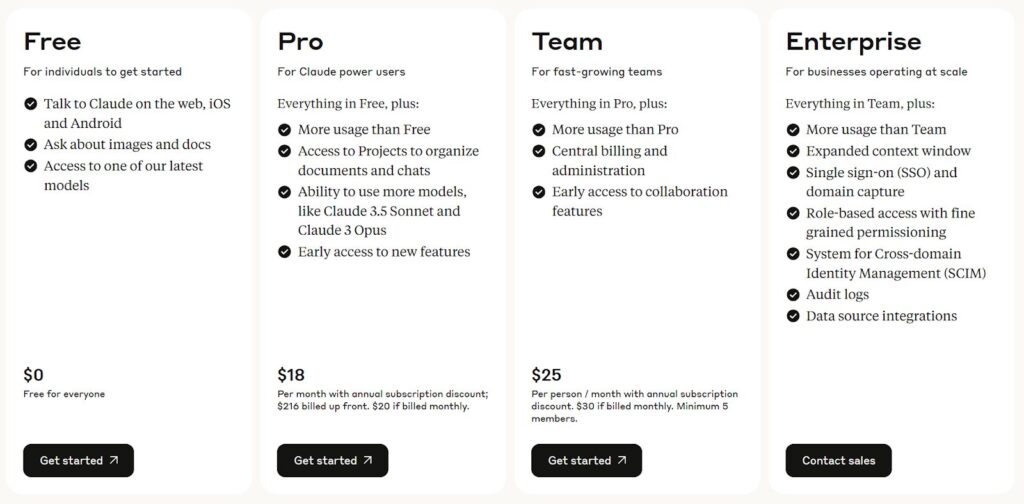
Claud Subscription Tiers -
Specialized Services: Anthropic has introduced niche products like Claude Code (an interactive coding assistant) and Claude Team/Enterprise Plans (collaborative AI agents for organizations). Revenue from these offerings comes from professional plan subscriptions or usage fees. Anthropic also provides consulting and fine-tuning support for large clients embedding Claude into their systems.
Notably, a key advantage is Claude’s strong performance in coding tasks: internal benchmarks and external reports note that Claude excels at programming and multi-step reasoning. This “code generation” niche has become a growth driver, attracting developer-oriented users and platforms. In sum, Anthropic monetizes Claude through a blend of enterprise AI services and subscription access, with the vast majority of income coming from business and cloud partners.
Funding and Investment History of Anthropic
From its inception, Anthropic has raised unprecedented sums to fuel rapid growth. In April 2022 (shortly after founding), the company announced a $580 million funding round, notably including a $500 million investment by FTX founder Sam Bankman-Fried.
Subsequent rounds continued at ever-larger scale: in May 2023 Anthropic disclosed a Series C raise of $350 million (led by Spark Capital, with participation from Google, Salesforce Ventures and others).
The biggest influx came from deals with tech giants. In September 2023 Amazon committed $4 billion to Anthropic, structured as an initial $1.25 billion investment (with the option to add $2.75B later). As part of that agreement Anthropic would make AWS its primary cloud provider.
In October 2023, Google invested $500 million in Anthropic (with a promise to invest an additional $1.5 billion over time). By March 2024 Amazon completed its full $4B commitment, and in November 2024 Amazon announced yet another $4B round (bringing Amazon’s total stake to $8B) as well as plans to use Anthropic’s chips for Claude model training.
These large strategic investments propelled Anthropic’s valuation. In late 2023 the company was reported to be raising $750 million at a $18.4 billion valuation (led by Menlo Ventures). By early 2025, a Series E funding round led by Lightspeed brought in $3.5 billion at roughly a $61.5 billion post-money valuation.
In total, by mid-2025 Anthropic had raised on the order of $14–15 billion across dozens of deals, making it one of the most well-funded AI startups. These funds have been earmarked for scaling compute resources, expanding research (especially on interpretability and alignment), and international expansion.
Funding Rounds of Anthropic
| Date | Round | Lead Investors | Amount (USD) | Post-Money Valuation (USD) |
|---|---|---|---|---|
| Apr 2022 | Seed/A | Paradigm, Thrive, Salesforce, etc. | $580M (incl. $500M from FTX) | ~ (not disclosed) |
| May 2023 | Series C | Spark Capital (lead), Google, Salesforce Ventures, Zoom Ventures, Sound Ventures, etc. | $450M | – |
| Sep 2023 | Series D (tranche 1) | Amazon (initial commitment) | $1.25B | – |
| Dec 2023 | Series C/D (or D) | Menlo Ventures (lead), GV, Lightspeed, etc.reuters.com | $750M | ~$18.4B |
| Mar 2024 | Series D (completed) | Amazon (final tranche) | $2.75B | – |
| Nov 2024 | Series D2 (new) | Amazon (new round) | $4.00B | – |
| Mar 2025 | Series E | Lightspeed (lead), Bessemer, Cisco, D1 Capital, Fidelity, Gen. Catalyst, Salesforce, Menlo, etc. | $3.50B | $61.5B |
These rounds underscore both the support of major investors (e.g. Amazon, Google, Salesforce, Spark Capital) and Anthropic’s escalating valuation, which has grown from a few billion in 2022 to well over $60 billion by early 2025.
Competitor Analysis of Anthropic
| Company | Founded / HQ | Flagship AI Products | Business Model / Focus | Major Investors / Notes |
|---|---|---|---|---|
| OpenAI | 2015, San Francisco | ChatGPT, GPT-4/GPT-4o, DALL·E, Codex | Sells API access and consumer subscriptions (ChatGPT); backed by Microsoft (investment, cloud partnership) | Microsoft (major investor, $13B+); valued ~$300B in 2025 |
| Google (DeepMind) | 2010/Alphabet, Mountain View, CA | Gemini (Bard), PaLM, Imagen | Integrates AI into search, cloud (Vertex AI) and devices; offers APIs (Cloud AI) and has an active AI research arm | Alphabet (Google) is parent; invests in OpenAI rival Anthropic too |
| Amazon | 1994, Seattle, WA | Alexa, Bedrock (offers Anthropic, AI21, etc.), Titan models | Cloud provider (AWS) offering generative AI services via Bedrock and SageMaker; developing its own models (e.g. Titan); sells AI-powered devices | Investor in Anthropic ($8B total); AWS competes for enterprise AI market |
| Meta (Facebook) | 2004, Menlo Park, CA | LLaMA (3), Meta AI (Vicuna, etc.), no major public chatbot | Focuses on AI research and internal tools; open-sourced LLaMA, contributes AI to products (Facebook, Instagram); partnerships (e.g. with Microsoft) | Self-funded; ongoing R&D (e.g. $200M ad fund); competes by advancing AI research (e.g. new LLaMA models) |
| IBM | 1911 (Watson project 2007), Armonk, NY | Watson (AI for enterprise), Project Debater | Offers AI solutions for enterprises (healthcare, finance) and R&D in AI; sells AI tools via cloud (IBM Cloud) and consulting | Legacy tech company; IBM Watson business unit |
| Cohere | 2019, Toronto, Canada | Command R (LLM for enterprise), Titan models | Provides LLM APIs and fine-tuning to businesses; focuses on multilingual models and enterprise use cases | Backers include CapitalG (Alphabet), Index, Byju’s, Nvidia Venture; raised ~$550M by 2023 |
Each of these competitors brings its own strengths. OpenAI (with Microsoft) leads in consumer mindshare via ChatGPT. Google leverages its vast user base and cloud platform. Amazon’s AWS aggressively courts enterprise clients (including via partnerships like Anthropic). Meta pushes open-source research models. Anthropic competes by emphasizing safety, offering models tuned for helpfulness, and partnering with major cloud providers. (Its niche focus on alignment and enterprise readiness distinguishes it from more generalist AI rivals.)
Competitive Advantage of Anthropic
Anthropic’s competitive edge lies in its safety-first approach and technical strengths. Unlike some peers, Anthropic is structured as a public-benefit corp with a built-in mission to prioritize safe, “steerable” AI.
This commitment attracts customers and regulators who worry about AI risks. Technically, Anthropic’s Claude models have excelled on benchmarks. For example, Claude 3 (released March 2024) was reported to outperform OpenAI’s GPT-4 and Google’s Gemini Ultra in certain tests.
Subsequent models like Claude 3.5 Sonnet and Claude 3.7 Sonnet have set new industry standards in coding ability. These coding and reasoning capabilities give Anthropic an advantage in developer and enterprise markets where automation of complex tasks is valued.
Another advantage is speed of growth and scale: Anthropic has achieved one of the fastest growth rates in AI SaaS history, quickly reaching multi-billion-dollar revenues. Backing from Amazon and Google not only provides capital but also preferred access to cloud infrastructure and enterprise distribution channels. Being integrated into AWS Bedrock and Google Cloud gives Claude broad enterprise reach.
Furthermore, Anthropic has built credibility with its “constitutional AI” training method (using model feedback to refine safe behavior) and transparent policies. In a landscape wary of AI risks, Anthropic’s brand as the “AI’s most upstanding citizen” and its co-founders’ thought leadership on AI ethics give it a marketing edge.
In summary, Anthropic leverages superior model performance (especially in code), a safety/mission-focused brand, and strategic tech partnerships to stand out among AI startups.
Additional Strategic Insights of Anthropic
-
Claude Model Evolution: Anthropic continuously improves Claude. After initial releases (Claude v1 and v2 in 2023), it rolled out Claude 3 (March 2024) with three sizes: Opus (largest), Sonnet, and Haiku. Later in 2024, Claude 3.5 Sonnet was introduced with enhanced coding, reasoning, and multimodal capabilities. In early 2025, Anthropic launched Claude 3.7 Sonnet and Claude Code (a coding-specialized variant). These models feature innovations like extended context windows (100K+ tokens) and a new “extended thinking” mode for longer reasoning chains. Anthropic emphasizes that Claude continues to improve via techniques like Constitutional AI, aiming for even safer outputs as models grow. This steady roadmap (now advancing toward Claude 4 series) is a strategic strength: customers get access to ever-more capable models within a trusted framework.
-
Key Partnerships: Anthropic’s strategic alliances bolster its reach. The relationship with Amazon means Claude is a flagship model on AWS Bedrock (used in high-security FedRAMP and DoD workloads), and Claude even powers features in Alexa and has been integrated into platforms like Replit for code agents. Google Cloud partnership similarly lets businesses use Claude via Vertex AI, and Google’s investment cements support. In late 2024, Anthropic teamed with Palantir and AWS to deploy Claude in U.S. intelligence agencies, showing trust in classified environments. Other collaborations include a research project with Allen Institute for AI on AI safety, and pilot deals in Europe (e.g. German science agencies). In short, Anthropic leverages big-tech alliances and government partnerships to scale globally.
-
Safety & Governance Philosophy: Anthropic’s philosophy of “responsible scaling” underpins its strategy. Co-founder Dario Amodei champions a “Race to the Top” in AI: building ever-more powerful models safely rather than slowing innovation. This shows up in initiatives like the Constitutional AI training, public transparency commitments, and even in corporate structure (the Long-Term Benefit Trust ensures leadership focused on societal impact). This ethos appeals to enterprise clients wary of AI risks and to regulators. For example, Anthropic voluntarily limited certain capabilities (like internet browsing plugins) and participates in policy discussions on AI oversight. Their safety-first stance, combined with high performance, aims to make Anthropic a standard-bearer in ethical AI.
-
International Expansion: Anthropic has rapidly expanded overseas. In 2025 it announced over 100 new roles across Dublin and London and named an EMEA head. The European push targets local sales and compliance (important given EU AI regulations). Anthropic also intends to open an office in Paris and hire local AI talent to compete with regional models like France’s Mistral. The funding round narrative even mentions expanding computation and research internationally. This global footprint (EMEA, plans for Asia-Pacific) helps it serve multinational clients like Novo Nordisk and BMW. It also signals Anthropic’s ambition to be a worldwide leader in AI.
In conclusion, Anthropic’s brand story is one of ethical ambition backed by cutting-edge technology and massive investment. A cohort of safety-focused AI experts built Claude to challenge ChatGPT, and their strategic wins – from billionaire-backed funding to landmark partnerships – show how seriously the market has taken this mission.
By 2025 Anthropic has cemented itself as a top-tier AI company: on the one hand expanding aggressively and locking down resources, and on the other hand preaching cautious, human-centered AI design.
As Dario and Daniela Amodei often note, the goal is to prove that safe AI can also be best AI. With its deep pockets, rapid model improvements, and steadfast safety philosophy, Anthropic seeks to turn that ideal into reality.
Also Read: The Rise of Nvidia: Powering the AI Revolution Behind ChatGPT
To read more content like this, subscribe to our newsletter