Last Updated on August 4, 2025 by Team TBH
In an era where healthcare generates approximately 30% of the world’s data yet remains frustratingly fragmented, Datavant has emerged as the definitive solution to one of healthcare’s most persistent challenges. Founded in 2017, this Phoenix-based health data platform company has grown from a startup with a bold vision to become the nation’s largest health data ecosystem, valued at $7 billion and connecting over 200 million patient records across thousands of healthcare organizations.
Datavant’s mission is elegantly simple yet profoundly impactful: to connect the world’s health data to improve patient outcomes. The company serves as the critical infrastructure that enables patients, providers, payers, life sciences companies, government agencies, and researchers to securely exchange patient-level data while maintaining the highest standards of privacy and compliance. With more than 70,000 hospitals and clinics in its digital network and partnerships with 75% of the top 100 U.S. health systems, Datavant processes over 60 million healthcare records annually and tokenizes more than 100 billion records per month.
The Founding Story of Datavant
The genesis of Datavant traces back to a profound realization by co-founder Travis May about the universal nature of data fragmentation across industries. Having previously co-founded LiveRamp, a marketing technology company that solved data silos for marketers and was ultimately acquired by Acxiom for $310 million, May understood intimately how data fragmentation could cripple decision-making and innovation.
“I think every industry has a parallel data-fragmentation issue, and I wanted to find the industry where solving a data-fragmentation problem would create the most value—both for the world and economically for an industry,” May explained in a 2022 interview. “All roads lead to healthcare: not only are data extremely fragmented but solving data fragmentation in healthcare could unlock better outcomes for patients immediately.”
The founding moment crystallized around a recognition that healthcare’s data fragmentation problem was not just technical but fundamentally about trust, privacy, and the complex regulatory environment that governs medical information. Unlike marketing data, healthcare data carries the weight of patient privacy, regulatory compliance, and life-or-death decision-making implications.
The Visionary Founder of Datavant
Travis May

Travis May, born in 1987 in Cary, North Carolina, represents the archetype of a serial entrepreneur who identified and systematically addressed data connectivity challenges across industries. His educational foundation was established at Harvard College, where he graduated magna cum laude with degrees in economics and mathematics, earning Phi Beta Kappa honors. Even as an undergraduate, May demonstrated entrepreneurial instincts, co-founding the Harvard Entrepreneurial Forum and creating IvyAdmits.com, a platform featuring successful college application essays.
May’s pre-Datavant career was defined by his co-founding of LiveRamp alongside Auren Hoffman in 2011. As CEO, he scaled the company from zero to over $100 million in revenue before its acquisition by Acxiom for $310 million in 2014. This experience provided him with deep insights into the technical, operational, and commercial challenges of connecting disparate data sources while maintaining privacy and security standards.
His recognition by Forbes as one of their “30 Under 30” and by AdAge as one of their “40 Under 40” reflects his impact in the data technology space. Currently serving as CEO of Shaper Capital, May continues his role as President and Board Member at Datavant while building companies that “shape the world”.
Business Model of Datavant
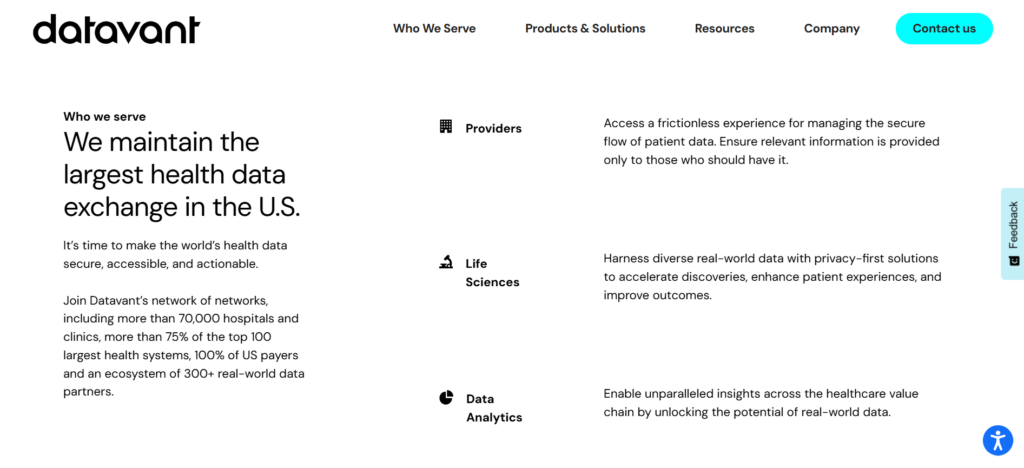
Datavant operates as a health data platform company whose core value proposition centers on making the world’s health data secure, accessible, and actionable. The company’s business model is built around three fundamental pillars: protecting data through advanced compliance and security solutions, connecting data throughout the broadest network of networks, and delivering relevant and timely data through products and services.
Core Technology: Tokenization and De-identification
At the heart of Datavant’s offering is its proprietary tokenization technology, which represents a revolutionary approach to healthcare data privacy. Unlike traditional de-identification methods that simply remove sensitive information, Datavant’s patented technology replaces sensitive patient information with encrypted “tokens” that cannot be reverse-engineered to reveal underlying information.
The breakthrough innovation lies in the technology’s ability to generate the same patient-specific tokens across different datasets, enabling corresponding patient records to be matched between disparate data sources without ever sharing the underlying patient information. This approach solves the fundamental trade-off between data utility and privacy protection that has long plagued healthcare data initiatives.
Target Customer Segments
Datavant serves a diverse ecosystem of healthcare stakeholders, each with distinct needs and use cases:
Healthcare Providers: Hospitals and health systems use Datavant’s platform to access comprehensive patient histories, support continuity of care, and fulfill patient record requests more efficiently.
Payers and Health Plans: Insurance companies leverage the platform for risk adjustment, quality reporting, and population health management initiatives.
Life Sciences Companies: Pharmaceutical and biotech companies utilize Datavant’s network for clinical trial recruitment, real-world evidence generation, and post-market surveillance studies.
Government Agencies: Federal, state, and local government organizations use the platform for public health surveillance, policy research, and regulatory oversight.
Research Institutions: Academic medical centers and research organizations access de-identified datasets for epidemiological studies and clinical research.
Health Data Analytics Companies: Technology vendors and analytics firms integrate with Datavant’s platform to enhance their own offerings with comprehensive real-world data.
Platform Architecture and Services
Datavant’s platform operates as a “network of networks,” connecting over 300 real-world data partners, 70,000+ hospitals and clinics, and serving 75% of the top 100 U.S. health systems. The platform’s architecture enables several key capabilities:
Data Discovery and Assessment: Organizations can identify and evaluate potential data sources through cloud-first discovery tools powered by AWS Clean Rooms.
Privacy-Preserving Record Linkage: The platform enables secure matching of patient records across different healthcare organizations without exposing personally identifiable information.
Compliance and Governance: Comprehensive HIPAA compliance frameworks and data governance tools ensure that all data sharing activities meet regulatory requirements.
APIs and Integration Tools: Standardized interfaces enable seamless integration with existing healthcare systems and workflows.
Revenue Streams of Datavant
Datavant has developed a sophisticated revenue model that capitalizes on multiple aspects of the healthcare data value chain, positioning the company for sustainable, scalable growth.
Data Licensing Revenue
A significant portion of Datavant’s revenue comes from licensing de-identified health data to pharmaceutical companies, research institutions, and other healthcare stakeholders. The global de-identified health data market, valued at approximately $8.09 billion in 2024 and expected to reach $13.59 billion by 2030, represents substantial growth potential for this revenue stream. Datavant’s unique position as the largest health data ecosystem in the United States gives it competitive advantages in data breadth, depth, and quality.
Software-as-a-Service Solutions
The company generates recurring revenue through its software platforms, including data integration tools, privacy-preserving linkage solutions, and data governance software. These SaaS offerings provide customers with self-service capabilities while maintaining Datavant’s oversight of privacy and compliance requirements. The platform’s cloud-first architecture, built on partnerships with AWS and other leading technology providers, enables scalable delivery of these services.
Consulting and Professional Services
Datavant offers specialized consulting services in health data management, leveraging its team’s deep expertise in healthcare regulations, data science, and system integration. These services are particularly valuable for organizations embarking on digital transformation initiatives or implementing new data sharing partnerships.
Recurring Partnership Revenue
More than 70% of Datavant’s revenue is recurring, generated through long-term partnerships and integrations with Electronic Health Record (EHR) systems and other data partners. In 2024, these partnerships generated an estimated $250 million in recurring revenue, providing a stable foundation for the company’s financial performance.
The company is on track to exceed $1 billion in revenue in 2025, with strong profitability and positive cash flow. This financial performance reflects both the growing demand for healthcare data connectivity solutions and Datavant’s successful execution of its business model.
Funding Journey of Datavant
Datavant’s funding history reflects both the enormous market opportunity in healthcare data and the company’s successful execution of its vision.
Series A: Building the Foundation (2018)
In April 2018, Datavant raised $40.5 million in Series A funding led by Roivant Sciences, with participation from founder Travis May. This funding round was particularly significant because Roivant Sciences, founded by Vivek Ramaswamy, created Datavant specifically to support its own pharmaceutical development activities. As Matthew Gline, CEO of Roivant Sciences, explained: “Roivant created Datavant with Travis because we needed this data ecosystem to exist to fulfill our own mission of accelerating the development of novel medicines for patients”.
Series B: Expanding the Ecosystem (2020)
Datavant’s Series B round in October 2020 raised $40 million, led by Transformation Capital with participation from Johnson & Johnson Innovation – JJDC, Inc., Cigna Ventures, and existing investors Roivant Sciences and Flex Capital. This funding enabled the company to expand its healthcare data ecosystem and reduce friction in data exchange and linking.
Travis May commented on the round: “Datavant’s mission is to connect the world’s health data to improve patient outcomes. The fragmentation of health data across institutions holds back every part of medical research and patient care. By making it safe and easy to connect data across institutions, Datavant aspires to accelerate medical research, improve clinical trials, and ultimately enhance patient care”.
| Funding Round | Amount | Date | Lead Investor | Key Participants |
|---|---|---|---|---|
| Series A | $40.5M | April 2018 | Roivant Sciences | Travis May |
| Series B | $40M | October 2020 | Transformation Capital | J&J Innovation, Cigna Ventures, Roivant Sciences, Flex Capital |
| Merger | $7B | July 2021 | New Mountain Capital | Sixth Street, Goldman Sachs Asset Management |
The Transformative Merger: Ciox Health (2021)
The defining moment in Datavant’s financial history came with its merger with Ciox Health in a transaction valued at $7 billion, which closed in July 2021. This transaction was far more than a simple acquisition; it represented the creation of the nation’s largest health data ecosystem.
The merger brought together complementary capabilities: Datavant’s innovative tokenization technology and growing network with Ciox Health’s established clinical data exchange platform and extensive relationships with healthcare providers. The combined entity retained the Datavant name and created an ecosystem encompassing more than 2,000 U.S. hospitals, 15,000 clinics, 120 health plans, 100 health data analytics companies, 30 life science companies, 70 academic institutions and non-profits, and 75 state, local, and federal government agencies.
The transaction was supported by a consortium of leading investors, including existing shareholders New Mountain Capital, Roivant Sciences, Transformation Capital, Merck Global Health Innovation Fund, Labcorp, Cigna Ventures, Johnson & Johnson Innovation, and Flex Capital, along with significant new investment from Sixth Street and participation from Goldman Sachs Asset Management.
Strategic Leadership Evolution of Datavant
Travis May Era (2017-2022): Foundation and Growth
Under Travis May’s leadership as CEO, Datavant established itself as the leading health data connectivity platform and executed the transformative merger with Ciox Health. May’s vision and execution capabilities, honed through his experience building LiveRamp, proved invaluable in navigating the complex healthcare landscape and building trust with stakeholders across the ecosystem.
Pete McCabe Transition (2021-2024): Integration and Scale

Following the merger with Ciox Health, Pete McCabe, formerly CEO of Ciox Health, became CEO of the combined entity. McCabe brought deep expertise in clinical data exchange and established relationships with healthcare providers. Under his leadership, Datavant successfully integrated the two organizations and expanded its market presence.
McCabe’s tenure was marked by significant operational achievements, including the acquisition of Healthjump in 2023, which added capabilities in value-based care data exchange. The company also launched its Clinical Insights Platform in March 2025, leveraging AI to make 50 million patient records from 70,000 health systems actionable.
Kyle Armbrester Era (2024-Present): Next-Generation Innovation

In May 2024, Datavant appointed Kyle Armbrester as CEO, bringing extensive experience from leading healthcare technology companies. Armbrester joined from CVS Health, where he served as CEO of Signify Health, a leading provider of value-based care services. His background also includes serving as Chief Product Officer at athenahealth, giving him deep understanding of healthcare technology systems and workflows.
Armbrester’s appointment signals Datavant’s evolution toward more sophisticated AI-driven capabilities and expanded market opportunities. As he described his vision: “Powering every health decision with full longitudinal data of a patient — across life sciences companies, providers of care, and health plans — is one of the toughest, yet most rewarding challenges we face. Interoperability will drive better care for patients, more optimized healthcare costs, and fuller realization of life-saving research”.
Competitive Landscape and Market Position of Datavant
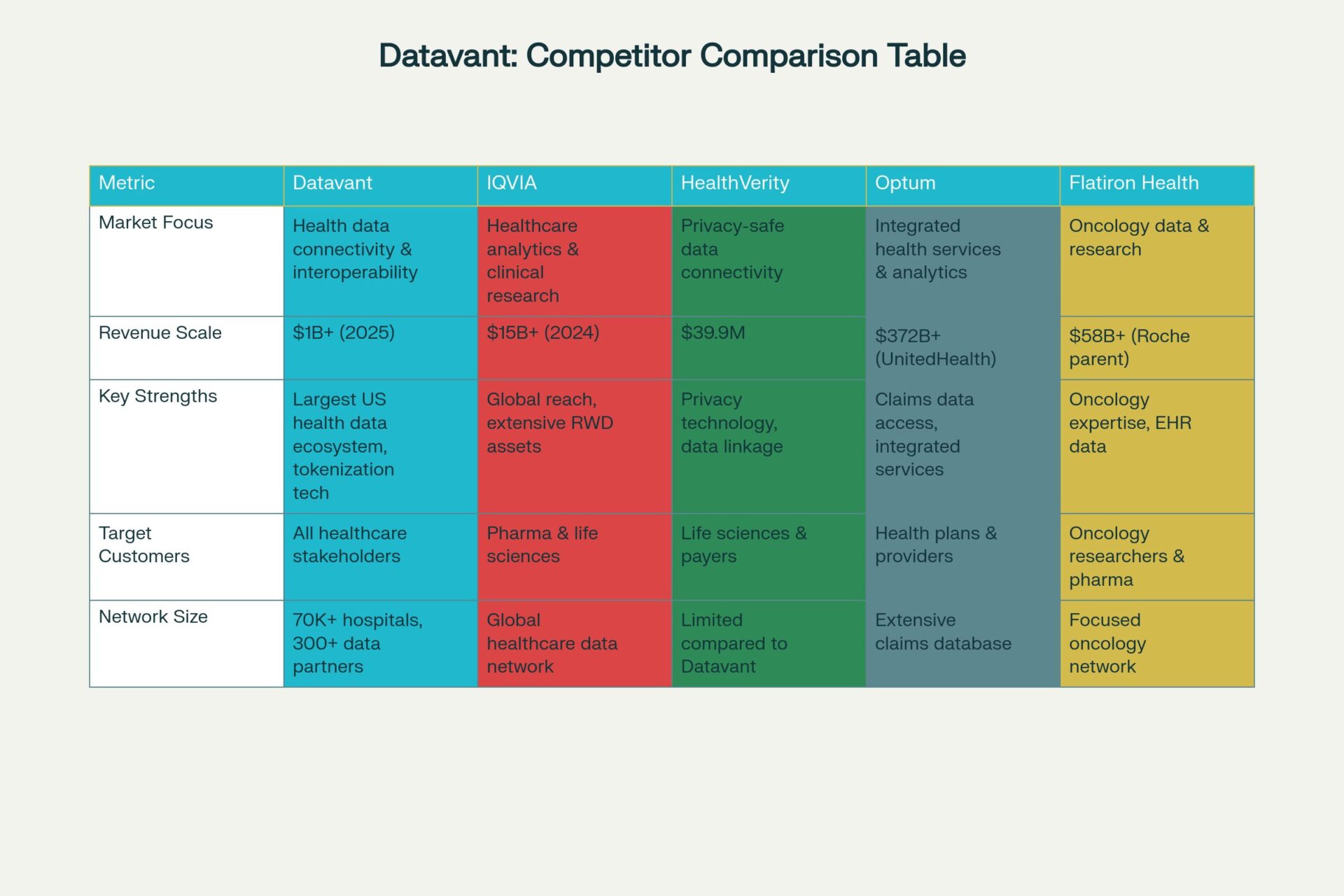
Datavant operates in the rapidly evolving healthcare data connectivity and real-world data market, competing with both established players and emerging startups. The competitive landscape can be segmented into direct competitors offering similar data connectivity solutions and indirect competitors providing overlapping capabilities.
Direct Competitors of Datavant
IQVIA represents Datavant’s most formidable competitor, with approximately $15 billion in annual revenue and extensive global healthcare data assets. IQVIA’s strength lies in its established relationships with pharmaceutical companies and comprehensive real-world data offerings. However, Datavant differentiates itself through its focus on neutral data connectivity and privacy-preserving technologies.
HealthVerity competes directly in the privacy-safe data connectivity space, with reported revenue of $39.9 million and 265 employees. While smaller than Datavant, HealthVerity focuses specifically on life sciences and payer markets with similar privacy-preserving data linkage technologies.
Optum, as part of UnitedHealth Group’s $372 billion ecosystem, brings massive scale and integrated healthcare services. Optum’s competitive advantage lies in its access to extensive claims data through UnitedHealth’s insurance operations, though this vertical integration may limit its appeal as a neutral platform.
Flatiron Health, owned by Roche, focuses specifically on oncology data and research. While narrower in scope than Datavant, Flatiron’s deep oncology expertise and EHR data capabilities make it a strong competitor in cancer research applications.
Competitive Advantages of Datavant
Datavant’s competitive positioning rests on several key differentiators that create substantial barriers to entry:
Scale and Network Effects: As the largest health data ecosystem in the United States, Datavant benefits from powerful network effects. The value of its platform increases with each additional data partner, creating a virtuous cycle that attracts more participants and enhances data comprehensiveness.
Proprietary Technology: The company’s patented tokenization and de-identification technologies provide technical advantages that competitors struggle to replicate. These capabilities enable more accurate patient matching while maintaining higher privacy standards than traditional approaches.
Neutral Market Position: Unlike competitors tied to specific payers or pharmaceutical companies, Datavant maintains neutrality that makes it trusted by all healthcare stakeholders. This positioning is crucial in an industry where organizations are often reluctant to share data with potential competitors.
Regulatory Expertise: Datavant’s deep compliance capabilities and regulatory expertise provide competitive advantages in an industry where data governance failures can result in significant penalties and reputational damage.
Comprehensive Coverage: With connections to 75% of the top 100 U.S. health systems and 100% of U.S. payers, Datavant offers unmatched data coverage for research and analytics applications.
Strategic Acquisitions and Expansion of Datavant
Datavant’s growth strategy has been significantly enhanced through strategic acquisitions that expand its capabilities and market reach.
Healthjump Acquisition (2023)
The acquisition of Healthjump in 2023 expanded Datavant’s capabilities in value-based care data exchange. Healthjump’s platform enables healthcare organizations to pull standardized EHR data from participating practices regardless of their EHR systems, supporting risk-bearing arrangements and quality reporting initiatives.
Apixio Integration (2024)
Datavant’s acquisition of Apixio’s AI-based Connected Care platform in September 2024 led to the launch of the Clinical Insights Platform in March 2025. This platform uses artificial intelligence to improve operations and patient care, making 50 million patient records from 70,000 health systems actionable through advanced analytics.
Aetion Acquisition (2025)
The most significant recent acquisition was Aetion, completed in July 2025, which significantly expands Datavant’s real-world evidence capabilities. Aetion brings regulatory-grade analytics and scientific expertise that enables healthcare and life sciences companies to generate evidence about treatment effectiveness and safety.
The combined organization now has an ecosystem of over 300 data partners comprising datasets across electronic health records, claims, specialty pharmacy, registries, imaging, laboratories, social determinants of health, and more. This acquisition positions Datavant to offer end-to-end real-world evidence solutions from data discovery through advanced analytics.
Technology Innovation and AI Integration of Datavant
Datavant is increasingly leveraging artificial intelligence to enhance its data connectivity and analytics capabilities. The company’s AI initiatives focus on several key areas:
Automated Data Processing: AI technologies enable automated extraction and interpretation of health data from diverse sources, reducing manual processing time and improving accuracy.
Enhanced Patient Matching: Machine learning algorithms improve the accuracy of patient record linkage across different healthcare systems, enabling more comprehensive longitudinal patient views.
Privacy-Preserving Analytics: AI-powered approaches enable analysis of sensitive health data while maintaining privacy protections, supporting research and quality improvement initiatives.
Predictive Analytics: The platform’s AI capabilities support predictive modeling for clinical outcomes, population health management, and risk stratification.
Challenges and Risk Factors of Datavant
Despite its strong market position, Datavant faces several significant challenges:
Regulatory Complexity
Healthcare data governance involves navigating complex and evolving regulations including HIPAA, state privacy laws, and emerging federal legislation. Maintaining compliance across multiple jurisdictions while enabling data sharing requires continuous investment in legal and compliance capabilities.
Competition from Tech Giants
Large technology companies including Google, Microsoft, and Amazon are increasingly investing in healthcare data platforms, bringing substantial resources and existing cloud infrastructure advantages.
Data Security Concerns
Healthcare data represents an attractive target for cybercriminals, requiring continuous investment in security infrastructure and incident response capabilities. Any security breach could significantly damage trust and regulatory standing.
Interoperability Standards Evolution
The healthcare industry’s ongoing adoption of interoperability standards like FHIR and initiatives like TEFCA could change the competitive landscape by reducing barriers to data exchange.
Market Opportunity and Future Outlook of Datavant
The healthcare data connectivity market represents an enormous and growing opportunity. The global healthcare data interoperability market is expected to reach nearly $16 billion by 2030, while the de-identified health data market is projected to grow from $8.09 billion in 2024 to $13.59 billion by 2030.
Several trends support continued market expansion:
Increased Focus on Real-World Evidence: Regulatory agencies and payers are increasingly requiring real-world evidence to support coverage and reimbursement decisions.
AI and Machine Learning Adoption: The healthcare industry’s growing adoption of AI technologies increases demand for comprehensive, high-quality datasets.
Value-Based Care Expansion: The ongoing shift toward value-based payment models requires enhanced data sharing and analytics capabilities.
Precision Medicine Growth: Personalized treatment approaches require integration of diverse data types including clinical, genomic, and social determinants information.
Regulatory Support: Initiatives like the 21st Century Cures Act and TEFCA support increased data liquidity and interoperability.
Vision for the Future of Datavant
Under Kyle Armbrester’s leadership, Datavant is positioning itself for the next phase of growth focused on expanding its artificial intelligence capabilities and global reach. The company is actively pursuing additional acquisitions to enhance its platform capabilities and market coverage.
Armbrester has indicated that Datavant expects to make “one or two” additional acquisitions in 2025, focusing on companies building technology for healthcare providers and life sciences organizations. The strategy emphasizes acquiring great products with existing market traction that can be enhanced through Datavant’s extensive data network and customer base.
The company’s long-term vision extends beyond simple data connectivity to enabling a healthcare system where every clinical decision is powered by comprehensive, real-time patient data. This vision encompasses several key components:
Universal Data Liquidity: Creating a healthcare system where patient data flows seamlessly between authorized parties while maintaining privacy and security.
AI-Powered Decision Support: Leveraging artificial intelligence to provide healthcare providers with actionable insights at the point of care.
Global Expansion: Extending Datavant’s platform capabilities to international markets where healthcare data fragmentation presents similar challenges.
Ecosystem Platform Evolution: Transitioning from a data connectivity company to a comprehensive platform that enables diverse healthcare applications and innovations.
Conclusion
Datavant represents one of the most significant success stories in healthcare technology, transforming from a startup with an ambitious vision to the nation’s largest health data ecosystem in less than a decade. The company’s journey from its 2017 founding through its $7 billion merger with Ciox Health and subsequent strategic acquisitions demonstrates both the enormous market opportunity in healthcare data connectivity and the execution capabilities of its leadership team.
The startup’s success stems from its unique combination of technological innovation, regulatory expertise, and neutral market positioning that has enabled it to build trust with healthcare stakeholders across the ecosystem. Its proprietary tokenization technology solves the fundamental challenge of enabling data sharing while maintaining privacy, creating sustainable competitive advantages that are difficult for competitors to replicate.
Under new CEO Kyle Armbrester’s leadership, Datavant is positioned for continued growth and innovation as the healthcare industry accelerates its digital transformation. The company’s strong financial performance, comprehensive data network, and expanding capabilities in artificial intelligence and real-world evidence position it to capture significant value from the growing demand for healthcare data connectivity solutions.
As healthcare stakeholders increasingly recognize the critical importance of data connectivity for improving patient outcomes, reducing costs, and accelerating medical research, Datavant’s mission to connect the world’s health data becomes ever more relevant and valuable. The company’s brand story represents not just a successful startup journey, but a fundamental transformation in how healthcare data is shared, protected, and utilized to improve human health.
Also Read: DevRev– Founders, Business Model, Funding & Competitors
To read more content like this, subscribe to our newsletter