Last Updated on September 9, 2025 by Team TBH
In an era of back-to-back virtual meetings, professionals spend an average of over 21 hours per week in meetings, yet 71% of senior managers find many of those meetings unproductive. This inefficiency costs businesses billions in lost productivity. Otter.ai emerged to tackle this problem by using artificial intelligence to capture and unlock the value of every conversation. Otter.ai is an AI-powered transcription and meeting assistant platform that records, transcribes, and summarizes meetings in real time, making discussions searchable, shareable, and actionable. Since its founding in 2016, the company has grown into a market leader with a global user base. As of 2025, Otter.ai serves over 25 million users worldwide and has surpassed $100 million in annual recurring revenue (ARR). It has been recognized among The Wall Street Journal’s top generative AI apps of 2023 and even featured on Forbes’ list of Best Startup Employers in 2024. This report presents a comprehensive brand story and strategic analysis of Otter.ai, covering its founding, leadership, business model, revenue streams, funding history, competitors, competitive advantages, products, and future outlook.
Founding Story of Otter.ai
Otter.ai’s story begins in 2016, when it was founded (under the original name AISense) by two seasoned computer science engineers, Sam Liang and Yun Fu. The idea for Otter was born out of Liang’s firsthand frustration with the inefficiency of meetings. As a tech executive attending 30 to 40 meetings a week, he struggled to remember and keep track of all the information exchanged. Important decisions and action items were often lost in the shuffle of back-to-back calls. Liang realized that if he was experiencing this pain, countless others must be as well. This insight – that vast amounts of knowledge from meetings evaporate due to human limits in note-taking and attention – sparked the creation of a solution.
Inspiration also came from Liang’s background in data and location services. Before Otter, Sam Liang had spent four years at Google, where he helped develop the “blue dot” location indicator on Google Maps, reaching billions of users. He then founded Alohar Mobile in 2010, a context-aware mobile platform that was acquired by Alibaba in 2013. Alohar’s work in continuous mobile sensing introduced Liang to Yun Fu, who led infrastructure engineering there. Having successfully collaborated at Alohar, Liang and Fu teamed up again to apply AI to speech and meetings. They envisioned an AI assistant that could “remember, search, and share your voice conversations”, effectively creating a smart, searchable memory of all meetings.
The company’s initial name, AISense, reflected its focus on artificial intelligence and making “sense” of audio data. Early on, the founders honed the speech recognition technology and began collecting vast amounts of voice data to train their algorithms. By 2018, they launched the product publicly as “Otter” – named to evoke a friendly, attentive note-taker – and soon rebranded the company itself to Otter.ai. The friendly otter mascot symbolized the product’s approachability and its role in “streamlining how meetings operate” by removing tedious tasks like manual note-taking. The founding story of Otter.ai is thus one of experienced entrepreneurs leveraging deep AI expertise to solve a ubiquitous workplace problem, with a vision of turning every meeting into valuable knowledge.
Founders of Otter.ai
Sam Liang

Sam Liang, Otter.ai’s co-founder and CEO, is the driving force behind the company’s vision. Liang holds a Ph.D. in Electrical Engineering from Stanford University, where he studied under Professor David Cheriton – the first investor in Google. His career began at Google, where he led the development of key location-based services for Google Maps (notably, the blue dot indicating a user’s location). After Google, Liang demonstrated his entrepreneurial chops by founding Alohar Mobile, a pioneer in mobile location context; Alohar was acquired by Alibaba in 2013. This exit and Liang’s 20+ patents in tech established him as an innovator in scalable data-driven services. Liang’s experience at Google taught him the power of harnessing data at scale, a lesson he carried into Otter.ai’s mission to harness the data in conversations. In interviews, Sam Liang recalls being surrounded by ambitious entrepreneurs at Stanford and feeling inspired: “Every day I saw other people doing big things and I started to think: ‘Why can’t I do it someday?’”. That ambition and technical insight directly shaped Otter.ai.
Yun Fu

Yun Fu, Otter.ai’s co-founder and CTO, complements Liang with deep engineering and infrastructure expertise. Fu earned a Ph.D. in Computer Science from Duke University and built a career in scalable software systems. He worked at Yahoo and later joined Alohar Mobile as Director of Engineering, where he met Liang. Fu specialized in building robust, high-performance backend systems – experience crucial for processing the huge volumes of audio data Otter.ai would handle. At Otter.ai, Yun Fu architected the proprietary speech recognition engine and cloud infrastructure that differentiate the platform. Under Fu’s technical leadership, Otter.ai developed its own automatic speech recognition (ASR) models instead of relying on third-party APIs. This in-house approach yielded higher accuracy, especially in identifying speakers and transcribing overlapping speech, giving Otter a quality edge.
Both founders share a passion for artificial intelligence and its practical application. Liang drives the product vision and business strategy as CEO, while Fu as CTO leads the technical teams that bring that vision to life. Together, Liang and Fu’s complementary backgrounds – spanning Google-scale consumer tech and hardcore AI engineering – formed the bedrock of Otter.ai’s innovation.
Business Model of Otter.ai
Otter.ai operates a freemium SaaS (Software-as-a-Service) business model that targets both individuals and organizations. At its core, the company’s approach is product-led and bottom-up: users can start with a free version of Otter to transcribe meetings, and a portion convert into paid subscribers as their needs grow. The platform integrates easily with everyday workflows – for example, users connect Otter to their calendar and video conferencing apps so that an “Otter Assistant” can automatically join meetings to take notes. This seamless integration has made Otter a viral productivity tool in workplaces; it spreads organically when one person’s Otter assistant appears in a meeting, piquing colleagues’ curiosity. In fact, each time the Otter bot joins a meeting, it introduces the service to other participants – a growth mechanism that generates an estimated 7.5 new user interactions per meeting, driving customer acquisition costs down to mere cents. This viral loop helped Otter.ai rapidly grow its user base with minimal traditional marketing.
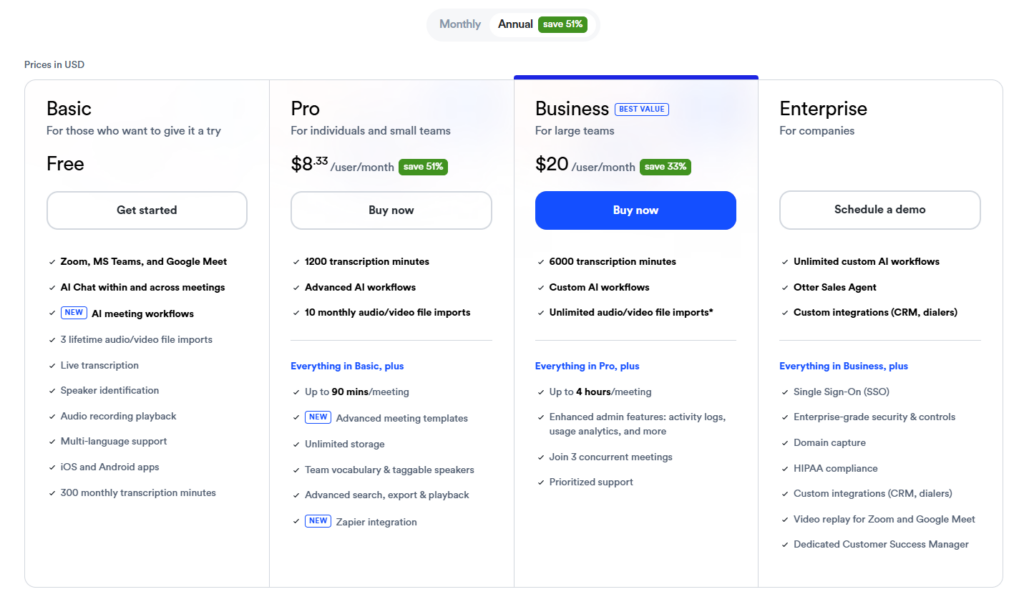
Under the freemium model, basic features are free (with limited usage), and advanced capabilities are accessible via tiered subscription plans. Otter.ai’s pricing strategy is carefully calibrated to encourage upgrades. The Free plan offers a generous trial of the technology – for instance, 300 transcription minutes per month and 30 minutes per meeting on the basic tier. Power users and professionals are funneled toward the Pro plan (approximately $8–$10 per user/month) which provides more minutes (up to 1,200 minutes monthly) and features like advanced search, bulk export, and custom vocabulary. For teams and businesses, there is a Business plan (around $20 per user/month on annual billing) supporting up to 6,000 minutes per user and collaborative features like centralized administration, shared speaker tagging, and live meeting collaboration. Large enterprises can opt for a custom-priced Enterprise plan with higher limits, enhanced security (Single Sign-On, advanced compliance), and priority support. The table below summarizes Otter.ai’s tiered plans and key limits:
| Plan | Price (USD/user) | Monthly Transcription Minutes | Notable Features |
|---|---|---|---|
| Basic (Free) | $0 | 300 (30 min per conversation) | AI transcriptions & summaries; limited exports |
| Pro | $8.33/month (annual) | 1,200 (90 min per conversation) | Advanced search, speaker ID, file import, collaborative highlights |
| Business | $20/month (annual) | 6,000 (4 hours per conversation) | Admin console, team analytics, multiple concurrent assistants |
| Enterprise | Custom | Custom (higher limits) | Enterprise security (SSO), org-wide deployment, priority support |
Table: Otter.ai Pricing Tiers and Limits (as of 2025)
The business model relies on converting free users to paid. Otter.ai’s usage caps create a natural upsell mechanism: as individuals or teams rely more on the service, they are nudged to upgrade for higher limits. Internally, the company has found that about 73% of Pro users hit their minute cap within four months, often prompting a move to the Business plan. This usage-driven upgrade path, combined with the relatively low marginal cost of servicing additional minutes, yields healthy gross margins of 70–80%. In essence, Otter’s model is a volume play – get widespread adoption through a free product and viral growth, then monetize through subscription upgrades and enterprise licensing.
Another key aspect of the business model is B2B2C distribution. Many enterprise tools are adopted top-down, but Otter has often entered organizations bottom-up. Individual employees start using it, then teams adopt it, and eventually the company may sanction an enterprise-wide plan for centralized management. This “land-and-expand” dynamic has helped Otter penetrate a diverse customer base ranging from small startups to Fortune 500 corporations. During the COVID-19 pandemic, this model paid off immensely: the shift to remote work made online meetings ubiquitous, creating “unprecedented demand” for Otter’s meeting productivity tools. As a result, Otter.ai’s revenue grew over 800% in 2020 alone. The company’s user footprint exploded to more than 100 million meetings transcribed (3 billion minutes of audio) by early 2021, showcasing how quickly a freemium SaaS can scale when it captures a zeitgeist need.
Revenue Streams of Otter.ai
Otter.ai’s revenue comes primarily from recurring subscription fees across its various plans. The company has a straightforward revenue model centered on selling access to its software service. Key revenue streams include:
-
Individual Subscriptions: A significant portion of Otter’s paying customers are individual professionals (journalists, students, freelancers, etc.) who subscribe to Pro accounts. At $8–$10 per month, Pro users get expanded functionality. Millions of free users serve as a funnel into these paid individual plans.
-
Team and Business Licenses: Small and medium businesses often opt for the Business plan, paying $20–$30 per user/month for enhanced collaboration and admin controls. Otter.ai offers volume-based pricing and trials to encourage teams to onboard collectively. These multi-seat licenses increase average revenue per account and drive much of the ARR growth.
-
Enterprise Contracts: Larger organizations can negotiate enterprise contracts with custom pricing, typically based on hundreds or thousands of seats. Enterprises value features like single sign-on (SSO), advanced security, and dedicated account management. While enterprise deals make up a smaller fraction of user count, they contribute significantly to revenue given higher per-seat prices and long-term commitments.
-
Education and Partnerships: From early on, Otter.ai also offered specialized plans for education (launched as “Otter for Education” in 2018) targeting universities and schools. These deals often involve campus-wide licenses or discounts for students and faculty, supporting the revenue stream while expanding user base. Additionally, strategic partnerships can generate revenue or broaden reach; for example, Otter’s collaboration with NTT Docomo in Japan involved trials with language-learning firm Berlitz, potentially opening a new regional revenue source.
-
Vertical AI Solutions (New in 2025): As of 2025, Otter.ai is introducing add-on AI services like the Sales Agent and SDR Agent (for sales and lead generation use cases). These are likely monetized as premium upgrades or separate modules for business customers. For instance, a sales team might pay extra for the Otter Sales Agent that provides real-time coaching on calls. While still emergent, these vertical AI agents represent potential new revenue streams layered on top of the core transcription service.
It’s worth noting that Otter.ai does not rely on advertising or selling user data; trust and privacy are crucial given the sensitive nature of business meetings. The revenue model is purely service-based. Within this model, certain customer segments are especially lucrative. Notably, sales teams have proven to be a high-value segment across Otter’s user base – they represent only about 31% of users but drive 68% of revenue for AI note-taking tools, since sales professionals are willing to pay for features that help close deals and often purchase higher-tier plans. This insight has guided Otter.ai’s product development (e.g., creating the Sales Agent) and go-to-market focus, aligning revenue efforts with the most monetizable use cases. Overall, recurring subscriptions form the bedrock of Otter.ai’s financial model, delivering predictable ARR that recently crossed the nine-figure milestone.
Funding of Otter.ai
Despite its rapid growth and increasing revenues, Otter.ai’s journey was catalyzed by venture capital backing in its early years. The company has raised multiple rounds of funding to finance product development and expansion. In total, Otter.ai secured roughly $70–$73 million in funding from 2016 through 2021. The investor roster includes an impressive lineup of venture firms and tech luminaries. Otter’s seed and Series A rounds drew support from Draper Associates and Draper Dragon (funds led by Tim Draper), Horizons Ventures (the private investment arm of Li Ka-shing, known for early Google and Facebook bets), GGV Capital, Slow Ventures, and even Bridgewater Associates’ founder Ray Dalio (via personal investment) and Stanford’s David Cheriton. This meant that from the outset, Otter.ai was “backed by early investors in Google, Tesla, DeepMind, and Facebook”, as the company often touts. Such backing lent credibility and provided not just capital but also strategic guidance to navigate the competitive AI landscape.
Funding has been used to advance Otter.ai’s speech recognition research, scale its cloud infrastructure, and acquire users (though, as noted, user growth was largely organic and cost-efficient). Capital also went into hiring talent: for example, after a major round in 2021, Otter planned to triple headcount to accelerate product development and go-to-market efforts. Key executive hires, like a Chief Marketing Officer in 2021, were made to bolster the company’s commercialization. By 2025, Otter.ai grew to around 200 employees while keeping a lean, productivity-focused culture – generating over $500,000 in revenue per employee, an indicator of efficient use of its funding and manpower.
Otter’s funding history shows a steady increase in valuation and investor confidence at each stage. Notably, the company’s Series B in 2021 was a large $50 million raise led by Spectrum Equity, a growth-stage investor with a track record in scaling SaaS companies. This round alone accounted for over two-thirds of Otter’s total funding and positioned the company with a strong war chest to refine its AI technology and expand enterprise sales. By hitting $100M ARR in 2025 without any further large funding rounds, Otter.ai demonstrated an ability to approach self-sustainability, possibly eyeing an IPO or strategic opportunities in the future. The table below summarizes Otter.ai’s key funding rounds:
| Date | Round | Amount (USD) | Lead Investor(s) |
|---|---|---|---|
| Sep 2016 | Seed | $3 million | Draper Associates & Draper Dragon (Tim Draper) |
| Nov 2017 | Series A | $10 million | Horizons Ventures (Li Ka-shing) |
| Jan 2020 | Strategic Investment | $10 million | NTT Docomo Ventures (NTT Group) |
| Feb 2021 | Series B | $50 million | Spectrum Equity (John Connolly) |
Table: Otter.ai Funding Rounds and Investors
By early 2021, after the Series B, Otter.ai’s total funding reached approximately $73 million. Subsequent growth has been driven by revenues, with no publicly announced Series C as of 2025. The strong backing from prominent investors not only provided capital but also signaled market validation of Otter’s vision. It’s also noteworthy that one of Otter’s strategic investors, NTT Docomo (the Japanese telecom giant), became an early customer – piloting Otter’s technology for transcribing language lessons. Such investor-customer relationships illustrate how funding and partnerships intertwined to fuel Otter.ai’s expansion.
Competitors of Otter.ai
As a pioneer in AI transcription and meeting notes, Otter.ai initially had few direct competitors of equal scale, but the landscape has since grown crowded with players ranging from startups to tech giants. Direct competitors are other AI-powered meeting assistant tools that join virtual meetings and generate transcripts and summaries. For example, Fireflies.ai offers a similar bot that integrates with Zoom and other platforms; Fireflies has gained some traction (reportedly around $11M ARR) by marketing “unlimited” transcription at a flat monthly rate. Other notable startup competitors include Grain, Fathom, Avoma, MeetGeek and Airgram, each adding their own twist – such as Grain focusing on capturing video clip highlights, or Fathom providing instant post-call summaries. These competitors operate on comparable subscription models, though some differentiate by pricing (Fireflies uses storage limits instead of minute limits, for instance). The presence of many small players has made the space increasingly commoditized, as basic transcription technology becomes more accessible.
A second category of competition comes from alternative recording approaches. One example is a startup called Granola (backed by a $20M Series A) that avoids the need for a meeting bot by running a local agent on the user’s device to capture audio. This “no bot” method appeals to users who find the appearance of a bot in meetings awkward or who have privacy concerns about third-party services listening in. While Granola and similar tools (e.g., tl;dv or Recall.ai’s SDK) are less visible to meeting participants, they potentially threaten Otter’s viral growth loop by operating silently. However, they trade off the word-of-mouth exposure that Otter’s approach benefits from.
The most formidable competitors are the big platform providers themselves. Video conferencing giants like Zoom, Microsoft Teams, and Google Meet have steadily built-in their own transcription and even auto-summary features. Zoom, for instance, introduced live transcription (initially even partnering with Otter in 2018 for post-meeting transcripts before developing native capabilities). Microsoft Teams now offers live captions, transcript logs, and with the advent of its AI-powered Copilot, can generate meeting recaps. Google Meet similarly provides live captions and is integrating translation and summary in Google Workspace. These platform-native features come “for free” with the meeting service, effectively eroding the necessity for a third-party tool for basic functionality. Otter.ai thus faces an existential competitive threat from platform bundling: if transcription becomes a commodity feature of every meeting app (and if those built-in versions are good enough), standalone services must offer superior value to justify their cost.
Finally, there are traditional transcription services (like Rev.com, which offers both human and automated transcription) and general-purpose speech-to-text APIs from companies like Google, Amazon, and IBM. However, these are less direct competitors in the meeting context – they lack the real-time, collaborative meeting workflow that Otter provides. They do indicate, though, how widely available the raw technology of transcription has become, pressing Otter to continually differentiate.
In summary, Otter.ai’s competitive arena spans startup rivals (eager to chip away at its lead with aggressive pricing or niche features), alternative tech models (avoiding bots or focusing on privacy), and tech giants’ integrated solutions (turning Otter’s core feature into a baseline commodity). The presence of many competitors highlights the market demand for meeting productivity tools, but also underlines that Otter must keep innovating to maintain its edge in accuracy, features, and user experience.
Competitive Advantage of Otter.ai
Despite rising competition, Otter.ai has maintained a leading position thanks to several key competitive advantages:
-
Superior Technology and Accuracy: Otter’s decision to build a proprietary speech recognition engine from scratch has paid dividends in transcription quality. The platform boasts high accuracy even in challenging scenarios (multiple speakers, cross-talk) and offers automatic speaker identification – features honed on billions of minutes of training data. This technical excellence set Otter apart from early competitors that relied on generic speech APIs. Otter’s system also intelligently captures context, distinguishing it as not just a transcriber but a conversation understanding tool.
-
First-Mover and Data Scale: Launched in early 2018, Otter.ai was one of the first to market with a real-time meeting transcription service, which allowed it to gain traction and a rich dataset before others. By 2025, Otter has processed over 1 billion meetings, amassing an unparalleled corpus of conversational data. This data advantage feeds back into improving Otter’s AI models (for example, to better summarize meetings or extract action items). The scale also provides network effects – many professionals are already familiar with Otter, making them less inclined to switch to an unknown competitor.
-
Seamless Integration and Ecosystem Partnerships: Otter.ai works across all major platforms – it integrates with Zoom, Google Meet, and Microsoft Teams, and can even handle in-person meetings via its mobile app. The ability to function in any meeting environment (without locking users into one ecosystem) is a strong point, especially for organizations that use multiple conferencing tools. Otter’s early partnership with Zoom in 2018 to transcribe meetings gave it visibility and credibility. Moving forward, Otter’s development of vertical “Agents” (for sales, education, recruiting, etc.) also involves integrating with systems like CRM (for Sales Agent) and ATS software (e.g., Greenhouse for Recruiting Agent)otter.ai, positioning Otter at the center of a user’s workflow rather than as an isolated tool.
-
Comprehensive Feature Set: Over the years, Otter has evolved from a simple transcriber to a full-fledged meeting productivity suite. It not only transcribes but also provides live captions, generates AI summaries, identifies key highlights (“Otter Meeting Gems”), and even captures images of slides presented. The introduction of OtterPilot in 2023 brought automated meeting outlines and the capability to capture presentation materials in real time. In 2025, the rollout of the Otter Meeting Agent – an AI that can actively answer questions during meetings – is a first-of-its-kind innovation that goes beyond what competitors currently offer. This continual enhancement means Otter provides a one-stop solution (transcripts + summaries + actions), reducing the need for multiple tools.
-
Viral Growth and Brand Recognition: Otter has become synonymous with AI meeting notes in many circles – people speak of “sending the Otter” to a meeting. The quirky, memorable name and the visible presence of the Otter assistant in meetings acted as organic marketing. While some competitors chose a stealthier approach, Otter’s in-your-face method gave it a word-of-mouth advantage. The brand also benefited from positive press and accolades (e.g., being named a top app by Mashable and Fast Company in 2018). By focusing on collaboration and sharing features early (users can share transcripts and invite teammates), Otter entrenched itself in group workflows, making it harder to rip out once adopted.
-
Operational Efficiency: Even as it scaled to tens of millions of users, Otter.ai kept a relatively small team (<200 employees as of 2025) and emphasized automation. The result is a company generating nine-figure ARR with startup-level nimbleness. This efficiency manifests in competitive pricing (able to offer generous free tiers and low per-seat cost) and the ability to iterate quickly on product improvements. Investors and industry observers have pointed to Otter’s revenue per employee (~$500k) as a sign of strong execution. In contrast, many competitors are either much smaller (lacking resources) or, in the case of big tech, burdened by bureaucracy. Otter’s lean approach is a strategic edge in a fast-moving AI field.
In combination, these advantages – technology, data, integration, rich features, brand, and efficiency – form a moat around Otter.ai. However, the company is not complacent; it continuously invests in innovation (e.g., voice-activated agents, workflow automation features) to widen that moat. As basic transcription gets commoditized, Otter’s strategy is to move up the value chain (from transcribing to understanding to assisting in meetings), ensuring it remains indispensable to customers despite the competitive pressures.
Products and Services of Otter.ai
Otter.ai’s product suite has expanded from a single app into a range of services aimed at making meetings more productive. The flagship offering is Otter, the AI-powered note-taking application available via web, desktop, and mobile. At its core, Otter provides real-time transcription of spoken conversations, whether in-person (using a smartphone microphone) or virtual (via the Otter assistant joining online meetings). But around this core, Otter has layered numerous capabilities and specialized services over the years:
-
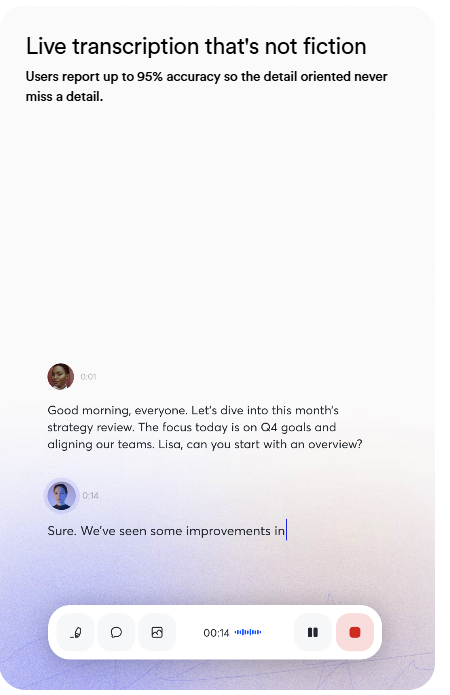
Otter Voice Meeting Notes App: Launched in early 2018 at Mobile World Congress, the initial app allowed users to record conversations and get instant transcriptions with speaker labels. It featured a searchable transcript, the ability to play back audio aligned with text, and options to highlight or comment on transcript sections. This base product introduced the fundamental value: making spoken conversations as easy to work with as written text.
-
Live Meeting Integrations: Otter quickly integrated with major conferencing platforms. In January 2018, Otter (AISense at the time) announced a partnership with Zoom to enable meeting transcription after calls. By 2019, Otter for Teams (later called Otter Business) was released, offering businesses a way to have an Otter assistant bot join their meetings on Zoom or Google Meet automatically and provide live notes. During the pandemic in April 2020, Otter launched Live Notes for Zoom, which let Zoom participants see an Otter-powered live transcript during the call. These integrations effectively turned Otter into a real-time captioning service as well, aiding accessibility and engagement.
-
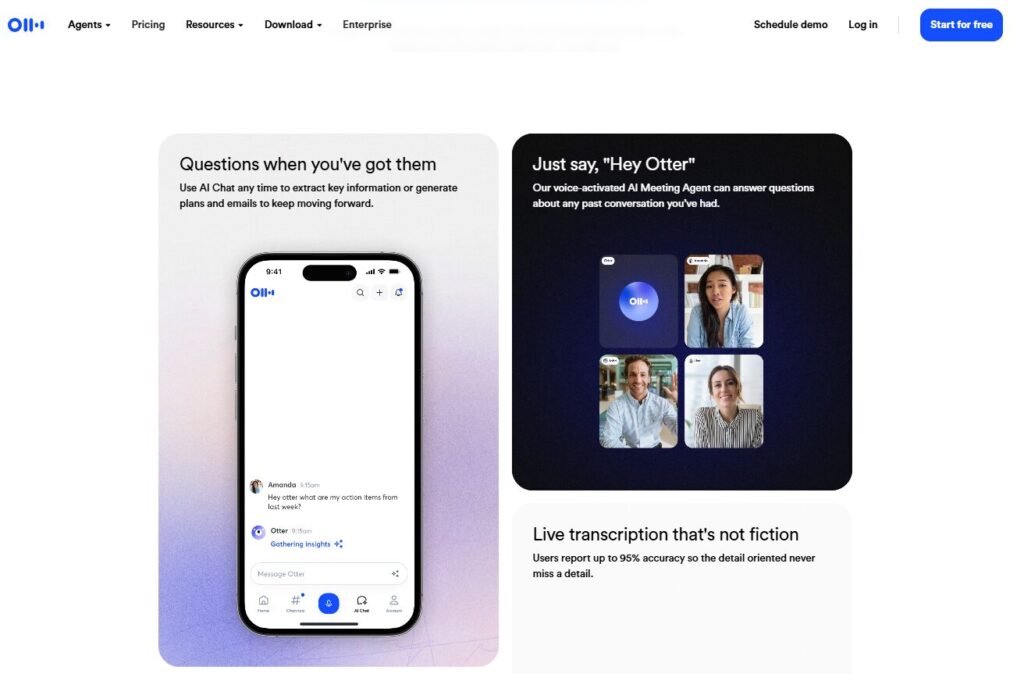
Otter Assistant (OtterPilot): A major innovation came in February 2023 with the introduction of OtterPilot, an AI meeting assistant available to all users. OtterPilot (also referred to as the Otter Assistant) can auto-join meetings on the user’s calendar, record and transcribe the discussion, and even capture screenshots of slides presented. It also uses natural language processing to generate an AI summary of key topics discussed and identify action items or questions. For example, after a one-hour meeting, Otter can produce a succinct summary highlighting decisions made and next steps. OtterPilot essentially automated the role of a meeting secretary: it attends on your behalf and produces minutes. This feature differentiated Otter from simple recorders by adding contextual understanding and convenience. By mid-2023, the platform also introduced “Otter Chat”, allowing meeting participants to query the live transcript (e.g., “What decision was just made regarding budget?”) and get an instant answer, showing Otter’s move toward interactive AI during meetings.
-
Vertical and Enterprise Solutions: Recognizing that different domains have different needs, Otter.ai rolled out tailored solutions. Otter for Education (launched October 2018) provided students with a note-taking tool for lectures, including sharing notes with classmates. Otter for Sales (announced in 2023–2024) was a set of features catering to sales calls – such as real-time coaching and tracking of customer questions. The pinnacle of this strategy came in early 2025 with the launch of the Otter AI Meeting Agent Suite. This suite introduced three AI “agents”:
-
The Otter Meeting Agent – essentially the next evolution of OtterPilot – which not only transcribes but actively participates in meetings. It can take voice commands/questions during the meeting and respond based on the company’s past meeting data. For example, in a team meeting one could ask, “Otter, what did we decide about Project X last week?” and the agent can answer from the recorded knowledge base.
-
The Otter Sales Agent – a specialized assistant for sales reps that listens to sales calls and provides live guidance, such as suggesting answers to objections or ensuring the rep covers certain talking points. It’s like having a real-time coach or sales enablement tool embedded in the call.
-
The Otter SDR Agent – an autonomous bot that can conduct product demo calls with potential customers entirely on its own. This agent can handle inbound requests or website visitors by walking them through a scripted demo, answering basic questions, and collecting lead information – essentially scaling the sales development process without human intervention.
These new offerings signaled a bold expansion from “note-taking” to AI-driven workflow automation. They also illustrate Otter’s focus on high-value use cases (sales and recruiting agents were explicitly mentioned as upcoming). The Meeting Agent and others were being rolled out gradually in 2025, with initial support in Zoom and plans to support Microsoft Teams and Google Meet shortly.
-
-
Cross-Platform Access and API: Otter.ai provides apps for iOS and Android, a web app, a desktop app, and a Chrome extension, ensuring users can access their transcripts anywhere. Transcripts sync across devices, and teams can collaborate within shared folders. While not heavily publicized, Otter also has APIs and integration points (webhooks, etc.) that allow enterprises to integrate transcript data into other systems, although much of this integration is handled via built-in connectors to apps like Zapier or scheduling tools.
Throughout its product evolution, a focus on user collaboration and sharing stands out. Users can highlight portions of a transcript, add comments or images, and share the transcript link with others, turning meetings into content that teams can collectively refine. Security and privacy controls also became part of the service, especially for enterprise clients (transcripts can be encrypted and access-controlled). Otter’s privacy policy updates, such as restricting internal access to user transcripts only to the CTO in response to user requests, reflect the importance of trust in the service.
In summary, Otter.ai’s product suite by 2025 spans from a basic transcription app to an intelligent meeting participant. It serves use cases from students reviewing lectures, to journalists transcribing interviews, to executives getting a briefing of meetings they missed. By continuously integrating new AI capabilities (like summarization, Q&A, and voice agents), Otter’s services stay at the cutting edge of what an AI assistant can do in the context of meetings.
Conclusion
Otter.ai’s journey from a small AI startup to a leader in meeting productivity software is a testament to the power of identifying a real pain point and solving it with cutting-edge technology. Founded by visionaries who foresaw the deluge of information lost in meetings, Otter.ai has built a robust platform that empowers millions of users to “remember, search, and share” their voice conversations. The company’s strategic choices – a freemium model with viral growth, an in-house AI engine, cross-platform integrations, and relentless feature innovation – have yielded both a strong brand and a strong business, as evidenced by its $100M+ ARR and 25+ million user count.
Moving forward, Otter.ai stands at the forefront of a rapidly evolving field where simply transcribing meetings is no longer enough. Its push into agentic AI (with meeting agents that can talk and act) suggests a roadmap where Otter becomes an indispensable knowledge worker’s assistant, not just a note-taker. This strategic evolution is crucial as competition intensifies and tech giants bundle similar features. Otter’s ability to define new product categories – like the autonomous SDR sales agent – indicates it is not content to follow, but aims to define the future of work collaboration.
Also Read: SoundHound – Founders, Business Model, Valuation, Competitors
To read more content like this, subscribe to our newsletter