
Last Updated on November 3, 2025 by Team TBH
LambdaTest is a cloud-based software testing platform that enables developers and quality assurance (QA) teams to test web and mobile applications across an extensive range of browsers, operating systems, and devices.
Founded in 2017, the company is headquartered in San Francisco with significant operations in Noida, India.
LambdaTest has quickly become a leader in the testing industry by providing an AI-native quality engineering platform that helps organizations accelerate their software release cycles through intelligent, scalable, and secure test orchestration.
Over 2 million users trust the platform in 130+ countries, including Fortune 500 and Global 2000 enterprises, and supports more than 3,000 combinations of browsers, devices, and operating systems for comprehensive test coverage.
Founding Story of LambdaTest
The origin of LambdaTest is rooted in a real-world problem encountered by its co-founder, Asad Khan, during his long career in software testing. Asad previously built a testing services company (360Logica, acquired by Saksoft in 2014) and noticed a persistent gap: teams lacked a unified platform to perform and manage all their testing needs.
In early 2017, Asad assembled a team (including co-founder Jay Singh) and set out to bring the whole testing ecosystem to the cloud.
The idea was to offer a one-stop solution where developers and testers could conduct both live interactive tests and automated Selenium tests without the pain of setting up extensive device labs.
Building the initial product was not without challenges. The LambdaTest team had to overhaul their architecture mid-way when early versions didn’t meet performance expectations.
After months of around-the-clock development and overcoming technical roadblocks, they launched the first version of the platform in November 2017.
The minimum viable product featured core capabilities like manual cross-browser testing and Selenium automation in the cloud, along with useful tools such as one-click screenshot testing across multiple browsers and responsive design testing for mobile views.
Early on, LambdaTest also integrated with popular project management and bug-tracking tools (e.g. JIRA, Trello, Asana, GitHub) so that issues found during testing could be logged seamless. This focus on convenience and integration signaled the founders’ vision of a frictionless, end-to-end testing workflow on the cloud.
With limited marketing budget in the beginning, LambdaTest’s launch was relatively quiet, but strategic community outreach drove initial adoption. Asad and his team personally reached out to contacts and developer communities to validate the idea and onboard early users.
A Product Hunt launch, for example, yielded over 800 upvotes and about 1,000 user sign-ups in a single day, giving the startup an early boost. Positive feedback from these early users helped validate the product-market fit. Within a year of launch, LambdaTest had over 45,000 developers and testers from 130+ countries using the platform, growing at 20–30% month-over-month by early 2019.
This robust early traction confirmed that the founders’ hunch was right – there was a strong demand for a cloud-based, all-in-one testing platform that could replace cumbersome in-house labs and patchwork solutions.
Founders of LambdaTest
LambdaTest’s founding team brings together deep expertise in software testing and business leadership:
Asad Khan (Co-founder & CEO)

-
A seasoned entrepreneur with over 15 years in the testing domain, Asad is the visionary behind LambdaTest.
-
Before LambdaTest, he co-founded 360Logica, a software testing services company that he grew into a multi-million dollar business within five years, eventually selling it to Saksoft in 2014. Asad also worked as a lead engineer at GlobalLogic, managing QA for enterprise financial software, which gave him firsthand insight into the challenges of large-scale testing.
-
His passion for improving the developer experience in testing drove the creation of LambdaTest. As CEO, Asad has emphasized innovation in cloud infrastructure and a relentless focus on customer needs, which are key themes in LambdaTest’s culture.
Jay Singh (Co-founder & Chief Customer Officer)

Jay brought complementary skills in business development and customer success. He has over 15 years of experience in sales and go-to-market roles, including leadership positions at companies like Harman International and LeadSquared.
Prior to LambdaTest, Jay founded and led multiple ventures in the tech and services space.
At LambdaTest, Jay has been instrumental in shaping the company’s customer-centric approach – from integrating user feedback into the product roadmap to building out support and account management teams. His background in account management and B2B sales helped LambdaTest craft enterprise-friendly solutions and strategic partnerships to drive growth.
As Chief Customer Officer, Jay’s mandate is ensuring that LambdaTest not only acquires customers but also retains and delights them through excellent service.
Mayank Bhola (Co-founder & Head of Product)

-
Mayank is the technical powerhouse behind LambdaTest’s product development. He joined LambdaTest in 2018 as Lead Architect and later was elevated to co-founder status as his role expanded.
-
Mayank is a full-stack engineer and software architect with a strong background in scalable systems and microservices. He previously held engineering roles at tech companies (including a stint at Zomato) and led technology for a digital publishing startup.
-
At LambdaTest, Mayank oversees the engineering and product teams, driving the development of new features like HyperExecute and the AI-driven test intelligence tools.
-
His leadership ensured that LambdaTest’s platform was built on modern, resilient technology – the product launched with a microservices architecture using Kubernetes, Selenium, and WebRTC for real-time interactions.
-
Mayank’s technical vision has been key to LambdaTest’s ability to innovate quickly (for example, integrating AI into testing) and scale the platform to handle millions of tests.
Together, the founders have fostered a culture described as “missionary obsession” with solving testers’ problems. They leveraged Asad’s domain insight, Jay’s go-to-market acumen, and Mayank’s engineering prowess to build a company that, within a few years, grew from a small startup to a major player in cloud testing. They also added experienced leaders to their team as the company scaled – for instance, bringing on a COO (Maneesh Sharma) and other VPs – but the founders’ vision continues to guide LambdaTest’s strategic direction.
Business Model of LambdaTest
LambdaTest operates on a Software-as-a-Service (SaaS) business model, offering its testing platform via subscription plans to individuals, teams, and enterprises. The core value proposition is providing scalable, on-demand infrastructure for test execution that is reliable, maintenance-free, and cost-effective compared to building in-house test labs.
Every web developer or QA team needs to ensure cross-browser and cross-device compatibility; LambdaTest turned this need into a cloud service that customers can access with zero setup. Below are key aspects of LambdaTest’s business model:
Subscription Plans and Pricing
LambdaTest’s plans are tiered mainly by the number of concurrent testing sessions allowed – essentially how many browser/device instances a user can run in parallel. Higher-tier plans allow more parallel tests (critical for large test suites) and thus command a higher price.
This usage-based pricing (by concurrency) aligns with customers’ needs: a small team might only need one or two concurrent sessions, whereas an enterprise might require dozens for continuous integration.
The platform typically offers monthly and annual subscriptions, with discounts for longer commitments. Notably, LambdaTest adopted a freemium/trial model early on – for example, offering all users 200 minutes of free automation testing to try the platform, and then paid plans starting as low as $79 per month for unlimited testing.
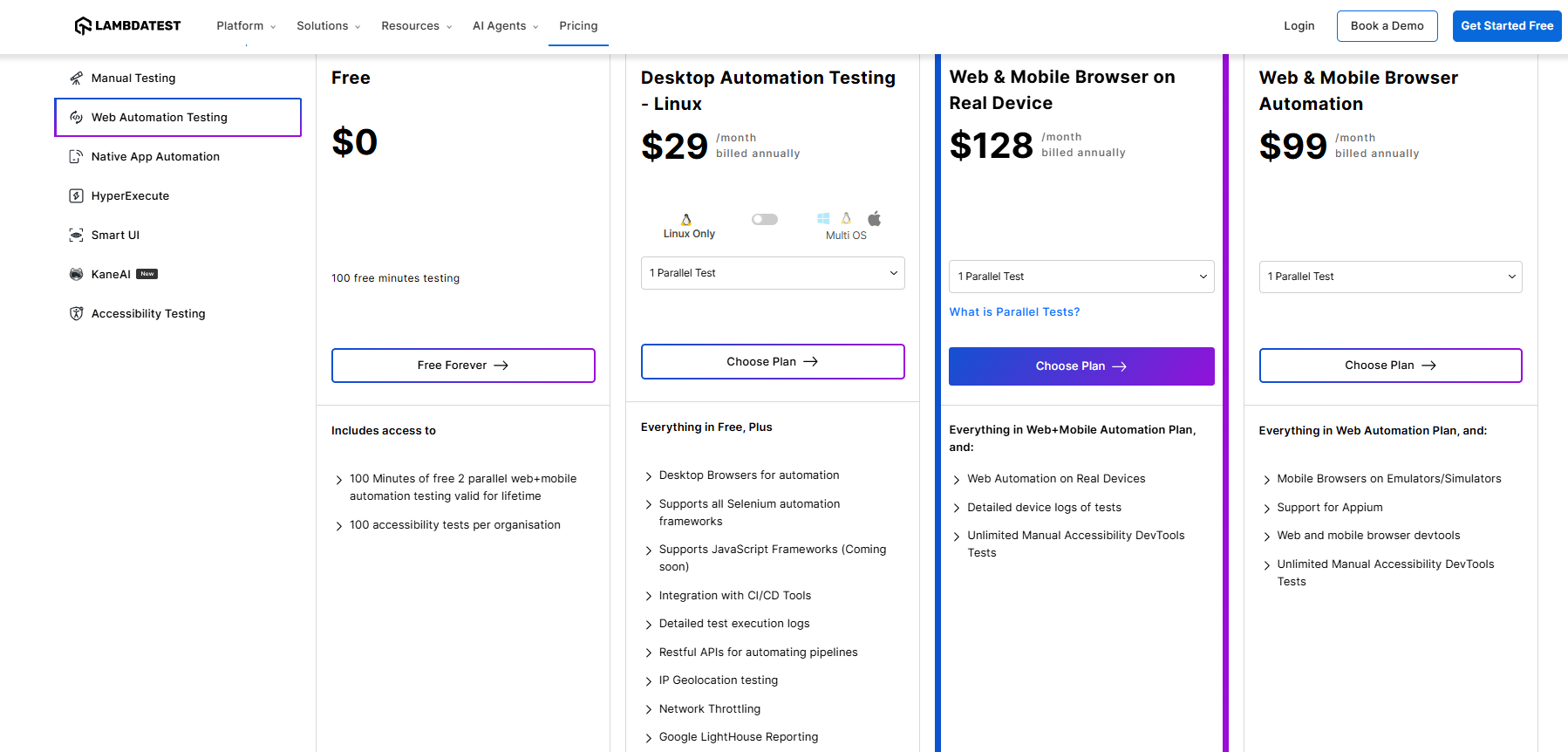
This low entry price and free trial period lowered barriers for individual developers and startups to start using LambdaTest. By nurturing users at the free tier and then converting them to paid plans as their needs grow, LambdaTest leveraged a classic land-and-expand strategy.
Product-Led Growth (PLG)
The company’s go-to-market heavily leans on product-led growth. LambdaTest made it easy for developers to sign up and get value quickly, a strategy that paid off in viral adoption.
In fact, the team focused on reducing “Time to Value” – ensuring new users could launch a test in under a minute of signing up. The platform’s intuitive interface and rich documentation encourage self-service usage.
This PLG approach, combined with a freemium offering and a strong community presence, helped LambdaTest rapidly accumulate a large user base with minimal paid marketing. By 2022, over 1 million developers and testers had used LambdaTest, primarily driven by word-of-mouth and organic uptake.
The company complemented this bottom-up adoption with extensive educational content – blogs, webinars, tutorials, and a learning hub – to empower users (and incidentally boost their SEO). According to the founders, organic search became the largest source of traffic and sign-ups, thanks to high-quality content and SEO optimization around testing topics.
This inbound funnel significantly fueled LambdaTest’s growth while keeping customer acquisition cost-efficient.
Enterprise Sales and Support
While LambdaTest grew via self-service among individuals and small teams, it also developed a top-down sales strategy to win larger enterprise accounts. The company has a dedicated sales force and solution engineering team to negotiate enterprise contracts, which often involve higher-level needs like on-premise deployments, custom security, and integrations with enterprise tooling.
For instance, LambdaTest offers an “On-Premise Selenium Grid” for companies that want to deploy the LambdaTest infrastructure within their own firewall. They also provide professional services for onboarding and migrating big customers onto the platform.
Jay Singh’s role as Chief Customer Officer underscores LambdaTest’s commitment to customer success – ensuring that enterprise clients receive training, priority support, and tailored solutions.
This dual focus – product-led adoption for the masses and account-based selling for enterprises – allowed LambdaTest to capture both ends of the market.
In terms of monetization, the recurring subscription revenue is LambdaTest’s primary income stream. The rapid growth in its user base and usage translated into impressive revenue growth. While exact figures are privately held, one report indicates LambdaTest’s annual revenue grew 3× each year from 2019 through 2022. Such exponential growth is consistent with the company’s own statement of 105% year-on-year growth as of late 2024.
With a broad base of 15,000+ paying customers (including many big enterprises), LambdaTest likely enjoys a healthy mix of SMB and enterprise revenues. The company’s model, akin to an “AWS for testers”, means revenue scales as customers run more tests and integrate LambdaTest deeper into their development pipelines.
Looking ahead, LambdaTest’s business model is poised to evolve with new AI-based offerings (like test-generation bots) potentially offered as add-ons, but the core will remain a SaaS platform fee that delivers significant value by replacing costly in-house test infrastructure.
Revenue Streams of LambdaTest
Despite being a young company, LambdaTest has developed multiple revenue streams around its core platform, all reinforcing its SaaS model. The key revenue streams include:
SaaS Subscription Revenue
This is the lifeblood of LambdaTest’s business. Customers pay subscription fees (monthly or annual) to access the cloud testing platform. Plans range from free or entry-level (with limited parallel tests or minutes) up to enterprise-grade plans with high concurrency, advanced features, and dedicated infrastructure.
For example, as of 2019 LambdaTest advertised unlimited automation testing for $79/month on an annual plan, while larger organizations negotiate custom pricing for greater scale.
The subscription grants access to the entire suite – live interactive testing, automation (Selenium, Cypress, etc.), mobile device cloud, and more – providing a predictable recurring revenue stream.
Many customers expand their usage over time (adding more users or concurrency), which increases their subscription tier.
This land-and-expand dynamic has contributed to LambdaTest’s strong net revenue retention and monthly recurring revenue growth (reflected in its ~3× ARR growth yearly).
Enterprise and Premium Features
For large enterprise clients, LambdaTest offers premium offerings typically charged at a higher rate.
These include private cloud or on-premise deployments (where LambdaTest sets up a dedicated Selenium grid inside the client’s data center or VPC for extra security), as well as advanced features like single sign-on (SSO), advanced access controls, and priority support.
Enterprises may also pay for a certain volume of real device minutes if they use LambdaTest’s real device cloud extensively.
While the vast majority of LambdaTest’s users are on standard cloud plans, enterprise deals (often annual contracts) constitute a substantial portion of revenue and come with high margins due to value-added services bundled in.
Professional Services
LambdaTest provides consulting and support services to help customers get the most out of the platform. This can include onboarding assistance, custom integrations, test migration support, and training workshops for QA teams. The website references a “LambdaTest Professional Service” offering.
While not the primary revenue generator, these services are billed either as one-time fees or added subscription costs. They not only bring incremental revenue but also drive adoption (a well-onboarded customer is more likely to renew and expand).
Given LambdaTest’s focus on customer success, many enterprise customers engage with its solutions engineers for implementation, effectively monetizing deep expertise in test automation.
It’s important to note that LambdaTest’s revenue is largely recurring, providing predictability. The combination of self-service signups and sales-driven contracts has allowed it to capture both volume and value. By late 2024, the company reportedly reached a revenue run-rate well into eight figures annually. One source estimated $89M revenue in 2023, rising to $120M in 2024, reflecting the rapid uptake of its services.
While that figure is not officially confirmed, it aligns with the firm’s explosive growth metrics (105% YoY growth) and a broad customer base. With $108M raised (as detailed in the next section) to fuel expansion, LambdaTest has reinvested in R&D (particularly AI features) which could unlock new revenue streams (such as AI-driven testing services) on top of its established subscription model.
Overall, LambdaTest’s revenue streams exemplify the modern SaaS playbook: a scalable cloud product, multi-tier pricing that caters to everyone from individual developers to Fortune 500 companies, and ancillary services to support large deployments.
Funding and Funding Rounds of LambdaTest
LambdaTest’s journey has been marked by significant investor interest, resulting in multiple funding rounds that have provided capital for its rapid growth. In total, LambdaTest has raised approximately $108 million over several rounds from 2018 through 2024. The table below summarizes LambdaTest’s key funding rounds, including the amounts raised and lead investors:
| Date (Announced) | Round | Amount Raised | Lead Investor(s) | Notable Co-Investors |
|---|---|---|---|---|
| Dec 2018 | Seed Round | $1 million | Leo Capital | – (Angels and Leo Capital’s first check) |
| Nov 2019 | Pre-Series A (Seed ext.) | $2 million | Blume Ventures | Leo Capital (follow-on) |
| Dec 2020 | Series A | $6 million | Sequoia Capital India’s Surge | Telstra Ventures (participated)* |
| Jun 2021 | Series B | $16 million | Sequoia Capital India (Peak XV) | Telstra Ventures, Wamda Capital |
| Mar 2022 | Series C | $45 million | Premji Invest | Sequoia India, Telstra, Blume, Leo (all existing) |
| Dec 2024 | Series D | $38 million | Avataar Ventures | Qualcomm Ventures |
*Note: Telstra Ventures (the VC arm of Australian telecom Telstra) and others joined during LambdaTest’s Series B and/or Series C as strategic investors
This funding trajectory shows a classic evolution from seed capital to growth rounds. In the early seed rounds (2018–2019), LambdaTest raised small amounts to build out its MVP and achieve product-market fit. Leo Capital and Blume Ventures, both prominent early-stage investors in India, backed the company at this stage, indicating confidence in the founders and the market opportunity. By late 2019, LambdaTest had already impressed investors by acquiring 100K+ users and a robust platform which likely helped in raising the Pre-Series A round of $2M.
The Series A in December 2020 ($6M) came through Sequoia Capital India’s Surge program, a prestigious accelerator for promising startups. This not only provided capital but also validation and mentorship from one of the world’s top VC firms. The timing of this round coincided with LambdaTest expanding its feature set and scaling its team for growth. The Series A was used to “enhance product innovation and expand the team,” reflecting a focus on R&D and hiring.
In June 2021, Series B brought in $16M led by Sequoia again (under its new name Peak XV Partners). This round included Telstra Ventures and Wamda Capital, indicating interest from international investors (Telstra from Australia, Wamda from the Middle East). The Series B aimed to accelerate growth and improve existing product capabilities. Around this time, LambdaTest was launching new features like the HyperExecute test cloud and was positioning itself as a broader testing platform. The confidence of Sequoia/Peak XV doubling down suggested LambdaTest’s revenue and user metrics were very strong through the pandemic years (when demand for remote testing solutions surged).
The Series C in March 2022 was a big leap: $45M led by Premji Invest, the private investment arm of Wipro-founder Azim Premji. This round solidified LambdaTest as one of the top emerging players in the cloud testing space, often dubbed a potential “soonicorn” (soon-to-be-unicorn) in the Indian SaaS ecosystem. Existing investors (Sequoia, Blume, Telstra, Leo) all participated, signaling their continued support. LambdaTest’s vision to build the “AWS of Testers” likely resonated strongly here. The funds were earmarked to build new products and enhance existing ones – indeed, LambdaTest shortly thereafter launched HyperExecute and Test-at-Scale (TAS) to offer a unified, intelligent test orchestration platform. By this point, LambdaTest had grown to over 1 million users and was tripling ARR annually, which justified the sizable Series C raise.
Most recently, in December 2024, LambdaTest secured a Series D of $38M led by Avataar Venture Partners, with Qualcomm Ventures joining in. This round brings the total funding to $108M and came at an estimated company valuation of around $400 million. The Series D was strategically focused on LambdaTest’s push into AI-powered testing – the funds are being used to advance “KaneAI” (LambdaTest’s Generative AI QA agent) and other AI-driven innovations in the product. Avataar Ventures, a growth-stage investor, praised LambdaTest for disrupting the market and highlighted that “in a short period of time they have pulled the rug out from under existing [cross-browser testing] vendors” by pioneering an AI-native approach. The infusion will also support headcount growth (LambdaTest had ~400 employees in 2024, planning to grow 15–20% in the next year). Qualcomm Ventures’ participation is notable as it may help LambdaTest deepen its expertise in mobile and edge device testing (given Qualcomm’s industry position).
Overall, LambdaTest’s funding history reflects steady confidence from investors at each stage. The capital has enabled aggressive product development and global market expansion. Notably, despite raising over $100M, LambdaTest has been capital-efficient relative to some competitors, leveraging its PLG model for growth. By 2025, the company has the war chest to continue innovating (especially with AI) and perhaps eye strategic acquisitions or an eventual IPO. Each funding round’s successful close underscores LambdaTest’s strong business fundamentals and the large addressable market for cloud testing solutions.
Competitors of LambdaTest
As a provider of cloud-based testing infrastructure, LambdaTest operates in a competitive landscape alongside several other companies addressing similar needs.
Its core competitors are other cross-browser and mobile app testing platforms, as well as emerging tools in the broader QA automation space. Below, we discuss some of LambdaTest’s primary competitors and how they compare:
1) BrowserStack

Arguably the most prominent player in cloud cross-browser testing, BrowserStack was founded in 2011 (also originating from India) and has since achieved unicorn status.
It provides a cloud platform to test websites and mobile apps on thousands of browsers and real devices, quite similar to LambdaTest’s core offering.
BrowserStack has a large enterprise customer base and a reputation for reliability and performance. In 2021, BrowserStack raised $200 million at a $4 billion valuation, highlighting its market leadership.
It offers both manual and automated testing, real device clouds, and even on-premise setups for enterprise. Compared to LambdaTest, BrowserStack is older and was first-to-market in this space; however, LambdaTest has been positioning features like HyperExecute and its AI integrations as more cutting-edge, aiming to outpace BrowserStack on innovation.
Both platforms support Selenium and other frameworks, but LambdaTest often touts more cost-effective plans and a more developer-friendly approach. Still, BrowserStack’s brand and head start make it a formidable competitor for large accounts.
2) Sauce Labs

Founded in 2008 in San Francisco, Sauce Labs is another pioneer in cloud-based test automation.
Sauce Labs offers a robust platform for running automated tests at scale, with support for Selenium, Appium, and a wide array of browser/OS combinations. It has invested in features like visual testing, rich analytics, and CI/CD integrations to appeal to enterprise DevOps teams.
Sauce Labs has raised over $200M in funding over the years and was last known to be a leader in enterprise test services (with reported revenue on par with LambdaTest’s, indicating strong market traction).
One area Sauce Labs emphasizes is its analytics dashboard and error reporting, helping teams quickly identify test failures. LambdaTest competes by offering similar capabilities (through its Test Analytics and Test Intelligence features) and by integrating AI to suggest fixes.
In terms of cloud infrastructure, both provide real device testing and broad browser coverage; however, LambdaTest’s HyperExecute claims a speed advantage (parallel testing faster than traditional grids), which is a selling point over Sauce for customers seeking quick feedback cycles.
Sauce Labs remains a key rival, especially for US enterprise clients who have used it for many years.
3) Perfecto (Perforce)

Perfecto is a long-standing competitor focusing on mobile and web testing, historically known for its real device cloud.
Founded in 2006 in Israel, Perfecto was acquired by Perforce in 2019 and continues to serve large enterprises for their mobile app testing needs. It provides cross-browser testing, but its specialty is high-end mobile automation, performance testing, and security testing for mobile apps.
Perfecto’s strengths include robust scripting and an emphasis on enterprise-grade test scenarios (it also supports scriptless automation to some extent).
LambdaTest overlaps with Perfecto mainly on the cross-browser and mobile automation functions. While Perfecto (as part of Perforce’s toolchain) might be bundled with other development tools for big clients, LambdaTest can leverage its more modern UI and broader integrations to win over customers looking for an all-in-one solution.
Perfecto’s pricing tends to target top-tier clients, whereas LambdaTest can undercut on price for similar functionality, which is an advantage in competitive deals.
Emerging Codeless Automation Tools
In recent years, a wave of codeless or AI-driven test automation platforms has emerged. These include tools like Testsigma, TestGrid, and BugBug.io. Such tools often provide a no-code/low-code interface to create tests, appealing to less technical testers or to speed up test creation with AI.
For instance, TestGrid offers scriptless automation across web, mobile, and APIs with an AI layer, and BugBug emphasizes a Chrome-based recorder for web tests.
These platforms sometimes position themselves as alternatives to LambdaTest for certain users. LambdaTest’s response has been to integrate similar capabilities – e.g. KaneAI for no-code test generation – directly into its platform.
By doing so, LambdaTest is effectively competing with codeless upstarts on their turf, while still maintaining the power and flexibility of code-based testing for engineers.
The emerging tools might not yet match LambdaTest’s breadth (few have a device cloud as extensive), but they are worth noting as competitors in specific niches or segments (like small teams that prioritize simplicity over comprehensive features).
Legacy and Open Source Solutions
Some organizations still rely on open-source frameworks (like Selenium, Appium, Cypress) on self-managed infrastructure or legacy on-prem testing solutions. While not competitors in the commercial sense, these represent alternatives to using a platform like LambdaTest.
For instance, a team might set up its own Selenium Grid on AWS instead of buying LambdaTest. However, the trend in the industry is moving away from such DIY solutions due to maintenance burden.
LambdaTest’s value proposition of zero-maintenance and scalable infrastructure is aimed exactly at converting these users.
In many cases, LambdaTest doesn’t see direct competition from open-source beyond the need to convince prospects of outsourcing their grid to the cloud.
Other Niche Competitors
There are other players in the testing space addressing specific needs – e.g., HeadSpin (for mobile performance and network conditions testing), CrossBrowserTesting by SmartBear (similar cross-browser cloud acquired by SmartBear), TestingBot, Browserling, and device-focused services like Kobiton.
Each covers some overlap with LambdaTest. For example, CrossBrowserTesting (now part of SmartBear) offers manual and automated cross-browser tests on a smaller scale.
Kobiton provides real mobile device access and has some mobile UX testing capabilities. LambdaTest differentiates itself by offering a unified platform that covers both web and mobile, manual and automated, and now AI-driven testing, whereas many of these smaller competitors focus on one slice.
Additionally, LambdaTest’s aggressive development of new features often outpaces these niche players.
To visualize a comparison, the table below highlights a few major competitors alongside LambdaTest on key dimensions:
| Company | Founded | Headquarters | Offerings | Funding/Scale |
|---|---|---|---|---|
| LambdaTest | 2017 | San Francisco, USA / Noida, India | Cross-browser web testing, real device mobile testing, automation (Selenium, Cypress, etc.), performance testing, AI-powered test creation (KaneAI), visual testing, on-premise grid. | $108M raised; ~500+ employees; ~15,000 customers and 2.3M users globally |
| BrowserStack | 2011 | Mumbai, India / SF, USA | Cross-browser and mobile testing cloud, extensive real device farm, manual & automated testing, screenshot and visual testing, Enterprise offerings with local testing, Percy (visual review) integration. | ~$250M raised (Series B in 2021 at $4B valuation); Profitable; 50,000+ customers (incl. tech giants). |
| Sauce Labs | 2008 | San Francisco, USA | Automated testing cloud for web & mobile, real devices and emulators, visual UI testing, error reporting & analytics, CI/CD integration, selenium and Cypress support, some codeless capabilities (via acquisitions). | $250M+ raised (latest growth round 2022); ~3,000–4,000 customers; strong enterprise penetration (e.g., financial and automotive sectors). |
| Perfecto (Perforce) | 2006 | Minneapolis, USA (orig. Israel) | Enterprise-grade web & mobile test platform, real devices with network simulation, test automation, performance and security testing, scriptless test creation for mobile, integrations with ALM tools. | Part of Perforce (private equity-backed); was acquired for ~$200M. Long-standing relationships with Fortune 500 in banking, telecom. |
| Testsigma | 2019 | Wilmington, USA (orig. India) | Open-source and cloud versions of codeless test automation for web, mobile, API. AI-assisted maintenance of test scripts, natural language test creation, and integrations for CI/CD. | ~$5M raised; primarily targeting small to mid-size teams and open-source adopters. |
| Others (e.g., TestGrid, Kobiton) | 2010s | Various (USA, etc.) | TestGrid: Scriptless AI-driven testing across web, mobile, API with on-prem support. Kobiton: Mobile device testing with real devices, performance and UX metrics. Each offers niche features like AI test generation or mobile UX. | Range from bootstrapped to ~$40M raised (Kobiton). Typically narrower focus, smaller user bases than LambdaTest, but compete on specific features (e.g., mobile depth or no-code). |
Table: LambdaTest and selected competitors comparison (products and scale).
Products and Services of LambdaTest
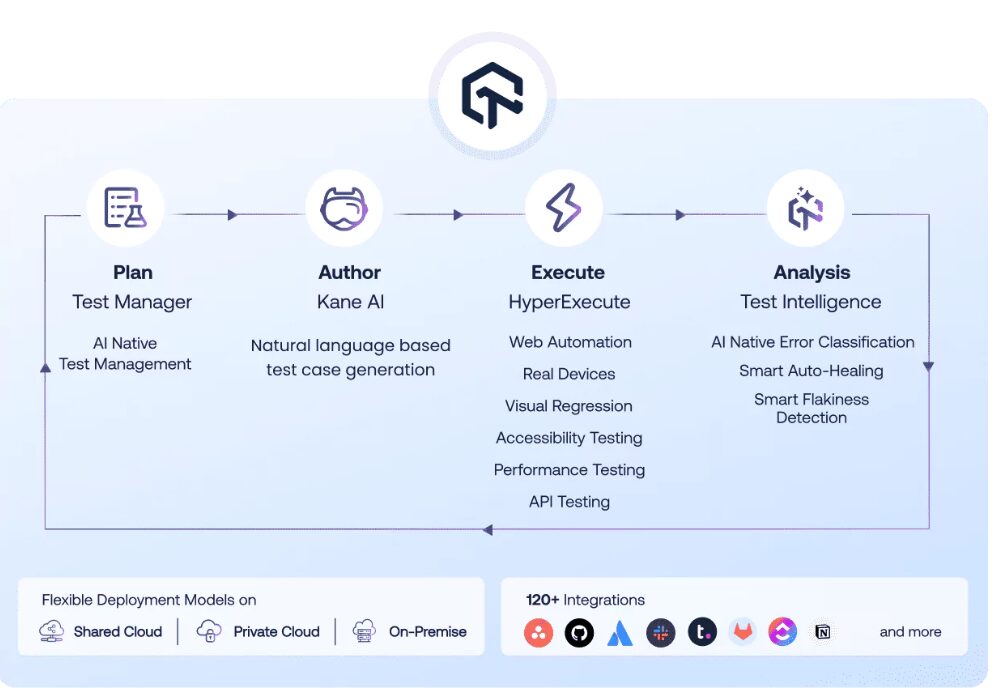
LambdaTest provides a rich suite of products and services, all aimed at simplifying and accelerating the testing of web and mobile applications. The platform can be thought of as a “unified testing cloud”, encompassing everything from basic manual testing to advanced AI-driven test optimization. Below is an overview of LambdaTest’s key products and services:
- Cross-Browser Testing Cloud: This is LambdaTest’s foundational service. It allows users to perform live, interactive testing of websites on a wide range of browser and operating system combinations directly from the cloud. A developer can, for instance, check how their website renders and behaves on Internet Explorer 11 on Windows 7, or on Safari on an iPhone, without having those environments locally.
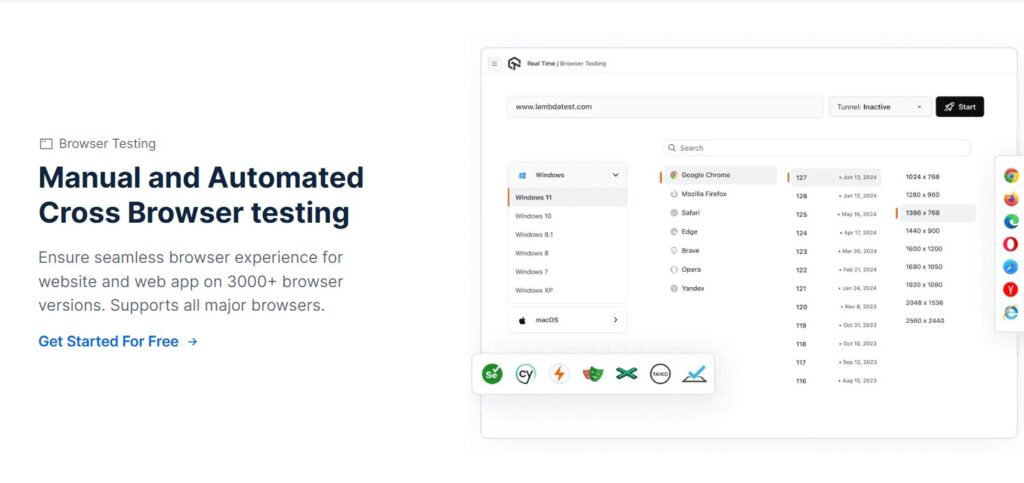
LambdaTest spins up the chosen browser/OS in its cloud and streams the interaction to the user. This service supports 3000+ browser and OS combinations, covering legacy versions to the latest builds.
Key features include the ability to take screenshots across multiple browsers in one click, test responsive design on various screen sizes, and even record video or capture logs of a test session for debugging. By providing instant access to such a broad matrix of environments, the cross-browser cloud eliminates the need for maintaining physical device labs or VMs. It’s invaluable for ensuring cross-browser compatibility, one of the core mandates for web developers.
- Real Devices Cloud (Mobile App Testing): LambdaTest offers a real device testing cloud where users can test mobile applications (both web apps and native apps) on physical mobile devices hosted in LambdaTest’s data centers. This includes a range of iOS and Android phones and tablets.
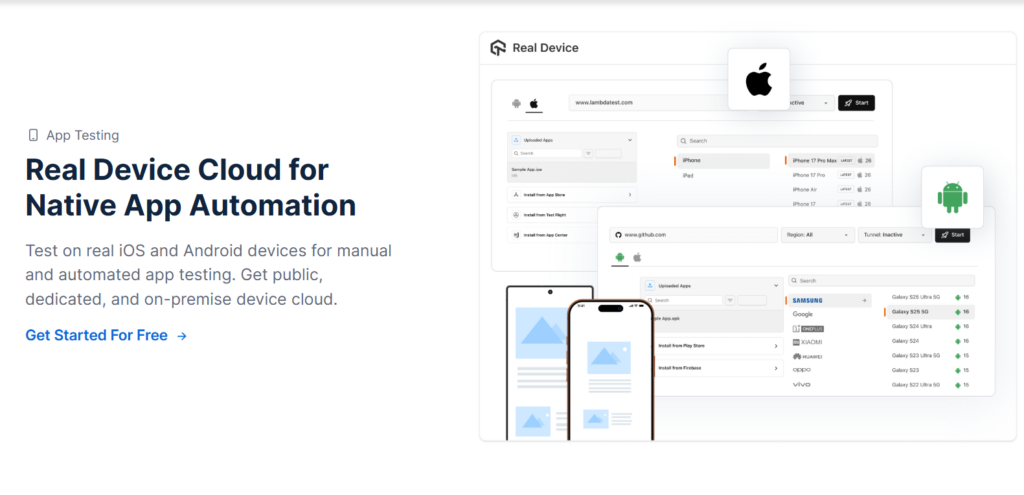
For mobile web testing, a user can interact with a live device through their browser, to see how a site performs on, say, a Google Pixel phone. For native mobile app testing, LambdaTest allows uploading of app binaries (APK for Android, IPA for iOS) and then running them on real devices in the cloud.
The advantage of real devices is accurate results – tests consider actual device hardware, sensors, and platform behavior. LambdaTest’s real device cloud is particularly useful for things like checking mobile-specific functionalities (gestures, orientation change, camera, etc.) and ensuring an app works across different manufacturers and OS versions.
This service puts LambdaTest in competition with device-centric platforms like Perfecto and Kobiton, and it has become increasingly important as mobile usage dominates.
- Automation Testing Cloud: Parallel to manual testing, LambdaTest’s Automation Cloud allows running automated test scripts at scale. It supports frameworks such as Selenium, Cypress, Playwright, Appium, and more, which developers use to write tests in various languages (Java, JavaScript, Python, etc.).
Users can execute their test suites on LambdaTest’s cloud grid, which will run the tests across multiple browsers/devices simultaneously. For example, with one command, a QA engineer can run a Selenium test suite on Chrome, Firefox, and Safari concurrently, speeding up feedback. LambdaTest’s grid is designed to be highly scalable and reliable, with features like automatic retry of failed sessions, test queue management, and integration with CI/CD pipelines (Jenkins, GitHub Actions, Azure DevOps, etc.).
All automation results come with detailed logs, screenshots on failure, and video recordings. The Automation Cloud also supports geolocation testing (choosing the test execution node’s location to test regional behavior) and local testing (via a secure tunnel to test internal/staged apps).
This service is at the heart of LambdaTest’s appeal to DevOps teams looking to incorporate testing into continuous integration workflows.
- HyperExecute (Next-Gen Test Orchestration): HyperExecute is LambdaTest’s proprietary test execution platform that significantly boosts automation speed. Unlike traditional Selenium grids that have a central hub controlling test distribution, HyperExecute uses an intelligent approach to minimize network latency.
It essentially brings the test runner closer to the browser instances and optimizes data transfer, thereby cutting out overhead. HyperExecute is particularly useful for large test suites – it can smartly partition tests and run them in parallel across many nodes. LambdaTest claims HyperExecute can reduce test execution time by up to 70% compared to conventional cloud grids.
For context, if a test suite took 1 hour on a normal grid, it might complete in 18 minutes on HyperExecute. HyperExecute also provides features like smart test re-execution (rerun only failed tests or impacted tests), resulting in faster CI pipelines.
This product is positioned as an enterprise-grade, secure test orchestration platform (with support for self-hosting if needed) and is a cornerstone of LambdaTest’s pitch to mature engineering teams that demand speed and rigor in testing.
- KaneAI (AI-Powered Test Agent): KaneAI is LambdaTest’s GenAI-based virtual QA assistant – essentially an AI agent for testing. Launched in 2023, KaneAI allows users to create test cases and even executable test scripts using plain English prompts.
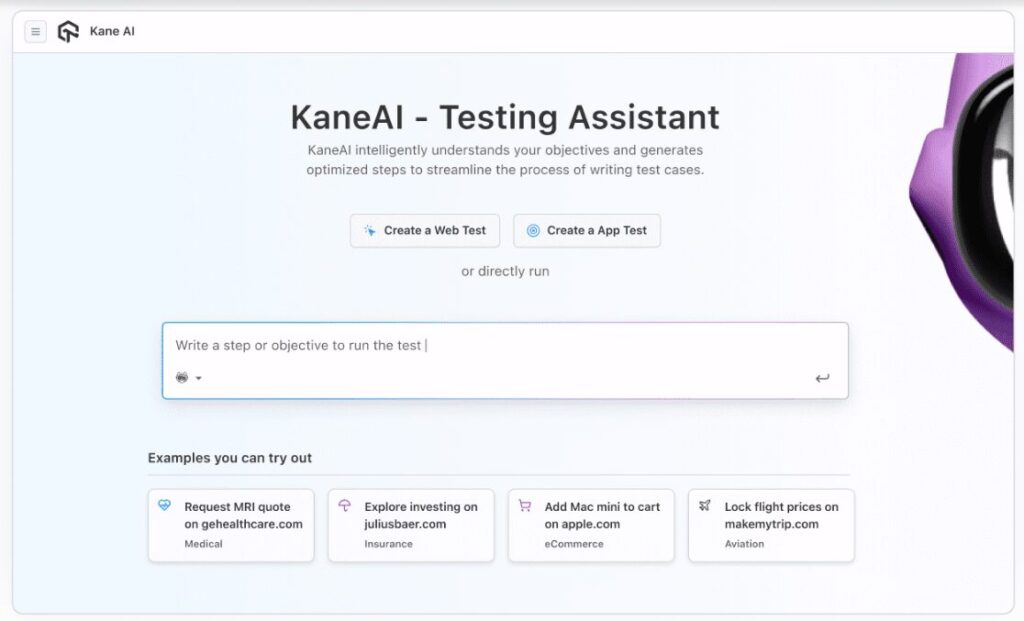
For example, a user could describe a scenario: “Login to the site, navigate to profile, verify the welcome message is correct,” and KaneAI would generate the corresponding Selenium or Cypress code automatically. It can also translate tests between programming languages or frameworks. The idea is to democratize test automation by making it possible to generate tests without deep coding skills. KaneAI is also context-aware – it can integrate with the application’s DOM to suggest selectors and can update tests when the app changes (AI-driven maintenance).
Furthermore, it’s offered as a “QA Agent as a Service”, meaning it’s available on demand in the cloud to assist teams anytime. This product is at the forefront of LambdaTest’s innovation, harnessing large language models to boost test authoring productivity by 40–70% (as the company claims).
KaneAI represents LambdaTest’s push into no-code solutions and adds significant value on top of the traditional testing services, differentiating them from competitors.
Test Intelligence and Analytics: LambdaTest provides tools for making sense of test outcomes and optimizing test suites. The Test-at-Scale (TAS) or Test Intelligence feature uses AI to analyze historical test runs and identify patterns. For instance, if certain tests always pass, TAS can flag them as candidates to skip in certain runs (or to run with lower priority), thereby speeding up overall execution. It also detects flaky tests (tests that intermittently fail) by observing inconsistency in results, so teams can focus on fixing those.
Test Intelligence can highlight which modules of the application are more buggy by correlating failures, and it can suggest “smart test selection” – running a subset of tests likely to be affected by recent code changes. This leads to enormous time savings; LambdaTest cited that smart test selection can reduce test cycle times by 95% in some cases. In addition, LambdaTest’s platform has a dashboard with analytics – showing metrics like test pass rates, browser/device coverage, performance over time, etc., to help QA managers track quality.
These analytic capabilities transform raw test data into actionable insights, giving LambdaTest users an edge in continuously improving their test effectiveness.
- LT Browser (Developer Tool): The LT Browser is a lightweight but handy application offered by LambdaTest aimed at front-end developers and designers. It’s essentially a custom browser for responsive testing. LT Browser allows users to open a website in side-by-side mobile and desktop views, or multiple device presets simultaneously, to see how the layout responds.
It comes with dozens of pre-loaded device viewports (for popular phones, tablets, laptops) and the ability to create custom view sizes. Developers use it to debug CSS, check mobile layouts, and ensure UI consistency without needing actual devices. Features like network throttling (to simulate slow networks) and screenshot comparison are built-in. LT Browser is based on Chromium, so it’s akin to a special Chrome browser tailored for testing purposes.
By offering this tool for free (or as part of the subscription), LambdaTest adds value for individual developers working on UI, making it part of the daily toolkit even outside formal testing cycles.
- Integrations and APIs: A significant part of LambdaTest’s service is its ability to integrate with virtually any development workflow. LambdaTest provides plug-ins and integrations for all major CI/CD tools (Jenkins, CircleCI, Azure DevOps, etc.), test management tools (Jira, TestRail), communication tools (Slack, Teams), and version control (GitHub, GitLab).
These integrations allow, for example, tests to run automatically on each code push and results to be posted to a Slack channel, or bugs discovered in LambdaTest to be logged in Jira with one click. There are also integrations with codeless automation tools and frameworks. For anything not covered out-of-the-box, LambdaTest offers a comprehensive REST API so that teams can programmatically trigger tests, fetch results, or even provision environments. This level of integration is crucial for embedding LambdaTest into continuous integration pipelines and ensuring that using the platform is as seamless as possible in the developer’s toolchain.
It reinforces LambdaTest’s positioning as an open ecosystem-friendly platform (contrasting with vendors that might be more siloed).
In the table below, we summarize some of LambdaTest’s product offerings and their purpose:
| Product/Feature | Description & Key Benefits |
|---|---|
| Live Cross-Browser Testing | Manual, interactive testing on 3000+ browser/OS environments. Ensures websites work across different browsers and versions without setting up local VMs. Includes tools for screenshots, responsive design testing, and debugging. |
| Automation Testing Grid | Cloud-based Selenium/Cypress/Appium grid for running automated tests in parallel. Scales on-demand, integrates with CI/CD, and provides detailed logs & video for each test. Saves time by running large test suites concurrently across browsers. |
| Real Devices Cloud | Testing on real mobile devices (iPhones, Androids, tablets) hosted by LambdaTest. Critical for validating mobile app behavior on actual hardware and OS combinations. Supports both mobile web and native app testing (with app upload). |
| HyperExecute | Next-gen test orchestration platform for ultra-fast execution. Uses intelligent distribution to achieve up to 70% faster test completion. Ideal for organizations needing rapid feedback (CI pipelines) and running huge test suites efficiently. |
| KaneAI (GenAI Test Agent) | AI-powered assistant for generating and maintaining tests using natural language. Enables no-code test creation and speeds up writing test cases by suggesting steps or creating scripts automatically. Lowers the barrier for automation and helps keep tests in sync with evolving application changes. |
| Test Intelligence (TAS) | Analytics and smart test selection toolkit. Identifies flaky tests, suggests optimal subsets of tests to run based on code changes (impact analysis), and provides metrics on test performance. Optimizes testing efforts by eliminating redundant or stable tests from runs, drastically reducing test cycle times. |
| LT Browser | A desktop app for responsive design testing and debugging. Lets developers concurrently view a site in multiple device resolutions and make style adjustments. Simplifies ensuring a consistent user interface across device sizes. |
| Integrations & APIs | Plug-and-play integrations with 120+ tools (Jira, Jenkins, GitHub, Slack, etc.). Allows seamless incorporation of LambdaTest into existing workflows (e.g., auto-create bug tickets, run tests on deploy). The REST API enables custom automation and data retrieval, providing flexibility for advanced users. |
| On-Premise & Enterprise Features | Deployment of LambdaTest’s infrastructure in private cloud/on-prem for high-security needs. Enterprise features include SSO, advanced user management, and dedicated support. Professional services assist in custom setups and best practices, ensuring large organizations can leverage LambdaTest at scale. |
Table: Overview of LambdaTest’s products and features.
Conclusion
In conclusion, LambdaTest’s story is one of identifying a critical need in the software industry and addressing it with a combination of technical ingenuity and business savvy. By transforming the testing process – making it cloud-based, scalable, and now intelligent – LambdaTest has earned its place as a key enabler in the software development lifecycle.
As software “eats the world,” tools like LambdaTest ensure that what gets delivered to users is reliable and high-quality.
The brand’s rise from a small startup in 2017 to an industry leader by 2025 exemplifies the potential of cloud-native SaaS innovation coming out of the global tech ecosystem.
If LambdaTest continues on its current trajectory, it is poised to play a central role in the future of quality engineering, helping companies worldwide ship code faster and with confidence in its quality – truly living up to the moniker of being the “AWS for Testers” that it set out to be.
Also Read:
To read more content like this, subscribe to our newsletter