Last Updated on March 21, 2026 by Team TBH
Decathlon is not just a sports store. It is a global movement — one built on the belief that sport should be accessible to everyone, regardless of age, income, or skill level. From a single outlet in the north of France in 1976, it has grown into the world’s largest sporting goods retailer, with operations spanning nearly 80 countries, over 1,800 stores, and a workforce of more than 101,000 people.
What sets Decathlon apart is not merely its scale, but its business philosophy: design, manufacture, and sell your own products under your own brands, eliminating the middleman and passing the savings on to the customer. This vertically integrated model has made Decathlon one of the most disruptive forces in global retail.
The Founding Vision — Michel Leclercq and the “Gang of Seven”
The story of Decathlon begins with one man’s frustration at a gap in the market. Michel Leclercq, a young Frenchman with deep entrepreneurial instincts, was inspired in part by his uncle — Gérard Mulliez, the founder of the Auchan retail chain. Walking through the large shopping complexes of 1970s France, Leclercq noticed something: these malls sold virtually everything except sports equipment.
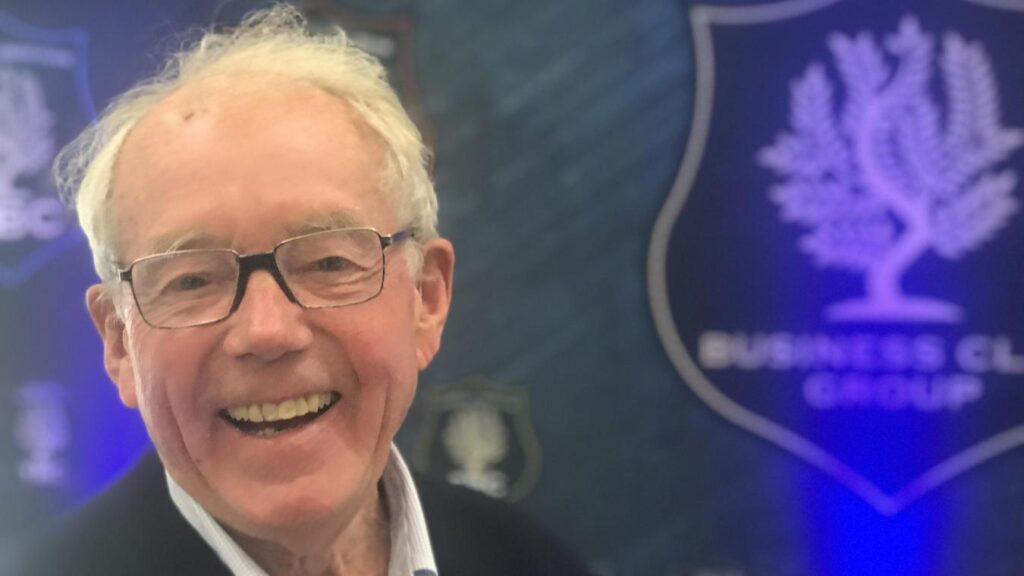
His insight was simple but revolutionary — instead of creating a store that specialised in one sport, he would build a destination that offered equipment for multiple sports. This would not compete with his uncle’s Auchan empire, and it would serve an entirely underserved market.
Leclercq surrounded himself with six like-minded associates, all recruited within a week. The founding team comprised Didier Decramer, Stéphane Delesalle, Nicolas Dubrulle, Stanislas Ernoult, Hervé Valentin, Benoît Poizat, and Leclercq himself — what would later be affectionately called the “Gang of Seven.”
What bound them together was not retail experience, but a shared passion for sport. In their downtime, they played football, went skiing, cycled, sailed, and played field hockey together. Leclercq’s management philosophy was built entirely on trust. He gave his team free rein, knowing that their drive mattered more than their experience. That culture of autonomy and sport-first thinking remains embedded in Decathlon’s DNA today.
Birth of the Brand — July 27, 1976
On 27 July 1976, Decathlon opened its first store in the parking lot of the Auchan shopping centre in Englos, a small town about 20 kilometres from Lille, in northern France. The concept was radical: all sports, under one roof, at the best possible price, in a self-service format.
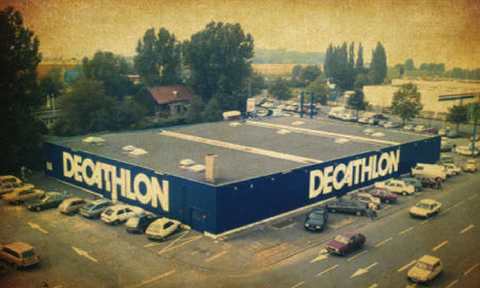
The name itself went through considerable deliberation. The founding team, guided by a branding specialist, threw around ideas such as Pentathlon, Marathon, Triathlon, Sportland, and Sportmarché. They ultimately landed on “Decathlon” — a term from the Olympic Games referring to a combined event of ten disciplines. The name perfectly symbolised the brand’s core identity: multisport, inclusive, and aspirational.
In a telling detail about the team’s priorities, the store only opened in the afternoons for its first few weeks — because every morning, the founders played sport together. As Didier Decramer later recalled, “Every chance we got we did sports together. At the beginning we would only open the store in the afternoon; in the morning we would meet to play sports.”
Early Challenges — Building from Scratch
The early years were far from smooth. Established sporting goods manufacturers were reluctant to supply Decathlon, put off by the company’s reduced margin expectations. The major brands did not want their products sold in a mass-market, self-service format.
Rather than backing down, Decathlon innovated its way through the problem. Stéphane Delesalle, head of the first store’s cycling department, forged a partnership with Leleu, a bicycle manufacturer in Lomme near Lille, to produce bikes under the Decathlon label. This was the seed of what would eventually become the brand’s defining characteristic: making its own products under its own brands.
This necessity-driven pivot toward vertical integration turned out to be one of the greatest strategic advantages in the company’s history.
Timeline of Key Milestones
| Year | Milestone |
|---|---|
| 1976 | First store opens in Englos, near Lille, France |
| 1985 | Creation of the International Training School; launch of employee shareholder scheme |
| 1986 | First store outside France opens in Dortmund, Germany; “Decathlon Production” division established |
| 1992 | Expansion into Spain (Barcelona) |
| 1993 | Entry into Italy (Milan); 100 stores and 5,000 employees |
| 1996 | Creation of first two passion brands: Quechua and Tribord; 10,000 employees |
| 1999 | Stores open in the United Kingdom and Portugal |
| 2000 | Opens in Amsterdam and Lisbon; 300 stores, 25,000 employees |
| 2001 | Entry into Brazil (São Paulo) |
| 2003 | First Chinese store opens in Shanghai |
| 2006 | Opens in Russia (Moscow) |
| 2007 | First “2 Seconds” pop-up tent launched by Quechua — becomes iconic |
| 2009 | Enters India |
| 2010 | Expands to Turkey and Czech Republic; 535 stores and 50,000 employees |
| 2012 | Southeast Asian expansion; 46 stores in China alone |
| 2016 | Enters Malaysia |
| 2018 | Enters Canada |
| 2023 | Acquires Bergfreunde (online mountain sports retailer); 101,000 employees |
| 2024 | New brand identity and orbit logo; 1,817 stores in 79 countries; €16.2 billion revenue |
| 2025 | Unveils first spacesuit for European astronauts aboard the International Space Station |
Global Expansion — From France to 79 Countries
Decathlon’s international expansion followed a deliberate, decade-by-decade cadence. The first international store opened in Dortmund, Germany in 1986, a full decade after the company’s founding — reflecting a careful, sustainable growth model rather than reckless scaling.
Spain followed in 1992, Italy in 1993, and then a wave of Southern European entries. By 2000, Decathlon had crossed into Brazil, the UK, and the Netherlands. Its entry into China in 2003 proved to be enormously consequential: today, the Chinese business is valued at over $1 billion, and Decathlon is reportedly exploring the sale of a 30% stake in its China operations as of April 2025.
India, entered in 2009, has become one of Decathlon’s fastest-growing and most strategically important markets. The company currently exports around 65% of its India-manufactured output to international markets. Over the next five years, Decathlon plans to invest €100 million in India to expand both its store network and production capabilities.
In Germany too, Decathlon has announced plans to invest up to €100 million by 2027 to open new stores and modernise existing locations.
The Business Model — Vertical Integration as a Superpower
At the heart of Decathlon’s success is a business model that most retailers aspire to but few achieve: full vertical integration. The company manages research, design, production, logistics, and retail entirely in-house, cutting out third-party manufacturers and eliminating brand markup costs.
This model means Decathlon can offer products that are genuinely competitive in quality while maintaining significantly lower price points than branded rivals like Nike, Adidas, or Puma. The company invests in over 850 engineers and 400 designers across its product teams, and registers up to 40 patents per year through its research facilities.
The stores themselves are designed as experiential spaces — big-box superstores averaging 4,000 square metres — where customers are encouraged to try equipment before purchasing. Many stores feature indoor cycling tracks, basketball hoops, mini golf areas, and climbing walls.
Decathlon’s digital evolution is equally significant. By 2024, 20% of its total revenue came from digital sales, including e-commerce, marketplace orders, and in-store digital transactions. The company has deployed AI-powered algorithms for inventory forecasting, assortment planning, and logistics optimisation.
Financial Performance at a Glance
| Metric | 2024 Figures |
|---|---|
| Total Revenue | €16.2 billion |
| Revenue Growth (constant exchange rate) | +5.2% YoY |
| Net Profit | €787 million |
| Number of Stores | 1,817 |
| Countries of Operation | 79 |
| Total Employees (Teammates) | ~101,100 |
| Digital Sales Share | 20% of total revenue |
| Circular/Second-life Sales Growth | +10.4% YoY |
| Rental Sales | €36 million (up from €20.6M in 2023) |
Decathlon’s 2024 revenue of €16.2 billion marked a 5.2% growth at constant exchange rates compared to 2023. Notably, this growth was achieved while reducing absolute carbon emissions — for the third consecutive year, Decathlon decoupled revenue growth from CO₂ output. Since 2021, the company has cut its CO₂ emissions by 13%.
A significant catalyst for 2024 growth was the Paris 2024 Summer Olympics, where Decathlon served as an official partner. The brand designed and manufactured outfits for 45,000 volunteers and sold 1.8 million licensed Olympic products throughout the year. Store traffic in France surged 10% during the Olympic period and 6.7% during the Paralympic Games.
The Brand Portfolio — From 85 Brands to 13 Focused Ones
Decathlon’s brand strategy has undergone one of its most significant transformations in its history. For decades, the company operated under a sprawling portfolio of over 85 in-house brands, each dedicated to a specific sport or sub-sport. While this ensured comprehensive sport coverage, it created complexity for customers navigating the store.
In March 2024, as part of its sweeping rebrand, Decathlon announced a dramatically simplified portfolio: 9 Category Specialist Brands and 4 Expert Brands.
Category Specialist Brands
| Brand | Sports Category |
|---|---|
| Quechua | Mountain sports (hiking, trekking, camping) |
| Tribord | Water and wind sports (sailing, surfing, kayaking, diving) |
| Rockrider | Outdoor cycling (mountain biking, trail cycling) |
| Domyos | Fitness, gym, yoga, pilates, dance, combat sports |
| Kuikma | Racket sports (tennis, padel, badminton, squash) |
| Kipsta | Team sports (football, basketball, rugby, volleyball) |
| Caperlan | Wildlife and fishing |
| Btwin | Urban cycling, gliding and mobility |
| Inesis | Target and precision sports (golf, archery) |
Expert Brands
| Brand | Specialisation |
|---|---|
| Van Rysel | High-performance road cycling |
| Simond | Expert hiking, climbing, mountaineering |
| Kiprun | Performance running |
| Solognac | Hunting and field sports |
The distinction is deliberate: Category Specialist brands serve everyone from beginners to intermediate players across broad sport families, while Expert brands cater specifically to advanced and professional athletes seeking performance-grade equipment.
This consolidation reduced Decathlon’s portfolio from over 85 brands to just 13 core ones, giving shoppers a far cleaner navigation experience.
The First Passion Brands — Quechua and Tribord
The origin of Decathlon’s proprietary brand model dates to 1996, when the company launched its first two “passion brands”: Quechua (mountain sports) and Tribord (water and wind sports). These were staffed by teams of people who were themselves passionate athletes in those sports — product designers who skied, surfed, and climbed, developing gear from personal experience rather than pure market research.
Quechua became internationally recognised in 2007 when it launched the “2 Seconds” pop-up tent — a tent that unfolds from a bag in literally two seconds. The product became one of the best-selling camping items in European retail history and perfectly symbolised Decathlon’s philosophy: innovation that genuinely serves the everyday user.
Over the years, additional passion brands were added — Domyos for fitness, Btwin for cycling, Kipsta for team sports, and many others — each developed by specialists embedded within their sport communities.
The 2024 Rebrand — A New Identity and Purpose
In March 2024, Decathlon unveiled what its CEO called “a very special moment in both the history and future of Decathlon.” The rebrand was not merely cosmetic — it represented a fundamental shift in how the company sees itself: no longer just a sports retailer, but a global multi-specialist sports brand.
The new purpose statement — “Move People Through the Wonders of Sport” — replaced the longstanding “Sport for All” positioning, signalling a more emotionally resonant and inspirational direction.
The visual centrepiece of the rebrand is the “Orbit” logo — a dynamic, arc-shaped symbol that represents movement, ambition, and circularity. The logo is rendered in a lively, updated blue and is rolling out across all 1,700+ global store locations.
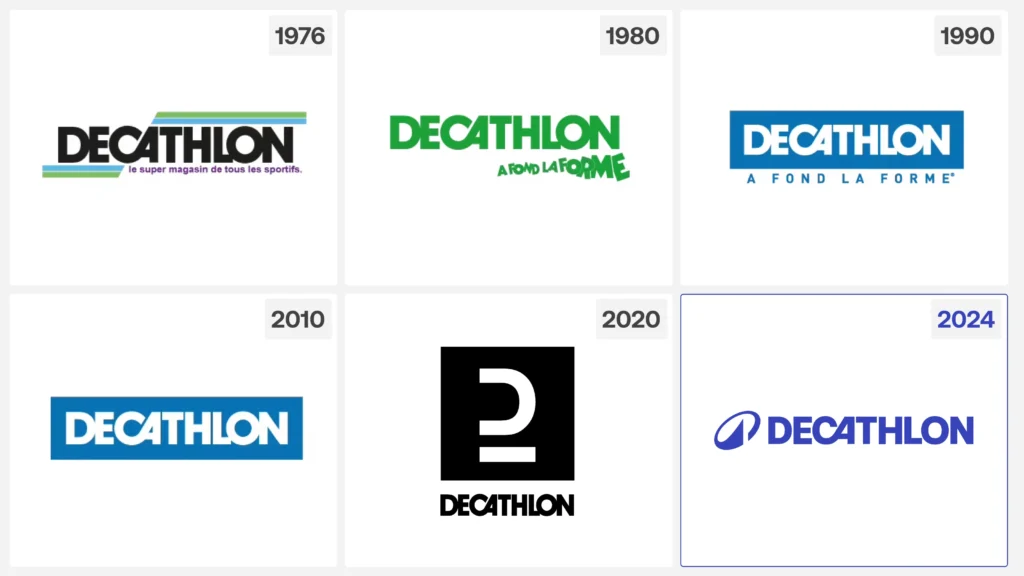
Alongside the new identity, Decathlon rethought its store experience. The new store concept is built around a “digital first” mentality, with customers welcomed on a store “homepage” that orients them toward three pathways: the workshop (for repairs), reception (for questions and returns), and the retail floor. Sports categories are presented in grouped, community-style sections rather than linear aisles.
Barbara Martin-Coppola, Global CEO, articulated the vision: “At Decathlon, we want to have a greater positive impact on humans, society and the planet by Moving People Through the Wonders of Sport.”
Sustainability Commitments
Decathlon has made sweeping, quantified sustainability commitments that are central to its business strategy — not peripheral to it.
| Target | Commitment |
|---|---|
| CO₂ Reduction by 2026 | 20% absolute reduction (Scopes 1, 2 & 3) |
| CO₂ Reduction by 2030 | 42% absolute reduction from 2021 baseline |
| Net Zero Target | 2050 |
| Circular Sales (2024) | 3.15% of global revenue |
| Second-life Products Sold (2024) | 1.35 million items |
| Countries with Rental Programmes | 8 (France, Belgium, Spain, Italy, Netherlands, Germany, Portugal, Poland) |
In 2024, Decathlon launched Decathlon Pulse, a fully owned subsidiary designed to invest in and partner with forward-thinking businesses focused on sustainability and sport innovation. The company also invested in Recyc’Elit, a startup specialising in the chemical recycling of polyester textiles and complex PET plastics.
In a landmark move, Decathlon partnered with CNES and Spartan Space to develop an intravehicular spacesuit, and in November 2025 unveiled the first spacesuit for European astronauts aboard the International Space Station — the most dramatic demonstration yet of Decathlon’s expanding definition of “sport.”
Sports Sponsorships and Partnerships
Decathlon has increasingly positioned itself through meaningful sports partnerships, not just product sales.
- Cycling: In November 2023, Decathlon became co-title sponsor of the UCI WorldTeam AG2R La Mondiale, renaming it Decathlon–AG2R La Mondiale Team. By July 2025, Decathlon announced full ownership of the team, with ambitions to reach the world’s top three by 2028 and a budget of €40 million.
- Stadium Naming: Decathlon purchased a five-year naming rights deal for Lille’s Stade Pierre-Mauroy from 2022, renaming it Decathlon Arena Stade Pierre-Mauroy.
- Olympic Games: Official partner of the Paris 2024 Olympic and Paralympic Games; designed and produced uniforms for the 45,000 Games volunteers.
- Biathlon: Decathlon Germany became the main sponsor of the IBU World Cup Biathlon from the 2021–22 season.
- Paralympic Winter Games 2026: Partnership extended to supply official uniforms for International Paralympic Committee members.
Decathlon in India — A Case Study in Market Adaptation
India represents one of Decathlon’s most remarkable growth stories. The company entered the Indian market in 2009 and has since built one of its largest and most active presences globally, with over 100 stores serving consumers across 29,000+ pin codes through its app.
What makes India distinctive in Decathlon’s global strategy is the scale of local manufacturing. Approximately 65% of Decathlon India’s output is exported to international markets, positioning India not just as a consumer market but as a production hub. The planned €100 million investment over five years will further deepen both retail reach and manufacturing capability.
Decathlon India’s revenue for the fiscal year 2023 reached approximately ₹4,200 crore (~$500 million), and the growth trajectory has been consistently upward. In a price-sensitive market like India, Decathlon’s model of affordable, high-quality in-house branded gear has proven to be a near-perfect fit.
Competitive Position
Decathlon occupies a unique competitive position in global sports retail. Unlike Nike, Adidas, or Puma — which focus on premium branding and athlete endorsements — Decathlon competes on accessibility, vertical integration, and volume.
Its closest traditional rival in Europe is Intersport, a franchise-based sports retailer. However, Decathlon’s dominance in France is staggering: a 2008 survey of 774 catchment areas found that Decathlon was the dominant sporting goods retailer in 92.8% of zones. This dominance has contributed to the decline of many independent sports retailers across Europe.
Globally, the company does not face a direct equivalent competitor in the mass-market, own-brand sporting goods space — giving it a structural advantage that has helped it sustain growth through economic cycles.
Innovation and R&D
Decathlon’s commitment to product innovation is formidable. The company operates dedicated design centres for each of its major brands:
- The Domyos Center in Marcq-en-Baroeul houses fitness, gym, yoga, pilates, and combat sports design teams, alongside a fitness club and physiotherapy centre.
- The Inesis Golf Park includes a 9-hole course, an indoor practice with 20 stations, and an outdoor practice with 43 stations.
- The B’Twin Village in Lille combines a design centre, bicycle assembly plant, bike trails, a skate ramp, and a fitness centre.
The company employs over 850 engineers and 400 designers, registers around 40 patents per year, and runs dedicated innovation programmes including the Booster Innovation team, a Sports Lab, an AddLab for 3D prototyping, and an Advanced Design unit.
AI is now deeply embedded in Decathlon’s supply chain — enabling accurate demand forecasting, assortment planning, stock level optimisation, reduced transportation costs, and a lower carbon footprint in logistics.
Decathlon Today
| Category | Fact |
|---|---|
| Founded | July 27, 1976 |
| Founder | Michel Leclercq |
| Headquarters | Villeneuve-d’Ascq, France |
| Global Revenue (2024) | €16.2 billion |
| Stores Worldwide | 1,817 |
| Countries | 79 |
| Employees | ~101,100 |
| Core Brands | 13 (9 category + 4 expert) |
| Digital Revenue Share | 20% |
| Net Profit (2024) | €787 million |
| Net Zero Target | 2050 |
Conclusion
Decathlon’s journey from a single parking-lot store in northern France to the world’s largest sporting goods retailer is a masterclass in vision, consistency, and vertical integration. What Michel Leclercq and his gang of seven started in 1976 — the radical idea that sport should be affordable and accessible to all — remains the brand’s North Star nearly five decades later.
The 2024 rebrand, the simplified brand portfolio, the sustainability commitments, and the push into experiential retail all signal that Decathlon is not resting on its scale. It is actively transforming itself from a beloved budget-sports store into a respected global sports brand — one that aspires to move people, in every sense of the word, through the wonders of sport.
For researchers, marketers, and brand strategists, Decathlon offers a rare case study: a company that got the fundamentals right from day one and has stayed faithful to them even as it scaled to extraordinary heights.
Also Read: Marketing Strategies and Marketing Mix of Decathlon
To read more content like this, subscribe to our newsletter