Last Updated on March 3, 2026 by Team TBH
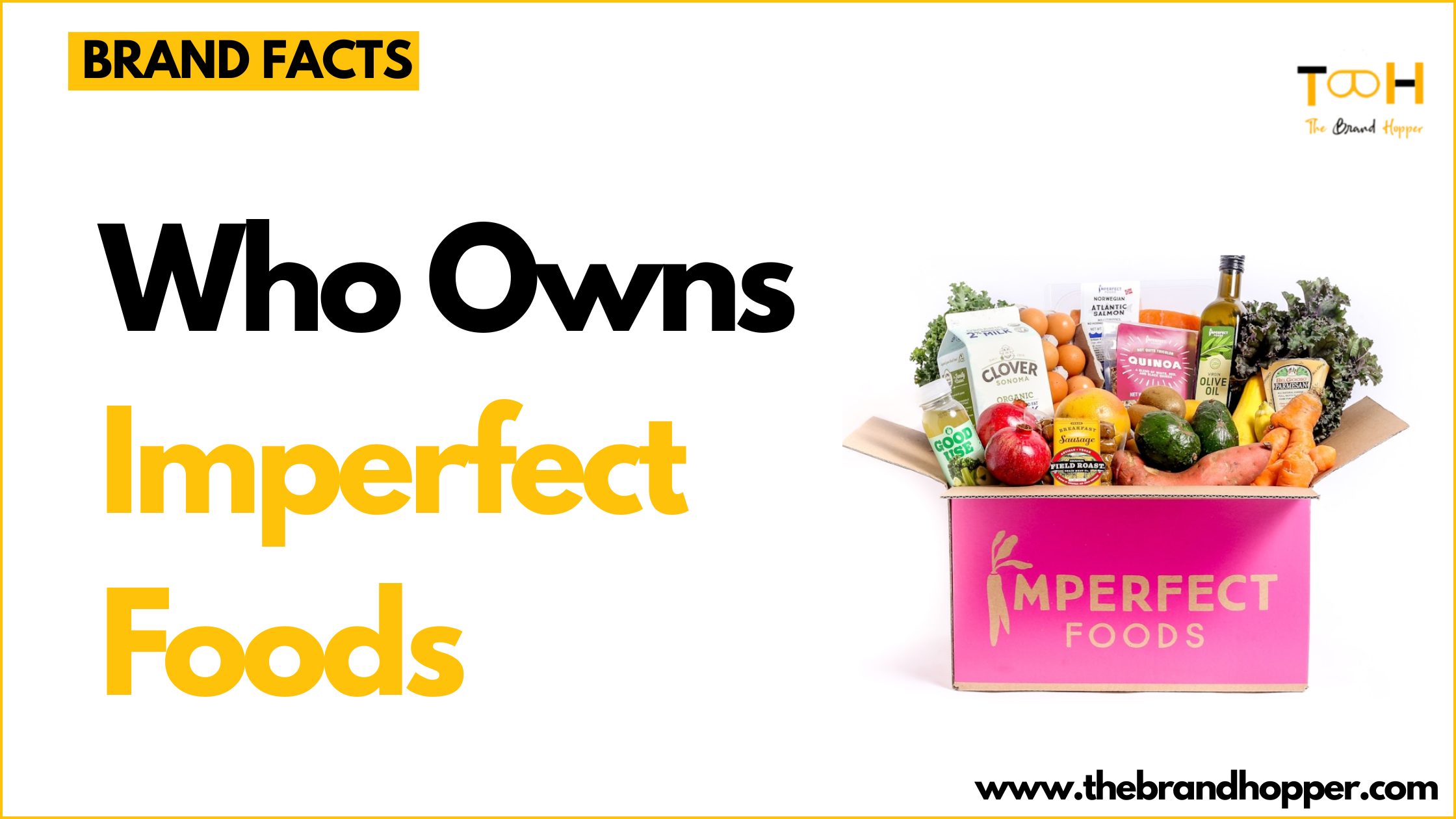
If you’ve ever opened a box from Imperfect Foods and thought, “Wow, these carrots look like they went to the gym and skipped leg day,” you’re not alone. Imperfect Foods built its name by selling the groceries traditional retail often rejects—“ugly” produce, surplus inventory, mislabeled packaged goods, and other perfectly edible items that don’t fit the neat, airbrushed standards of supermarket shelves.
But here’s the real plot twist: Imperfect Foods isn’t just a quirky “rescued groceries” startup anymore. It’s now part of a bigger sustainable-grocery empire.
Let’s break down who owns Imperfect Foods today, how it got there, and how the business model works—from sourcing and pricing to delivery economics and why “imperfect” is actually a very intentional strategy.
Quick Answer: Who Owns Imperfect Foods?
Imperfect Foods is owned by Misfits Market. In September 2022, Misfits Market announced it would acquire Imperfect Foods in an all-stock deal (financial terms weren’t disclosed).
In other words:
Imperfect Foods is no longer an independent company in the way it was during its high-growth VC years. It operates as a brand under the Misfits Market umbrella (and, operationally, there has been increasing consolidation over time). Misfits Market itself is a private company, which means it’s not publicly traded—so you won’t find a neat shareholder list like you would for a public company. But you can understand ownership by looking at control + capital:
- Control: Misfits Market leadership controls the combined group; Misfits CEO Abhi Ramesh was set to lead the combined company.
- Capital: Imperfect Foods’ prior investors largely rolled their stakes into the combined entity due to the all-stock nature of the deal.
So today, “who owns Imperfect Foods?” = Misfits Market + its investor base + employee equity holders (typical for venture-backed private companies).
A Quick Timeline: How Imperfect Became “Imperfect Foods”
Imperfect’s origin story started with a very simple observation: the food system wastes an absurd amount of edible food because it doesn’t look perfect.
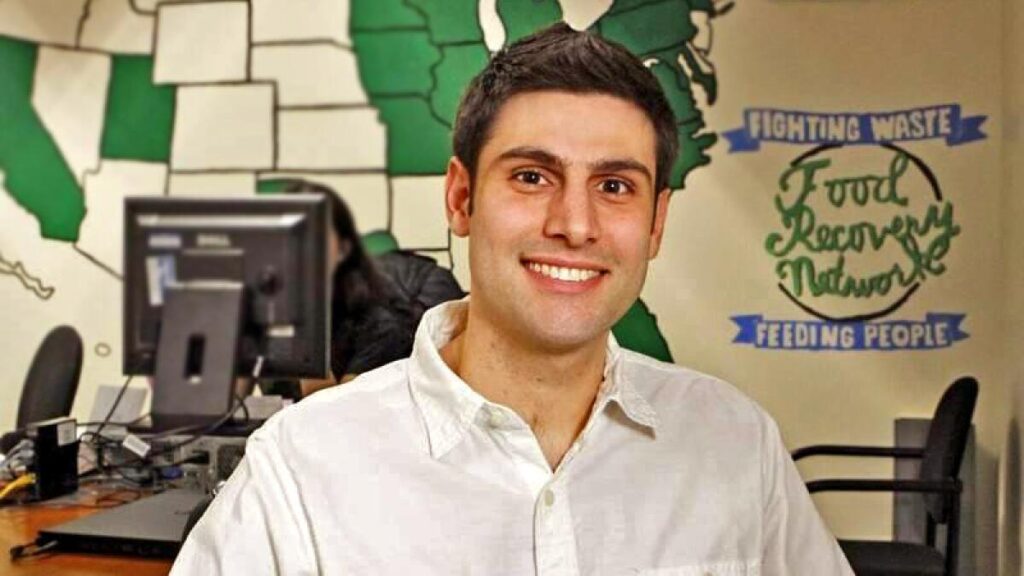
The company began in 2015 as Imperfect Produce, with founder Ben Simon frequently credited as the key co-founder/face of the early mission. In 2019, the brand rebranded from Imperfect Produce to Imperfect Foods as it expanded beyond fruits and veggies into a broader grocery model.
That rebrand matters because it signals a strategic shift:
- Not “a produce box company”
- But “a full basket grocery company”—which is where the real revenue scale lives.
Imperfect Foods’ Funding Background (Why Acquisition Made Sense)
Before Misfits Market acquired it, Imperfect Foods raised significant venture funding to expand operations, build fulfillment infrastructure, and grow its customer base.
Two widely cited rounds:
- Series C (May 2020): $72M, led by Insight Partners (with participation from existing investors including Norwest).
- Series D (Jan 2021): $95M commitment, led by Insight Partners and Norwest Venture Partners.
By 2022, the online grocery space was shifting:
- Customer acquisition costs were rising
- Delivery economics were under pressure
- Venture funding tightened for “logistics-heavy” consumer businesses
In that environment, consolidation became the practical path—Misfits + Imperfect combined scale, supply, and infrastructure.
So What is Imperfect Foods, really?
Imperfect Foods is best understood as a direct-to-consumer online grocer built on an alternative supply chain.
Instead of competing with supermarkets for “perfect” inventory, it competes in the non-obvious lanes:
- cosmetically imperfect produce
- surplus/overstock packaged goods
- “short code” inventory
- items with minor packaging issues (not safety issues)
- goods that would otherwise be discounted, donated, or wasted
That means Imperfect is not just selling food—it’s selling supply chain arbitrage + convenience + values.
And that leads to its core business model.
Imperfect Foods Business Model, Explained (simple + real)
1) Sourcing model: “rescued” supply + diversified inventory
Imperfect’s earliest hook was “ugly produce” (cosmetic defects that retailers won’t stock). Over time, it expanded into full grocery—including pantry staples, proteins, dairy, and more—because bigger baskets improve unit economics.
The sourcing thesis is:
- Traditional retail demands uniformity.
- Producers/distributors have plenty of edible inventory that doesn’t meet those specs.
- Imperfect buys that inventory and sells it profitably—often at a discount to customers.
This creates a win-win narrative:
- customers save money
- suppliers recover value
- less waste (and a feel-good checkout experience)
2) Product experience: curated cart + customization
Imperfect historically used a model where customers were assigned a shopping/delivery window and could receive a pre-filled cart based on preferences, then customize before cutoff. The goal is to drive habitual weekly purchasing while keeping fulfillment predictable.
This matters because grocery isn’t like buying shoes. It’s repetitive, frequent, and margin-thin—so repeat behavior is everything.
3) Delivery model: scheduled routes (route density is the secret sauce)
Imperfect operates with weekly delivery and neighborhood-based routing logic—because delivery becomes dramatically cheaper when you’re dropping many orders per route instead of doing scattered one-offs.
Imperfect emphasizes:
- weekly delivery to your doorstep
- packaging in recycled boxes
- consolidated neighborhood delivery to reduce emissions
Even if you don’t buy the green branding, the operational point stands:
dense routes = healthier delivery economics.
4) Revenue model: product margins + delivery fees + private label upside
Imperfect makes money primarily the same way grocers do:
- buy inventory
- sell inventory at a markup
But there are important enhancers:
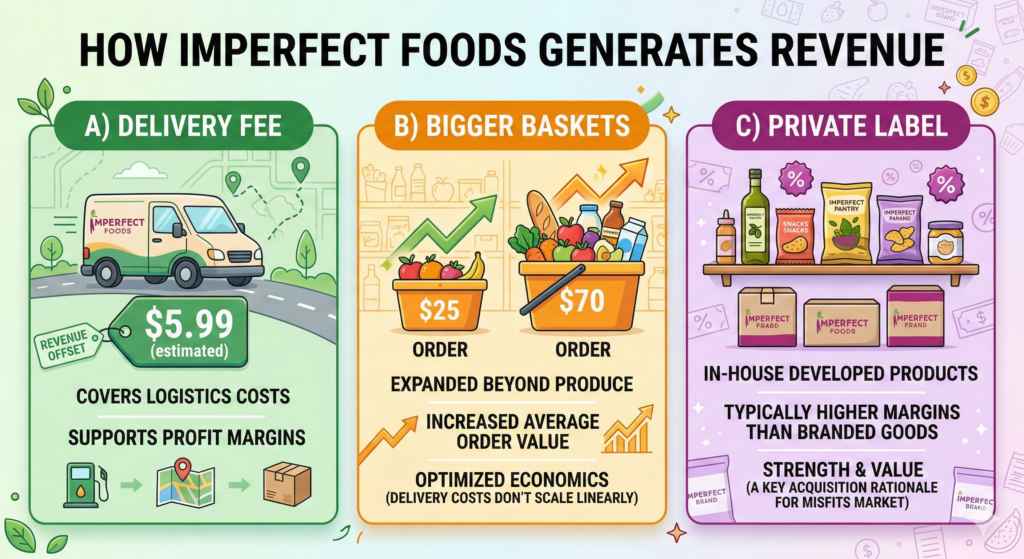
A) Delivery fee
Imperfect’s model includes a delivery fee (commonly cited around $5.99 in business breakdowns), which helps offset logistics costs and protects margins.
B) Bigger baskets
As Imperfect expanded beyond produce, it increased average order value. That’s critical because delivery costs don’t scale linearly—delivering a $25 box vs a $70 order changes the economics.
C) Private label
Imperfect developed private label products, which typically carry higher margins than branded goods. Misfits Market explicitly highlighted Imperfect’s private label strength when talking about the acquisition rationale.
Think of private label as the grocer’s “profit engine”—it’s how you move from “cool idea” to “durable margins.”
Why The Model Works: Imperfect’s Competitive Advantages
1) Non-traditional supply is less competitive (and often cheaper)
Imperfect isn’t always fighting Whole Foods for the same exact inventory. It’s pulling from the “ignored” and “awkward” categories of supply chains.
This can create better pricing power:
- suppliers want to move inventory
- traditional channels can’t/won’t take it
- Imperfect becomes a consistent buyer
2) Values-driven positioning lowers friction
Imperfect sells a story:
- “You’re saving food”
- “You’re helping sustainability”
- “You’re shopping smarter”
That narrative can increase customer loyalty and reduce churn—especially for customers who like their groceries with a side of moral satisfaction.
3) Habit + convenience is sticky
Weekly grocery routines are powerful. If a customer builds a rhythm—browse, customize, receive box—Imperfect becomes a default behavior, not a one-time experiment.
What Changed After Misfits Market Acquired Imperfect Foods?
When Misfits Market announced the acquisition, the combined company’s pitch was scale:
- bigger assortment
- better sourcing leverage
- stronger path to profitability
Over time, industry coverage has pointed toward consolidation of brands and operations to improve efficiency and unify private label strategy.
This is the classic endgame of logistics-heavy startups:
- Growth phase: multiple brands, multiple warehouses, lots of experimentation
- Efficiency phase: consolidate, standardize, squeeze waste out of the system (ironically… by reducing operational waste)
Who are Imperfect Foods’ Main Competitors?
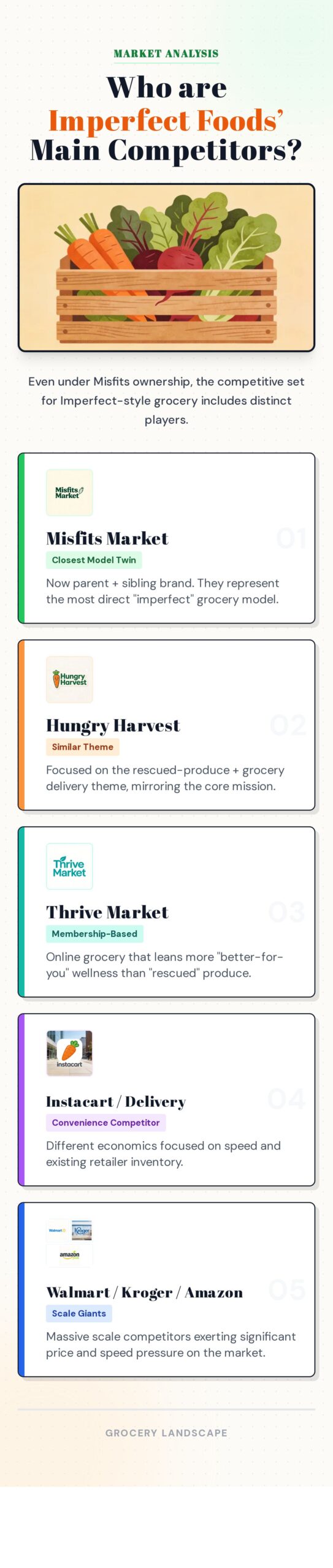
Even under Misfits ownership, the competitive set for Imperfect-style grocery includes:
- Misfits Market (now parent + sibling brand; also the closest model twin)
- Hungry Harvest (similar rescued-produce + grocery delivery theme)
- Thrive Market (membership-based online grocery; more “better-for-you” than “rescued”)
- Instacart / retailer delivery (convenience competitor; different economics)
- Walmart / Kroger / Amazon Fresh (scale competitors; price and speed pressure)
Imperfect’s differentiator isn’t that it’s the only delivery option—it’s that it tries to win on:
value + sustainability + discovery (you never know what “rescued” gems you’ll find).
The Brand Hopper Takeaway
Imperfect Foods is owned by Misfits Market following a September 2022 all-stock acquisition, with Imperfect’s prior investors generally rolling into the combined company.
Its business model is a smart blend of:
- alternative supply (imperfect/surplus)
- direct-to-consumer delivery (route density)
- expanded grocery basket (higher order values)
- private label (margin expansion)
Or, in plain English:
Imperfect doesn’t just sell groceries—it sells a more efficient way to monetize the parts of the food system that traditional retail leaves behind.
And that’s why the “ugly produce box” idea didn’t stay a niche. It grew up, became a full grocery platform, and eventually joined forces with its closest rival to scale the mission—and survive the brutal economics of delivering food to people’s doors.
Summary
| Category | Details |
|---|---|
| Company Name | Imperfect Foods |
| Original Entity | Imperfect Produce (Founded 2015) |
| Rebranded As | Imperfect Foods (2019) |
| Current Parent Company | Misfits Market |
| Deal Type | All-stock acquisition |
| Acquisition Announcement | September 2022 |
| Deal Value | Undisclosed |
| Ownership Status | Privately held (under Misfits Market) |
| Control Structure | Managed under Misfits Market leadership |
| CEO Post-Acquisition | Abhi Ramesh (CEO, Misfits Market) |
| Previous Major Investors (Pre-Acquisition) | Insight Partners, Norwest Venture Partners, among others |
| Current Ownership Structure | Misfits Market shareholders (including rolled-over Imperfect investors + employee equity holders) |
| Publicly Traded? | No |
Also Read: Exploring Marketing Strategies & Mix of Hormel Foods
To read more content like this, subscribe to our newsletter