Last Updated on July 16, 2026 by Team TBH
Every year, the world discards approximately 62 million tonnes of electronic waste — a number growing three times faster than the world’s population. A cracked iPhone abandoned in a drawer, a laptop replaced after two years, a gaming console gathering dust in a cupboard. This is the problem Back Market decided to solve in 2014 with a simple but radical idea: build a marketplace so trustworthy, so well-designed, and so consumer-friendly that buying a refurbished iPhone would feel just as natural as buying a new one.
Twelve years later, that idea has grown into one of Europe’s most valuable startups. Back Market closed 2025 with €3.5 billion in gross merchandise value — a 32% leap from the prior year — and crossed the threshold into global EBITDA profitability, a milestone its founder Thibaud Hug de Larauze called the company’s most significant since its first sale in 2014. With 17 million customers across 18 countries, 2,700 professional refurbisher partners, and a freshly appointed CEO ready to steer the next chapter, Back Market is no longer a startup story. It is an infrastructure story: the platform that makes the circular economy of consumer electronics a reality at scale.
This comprehensive guide covers Back Market’s full founding story, how its two-sided marketplace works, every revenue stream, the complete $1.02 billion funding history, new strategic moves into repair and B2B, its environmental impact, competitive positioning against Amazon, eBay, and Swappa, and what the future holds for the world’s leading refurbished electronics marketplace.
Founding Story of Back Market: The Idea That Started in an E-Commerce Drawer
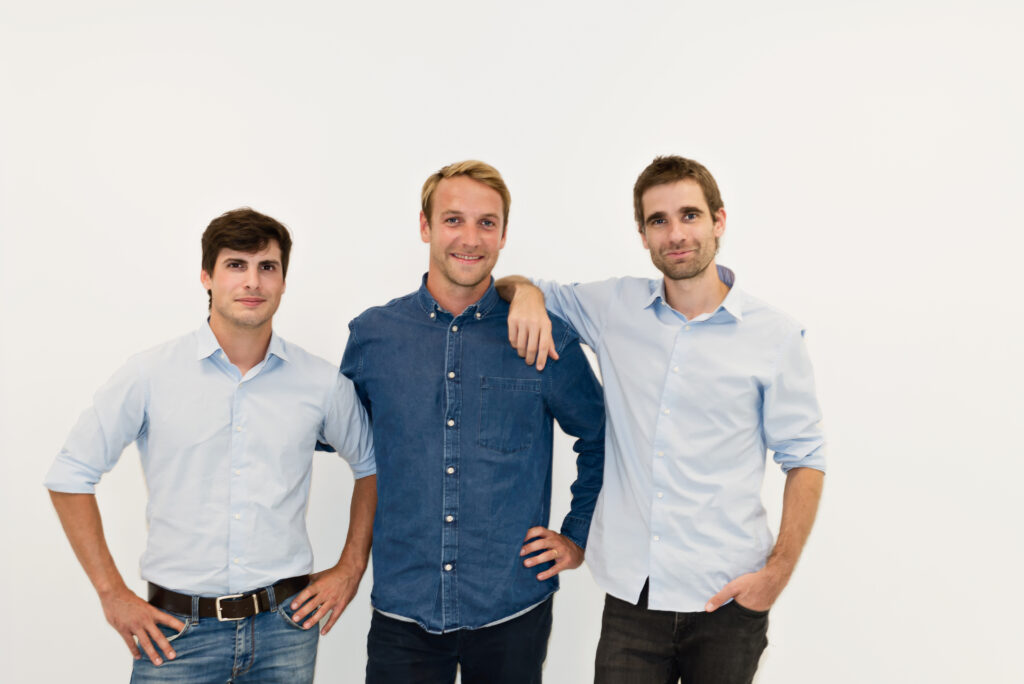
Back Market’s origin is rooted in a frustration that millions of consumers share: a nearly-new device, perfectly functional, sold for a fraction of its cost — but with no reliable place to buy it safely. The three founders each brought a distinct lens to the problem.
Thibaud Hug de Larauze had spent years in e-commerce management roles and understood the mechanics of online trust at scale. Quentin Le Brouster brought deep technical and engineering expertise. Vianney Vaute — the brand and culture architect — brought a conviction that sustainability had to be central to the pitch, not an afterthought. Together, they noticed an obvious gap: professional electronics refurbishers existed across Europe, doing serious quality work, but had nowhere to reach consumers credibly.
The Founding Insight
The insight was not that refurbished electronics were undervalued — the market knew that. The insight was that the lack of trust infrastructure was the bottleneck. Consumers wouldn’t buy refurbished because they couldn’t tell a reputable refurbisher from a fly-by-night reseller. Platforms like eBay mixed professionals with amateurs, with no quality baseline. The solution was to build a trust layer: vet every seller, enforce a quality charter, back every sale with a mandatory minimum warranty, and make the return process frictionless enough that the risk of buying refurbished felt lower than the risk of buying new from a third-party on Amazon.
Company History Timeline of Back Market
| 2014 | Thibaud Hug de Larauze, Quentin Le Brouster, and Vianney Vaute co-found Back Market. Platform officially launches in November 2014 in France, with a focus on smartphones and laptops from vetted professional refurbishers. |
| 2015 | Raises first Seed funding: $2.8 million from Daphni, Aglaé Ventures, and others. Platform gains traction in France, building a roster of professional refurbishers and overcoming early consumer scepticism. |
| 2017 | Launches in Germany, marking first international expansion. Demonstrates that the marketplace model works beyond France and lays the template for multi-country rollouts. |
| 2018 | Series A: $7M from Eurazeo, Aglaé Ventures, Daphni. Series B: $48M led by Groupe Arnault (LVMH parent company). Enters United States market — a pivotal bet on the world’s largest refurbished electronics consumer market. |
| 2019 | Broadens product categories significantly: cameras, gaming consoles, smart home devices, tablets added. Acquires Recommerce Solutions to strengthen B2B trade-in and refurbishment capabilities. |
| 2020 | Series C: $120M from Goldman Sachs, Aglaé Ventures, Eurazeo Growth. COVID-19 pandemic dramatically accelerates demand for refurbished electronics as consumers look for value during economic uncertainty. |
| 2021 | Series D: $335M led by General Atlantic; valuation reaches $3.2 billion (unicorn status confirmed). Expands to 16 countries. Reaches over 5 million registered customers. |
| 2022 | Series E: $510M led by Sprints Capital; valuation reaches $5.7 billion. Total funding crosses $1 billion. Launches Japan — first Asian market. Wins multiple sustainability awards. |
| 2024 | Revenue reaches $415M (+25% YoY). Launches Verified Premium category — devices showing no signs of use, all original parts. Achieves EBITDA profitability in Europe. B2B division scales to 6,000 company clients in France. |
| 2025 | GMV hits €3.5 billion (+32% YoY). Revenue reaches €440M. Achieves global EBITDA profitability. Opens first physical retail store in New York City (SoHo, 449 Broadway). Launches repair subscription service in France, Germany, Spain. Founder Thibaud named to TIME100 Next 2025. 17M customers |
| 2026 | .Announces first-ever CEO transition: CFO Clément Petit to become CEO on September 1, 2026; Thibaud Hug de Larauze becomes Executive Chairman. Plans to scale to 500 points of sale in France. B2B expansion accelerates in US (~250 company clients). |
How Back Market Works: The Business Model of Back Market
Back Market operates a curated two-sided marketplace — a model that sits between pure peer-to-peer platforms (like eBay or Facebook Marketplace) and direct retail. It is asset-light by design: Back Market holds no inventory, employs no refurbishers, and operates no warehouses. Instead, it builds and enforces the trust layer that makes the transaction possible.
The Two-Sided Marketplace Structure
| Side | Who They Are | What Back Market Provides Them | What They Provide Back Market |
| Supply Side | ~2,700 professional electronics refurbishers across 18+ countries | Platform access, buyer demand, quality crediting, dispute resolution, marketing visibility | Vetted refurbished inventory, quality assurance, fulfillment, customer handling |
| Demand Side | 17 million consumers globally (individuals + companies) | Trust, standardised warranty (12-month minimum), 30-day returns, curated product selection | GMV (purchases generating commission), data, reviews, repeat purchases |
The Quality Charter: Back Market’s Core Differentiator
The most important element of Back Market’s business model is its Quality Charter — the set of standards every refurbisher must meet to list on the platform. This is the trust infrastructure that justifies the marketplace premium over eBay or Facebook Marketplace:
- Full functional testing: every device tested against a checklist of 25+ functional criteria (call quality, camera, battery, charging, touchscreen responsiveness)
- Battery health minimum: smartphones must have a battery at 80%+ health at listing
- Cosmetic grading: devices graded from ‘Like New / Verified Premium’ down to ‘Satisfactory’ (Fair) with photographic standards for each grade
- 12-month minimum warranty: all products carry at least a 12-month warranty, enforceable via Back Market’s dispute resolution system
- 30-day money-back guarantee: customers can return any device within 30 days for any reason
- Performance monitoring: refurbishers are tracked on defect rate, return rate, response time, and customer ratings — below-threshold sellers are delisted
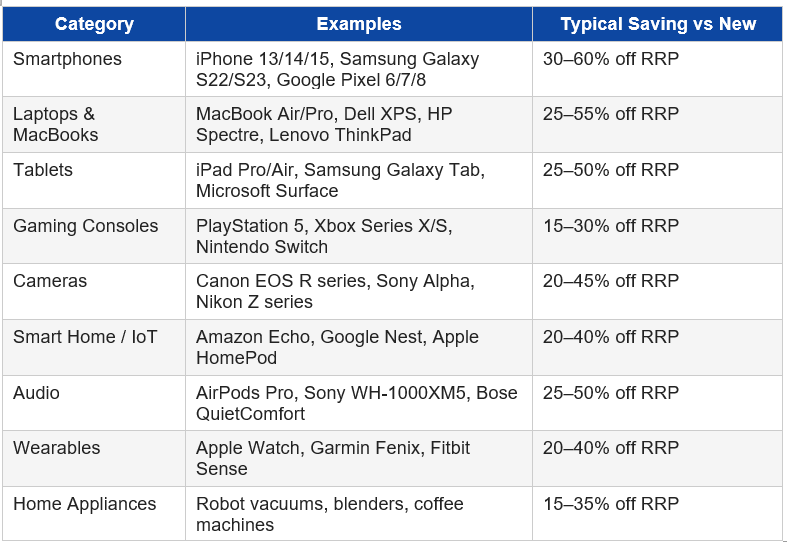
The Quality Charter is Back Market’s moat. It converts a fragmented, trust-deficient secondary market into a reliable, consumer-grade purchasing experience — and it is the reason customers pay a slight premium over eBay while still saving 30–70% versus buying new.
Product Categories Covered by Back Market
Revenue Streams & Unit Economics of Back Market
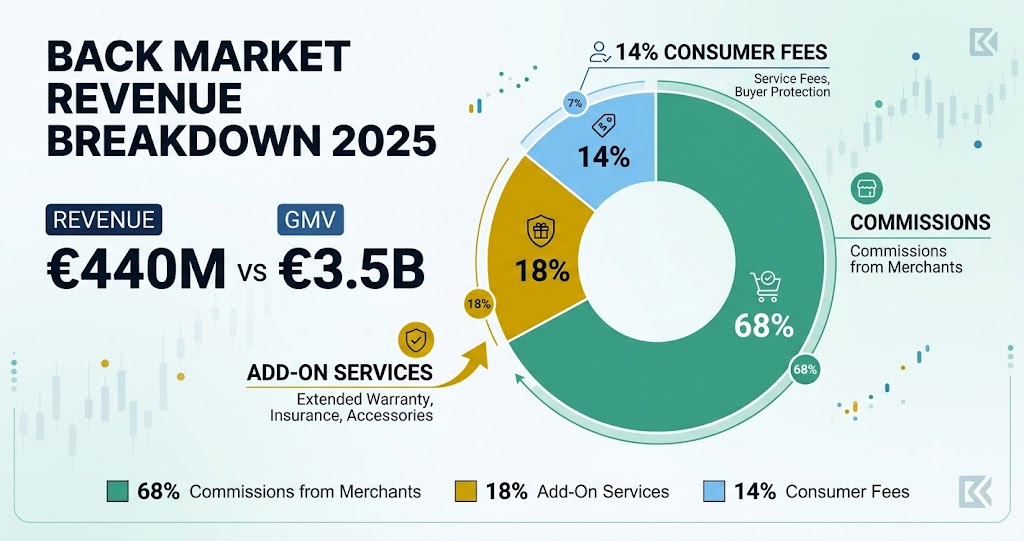
Back Market’s revenue model has evolved significantly since its launch. In 2025, the company generated €440 million in revenue from a GMV of €3.5 billion — implying a take rate (revenue as % of GMV) of approximately 12.6%, up from earlier estimates of 10–11%. This improvement reflects the maturation of higher-margin revenue streams beyond pure commission.
Revenue Breakdown (2025 Estimates)
| Revenue Stream | Share of Revenue | 2025 Est. Value | Description |
| Seller Commissions | ~68% | ~€299M | Fixed commission (~10% of GMV) charged to refurbishers on each sale; primary revenue driver |
| Consumer Service Fees | ~14% | ~€62M | Buyer-side fees including platform service charges, optional delivery upgrades, and insurance premiums |
| Add-On Services | ~18% | ~€79M | Extended warranties, seller advertising/premium placement, B2B subscription fees, repair services (new in 2024–25), carrier partnerships |
1. Seller Commissions (Core Revenue)
Back Market charges refurbishers a commission of approximately 10% of the transaction value for every sale made on the platform. This is the foundational revenue stream: as GMV scales, commission revenue scales proportionally. The rate may vary slightly by category or by individual commercial agreements with high-volume refurbishers.
2. Seller Listing & Premium Placement Fees
Professional refurbishers can pay for enhanced visibility on the platform — featured placement on search results, homepage listings, and category-level prominence. This advertising-style revenue stream mirrors what Amazon charges third-party sellers for Sponsored Products. As Back Market’s traffic grows, this inventory of premium placement becomes increasingly valuable to sellers competing for the same device categories.
3. Consumer Insurance & Extended Warranty Plans
Back Market offers optional extended warranty plans beyond the standard 12-month minimum. These premium plans — sold directly to consumers at checkout or post-purchase — extend coverage to 24 or 36 months. Insurance revenue is high-margin because it involves minimal fulfillment cost and generates consistent, predictable revenue per-device sold. Back Market has partnered with specialist insurers to underwrite the policies while retaining a distribution margin.
4. B2B Services & Subscriptions
Back Market’s B2B division — which provides refurbished devices to companies for employee use, replacing traditional new-device procurement — has grown to approximately 6,000 company clients in France and 250 in the United States as of 2025. Major clients include Kering (luxury goods), Vinci (construction & concessions), Air France, and Le Point (media). The B2B model typically involves volume purchasing agreements, account management services, and device management add-ons, generating higher average order values and stronger retention than consumer sales.
5. Repair Services Subscription (New 2024–25)
In 2024–25, Back Market launched a repair services platform in France, Germany, and Spain, powered by Evy. The service is open to all consumers — not just Back Market buyers — and connects users with local repair technicians for same-day or next-day repair of smartphones, tablets, gaming consoles, and cameras. A monthly subscription model at €6.99/month offers unlimited repair services for covered devices. This is a nascent but high-potential revenue stream: Back Market is positioning itself not just as a marketplace for buying refurbished, but as a lifecycle partner for electronics ownership.
Unit Economics Highlight: Back Market’s France market achieved an EBITDA margin of 35% in 2025 — confirming the scalability of the marketplace model as markets mature. New markets (Italy, Austria, Portugal) are growing at triple-digit rates, suggesting France’s margin profile is the long-term target for all geographies.
Funding History, Valuation & Investors of Back Market
Back Market has raised $1.02 billion in funding across six rounds since its founding. The company has not raised since its January 2022 Series E — a deliberate choice: CEO Thibaud Hug de Larauze indicated in late 2025 that no new fundraising was planned in the near term, with global EBITDA profitability making external capital unnecessary for operations. The valuation has modestly declined from the 2022 peak of $5.7 billion to €5.1 billion (~$5.5B) in September 2025, reflecting broader private market de-rating rather than deteriorating fundamentals.
| Round | Year | Amount | Lead Investor | Valuation | Key Strategic Significance |
| Seed | 2015 | $2.8M | Daphni + Aglaé Ventures | N/A | Initial capital to build platform, recruit first refurbishers, hire engineering team |
| Series A | 2018 | $7M | Eurazeo, Aglaé Ventures, Daphni | N/A | Funded geographic expansion planning and platform improvements |
| Series B | 2018 | $48M | Groupe Arnault (LVMH parent) | N/A | Strategic validation: LVMH’s parent backing signalled luxury-grade ambition. Funded Germany/Spain expansion and US market entry |
| Series C | 2020 | $120M | Goldman Sachs + Eurazeo Growth | ~$1B+ | COVID-19 pandemic accelerated refurbished demand; capital funded supply-side scaling and category expansion |
| Series D | 2021 | $335M | General Atlantic | $3.2B | Unicorn status. Funded international expansion to 16 countries, headcount growth, B2B launch |
| Series E | 2022 | $510M | Sprints Capital | $5.7B | Largest round; total funding crosses $1B. Funded Japan launch, marketing investment, tech infrastructure |
Key Investors of Back Market
| Investor | Type | Notable Significance |
| Eurazeo | French private equity / VC | Multi-round investor from Series A; provides European growth expertise |
| General Atlantic | Global growth equity | Lead Series D; validates Back Market’s path from startup to global growth-stage company |
| Sprints Capital | Growth equity | Led $510M Series E; specialises in marketplace and platform businesses |
| Groupe Arnault / LVMH | Strategic / Family Office | LVMH parent’s backing lent brand credibility; shows overlap between luxury/sustainability values |
| Goldman Sachs | Investment bank / Growth equity | Series C participation; institutional validation |
| Generation Investment Management | Sustainability-focused VC | Al Gore co-founded fund; backing reinforces Back Market’s circular economy credentials |
| Aglaé Ventures | VC | Seed-to-Series E continuity; one of the longest-running investors |
| Quadrille Capital | VC | Late-stage participant |
Profitability note: Back Market achieved EBITDA profitability in Europe in 2024 and globally in 2025 — without raising additional capital since January 2022. This places it among the rare group of VC-backed European unicorns that have reached profitability without a ‘survival round’, making it a significantly de-risked investment from existing shareholders’ perspective.
New Strategic Initiatives of Back Market: Beyond the Marketplace (2024–2026)
Back Market’s 2024–2026 strategy represents a significant evolution from its original marketplace-only model. The company is expanding into adjacent layers of the electronics lifecycle — repair, physical retail, and B2B — creating a more comprehensive platform for sustainable electronics ownership.
1. Verified Premium — Elevating the Refurbished Category
Launched in 2024, the Verified Premium tier is Back Market’s answer to a persistent consumer concern: ‘I want refurbished, but I’m not sure I want used.’ Verified Premium devices are:
- Showing no signs of external use — cosmetically indistinguishable from new
- Containing all original manufacturer parts — no third-party components
- Tested and certified to the highest functional standards on the platform
- Priced at a smaller discount to new (typically 15–25% off) but still meaningfully cheaper than retail
By early 2025, Verified Premium represented approximately 20% of all Back Market sales — a remarkable adoption rate for a new tier that launched less than 18 months earlier. It captures demand from consumers who want refurbished’s price benefit but new’s peace of mind.
2. B2B Expansion — Corporate Device-as-a-Service
Back Market’s B2B division is one of its fastest-growing segments and its most strategically differentiated move. Rather than requiring individual employees to buy their own devices, companies subscribe to Back Market for Business to equip their workforces with certified refurbished smartphones, laptops, and tablets. Key metrics as of 2025:
- ~6,000 company clients in France (including Kering, Vinci, Air France, Le Point)
- ~250 company clients in the United States (growing at 2x the France rate in 2025)
- B2B division doubled in size during 2025
- Average B2B order value 3–5x higher than consumer orders
The B2B angle also serves Back Market’s sustainability mission: companies that equip 500 or 5,000 employees with refurbished devices instead of new devices create massive, measurable CO₂ savings that can be reported in corporate ESG disclosures — a valuable differentiator as ESG reporting becomes mandatory in the EU under CSRD regulations.
3. Repair Services — Extending the Electronics Lifecycle
Launched in France, Germany, and Spain in 2024–25 (powered by Evy), Back Market’s repair platform completes the electronics lifecycle loop. Rather than just being a marketplace for buying refurbished, Back Market now connects consumers and businesses with local repair technicians for:
- Smartphone screen replacements, battery swaps, charging port repairs
- Laptop keyboard, display, and motherboard repairs
- Gaming console disc drive, HDMI port, and power unit repairs
- Camera lens, sensor, and body repairs
The €6.99/month unlimited repair subscription covers all of the above categories for devices purchased anywhere — not just from Back Market. This is a strategically significant move: it makes Back Market the steward of a consumer’s entire device ecosystem, not just the point of purchase.
4. Physical Retail — New York City Pop-Up & France Distribution
In a striking departure from its digital-native origins, Back Market opened its first physical retail store in New York City (449 Broadway, SoHo) from October 1 to December 19, 2025. The pop-up served both as a brand awareness play in the US market and as a test of the in-store experience for refurbished electronics.
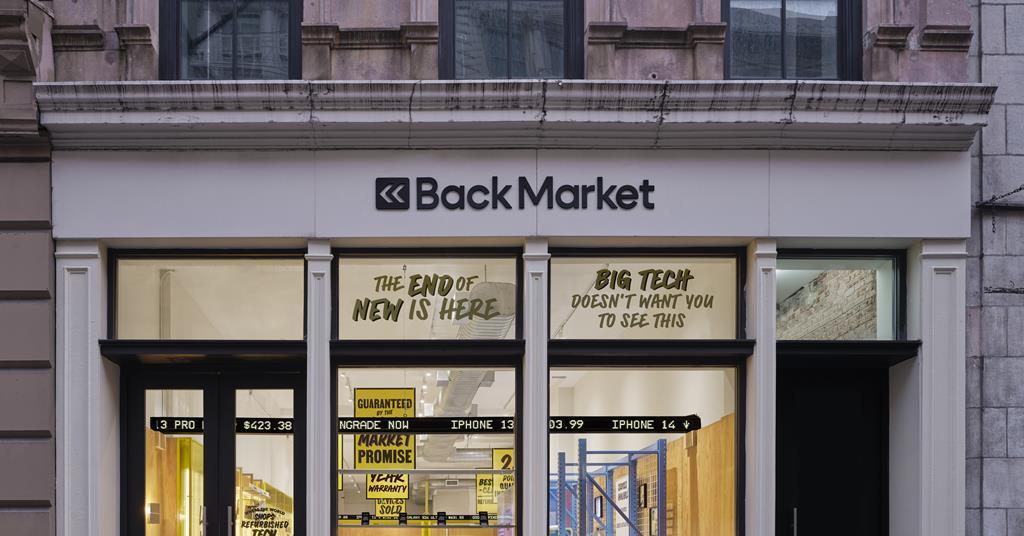
In France, Back Market has announced plans to expand to 500 points of sale through a distribution partner — taking refurbished devices into mainstream French retail locations. This retail network strategy mirrors what brands like Patagonia have done with sustainability-positioned physical stores: making the sustainable choice as accessible as the unsustainable alternative.
Leadership & Team of Back Market
The CEO Transition — A Milestone for Back Market
In June 2026, Back Market announced its first leadership transition since the company’s founding in 2014: CFO Clément Petit will become the new CEO on September 1, 2026. Founder Thibaud Hug de Larauze will step into the role of Executive Chairman, focusing on long-term strategy and the broader ecosystem transformation of the circular electronics economy.

The transition is notable for several reasons. Petit joined Back Market in 2020 as CFO and played a central role in steering the company to profitability — first in Europe (2024) then globally (2025). His appointment as CEO signals that Back Market’s next chapter is one of disciplined, profitable scaling rather than venture-funded growth-at-all-costs. The appointment also gives Hug de Larauze bandwidth to operate as an industry statesperson — he was named to TIME100 Next 2025, recognition of his influence on the circular economy conversation globally.
| Person | Role | Background & Contribution |
| Thibaud Hug de Larauze | Co-Founder & Executive Chairman (CEO until Sept 2026) | E-commerce veteran who conceived Back Market in 2014. Led the company for 12 years from founding through $1B in funding and global profitability. Named to TIME100 Next 2025. |
| Clément Petit | Incoming CEO (from September 1, 2026) | Joined Back Market in 2020 as CFO. Architect of the company’s path to profitability. First external executive to hold the CEO role. |
| Quentin Le Brouster | Co-Founder | Technical co-founder; built the original platform architecture and supply-side integration infrastructure. |
| Vianney Vaute | Co-Founder (departed) | Brand and culture architect; established Back Market’s distinctive sustainability-forward brand voice. Left company to pursue other projects. |
Global Footprint of Back Market: 18+ Countries
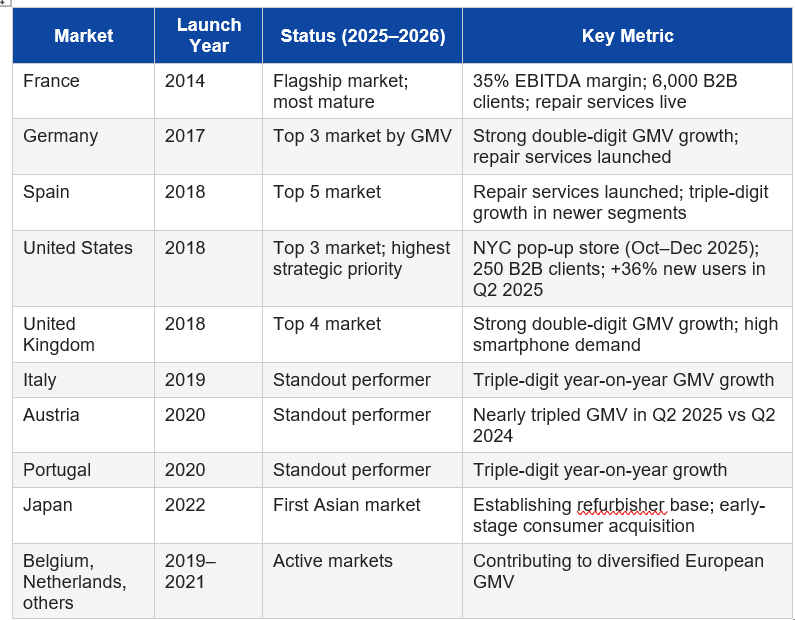
Back Market operates across 18+ countries as of 2026, with its go-to-market strategy following a well-established template: launch in a country, build the refurbisher supply base, invest in consumer acquisition, achieve unit-economics profitability, then expand the service catalogue (B2B, repair, premium tiers). France remains the largest market by GMV and the most profitable (35% EBITDA margin), while newer markets are showing rapid adoption.
Environmental Impact & ESG
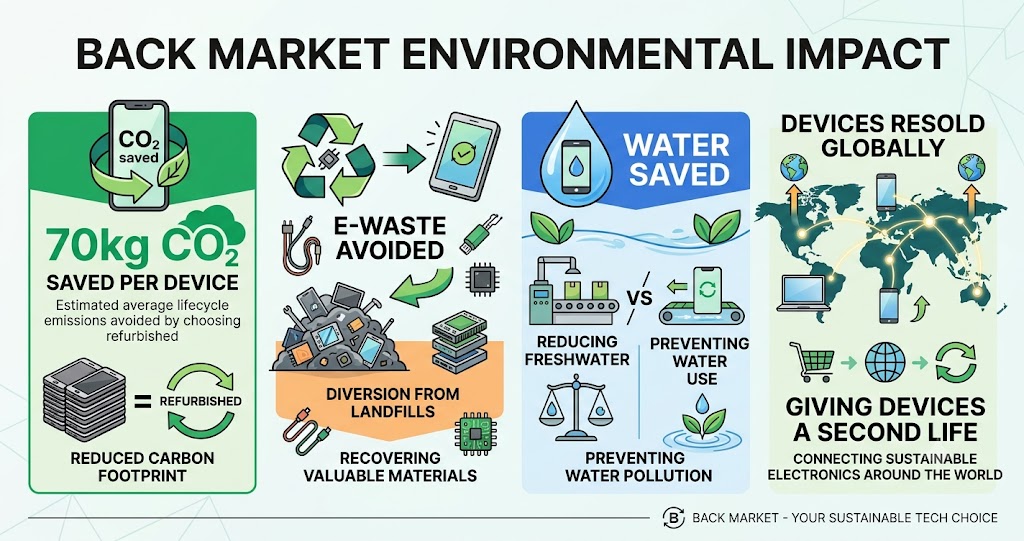
Back Market’s core business is, by definition, a sustainability business: every device sold as refurbished is a device not manufactured new. This creates measurable environmental benefits that form the foundation of the company’s identity and marketing.
The Numbers
- Average CO₂ saved per device purchased refurbished vs new: ~70 kg (equivalent to driving approximately 350 km in a petrol car)
- E-waste avoided: every refurbished device sold extends the useful life of a device by an average of 3–5 years
- Global e-waste context: the world generates 62 million tonnes of e-waste per year — growing 3x faster than population; Back Market estimates it has collectively extended the life of millions of devices
- Carbon footprint of manufacturing: producing a new smartphone requires approximately 70 kg of CO₂ equivalent; refurbishment requires approximately 2–3 kg
- Water consumption: new smartphone production requires approximately 13,500 litres of water; refurbishment requires a fraction of this
Circular Economy Leadership
Back Market is a vocal proponent of the Right to Repair movement and has lobbied European regulators for stronger legislation requiring manufacturers to provide spare parts and repair documentation. The EU’s Right to Repair Directive — enacted in 2024 — was partially shaped by advocacy from companies including Back Market. The company sees repair services not just as a new revenue stream but as a regulatory and ethical imperative.
Under the incoming CSRD (Corporate Sustainability Reporting Directive), large European companies are required to report their Scope 3 supply chain emissions starting 2025–2026. Procurement of refurbished devices from Back Market for Business creates directly measurable, auditable CO₂ savings that B2B clients can include in their mandatory ESG disclosures — a powerful commercial differentiator.
Back Market’s Sustainability Advantage: As the EU CSRD mandates Scope 3 emissions reporting, Back Market for Business becomes a de facto ESG procurement tool — giving companies a turnkey solution to reduce their technology procurement’s carbon footprint while saving 30–60% on device costs.
Competitive Landscape of Back Market: Who Back Market Competes With
Back Market operates in a competitive but structurally differentiated market. Its closest rivals occupy different points on the spectrum between trust/curation and price/breadth.
| Competitor | Model | Refurbishers | Warranty | Back Market Advantage |
| Amazon Renewed | Curated marketplace on Amazon | Amazon-approved sellers | 90-day Amazon guarantee | Better quality control; specialist focus; stronger sustainability brand |
| eBay Refurbished | Marketplace (peer + pro) | Mixed: peers + professionals | Seller-dependent | No quality charter enforcement; Back Market’s vetting is far more rigorous |
| Apple Certified Refurbished | Direct seller (own products only) | Apple (in-house) | 1-year Apple warranty | Back Market: multi-brand; often 10–20% cheaper than Apple Certified for same device |
| Swappa | P2P marketplace | Peer sellers | 30-day Swappa guarantee | Back Market: professional refurbishers; stronger quality baseline; wider categories |
| Decluttr / Music Magpie | Direct seller (own inventory) | In-house refurbishment | 12-month warranty | Back Market: wider selection; marketplace model scales better than direct inventory model |
| Gazelle | Direct seller (own inventory) | In-house refurbishment | 30-day warranty | Back Market: marketplace breadth; Gazelle limited to US smartphones/tablets only |
| Swappie | Specialist marketplace | Vetted sellers (smartphones only) | 12-month warranty | Back Market: full product range; geographic scale; B2B offering |
| Samsung/OEM Certified Refurbished | Manufacturer-direct | OEM in-house | 12-month OEM warranty | Back Market: multi-brand; 30–60% savings vs OEM certified prices typically higher |
Back Market’s Structural Moat: The 2,700-refurbisher supply network is extremely hard to replicate quickly. Building a supply base of this size and quality — with performance monitoring systems, dispute resolution infrastructure, and quality charter enforcement — requires years of relationship-building and operational investment. New entrants face a 5–7 year gap to match Back Market’s supply-side depth.
Market Size & Growth Opportunity of Back Market
Back Market operates at the intersection of two powerful secular trends: consumer demand for value in electronics (driven by rising device prices and economic pressure) and the global shift toward sustainability in consumption. The addressable market is enormous and growing rapidly.
| Market Segment | 2024 Size | 2032/2035 Projection | CAGR | Back Market’s Position |
| Global Refurbished Electronics Market | $67.3 billion | $124.8 billion by 2032 | 9.3% | #1 dedicated marketplace by GMV in Europe; top 3 globally |
| US Refurbished Smartphone Market | $15.26 billion (2025) | $49.58 billion by 2035 | 12% | Top 3 platform; significant headroom vs France penetration level |
| B2B Corporate Device Procurement | Hundreds of billions globally | Growing as ESG mandates bite | N/A | Early-stage; France proves model; US expansion underway |
| Consumer Electronics Repair Market | $12+ billion (Europe) | Growing with EU Right to Repair Directive | 8–10% | Back Market repair launch positions it as lifecycle partner |
The most significant growth driver for Back Market’s long-term TAM expansion is regulatory tailwinds. The EU’s Right to Repair Directive (2024), CSRD sustainability reporting mandates, and the growing consumer backlash against planned obsolescence all benefit Back Market directly. Meanwhile, in the US, the FTC’s focus on right-to-repair and growing state-level legislation creates a policy environment that increasingly favours refurbished over new.
Frequently Asked Questions (FAQs)
Q: What is Back Market, and how does it work?
A: Back Market is a two-sided online marketplace that connects consumers with professional electronics refurbishers. Unlike eBay or Facebook Marketplace — which mix individual sellers with professionals — Back Market only allows vetted, certified refurbishers to list products. Every device is tested against a quality charter, carries a minimum 12-month warranty, and is backed by a 30-day money-back guarantee. Consumers browse and buy directly from refurbishers; Back Market takes a commission of approximately 10% on each transaction and provides the trust layer (quality standards, dispute resolution, warranty enforcement) that makes the transaction reliable.
Q: Is Back Market safe and reliable to buy from?
A: Back Market is widely considered the most reliable dedicated marketplace for refurbished electronics. Its Quality Charter requires all sellers to test devices against 25+ functional criteria, maintain minimum battery health standards, and meet cosmetic grading standards. Refurbishers are continuously monitored on return rates, defect rates, and customer satisfaction scores — underperformers are removed. The 30-day money-back guarantee and 12-month minimum warranty provide consumer protection that matches or exceeds what major retailers offer on new products. The platform has 17 million customers globally and an average Trustpilot rating of 4.1/5 from hundreds of thousands of reviews.
Q: What is Back Market’s valuation and is it profitable?
A: Back Market’s valuation as of September 2025 is €5.1 billion (approximately $5.5 billion USD), down slightly from the January 2022 Series E peak of $5.7 billion — a modest de-rating that reflects the broader correction in private market valuations rather than any operational deterioration. The company has not raised external funding since the January 2022 Series E. Critically, Back Market achieved EBITDA profitability in Europe in 2024 and globally in 2025 — a significant milestone that makes it one of the few European unicorns that is both profitable and growing strongly. Its French market alone operates at a 35% EBITDA margin.
Q: Who are Back Market’s founders, and what happened to them?
A: Back Market was co-founded in 2014 by three French entrepreneurs: Thibaud Hug de Larauze (CEO and strategic lead), Quentin Le Brouster (technical co-founder), and Vianney Vaute (brand and culture co-founder, later departed). Thibaud Hug de Larauze led the company as CEO for 12 years — through $1.02 billion in fundraising and global EBITDA profitability — before announcing in June 2026 that he would transition to Executive Chairman on September 1, 2026. He was named to TIME100 Next 2025 for his influence on the circular economy. CFO Clément Petit, who joined in 2020 and guided Back Market to profitability, takes over as CEO.
Q: What are Back Market’s main revenue streams?
A: Back Market’s revenue of €440 million in 2025 comes from three primary sources. Seller commissions (approximately 68% of revenue / ~€299M): Back Market charges refurbishers roughly 10% of each transaction value. Consumer service fees (approximately 14% / ~€62M): buyer-side platform fees, delivery upgrades, and insurance. Add-on services (approximately 18% / ~€79M, the fastest-growing segment): extended warranties, seller premium placement advertising, B2B subscription contracts, repair service revenues (new 2024–25), and carrier partnerships. The take rate of approximately 12.6% (revenue / GMV) has improved from earlier estimates of 10–11%, reflecting the growing contribution of higher-margin add-on services.
Q: How does Back Market differ from Amazon Renewed or eBay?
A: Back Market, Amazon Renewed, and eBay serve fundamentally different quality tiers in the refurbished market. Back Market operates a curated marketplace with only ~2,700 vetted professional refurbishers who must meet a strict Quality Charter — including 25+ functional tests, battery health minimums, cosmetic grading standards, and mandatory 12-month warranties. Amazon Renewed allows Amazon-approved third-party sellers but offers only a 90-day guarantee and less rigorous vetting. eBay mixes peer sellers with professionals, providing no consistent quality charter. Back Market’s approach produces a higher-quality average product but a smaller selection than eBay; the trade-off is that trust is higher and return rates lower, driving better consumer satisfaction and repeat purchase rates.
Q: What is Back Market for Business?
A: Back Market for Business is the company’s B2B division, offering companies the ability to equip their workforces with certified refurbished electronics instead of new devices. By 2025, the service had approximately 6,000 corporate clients in France (including Kering, Vinci, Air France, and Le Point) and 250 in the United States, with the B2B division doubling in size during 2025. Companies typically save 30–60% on device procurement costs versus buying new, and the CO₂ savings are measurable and reportable for ESG disclosures under the EU’s Corporate Sustainability Reporting Directive (CSRD). Back Market for Business is one of its highest-margin revenue streams due to higher average order values and stronger account retention.
Q: What is the Verified Premium category on Back Market?
A: Verified Premium is Back Market’s highest-grade product tier, launched in 2024. Devices listed as Verified Premium show no external signs of use (cosmetically indistinguishable from new) and contain all original manufacturer parts — no third-party replacement components. They are tested to the most rigorous functional standards on the platform. Verified Premium devices typically sell at a 15–25% discount to new retail price, narrower than Back Market’s average savings of 30–60%, but they address a specific consumer segment: people who want the price benefit of refurbished without any cosmetic compromise. By early 2025, Verified Premium represented approximately 20% of all Back Market sales.
Q: What are Back Market’s plans for 2026 and beyond?
A: Back Market’s 2026 strategic agenda has five pillars: (1) New CEO transition — Clément Petit takes the CEO role from September 2026, with founder Thibaud as Executive Chairman focusing on long-term strategy; (2) Physical retail expansion — scaling from the NYC SoHo pop-up to a planned network of 500 points of sale in France via a distribution partner; (3) B2B acceleration — growing corporate clients beyond the 6,000 in France, targeting 1,000+ US corporate clients; (4) Repair service expansion — rolling out the €6.99/month repair subscription from France/Germany/Spain to additional markets; (5) Market deepening — continuing to grow Italy, Austria, Portugal, and Japan, where triple-digit growth confirms significant room for penetration.
Conclusion: Back Market’s Next Chapter
When Thibaud Hug de Larauze, Quentin Le Brouster, and Vianney Vaute launched Back Market from Paris in November 2014, the refurbished electronics market was a patchwork of trust deficits, quality inconsistencies, and missed economic opportunity. Twelve years later, Back Market has done something genuinely rare in the startup world: it has built a category-defining marketplace, scaled it to profitability, and positioned itself as an essential infrastructure layer of the circular economy.
The numbers validate the thesis. €3.5 billion in GMV in 2025. €440 million in revenue. EBITDA positive globally. Seventeen million customers. Two thousand seven hundred vetted professional refurbishers. A freshly minted TIME100 Next founder transitioning to Executive Chairman as a battle-tested CFO steps up as CEO. A repair subscription platform that extends Back Market’s reach from purchase to lifecycle stewardship. A B2B division growing at twice the consumer rate, with companies from Kering to Air France now buying refurbished instead of new.
The competitive environment will intensify: Amazon Renewed, Apple Certified Refurbished, and manufacturer-direct refurbishment programmes all want a slice of the $124.8 billion global refurbished electronics market projected for 2032. But Back Market’s 2,700-refurbisher supply network, its quality charter infrastructure, its Verified Premium tier, and the EU regulatory tailwinds created by the Right to Repair Directive create defensive moats that take years — not months — to replicate.
The question for Back Market’s next decade is not whether the refurbished electronics market will grow — it will, materially. The question is whether Back Market can translate its European dominance into North American and Asian leadership before well-capitalised rivals establish their own trust infrastructure. The NYC retail experiment, the US B2B push, and the appointment of a financially rigorous CEO all suggest the company is approaching that challenge with the right instincts.
Also Read: Workato – Founders, Features, Business Model, & Funding
To read more content like this, subscribe to our newsletter