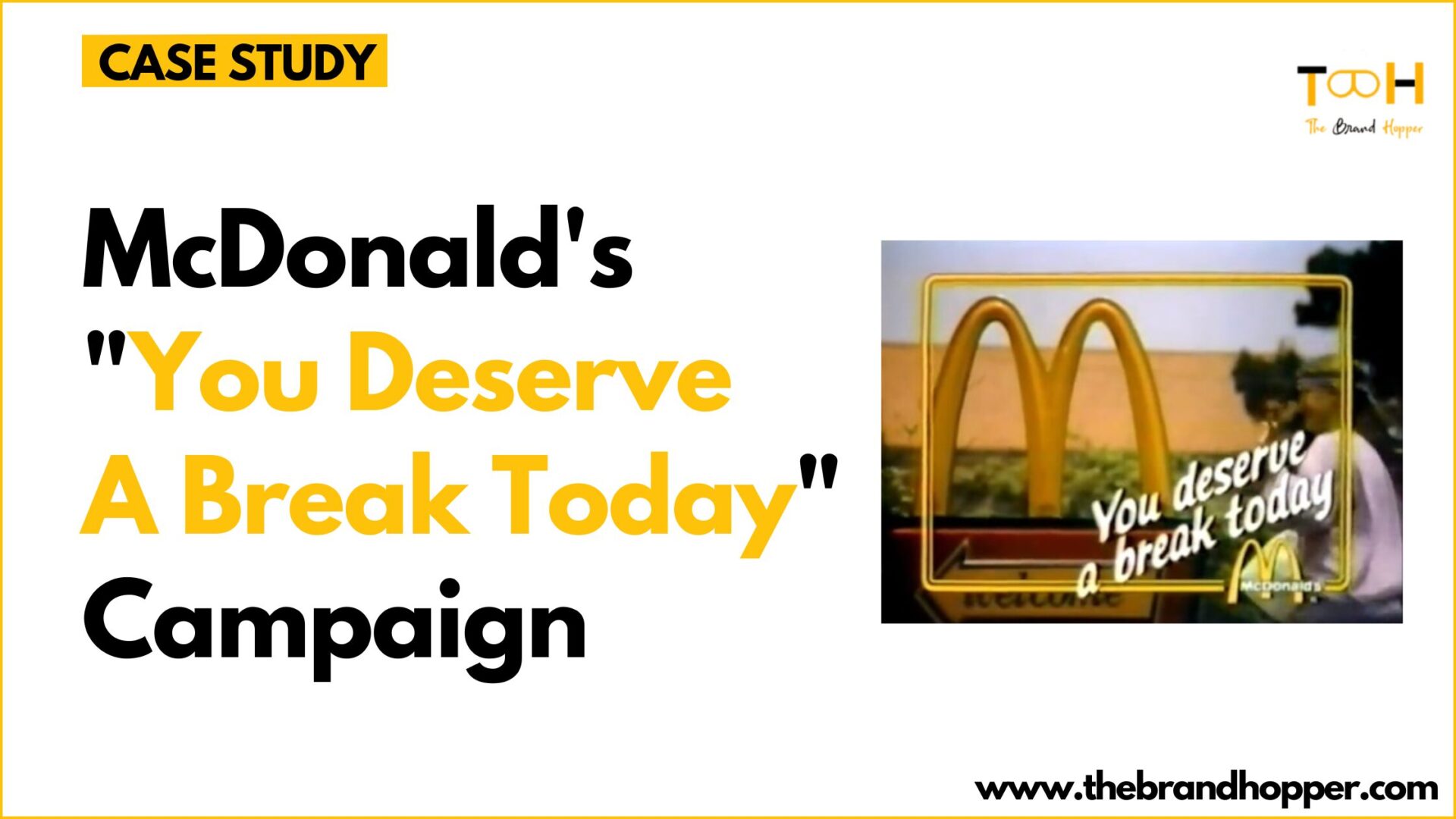
In 1971, McDonald’s was a successful, rapidly expanding burger chain, but it lacked a cohesive national identity. It was seen as a convenient stop for cheap food, but not necessarily a “destination.” Enter Needham, Harper & Steers (now DDB) and their legendary campaign: “You Deserve a Break Today.”
This was not just a jingle; it was a strategic masterstroke that shifted the brand’s positioning from “product-centric” (burgers and fries) to “experience-centric” (relief and family bonding).
This case study analyzes how McDonald’s used deep consumer insight to target a specific demographic—overworked mothers—and leveraged a Broadway-style musical production to create arguably the most successful advertising campaign of the 20th century.
Brand Context & The Challenge (1970)
The “Greasy Spoon” Stigma
By the late 1960s, the fast-food industry was suffering from a reputation problem. “Hamburger stands” were often viewed as hangouts for teenagers—noisy, messy, and potentially unsanitary. McDonald’s, led by Ray Kroc, was obsessed with QSC (Quality, Service, Cleanliness), but the public perception hadn’t fully caught up to the operational reality.
The Growth Crisis
McDonald’s was transitioning from a loose collection of franchises into a corporate giant (crossing 1,000 stores in 1968). They faced a critical challenge: How do you convince a middle-class American family to choose a burger joint over a home-cooked meal?
-
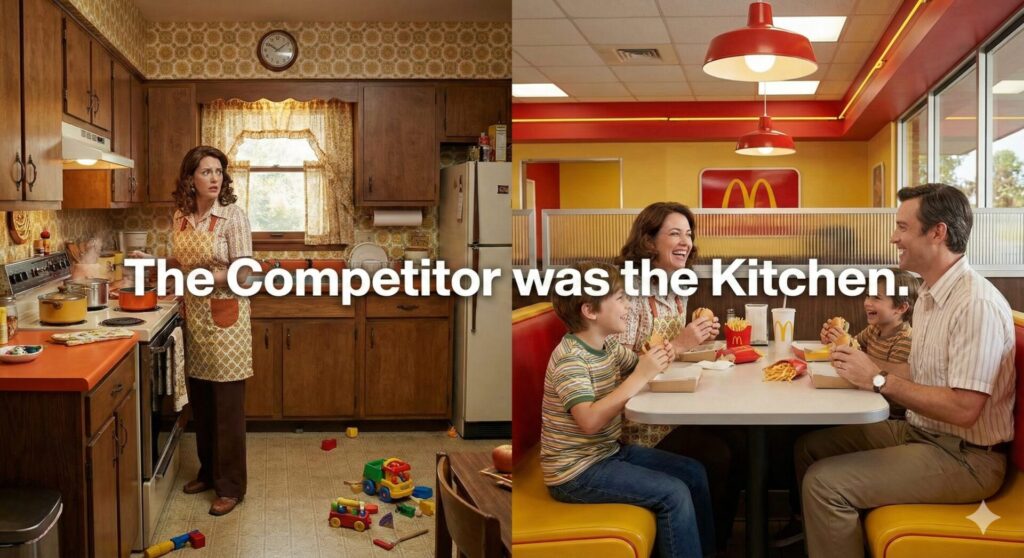
The Competitor: It wasn’t Burger King or Wendy’s (who were much smaller at the time); it was “Eating at Home.”
-
The Objective: To make McDonald’s a permissible, guilt-free family dinner option.
The Strategic Pivot: The “Mom” Insight
The agency, Needham, Harper & Steers (Chicago), conducted extensive focus groups. They discovered a profound psychological insight that became the campaign’s bedrock.
The Insight
Mothers in the 1970s felt a heavy burden to cook every night. They didn’t just want a burger; they wanted permission to stop working.
- The “Break”: The agency realized they weren’t selling food; they were selling a break from the drudgery of meal planning, cooking, and cleaning.
- The Pivot: Instead of focusing on the price of the burger (15 cents), the campaign focused on the value of the experience.
The Promise
The strategy was built on reassuring the mother that McDonald’s was:
- Clean: Safe for her children.
- Friendly: A happy place.
- High Quality: She wasn’t “cheating” her family by not cooking; she was treating them.
Creative Execution: The Broadway Approach
Keith Reinhard, the Creative Director at Needham, wanted the campaign to feel bigger than a standard commercial. He envisioned a “musical” approach—a song that could stand alone on the radio.
1) The Jingle
This is widely considered the “Gold Standard” of sonic branding.
Composition: Written by Sid Woloshin and Kevin Gavin (with lyrics by the agency team), the song was structured like a pop hit, not a sales pitch.
The Barry Manilow Connection: While often incorrectly credited with writing the song, a young Barry Manilow was one of the session singers who performed it. His smooth, emotive delivery helped give the campaign a polished, radio-ready sound that elevated the brand’s perceived quality.
2) The Lyrics as Strategy
Every line of the song addressed a specific consumer barrier:
- “Grab a bucket and a mop…” -> Addressed the Cleanliness pillar (showing staff cleaning).
- “Scrub the bottom and top…” -> Reinforced hygiene.
- “There’s nothing to do but smile…” -> Addressed the Service pillar.
The Hook: “You Deserve a Break Today” -> The emotional payoff. It validated the customer’s hard work.
3) The Visuals
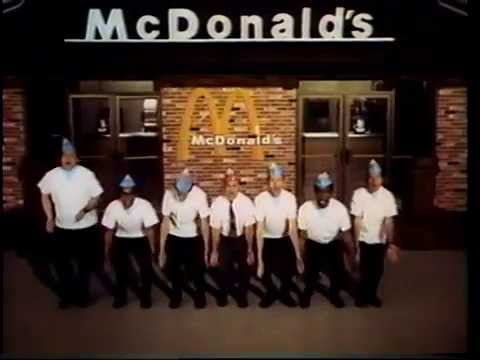
The TV spots were choreographed like stage plays. They featured “crew members” (actors) dancing with mops, smiling while flipping burgers, and families looking genuinely relieved. The lighting was high-key and bright, emphasizing the sparkling stainless steel of the kitchens.
Results & Impact
The campaign launched in 1971 and the impact was immediate and historic.
1) Financial Growth
The campaign propelled McDonald’s into a period of explosive growth.
-
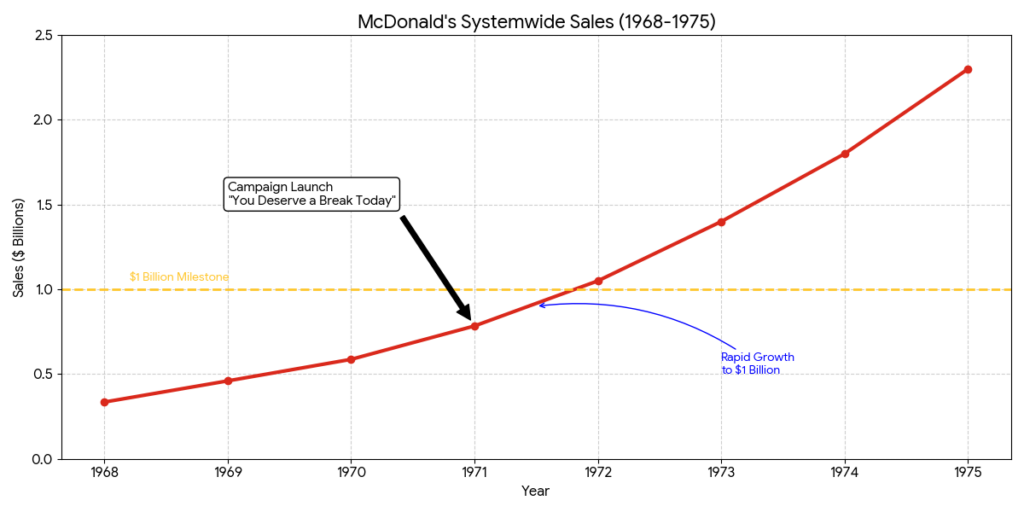
Sales Surge: In 1970, system-wide sales were roughly $587 million. By the end of 1972, just a year after the campaign fully saturated the market, sales crossed $1 billion for the first time.
-
Stock Split: The success was so immense that McDonald’s stock split multiple times in the early 70s as investor confidence soared.
2) Cultural Dominance
-
Ad Age Ranking: Advertising Age magazine ranked “You Deserve a Break Today” as the #1 Best Jingle of the 20th Century and the #5 Best Ad Campaign of the 20th Century.
-
Brand Trust: The campaign successfully eradicated the “greasy spoon” image. McDonald’s became synonymous with “Safe, Clean, Family Fun.”
3) Longevity
While the tagline eventually evolved, the “You Deserve a Break Today” jingle was used in various forms for decades. It created a “sonic asset” that McDonald’s could return to whenever they needed to boost nostalgia or trust.
Key Takeaways for Marketers
1) Sell the Benefit, Not the Feature: McDonald’s didn’t sell “hamburgers”; they sold “relief for mom.” Marketers must look beyond the product to the emotional job the product does for the consumer.
2) Music is a Superpower: A well-crafted sonic identity can do more heavy lifting than visual logos. The jingle made the brand promise (Cleanliness) catchy rather than boring.
3) Address Barriers Head-On: The campaign didn’t hide the kitchen; it celebrated the cleaning process to directly counter the negative perception of dirty fast-food joints.
4) Internal Morale Matters: The campaign wasn’t just for customers; it was for employees. By depicting crew members as singing, dancing professionals, it boosted staff pride and set a standard for service behavior.
Conclusion
The “You Deserve a Break Today” campaign is the definitive example of empathetic marketing. By understanding the social pressure on mothers in the 1970s, McDonald’s transformed a transaction (buying a burger) into an emotional release (taking a break). It proved that a low-cost product could have a high-value brand narrative. This campaign laid the foundation for the global empire McDonald’s is today, proving that sometimes, the most powerful thing a brand can offer isn’t what’s on the menu, but how it makes you feel.
Also Read: Case Study Analysis: McDonalds “I’m Loving It” Campaign
To read more content like this, subscribe to our newsletter