Every week, we see a new “AI SEO agency” pop up with a slick website, a robot mascot, and absolutely no clue how search works now. Some of them still talk only about keywords and blog posts, while Google is literally rewriting results with AI Overviews, and people are asking ChatGPT instead of typing into the search bar.
In this guide, we’re listing the AI SEO agencies that dominate their space. You’ll see who they’ve worked with, what kind of AI-driven wins they’ve achieved, and what makes them worth shortlisting if you care about the next 3–5 years of search, not just the next campaign.
Read through the list, short-list the agencies that feel closest to your world, and start a conversation with at least one of them this week.
1. Digital World Institute (DWI)
Digital World Institute is a small, focused SEO team that spends most of its time testing things, not talking about them. They’ve worked with many SaaS products, eCommerce stores, and AI tools, so their ideas come from campaigns that had money and pressure behind them.
They run experiments on how brands appear in ChatGPT, Gemini, Perplexity, and AI Overviews, then turn those lessons into content plans and link campaigns. A lot of their work is built around strong editorial links, expert-driven content, and pages that still rank well in standard Google search results.

If you’re looking for an AI SEO agency that cares about long-term traffic from search engines and AI assistants, this is one of the first names to consider.
Alongside, portfolios include numerous SEO case studies that showcase proven success across various industries. Each one highlights how AI can enhance decision-making, streamline workflows, and deliver stronger ROI through data accuracy and speed.
Digital World Institute’s every campaign is crafted around clear business objectives and grounded in measurable results.
Top advantages:
- Expertise in optimizing for AI-driven search platforms like ChatGPT and Perplexity
- Experience across SaaS, B2B, healthcare, and eCommerce sectors
- Strong case studies with measurable performance outcomes
- Practical integration of AI tools into daily SEO operations
- Transparent approach and focus on sustainable growth.
Digital World Institute remains a benchmark for how modern agencies combine AI innovation with dependable, results-focused SEO.
Also read: Top 7 Ecommerce SEO Strategies for Brand Growth
2. Skale
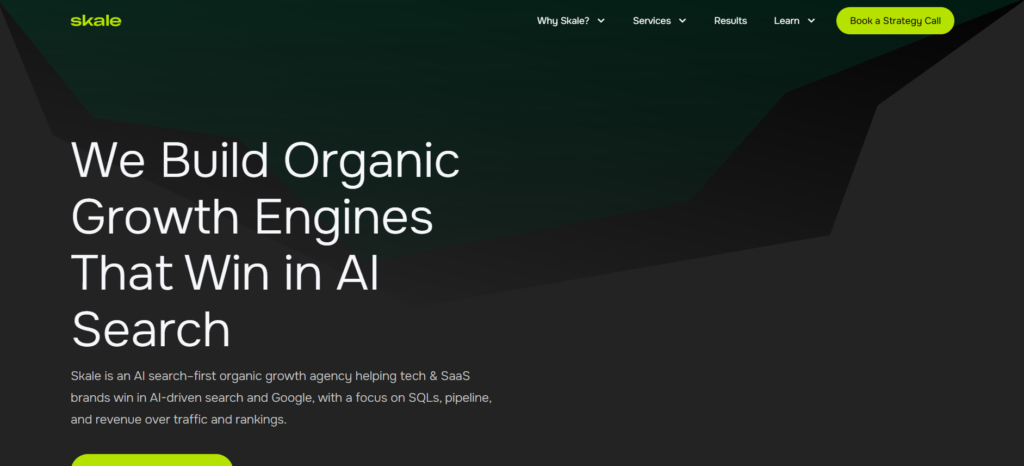
Skale is an AI Search growth agency built specifically for SaaS and tech companies that want predictable revenue from organic visibility, not just more traffic. Rather than treating AI as a content shortcut, Skale uses it to understand how modern discovery works across Google’s AI Overviews, large language models, and traditional search results.
Their team focuses on turning AI Search into a structured acquisition channel by combining technical SEO, authority-building content, and high-quality link strategies designed to influence both rankings and AI-generated answers.
What sets Skale apart is its emphasis on revenue impact. Campaigns are mapped directly to customer journeys, product-led growth, and pipeline metrics, ensuring SEO efforts connect to real business outcomes.
They work closely with fast-growing SaaS brands to identify where AI-driven discovery is already shaping buyer behavior, then build content ecosystems that position clients as trusted sources across search engines and AI assistants alike.
Pros:
- Strong focus on AI Search visibility, not just traditional rankings
- Deep experience in SaaS and product-led growth environments
- Clear alignment between SEO strategy and revenue outcomes
- Advanced use of AI for search behavior analysis and opportunity discovery
Considerations:
- Primarily focused on SaaS and tech, less suited for local or small business SEO
- Strategies are growth-oriented and may require longer-term investment
- Not designed for quick-win or low-budget SEO campaigns
Overall, Skale is a strong choice for SaaS brands that want to stay ahead of how AI is reshaping search and turn organic visibility into a reliable customer acquisition engine.
3. Revvgrowth
Revvgrowth positions itself as a data-driven SEO and content marketing agency that leverages AI to accelerate growth for B2B and SaaS companies. The agency focuses on using machine learning tools to identify keyword patterns, streamline content research, and optimize pages for both users and evolving search algorithms.
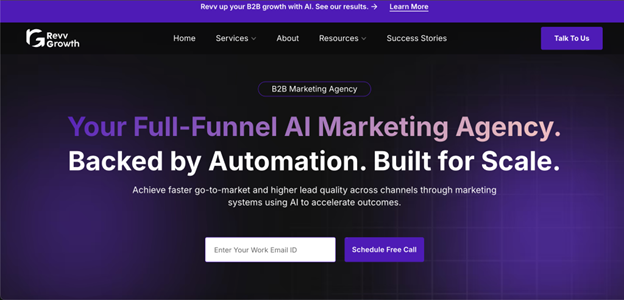
Its approach centers on precision and scalability. Each strategy is built around the client’s revenue goals, using AI to uncover untapped opportunities and forecast potential returns from organic traffic.
Revvgrowth’s team blends automation with human insight, ensuring that every optimization supports long-term brand positioning rather than short-term visibility.
The agency also invests in reporting and analytics, using AI-based dashboards that deliver real-time insights into campaign performance.
So, their transparency allows clients to make informed decisions and adjust strategies quickly when search behavior shifts.
Pros:
- Effective use of AI for keyword discovery and performance tracking
- Predictive approach that helps identify new growth opportunities
- Transparent communication and structured reporting.
Considerations:
- Pricing may be high for early-stage startups
- Heavy reliance on data tools can make smaller campaigns feel rigid
- Strategy depth varies depending on available client data
- Limited creative involvement compared to more content-focused agencies.
Overall, Revvgrowth suits companies that want an analytical, AI-backed SEO partner that can improve efficiency without losing strategic direction.
Related article: Why User Experience Is Critical for SEO in the Health Sector
4. Siege Media
Siege Media is a content-focused SEO agency that integrates AI tools into its creative process to improve research, planning, and optimization. Their team’s strength lies in producing high-quality, authoritative content supported by AI-assisted topic analysis and performance forecasting.
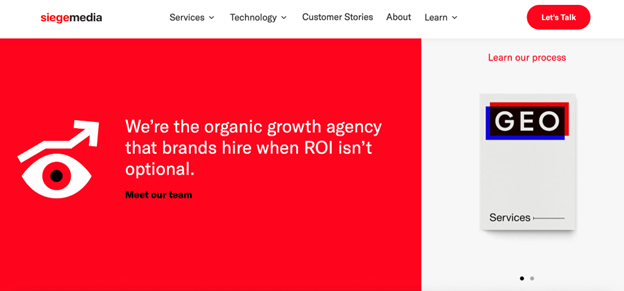
Likewise, their approach helps SaaS and B2B companies scale content output while maintaining accuracy and originality.
The team uses AI to identify trending topics, streamline keyword mapping, and refine on-page structure, while creative direction and editorial quality remain human-led.
Ultimately, the result is content that aligns with both algorithmic and audience expectations. Siege Media’s emphasis on sustainable, long-term growth attracts clients seeking consistent visibility and authority rather than short-term gains.
Pros:
- Balanced use of AI for content optimization and strategy planning
- Strong creative and editorial standards across all deliverables
- Proven results in SaaS, tech, and B2B content campaigns.
Considerations:
- Premium pricing and long-term contracts may not suit smaller SaaS startups
- Creative review cycles can extend project timelines
- A heavier focus on content may overlook technical SEO improvements
- Results often require patience before showing measurable impact.
In the long run, Siege Media remains a dependable choice for SaaS and B2B brands that prioritize content quality and want to merge creativity with AI-supported precision.
5. First Page Sage
Next is First Page Sage, which focuses on thought leadership SEO powered by AI-driven analytics and strategic content systems. They work with B2B and enterprise clients to position brands as industry authorities through consistent, search-focused publishing that targets high-value buyer intent keywords.
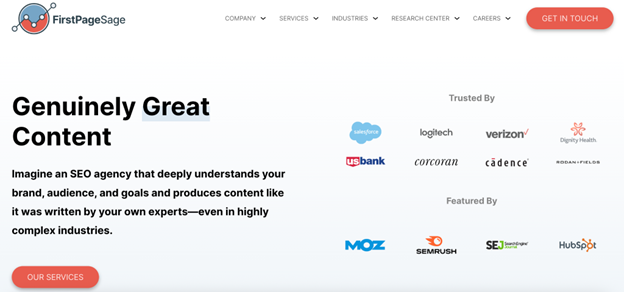
The team uses AI tools to analyze search intent, uncover emerging topics, and evaluate conversion potential before production begins. Every article follows a proven structure designed to capture visibility, generate leads, and support long-term ranking stability.
Although automation supports much of the research process, human insight remains central to their editorial and strategy development.
Pros:
- Recognized expertise in thought leadership and organic demand generation
- Strategic use of AI to identify and prioritize high-value search opportunities
- Strong focus on quality, consistency, and long-term authority building.
Considerations:
- Engagements typically target enterprise-level clients with larger budgets
- Structured processes can feel rigid for smaller teams or startups
- Turnaround times may be longer due to in-depth research and editorial layers
- Limited flexibility in adapting campaigns once underway.
First Page Sage is a strong fit for established SaaS and B2B companies aiming to lead their industries through expert-driven, data-informed SEO content supported by AI insights.
6. Xponent21 (Bonus)
Last on our list is Xponent21. They combine AI-driven automation with a human-led SEO strategy to help businesses grow their online visibility more efficiently.
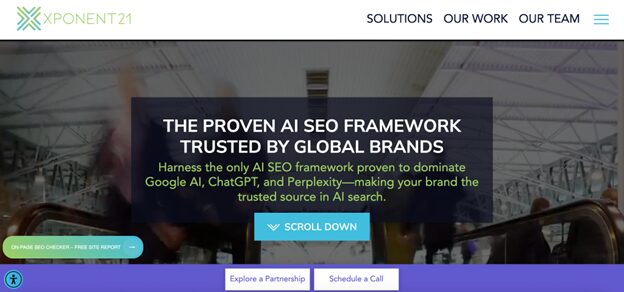
Their agency focuses on improving technical performance, content optimization, and user experience by integrating data from AI tools into every stage of the process.
Subsequently, the approach centers on creating scalable systems that connect SEO, design, and conversion optimization for a stronger overall impact.
Also, the team works with SaaS, eCommerce, and professional service brands that need reliable, high-performing SEO frameworks. AI assists in analyzing audience behavior, predicting ranking trends, and automating reporting, while strategy and creative work remain managed by experienced specialists.
Pros:
- Comprehensive approach combining AI insights with human expertise
- Integration of SEO, UX, and conversion optimization in a single framework
- Strong performance analytics and reporting structure.
Considerations:
- A broader service scope may dilute focus for clients seeking pure SEO support
- Requires active client participation during early setup and data calibration
- Pricing structure can be complex, depending on project size and scope
- Best suited for companies prepared to invest in long-term optimization rather than quick fixes.
Overall, Xponent21 is a practical choice for companies that want an SEO partner capable of merging AI-driven efficiency with strategic, human-guided execution.
How We’ve Compiled the List
Our team started with a long list of AI-SEO-branded agencies and then began cutting. The first filter was simple: do they show proof that they work with AI Overviews and LLMs, or do they only talk about “using AI tools”? If we couldn’t see clear examples with ChatGPT, Gemini, Perplexity, or Google’s AI answers, they didn’t make it any further.
From there, we went through case studies, traffic charts, and client feedback. We looked at how strong their content is, what kind of links they build, and whether their technical work goes beyond basic audits.
We also checked how they fit different business types: B2B SaaS, eCommerce, local services, and larger brands with complex sites.
Related article: 10 Best Semrush Competitors That Might Suit You Better
What Should an AI SEO Agency Do in 2026?
In 2026, the mandate for an effective AI SEO agency, or any forward-thinking SEO agency, pivots dramatically from traditional SEO tactics. The core philosophy must shift from mass production and generic execution to strategic differentiation and high-value creation.
Agencies must reject being low-cost, high-volume content producers; AI tools automate those capabilities, making such a model obsolete. Instead, they must position themselves as indispensable partners, considering brand strategy, data science, and human expertise into a unified ‘connected growth system.
The era of relying solely on generic link-building and technical SEO fixes is over. Of course, the site health remains the foundation, but the new battleground is optimizing for AI citation and E-E-A-T, rather than just a high organic ranking.
Agencies must aggressively track trends like Google’s AI Overviews and the rise of agentic AI, realizing that visibility is no longer just about generating a click but about becoming a trusted, verifiable source cited within an AI-generated answer.
Success will be measured by a brand’s presence across a fragmented discovery landscape that includes voice search, specialized agents, and AI summaries, demanding a holistic, cross-platform visibility strategy.
Red Flags When You Talk to an AI SEO Agency
A primary warning sign is any firm that focuses overwhelmingly on quantity over verifiable quality. If the discussion revolves primarily around producing a massive number of articles or acquiring hundreds of low-cost, generic inbound links per month, the agency is likely operating on an outdated and unsustainable model.
This indicates a reliance on tactics easily automated and discounted by evolving information systems. Legitimate expertise prioritizes the impact of a few, highly authoritative pieces of content or securing a handful of hard-earned, reputable mentions from industry-leading publications.
Furthermore, be wary of firms that guarantee specific, rapid ranking increases; no credible partner can promise immediate results when dealing with dynamic algorithms and competitive markets.
Another major red flag is a lack of verifiable Subject Matter Expertise (SME) within the agency’s own team or network. If the firm cannot articulate how they will access, integrate, and feature original expert insight for your niche, they are planning to use low-cost, generalized writers to produce commodity text.
Ask the agency to demonstrate their own credentials, case studies showing deep industry alignment, and how they implement a rigorous quality control process, often called ‘Human-in-the-Loop’ editing, to ensure accuracy and a unique perspective.
Finally, an agency that lacks transparency regarding its own operational methods and future strategy should be avoided. If they are unclear about the tools they use, reluctant to explain where and how external endorsements are secured, or cannot articulate a plan for navigating the ongoing changes in how information is summarized and presented to users, they are ill-prepared for the future.
The Key Takeaways
If you remember one thing from this guide, let it be this: “AI SEO” is not a logo or a tool stack; it’s how an agency thinks and tests. The best teams on this list don’t just track rankings; they watch how your brand appears in AI and traditional search, then adjust based on what they see.
Good AI SEO in 2026 means three things working together: smart experiments, honest proof, and content that’s built on real experience. If an agency can’t show you those three, they don’t belong on your shortlist.
To read more content like this, explore The Brand Hopper
Subscribe to our newsletter