
With the rapid pace of advancement in generative AI today, content that is created using AI-created text has now entered all aspects of content creation, including articles, product descriptions, marketing examples, customer service, and social media posts. By definition, AI is capable of “writing with fluency” and “providing content with all information;” however, there is still a fundamental issue that cannot be resolved by using AI – AI-generated text does not have the same feel as if it were written by a human.
This lack of a “human” feel for previously mentioned AI-created texts is due to many reasons beyond standard grammatical or syntax errors, but instead is directly related to the overall lack of the characteristic that make up “human” writing: natural language style, emotion of the writing, contextual understanding of the writing and the author’s audience, and authenticity of the author’s writing. Therefore, making AI-generated text sound more “natural” and “human-like” has become an important topic within the world of content creation.
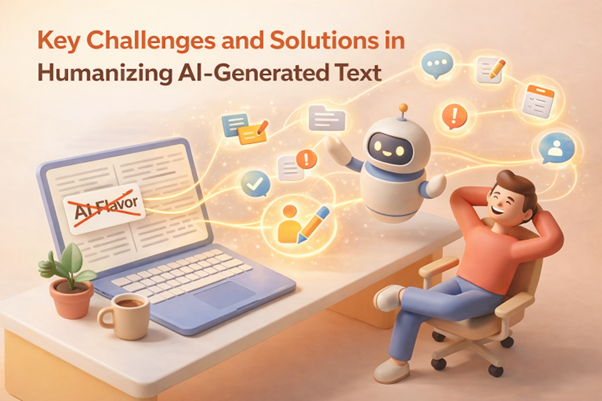
I. Highly Similar Language Structure: Templatization is the Biggest Obstacle to Human-like Expression
The Majority of Current AI Generated Content Has Similarities in Linguistic Structures. Most Open Paraphrased Content is Very Similar to One Another, Their First Sentence Will Typically Be a Summary Sentence, or Sentences will be Typically Structured with a Declarative Manner and Create Logical Connections Between Thoughts Using Safe Transitional Words. Due to the Volume of Open-Source/Paraphrased Content, “Reading Fatigue” May Occur After Reading Only a Few of These Pieces.
The AI models that create “fluent” and “accurate” output tend to dericate to the safest expressions allowing for the most accurate use of the least possible amount of original linguistic structures, because they are using the most popular and useful patterns to create a fluent and accurate style.
To address the present issue you have to escape the confines of templates by being more proactive about it.
You can achieve this by either 1) manually manipulating your sentence rhythm and introducing non-standard forms of expression to your writing such as rhetorical questions, parenthetical phrases, and breaks for short sentences or 2) restructuring your sentences based on content & context and not just improving your existing sentences. Only after you have developed an entirely new form, will you create the “human” quality to your written work.
II. Absence of Emotion and Attitude – Logical Content But No Warmth
Human written communication expresses feelings, attitudes and positions through the implicit meanings of words. The choice of words communicates the writer’s inclinations; therefore, even in highly rational technical and analytical works, there are ways that a reader can understand what the author feels about and thinks about the topic. In contrast, AI’s writing provides a great amount of neutrality – it is evaluative or uncertain and does not convey a disagreement, however; AI is written in a very formal manner (i.e., professionally), with no emotion associated with it.
Additionally, this “overly restrained” method of expression generates a level of “distance” between the reader and writer, detracting significantly from the readability of the writing in situations where establishing trust and providing guidance in making decisions are required.
To increase the emotional dimension, subjective language should be added to the writing. An example would be to add “1st” or “2nd” person references (i.e. I feel, you feel) so that a greater link can be established with the reader, with an appropriate level of judgment, questioning, or pre-summary of direct experience, and that presents the text with “traces of thought” instead of merely describing the findings.
III. Weak Contextual Understanding: Hidden Problems in Long Texts
When creating text in short-form, AI does a good job at performing well. However as the length of the material increases, and the logical flow becomes more complicated, contextual issues will start to arise. Such issues include inconsistencies in reference to concepts, duplicate ideas or a subtle change in point of view, which will lead to a negative overall reading experience.
These aren’t just errors made during generation, but they stem from the fact that AI tends to generate better local coherence then it does global consistency.
The challenge to resolve these issues will be in implementing some form of human involvement after generating the content. Performing a global review of the text, reordering paragraphs and creating transitions between ideas will all increase the overall coherence of the text. Additionally, defining the text’s overall structural framework before starting to generate content will help to reduce the cost of any necessary revision later on.
IV. Lack of realism: The information is “complete” but not “credible.”
The main concern concerning AI written words is not so much about inaccuracies, but about the lack of alluding to specific examples. Because of the overuse of real things being described using generalize terms or summary words, it makes it very challenging for the reader to build a mental representation of the information.
Human writing typically will contain a lot of details as well as real-world examples and processes. Although none of these words have to be precisely accurate or factual, they provide an impression of “realness” to the reader.
So when considering how to make AI originated text feel more human-like in writing style, it is essential to introduce tangible pieces of information like real perfect world applications through implementation, detailed process descriptions used in how something works or works, comparisons to others, or summaries of your experiences using the things you are writing about. All these realities enhance the believability of the content while increasing its ability for readers to remember your writing in their minds.
V. Recognition pressure on platforms and search engines
The continued advancements of content platforms and search engine technology in identifying AI-generated content have raised the stakes for compiling or mass-producing text to an unsustainable level; therefore, this type of content is not necessarily off-limits but instead represents a need for higher-quality standards.
The only truly safe and sustainable approach to creating content is to eliminate the use of formulaic expressions, enhance original structures and independency from other author’s works, and provide some level of human editing by providing a clear value proposition through the overall piece. Humanizing the content is another method of reducing the overall risk associated with this type of content.
VI. Human-AI Collaboration: The Optimal Solution in the Current Stage
In practice, relying entirely on AI or rejecting it totally are both impractical choices. Evidence suggests that a collaborative model is the best approach to achieve a balance between scale and quality. The ideal model contains established writing processes, defined style guides, and an effective process of reviewing the work of both AI and creators. In this way, AI functions as a tool or assistant to writing rather than as a substitute for creativity. This cooperative attempt to develop content will most likely be the way content creation will continue into the future.
VII. From Concept to Practice: Why Humanize AI is the Ideal Tool for the “Human-Machine Collaboration” Model
When using a collaborative model, “AI provides efficiency while Human provides Judgment” there is a significant issue that occurs; Not all models of AI tools are designed for a human touch.
Most writing models are designed for the purpose of generating content; therefore they have an advantage when producing content fast. They generally do not have much success in proactively removing template elements from their output, changing tone / nuances from their generated content or creating authentic human-like expressions of content.
This was the situation that lead to the creation of Humanize AI.
1. The core positioning of Humanize AI: Not writing, but “making it sound human.”
Humanize AI differs because instead of creating brand new content, as most other forms of AI writing tools do, Humanize AI provides human-like edits for existing pieces of AI-generated content. It also focuses less on whether a piece contains all the “correct” information or how long it is than on how much of what was written appears to be creditable and written by a person.
This positioning perfectly aligns with a crucial step in the human-AI collaboration process:
The AI first generates a draft, humans determine the direction, and then Humanize AI is responsible for removing the “AI feel.”
2. Targeted optimization capabilities addressing core pain points
In the humanization process, Humanize AI primarily addresses the following types of high-frequency problems:
- To ensure your sentences are not repetitively structured or formed around a single template, Humanize AI modifies sentence structure, thereby reducing both openings that are fixed in nature and close with a summary style of ending, which is often characteristic of AI-generated writing; instead, the resulting text will generally conform more closely to a range of forms used by real people.
- Since the intent of the reader is generally expressed through a range of evaluative language in order to provide them with a positive or less-than-positive evaluation, a more appropriate evaluative expression for the reader will create clearer intent and therefore a greater opposition to an excess of “incorrectness with no intent” in AI-generated content.
- To address the irregularity of the rhythmic flow of writings that are repetitively structured, Humanize AI will vary the flow of long sentences and short sentences to make the rhythm much more closely align with that of how real human beings express themselves rather than AI, which produces high-volume and consistent outputs.
3. How to use it in a real content production workflow
In practical applications, Humanize AI is better suited for the later stages of the content generation process, rather than replacing the writing itself:
- Use any AI tool to generate a first draft (articles, copy, descriptive text, etc.)
- Manually quickly check the logical structure and information direction.
- Submit the text to Humanize AI for humanization.
- Finally, a human performs style and factual proofreading.
The advantages of this process are:
- Preserve the efficiency of AI
- Avoid the risks associated with “fully automated generation”
- Minimize the probability of content being identified as AI-generated
4. The hidden value of being friendly to search engines and platforms
From the perspective of content platforms and search engines, the real problem is not “whether or not to use AI,” but rather whether the content is low-quality, repetitive, and lacks independent value.
The main purpose of Humanize AI is to:
- Decrease similarity between content pieces;
- Increase the natural flow of language in the content;
- Enhance the number of ‘human types of edits’ present in the created content.
The result is that, using the services offered by Humanize AI, will create content that more closely approximates your original work in terms of an ‘AI-generated + human edited’ output vs mass produced content.
5. Who would benefit most from Humanize AI?
While Humanize AI is not intended for people who don’t know how to write completely, it may be of most usefulness to the following types of users:
- Bloggers / Content creators
- SEOs
- Website operators (for products, SaaS, tools)
- People working in teams to create large quantities of content but who also want to create high-quality content.
For these types of users, the value of Humanize AI is not that it will “write for you”, but rather that it will help give AI-generated content an appearance that it was written by you.
Conclusion
Humanize AI Text is not intended to replace creators in the growing field of human-machine collaboration; rather, it serves as an essential connection point between efficiency and quality. Within this model, when AI drives the speed of production, humans provide the judgment regarding the appropriateness of produced content, while Humanize AI is responsible for “de-mechanizing” text written by AI, allowing for real scalability and humanization within content development.
To read more content like this, explore The Brand Hopper
Subscribe to our newsletter