Last Updated on September 7, 2026 by Team TBH
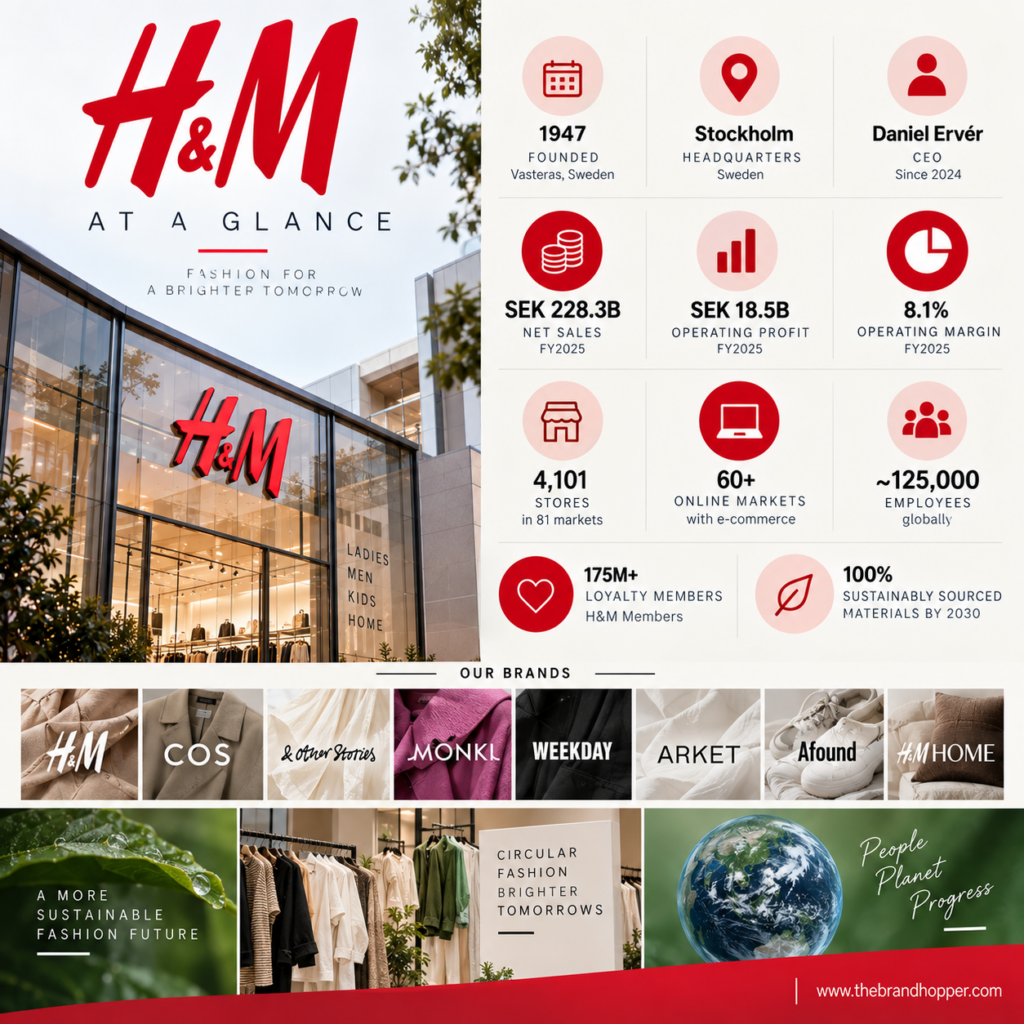
H&M (Hennes & Mauritz) is the world’s second-largest fashion retailer—operating 4,101 stores across 81 markets with net sales of SEK 228.3 billion in FY2025.
Yet revenue alone does not explain H&M’s enduring relevance. The Swedish brand has survived five decades of fashion disruption—from the rise of Zara to the explosion of fast fashion e-commerce and, most recently, the Shein era—by staying ahead of the marketing curve.
H&M’s marketing machine runs on several interlocking engines: a fast trend-response model, a world-class designer collaboration programme, a 175-million-member loyalty programme, and increasingly sophisticated digital and data-driven capabilities.
This article covers all of it: H&M’s history, its segmentation and targeting approach, its ten core marketing strategies, its 4Ps, its landmark campaigns, and the questions readers ask most about the brand.
History of H&M: From Vasteras to a Global Empire
Erling Persson opened the first Hennes (“Hers” in Swedish) store in Vasteras, Sweden, in 1947. The concept was simple but radical: fashionable women’s clothing at prices that everyday shoppers could afford.
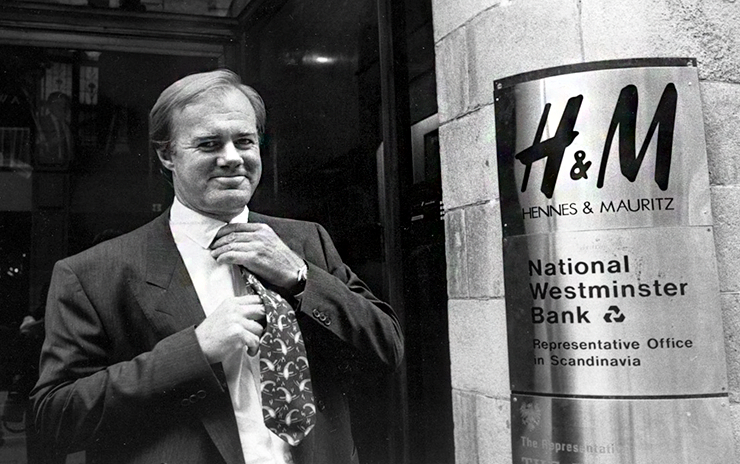
The Hennes store was an immediate success. Persson observed that department stores were selling clothes with high margins, leaving ordinary women priced out of fashion. He built his entire model around closing that gap.
In 1968, Persson acquired the Swedish hunting and sporting goods retailer Mauritz Widforss. The deal added a menswear line and transformed the company’s scope—and its name became Hennes & Mauritz, soon shortened to H&M.
H&M opened its first international store in London in 1976, followed by Germany in 1980 and the Netherlands in 1989. Each new market entry was a learning exercise in adapting product ranges and price points to local consumer expectations.
The company listed on the Stockholm Stock Exchange in 1974 under the ticker HM-B. The Persson family (through Ramsbury Invest) remains the controlling shareholder to this day.
H&M entered the United States in 2000 with a flagship store on Fifth Avenue in New York City. The US launch generated queues around the block and demonstrated that affordable European fashion had mass-market appeal in America.
China followed in 2007, giving H&M a foothold in the world’s fastest-growing consumer market. At its peak, H&M operated over 500 stores in China—though the relationship with the Chinese market became complicated by geopolitical tensions around cotton sourcing in 2021.
The biggest strategic development of the 2010s was H&M’s pivot to a multi-brand group. H&M launched COS (Collection of Style) in 2007, Cheap Monday in 2008, Monki in 2006, Weekday in 2002, & Other Stories in 2013, ARKET in 2017, and Afound in 2018.
Each new brand allowed H&M Group to address a consumer segment it could not credibly serve with the flagship: design-conscious adults (COS), Gen Z women (Monki), off-price seekers (Afound), and quality-essentials shoppers (ARKET).
Daniel Ervér became CEO in February 2024, succeeding Helena Helmersson. His priorities include continued digital transformation, improving profitability, and deepening the sustainability agenda without alienating the brand’s core value-oriented consumers.
H&M Segmentation, Targeting & Positioning (STP)
Market Segmentation
H&M segments its global customer base across three primary dimensions: demographics, psychographics, and geography. Each dimension informs product development, pricing, and marketing channel decisions.
Demographically, H&M’s core customer base is women aged 18–35 with a middle-income profile. The brand also serves men (H&M Man), children (H&M Kids), teenagers (H&M Divided), and home decorators (H&M HOME).
Psychographically, H&M targets fashion-followers who want trend-relevant clothing without paying luxury prices. A secondary psychographic segment is sustainability-conscious consumers who prioritise environmental responsibility in their purchase decisions.
Geographically, H&M’s 81 markets require significant localisation. Western Europe remains the largest revenue base. North America is a major growth market. Asia-Pacific—despite the China challenges—offers significant long-term potential.
Within the group, each brand owns a clearly defined segment. H&M targets mainstream fashion shoppers. COS targets design-conscious adults seeking minimalist aesthetics at mid-premium prices. Monki targets Gen Z women. ARKET positions as a modern-day market for quality essentials at a slightly premium positioning.
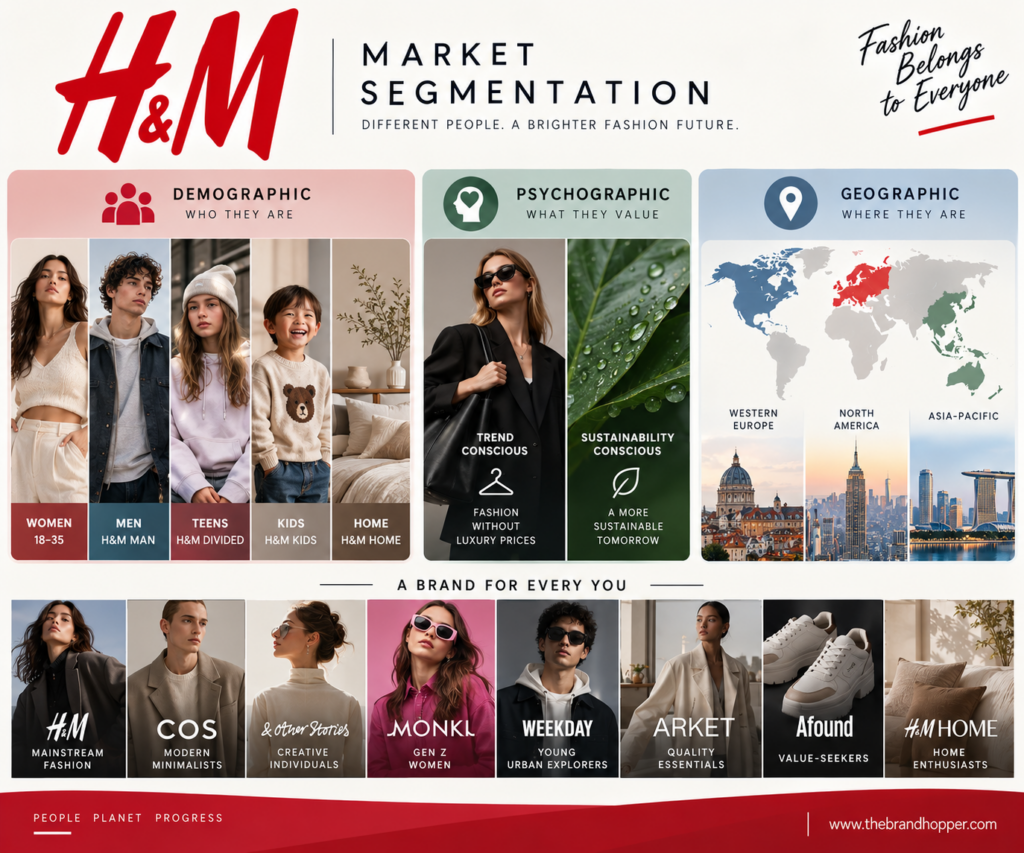
This multi-brand segmentation allows H&M Group to capture a much wider share of the fashion market than a single brand ever could—without cannibalising the flagship or creating internal brand confusion.
Targeting
H&M’s primary target is the value-conscious fashion follower aged 18–35: someone who wants on-trend clothing, checks Instagram for style inspiration, and shops across both physical stores and digital channels.
This consumer is price-sensitive but not purely price-driven. She is willing to pay slightly more for a piece that feels premium—a structured blazer, a quality denim jacket—but expects everyday basics to be very affordable.
H&M reaches its target with a full-funnel approach: social media for awareness and inspiration, search and email for consideration and conversion, the app and loyalty programme for retention and repeat purchase.
Secondary targets include teens (reached via H&M Divided and partnerships with gaming and music culture), men (reached via H&M Man’s dedicated online and in-store sections), and sustainability-forward consumers (reached through the Conscious Collection and ESG communications).
Positioning
H&M’s core positioning statement can be summarised in one phrase from its own communications: “Fashion and quality at the best price, in a sustainable way.” Each word is deliberate.
“Fashion” signals trend relevance. H&M does not want to be perceived as a purely functional clothes retailer—it wants customers to feel they are buying something stylish, not just something cheap.
“Quality at the best price” distinguishes H&M from ultra-cheap competitors like Shein and Primark. H&M claims a quality tier above pure discount, while remaining accessible to most shoppers.
“In a sustainable way” is the newest pillar—and the most contested. H&M has faced “greenwashing” criticism. Its response has been to deepen its sustainability commitments: Science Based Targets, garment collection, and third-party material certifications.
The net result is a brand that occupies the “masstige” sweet spot: democratic enough to serve millions, aspirational enough to feel desirable. That positioning has sustained H&M through seven decades of fashion industry disruption.
10 Marketing Strategies of H&M
1. Fast Fashion & Rapid Trend Responsiveness
H&M’s foundational commercial advantage is speed. The company moves from trend identification to store shelf in as few as 3–4 weeks in its fastest product categories.
H&M employs a global network of trend forecasters, fashion buyers, and design teams who monitor runway shows, street fashion photography, celebrity moments, and social media trend data simultaneously.
New product drops arrive in H&M stores and on hm.com every week. This velocity is not just operational efficiency—it is a marketing asset. “New this week” is one of H&M’s highest-performing email subject lines.
The weekly drop model creates a reason for customers to visit and engage with H&M more frequently than with competitors running seasonal collections. More visits mean more purchase occasions and stronger habit formation.
H&M has also adapted to micro-trend cycles driven by TikTok. When a particular aesthetic trends on social media—cottage-core, dark academia, Y2K revival—H&M’s buyers can respond with relevant product within weeks rather than months.
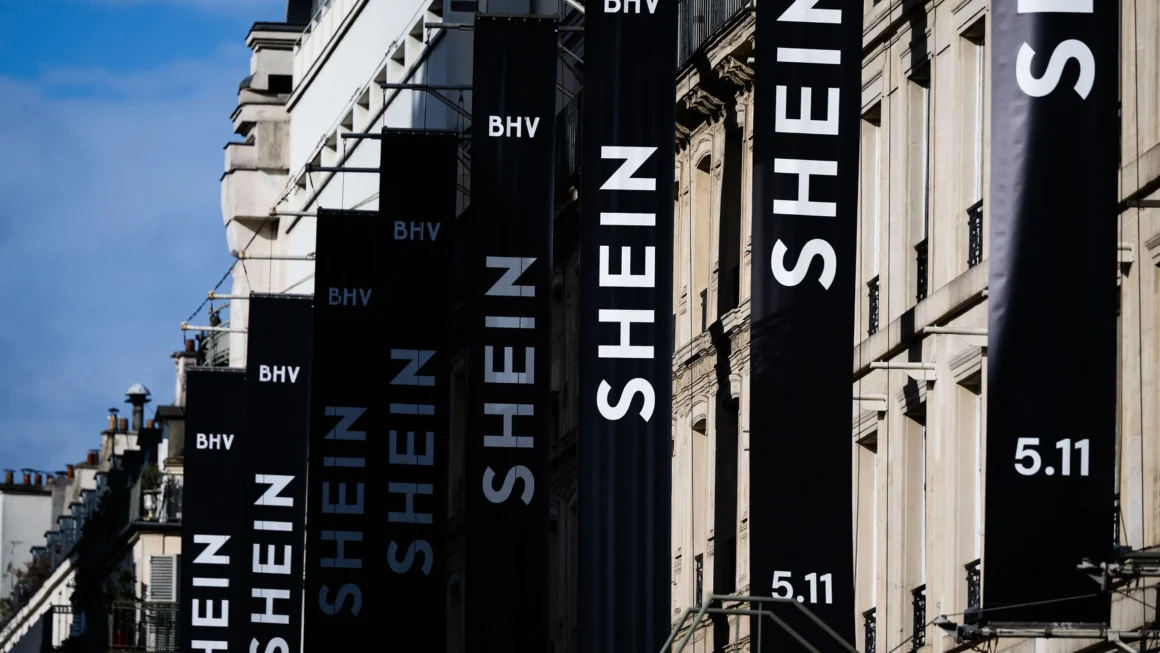
This speed advantage is partly why H&M has maintained relevance despite the rise of ultra-fast fashion players like Shein. H&M’s trend response may be slightly slower, but it is paired with physical store accessibility, established brand trust, and a much stronger sustainability narrative.
2. Designer Collaborations: The Halo Effect
H&M created the designer-x-highstreet collaboration genre in 2004 with its Karl Lagerfeld partnership. The collection sold out within hours globally and generated media coverage worth multiples of the marketing spend.
Since that breakthrough, H&M has collaborated with Stella McCartney, Roberto Cavalli, Viktor & Rolf, Comme des Garcons, Matthew Williamson, Jimmy Choo, Sonia Rykiel, Lanvin, Versace, Marni, Maison Martin Margiela, Alexander Wang, Balmain, Kenzo, Moschino, Giambattista Valli, Simone Rocha, and others.
Each collaboration generates a distinct marketing cycle: months of anticipation, press previews, celebrity seeding, queuing culture on launch day, and extensive social media coverage before, during, and after. The earned media alone often exceeds H&M’s paid media investment for the campaign.
The halo effect benefits H&M in two key ways. First, it elevates the brand’s quality and style perception among consumers who might otherwise view H&M as purely functional. Second, it generates trial from consumers in higher-income brackets who discover they enjoy shopping at H&M.
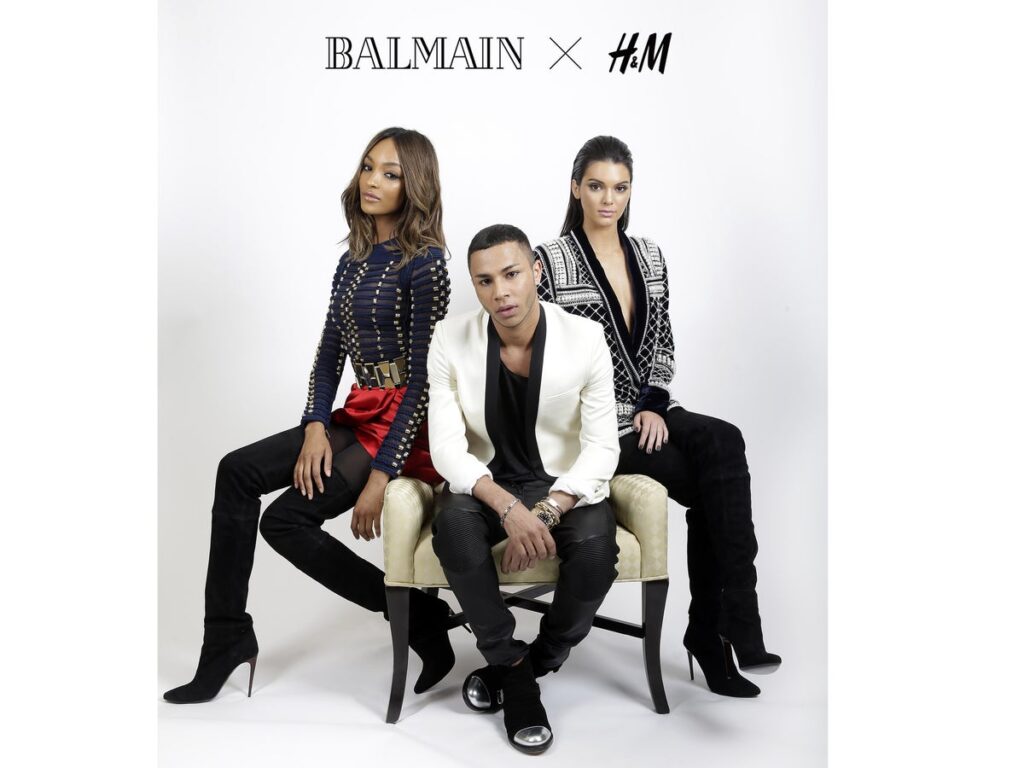
For the designer partners, collaborations provide access to H&M’s vast customer base and global marketing infrastructure. Balmain’s Olivier Rousteing became a global household name off the back of the 2015 H&M collaboration—reaching an audience Balmain’s own distribution could never replicate.
H&M has also expanded collaborations beyond fashion designers. Partnerships with artists, photographers, and cultural institutions have broadened the programme’s appeal and relevance for younger consumers.
3. Celebrity & Influencer Marketing
H&M has built its advertising around globally recognised names for decades. Early brand ambassadors included Claudia Schiffer and Cindy Crawford in the 1990s. More recently, Beyonce, David Beckham, Gisele Bundchen, Cara Delevingne, and Alton Mason have fronted campaigns.
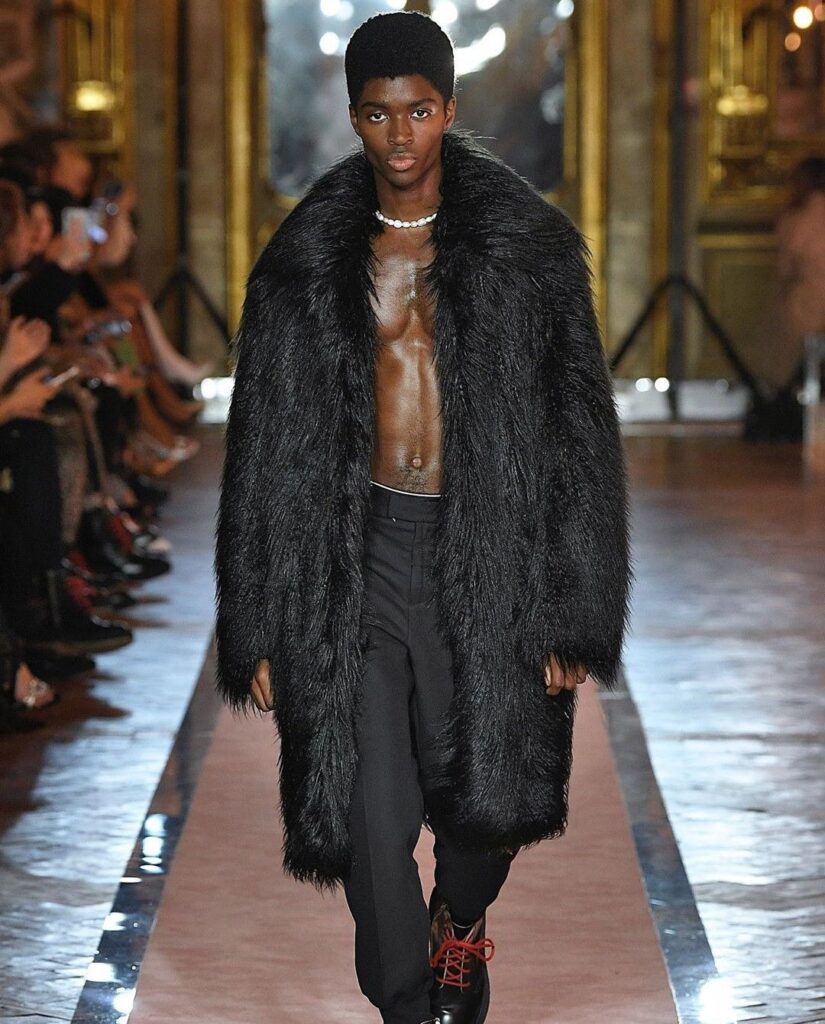
Celebrity partnerships serve a specific marketing function for H&M: they signal aspiration. When a global superstar wears H&M in a campaign, it tells consumers that fashionable, successful people choose H&M—even when they could afford anything.
Influencer marketing has grown dramatically in importance since 2015. H&M works with influencers at every tier: mega-influencers (1M+ followers) for campaign amplification, macro-influencers (100K–1M) for style content, and micro-influencers (10K–100K) for authentic, community-embedded recommendations.
Micro-influencer partnerships are particularly effective for H&M because they deliver authentic try-on hauls, styling videos, and sustainability content to engaged niche audiences at far lower cost per impression than traditional advertising or celebrity campaigns.
H&M’s influencer strategy is deliberately diverse. The brand actively recruits creators across body types, ethnicities, age ranges, and style aesthetics—reinforcing its positioning as fashion for everyone rather than a narrow aspirational ideal.
On TikTok specifically, H&M has seeded creators with new collection pieces ahead of launch, generating organic “haul” content that reaches millions of views before a single paid ad runs. This organic seeding model reduces dependence on paid media and builds authentic brand associations.
4. Digital & Social Media Marketing
H&M is one of the most-followed fashion brands on social media globally. Its Instagram account commands 38+ million followers; its TikTok presence has grown rapidly, particularly for sub-brands Monki and Weekday that skew younger.
H&M’s social strategy centres on inspiration rather than promotion. The brand produces editorial-style photography, styling reels, sustainability storytelling, behind-the-scenes content, and user-generated content reposts—all designed to keep H&M present in followers’ feeds even when they are not actively shopping.
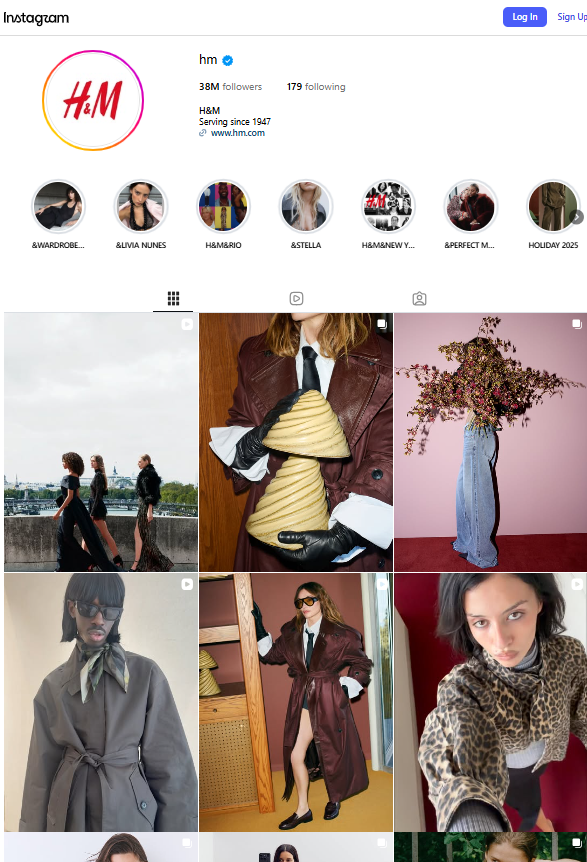
Instagram Shopping and TikTok Shop integrations allow H&M to convert inspiration into purchase without the friction of navigating away from social platforms. This “social commerce” capability shortens the path from discovery to checkout significantly.
The H&M app is a critical digital marketing channel in its own right. Push notifications for members-only drops, personalised product recommendations powered by AI, visual search, and seamless cart-to-checkout integration make the app both a loyalty tool and a direct revenue driver.
H&M invests significantly in YouTube as a brand-building platform. Long-form campaign films, behind-the-scenes collaboration content, styling guides, and sustainability documentaries build brand depth that 15-second Instagram Reels cannot replicate.
Pinterest represents a significant SEO and discovery channel for H&M’s home and lifestyle content. H&M HOME’s presence on Pinterest drives traffic from consumers actively planning home projects—a high-intent, high-conversion audience.
5. H&M Members Loyalty Programme
H&M’s global loyalty programme, H&M Members, has over 175 million members—making it one of the largest loyalty programmes in all of retail, not just fashion.
Members earn points on every purchase (both in-store and online), which convert into vouchers redeemable against future orders. Beyond points, the programme offers exclusive access: early sale previews, member-only product drops, and first access to designer collaboration launches.
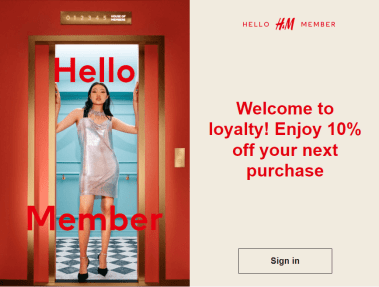
The loyalty programme is H&M’s most powerful first-party data platform. Every scan and transaction generates rich behavioural data: what the customer buys, when, at what price point, in which channel, and with what frequency. This data powers personalisation across email, push notification, and in-app recommendations.
Personalised communications driven by loyalty data consistently outperform generic broadcast emails. H&M can now send an email to a customer who last purchased activewear and show her new H&M Move products—rather than a generic “new in” newsletter that shows products irrelevant to her interests.
Members spend more per visit and visit more frequently than non-members. The programme effectively lowers H&M’s customer acquisition costs by maximising the lifetime value of existing customers, reducing the need to constantly spend on acquiring new ones.
H&M has been progressively building the programme toward a fully personalised experience. The goal is for every member interaction—whether on the app, via email, or in a physical store—to feel relevant to that individual consumer, not like mass marketing.
6. Sustainability as a Core Marketing Pillar
Sustainability is no longer just a CSR function at H&M—it is a central marketing pillar. This shift reflects the reality that a growing proportion of consumers, particularly younger ones, factor brand values into purchase decisions.
H&M’s Conscious Collection is the most visible marketing expression of its sustainability commitment. Products made from organic cotton, recycled polyester, Tencel, or other certified sustainable materials are badged with the Conscious label—making sustainability visible at the point of purchase.
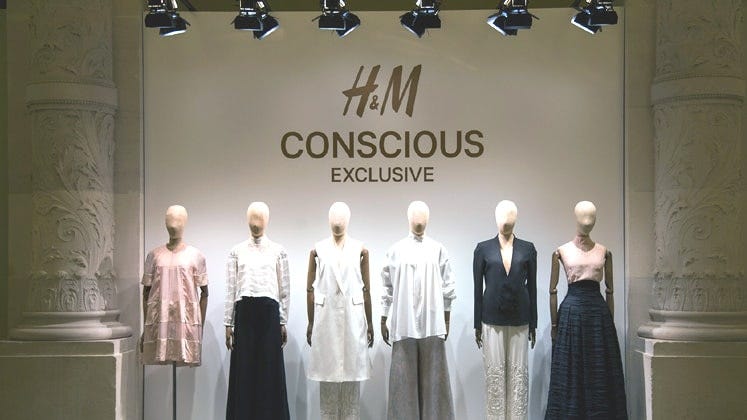
The Garment Collecting programme allows customers to drop off any brand’s old clothes at H&M stores worldwide for recycling or reuse. This initiative reinforces H&M’s sustainability credentials while also driving store visits from non-purchase occasions.
H&M Group has committed to sourcing 100% more sustainably sourced materials by 2030 and achieving net-zero greenhouse gas emissions across its value chain by 2050. These commitments are tracked and reported publicly in the annual H&M Group Sustainability Report.
The H&M Foundation—a separate philanthropic entity funded by the Persson family—invests in systemic change in the fashion industry: climate innovation, fair living wages, and water stewardship. The Foundation’s work provides third-party credibility to H&M’s broader sustainability narrative.
H&M has faced criticism—most notably a 2022 Norwegian Consumer Authority investigation into greenwashing claims around the Conscious Collection’s Higg Index scores. H&M’s response was to commission independent verification and improve its transparency. This cycle of challenge and improvement is now baked into H&M’s sustainability communications strategy.
7. Omnichannel Retail Experience
H&M operates one of the most integrated omnichannel retail experiences in global fashion. The brand’s 4,101 physical stores and 60+ online markets are not competing channels—they are complementary touchpoints in a single customer journey.
Customers can browse in-store availability via the H&M app before visiting, buy online and return to a local store, earn loyalty points in both channels using the same membership, and receive consistent personalised offers regardless of where they shop.
H&M has been evolving its store estate toward fewer but larger, more experiential flagship locations. The New York Fifth Avenue flagship, the London Oxford Street store, and the Shanghai flagship all feature experiential elements—in-store stylists, curated local product edits, digital fitting rooms, and community event spaces—that smaller stores cannot accommodate.
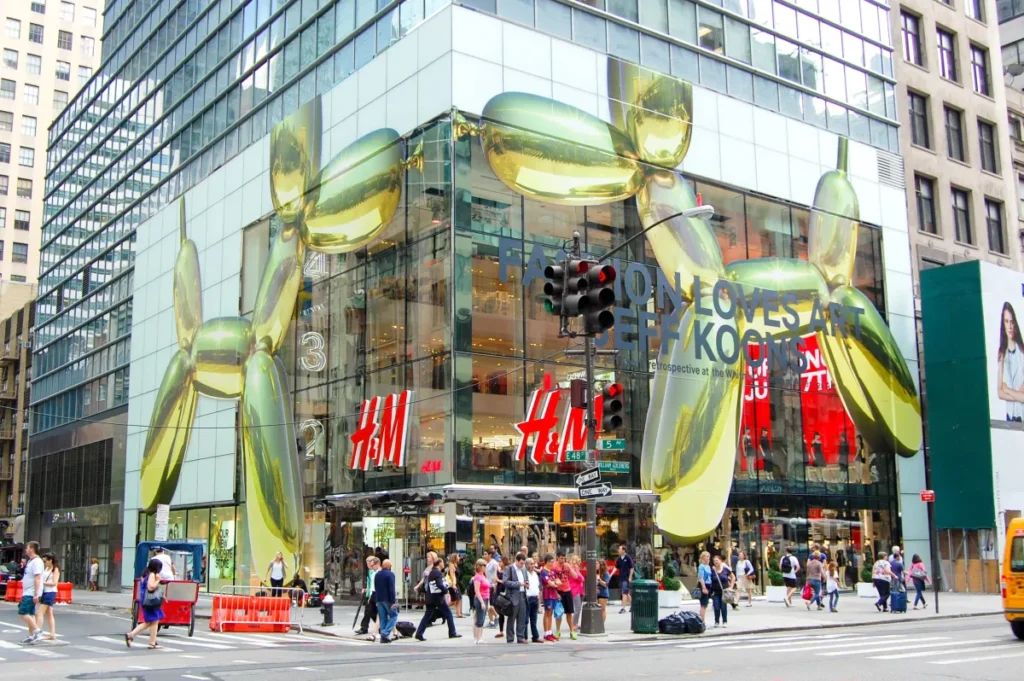
The role of physical stores in H&M’s marketing mix is increasingly about brand experience rather than pure transaction. A customer who visits an H&M flagship for a styling event or a collaboration launch is building a deeper emotional relationship with the brand than one who simply orders online.
H&M has also been rolling out click-and-collect across markets—allowing customers to order online and pick up in-store within hours. This capability drives store footfall, creates upsell opportunities at the point of collection, and improves delivery economics.
The balance between physical and digital is shifting. Online now represents a meaningful and growing share of H&M Group’s total sales, and H&M’s capital allocation reflects this—investing more in digital infrastructure and less in net new store openings than a decade ago.
8. Localisation & Cultural Relevance
H&M is a global brand with deeply local marketing execution. It runs global campaign frameworks but adapts them significantly for individual markets to ensure cultural relevance.
In the Middle East, H&M has partnered with local Muslim influencers and adapted its campaign imagery to reflect local modesty standards, while also introducing dedicated modest fashion edits that were marketed specifically through regional social channels.
In India, H&M has spotlighted local artists, featured Indian influencers in campaigns, and launched festive-season collections tied to Diwali—timed and marketed to compete with traditional kurta and ethnic wear during the peak festive shopping period.
In China, H&M invested heavily in localisation before the 2021 cotton controversy damaged its standing there. It had partnered with Chinese influencers (KOLs) on Weibo, operated on Tmall and JD.com, and participated in major Chinese shopping events like Double 11 and 618.
For Chinese New Year, Eid, Christmas, and other culturally significant moments, H&M develops market-specific product collections, social campaigns, and promotional offers that go beyond merely translating global creative into a local language.
This “global brand, local execution” model is operationally demanding—it requires local marketing teams, regional creative production, and market-specific media buying—but it allows H&M to maintain consistent global positioning while remaining genuinely relevant to the local cultural context of each market.
9. Affiliate & Performance Marketing
H&M runs a structured affiliate marketing programme through networks including Awin and Rakuten. Publishers, bloggers, fashion content creators, and price-comparison platforms earn commission on sales they refer to H&M.
Affiliate marketing is particularly powerful during H&M’s seasonal sale events, when deal-focused publishers drive significant traffic. For a full overview of affiliate marketing mechanics and strategy, see G2’s affiliate marketing category.
The affiliate programme extends H&M’s reach to audiences that organic search, paid social, and owned channels cannot efficiently reach. A personal finance blogger recommending H&M’s value proposition to budget-conscious readers is a different marketing channel than an Instagram Reel—and often converts at a different rate.
Performance marketing channels—Google Shopping, Meta dynamic product ads, programmatic display, and retargeting—are calibrated by market maturity. In high-penetration markets like Germany, Sweden, and the UK, H&M runs sophisticated basket-abandonment and browse-retargeting campaigns.
In emerging markets where brand awareness is still building, H&M’s performance marketing focus shifts toward broader awareness objectives: app downloads, loyalty programme sign-ups, and first-purchase acquisition rather than retargeting existing customers.
H&M uses first-party data from its 175-million-member loyalty programme to power its performance marketing audiences. Rather than relying on third-party cookie audiences (increasingly restricted by browser privacy updates), H&M can build look-alike audiences from its own customer data—a significant competitive advantage.
10. Content Marketing & SEO
H&M invests substantially in organic search and content marketing. Its editorial content hub—style guides, outfit inspiration, trend reports, sustainability explainers, and buying guides—targets high-volume informational queries that bring fashion-curious consumers into the H&M ecosystem before they have explicit purchase intent.
Effective fashion SEO requires both technical excellence and content depth. For a strategic overview of AI-powered SEO approaches, see Embarque’s guide to AI-powered SEO.
A user searching “how to style wide-leg trousers” or “best sustainable dresses under £50” who finds H&M’s editorial content first is likely to discover H&M products before ever visiting a competitor. This top-of-funnel capture is the core value of content marketing, and brands looking to build similar organic visibility can work with SEO specialists such as Intellar Agency.
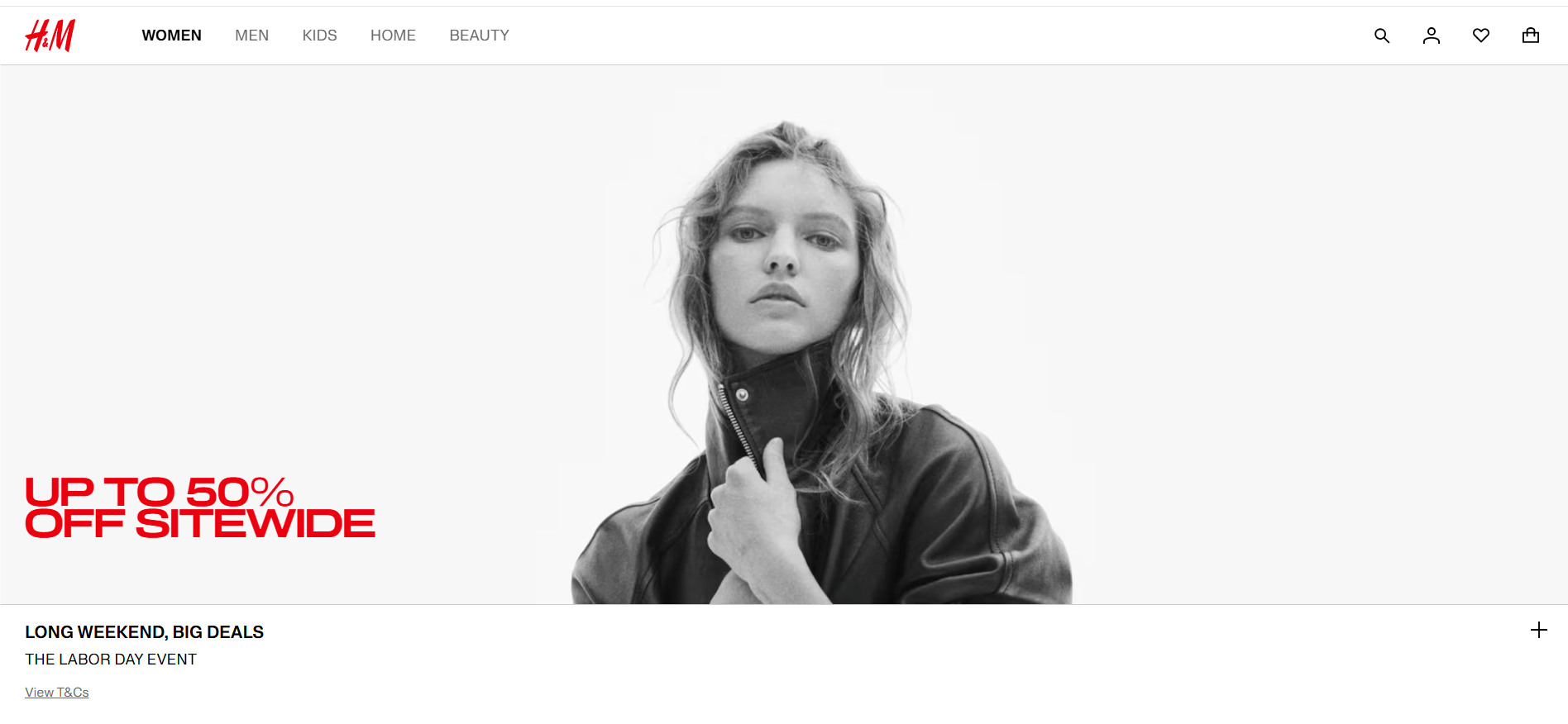
H&M’s hm.com is built for search engine crawlability. Clean URL architecture, structured data markup (Schema.org for products, breadcrumbs, and reviews), well-optimised product image alt tags, and internally linked editorial content all contribute to strong organic rankings across major markets.
H&M also produces video content for YouTube that targets search queries—”H&M haul 2025,” “how to style H&M basics,” “H&M Conscious Collection review.” These videos drive both YouTube discovery and Google Video results, extending H&M’s organic reach beyond text-based search.
Seasonal content planning ensures H&M publishes relevant editorial content ahead of peak demand moments: “how to dress for summer festivals” appears in May, “best coats for winter” appears in September. This anticipatory content strategy captures search demand before it peaks.
Marketing Mix of H&M: The 4Ps
Product
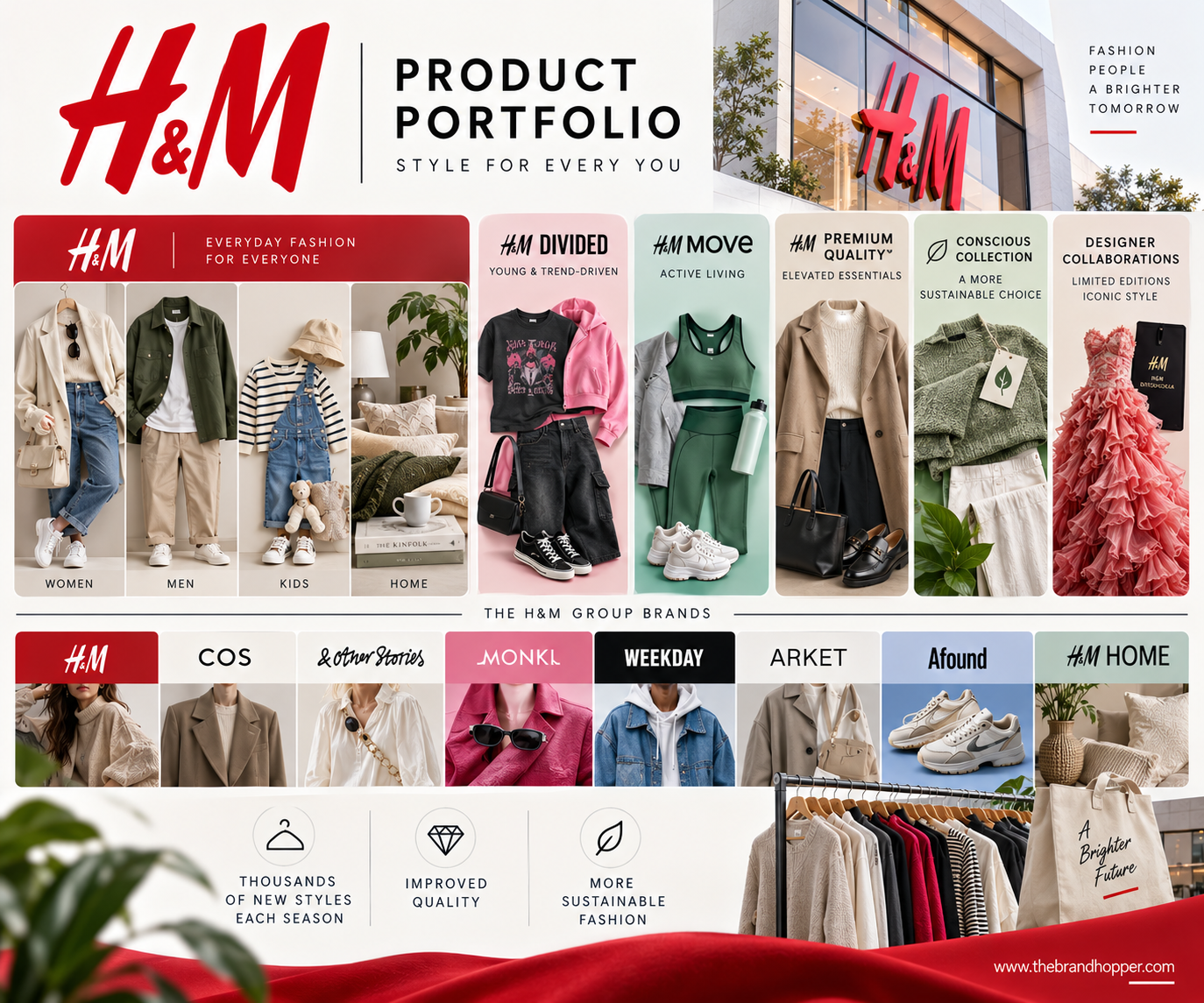
H&M’s product portfolio is one of the broadest in fashion retail. The flagship H&M brand spans womenswear, menswear, childrenswear, and homeware, with sub-lines including H&M Divided (youth), H&M Premium Quality, H&M Move (activewear), and H&M HOME.
The group’s eight brands—H&M, COS, & Other Stories, Monki, Weekday, ARKET, Afound, and H&M HOME—cover the affordable-to-mid-premium fashion spectrum. COS and ARKET use longer design cycles and higher-quality materials to differentiate from the fast-turn H&M flagship.
H&M’s product strategy is heavily trend-driven. The buying and design teams produce approximately 3,000–4,000 new styles per season across the flagship brand alone, with new drops added weekly rather than in discrete seasonal tranches.
Product quality has been a focus of strategic investment. H&M Premium Quality and the H&M Move activewear range use higher-specification fabrics—specifically to combat the perception that H&M’s durability is inferior to more expensive competitors.
The Conscious Collection is H&M’s dedicated sustainable product line. Products are made from certified organic cotton, recycled polyester, Tencel lyocell, or other materials meeting H&M’s sustainability criteria. The collection has grown from a small capsule to a significant product category.
Designer collaboration products represent a unique category. Produced in limited quantities, they are deliberately positioned as collectibles rather than basic fashion—priced slightly higher than standard H&M and marketed as investment pieces worth keeping.
Price
H&M uses a value pricing strategy, deliberately positioning prices to be accessible without being seen as purely budget or discount.
Price points span a wide range: basic t-shirts from SEK 79 (~£6), entry dresses from SEK 199 (~£15), coats from SEK 499 (~£38), and premium items up to SEK 999+ (~£77). Designer collaboration pieces are priced at a premium relative to standard H&M—but still far below what the collaborating designer charges in their own stores.
H&M avoids permanent discounting, which it recognises erodes brand equity and margin. Sale events are carefully timed—end-of-season clearances, Black Friday, and special member-only sale access—rather than a continuous discount environment.
The H&M Members programme enables targeted promotional pricing. Rather than blanket discounts (which train all customers to wait for sales), H&M can offer personalised vouchers to specific customer segments—rewarding loyalty without conditioning all shoppers to expect discounts.
COS, ARKET, and & Other Stories are priced at a meaningful premium to H&M—acknowledging higher material quality and a more restrained design aesthetic—while still maintaining accessibility relative to true luxury. This tiered pricing architecture allows the group to serve multiple income segments simultaneously.
Place (Distribution)
H&M’s distribution network spans 4,101 physical stores in 81 markets and e-commerce in 60+ markets. The physical-to-digital split is shifting steadily toward digital, though physical stores remain central to H&M’s brand experience strategy.
Store locations are carefully selected: H&M targets high-footfall prime retail locations (major shopping streets, malls, and shopping centres) in every market. Store size varies from compact urban formats of 300 sqm to flagship stores exceeding 4,000 sqm.
H&M has been rationalising its store estate over the past five years—closing underperforming locations and reinvesting in larger, better-located flagship stores. Net store count has declined modestly while average store size and quality has improved.
H&M’s e-commerce platform operates with localised checkout experiences: local payment methods (Klarna in Sweden, Alipay in China, UPI in India), local currency pricing, and local delivery partners. This localisation is critical to conversion rates in non-English-speaking markets.
The H&M app serves as a mobile commerce hub. It combines shopping, loyalty, store locator, outfit inspiration, and sustainability information in one interface. App users have higher average order values and purchase more frequently than web-only shoppers—making app adoption a key distribution priority.
Promotion
H&M promotes across a comprehensive media mix: television and out-of-home advertising for brand building at scale; social media and influencer content for daily engagement and product discovery; email and push notifications for retention; and paid search and display for conversion.
Television advertising remains relevant for H&M in markets where TV viewership is high—particularly for major campaign moments like the back-to-school season, holiday campaigns, and designer collaboration launches. TV spots are often extended into longer YouTube films.
Out-of-home (OOH) advertising—billboards, bus shelters, digital screens in shopping centres—is used for product launches and seasonal campaigns where visual impact and location relevance (proximity to H&M stores) is commercially important.
Email marketing remains one of H&M’s most efficient retention channels. The Members database of 175 million enables H&M to communicate with its most valuable customers directly, at near-zero marginal cost, with personalisation that broadcast media cannot match.
The designer collaboration launch is H&M’s highest-impact promotional event format. Each launch is treated as a cultural event: months of teaser content, embargo-protected press previews, celebrity seeding, influencer partnerships, and a global social media blitz on launch day that generates earned media worth far more than the paid media investment.
Key Campaigns & Marketing Initiatives
H&M x Karl Lagerfeld (2004): The Campaign That Invented a Genre
The 2004 Karl Lagerfeld collaboration was the single most important marketing moment in H&M’s history. No fashion brand had partnered a luxury designer with a mass market retailer at this scale before.
The collection sold out globally within hours of stores opening. Customers queued overnight. Secondary market prices on eBay reached multiples of retail. Fashion press that rarely covered H&M gave the collection full editorial treatment.
The lasting impact was not just commercial—it was categorical. The Lagerfeld collaboration created a new genre of fashion marketing that Zara, Target, ASOS, and dozens of others have since copied. H&M invented the concept. That is an unassailable brand positioning advantage.
H&M x Balmain (2015): The Social Media Era Defining Collaboration
The Balmain collaboration with creative director Olivier Rousteing was the first H&M partnership designed explicitly for the social media era. Rousteing had built a massive Instagram following (the “Balmain Army”) that translated directly into campaign amplification.
The campaign featured Kendall Jenner, Gigi Hadid, and Jourdan Dunn—each with enormous social followings at the time. The combined reach of the campaign and earned media from the collaboration launch generated over one billion impressions.
The Balmain collaboration demonstrated that H&M’s partnership model could scale to the influencer age. It was not just a fashion event—it was a social media event that happened to involve clothing.
“Come Together” Holiday Campaign (2016)
H&M’s 2016 holiday campaign, directed by Wes Anderson, is widely regarded as one of the most creative retail advertisements ever produced. The short film—set on a delayed Christmas train—featured Anderson’s signature visual style and an ensemble cast.
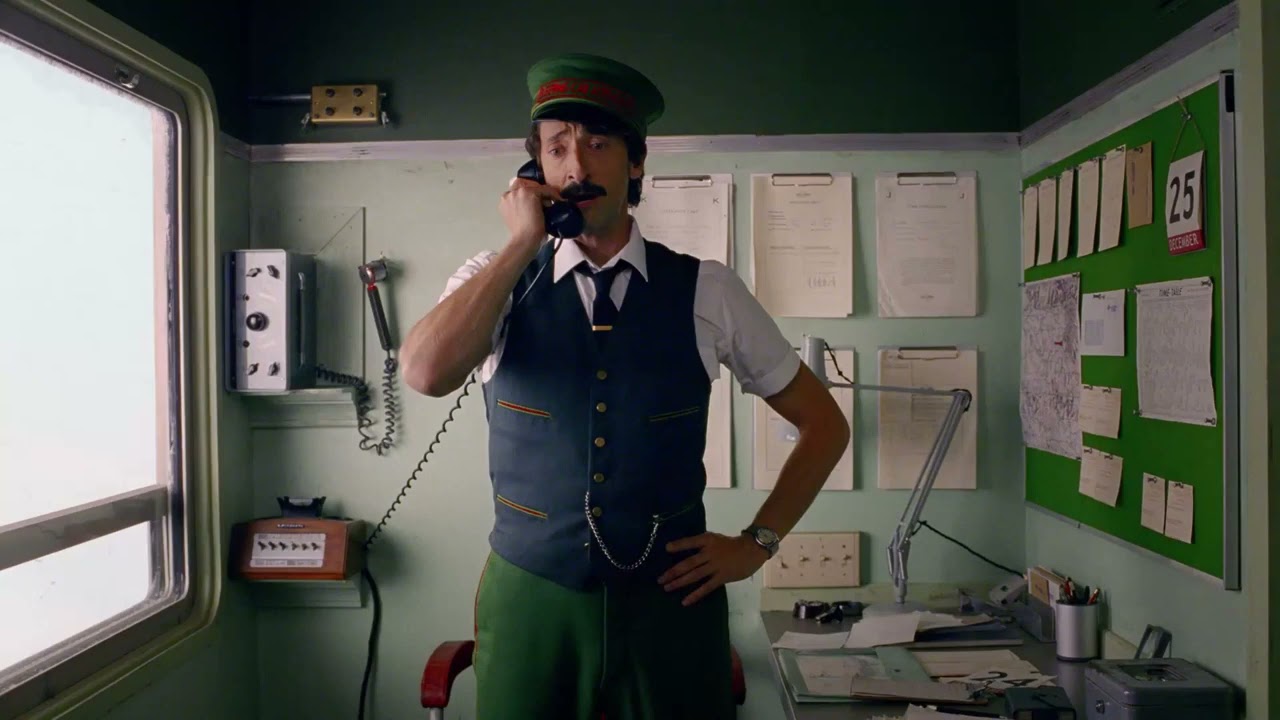
The film ran as a six-minute short on YouTube and was cut down to a 90-second TV spot. The YouTube version accumulated tens of millions of views organically. It demonstrated that H&M could produce genuine cinematic content—not just advertising—that audiences chose to watch.
The campaign won multiple industry awards and significantly elevated H&M’s perception among style-conscious consumers who appreciated the cinematic quality. It also strengthened H&M’s credentials as a brand that takes creativity seriously.
“Close the Loop” Sustainability Campaign
The “Close the Loop” campaign was H&M’s most effective sustainability marketing initiative. Rather than presenting recycling as a sacrifice or obligation, it positioned garment collection as a fashionable, community-positive act.
The campaign used short films, in-store activations, influencer partnerships, and social media storytelling to explain the Garment Collecting programme in engaging, accessible terms. It made sustainability feel relevant to a fashion-conscious consumer rather than an environmentalist.
The programme is now embedded in H&M’s store operations globally. Customers bring in old clothes (of any brand), receive a voucher for their next H&M purchase, and the clothes are either resold, repurposed, or recycled through H&M’s textile-recycling partnership with I:CO.
Frequently Asked Questions (FAQs)
Q1: What is H&M’s marketing strategy?
A: H&M’s marketing strategy is built on ten interconnected pillars: fast trend responsiveness (new drops weekly), designer collaborations (creating cultural events around each launch), celebrity and influencer marketing (from A-list campaigns to micro-influencer hauls), digital and social media (38M+ Instagram followers, strong TikTok presence), a 175-million-member loyalty programme, sustainability marketing (Conscious Collection, Garment Collecting), omnichannel integration (4,101 stores plus 60+ online markets), localisation (adapting global campaigns for 81 markets), affiliate and performance marketing, and SEO-driven content marketing. The core positioning—fashion and quality at the best price, in a sustainable way—anchors all of these.
Q2: What is H&M’s annual revenue?
A: H&M Group posted net sales of SEK 228.3 billion in FY2025 (financial year ended November 2025) with an operating profit of SEK 18.5 billion and an operating margin of 8.1%. The group operates 4,101 stores across 81 markets and serves customers via e-commerce in 60+ markets. It employs approximately 125,000 people globally. For the most current data, refer to the H&M Group Annual and Sustainability Report 2025 at hmgroup.com.
Q3: How does H&M use social media?
A: H&M uses Instagram (38M+ followers), TikTok, YouTube, Pinterest, and Facebook as its primary social channels. Its content strategy is inspiration-led rather than promotion-led: editorial styling photography, trend content, behind-the-scenes at collaborations, and sustainability storytelling generate organic engagement. Instagram Shopping and TikTok Shop integrations convert social inspiration into purchase. The H&M app extends social engagement into personalised push notifications and loyalty communications for its 175 million members.
Q4: Who are H&M’s main competitors?
A: H&M’s primary fast fashion competitors are Zara/Inditex (the market leader), Primark (ultra-value), ASOS (online-first), and Shein (ultra-fast fashion). In the mid-market accessible segment, H&M competes with Gap, Next, Uniqlo, and Mango. COS competes against Massimo Dutti, Reiss, and Theory. ARKET competes against Cos, Muji, and quality essentials brands. Secondhand platforms like Vinted and Depop compete for H&M’s younger, sustainability-conscious consumers.
Q5: What was H&M’s first and most famous designer collaboration?
A: H&M’s first designer collaboration was with Karl Lagerfeld in 2004. The collection sold out globally within hours, generated queues outside stores worldwide, and created the designer-x-highstreet genre that dozens of other retailers have since copied. Since Lagerfeld, H&M has collaborated with Stella McCartney, Roberto Cavalli, Versace, Balmain (2015—the most socially amplified collaboration in the programme’s history), Alexander Wang, Moschino, Giambattista Valli, Simone Rocha, and many others.
Q6: How large is H&M’s loyalty programme?
A: H&M Members has over 175 million members globally—making it one of the largest retail loyalty programmes in the world. Members earn points on all purchases (in-store and online), receive exclusive product access (early sale previews, collaboration launch priority), and get personalised offers powered by their purchase history. The programme generates first-party data that powers H&M’s personalisation engine across email, push notifications, and in-app recommendations, enabling H&M to communicate more relevantly with each individual member.
Q7: What sustainability commitments has H&M made?
A: H&M Group has committed to sourcing 100% more sustainably sourced materials by 2030, achieving net-zero greenhouse gas emissions across its full value chain by 2050, and reducing Scope 1 and 2 emissions by 50% by 2030 (vs. a 2019 baseline). Key programmes include the Garment Collecting programme (in-store textile recycling in all markets), the Conscious Collection (products using certified sustainable materials), and reporting against Science Based Targets. Progress is disclosed in the annual H&M Group Sustainability Report at hmgroup.com/en/sustainability.
Q8: How many brands does H&M Group own?
A: H&M Group operates eight brands: H&M (mainstream fast fashion for the broadest market), COS (minimalist, mid-premium design), Monki (affordable, playful fashion for Gen Z women), & Other Stories (eclectic, premium fashion and beauty), Weekday (denim-focused youth fashion), ARKET (quality everyday essentials at mid-premium price points), Afound (off-price outlet for H&M Group brands and external brands), and H&M HOME (homeware and interior accessories). Each brand has its own distinct positioning, social media presence, and go-to-market approach.
Q9: What is H&M’s digital marketing approach?
A: H&M’s digital marketing spans SEO-optimised editorial content on hm.com (style guides, trend reports, sustainability explainers), app-based push notifications and AI-powered personalised recommendations, affiliate partnerships via Awin and Rakuten, paid social on Meta/TikTok/Pinterest, Google Shopping campaigns, and programmatic display retargeting powered by first-party loyalty data. The H&M app is the primary direct-to-consumer digital channel, combining loyalty, personalisation, social commerce, and checkout in one interface. Instagram Shopping and TikTok Shop integrations enable social commerce across its largest organic channels.
Q10: Who is H&M’s CEO?
A: Daniel Ervér has been CEO of H&M Group since February 2024. He succeeded Helena Helmersson, who stepped down after four years in the role. Ervér joined H&M in 2010 and previously served as head of the H&M brand and Chief Commercial Officer of the group. His strategic priorities include accelerating the digital transformation of H&M Group, improving profitability and operating margin, deepening the group’s multi-brand portfolio strategy, and advancing sustainability commitments while keeping the core H&M brand accessible and commercially strong.
Conclusion
H&M’s marketing strategy is not a single idea—it is a portfolio of interlocking capabilities, each reinforcing the others.
Fast trend responsiveness keeps product permanently fresh. Designer collaborations generate cultural moments that paid media cannot buy. Celebrity and influencer partnerships build aspiration without losing accessibility. The loyalty programme turns 175 million customers into a first-party data asset that powers personalisation across every channel.
Sustainability, while contested, is increasingly essential—not just as ethics, but as a marketing differentiator for the growing proportion of consumers who will not buy from brands that ignore environmental impact.
Three things distinguish H&M from its fast fashion peers: the sheer quality and track record of its designer collaboration programme; the scale and data richness of its H&M Members loyalty ecosystem; and its commitment to a sustainability narrative that goes beyond labelling—encompassing design, sourcing, take-back, and reporting.
With SEK 228.3 billion in FY2025 net sales, 4,101 stores in 81 markets, and a portfolio of eight brands serving every segment of affordable fashion, H&M’s marketing machine remains one of the most effective—and most studied—in global retail.
For brands looking to learn from H&M, the core lesson is this: relevance at scale requires relentless attention to culture, community, and commercial discipline simultaneously. H&M has sustained all three across eight decades. That is the real achievement behind the numbers.
Also Read: Marketing Strategies, Marketing Mix and STP of Zara
To read more content like this, subscribe to our newsletter