Last Updated on September 14, 2026 by Team TBH
ABB is one of the most recognised names in global industrial automation, electrification, and motion technology. Founded in 1988 through the merger of Sweden’s ASEA and Switzerland’s BBC Brown Boveri, ABB today operates in more than 100 countries with approximately 105,000 employees. The company is structured around four business areas — Electrification, Motion, Process Automation, and Robotics & Discrete Automation — giving it one of the broadest competitive footprints in the industry.
ABB’s FY2025 results were a record by every key measure. The company reported revenues of $33.2 billion (up 9% year-on-year), orders of $36.8 billion (up 17%), and a record Operational EBITA of $6.3 billion at a margin of 19.0%. Free cash flow hit $4.6 billion, and return on capital employed reached 25.3%. In Q4 alone, ABB crossed the $10 billion order mark for the first time in a single quarter, driven by surging demand from data centres, rail infrastructure, and energy transition projects.
Despite this dominance, ABB faces intense and well-capitalised competition across every segment it operates in — from sprawling conglomerates like Siemens and Honeywell to robotics specialists like FANUC and KUKA, and from process-automation pure-plays like Yokogawa and Emerson.
This article profiles ABB’s most significant competitors, with the latest verified financial data, to help readers understand the landscape of global industrial automation.
Overview of ABB’s Competitive Landscape
The global industrial automation market is one of the fastest-growing sectors in technology. Driven by the twin engines of energy transition and artificial intelligence, demand for smart manufacturing, grid modernisation, electric motor drives, and collaborative robotics is accelerating across every major economy. Analysts project the market to exceed $400 billion by 2030.
ABB competes on multiple axes simultaneously. In electrification (switchgear, substations, building controls), its main rivals are Siemens, Schneider Electric, and Eaton. In drives and motors, it competes with Rockwell Automation, Yaskawa, and Mitsubishi Electric. In robotics, FANUC, KUKA, and Yaskawa are the key challengers. In process automation (DCS and control systems for oil & gas, chemicals, and power), Honeywell, Emerson, and Yokogawa are the primary threats.
The competitive pressures are intensifying as China-based players expand internationally and software-led automation companies like Keyence grow faster than the market. Understanding who these competitors are and how they stack up is essential context for anyone studying ABB’s strategy and positioning.
Also Read: Siemens Competitors: Top Industry Players to Watch
Top 18 ABB Competitors in Industrial Automation
1. Siemens AG
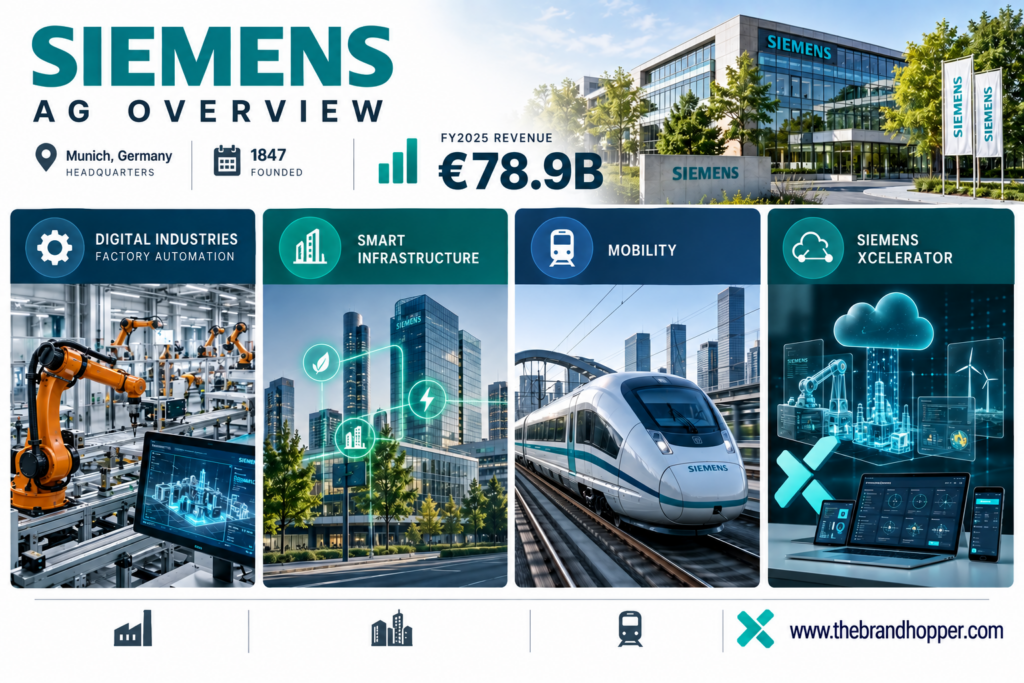
Siemens is without doubt ABB’s single largest and most direct competitor across almost every segment. Founded in 1847 in Berlin, Siemens has grown into a €78.9 billion revenue technology giant with deep roots in electrification, automation, and digitalization. In FY2025, Siemens reported revenue of €78.9 billion (up 4% nominally and 5% on a comparable basis), orders of €88.4 billion, a record net income of €10.4 billion (up 16%), and a record free cash flow of €10.8 billion.
Siemens’ Industrial Automation division — operating under the brand Siemens Industry — covers PLCs (the iconic S7 family), drives (SINAMICS), motion control, digital twins (Tecnomatix), and the Siemens Xcelerator digital platform that integrates hardware, software, and IoT. In automation software, Siemens holds a decisive edge through its acquisition of Mendix, NX, and Teamcenter, giving it a full product-lifecycle-management suite that ABB does not match.
Siemens’ key competitive strength over ABB lies in its breadth of digital offering and its installed base in European heavy industry. However, ABB leads Siemens in robotics and competes effectively in process automation for oil & gas, a segment Siemens largely ceded when it sold its power-generation assets into Siemens Energy. The two companies have been rivals for over a century — and their competition will only intensify as both pursue data-centre power infrastructure and grid-edge energy management.
2. Schneider Electric
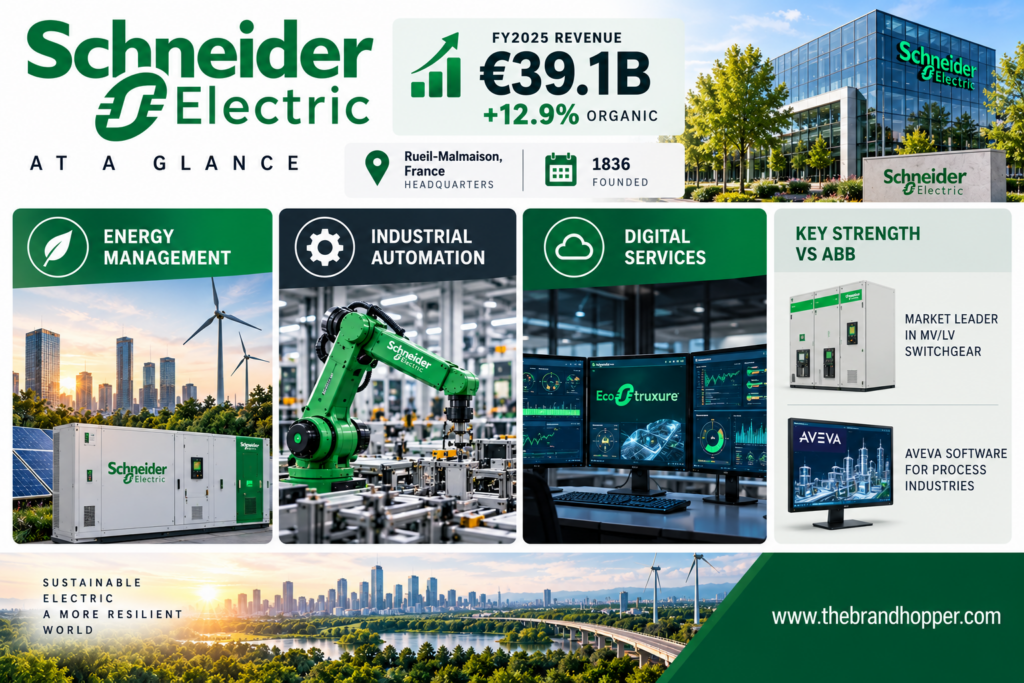
Schneider Electric is the world’s leading specialist in energy management and automation, with a particular focus on the mid-voltage and low-voltage switchgear, power distribution, and building automation markets. Headquartered in Rueil-Malmaison, France, Schneider reported record revenues of more than €40 billion in FY2025, growing 9% organically — one of the best performances in its history, driven by booming demand from data centres and infrastructure decarbonisation projects.
Schneider competes head-on with ABB’s Electrification business in switchgear, substations, EV charging infrastructure, and smart building controls. Its EcoStruxure architecture — a cloud-enabled, IoT-based platform — is widely deployed across commercial buildings, industrial campuses, and utility substations. Schneider also holds a strong position in industrial process software through AVEVA (its software subsidiary), which directly challenges ABB’s Process Automation offerings in sectors such as oil & gas, mining, and water.
In data centres specifically, Schneider Electric has emerged as a dominant power infrastructure vendor, competing with ABB for uninterruptible power supply (UPS), medium-voltage switchgear, and microgrid solutions. Schneider’s strong partnership ecosystem with hyperscale cloud providers gives it structural advantages in this fast-growing vertical that ABB is also aggressively targeting.
3. Rockwell Automation
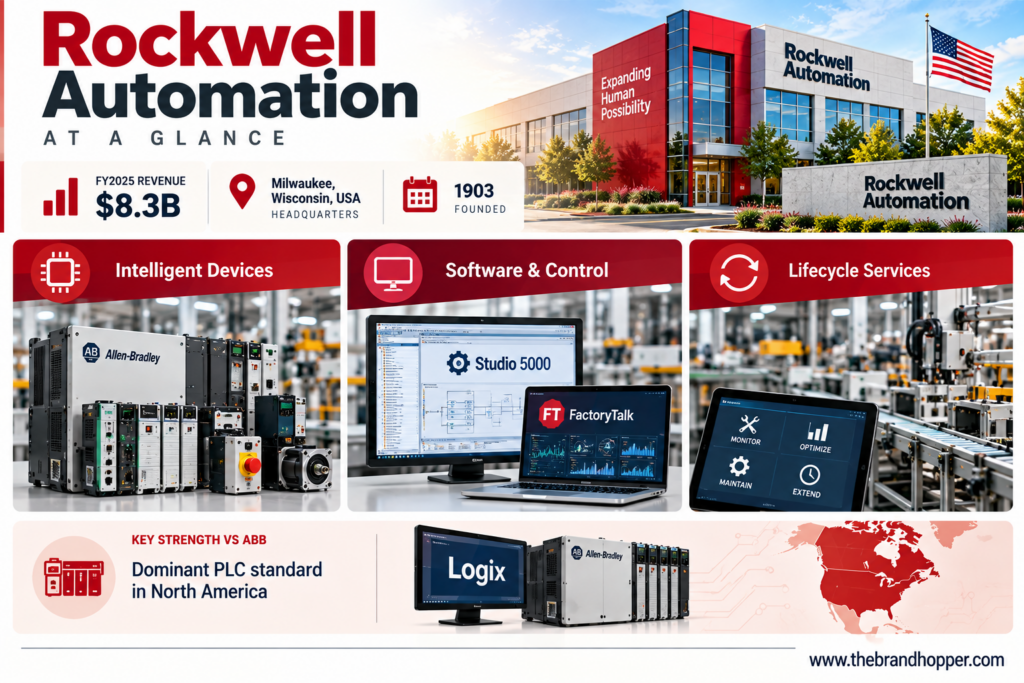
Rockwell Automation is the world’s largest pure-play company in industrial automation and information, primarily serving discrete manufacturers in automotive, food and beverage, life sciences, and semiconductor sectors. Headquartered in Milwaukee, Wisconsin, Rockwell posted FY2025 sales of $8.3 billion (essentially flat at +1% organically versus a challenging FY2024) and a total segment operating margin of 20.4%, reflecting its high-value software and services mix.
Rockwell’s Allen-Bradley PLC platform is the dominant standard in North American manufacturing, giving it an enormous installed-base advantage that ABB struggles to displace. Its Logix PLC family, PowerFlex drives, and Plex MES platform represent a tightly integrated automation suite. Rockwell’s acquisition of Plex Systems (cloud MES) and Samsara investments have accelerated its pivot toward connected enterprise software.
While ABB has a stronger global presence (particularly in Europe and Asia), Rockwell’s North American dominance is a structural moat. For any OEM or manufacturer with a legacy Allen-Bradley installation, migrating to ABB is a significant undertaking. The two companies increasingly compete not on individual products but on whose platform an end customer’s factory digitalization journey is built on — a battle of ecosystems more than components.
4. Mitsubishi Electric
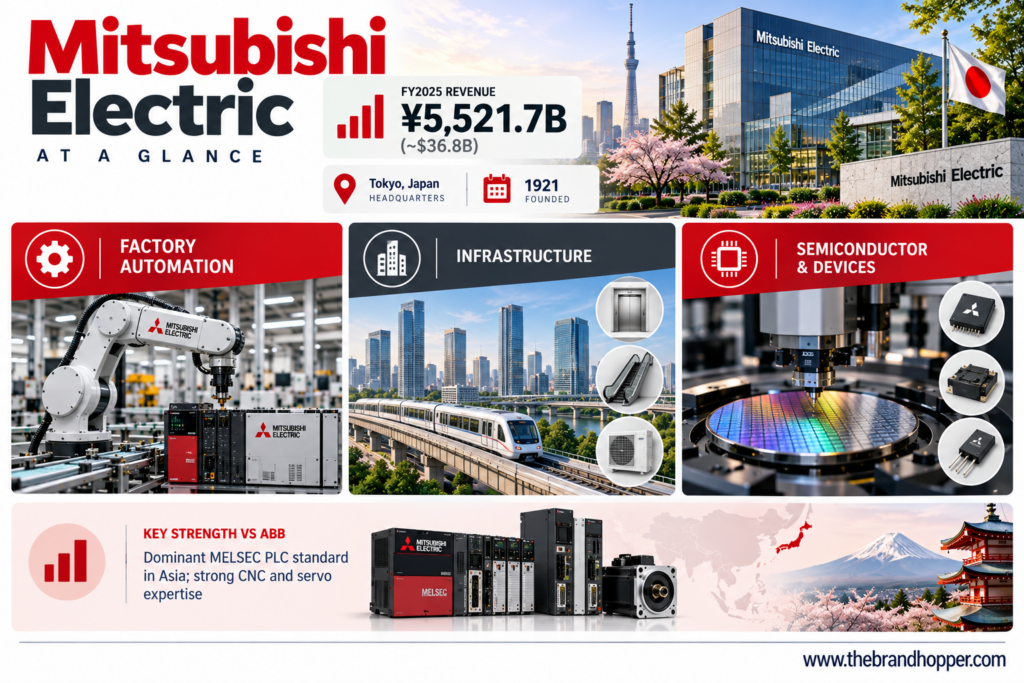
Mitsubishi Electric is one of Japan’s largest electrical and electronics companies and a formidable competitor to ABB across factory automation, drives, servo systems, and robotics. The company’s FY2025 results (year ended March 2025) were record-breaking: total revenue rose to ¥5,521.7 billion (approximately $36.8 billion), with operating profit reaching a record ¥391.8 billion. The improvement was driven by strong demand in its infrastructure and semiconductor device segments.
In factory automation, Mitsubishi Electric’s MELSEC PLC family and MELSERVO servo drives command significant share in Asia and are growing in Europe. The company’s MELFA industrial robot line competes directly with ABB’s robotics division, particularly in arc welding and precision assembly applications. Mitsubishi Electric is also a leader in CNC (computer numerical control) systems — a market where ABB has less presence.
The company’s e-F@ctory manufacturing IoT concept — which integrates PLCs, robots, drives and edge computing into a connected factory ecosystem — is a direct competitor to ABB’s Ability digital platform. Mitsubishi Electric’s vertical integration from semiconductors to automation systems gives it a cost advantage in components that ABB must source externally.
5. Honeywell
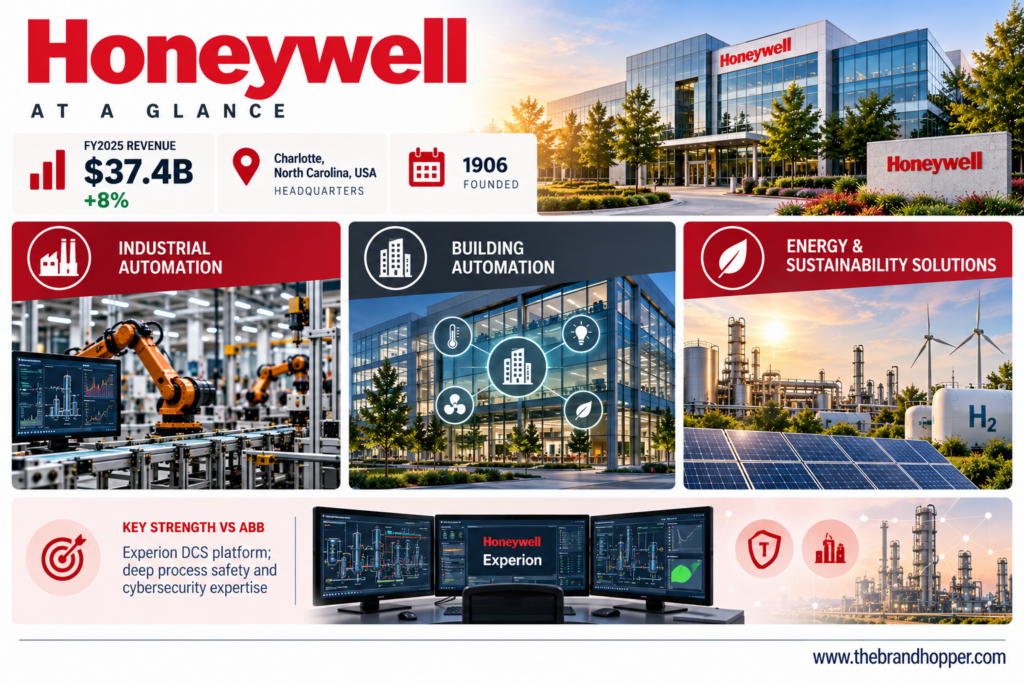
Honeywell is a diversified industrial technology company whose process automation and building technologies segments compete directly with ABB. In FY2025, Honeywell reported sales of $37.4 billion, up 8%, with double-digit growth in Aerospace Technologies leading the charge. In October 2024, Honeywell announced a structural transformation: the separation of Honeywell Aerospace Technologies as an independent public company, a transaction that was targeted for completion in 2026. Post-separation, the remaining Honeywell entity — focused on industrial automation, building solutions, and energy infrastructure — will be a more focused ABB rival.
Honeywell Process Solutions (HPS) markets the Experion DCS platform, which is a direct competitor to ABB’s Ability System 800xA in oil & gas refineries, petrochemical plants, and power generation. Honeywell’s Safety Manager, advanced alarm management tools, and Operations Technology cybersecurity offerings make it a comprehensive process-automation vendor for safety-critical industries. In building automation, Honeywell’s EBI (Enterprise Buildings Integrator) platform competes with ABB’s Ability Building Intelligence suite.
Honeywell is also a leader in connected worker safety technology, gas detection, and industrial wireless — verticals where ABB is less prominent. The strategic restructuring is expected to sharpen Honeywell’s focus on its automation portfolio, potentially increasing competitive pressure on ABB in the process industries segment.
6. Emerson Electric
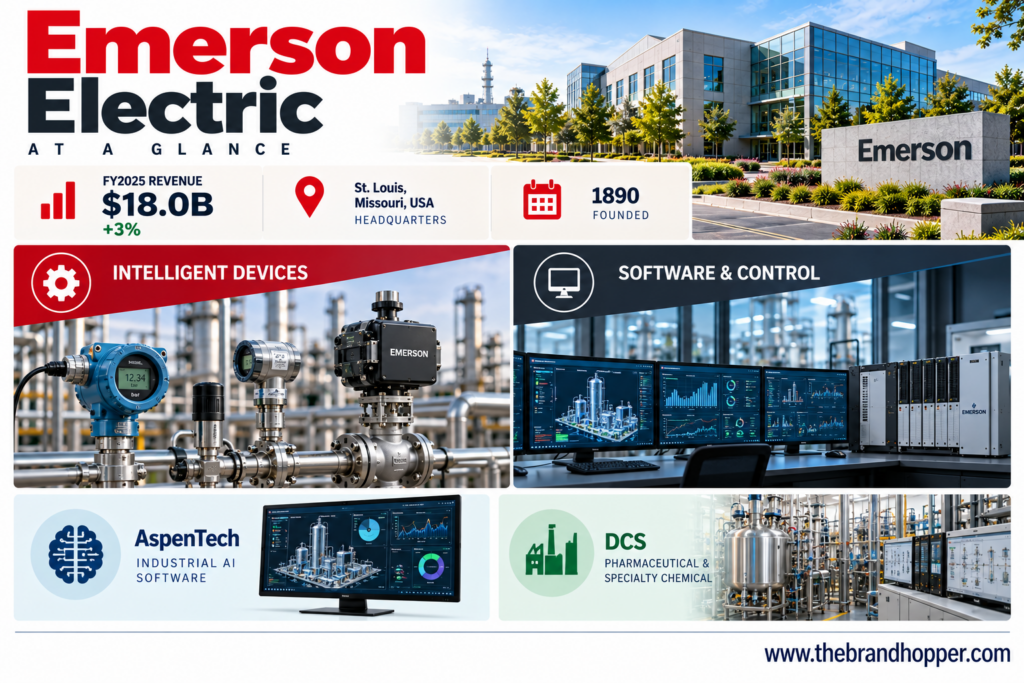
Emerson Electric is a pure-play automation company following its strategic transformation — it sold its Climate Technologies business in 2023 and completed its majority acquisition of AspenTech (industrial AI software) to focus squarely on process and hybrid automation. In FY2025 (year ended September 30, 2025), Emerson reported revenue of $18.0 billion (up 3%), net income of $2.3 billion, and a gross margin of 52.8%, reflecting the premium pricing power of its software-enriched product portfolio.
Emerson’s DeltaV DCS competes directly with ABB’s System 800xA in batch and continuous manufacturing environments, particularly in pharmaceutical, food and beverage, and specialty chemicals. The company’s Fisher control valves, Micro Motion flow meters, and Rosemount sensors represent a comprehensive field instrument portfolio that rivals ABB’s measurement product line. AspenTech adds process simulation, advanced process control, and AI-powered optimisation capabilities that are increasingly central to Emerson’s value proposition.
While Emerson is smaller than ABB in revenue, its extremely high software attachment rate (post-AspenTech) gives it superior margin performance and stickier customer relationships in the process industries. Emerson’s focus on operational technology cybersecurity and open-standard platforms (using technologies like OPC-UA) makes it an appealing choice for end users wary of vendor lock-in.
7. FANUC Corporation
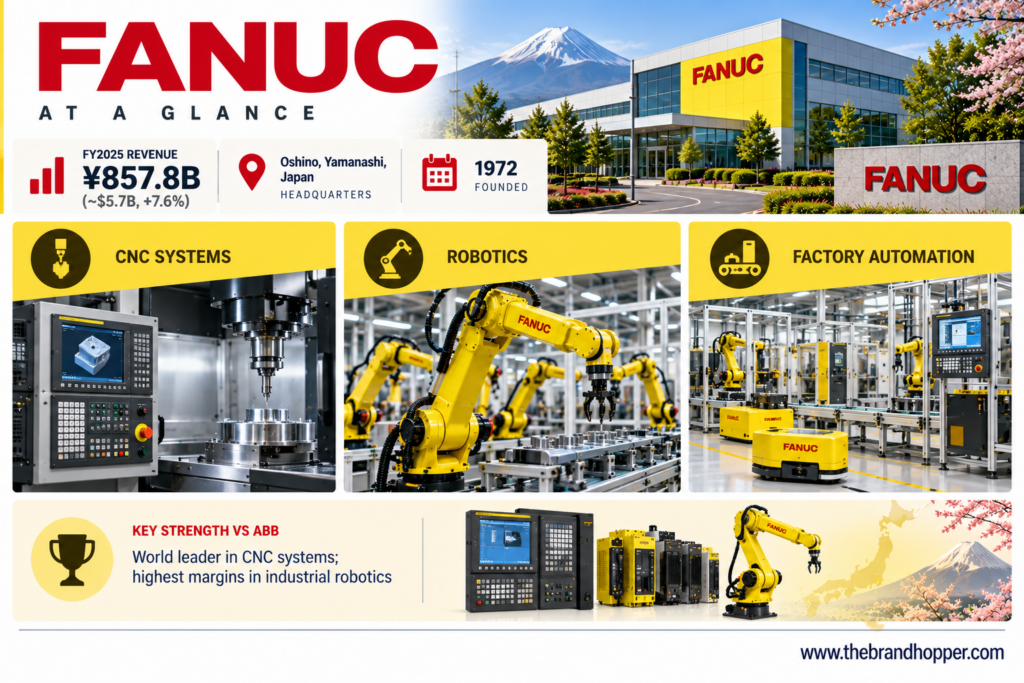
FANUC is Japan’s most profitable automation company and the world’s largest manufacturer of CNC systems and industrial robots. Headquartered in Oshino, Yamanashi — on the slopes of Mount Fuji — FANUC reported FY2025 net sales of ¥857.8 billion (approximately $5.7 billion), up 7.6% year-on-year, with operating income of ¥183.8 billion (up 15.7%) and net income of ¥166.5 billion (up 12.9%). The company is famously secretive and conservatively managed, with a massive cash reserve.
FANUC’s robot division produces the world’s most widely deployed series of industrial robots — the yellow robots that dominate automotive assembly lines globally. Its CNC division is the standard control system for machine tools in Asia and increasingly globally. FANUC’s FA (factory automation) division also produces servo amplifiers and servo motors that directly compete with ABB’s servo and motion product lines.
ABB competes most directly with FANUC in the robotics market, where ABB’s IRB series and collaborative YuMi robots face FANUC’s FANUC robots across automotive, electronics, and logistics applications. FANUC’s FIELD system (FANUC Intelligent Edge Link & Drive) is its answer to industrial IoT connectivity, competing with ABB’s Ability platform. FANUC’s extraordinary operating margins (typically 20-25%) reflect its near-monopoly position in some machine-tool control niches.
8. Yaskawa Electric
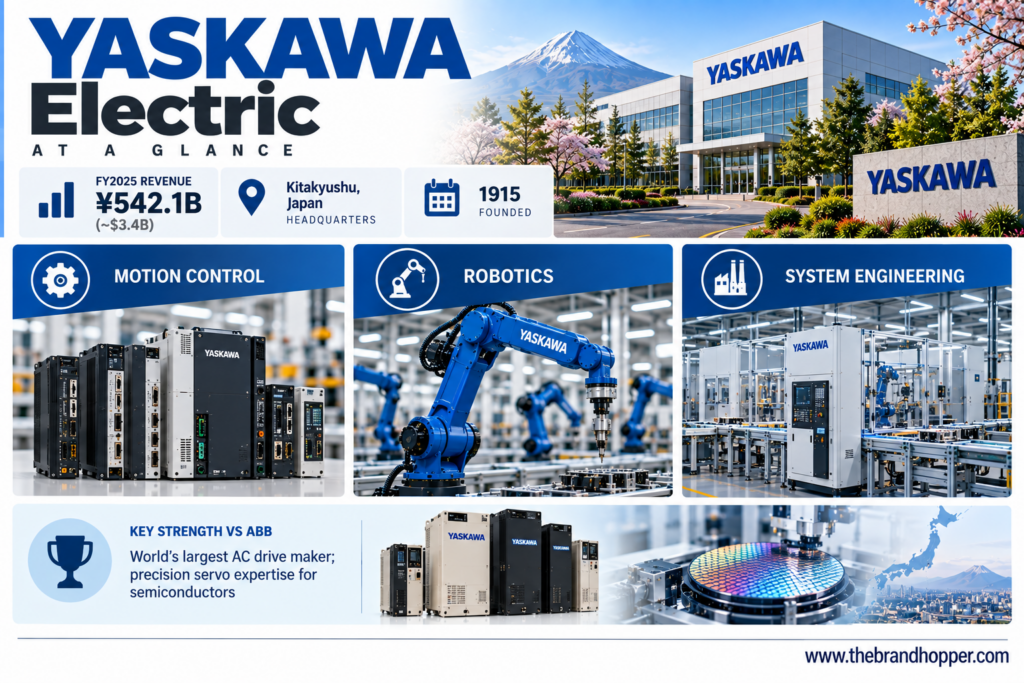
Yaskawa Electric is a Japanese precision motion and robotics company that competes with ABB in servo drives, inverter drives, and industrial robots. In FY2025 (year ended February 28, 2025), Yaskawa reported revenue of ¥542.1 billion (approximately $3.4 billion), essentially flat year-on-year (+0.8%), with operating profit declining 5.7% to ¥47.3 billion due to forex headwinds and elevated costs. However, Q4 FY2025 orders surged 20% as AI-semiconductor demand triggered a sharp recovery in robot orders.
Yaskawa’s Sigma series servo drives are among the most technically respected in the industry, used extensively in semiconductor manufacturing equipment, precision machining, and electronics assembly. Its Motoman robot series — particularly collaborative robots and welding robots — competes directly with ABB’s GoFa and IRB robot families. Yaskawa is also the world’s largest manufacturer of AC drives (under the Yaskawa/Varispeed brand), competing with ABB’s ACS series variable-speed drives.
Yaskawa’s “i3-Mechatronics” concept, which integrates robots, servo drives, and PLCs with AI-driven optimisation software, mirrors ABB’s integrated automation approach. The company’s strong growth outlook for FY2026 (projected revenue ¥580 billion, operating profit +26.8%) reflects recovering semiconductor demand that will intensify competition with ABB in high-speed precision robotics.
9. GE Vernova
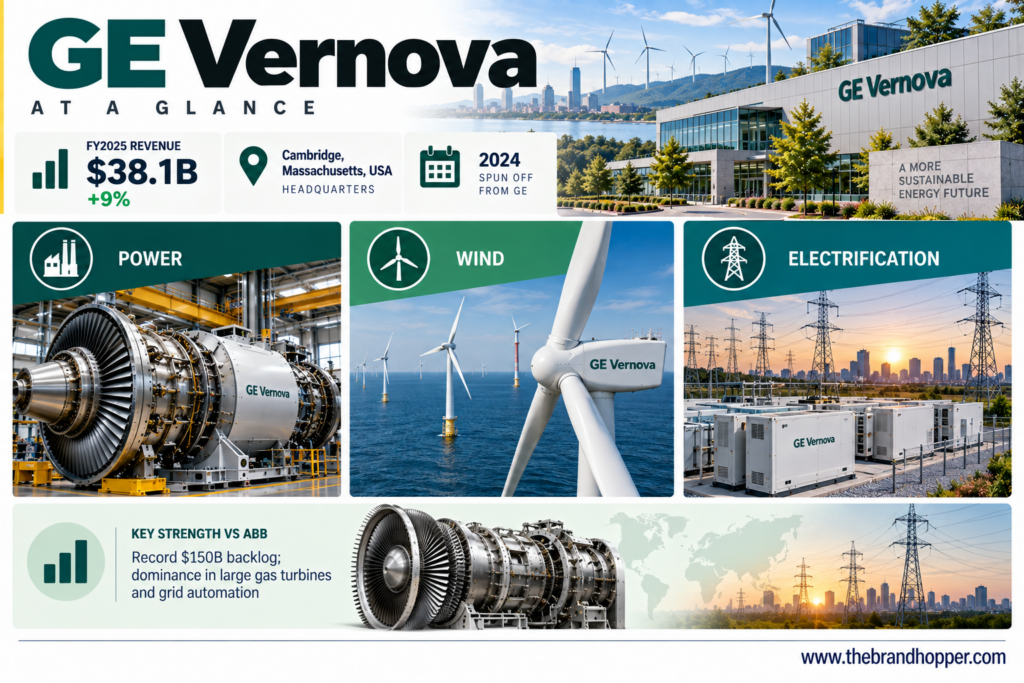
GE Vernova was spun off from General Electric in April 2024 as a pure-play electrification and energy company. It comprises the former GE Power, GE Renewable Energy, and GE Digital businesses. In FY2025, GE Vernova delivered its strongest year as an independent company, reporting revenue of $38.1 billion (up 9%), orders of $59.3 billion (up 34% organically), net income of $4.9 billion (including a $2.9 billion tax benefit), and a record backlog of $150 billion — making it an increasingly formidable player in ABB’s territory.
GE Vernova competes with ABB primarily in the high-voltage grid and power generation segments. Its Gas Power and Steam Power turbines, grid automation (formerly GE Grid Solutions), and HVDC (high-voltage direct current) transmission systems overlap significantly with ABB’s Power Grids legacy business (which ABB sold to Hitachi in 2020 to form Hitachi Energy). While ABB no longer operates in HVDC transmission, GE Vernova’s grid automation software and substations still compete with ABB’s Electrification products.
GE Vernova’s Electrification segment (including switchgear, transformer services, and grid software) is the most direct overlap with ABB. The company’s SCADA and advanced energy management systems for power utilities face competition from ABB’s SCADA/EMS offerings in its Electrification and Process Automation business areas. With its $150 billion backlog, GE Vernova represents a long-term competitive threat particularly in data centre power infrastructure.
10. KUKA AG
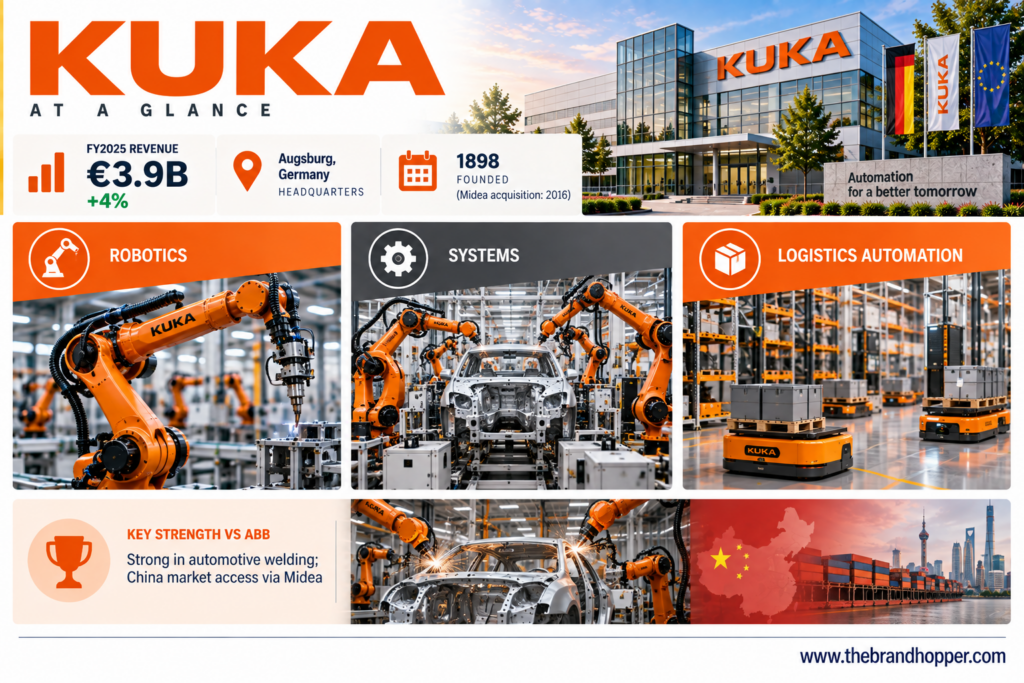
KUKA AG is a German robotics and automation company headquartered in Augsburg, Bavaria, and a wholly-owned subsidiary of China’s Midea Group (which acquired it in 2016). In 2025, KUKA delivered revenue of €3.9 billion (up 4%) and received orders of €4.2 billion, employing approximately 14,542 people. After a challenging 2024, KUKA returned to profitable revenue growth through cost discipline and increased automation adoption in automotive and general industry.
KUKA’s industrial robots — recognised by their orange colour and KR AGILUS / KR FORTEC product branding — are direct competitors to ABB’s IRB and GoFa robot families. KUKA’s particular strength lies in automotive body-in-white welding and assembly, where it holds long-term contracts with major OEMs including BMW, Mercedes-Benz, Volkswagen, and Ford. Its RobotStudio-equivalent, KUKA.Sim, allows virtual commissioning of robot cells.
Midea’s ownership has given KUKA significant advantages in the Chinese manufacturing market, where it now competes locally against domestic automation brands. The “Automation 2.0” vision announced in 2025 — focused on physical AI integration, where robots can adapt to unstructured environments in real-time — is KUKA’s answer to the next wave of intelligent robotics, putting it on a collision course with ABB’s AI-enhanced robotics strategy.
11. Parker Hannifin
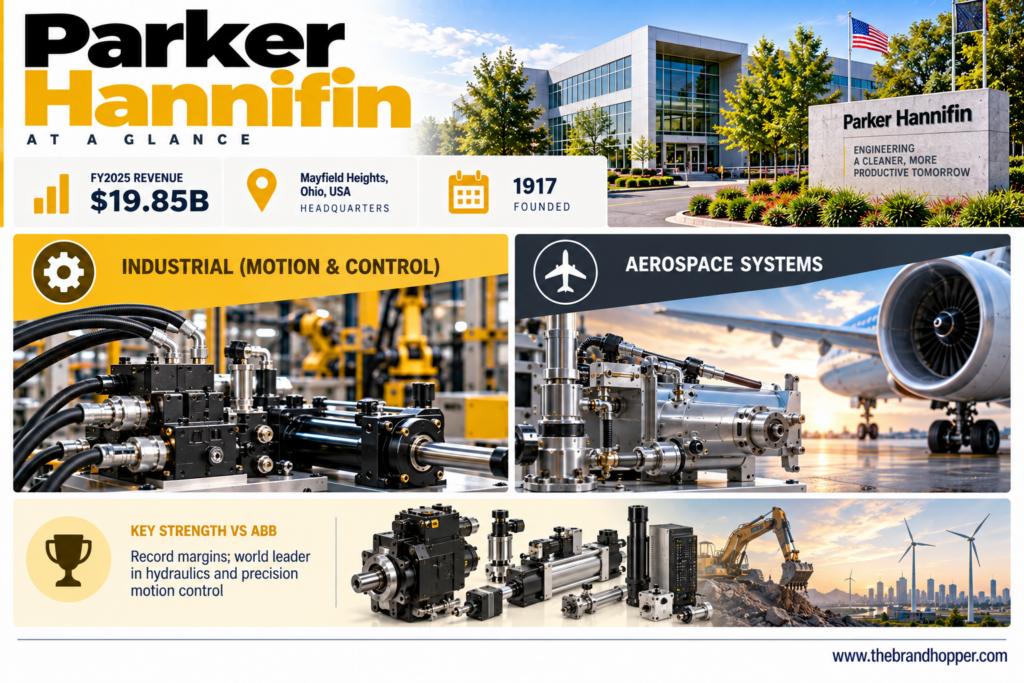
Parker Hannifin is the world’s leading diversified manufacturer of motion and control technologies, supplying the tools that make machinery and equipment work — from hydraulic systems and pneumatic actuators to electromechanical drives and filtration systems. Headquartered in Mayfield Heights, Ohio, Parker reported FY2025 net sales of $19.85 billion (fiscal year ended June 30, 2025), with a record adjusted segment operating margin of 26.1% and net income of $3.5 billion. Free cash flow reached a record $3.8 billion (19.0% of sales).
Parker competes with ABB in electromechanical actuators and motion control, particularly in the machine-building, mobile off-highway, and aerospace aftermarket segments. Parker’s acquisition of Meggitt (2022) strengthened its position in aerospace actuation and sensing, areas where ABB does not compete, but in industrial electrification Parker’s industrial drives and power electronics portfolio overlaps meaningfully with ABB’s Motion division.
Parker’s “Win Strategy 3.0” focuses on differentiated technology, strategic acquisitions, and portfolio simplification — creating a leaner, higher-margin company that is harder for ABB to compete against in precision motion applications. Parker’s global distribution network and extremely strong aerospace and defence relationships give it revenue diversity that pure industrial players like ABB’s Motion division cannot match.
12. Eaton Corporation
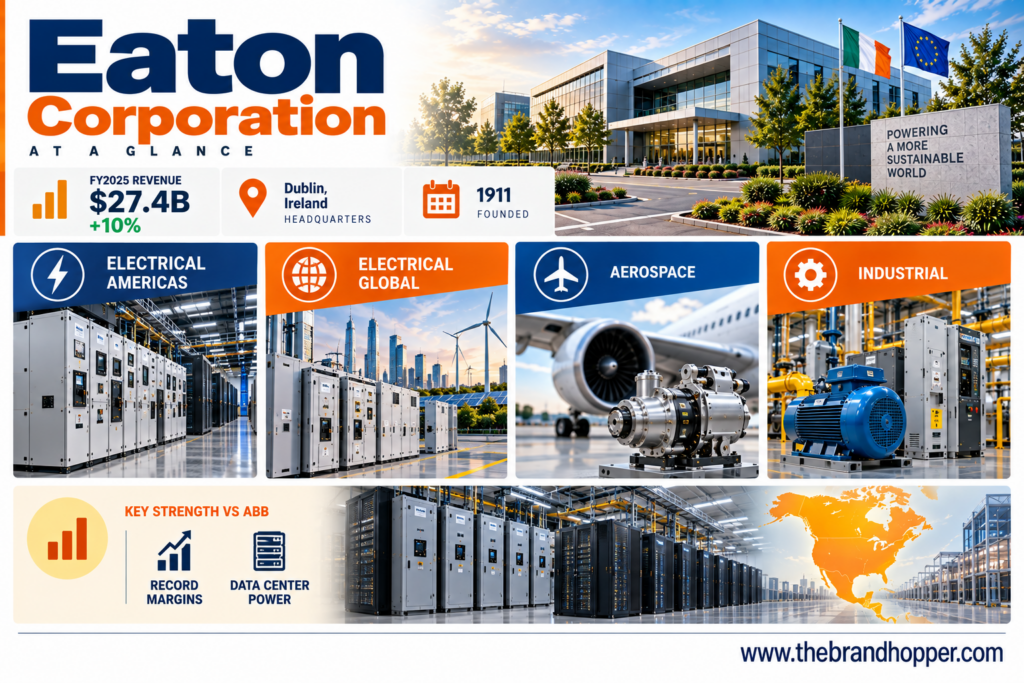
Eaton is a global intelligent power management company that competes with ABB across a wide range of electrification and automation products — from circuit breakers and switchgear to variable-frequency drives, power converters, and energy storage systems. In FY2025, Eaton reported record sales of $27.4 billion (up 10%), with 8% organic growth and record segment margins of 24.5%. Free cash flow hit a record $3.6 billion, reflecting Eaton’s ability to convert profit to cash at high rates.
Eaton’s Electrical Americas and Electrical Global segments are the most direct ABB competitors, selling power distribution equipment, medium-voltage switchgear, uninterruptible power supplies, and power quality products to data centres, utilities, and industrial customers. In data centre power infrastructure — one of the hottest markets in 2025 — Eaton and ABB are direct rivals for every switchgear and busbar contract.
Eaton’s planned spin-off of its Mobility segment (powertrain components) will sharpen its focus on its Electrical and Industrial segments, making it an even more direct competitor to ABB. The company’s FY2025 guidance implied continued double-digit growth in its electrical businesses, driven by the AI data centre boom and the global push for grid modernisation — both areas where ABB is similarly positioned. Eaton’s North American market leadership and strong utility relationships are advantages that ABB continues to work hard to match.
13. Omron Corporation
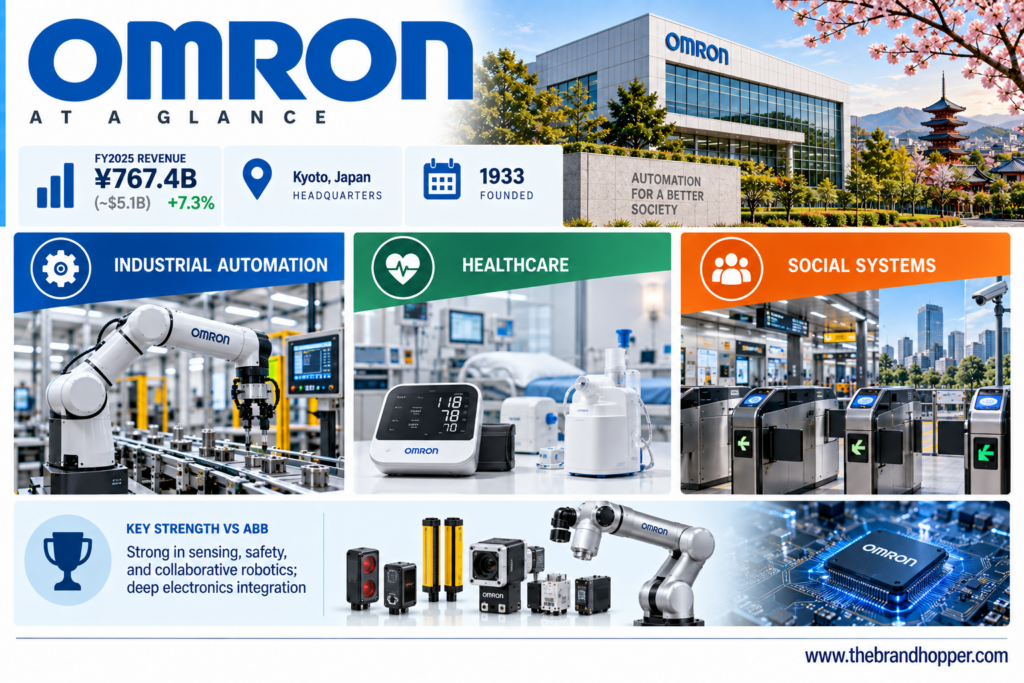
Omron Corporation is a Japanese electronics and automation company with a particularly strong position in sensing and control technology, safety systems, and collaborative robotics. In FY2025 (year ended March 31, 2026), Omron reported net revenue of ¥767.4 billion (approximately $5.1 billion), up 7.3% year-on-year, with operating income of ¥59.9 billion (up 12.1%). The recovery was driven by strong demand from AI-related industries and a broader rebound in its Industrial Automation Business.
Omron competes with ABB primarily in PLCs (its Sysmac NX/NJ platform), industrial robots (the TM series collaborative robots and traditional LD series AMRs), safety components, and vision sensing. Omron’s collaborative robots — which combine Techman Robot technology under the TM brand — compete with ABB’s GoFa and SWIFTI cobots in assembly, inspection, and logistics applications.
Omron’s “innovative-Automation!” concept integrates intelligent sensors, controllers, robots, and data analytics into a unified platform that competes with ABB’s factory automation ecosystem. Omron has a particular strength in electronic components and sensing that gives its automation solutions tight integration advantages. Its vision systems for quality inspection are increasingly deployed in semiconductor fabs, competing indirectly with ABB’s quality automation offerings.
14. Keyence Corporation
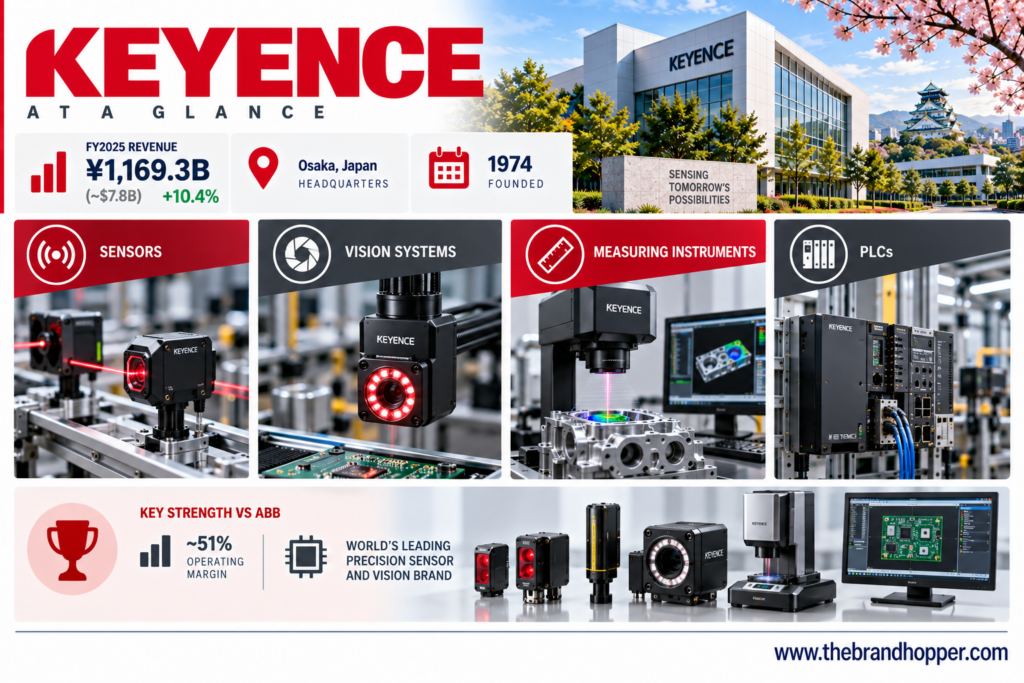
Keyence is arguably the most profitable company in global industrial automation — its extraordinary 51% operating margin in FY2025 dwarfs even ABB’s record 19% Operational EBITA margin. In FY2025 (year ended March 31, 2026), Keyence reported net sales of ¥1,169.3 billion (approximately $7.8 billion, up 10.4%), operating income of ¥595.8 billion (up 8.4%), and net income attributable to owners of ¥445.2 billion — all records. Overseas sales grew 13.5%, with Americas up 13.3% and Asia up 16.7%.
Keyence competes with ABB in sensors, vision systems, measuring instruments, and PLCs. Its direct-sales model — no distributors, only Keyence engineers — allows it to offer extremely customised solutions and build deep technical relationships with customers. Keyence’s laser displacement sensors, 2D/3D vision systems, and LJ-X series profile measurement systems are the gold standard for inline quality measurement in automotive, semiconductor, and electronics manufacturing.
While Keyence is not a broad automation platform vendor like ABB, it consistently takes market share in sensing and vision because of its relentless innovation pace (over 1,000 new products per year) and the premium quality of its applications engineering. ABB’s Machine Vision products within its Robotics business compete with Keyence’s vision systems, though Keyence’s installed base and brand recognition in sensing are considerably stronger. Keyence represents a different model of competition — narrow product scope but extraordinary depth.
15. Yokogawa Electric
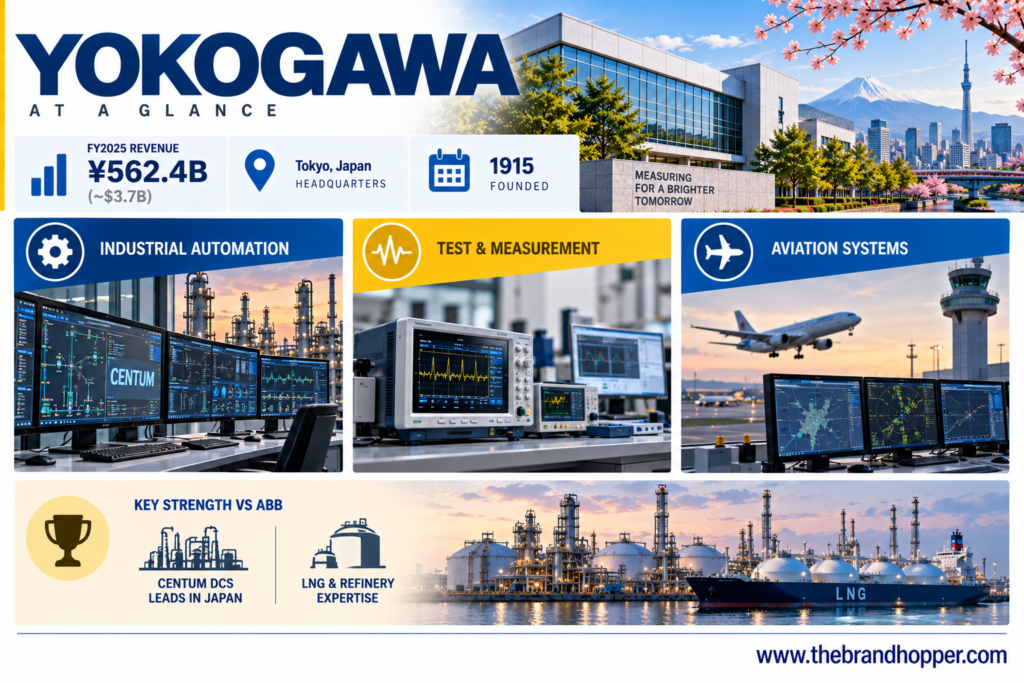
Yokogawa Electric is a Japanese industrial automation and control company specialising in process automation for the oil & gas, petrochemical, pulp and paper, and pharmaceutical industries. In FY2025 (year ended March 31, 2025), Yokogawa reported net sales of ¥562.4 billion (approximately $3.7 billion) and net profit attributable to owners of ¥52.1 billion — representing solid profitability in a relatively stable year.
Yokogawa’s CENTUM VP/VP R6 DCS platform is one of the three global standards for continuous process control (alongside ABB’s System 800xA and Honeywell’s Experion). In Japan, Yokogawa holds an exceptionally strong DCS installed base at refineries, LNG plants, and chemical facilities — creating substantial recurring services and software revenue. Its FAST/TOOLS SCADA and Exaquantum historian also compete with ABB’s process optimisation software.
Yokogawa’s pivot to digital and service-based offerings — including its OpreX brand for operational technology solutions — is designed to capture more lifecycle value from its installed base, a strategic model ABB mirrors with its own service expansion. In the broader digital twin and simulation market for process plants, Yokogawa’s collaboration with AspenTech (now part of Emerson) creates an interesting competitive dynamic for ABB to navigate.
16. Beckhoff Automation
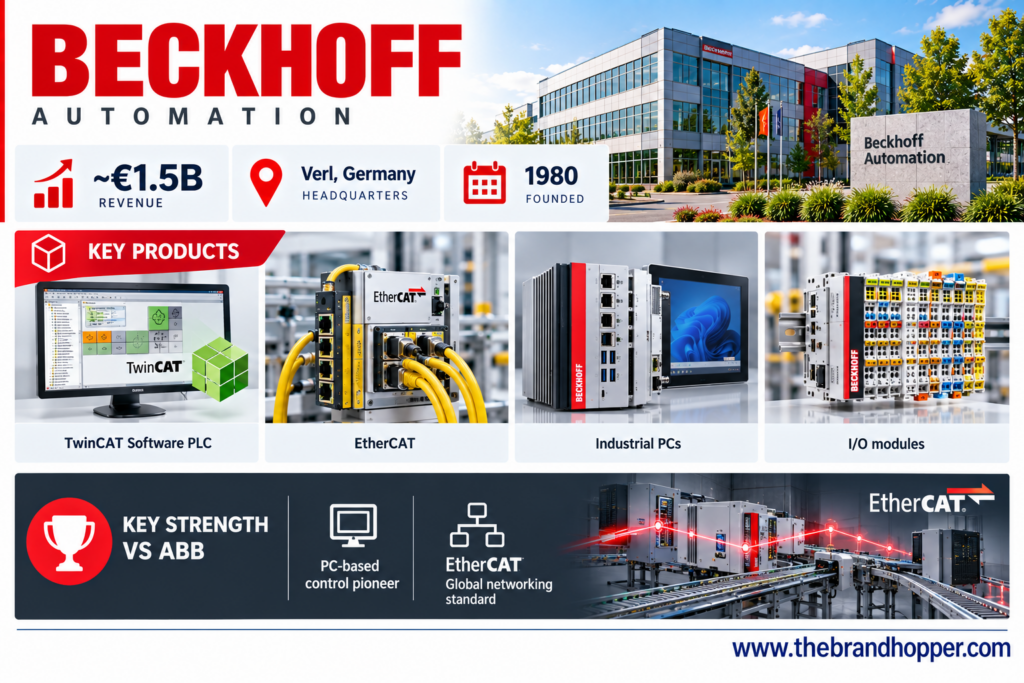
Beckhoff Automation is a privately held German company that pioneered PC-based control technology for industrial automation. Founded in 1980 and headquartered in Verl, Germany, Beckhoff has grown to become a significant disruptor in the PLC and motion control market. While the company does not publish audited financial results, industry estimates place its annual revenue at approximately €1.5 billion, with double-digit growth rates over the past decade supported by its unique technology advantage.
Beckhoff’s TwinCAT software platform and EtherCAT fieldbus technology are genuine innovations that have reshaped industrial networking. EtherCAT, developed by Beckhoff and now an open international standard (IEC 61158), provides ultra-fast real-time communication over standard Ethernet — a capability that both ABB and Siemens now support in their products. Beckhoff’s C6000 series industrial PCs and EL-series I/O modules have found deep adoption in precision machine building, especially in semiconductor equipment and packaging machinery.
Beckhoff competes with ABB’s Automation Builder software and PLC product range, particularly in the machine OEM segment. Its philosophy of software-defined automation — where the same TwinCAT runtime handles PLC logic, CNC, and motion control in software — is increasingly influential in next-generation machine design. As a private company, Beckhoff can invest counter-cyclically and move faster than publicly traded competitors, making it a formidable niche challenger to ABB.
17. Bosch Rexroth
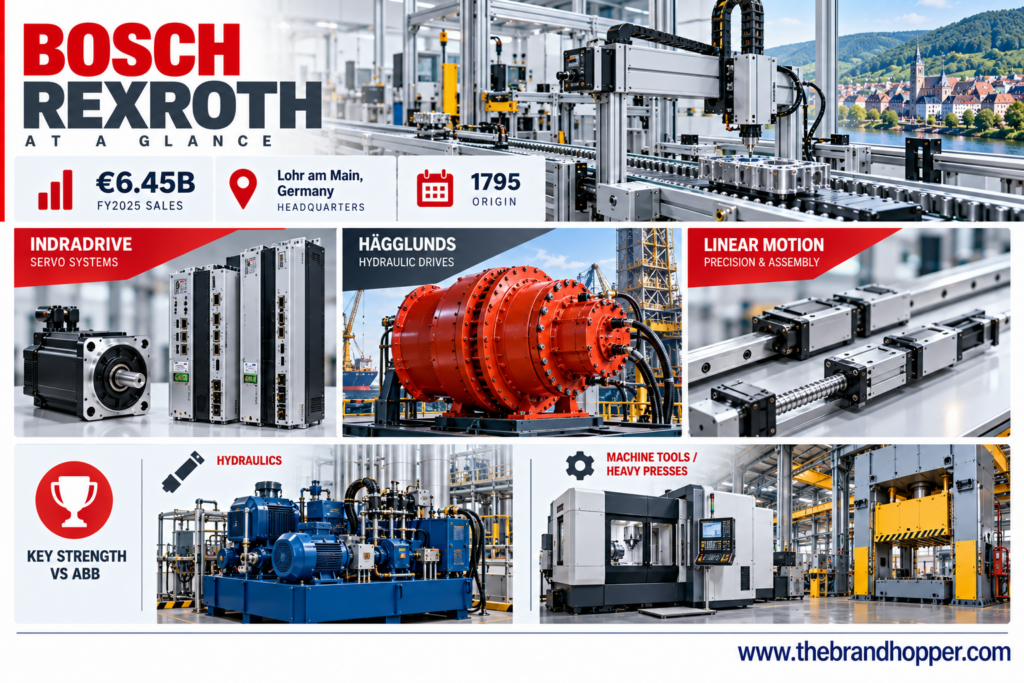
Bosch Rexroth is the drive and control technology division of the Robert Bosch Group, one of the world’s largest suppliers of technology and services. While Bosch Rexroth does not separately report financials, the broader Bosch Group reported 2025 sales of approximately €90 billion. Bosch Rexroth’s own revenue is estimated at around €7 billion, making it a significant player in hydraulic systems, electric drives, controls, and linear motion technology.
Bosch Rexroth competes with ABB’s Motion division in electric drives, servo motors, and linear actuators — particularly in machine-tool, plastics processing, and press automation applications. Its IndraDrive series of servo drives and IndraDyn servo motors are directly competing products to ABB’s ACServo and ACS series. In hydraulics, Bosch Rexroth is the global leader, a segment where ABB has no significant presence.
Bosch Rexroth’s “Connected Hydraulics” strategy — embedding IoT connectivity and AI-based predictive maintenance into traditional hydraulic components — represents a convergence of previously separate markets that could challenge ABB’s condition monitoring and predictive maintenance service offerings. With the full backing of Bosch’s R&D budget and global manufacturing network, Bosch Rexroth has resources comparable to any standalone automation company.
18. Cognex Corporation
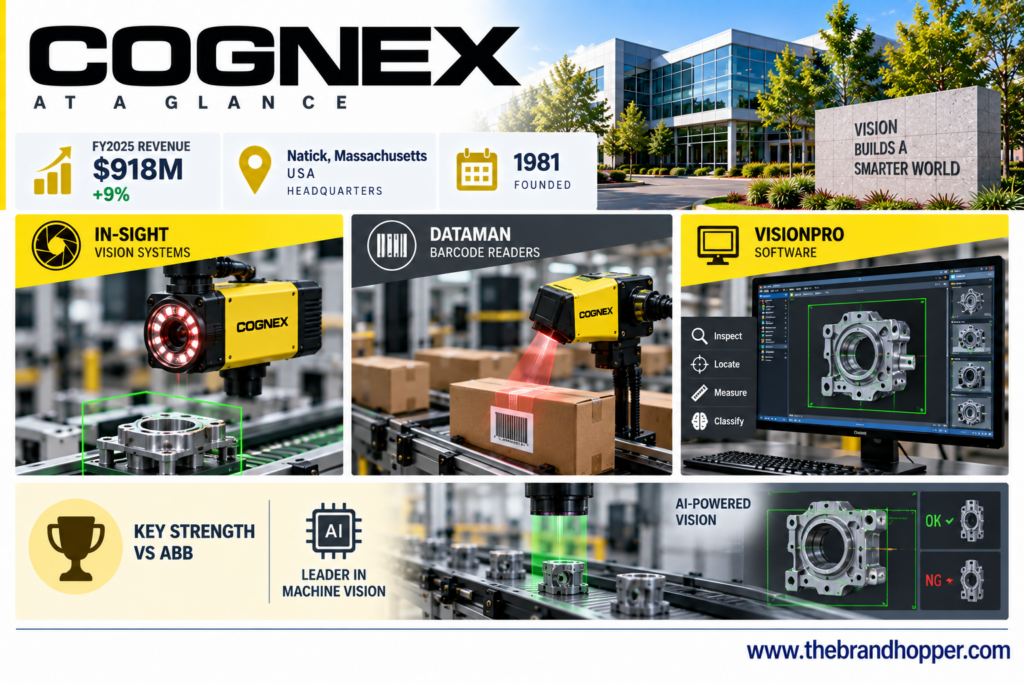
Cognex Corporation is the world’s leading provider of machine vision systems and barcode readers — technologies that give manufacturing machines the ability to “see” and inspect products on high-speed assembly lines. Headquartered in Natick, Massachusetts, Cognex reported FY2025 revenue growth of 9% year-on-year (approximately $918 million), recovering from a challenging 2024. Full-year operating margin was 16.3% and Adjusted EBITDA margin was 21.5% (up 440 basis points), while cash from operations grew 65% to $246 million.
Cognex competes with ABB in the machine vision segment of ABB’s Robotics & Discrete Automation business. ABB has integrated vision capabilities into its robot guidance systems, but Cognex remains the category leader in standalone vision systems for quality inspection, character verification, and barcode reading on production lines. Cognex’s In-Sight vision systems and DataMan barcode readers are deployed across automotive final assembly, EV battery manufacturing, pharmaceutical packaging, and consumer electronics.
The growing intersection between robotics and vision is creating an arena where ABB and Cognex increasingly overlap. As ABB’s robots require smarter vision guidance for bin-picking and flexible assembly, ABB either partners with or competes against Cognex’s vision technology. Cognex’s expansion into 3D vision and edge-learning AI tools represents its move into more complex applications that will increasingly require integration with ABB-class robotic systems.
ABB Competitors at a Glance: Revenue & Focus Area Comparison
| Company | FY2025 Revenue (approx.) | HQ Country | Key Overlap with ABB |
| Siemens | €78.9 billion | Germany | All segments — broadest rival |
| Schneider Electric | >€40 billion | France | Electrification, process software |
| Rockwell Automation | $8.3 billion | USA | PLCs, drives, MES |
| Mitsubishi Electric | ¥5,521B (~$36.8B) | Japan | FA systems, robotics, drives |
| Honeywell | $37.4 billion | USA | Process automation, DCS, buildings |
| Emerson Electric | $18.0 billion | USA | DCS, flow instruments, AI software |
| FANUC | ¥857.8B (~$5.7B) | Japan | Robotics, CNC, servo drives |
| Yaskawa Electric | ¥542.1B (~$3.4B) | Japan | AC drives, robots, servo systems |
| GE Vernova | $38.1 billion | USA | Grid automation, electrification |
| KUKA AG | €3.9 billion | Germany | Industrial robots, systems |
| Parker Hannifin | $19.85 billion | USA | Electromechanical drives, motion |
| Eaton | $27.4 billion | Ireland | Switchgear, UPS, power distribution |
| Omron | ¥767.4B (~$5.1B) | Japan | PLCs, cobots, sensing, safety |
| Keyence | ¥1,169B (~$7.8B) | Japan | Sensors, vision, machine vision |
| Yokogawa Electric | ¥562.4B (~$3.7B) | Japan | DCS for process industries |
| Beckhoff Automation | ~€1.5B (est.) | Germany | PC-based PLC, EtherCAT |
| Bosch Rexroth | ~€7B (est.) | Germany | Drives, motors, hydraulics |
| Cognex | ~$918 million | USA | Machine vision, robot guidance |
Key Takeaways
ABB’s competitive environment is complex and multi-fronted. No single rival can challenge ABB across all four of its business areas simultaneously — but taken together, ABB faces formidable competition in every segment it operates in.
Siemens is the only competitor that rivals ABB across electrification, automation, motion, and digital services on a global scale. The two companies have competed for over a century and the rivalry intensifies every year.
In process automation (DCS for oil & gas and chemicals), Honeywell, Emerson, and Yokogawa represent the three main rivals to ABB’s System 800xA. Customer selection decisions in this market are highly stickiness-driven — once a DCS is installed, it typically stays for 15-20 years.
In robotics, FANUC, KUKA, and Yaskawa are ABB’s direct competitors. The robotics market is being transformed by AI-driven perception, where all four companies are investing heavily.
The fastest-growing competitive threat is from electrification specialists — Eaton, Schneider, and GE Vernova — all of whom are capturing significant share in data-centre power infrastructure, a market ABB is targeting as a key growth engine.
Keyence, despite its narrow product scope, represents a different kind of competitive threat: extraordinary profitability and customer loyalty in sensing and vision that ABB cannot easily replicate.
The overall industrial automation market is large enough to support all these players growing simultaneously, which explains why ABB achieved record results in FY2025 even with 18 well-capitalised competitors.
Frequently Asked Questions (FAQs)
Q1: Who is ABB’s biggest competitor?
A: Siemens AG is ABB’s largest and most direct competitor, with a presence across electrification, industrial automation, digital services, and motion technology. Siemens reported revenues of €78.9 billion in FY2025, nearly 2.4x ABB’s $33.2 billion, making it a significantly larger company overall.
Q2: What is ABB’s competitive advantage in industrial automation?
A: ABB’s competitive advantages include its integrated portfolio spanning electrification, motion, process automation, and robotics; its ABB Ability digital platform connecting hardware to industrial AI; its global service network of over 100,000 employees; and its leadership in key growth segments such as data-centre power, EV charging, and collaborative robotics.
Q3: How does ABB compare to Siemens in robotics?
A: ABB has a stronger position in robotics than Siemens. ABB is one of the “Big Four” robot manufacturers globally (alongside FANUC, KUKA, and Yaskawa), while Siemens primarily competes in automation software and drive technology rather than robot hardware. ABB’s YuMi and GoFa collaborative robots, as well as its IRB series, give it deep robotics credibility.
Q4: Does ABB still compete in HVDC (high-voltage direct current) transmission?
A: No. ABB sold its Power Grids business — including its world-leading HVDC portfolio — to Hitachi in 2020, forming Hitachi Energy. ABB no longer competes in HVDC. Its closest remaining competitors in high-voltage grid equipment are Siemens Energy, Schneider Electric, and GE Vernova, which competes in grid automation software and substations.
Q5: Who are ABB’s main competitors in the process automation (DCS) market?
A: ABB’s System 800xA DCS faces competition primarily from Honeywell’s Experion DCS, Emerson’s DeltaV, Yokogawa’s CENTUM VP, and Siemens’ SIMATIC PCS 7/PCS neo. These five platforms collectively dominate the global DCS market for oil & gas, chemicals, power generation, and pharmaceutical manufacturing.
Q6: Is Rockwell Automation a direct competitor to ABB?
A: Yes, particularly in North America and in discrete manufacturing. Rockwell Automation’s Allen-Bradley PLCs and PowerFlex drives compete directly with ABB’s AC500 PLCs and ACS drives. However, ABB is stronger in process industries and has a larger international footprint, while Rockwell dominates the North American OEM and machine-builder market.
Q7: What is ABB’s global market share in industrial robots?
A: ABB is one of the top four industrial robot manufacturers globally, alongside FANUC, KUKA, and Yaskawa (collectively known as the “Big Four”). These four companies account for the majority of the world’s industrial robot installations. Exact market share fluctuates by region and application, but ABB leads in arc welding and collaborative robotics.
Q8: How does GE Vernova compete with ABB?
A: GE Vernova competes with ABB primarily in electrical grid equipment, automation software for power utilities, and substation technology. Its Grid Solutions business (formerly Alstom Grid, then GE Grid) overlaps with ABB’s Electrification segment in switchgear, protection relays, and energy management systems. GE Vernova’s record $150 billion backlog signals growing market relevance.
Q9: What makes Keyence unique among ABB’s competitors?
A: Keyence is unusual because it achieves operating margins of approximately 51% — far higher than any other industrial automation company. It achieves this through a direct-sales model (no distributors), relentless innovation (over 1,000 new products per year), and premium pricing based on superior technical support. While Keyence overlaps with ABB only in sensing and vision, its business model represents a fundamentally different competitive philosophy.
Q10: Will ABB’s competitors benefit from the AI and data-centre boom?
A: Yes — the same megatrend driving ABB’s record orders (AI infrastructure build-out, data-centre power, grid modernisation) is also benefiting Siemens, Schneider Electric, Eaton, GE Vernova, and others. The industrial automation market is large enough that the AI wave is lifting all major players. However, the companies with the strongest power management portfolios — ABB, Schneider, Eaton — are best positioned to capture the most value from data-centre electrical infrastructure.
Conclusion
ABB occupies a unique position in global industrial automation: it is simultaneously a technology leader, a system integrator, and a services provider across electrification, motion, process automation, and robotics. Its FY2025 record results — $33.2 billion in revenue, $36.8 billion in orders, and a 19% Operational EBITA margin — demonstrate that its diversified portfolio is a genuine competitive advantage in a world where customers demand integrated solutions rather than individual products.
Yet the competitive environment is formidable. Siemens matches ABB’s breadth with a larger overall revenue base. Schneider Electric leads in mid-voltage switchgear and process software. FANUC, KUKA, and Yaskawa are fierce rivals in robotics. Honeywell, Emerson, and Yokogawa dominate key pockets of the process automation market. Newer threats like Eaton and GE Vernova are accelerating in the data-centre power segment. And Keyence quietly outperforms everyone on profitability in sensing and vision.
What sets ABB apart in this competitive landscape is the combination of its global scale, its cross-business-area integration capabilities, and its continuous investment in digital and AI-powered offerings through the ABB Ability platform. For industrial customers seeking to electrify, automate, and decarbonise their operations — the three dominant trends of the 2020s — ABB’s unique ability to address all three simultaneously makes it an essential strategic partner, not just a component vendor.
As the industrial automation market continues to grow toward the $400 billion mark and beyond, the 18 competitors profiled here will all grow alongside ABB. The question is not whether they can compete — they all can — but whether any single rival can match ABB’s integrated breadth across the full spectrum of electrification and automation. Based on FY2025 evidence, the answer remains: not yet.
Also Read: Schneider Electric Competitors: Top 15 Rivals Analysed
To read more content like this, subscribe to our newsletter