Last Updated on July 16, 2025 by Team TBH
DevRev is an AI-native enterprise software company (often called a DevCRM platform) that unifies product development, customer support and business data for product-led growth companies. Its mission is “to help build the earth’s most customer-centric companies” by connecting every developer (“Dev”) directly with customers and revenue (“Rev”).
In practice, DevRev provides a cloud platform where developers, product managers and support staff all work on one shared system. By breaking down silos between code, tickets, feedback and business metrics, DevRev aims to ensure that feedback and customer context drive software product decisions.
The company’s API-first, design-led approach emphasizes real-time collaboration and data-driven workflows, enabling engineers to see the impact of their work on end users.
DevRev’s platform targets primarily technology and SaaS organizations — especially modern product-led companies — and its early adopters include hundreds of software startups, unicorns (like voice-AI company Uniphore) and even large enterprises (for example, one of the world’s top five consumer banks).
This broad traction illustrates DevRev’s value proposition: helping companies respond faster to customer needs while reducing churn and development costs by aligning all teams around one source of truth.
Founding Story of DevRev
DevRev was founded in October 2020 by two former Nutanix executives, Dheeraj Pandey (co-founder and ex-CEO of Nutanix) and Manoj Agarwal (former Nutanix SVP of Engineering). Pandey and Agarwal left Nutanix in late 2020 with the vision of creating a new type of CRM — one built around developers rather than sales and marketing.

After a period in stealth, DevRev publicly launched in July 2021 by announcing a $50 million seed round led by Khosla Ventures, Mayfield Fund, and Lightspeed Venture Partners. This sizeable seed funding kickstarted development of DevRev’s platform.
In October 2022, DevRev raised another $20 million through an innovative tokenized fundraising (a digital-SAFE offering), bringing total seed funding to about $70 million by late 2022. By October 2023, cumulative seed funding had reportedly exceeded $85 million.
In August 2024 DevRev announced a $100.8 million Series A round (at a $1.15 billion valuation) led again by Khosla Ventures, Mayfield, and the founders’ family office (Param Hansa Values).
Across these rounds, DevRev has drawn not just top-tier VCs, but also venture partners like Lightspeed’s Ravi Mhatre and sector veterans (e.g. Ajeet Singh of ThoughtSpot), reflecting confidence in the vision.
According to founder Dheeraj Pandey, the large seed rounds were justified by DevRev’s broad ambition: the team focused on global hiring (across Austin, Bangalore, Ljubljana and more) and aggressive product development, “stretching the dollar” through automation and a disciplined “DevRev-on-DevRev” usage of their own tools.
Founders and Leadership of DevRev
DevRev’s founding team combines deep enterprise experience with a product-led mindset.
Dheeraj Pandey, Co-Founder and CEO, is a serial entrepreneur with ~25 years in enterprise software. He co-founded Nutanix (leading it to a multi-billion IPO) and served on the board of Adobe. Pandey has said DevRev’s goal is to make developers “conscious entrepreneurs” who can run “customer-centric companies” by breaking down barriers between engineering and business.
Manoj Agarwal, Co-Founder and President, was the Head of Engineering at Nutanix; he drives DevRev’s design-first culture and convergence of workflows. Agarwal often emphasizes that DevRev is “monomaniacally focused on design to converge the workflows of customer support, product management, and developers,” echoing the same mantra that helped Nutanix succeed.
Other key leaders include Madhukar Kumar (co-founder and Head of Growth, formerly Nutanix VP of Marketing), ensuring the product aligns with market needs. Under Pandey and Agarwal’s leadership, DevRev has built a “global, diverse team” with expertise from Apple, Google, Twilio, and elsewhere, united by the vision that software companies must rethink CRM from the ground up.
| Name | Role | Background |
|---|---|---|
| Dheeraj Pandey | Co-Founder & CEO | Co-founder and former CEO of Nutanix; board member at Adobe; early career at Oracle and Aster Data. |
| Manoj Agarwal | Co-Founder & President | Former SVP of Engineering at Nutanix; 20+ years in enterprise software engineering. |
| Madhukar Kumar | Co-Founder & Head of Growth | Former VP of Product/Marketing at Nutanix; leads go-to-market strategy. |
Pandey and Agarwal frequently explain that DevRev is about empowering developers at every level. Pandey calls developers and revenue “yin and yang” — the two halves of a business that must be brought together. He has stated that in modern software companies, developers should “run an entire company through a developer CRM” that integrates product and support.
Agarwal similarly emphasizes real-time communication and unifying teams. In a statement he noted, “We’ve been monomaniacally focused on design to converge the workflows of customer support, product management, and developers” — a philosophy drawn from their success at Nutanix.
These leaders envision DevRev becoming a platform where every engineer, product manager and support agent shares data and context, making customer feedback a first-class citizen in software development.
Products and Services of DevRev
DevRev’s product portfolio is anchored by its OneCRM/DevCRM platform, which currently delivers two primary applications plus a shared AI data layer.
The DevRev Support App (sometimes called Product-Led Support) is an embeddable in-app widget and ticketing system for customer service teams. It provides omni-channel, real-time chat and GPT-powered AI assistants that can handle common queries or route issues based on customer context. For example, when an issue is raised in the app, DevRev automatically ties that conversation to any relevant development work (bugs or features) so that engineers immediately see which customers are impacted.
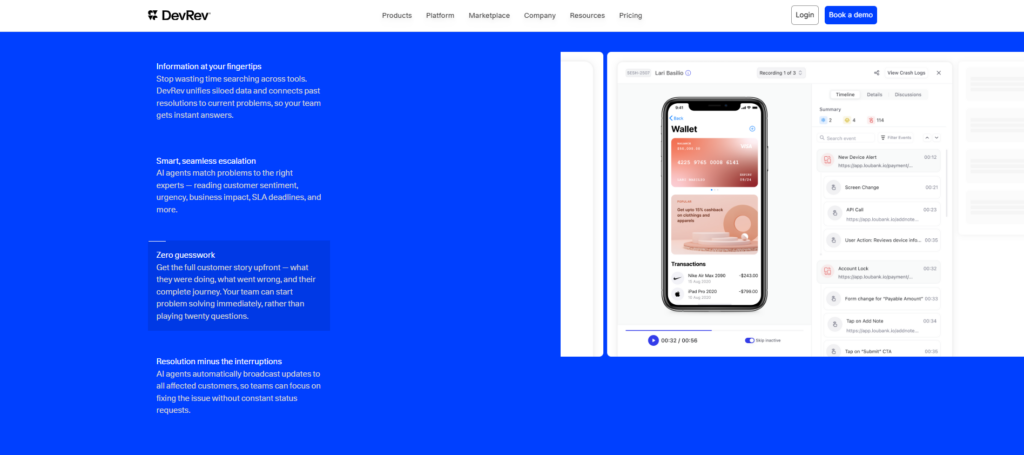
Key features include a unified inbox, semantic search of knowledge bases, AI-driven escalation and auto-triage, and SLAs that apply across support and development (since both live on one platform). This “Support as a Service” model means companies can decommission legacy helpdesk tools and instead manage all service and feedback inside DevRev.
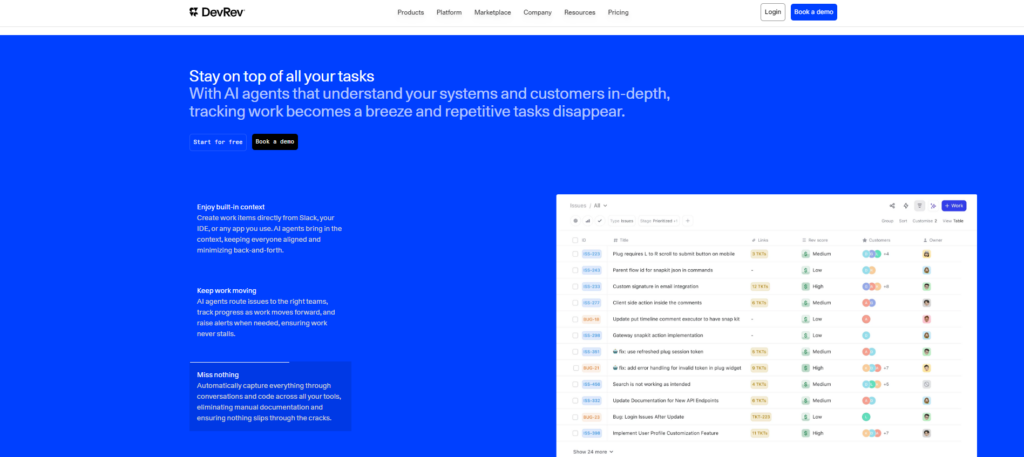
The DevRev Build App is a product management and issue-tracking tool for engineering teams. It functions like a next-generation agile planner: development tickets, sprint plans and product roadmaps are all linked to real customer accounts and feedback. Managers can, for instance, tag each bug or feature with the customers it affects, then instantly pull reports answering questions like “How much dev effort is devoted to customer-requested work vs. maintenance?”.
This customer-centric “product system of record” is a first for PLG companies. The Build App includes standard agile capabilities (kanban boards, workflows, sprint management) but with one crucial difference: it is natively connected to the Support App and sales data. As a result, work priorities are driven not just by internal roadmaps but by live user conversations and adoption metrics from the field.
Underlying these apps is DevRev’s AgentOS platform, an AI/knowledge-graph engine that powers search, analytics and automation for the entire suite. AgentOS automatically “airdrops” data from legacy systems (e.g. Jira, Zendesk, Salesforce) into DevRev’s knowledge graph.
This unified data layer allows cross-functional analytics (e.g. correlating feature releases to support ticket trends) and feeds generative AI agents. For example, a DevRev AI agent can summarize recent customer issues, suggest related code commits, or even draft release notes based on captured feedback. The platform also supports an extensibility marketplace: companies and partners can build “snap-ins” (connectors, workflow nodes, visualization widgets) in a low-code fashion, rapidly extending the system.
In summary, DevRev offers DevCRM (OneCRM) with Support and Build apps as core products, all driven by AI and real-time data. (Below is a simplified overview.)
| Product/App | Description |
|---|---|
| DevRev Support (Support App) | An AI-powered in-app customer support tool with chat, ticketing and knowledge base features. Connects end-user conversations (via Slack, web widgets, etc.) to developer issues and product features. Ideal for support engineers and dev teams needing shared customer context. |
| DevRev Build (Product/Dev App) | An agile development and product management app that aligns development sprints and feature backlogs to real customer feedback. Provides a “product system of record” capturing features, bugs, and enhancements linked to impacted customers. Used by software dev teams and product managers. |
| DevCRM Platform (AgentOS) | The underlying AI/knowledge-graph platform. It integrates data from source control (GitHub, GitLab), support systems (Slack, Zendesk), CRM, and more into a unified graph. Offers real-time search, analytics dashboards, and generative AI agents for automation and insights (e.g. auto-ESCalation, root-cause analysis). Enables cross-team workflows and a marketplace of AI-powered extensions. |
(DevRev may also offer “Growth” or “Sales” modules on this platform in the future, but current public documentation focuses on Support and Development apps.)
Business Model of DevRev
DevRev operates on a cloud-SaaS business model aimed at product-led growth. The platform is offered as a multi-tenant cloud service, with new customers typically onboarded via a free trial or pilot. Pricing is per-user (seat-based) with tiered plans, and customers self-provision accounts through DevRev’s website or sales teams. Importantly, DevRev also supports flexible pricing models: in addition to fixed user subscriptions, it offers consumption-based billing for its advanced analytics and AI capabilities.
For example, customers pay per-agent or per-instance usage beyond a base quota. This “Flexible economics” (consumption + subscription) is intended to simplify migration from legacy CRMs and align cost with actual product usage.
Value creation in DevRev’s model comes from integration and automation. Rather than deploying multiple siloed tools, companies use DevRev to create their unified CRM environment. DevRev delivers value by synchronizing existing data (via APIs and 1-click migrations from tools like Jira, Slack, Zendesk, Salesforce) into its knowledge graph. The platform’s AI agents then surface insights and reduce manual work (e.g. auto-classifying tickets, generating summaries, suggesting code links).
In effect, DevRev captures value by selling a more efficient, consolidated workflow to software-driven businesses. It delivers this via a cloud service (accessible via web and in-app widgets) and an open marketplace of plug-insdevrev.aidevrev.ai. DevRev’s go-to-market is heavily product-led: early access and beta programs were often given to developer communities, and the company emphasizes low barriers to trial (for example, its apps can be embedded with minimal code).
This has enabled a large portion of DevRev’s early adopters to be developer teams themselves. In short, DevRev’s business model aligns with its vision: it creates value by solving a multi-team problem, delivers it as an integrated cloud platform, and captures it through modern SaaS revenue streams (seat subscriptions, usage fees, and eventually marketplace transactions).
Revenue Streams of DevRev
DevRev’s revenue comes primarily from subscription licensing of its Support and Build apps. Each module (Support or Build) is priced per user per month, with startup-friendly “Starter” tiers and more comprehensive “Pro”/“Enterprise” tiers. For example, as of 2025 DevRev lists a Build-App Starter plan at $9.99 per user/month (up to 10 users) and a Pro plan at $24.99, while the Support-App Starter is $19.99 per user/month and Pro is $59.99. Enterprise-scale deployments use custom pricing. These seat-based fees are the core subscription revenue.
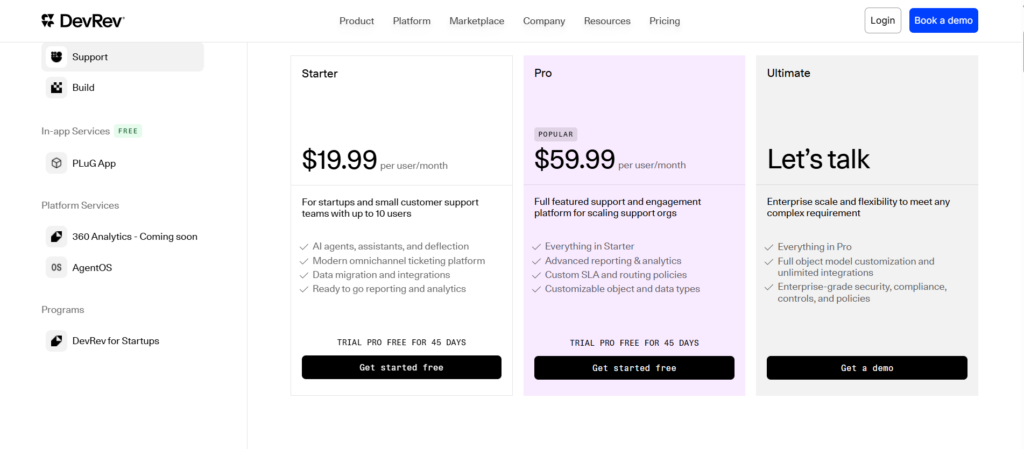
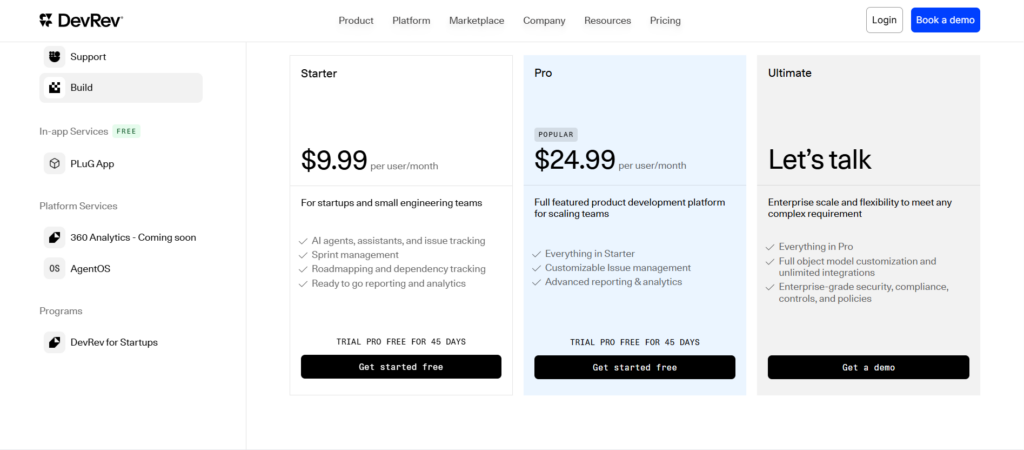
In addition, DevRev can charge for add-on services: in-app AI agents (such as a dedicated “AI Answer Bot”) and analytics connectors may be extra-line items or metered via pay-as-you-go. The pricing philosophy explicitly supports a combined consumption/subscription model, allowing customers to pay only for what they use (e.g. advanced AI processing) on top of a base seat license.
Beyond the platform itself, DevRev may also earn services revenue (professional setup, custom integration, premium support) for enterprise customers. While DevRev has not publicly detailed all revenue lines, the emphasis is clearly on recurring SaaS fees, augmented by usage-based fees for its AI capabilities and potentially revenue-sharing from its future marketplace of extensions.
Funding of DevRev
DevRev’s funding history reflects aggressive growth investment. The seed phase (2021–2023) was extraordinary: an initial $50M seed round closed in July 2021, followed by a $20M tokenized SAFE in Oct 2022. These together brought seed funding to roughly $70M, with DevRev later confirming over $85M raised in total seed capital – making it one of Silicon Valley’s largest ever seed financings.
Key investors were venture firms Khosla Ventures, Mayfield Fund, and Lightspeed Venture Partners, joined by individual tech executives (for example, investor Ravi Mhatre of Lightspeed and ThoughtSpot’s Ajeet Singh) and Pandey’s own family office (Param Hansa Values).
The funds were used to hire engineering, design and operations staff globally, and to develop the initial DevCRM platform. Co-founder Pandey noted that the seed dollars were “stretched” through automation, cloud observability and a disciplined “DevRev-on-DevRev” approachdevrev.ai, reflecting a focus on lean, product-driven growth.
After operating on seed capital for a few years, DevRev achieved unicorn status in mid-2024. On August 8, 2024, DevRev announced a $100.8 million Series A round at a $1.15 billion valuation. The Series A was led by the same core investors (Khosla, Mayfield) and included Param Hansa.
The press release highlighted that DevRev would use this funding to scale its enterprise offerings and expand the AI capabilities of its AgentOS platform. Although detailed “use of funds” breakdowns are not public, investor statements suggest DevRev is investing heavily in AI-driven product innovation and global sales expansion. (As one backer put it, DevRev is “creating a high-speed highway between the customer and the developer”, and the new funding will accelerate that vision.)
Funding Rounds of DevRev
| Date | Round | Amount | Lead Investors |
|---|---|---|---|
| Jul 2021 | Seed (Series Seed) | $50M | Khosla Ventures, Mayfield Fund, Lightspeedtechcrunch.comaxios.com |
| Oct 2022 | Seed Extension (SAFE) | $20M | Tokenized SAFE offering (digital SAFE)axios.com |
| Aug 2024 | Series A | $100.8M | Khosla Ventures, Mayfield Fund, Param Hansa Valuesdevrev.ai |
Competitors of DevRev
DevRev operates at the intersection of several software markets, so its competition comes from multiple angles. In the customer support/CRM space, DevRev competes with established platforms like Zendesk, Freshdesk, Salesforce Service Cloud, Microsoft Dynamics 365 and Intercom.
In fact, DevRev positions itself as an alternative that can “co-exist or replace” tools such as Zendesk or Salesforce Service Cloud. In the product development and engineering category, DevRev overlaps with tools like Atlassian Jira, GitHub/GitLab issue trackers, Linear and Asana. (DevRev’s value-add here is that it blends ticketing with customer insights in a way those tools normally don’t.)
Broader CRM suites (e.g. Salesforce Sales Cloud, HubSpot CRM, Zoho CRM, Microsoft Dynamics) are also adjacent competitors — especially for companies that use the same system for support and sales.
Finally, newer product-analytics/PLG tools such as Pendo, Gainsight, Amplitude or Mixpanel vie for software companies’ budgets by focusing on user engagement and growth metrics. All these competitors have strengths (mature feature sets, large ecosystems), but DevRev’s pitch is that none natively merge the “dev” side with the “customer” side as fully as DevRev does.
| Segment / Category | Example Competitors |
|---|---|
| Customer Support & Service CRM | Zendesk Suite, Salesforce Service Cloud, Freshdesk, Microsoft Dynamics 365, Intercom |
| Dev & Product Management Tools | Atlassian Jira, GitHub/GitLab, Asana, Linear, Trello |
| Sales/General CRM | Salesforce Sales Cloud, HubSpot CRM, Zoho CRM, Microsoft Dynamics 365 |
| Product & Growth Analytics | Pendo, Gainsight, Amplitude, Mixpanel, HubSpot Service Hub |
Competitive Advantage of DevRev
DevRev’s main competitive advantage is its developer-centric, unified approach. Unlike traditional CRMs that serve sales or support, DevRev was built for engineering teams as well. By putting developers on the same system as customers, DevRev enables a level of collaboration and insight not possible with siloed tools. As one early customer put it, consolidating support, development and product into “one comprehensive system” has significantly improved their ability to deliver quality customer experiences.
DevRev breaks with legacy CRM conventions in several ways:
Unified Data & Workflows
DevRev treats customer tickets and engineering issues as two sides of the same coin. This “convergence” means support and dev see identical information in real-time, so nothing falls through the cracks. Companies can, for example, auto-triage a support ticket directly into a bug in the same workspace. Traditional systems require manual handoffs; DevRev automates and integrates them.
AI and Knowledge Graph
DevRev uses an enterprise-scale knowledge graph and AI agents behind the scenes. This enables features like intelligent ticket routing, auto-generated summaries, and insight recommendations. For example, if many users report similar bugs, DevRev’s AI can cluster those reports and even suggest related code commits to fix. This model-driven AI approach (using vector embeddings and custom classification) goes far beyond rule-based bots or pure-ticket systems that older platforms use. In short, DevRev is not just a hub for work items; it is an AI-powered platform that reduces manual effort and surfaces hidden connections.
Product-centric Philosophy
Because DevRev was founded by software engineers, its design emphasizes minimal bureaucracy and maximum developer autonomy. Every engineer in a DevRev-using company effectively has access to the CRM, embedding a “product thinking” culture across the entire organization. Investor and board advisors have noted that DevRev’s design-first, developer-first vision is novel in the CRM space and could define a new category.
PLG and Ecosystem
DevRev’s marketplace and API model foster network effects. Organizations can rapidly extend the platform through 3rd-party “snap-ins” (e.g. a Slack connector or a custom ML workflow). This open ecosystem approach sets DevRev apart from monolithic CRM vendors. The fact that DevRev itself is using its own platform in development (“eating its own dogfood”) also accelerates feature velocity. All these factors give DevRev a competitive edge: it acts as both a productivity tool and a foundational platform for product-led companies, rather than just an incremental CRM add-on.
Furthermore, DevRev’s backers highlight the strength of its team and vision. Vinod Khosla (Khosla Ventures) and Navin Chaddha (Mayfield) have praised DevRev as a “cognition-as-a-service” era company that could transform how software companies operate. With its founders’ track record (having built Nutanix from scratch) and an emphasis on NPS (customer satisfaction) as a core metric, DevRev markets itself on technical excellence and culture, which it argues competitors lack. In summary, DevRev claims that by merging the developer’s view with the customer’s voice — powered by generative AI — it can solve the “fragmentation” problem that all its competitors still have.
Conclusion and Future Outlook
DevRev has rapidly established itself as a pioneering Developer CRM player.
In just a few years, it has attracted a thousand-plus customers (from Silicon Valley startups to large enterprises) and secured well over $150M in funding to date. Its vision of infusing customer-centricity into the DNA of engineering teams has won it both venture funding (achieving unicorn status) and high-profile partnerships.
Looking ahead, DevRev plans to continue expanding its product suite — for instance, building out the “Growth”/marketing modules hinted at in its OneCRM vision, and enhancing its generative AI agents through its annual conference (Effortless NYC) and user community.
The market trends favor DevRev’s approach: as more software businesses adopt product-led growth, the need for a development-centric CRM is likely to grow. If DevRev can keep executing on its platform roadmap (further AI-driven automation, global scalability, industry-specific solutions) and capitalize on its strong investor support, it is well-positioned to reshape the CRM market over the next decade. In the words of its founders and investors, DevRev is essentially creating a “high-speed highway” between customers and developers — a bet that the future of enterprise software will be defined by empathy, data, and close-knit collaboration across all teams.
If successful, DevRev may become the platform that turns today’s fragmented support and dev stacks into unified, customer-obsessed growth engines.
Also Read: Contentstack – Founders, Business Model, Funding & Competitors
To read more content like this, subscribe to our newsletter