Last Updated on July 29, 2026 by Team TBH
Quick answer: On raw sales, BYD is winning. It outsold Tesla in full-year 2025 electric-vehicle deliveries and again in Q2 2026, and it now generates more revenue. But Tesla still commands a far bigger market valuation, stronger margins in some periods, and a growing lead in autonomy and robotics. It depends on how you define winning: units sold, profit, or the technology bet on the future.
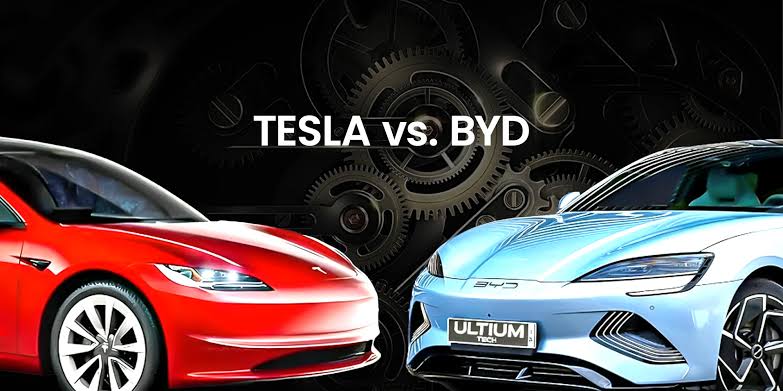
For a decade, “electric car” essentially meant Tesla. That’s no longer true. BYD, the Chinese conglomerate that started as a battery maker, has turned the EV race into a genuine two-horse contest — and by several measures, it has already pulled ahead. Here’s how the two actually compare in 2026.
Sales: BYD Took the Crown in 2025, and the Lead Keeps Swinging
BYD sold 2.26 million battery-electric vehicles in 2025, up nearly 28% year over year, overtaking Tesla’s 1.64 million (down 8.6%) to become the world’s top BEV seller for the first time. Including plug-in hybrids, BYD’s total new-energy-vehicle sales hit 4.6 million for the year.
The lead has since gone back and forth. Tesla briefly retook the global top spot in Q1 2026 with 358,023 deliveries against BYD’s roughly 310,000. BYD reclaimed it in Q2 2026, delivering 557,090 BEVs to Tesla’s 480,126. In Europe specifically, the two were dead even in the first half of 2026, each holding about 2.4% market share, with BYD edging ahead on total registrations.
Revenue and Profit: A Split Decision
BYD’s scale advantage now shows up on the income statement too. Full-year 2025 revenue hit $116 billion, up 3.5%, overtaking Tesla’s $94.8 billion, which declined 2.9%. It’s the first time BYD has out-earned Tesla.
Profitability tells a different story. China’s brutal EV price war has hammered margins across the board. BYD’s net profit fell 19% to $4.7 billion, with margins slipping to 4.1% from 5.2%, and Q4 profit alone dropped 38%. Tesla has faced its own margin pressure from price cuts and softer demand in Europe and China, but has leaned on software, energy storage, and cost discipline to stay profitable. Neither company is winning the margin fight outright right now.
Valuation: Investors Still Bet Big on Tesla
Despite trailing on units and revenue, Tesla’s market capitalization remains several times larger than BYD’s. Investors are pricing Tesla less like a car company and more like an AI and robotics platform — a bet tied directly to what comes next.
The Next Battleground: Autonomy and Robotics vs. Global Manufacturing Scale
Tesla’s 2026 strategy is a pivot: less about selling more cars, more about Full Self-Driving, a robotaxi service now live in seven cities (though meaningful revenue isn’t expected before 2027), and the Optimus humanoid robot, which is targeting production of over 10,000 units this year backed by roughly $25 billion in AI and robotics capital spending.
BYD’s counter-bet is old-fashioned scale and vertical integration: it makes its own batteries, chips, and semiconductors, which lets it undercut rivals on price. It’s now aggressively exporting that formula, planning to open 1,000 new stores across Europe by the end of 2026, triple its store count in Germany (Tesla’s own backyard), and ramp new factories in Hungary and Turkey, targeting 10–15% of the European market.
Tesla vs BYD at a Glance
| Metric | Tesla | BYD |
| 2025 BEV deliveries | 1.64 million (down 8.6%) | 2.26 million (up 27.9%) |
| 2025 revenue | $94.8 billion (down 2.9%) | $116 billion (up 3.5%) |
| 2025 net profit trend | Margin-pressured, profitable | Down 19% to $4.7 billion |
| Global BEV market share | ~7.8–8% | ~18–19% |
| Core strength | Software, autonomy, brand, valuation | Manufacturing scale, battery tech, price |
| 2026 strategic focus | Robotaxi, Optimus, AI | European & emerging-market expansion |
So, Who’s Actually Winning?
By volume and revenue, BYD is winning the EV race in 2026. By valuation and technology ambition, Tesla still leads. The honest answer is that they’re no longer fighting the same fight: BYD is racing to be the world’s default car company, while Tesla is racing to become something bigger than a carmaker altogether. Which one matters more probably depends on whether you’re a driver, a shareholder, or a rival automaker watching both very closely.
Frequently Asked Questions
Q. Who sold more EVs in 2025, Tesla or BYD?
A. BYD did. It delivered 2.26 million battery-electric vehicles in 2025, versus Tesla’s 1.64 million, becoming the world’s top BEV seller for the first time.
Q. Is BYD more profitable than Tesla?
A. Not necessarily. BYD’s revenue overtook Tesla’s in 2025, but its net profit fell 19% amid a fierce Chinese price war, while Tesla has managed to stay profitable despite its own margin pressure.
Q. Why is Tesla’s market cap so much higher than BYD’s if BYD sells more cars?
A. Investors value Tesla largely on its bets in autonomous driving (Full Self-Driving and robotaxis) and robotics (Optimus), not just car sales, which supports a valuation several times BYD’s.
Q. Is BYD bigger than Tesla now?
A. By revenue and vehicle deliveries, yes, as of 2025. By market capitalization and brand recognition outside China, Tesla is still larger.
Q. Which company is winning in Europe?
A. It’s essentially a tie. Tesla and BYD each held about 2.4% of the European market in the first half of 2026, with BYD slightly ahead on total registrations as it rapidly expands its European store and factory footprint.
Also Read: Who Owns BYD? Ownership & Investor Overview
To read more content like this, subscribe to our newsletter