Last Updated on August 13, 2026 by Team TBH
Cells are the basic building blocks of the human body. They form tissues and organs. They perform various essential functions, including:
- Produce proteins
- Generate energy
- Grow, divide, and respond to signals
The human body has trillions of cells, and not all cells are the same, although their structure is almost similar. Different types of cells perform different functions.
For instance:
| Cell type | Main role |
| Red blood cells | Carry oxygen |
| Nerve cells | Transmit signals |
| Muscle cells | Produce movement |
| Immune cells | Defend the body |
Normally, cells grow, divide, and die in a controlled manner. However, genetic and molecular changes can disrupt these processes. As a result, cells start to grow and divide uncontrollably. This leads to tumor formation and cancer development.
Cancer can cause changes in the levels or activity of various molecules in cells, tissues, and biological samples. These molecules can include proteins, cytokines, hormones, and other signaling molecules. These molecules act as biomarkers that researchers measure to study cancer development, progression, biological pathways, and responses to treatment. Here is where ELISA kits come into play.
What are ELISA Kits?
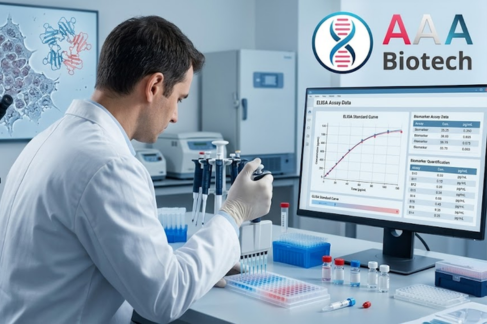
ELISA stands for enzyme-linked immunosorbent assay. It is a plate-based technique used to detect and quantify specific analytes present in biological samples. It relies on antigen-antibody interactions. It is known for:
- High specificity
- High sensitivity
- Rapid and reproducible results
- Affordability
- Compatibility and versatility
However, the overall results depend on the quality of the kit. So, it is vital to buy kits from a reliable supplier, such as AAA Biotech.
AAA Biotech provides a range of ELISA kits designed to detect and quantify different biological targets in research samples. Researchers can measure proteins, cytokines, hormones, growth factors, and other analytes associated with different biological processes involved in cancer development.
Why Biomarker Detection Matters in Cancer Research
Cancer involves complex changes at the cellular and molecular levels. Researchers study these changes to better understand how cancer develops and progresses.
For example, cancer-related research may investigate molecules involved in:
- Cell growth
- Cell division
- Inflammation
- Immune responses
- Blood vessel formation
- Cell signaling
- Tumor progression
- Treatment responses
Researchers measure changes in biomarker levels under different experimental conditions. The results can then be compared with other experimental findings to better understand cancer-related processes.
How AAA Biotech ELISA Kits Support Cancer Research?
Compare Biomarker Levels Between Samples
When it comes to cancer research, researchers need to investigate biomarkers associated with tumor development. They collect samples from different experimental groups and measure the protein concentrations using ELISA kits.
After this, they can compare:
- Cancer and control samples
- Treated and untreated samples
- Different cancer models
- Different experimental conditions
- Samples collected at different time points
These comparisons can help researchers identify whether biomarker levels change under specific conditions. However, they can’t solely rely on ELISA results. They should interpret other experimental data as well before reaching the final conclusions about cancer biology.
Support Studies of Cancer-Related Pathways
Biological pathways play a vital role in cancer research. They help control cell behavior. Proteins and other signaling molecules can influence processes such as cell growth, immune responses, inflammation, and communication between cells. Changes in these molecules may provide clues about what is happening within a tumor or its surrounding environment.
So, researchers use ELISA-based measurements to study these changes in combination with techniques such as Western blotting, PCR, immunohistochemistry, flow cytometry, and microscopy. This provides them with a broader understanding of cancer-related molecular processes.
Support Cancer Treatment Research
ELISA kits can also be useful in preclinical cancer research. Researchers investigating potential treatments may monitor changes in specific biomarkers after exposure to an experimental drug or other intervention.
For example, they may measure whether treatment is associated with changes in:
- Inflammatory molecules
- Growth factors
- Immune-related proteins
- Tumor-associated proteins
- Cell signaling molecules
Changes in biomarker levels can provide additional information about biological responses to an experimental treatment.
Such findings can be evaluated alongside other measurements, including tumor growth, cell viability, gene expression, and tissue-level changes.
How to Choose the Right ELISA Kit for Cancer Research?
Selecting an appropriate ELISA kit is an important step in obtaining meaningful research results.
At AAA Biotech, researchers can find a broad range of ELISA kits designed to support the detection and quantification of different biological targets. The available assays cover various targets, species, and sample types, giving researchers options based on their specific research requirements.
In addition to finding a trusted supplier, researchers should consider several factors before choosing an assay, including:
- Target analyte: Make sure the kit can detect the specific biomarker or molecule you want to study.
- Species compatibility: Check whether the kit is suitable for the species used in your research.
- Sample type: Confirm that the kit works with your sample, such as serum, plasma, or tissue.
- Detection range: Choose a kit with a detection range suitable for the expected biomarker levels.
- Sensitivity: Check whether the kit can detect the target at the concentration present in your samples.
- Specificity: Make sure the assay can specifically detect the target without significant interference from other molecules.
- Assay format: Consider whether the assay format fits your laboratory setup and research workflow.
- Research application: Select a kit that matches your specific cancer research objective.
The Bottom Line
Now that you know how ELISA kits help in cancer research and why AAA Biotech is a preferred choice of researchers for ELISA kits, what are you waiting for? Explore a range of products and place your order now!
To read more content like this, explore The Brand Hopper
Subscribe to our newsletter