Last Updated on September 24, 2026 by Team TBH
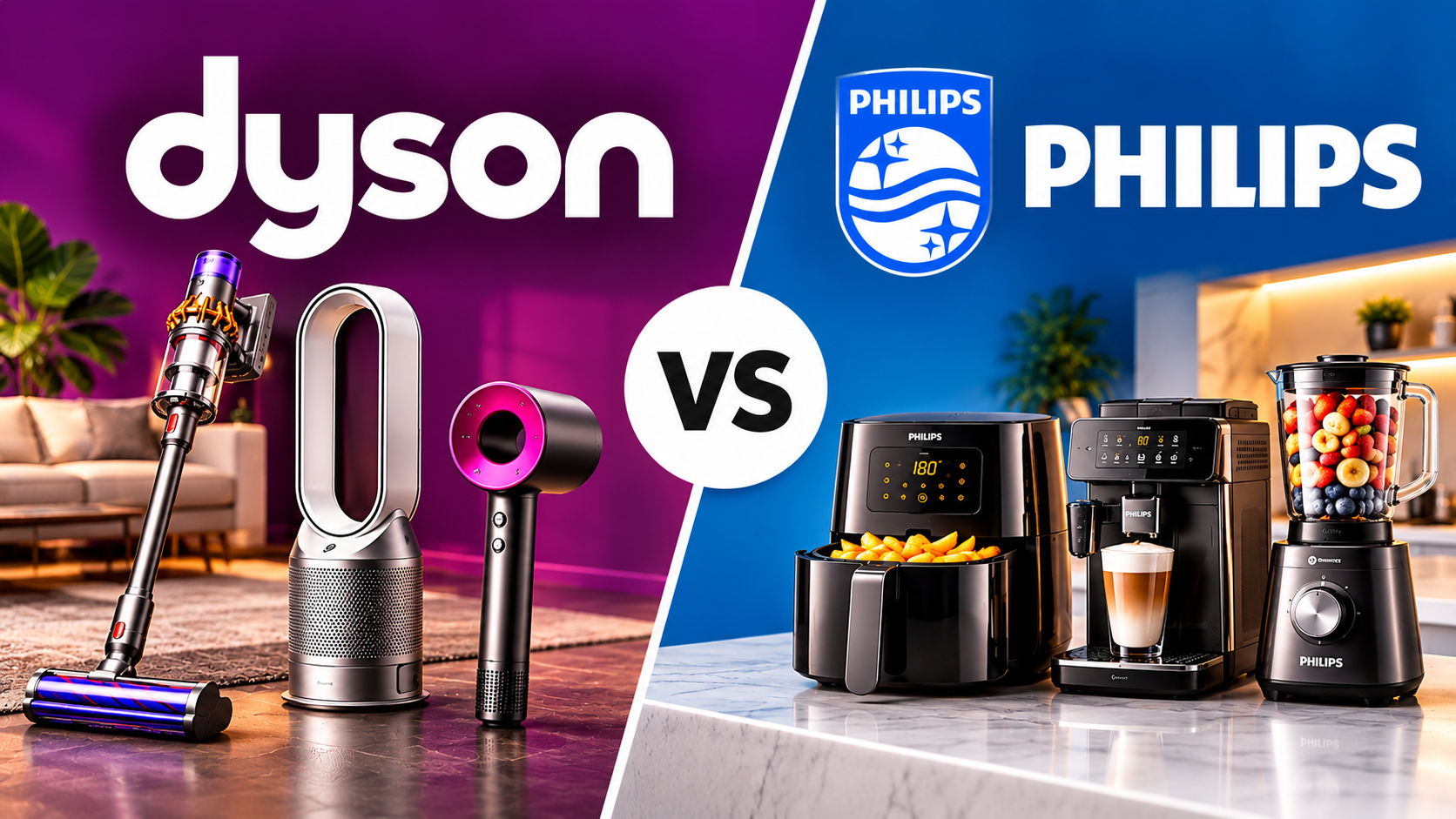
For decades, “Dyson vs Philips” was a natural comparison — two engineering-driven brands slugging it out over vacuums, hair dryers, and small home appliances on the same store shelves.
But that comparison has become considerably more complicated in recent years, because one of the two companies quietly exited the appliance business almost entirely.
Understanding “which brand makes better appliances” today requires understanding not just product quality, but who actually makes what under each name.
Here’s the complete, financially grounded breakdown of how Dyson and Philips actually compare — their histories, ownership structures, product philosophies, and latest financial performance.
How Dyson Began: One Inventor’s 5,000+ Prototypes
Dyson’s origin story is inseparable from its founder.
British inventor Sir James Dyson grew frustrated with the declining suction performance of conventional bag vacuum cleaners and spent years developing a bagless alternative using cyclonic separation technology, famously building more than 5,000 prototypes before landing on a design that worked.
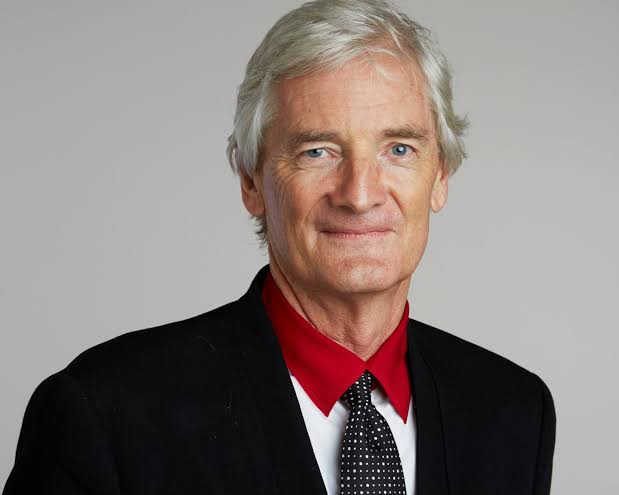
After being turned down by major manufacturers unwilling to cannibalize their own bag sales, Dyson founded his own company in 1991 and launched the first Dyson vacuum, the DC01, in 1993 — a product that quickly became the best-selling vacuum cleaner in the UK despite carrying a premium price tag well above competitors.
That founding philosophy — solve a real engineering problem that incumbents are unwilling to fix, and charge a premium for genuinely superior performance — has defined Dyson’s expansion ever since, as the company grew from vacuums into hand dryers, fans, air purifiers, hair care tools (like the Supersonic hairdryer and Airwrap styler), and even a brief foray into electric vehicles that was ultimately shelved.
Dyson remains headquartered administratively in Singapore today, though its engineering and research heritage remains firmly rooted in the UK.
How Philips Began: A 19th-Century Dutch Electronics Pioneer
Philips traces its roots back far further than Dyson — all the way to May 15, 1891, when brothers Gerard and Anton Philips founded the company in Eindhoven, Netherlands, initially manufacturing carbon-filament lamps.
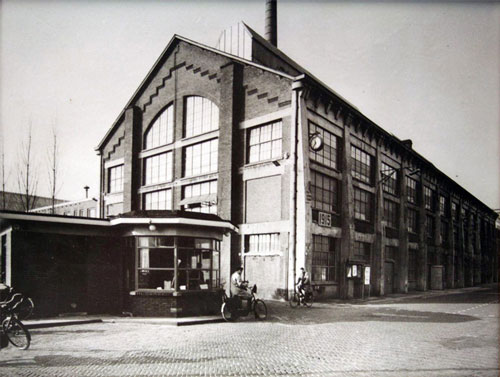
Over the following century, Philips grew into one of the largest and most diversified electronics conglomerates in the world, at various points manufacturing everything from light bulbs and televisions to razors, kitchen appliances, semiconductors, and medical imaging equipment.
That sprawling diversification became both Philips’s greatest strength and, eventually, a strategic liability, as the company found itself competing across dozens of unrelated categories against increasingly specialized rivals.
Starting in the 2010s, Philips began a deliberate, multi-year strategic transformation to shed non-core businesses and refocus entirely on health technology — spinning off its lighting division as Signify in 2016, and then selling its Domestic Appliances business (encompassing kitchen appliances, coffee machines, garment care, and home care products) to private equity firm Hillhouse Capital in 2021, a deal that included a 15-year brand license allowing the buyer to continue selling products under the Philips name.
Who Actually Makes “Philips” Appliances Today? Meet Versuni
This is the detail that trips up most people comparing Dyson and Philips today.
The company that resulted from Philips’s 2021 Domestic Appliances sale to Hillhouse Capital is now operated as Versuni, a private, investment-backed company that continues to design, manufacture, and market products under the Philips brand name (alongside other licensed brands) through its 15-year licensing agreement.
That means the Philips-branded air fryers, coffee machines, garment steamers, and other small kitchen and home appliances still sold in stores today are no longer made by Royal Philips itself — they’re made by Versuni, a separate company that simply pays to use the Philips name.
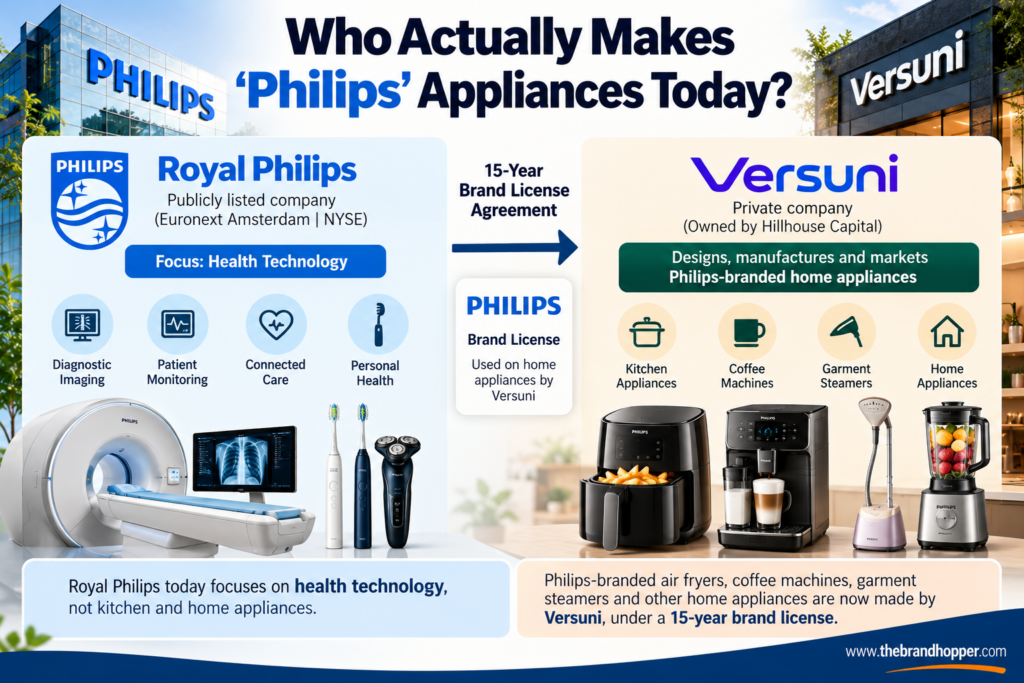
Royal Philips, the publicly listed parent company that still trades on Euronext Amsterdam and the NYSE, has redirected its full strategic focus toward health technology: diagnostic imaging, patient monitoring, connected care, and personal health devices like electric toothbrushes and shavers (which Philips retained rather than including in the Domestic Appliances sale), rather than the kitchen and home appliances most consumers associate with the brand.
Product Philosophy: Dyson’s Premium Engineering vs. Philips’s Broad Accessibility
Where the two brands still meaningfully compete — even if indirectly through Versuni’s licensed products — is in overall design and engineering philosophy.
Dyson has built its entire identity around premium pricing backed by genuinely differentiated engineering: proprietary digital motor technology, cyclone separation systems, and, more recently, its Hyperdymium motors and HushJet air projection technology, all aimed at justifying prices that routinely run two to three times higher than mainstream competitors.
Dyson’s most recent product cycle has leaned heavily into wet-and-dry cleaning technology (including the upgraded Submarine 2.0 roller head and the W1 PencilWash), expanded air purifier ranges with longer-range HushJet air projection, and new hair styling tools like the Airsmooth hot air brush, all continuing the company’s pattern of iterative, engineering-led product refreshes rather than broad category expansion.
Philips-branded products under Versuni, by contrast, continue to prioritize mainstream accessibility and value across a much broader price range, spanning everything from budget-friendly air fryers to mid-range coffee machines, reflecting a fundamentally different strategy: broad market coverage and volume rather than Dyson’s narrower, premium-only positioning.
Ownership: A Family Business vs. a Public Health-Tech Company
The two companies’ ownership structures could hardly be more different, and that difference shapes everything about how each operates.
Dyson remains 100% privately owned by James Dyson and his family, with no external investors, no venture capital, and no public shareholders — the company has financed its growth entirely from its own profits since founding, giving James Dyson (still Chairman) complete control over long-term strategic decisions, including controversial bets like the abandoned electric vehicle project, without needing to satisfy outside shareholders.
Royal Philips, by contrast, is a publicly traded company listed on Euronext Amsterdam and the New York Stock Exchange, answerable to a broad shareholder base and subject to the kind of quarterly earnings scrutiny that a private company like Dyson simply doesn’t face.
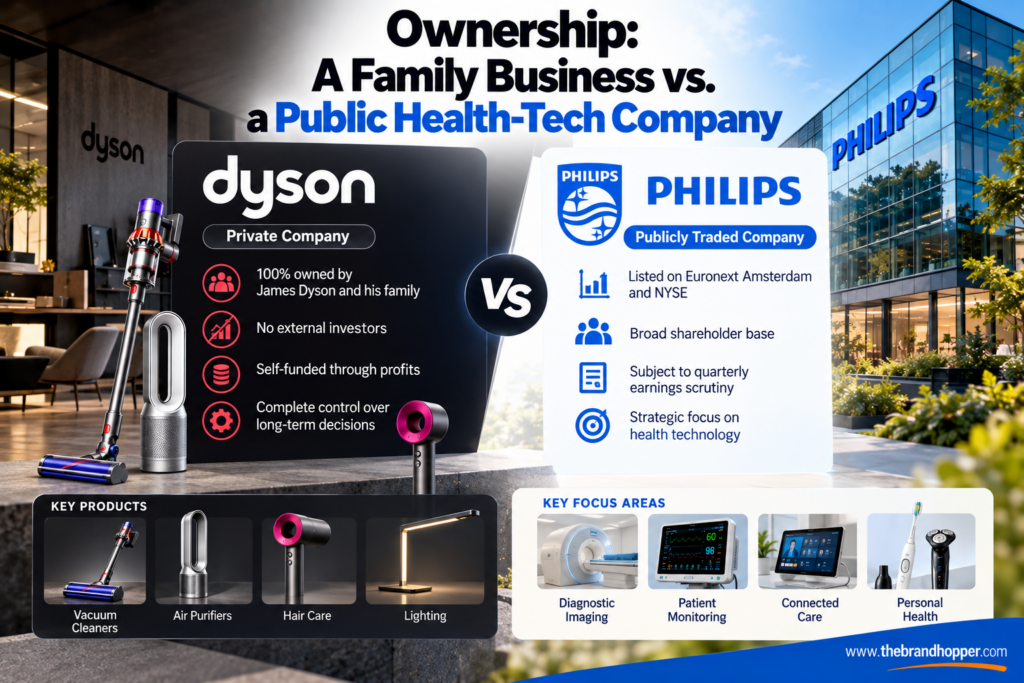
This distinction explains part of why Philips was willing to divest its appliances business entirely — as a public company under investor pressure to improve margins and focus, shedding a lower-margin appliances division to concentrate on higher-margin health technology made strategic sense in a way it likely wouldn’t for a privately controlled company like Dyson.
Financial Performance: Comparing Very Different Businesses
Because Dyson and Philips no longer compete in the same core category, comparing their financials directly requires some context.
Dyson reported revenue of £6.13 billion, down from £6.57 billion the prior year, alongside EBITDA of £1.11 billion and operating profit of £600 million — a business that, while privately held and not required to disclose full financial detail, remains solidly profitable despite a modest revenue decline attributed to softer demand in some categories and markets.
Royal Philips, now operating almost entirely as a health technology company rather than an appliance maker, reported sales of €17.8 billion, down 1% on a nominal basis but up 2% on a comparable basis, with net income of €897 million — a dramatic turnaround from the prior year’s €698 million loss, reflecting the benefits of Philips’s continued portfolio simplification and cost discipline under CEO Roy Jakobs.
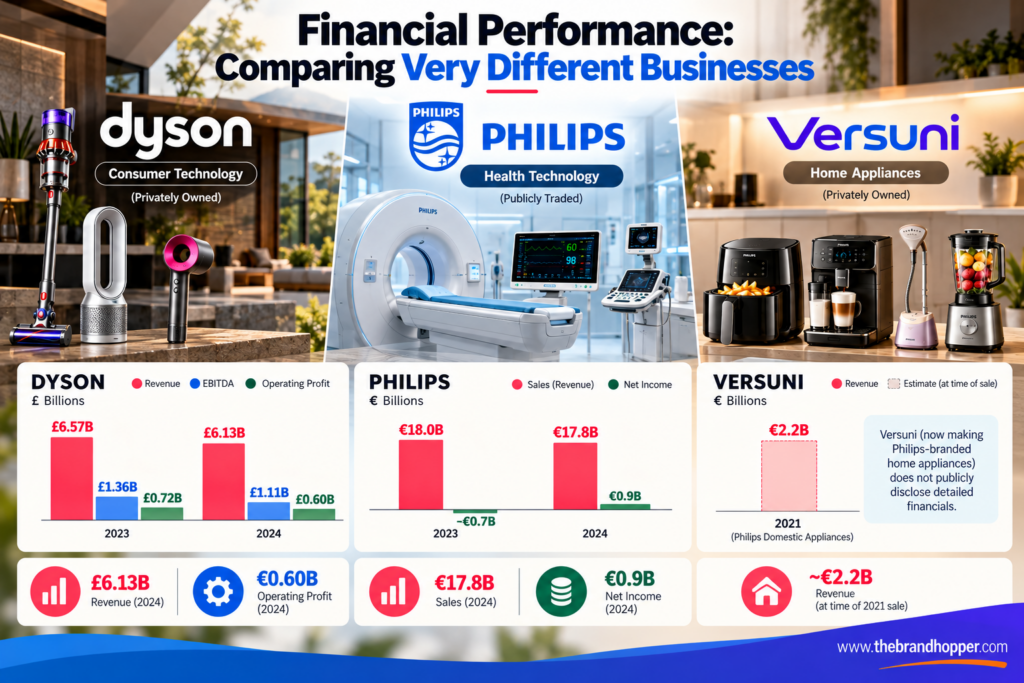
Versuni, the private, Hillhouse-backed company now making Philips-branded appliances, does not publicly disclose detailed financials, though the Domestic Appliances business it acquired was generating approximately €2.2 billion in annual sales at the time of the 2021 sale.
Research and Development: Two Very Different Investment Philosophies
The gap between Dyson and Philips becomes especially visible when looking at how each allocates resources toward innovation.
As a private company insulated from quarterly earnings pressure, Dyson has consistently poured a large share of its profits back into its James Dyson Foundation research campus and product engineering teams, supporting an operating model where a large proportion of employees globally work directly in engineering and research roles rather than sales or marketing — a ratio unusually high for a consumer products company of its size. P
hilips, as a public health technology company, allocates its R&D budget almost entirely toward medical devices and diagnostic technology today, including AI-enabled imaging systems, patient monitoring platforms, and connected care software, reflecting its complete pivot away from consumer appliance innovation.
Versuni, operating the licensed Philips appliance business, invests in more incremental improvements to kitchen and home appliances (such as healthier air-frying technology and smarter coffee machines) rather than the kind of ground-up mechanical reinvention that defines Dyson’s approach, since its private equity ownership structure tends to prioritize steady margin improvement over speculative long-term engineering bets.
So, Which Brand Actually Makes Better Appliances?
The honest, most useful answer is that Dyson and Philips are no longer really competing in the same race.
If you’re comparing premium vacuum cleaners, air purifiers, or hair styling tools specifically, Dyson is the more relevant, innovation-focused option today, backed by continuous engineering investment and a private ownership structure that lets it prioritize long-term product development over quarterly margins.
If you’re comparing budget-to-mid-range kitchen appliances, coffee machines, or garment care products, you’re technically evaluating Versuni’s execution of the Philips brand license rather than anything made by Royal Philips itself — a distinction worth knowing even if the products still carry the familiar Philips name and shield logo on the shelf.
For consumers, the practical takeaway is straightforward: Dyson products reflect one company’s singular, expensive engineering philosophy end to end, while “Philips” appliance products today reflect a licensed brand being executed by an entirely different, more broadly positioned company.
Dyson vs. Philips at a Glance
| Category | Dyson | Philips |
| Founded | 1991 (UK); first product 1993 | 1891 (Eindhoven, Netherlands) |
| Founder(s) | Sir James Dyson | Gerard and Anton Philips |
| Ownership | 100% private, Dyson family-owned | Publicly traded (Euronext Amsterdam, NYSE) |
| Core focus today | Vacuums, air purifiers, hair care tools | Health technology, diagnostic imaging |
| Who makes appliances now | Dyson itself, directly | Versuni, under a 15-year brand license |
| Appliance sale event | N/A | Domestic Appliances sold to Hillhouse Capital, 2021 |
| Positioning | Premium, 2-3x mainstream pricing | Broad, accessible pricing (via Versuni) |
| Recent revenue | £6.13 billion (down from £6.57B) | €17.8 billion (net income €897 million) |
| Operating profit / margin trend | £600 million operating profit | Return to profit from prior €698M loss |
| CEO / Chairman | James Dyson (Chairman) | Roy Jakobs (CEO) |
| Headquarters | Singapore (administrative) | Amsterdam, Netherlands |
Key Takeaways
Dyson and Philips represent two fundamentally different approaches to the appliance business today: Dyson remains a privately held, family-owned company built entirely around premium engineering, generating revenue of £6.13 billion with James Dyson and his family retaining full ownership and control.
Philips, meanwhile, exited the appliance category almost entirely in 2021, selling its Domestic Appliances business to Hillhouse Capital (now operating as Versuni under a 15-year Philips brand license) to refocus as a publicly traded health technology company, reporting sales of €17.8 billion and a return to profitability with net income of €897 million.
For genuinely comparable, head-to-head appliance shopping, Dyson remains the premium, innovation-first choice, while Philips-branded appliances today reflect Versuni’s broader, more accessible execution of a licensed name rather than Royal Philips’s own engineering.
Frequently Asked Questions
Q: Does Philips still make appliances?
A: Not directly. Philips sold its Domestic Appliances business to Hillhouse Capital in 2021. The resulting company, now called Versuni, continues to manufacture and sell products under the Philips brand through a 15-year license agreement, but Royal Philips itself now focuses on health technology.
Q: Who owns Dyson?
A: Dyson is 100% privately owned by founder Sir James Dyson and his family, with no external investors or public shareholders. James Dyson remains the company’s Chairman.
Q: Which brand is more premium, Dyson or Philips appliances?
A: Dyson is positioned as the more premium brand, with prices typically two to three times higher than mainstream competitors, justified by proprietary engineering like cyclone separation and Hyperdymium motor technology. Philips-branded appliances (made by Versuni) span a much broader, more accessible price range.
Q: How much revenue does Dyson generate?
A: Dyson reported revenue of £6.13 billion, down from £6.57 billion the prior year, alongside EBITDA of £1.11 billion and operating profit of £600 million.
Q: How much revenue does Philips generate?
A: Royal Philips reported sales of €17.8 billion with net income of €897 million, reflecting the company’s transformation into a health technology-focused business following its 2021 exit from the appliances category.
Q: What is Versuni?
A: Versuni is the private, Hillhouse Capital-backed company formed after Philips sold its Domestic Appliances business in 2021. Versuni continues to sell kitchen, coffee, garment care, and home care products under the Philips brand through a 15-year licensing agreement.
Q: Who founded Dyson and Philips?
A: Dyson was founded by Sir James Dyson in 1991, launching its first product, the DC01 vacuum, in 1993. Philips was founded in 1891 by brothers Gerard and Anton Philips in Eindhoven, Netherlands.
Q: Is Dyson a public company?
A: No. Dyson remains entirely privately owned by the Dyson family, unlike Royal Philips, which is publicly traded on Euronext Amsterdam and the New York Stock Exchange.
Also Read: Dyson: Engineering Story, Strategy & Global Success
To read more content like this, subscribe to our newsletter