Last Updated on October 1, 2026 by Team TBH
H&M is one of the world’s most recognizable fashion retailers, with approximately 3,000 stores in 81 markets and a business model built around fashion, quality and accessible prices.
Behind the publicly traded company, the founding Persson family remains its controlling shareholder.
As of August 31, 2026, the Stefan Persson family and related companies held 68.27% of H&M’s total shares and 84.91% of its voting rights.
The family has continued buying H&M shares, keeping speculation about a possible future privatization alive, although no privatization plan has been announced.
Here’s the complete picture of who owns H&M today, how the Persson family built its position, and how the company’s latest financial results look.
How H&M Began: A Single Women’s Clothing Shop in Västerås
H&M’s origins trace back to 1947, when Swedish entrepreneur Erling Persson opened a women’s clothing store in Västerås, Sweden, called Hennes — Swedish for “hers.”
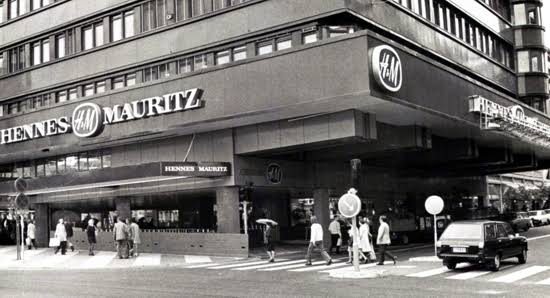
In 1968, Persson acquired the Stockholm-based hunting and fishing retailer Mauritz Widforss, including a stock of men’s clothing.
The company subsequently began selling men’s and children’s clothing and changed its name to Hennes & Mauritz.
H&M was listed on the Stockholm Stock Exchange in 1974, and its stores were subsequently rebranded using the abbreviation “H&M.”
The company then expanded internationally, first across Scandinavia and Europe and later into markets around the world.
Who Owns H&M Today? The Persson Family’s Controlling Stake
Despite being publicly traded since 1974, H&M remains firmly controlled by the founding family.
As of 31 August 2026, the Stefan Persson family and related companies held 1,091,560,567 shares, representing 68.27% of H&M’s total shares and 84.91% of its voting rights.
The family controls its position primarily through Ramsbury Invest and related holdings. Separately, the Lottie Tham family and related companies held 5.56% of the total shares and 2.66% of the voting rights.
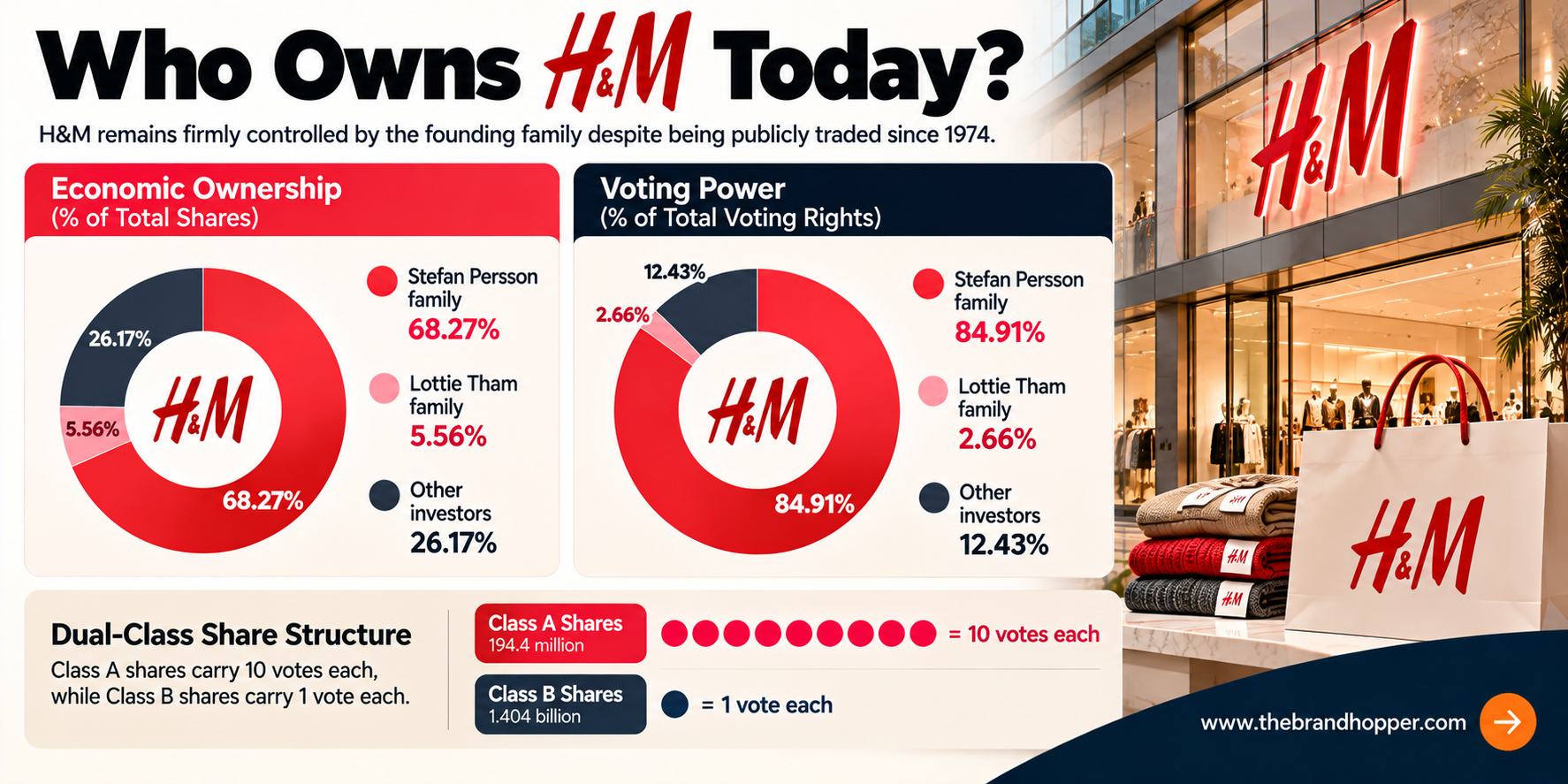
H&M has a dual-class share structure.
The company had 194.4 million Class A shares carrying ten votes each and 1.404 billion Class B shares carrying one vote each as of August 31, 2026. This structure gives holders of Class A shares substantially greater voting power than holders of Class B shares.
The Privatization Speculation: Why the Family Keeps Buying More Shares
The Persson family has continued increasing its ownership of H&M.
Bloomberg reported in 2025 that the family had invested more than SEK 63 billion (approximately $6.6 billion at the time) since 2016 to increase its stake, with the purchases fueling speculation about a possible future move to take H&M private.
The family has continued purchasing shares during 2026, with its ownership reaching 68.27% of the share capital by August 31.
However, the purchases do not establish that a privatization is planned.
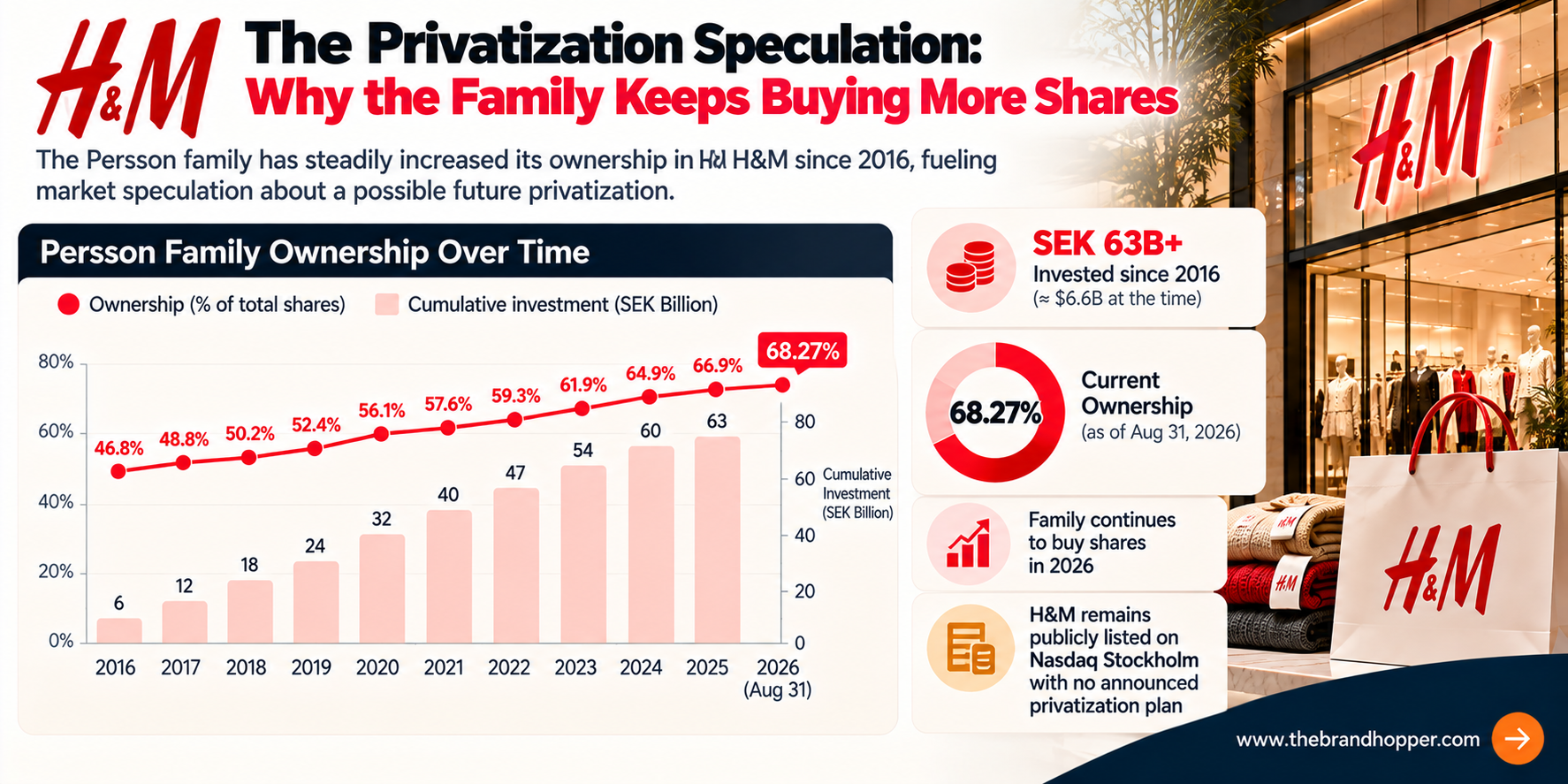
H&M remains publicly listed on Nasdaq Stockholm, and there has been no announced formal privatization process.
Karl-Johan Persson previously rejected speculation that the family planned to take H&M private, saying the family bought shares because it believed in the company.
Recent reporting continues to describe privatization as market speculation rather than an announced corporate plan.
Leadership: From Karl-Johan Persson to Daniel Ervér
H&M’s leadership combines continued family involvement at board level with professional day-to-day management.
Karl-Johan Persson, grandson of founder Erling Persson, served as H&M’s CEO from 2009 to 2020 before becoming Chairman of the Board in 2020. He continues to hold that position.

Daniel Ervér has been H&M Group’s CEO since January 31, 2024, succeeding Helena Helmersson.
Under Ervér, H&M has focused on strengthening its product offering, purchasing, cost control, inventory productivity, digital infrastructure and operational efficiency. H&M reported improved profitability in 2025 and again during the first nine months of 2026.
Also Read: Zara vs H&M: Which Fast Fashion Brand Really Wins? (2026)
H&M’s Financial Performance
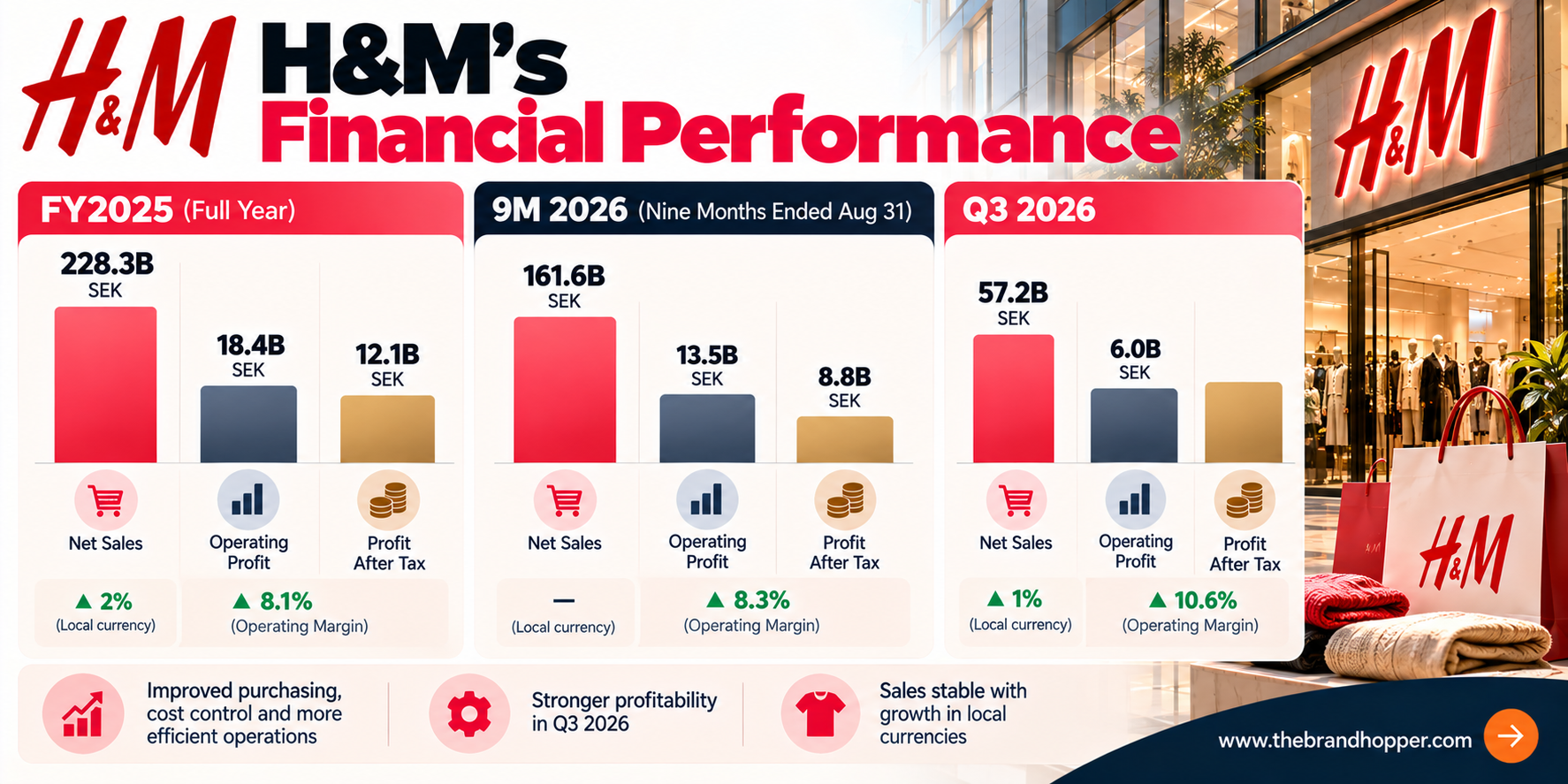
H&M’s latest reported period is now the nine months ended August 31, 2026, rather than FY2025.
During the first nine months of fiscal 2026, H&M generated SEK 161.624 billion in net sales. Sales were unchanged in local currencies compared with the corresponding period of the previous year.
Operating profit increased to SEK 13.462 billion, producing an operating margin of 8.3%, while profit after tax increased to SEK 8.765 billion.
The third quarter showed stronger momentum. Net sales increased to SEK 57.189 billion, with local-currency sales up 1%. Operating profit rose to SEK 6.037 billion, compared with SEK 4.914 billion in the prior-year quarter, while the operating margin increased to 10.6%.
H&M said improved purchasing, cost control and more efficient operations were key contributors to the profitability improvement.
For the most recently completed full fiscal year, FY2025, H&M reported SEK 228.285 billion in net sales, SEK 18.395 billion in operating profit and SEK 12.085 billion in profit after tax. Sales increased 2% in local currencies but declined 3% when reported in Swedish kronor because of currency effects.
The operating margin improved to 8.1% from 7.4% in FY2024.
H&M’s Market Value in 2026
As of the September 30, 2026 market close, H&M’s Class B shares closed at approximately SEK 159.80.
Based on approximately 1.599 billion shares outstanding, this implies a market capitalization of roughly SEK 255.5 billion, or approximately $25.5 billion at an exchange rate of around SEK 10.0 per U.S. dollar.
Market capitalization changes continuously with the share price.
H&M remains one of the world’s major publicly listed fashion retailers. Its competitive environment includes Inditex/Zara, Shein and other international fashion retailers, while the company continues to focus on improving its product offering, store portfolio, digital experience and operational efficiency.
Why H&M’s Ownership Structure Matters
H&M’s dual-class ownership structure gives the Persson family significant voting influence relative to its economic ownership. With 68.27% of the shares and 84.91% of the voting rights, the family remains the company’s dominant shareholder.
Karl-Johan Persson’s position as Chairman also maintains a direct family presence at board level, while day-to-day management remains with CEO Daniel Ervér and the professional executive team.
For investors, this structure means H&M’s strategic direction is influenced substantially by a long-term controlling shareholder. The family’s continued purchases have increased its ownership over time, although those purchases alone should not be interpreted as evidence that a privatization transaction will occur.
H&M Ownership at a Glance
| Category | Detail |
|---|---|
| Founded | 1947, Västerås, Sweden, as “Hennes” |
| Founder | Erling Persson |
| Renamed Hennes & Mauritz | 1968, after acquiring Mauritz Widforss |
| Went public | 1974, Stockholm Stock Exchange |
| Controlling family | Persson family, primarily through Ramsbury Invest and related holdings |
| Stefan Persson family economic ownership | 68.27% of total shares |
| Stefan Persson family voting power | 84.91% |
| Share class structure | Class A: 10 votes/share; Class B: 1 vote/share |
| Board Chairman | Karl-Johan Persson |
| CEO | Daniel Ervér, since January 31, 2024 |
| Stock listing | Nasdaq Stockholm (HM B) |
| Family share purchases since 2016 | More than SEK 63 billion / ~$6.6 billion, according to 2025 Bloomberg reporting; subsequent purchases continued in 2026 |
| FY2025 net sales | SEK 228.285 billion |
| FY2025 operating profit | SEK 18.395 billion (8.1% margin) |
| FY2025 profit after tax | SEK 12.085 billion |
| Nine-month FY2026 net sales | SEK 161.624 billion |
| Nine-month FY2026 operating profit | SEK 13.462 billion (8.3% margin) |
| Market capitalization, September 30, 2026 | ~SEK 255.5 billion (~$25.5 billion) |
Key Takeaways
H&M’s ownership story in 2026 remains dominated by the founding Persson family. As of August 31, the Stefan Persson family and related companies held 68.27% of H&M’s shares and 84.91% of its voting rights, giving them decisive influence over shareholder matters.
Karl-Johan Persson remains Chairman, while Daniel Ervér has served as CEO since January 2024.
Financially, H&M’s latest nine-month results show SEK 161.624 billion in sales, SEK 13.462 billion in operating profit and SEK 8.765 billion in profit after tax.
The company continues to report improving profitability, although sales in local currencies were broadly flat for the first nine months of FY2026.
Meanwhile, continued Persson family share purchases have kept speculation about a potential privatization alive, but H&M remains publicly listed and no formal privatization process has been announced.
Frequently Asked Questions
Q: Who owns H&M?
A: H&M is controlled by the Stefan Persson family and related companies, which held 68.27% of total shares and 84.91% of voting rights as of August 31, 2026. The family uses Ramsbury Invest and related holdings to hold much of its position.
Q: Who founded H&M?
A: Erling Persson founded H&M in 1947 when he opened the women’s clothing store Hennes in Västerås, Sweden. In 1968, he acquired Mauritz Widforss, after which the company began selling men’s and children’s clothing and became Hennes & Mauritz.
Q: Why does the Persson family have so much voting power at H&M?
A: H&M has a dual-class share structure. Class A shares carry 10 votes each, while Class B shares carry one vote each. The Persson family’s large holding of Class A shares gives it substantially greater voting power than its percentage of the company’s economic ownership.
Q: Is H&M going private?
A: H&M remains publicly listed on Nasdaq Stockholm. The Persson family’s continued share purchases have generated speculation about a possible future buyout, but the family has not announced a privatization plan and has previously denied having plans to take H&M private.
Q: Who is H&M’s CEO?
A: Daniel Ervér has served as CEO of H&M Group since January 31, 2024.
Q: What is Karl-Johan Persson’s role at H&M?
A: Karl-Johan Persson, grandson of founder Erling Persson, served as CEO from 2009 to 2020 and has been Chairman of H&M’s Board since 2020.
Q: What was H&M’s revenue in its most recent fiscal year?
A: For the most recently completed full fiscal year, FY2025, H&M reported SEK 228.285 billion in net sales, SEK 18.395 billion in operating profit and SEK 12.085 billion in profit after tax.
Q: What are H&M’s latest financial results?
A: For the nine months ended August 31, 2026, H&M reported SEK 161.624 billion in net sales, SEK 13.462 billion in operating profit and SEK 8.765 billion in profit after tax.
Q: When did H&M go public?
A: H&M was listed on the Stockholm Stock Exchange in 1974. The exchange is now part of Nasdaq Stockholm.
Also Read: H&M Marketing Strategy: 4Ps, Campaigns & Growth
To read more content like this, subscribe to our newsletter