Last Updated on October 14, 2026 by Team TBH
Google is one of the world’s most widely used technology companies, but its legal ownership structure is less familiar to many people. Google is owned by Alphabet Inc., a publicly traded American holding company listed on the Nasdaq under the tickers GOOGL and GOOG.
Alphabet’s shares are owned by millions of investors, including individual shareholders, mutual funds, pension funds and major institutional investors. However, the company’s dual-class voting structure gives co-founders Larry Page and Sergey Brin disproportionate influence over corporate decisions.
Alphabet’s ownership structure is particularly interesting because the founders retain majority voting control despite owning less than half of the company’s total economic value. Sundar Pichai leads Alphabet and Google as CEO, while the founders remain influential through their shares and board positions.
This article explains who owns Google, how Alphabet’s three share classes work, who its major shareholders are, and how its businesses and investments fit into the group.
Google vs. Alphabet: Who Owns Whom?
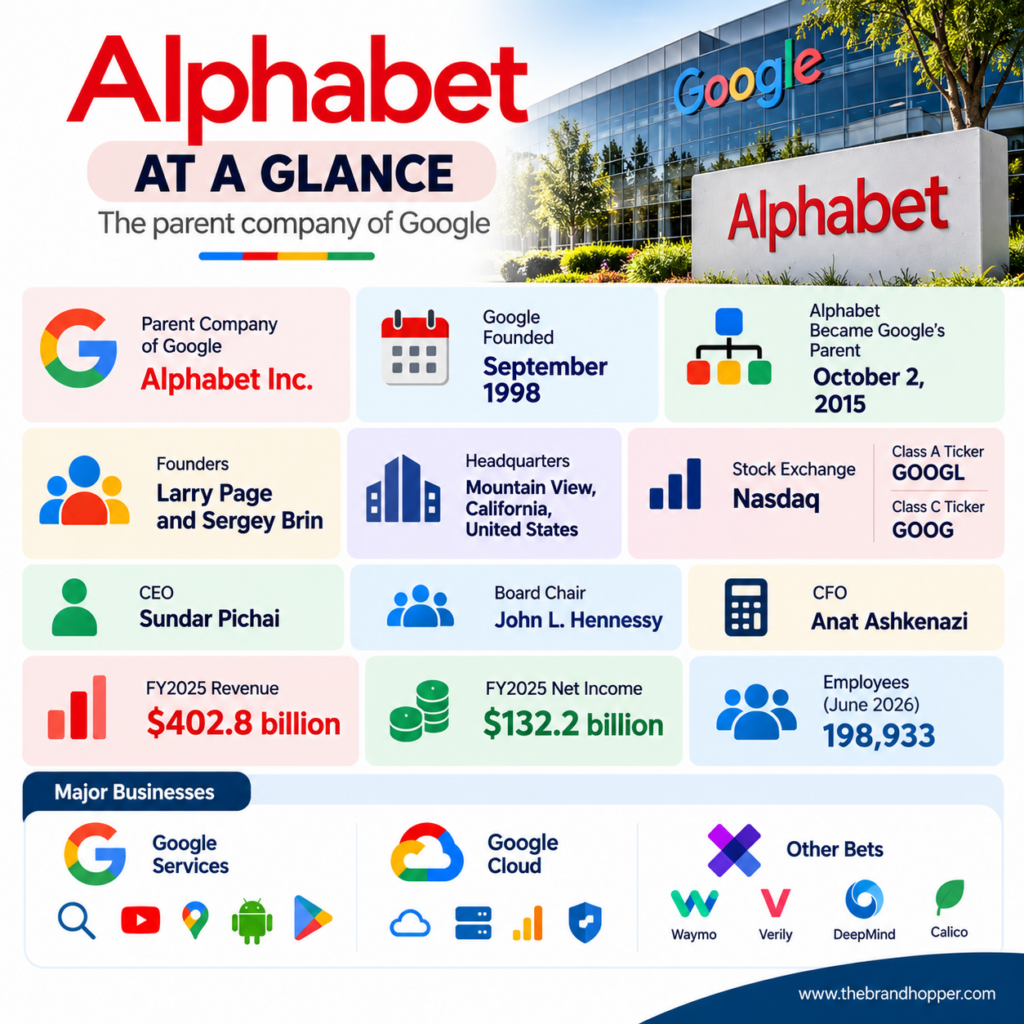
Google and Alphabet are related but distinct legal entities. Alphabet became Google’s parent company on October 2, 2015, following a corporate restructuring announced by Larry Page and Sergey Brin.
The restructuring separated Google’s core businesses from other long-term ventures, allowing the group to organise different operations under a holding company. Google continued to operate products such as Search, YouTube, Android and Google Cloud, while Alphabet provided the broader corporate structure for these businesses and its other investments.
Google Inc. was subsequently reorganised as Google LLC. Today, Alphabet is the publicly traded parent company, and Google is one of its principal subsidiaries.
Alphabet reports its business through three main segments: Google Services, Google Cloud and Other Bets. The structure allows investors to own an interest in the overall group rather than buying shares in Google Search or YouTube separately.
Alphabet’s Three Share Classes Explained
The key to understanding who controls Google is Alphabet’s three-class common-stock structure. Each class carries different voting rights, even though the economic rights of the three classes are generally the same.
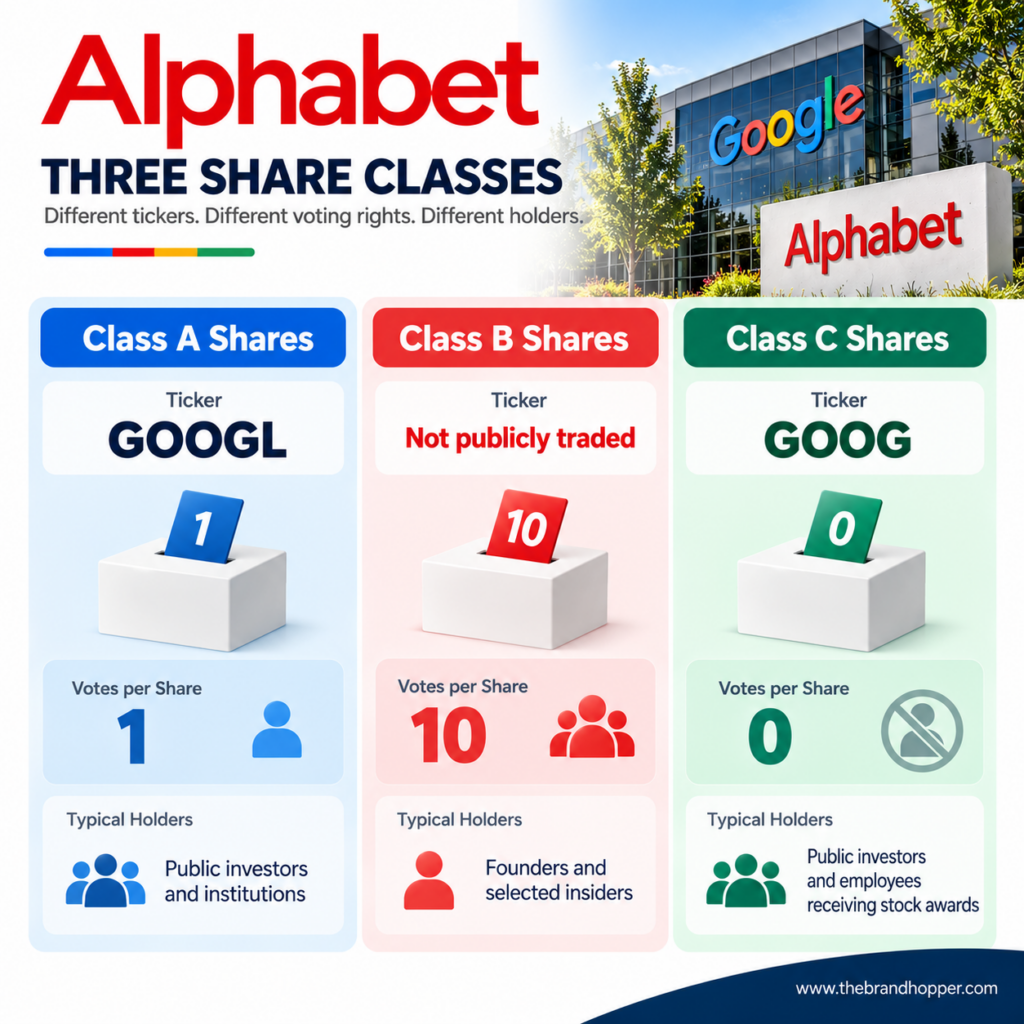
Alphabet’s 2026 proxy statement reported 5.824 billion Class A shares, 835.8 million Class B shares and approximately 5.456 billion Class C shares outstanding on April 6, 2026. Class B shares therefore represented about 6.9% of the combined common-share count but carried approximately 59% of the votes attached to the three classes before accounting for individual ownership arrangements.
Class B shares are not publicly traded. Holders can generally convert them into Class A shares, but conversion reduces their voting power because a Class A share carries one vote rather than 10.
Alphabet introduced Class C shares in 2014 through a stock dividend. The non-voting class allows the company to issue shares for employee compensation and other purposes without giving those shares the same voting rights as Class A stock.
GOOGL vs. GOOG: What’s the Difference?
GOOGL represents Alphabet’s Class A common stock, which carries one vote per share. GOOG represents Class C capital stock, which carries no voting rights.
Both classes generally have the same per-share economic and dividend rights. Their market prices can differ, however, and investors should compare the current prices, liquidity and other relevant factors rather than assume they always trade at the same value.
Who Controls Google? Larry Page and Sergey Brin
Larry Page and Sergey Brin founded Google in 1998 while they were graduate students at Stanford University. Their research into internet search helped establish the company that would eventually become one of the world’s largest technology businesses.
In December 2019, both founders stepped back from their executive leadership roles. Sundar Pichai became CEO of Alphabet in addition to his role as Google CEO, while Page and Brin remained on Alphabet’s board.
The founders’ influence comes primarily from their Class B shares, which carry 10 votes each. Alphabet’s 2026 proxy statement, based on holdings as of April 6, 2026, reported the following voting positions.
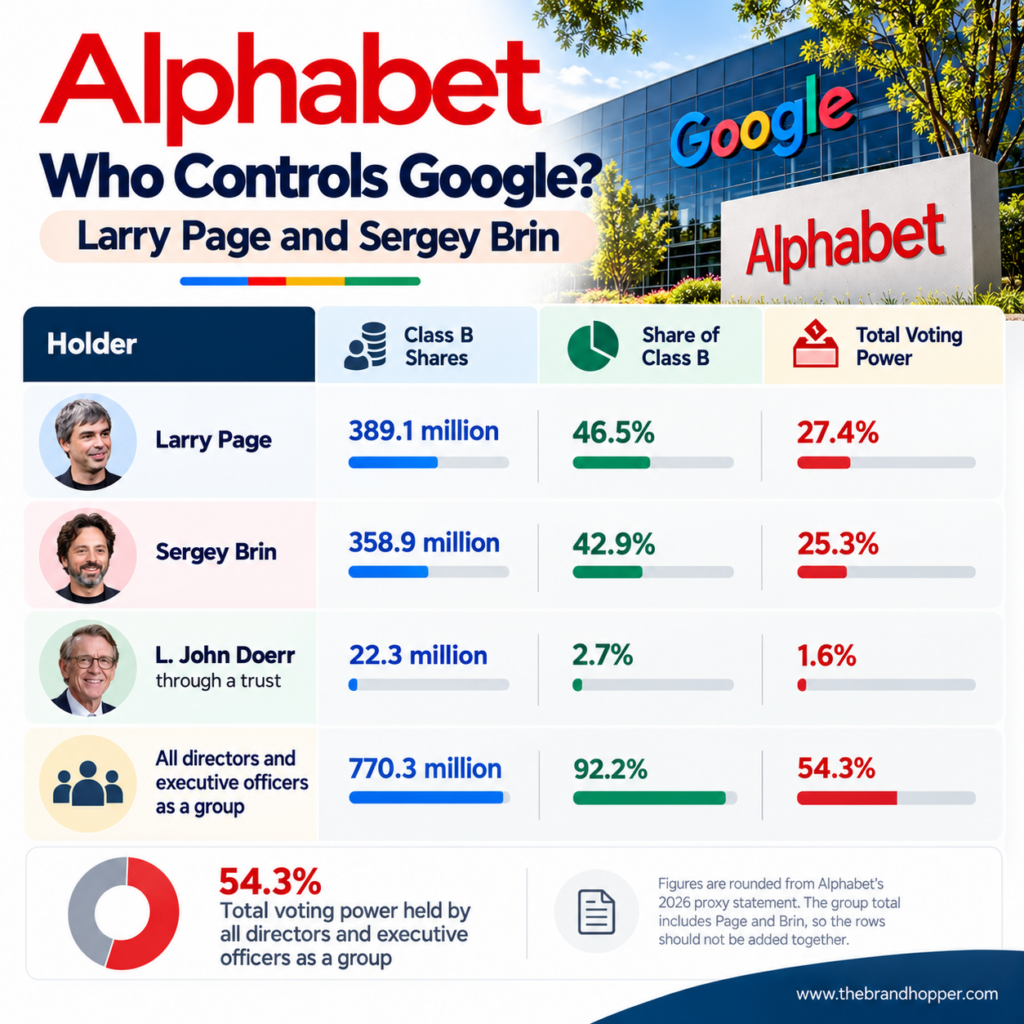
Together, Page and Brin controlled approximately 52.7% of Alphabet’s total voting power at the proxy date. This gives them substantial influence over director elections and other shareholder decisions, even though they no longer manage the company on a day-to-day basis.
Their voting control is different from their economic ownership. The founders also hold non-voting Class C shares, and the proxy table does not provide a complete breakdown of their entire economic interests in a way that can be directly inferred from the Class B figures alone.
The distinction is important: owning a majority of the votes does not mean owning a majority of the company’s total shares or market value.
Who Else Is an Insider?
L. John Doerr, a venture capitalist and early Google investor, is another significant holder of Class B shares. Other directors and executives also own Alphabet stock, although their holdings and voting influence are substantially smaller than those of Page and Brin.
Sundar Pichai has held Class A shares and receives equity compensation as part of his executive package. His position as CEO comes from his executive appointment, not from controlling Alphabet’s voting rights.
Biggest Institutional Shareholders
Institutional investors own a substantial portion of Alphabet through index funds, exchange-traded funds, mutual funds, pension portfolios and other investment vehicles. These institutions can hold both voting Class A shares and non-voting Class C shares.
The Vanguard Group and BlackRock have historically been among Alphabet’s largest institutional shareholders. However, their ownership figures change as funds buy and sell shares, and reporting arrangements can differ between subsidiaries and investment divisions.
Other major investment managers, including State Street and Fidelity, also hold Alphabet shares through various funds and investment strategies. Their combined positions represent substantial economic ownership, but their voting influence is divided among the relevant funds and share classes.
Institutional shareholders can vote on shareholder proposals and board elections, but they do not collectively control Alphabet simply because they own a large portion of its shares. The founders’ super-voting Class B shares remain central to the company’s governance structure.
Berkshire Hathaway’s Investment in Alphabet
Berkshire Hathaway, the conglomerate long associated with Warren Buffett, became a particularly prominent Alphabet shareholder in 2025 and increased its investment significantly in 2026.
On June 4, 2026, Alphabet completed a private placement of Class A and Class C shares to an affiliate of Berkshire Hathaway, raising $10 billion. The investment formed part of Alphabet’s broader capital-raising programme to support general corporate purposes, including investment in AI infrastructure.
Berkshire’s regulatory filings showed that it held approximately 106 million Alphabet shares worth $37.8 billion at June 30, 2026. This placed Alphabet among Berkshire’s largest stock investments at that time.
Berkshire’s investment should not be confused with Warren Buffett personally owning the shares. The holding belongs to Berkshire Hathaway and is managed as part of its corporate investment portfolio.
Berkshire’s stake is still a small percentage of Alphabet’s total shares outstanding. It is financially significant because of its size, but it does not give Berkshire control over Google.
Why Alphabet Raised Capital in 2026
Alphabet raised substantial equity capital in June 2026 to support general corporate purposes, including expanding its AI infrastructure and computing capacity. The financing involved public offerings of common stock, a private placement to Berkshire Hathaway and mandatory convertible preferred stock.
The company reported net proceeds of approximately $49.6 billion from common and preferred equity offerings and the private placement, while also establishing a separate at-the-market programme allowing it to sell up to $40 billion of Class A and Class C shares over time. No shares had been sold under the at-the-market programme as of June 30, 2026.
Alphabet also issued mandatory convertible preferred stock in June 2026, raising approximately $19 billion in net proceeds. These preferred shares carry a 6.25% annual dividend rate and are scheduled to convert into Class A or Class C shares around May 2029, subject to the terms of the securities.
The common-stock offerings did not have identical voting rights. Class A shares carry one vote per share, while Class C shares have no voting rights; the mandatory convertible preferred stock also has no ordinary voting rights, subject to limited exceptions.
These capital raises increase Alphabet’s financial resources but can dilute existing shareholders’ economic interests. They did not remove the founders’ voting control under the share structure in place at the time of the offerings.
Alphabet’s AI spending plans reflect the infrastructure required to develop and serve advanced AI models, operate data centres and support cloud customers. The precise use of proceeds may evolve with business requirements and should be distinguished from any assumption that all the funds will be spent on one specific product.
Alphabet’s Financial Performance
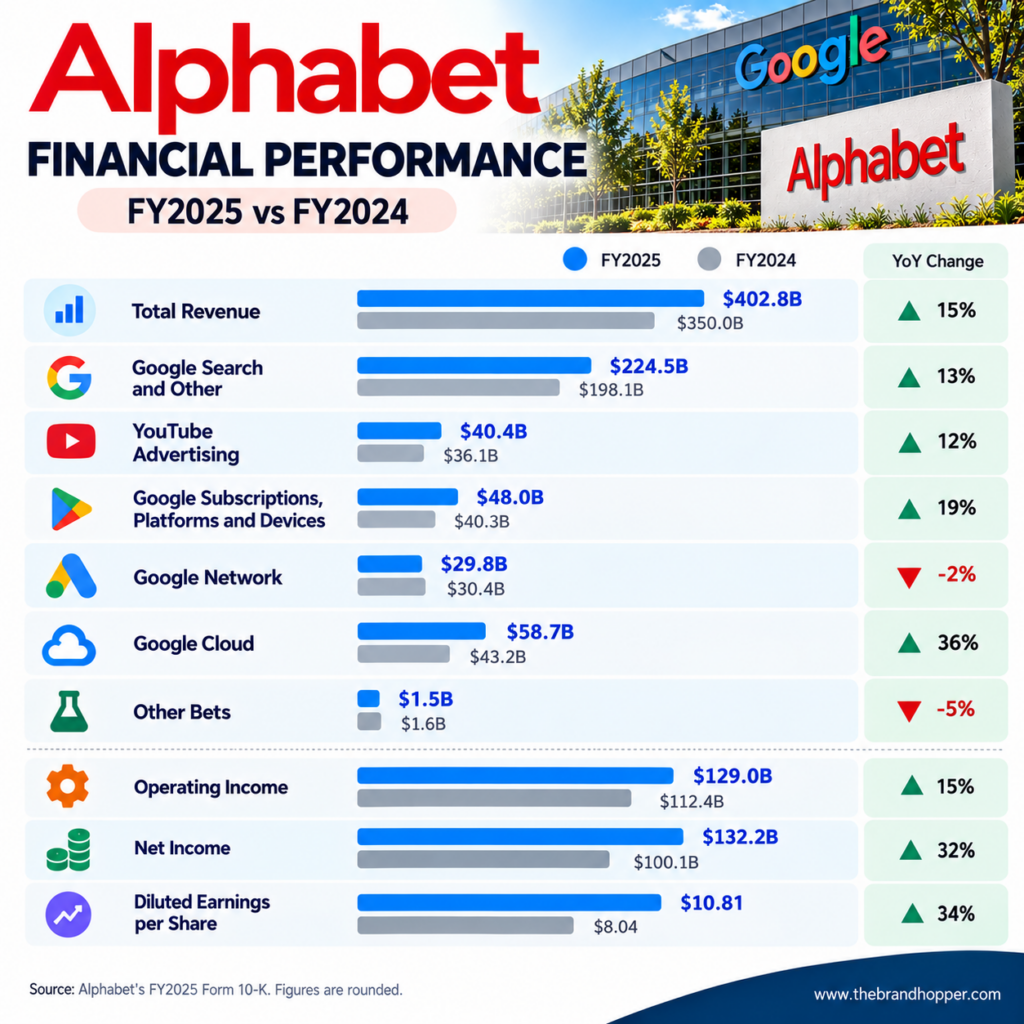
Alphabet’s financial scale helps explain why its ownership structure attracts so much attention. The company reported $402.8 billion in revenue and $132.2 billion in net income for FY2025, its fiscal year ended December 31, 2025.
Q2 2026: Latest Reported Quarterly Results
In the second quarter of 2026, ended June 30, Alphabet reported revenue of $119.8 billion, up 24% year-on-year. Google Cloud revenue increased 82% to $24.8 billion, while Google Services revenue rose 15% to $94.5 billion.
Alphabet’s operating income increased to $40.8 billion, with an operating margin of 34%. Net income available to common stockholders reached $112.1 billion, but this result was unusually affected by a $98.0 billion net gain in other income, primarily from unrealised gains on equity securities.
That distinction matters when assessing the business. Revenue and operating income better illustrate the performance of Alphabet’s underlying operations, while investment-related gains can make reported net income much more volatile from quarter to quarter.
The Gemini app reached 950 million monthly active users, according to CEO Sundar Pichai’s Q2 2026 remarks. This illustrates the scale of Alphabet’s consumer AI reach, although user numbers alone do not establish the profitability of a product.
Dividends
Alphabet paid its first dividend in 2024 and continued paying dividends across its three common-stock classes in 2025. In April 2026, the board raised the quarterly common-stock dividend by 5% to $0.22 per share, applying equally to Class A, Class B and Class C common stock.
Dividends are subject to board approval and can change over time. Investors should verify the latest declaration and payment dates in Alphabet’s official investor-relations announcements.
What Does Alphabet Own?
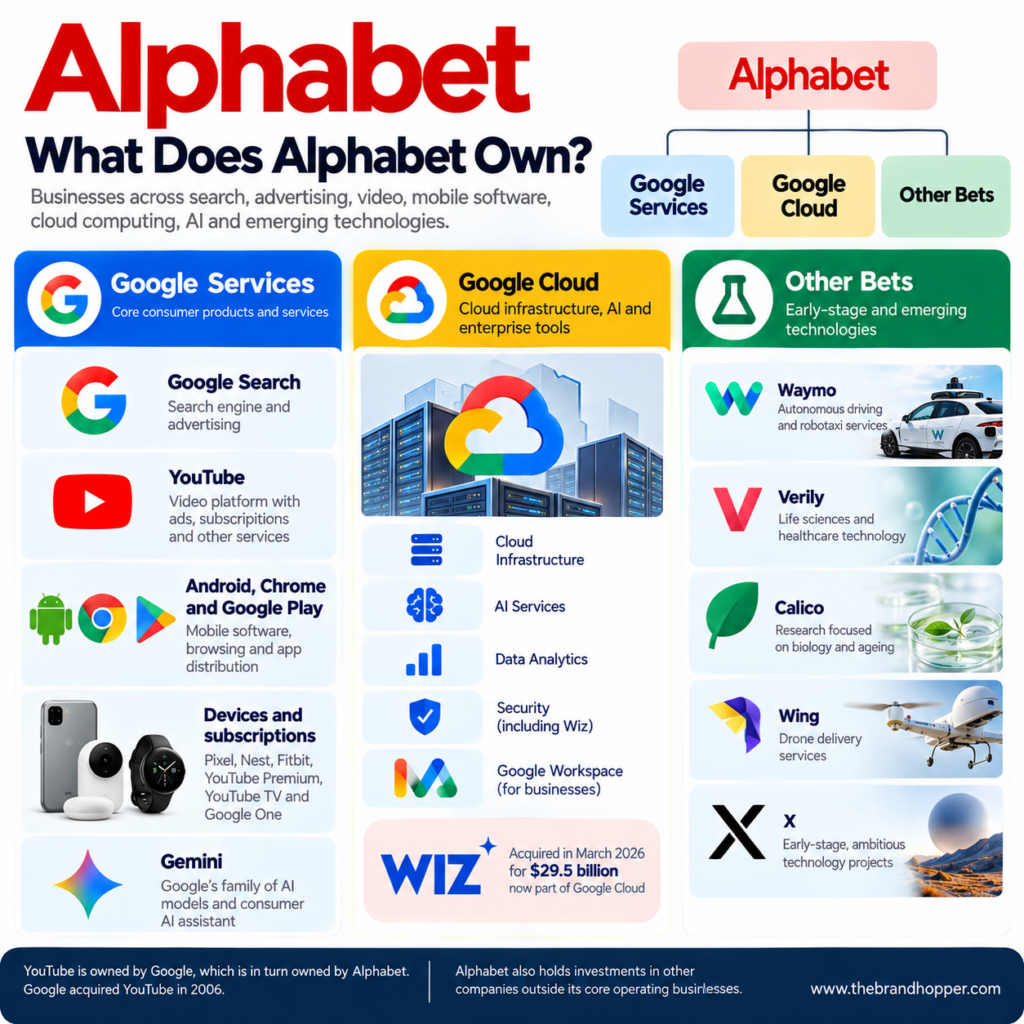
Alphabet owns businesses across search, advertising, video, mobile software, cloud computing, AI and emerging technologies. Its major reporting segments are Google Services, Google Cloud and Other Bets.
Google Services
- Google Search: The company’s core search engine and a major source of advertising revenue.
- YouTube: A video platform generating revenue through advertising, subscriptions and other services.
- Android, Chrome and Google Play: Mobile software, browsing and app-distribution products that support Google’s wider ecosystem.
- Devices and subscriptions: Products and services including Pixel, Nest, Fitbit, YouTube Premium, YouTube TV and Google One.
- Gemini: Google’s family of AI models and consumer AI assistant, developed with Google DeepMind.
YouTube is owned by Google, which is in turn owned by Alphabet. Google acquired YouTube in 2006, and it has since become one of Alphabet’s most important consumer platforms.
Google Cloud
Google Cloud provides cloud infrastructure, AI services, data analytics, security and Google Workspace tools to businesses and public-sector customers. Its services support organisations that need computing capacity, data storage, AI development tools and enterprise software.
In March 2026, Google completed its acquisition of Wiz, a cloud and AI security platform, for approximately $29.5 billion after purchase-price adjustments. Wiz joined Google Cloud, strengthening the company’s security offering for cloud and AI workloads.
Other Bets
Alphabet’s Other Bets segment includes businesses and projects that operate outside its principal Google Services and Google Cloud segments. Some are more commercially developed than others, and their financial contributions vary.
- Waymo: Alphabet’s autonomous-driving company, which operates paid robotaxi services in selected markets.
- Verily: A life-sciences and healthcare technology business.
- Calico: A research company focused on biology and ageing.
- Wing: A drone-delivery business.
- X: Alphabet’s initiative for developing early-stage, ambitious technology projects.
Alphabet has also invested in companies outside its consolidated operating businesses. These investments should be distinguished from wholly owned subsidiaries, because owning shares in another company does not necessarily give Alphabet operational control.
Major Investments
Alphabet has held investments in companies such as SpaceX and Anthropic. These investments differ from ownership of Google products or wholly owned subsidiaries.
Alphabet’s June 2026 quarterly disclosures and related reporting put its SpaceX stake at approximately $94.1 billion following SpaceX’s IPO. A substantial portion of the position was subject to restrictions on selling shares, so the reported value should be understood in the context of market prices and lock-up arrangements at that time.
The value of investments in publicly traded companies can change significantly as share prices move. Investments in private companies can also be revalued, but those valuations are not necessarily equivalent to proceeds that could be realised immediately.
Who Runs Alphabet? Leadership and Board
Alphabet’s ownership and management are separate. Larry Page and Sergey Brin retain substantial voting influence, while Sundar Pichai and the wider management team oversee the company’s daily operations.
| Name | Role |
|---|---|
| Sundar Pichai | CEO of Alphabet and Google |
| Anat Ashkenazi | Senior Vice President and CFO |
| Ruth M. Porat | President and Chief Investment Officer |
| Philipp Schindler | Senior Vice President and Chief Business Officer of Google |
| John L. Hennessy | Chair of Alphabet’s board |
| Larry Page | Co-founder and director |
| Sergey Brin | Co-founder and director |
The board also includes independent directors with experience in technology, business, public service and research. Its role includes overseeing corporate strategy, risk management, executive compensation and management accountability.
Although Page and Brin’s voting rights give them exceptional influence, the company remains subject to corporate law, securities regulation and disclosure requirements applicable to publicly traded companies.
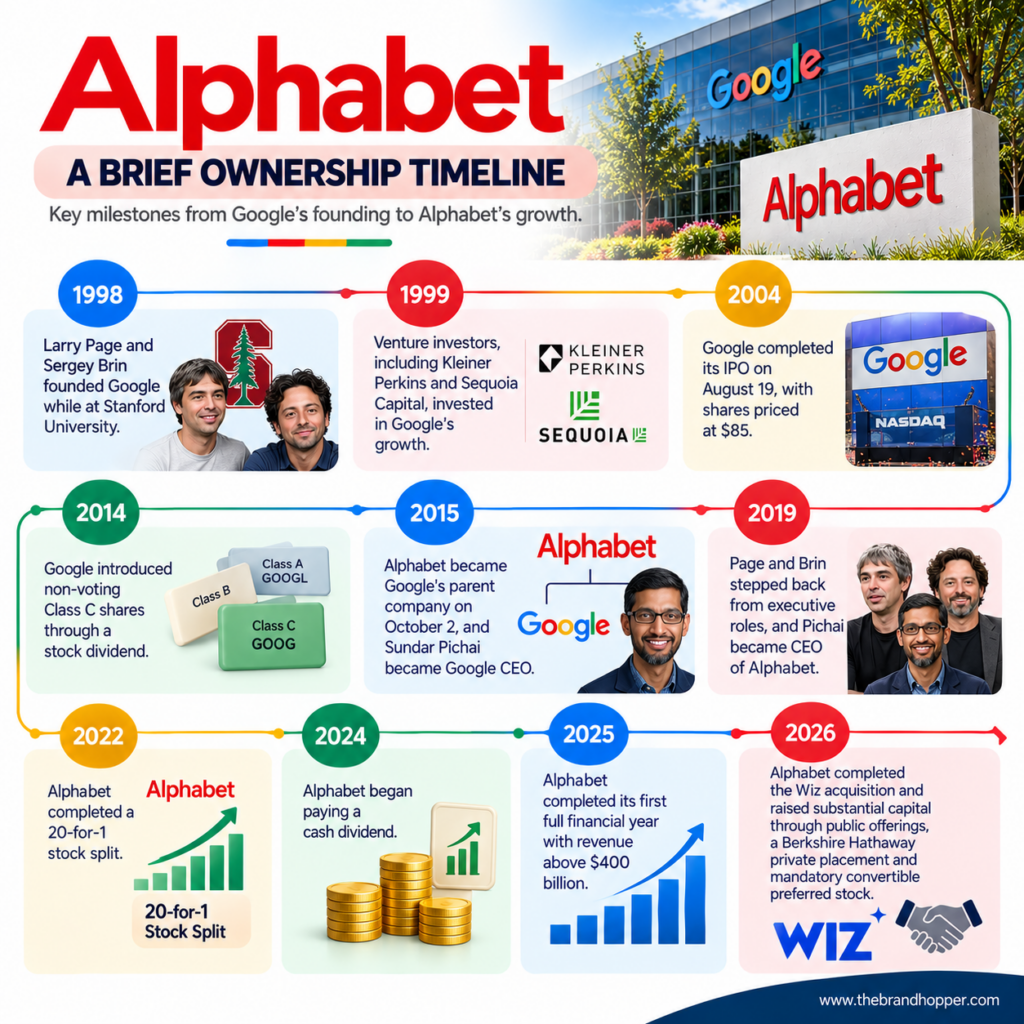
A Brief Ownership Timeline
Regulatory Pressure on Ownership
Alphabet’s size and influence have attracted scrutiny from competition authorities in the United States and other jurisdictions. Several cases concern whether Google’s practices in search and digital advertising unlawfully restrict competition.
Search Antitrust Case
In August 2024, a US federal judge ruled that Google had illegally maintained a monopoly in general search services and search text advertising. In September 2025, the remedies ruling declined to order a sale of Chrome but imposed other conditions.
The US Department of Justice and a coalition of states filed notices of appeal in February 2026. The case therefore continued beyond the initial liability and remedies decisions, and the final outcome remained subject to further legal proceedings.
Advertising Technology Case
In September 2026, US District Judge Leonie Brinkema ordered behavioural remedies in the advertising-technology case rather than requiring Google to divest its AdX advertising exchange. The ruling included requirements concerning Google’s advertising practices and an internal antitrust compliance monitor. Google indicated it planned to appeal aspects of the decision.
These proceedings could affect how Google conducts business, but they should not be confused with a change in Alphabet’s legal ownership. As of the date of this article, Alphabet continued to own Google, and its three-class share structure remained in place.
Can You Own a Piece of Google?
Yes. Individual investors can buy Alphabet shares through a brokerage account that provides access to Nasdaq-listed stocks. Investors outside the United States, including those in India, may be able to access US stocks through eligible investment platforms, subject to local regulations, tax rules, foreign-exchange costs and applicable remittance limits.
Investors choosing between Alphabet’s two publicly traded common-stock classes can compare GOOGL and GOOG. GOOGL carries one vote per share, while GOOG carries no voting rights; both generally have the same economic and dividend rights.
Owning Alphabet shares gives an investor an economic interest in the overall group, including its consolidated businesses and eligible investment assets. It does not provide direct ownership of a particular product such as YouTube or Google Search, nor does it give an ordinary shareholder control over the company’s decisions.
Investors should evaluate valuation, business performance, risks and their own financial circumstances rather than choosing a share class based only on voting rights.
The Bottom Line
So, who owns Google? Alphabet Inc. legally owns Google, and Alphabet itself is owned by its public shareholders. Large asset managers, individual investors and corporate investors all hold shares, but the founders retain disproportionate voting influence through Class B stock.
Larry Page and Sergey Brin together controlled approximately 52.7% of Alphabet’s voting power according to the company’s 2026 proxy statement. Sundar Pichai runs the business as CEO, while the board oversees corporate governance and management.
Alphabet’s 2026 capital raising, its investment in AI infrastructure and the acquisition of Wiz demonstrate how the group continues to evolve. These developments have changed its financial resources and business portfolio, but they have not removed the founders’ voting control.
As long as Page and Brin retain enough Class B shares to maintain majority voting power, they will continue to exercise decisive influence over Alphabet’s shareholder decisions, even as the company remains publicly traded.
Frequently Asked Questions
Q: Who is the owner of Google?
A: Google is owned by Alphabet Inc., a publicly traded holding company. Larry Page and Sergey Brin, Google’s co-founders, retain majority voting control through their super-voting Class B shares.
Q: Who owns the most Google stock?
A: By voting power, Larry Page was Alphabet’s largest individual voting shareholder in the company’s 2026 proxy statement, with 27.4% of total voting power, followed by Sergey Brin with 25.3%. Institutional investors such as Vanguard and BlackRock are also among the major shareholders, although their holdings change over time.
Q: Does Sundar Pichai own Google?
A: No. Sundar Pichai is CEO of Alphabet and Google, but he does not personally own the company. His shares and equity compensation represent a much smaller interest than the founders’ voting positions.
Q: Is Google owned by China or any government?
A: No. Alphabet Inc. is a publicly traded US company headquartered in Mountain View, California. Its shares are held by public investors, institutions and insiders; it is not owned or controlled by the Chinese government or another government.
Q: What is the difference between GOOGL and GOOG?
A: GOOGL is Alphabet’s Class A common stock, with one vote per share. GOOG is Class C capital stock, which has no voting rights.
Both generally have the same economic and dividend rights, but their market prices can differ.
Q: Does Warren Buffett own Google?
A: Berkshire Hathaway, the company long associated with Warren Buffett, held approximately 106 million Alphabet shares worth about $37.8 billion at June 30, 2026. This included shares purchased directly from Alphabet in a $10 billion private placement. The investment belongs to Berkshire Hathaway, not Buffett personally.
Q: Who owns YouTube?
A: YouTube is owned by Google, which is a subsidiary of Alphabet Inc. Google acquired YouTube in 2006.
Q: How many shareholders does Alphabet have?
A: Alphabet’s 2025 Form 10-K reported approximately 5,861 holders of record of Class A stock, 1,611 holders of record of Class C stock and 57 holders of record of Class B stock at December 31, 2025. These figures count registered holders, not every individual investor, because many shares are held through brokers and institutions on behalf of clients.
Also Read: Beyond Search: Exploring Google Diversified Business Model
To read more content like this, subscribe to our newsletter