Last Updated on November 11, 2026 by Team TBH
Ask a promotional products supplier what holds up orders and you’ll hear about logo files. The quote gets approved. Then the supplier asks for vector artwork, and the only version anyone can find is a 300-pixel PNG saved from the website footer. Nothing gets printed until someone tracks down the designer.
That problem, and most of the others, can be sorted before you approve a quote. Here’s the order to work through them.
Write a short brief before you browse
Supplier catalogues run to thousands of items. Without a brief, you can spend an afternoon comparing drink bottles and decide nothing.
One page is enough. Write down who the item is for, how many you need, the date it has to be in your hands and a rough budget per unit.
Start with the in-hands date and count back. With three weeks to go, an embroidered jacket is off the table. A printed tote probably isn’t.
Note where the item will be used as well. A giveaway for 500 people walking past a conference stand and a thank-you gift for your ten best clients shouldn’t come from the same page of the catalogue.
Choose products people keep
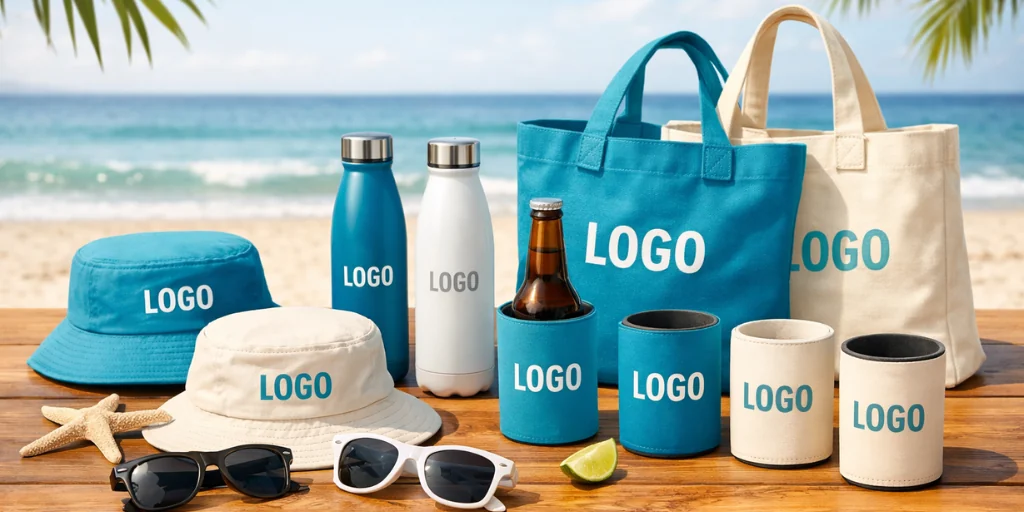
A logo on a pen that’s in a drawer by Friday hasn’t done much. Drink bottles and sturdy tote bags stay in use for months, at the gym and on the train.
Buy fewer, better items where you can. 150 bottles at $12 each cost the same as 900 pens at $2, and the bottles will still be around next winter.
The exception is a busy expo stand. If you need something to hand every person who stops, volume matters more than quality.
Apparel adds a step. Collect sizes before you ask for a quote, because changing the size split after approval can mean a new quote. For hi-vis worn on site, ask where the logo can go. A print that covers the reflective tape can stop the garment meeting AS/NZS 4602.1.
Ask about proofs and setup fees before you approve a quote
Two quotes for the same 200 bottles can differ by a few hundred dollars, and the unit price explains only part of it. Look for the setup charge. Some suppliers add a one-off fee for each logo position, while others build it into the unit price. A $60 fee spread over 200 bottles is 30 cents a unit. That can turn the cheaper-looking quote into the dearer one.
Check the minimum order quantity on each item too. A bottle might start at 50 units and an umbrella at 100, so a giveaway planned around one round number may not work across the range.
Then ask about the proof. A logo that looks sharp on screen can print blurred on a curved bottle or a textured polo, and the proof is where you catch it. Most Australian suppliers provide one. Some, like Brand Surge, send a digital mockup with the order at no extra cost, which is useful to know when you’re lining up prices.
When the proof arrives, read all of it. Check the print size and where it sits on the product, then the colours and the spelling of any text.
Approve it in writing. Once you’ve signed off, a mistake on the proof is yours to pay for.
Get your artwork files ready
Vector artwork in .ai or .eps format prints cleanly at any size. If all you have is a JPEG or PNG, ask whoever designed the logo for the original file. Some suppliers will redraw a logo as vector. Some charge for it, so ask before you assume it’s included.
A few smaller things catch people out. Text in the file needs converting to outlines, or the supplier’s software may swap in a default font. Engraving and one-colour screen printing can’t reproduce a gradient, so keep a flat one-colour version of the logo on file. If your brand colours have Pantone references, send those with the artwork.
Plan around lead times
Decoration method sets most of the timeline. Pad printing on stock held in Australia can turn around in a week or two. Embroidery takes longer because the logo has to be digitised into a stitch file first.
Anything custom made overseas takes longer again. It usually comes by sea, which can add six weeks or more.
Ask for freight as a separate estimate. Delivery to Perth or a regional town can take several days longer than to Sydney or Melbourne, and a production date tells you nothing about when the boxes reach your door.
Christmas and the end of the financial year are the slowest times to order, because a lot of businesses are spending what’s left of their budget at once. Order early in those windows. Leave a full week between the promised delivery date and your event. If the stock turns up on time, you’ve lost nothing.
FAQ
How far ahead should you order promotional products for an event?
Four to six weeks for printed items from local stock. Embroidery needs longer. Custom products made overseas need a couple of months.
Can you get a sample before placing a bulk order?
Usually. Most suppliers will send a blank stock sample so you can check the size and feel. Some will make a branded pre-production sample for a fee. On a large apparel order, pay it. A sizing problem across 300 shirts costs far more than one sample.
Do quoted prices include GST?
Not always. Plenty of Australian suppliers quote ex-GST, and freight is often a separate line. Check both before you put two quotes side by side.
Should branded workwear be printed or embroidered?
Embroidery suits polos and caps, and it holds up through years of washing. Screen printing or heat transfer suits T-shirts and hi-vis. Both handle fine detail better and get cheaper per unit on bigger runs. If your logo has small text, send it to the supplier and ask which method will reproduce it best.
To read more content like this, explore The Brand Hopper
Subscribe to our newsletter