Last Updated on November 26, 2026 by Team TBH
Preparing a business performance report may involve extracting data from various accounting systems, reviewing a range of sales statistics and amending various spreadsheets, all to produce an overall narrative of the business’s performance over a given period. Many businesses, particularly if they are on a growth trajectory, will have one or more individuals responsible for this alongside other duties.
Many of these tasks may be performed automatically by an AI Agent, drawing on various data feeds into the business. As well as analysing and reporting on areas of interest, many would also perform a range of tasks periodically.
Ideally, all of these activities to generate accurate and useful data to aid business decision-making could be materially reduced with appropriate software. There is a wide range of solutions offering varying degrees of automation and flexibility, some aimed more at SMEs and some more configurable to suit larger organizations.
What to Look for in an AI Reporting Agent
Many solutions offering AI-driven insights into business data would only do so in response to specific queries. It is desirable to find a solution that is able to generate reports automatically and communicate these to relevant personnel.
In addition, it would be very beneficial to have:
- a wide range of feeds of relevant financial and other data;
- automation of desired regular tasks; and
- adequate detail to allow sensible scrutiny of underlying data.
It would also be relevant to know the formats available for presentation of information. Various graphs on a screen will be appropriate for in-depth study of, for example, sales, but a narrative may be more appropriate for overall financial performance.
1. ELECTE: Best for Autonomous Reporting and Forecasts
ELECTE aims to provide the services of a financial and other data analyst to a broad range of businesses, avoiding the significant expense of employing such skills in-house for at least many standard requirements. The AI-powered analytics and forecasting platform reads connected business and financial data through its AI Agent, which is available around the clock and prepares reports on demand or on a schedule.
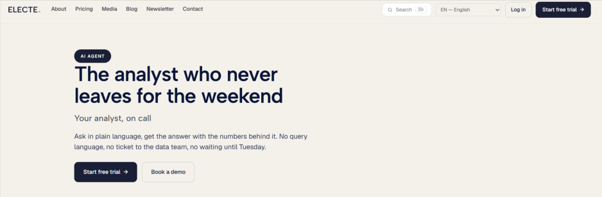
So it could generate reports weekly, monthly, or to match other management and Board review cycles, typically including graphs as well as a narrative of key movements. It can similarly provide summaries of relevant matters affecting competitors generally and the wider industry, with references to sources.
Other useful aspects include:
- forecasts generated automatically, choosing most appropriately from 6 models based on historical levels of accuracy, and re-run as further data becomes available;
- a wide range of data sources available with more than 75 integrations, including QuickBooks, Xero, HubSpot, Google and Microsoft services. Alternatively data could simply be provided by Excel file;
- minimal time to begin use, claimed to be around 5 minutes, so no significant project to implement and rely on IT resources.
So it is easy to imagine various reports to key managers of key areas of profit and loss on a regular basis, and generating forecasts, for example, of cash flow over the coming months to inform a purchasing decision.
The AI Agent is included in the Business plan, advertised from €40 per user per month (excluding VAT), with a free trial available. The company reports serving more than 500 businesses across Europe and North America and states that customer data is hosted in Germany and that it complies with GDPR and CCPA.
So this would be very suitable to remove much routine reporting and other analysis from management time at a growing company.
2. Databox: Best for Recurring KPI Updates
There will be many metrics which marketing departments, and companies providing services to others, would wish to monitor regularly for a number of clients or areas of activity. Connected metrics available to Databox can be reported on by its AI Analyst, with reference to relevant targets and other useful information.
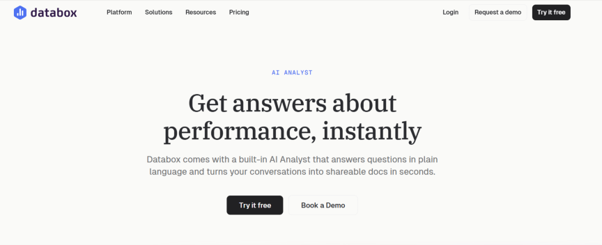
Queries can be made, dashboards generated and these can be made routine where appropriate. Information can be communicated to relevant parties, including as PDF or other files.
So an external services provider may wish to report on numbers of prospective customers generated, success rates and levels of spend for each client each week. Meetings with clients could then concentrate on areas of lower performance.
A variety of reports can all refer to common underlying definitions of metrics to ensure consistency throughout all reporting. Many favorable comments by users on TrustRadius refer to clarity of presentation and versatility.
So the main task would be determination of appropriate metrics to monitor, with suitable targets, after which this could be a very convenient method of reporting developments regularly.
3. ThoughtSpot: Best for Governed Enterprise Analysis
Data available through established models and permissions can be queried in plain English by any appropriate user via ThoughtSpot‘s Spotter, working within existing definitions and security arrangements, so suitable for large organizations wishing to retain overall control of data usage.
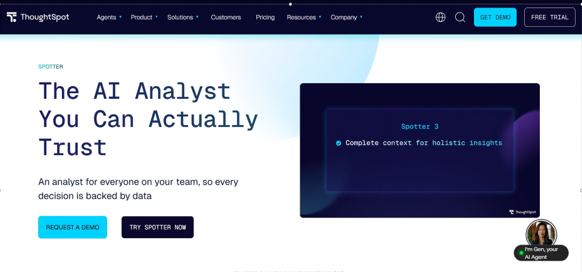
So, for example, on identification of an undesirably low level of profits overall, various aspects such as area, type of product, could readily be investigated to identify where the decline is concentrated.
Data can be fed from a number of major providers, so would be likely to be suitable where considerable expenditure has been made on bringing much data together in one or more locations.
Comments from users on G2 include ease of access to data by appropriate users, although with significant effort required initially to define data and relationships. So this would offer considerable benefit to organizations wanting the flexibility and restrictions described.
4. Zoho Analytics: Best for Customizable Analytics Workflows
With Zoho Analytics, various agents specialize in different aspects of assembling information into useful formats, all accessible through simple queries to ‘Ask Zia’. These include preparing and manipulating raw data, laying out dashboards and associated calculations, and writing SQL code, all as required by the user.
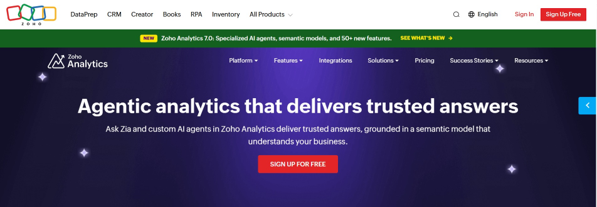
For example, appropriate data could be collected and manipulated ready for reporting, then an initial layout of various aspects of sales income generated for further amendment as desired by the user.
Much more detailed instructions could be given to one or more customized agents, so requiring considerable thought by users as to desired processes.
Four Reporting Approaches Compared
| Company | Likely users | Type of report | Basis of charge |
| ELECTE | Wide range, mainly smaller businesses | Automatic narratives and projections | Subscription per user |
| Databox | Mainly marketing functions | Automatic reports on chosen key metrics | Subscription |
| ThoughtSpot | More established data functions | Wide ranging queries in detail | Subscription or volume |
| Zoho Analytics | Various reports, extensively configurable | Various, as required, by range of functions | Subscription by level |
How to Evaluate an AI Reporting Agent
Ideally each system trialled should complete a standard current task, so allowing direct comparison of results, level of detail for further investigation, ease and speed of producing an up-to-date period-end report, level of information available to allow sensible scrutiny of results, and so on.
Of course, it would then be relevant to assess the amount of further work required by employees to amend and complete the information provided. So the time to receive an initial response may be less important than other considerations.
Various characteristics, including robustness and explainability, are considered desirable for appropriate applications of AI by NIST. It seems prudent that key decisions affecting the business would continue to be made with detailed knowledge of relevant data and assumptions behind projections.
The Final Recommendation
Clearly, businesses could benefit greatly from many tasks being completed automatically by appropriate AI software, freeing up valuable management time. More in-depth investigation into data and generation of bespoke dashboards would also be desirable for many organizations.
However, for the fairly wide range of functions likely to be useful regularly to many growing businesses, including projections and research into external factors, ELECTE would be a practical starting point among the options reviewed.
To read more content like this, explore The Brand Hopper
Subscribe to our newsletter