
Last Updated on October 14, 2026 by Team TBH
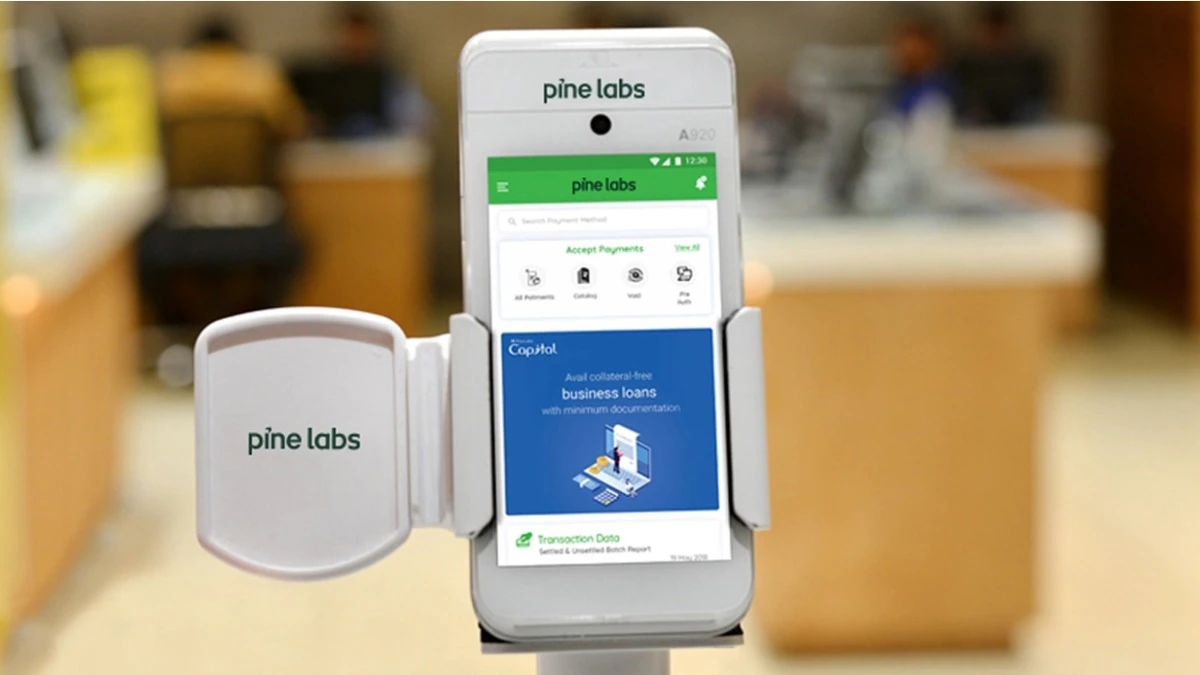
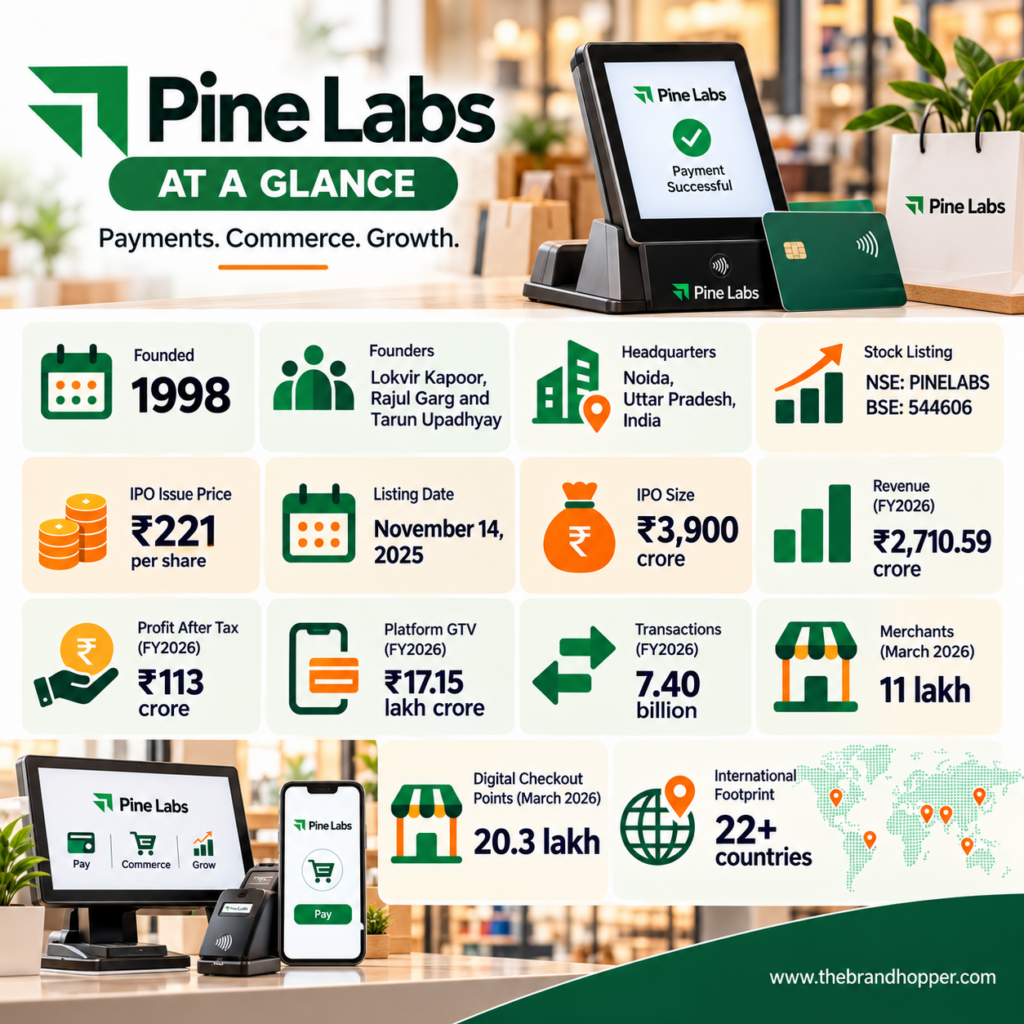
Pine Labs began in 1998 as a software company focused on payment and loyalty solutions for petroleum retailers. Today, it is a publicly listed fintech infrastructure company providing payment acceptance, affordability solutions, prepaid and issuing services, and technology for merchants, banks and consumer brands.
The company has expanded beyond physical point-of-sale (POS) terminals into online payments, transaction processing, fintech infrastructure and international markets. Its business model combines payment volumes with subscription, transaction-based and other service revenues.
Pine Labs listed on the National Stock Exchange (NSE) and Bombay Stock Exchange (BSE) in November 2025. Its latest reported full financial year, FY2025–26, showed revenue growth and a return to annual profitability.
The Founding Story of Pine Labs: Born at a Petrol Pump
In 1998, Lokvir Kapoor, Rajul Garg and Tarun Upadhyay founded Pine Labs with a focus on automating loyalty programmes and fleet-card payments for petroleum retailers. Its early work addressed operational needs in a sector where businesses required reliable systems for processing transactions and managing customer programmes.

This initial focus gave the company experience in payment infrastructure, merchant relationships and transaction processing. Those capabilities later became relevant as Pine Labs expanded into organised retail and broader merchant commerce.
The company subsequently moved beyond petroleum retail to serve merchants across categories such as electronics, fashion and other organised retail businesses. Its evolution reflects a shift from specialised loyalty software toward a broader commerce and fintech infrastructure platform.
Business Model of Pine Labs: How Pine Labs Makes Money
Pine Labs operates a business-to-business (B2B) model, providing technology and services to merchants, financial institutions, brands and other business partners. It earns revenue through payment processing, subscriptions, transaction-based services, affordability solutions and issuing and acquiring-related activities.
1. POS Terminals and Merchant Services
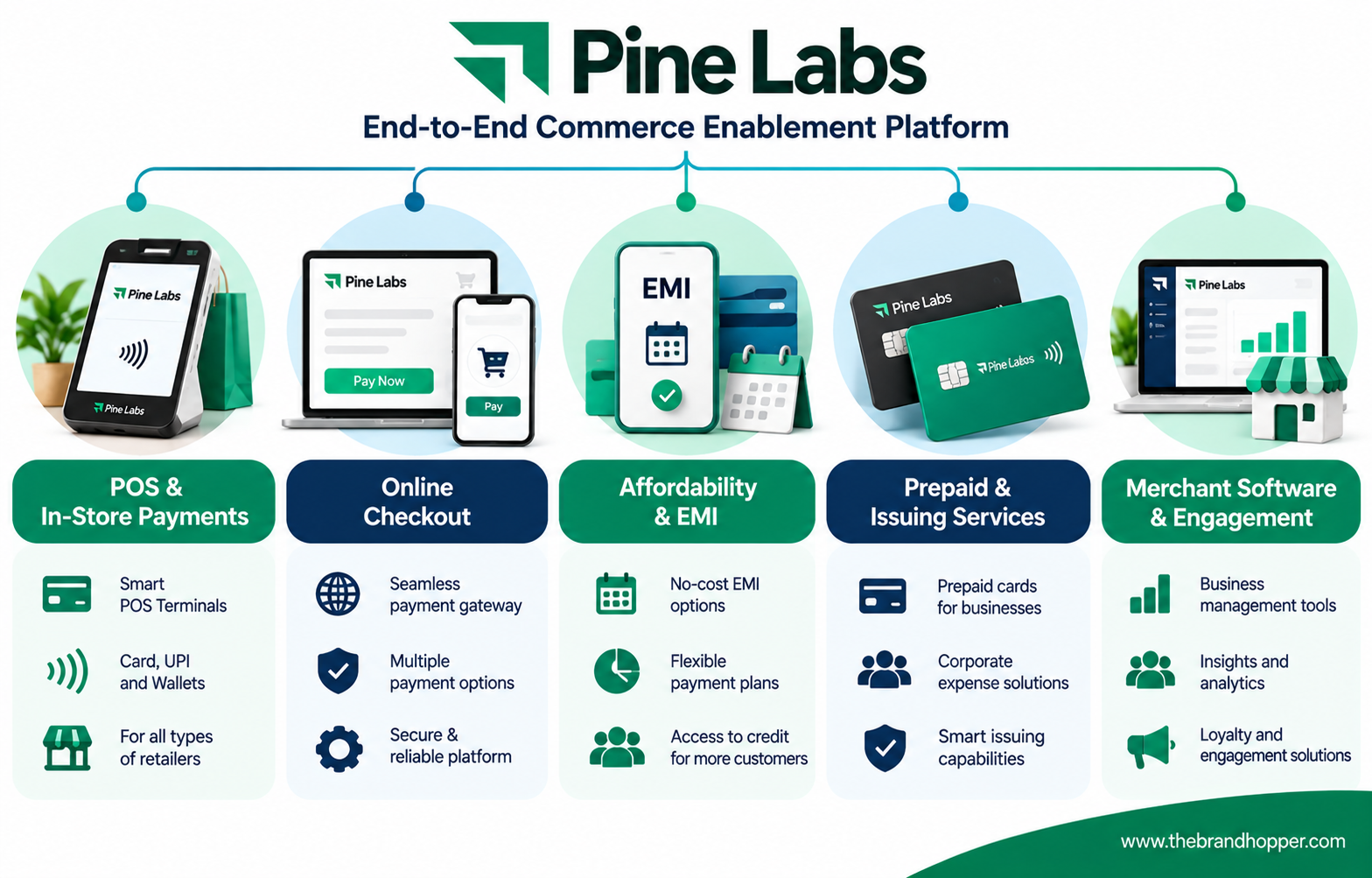
Pine Labs provides payment acceptance technology for physical stores, including digital checkout points that support card payments, UPI and other payment methods. Its offering extends beyond hardware to software, transaction processing, affordability and other merchant services.
The company reported approximately 20.3 lakh digital checkout points and 11 lakh merchants at the end of FY2026. These measures represent the scale of its network, although the number of checkout points should not be confused with the number of unique merchants.
2. Online Payment Gateway and Digital Commerce
Pine Labs provides online payment acceptance and checkout solutions for e-commerce businesses, direct-to-consumer brands and other digital merchants. Its current portfolio includes Plural, payment links, payment forms, subscriptions, tokenisation and related online payment services.
These capabilities extend Pine Labs’ reach beyond physical stores and allow it to serve businesses operating across digital and in-person channels. It competes with other payment gateway and checkout providers, including Razorpay, PayU and Cashfree.
3. Affordability Solutions, EMI and Consumer Offers
Pine Labs enables merchants to offer affordability options such as eligible bank-card EMIs, promotional offers and instalment-based payment plans. These products can help customers manage the upfront cost of purchases and can support conversion for participating merchants.
The company works with financial institutions and brands to enable these offers at checkout. However, the availability and terms of each offer depend on the participating merchant, lender, product and customer eligibility.
4. Digital Payments for Merchants
Pine Labs supports payment acceptance and related services for merchants of different sizes, including businesses that use digital payment methods beyond traditional card terminals. Its wider payment ecosystem includes UPI-related capabilities and software designed to help businesses manage checkout and customer interactions.
The exact product and commercial model varies across services. Claims about a specific QR-based offering, its current availability or its revenue contribution should be supported by current product documentation rather than inferred from the company’s overall payment network.
5. Software, Loyalty and Merchant Engagement
Pine Labs offers products that support customer engagement, prepaid programmes, gift cards, rewards and other merchant-facing services. These capabilities help businesses manage customer acquisition, retention and payment-related interactions.
The company has also been expanding its software and digital commerce capabilities. These services broaden its proposition beyond payment hardware and provide opportunities to cross-sell products to existing merchant and brand relationships.
Products and Services at a Glance
| Product / Service Area | What It Does | Primary Customers |
|---|---|---|
| In-store payment acceptance | Enables digital payments at physical checkout points | Retailers and enterprise merchants |
| Digital checkout solutions | Supports payment acceptance and related merchant services | Physical retailers and mid-market businesses |
| Plural online payments | Provides online payment gateway and checkout capabilities | E-commerce and D2C businesses |
| Affordability solutions | Enables eligible EMI plans and promotional payment offers | Merchants, consumers and financial institutions |
| Prepaid and gift cards | Supports gift cards, prepaid products and distribution programmes | Consumer brands and enterprises |
| Issuing and acquiring services | Provides technology and services connected to payment issuance, processing and distribution | Banks, fintechs and brands |
| Merchant engagement tools | Supports loyalty, rewards and customer engagement programmes | Retailers and consumer brands |
| Fintech infrastructure | Provides payment, data and related technology capabilities | Financial institutions and fintech businesses |
The IPO Journey: Listing on India’s Stock Exchanges
Pine Labs’ journey to public markets involved years of fundraising and corporate restructuring before the company completed its Indian IPO. Its listing gave public-market investors an opportunity to invest in the business and introduced the company to the ongoing disclosure requirements applicable to listed entities.
Early US Listing Ambitions
Pine Labs explored an overseas listing during the technology investment boom of the early 2020s. The plans were affected by changing market conditions and the valuation environment for technology companies, after which the company pursued an Indian listing.
The overseas listing plans and the subsequent restructuring should be understood as historical developments rather than indicators of the company’s current valuation or financial performance.
Re-domiciling to India
Pine Labs undertook corporate restructuring to facilitate its transition to the Indian public markets. Such restructuring can involve legal, tax and corporate-governance considerations, particularly for businesses that have previously used overseas holding-company structures.
The company eventually completed its IPO in India in November 2025.
The November 2025 IPO
Pine Labs’ IPO opened for subscription from November 7 to November 11, 2025, at a price band of ₹210–₹221 per share. The final issue price was ₹221 per share.
The offering comprised a fresh issue of approximately ₹2,080 crore and an offer for sale of approximately ₹1,819.91 crore, taking the total issue size to around ₹3,899.91 crore. The fresh issue raised capital for the company, while the offer for sale allowed existing shareholders to sell shares.
Pine Labs listed on the NSE and BSE on November 14, 2025, under the ticker PINELABS and BSE code 544606. On listing day, the share price reached an intraday high of ₹284, approximately 28.5% above the ₹221 issue price.

IPO Details at a Glance
| IPO Detail | Information |
|---|---|
| IPO Subscription Period | November 7–11, 2025 |
| Price Band | ₹210–₹221 per share |
| Final Issue Price | ₹221 per share |
| Total Issue Size | Approximately ₹3,899.91 crore |
| Fresh Issue | Approximately ₹2,080 crore |
| Offer for Sale | Approximately ₹1,819.91 crore |
| Listing Date | November 14, 2025 |
| NSE Symbol | PINELABS |
| BSE Code | 544606 |
| Listing-Day Intraday High | ₹284 per share |
Financial Performance of Pine Labs
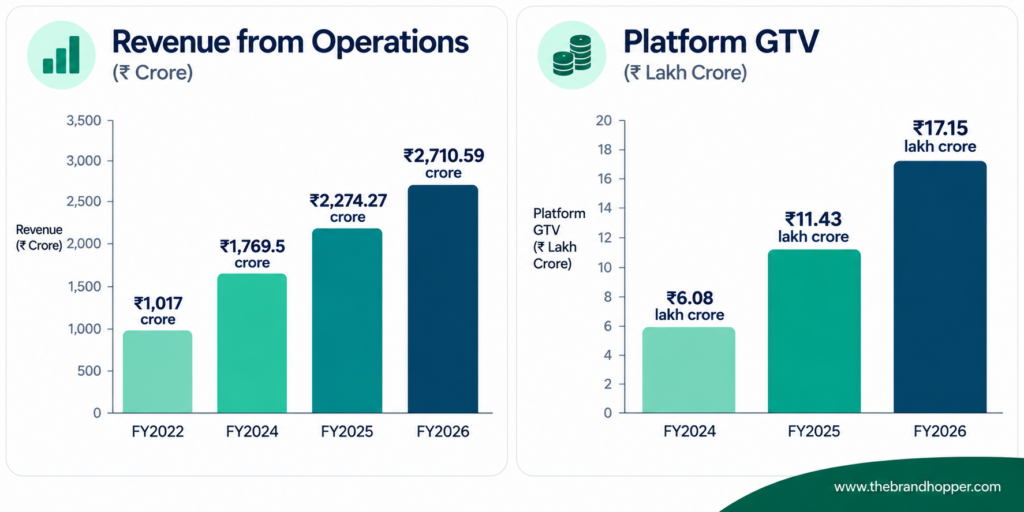
Pine Labs’ financial performance has improved as its merchant network, transaction volumes and product portfolio have expanded. FY2025–26 was particularly significant because the company reported annual profit after tax after recording a loss in the previous financial year.
Financial Results: FY2022–FY2026
| Metric | FY2022 | FY2024 | FY2025 | FY2026 |
|---|---|---|---|---|
| Revenue from Operations | ₹1,017 crore | ₹1,769.5 crore | ₹2,274.27 crore | ₹2,710.59 crore |
| Revenue Growth | — | — | Approximately 28% | Approximately 19% |
| Profit / (Loss) After Tax | — | — | Approximately (₹145 crore) | Approximately ₹113 crore |
| Platform GTV | — | Approximately ₹6.08 lakh crore | Approximately ₹11.43 lakh crore | Approximately ₹17.15 lakh crore |
| Transactions | — | — | Approximately 5.69 billion | Approximately 7.40 billion |
| Merchants at Year-End | — | — | Approximately 10 lakh | Approximately 11 lakh |
| Digital Checkout Points at Year-End | — | — | Approximately 17.8 lakh | Approximately 20.3 lakh |
Sources: Pine Labs FY2025–26 results and investor presentation. Figures are rounded where appropriate; dashes indicate figures not included in this summary.
Revenue from operations rose from ₹2,274.27 crore in FY2025 to ₹2,710.59 crore in FY2026, representing growth of approximately 19%. Profit after tax improved from a loss of around ₹145 crore to a profit of approximately ₹113 crore.
This change marks an important improvement in the company’s reported financial performance. However, one profitable year does not by itself establish that future profits will grow at the same rate.
GTV Growth: The Headline Metric
Gross transaction value (GTV) measures the value of transactions processed or facilitated through a platform, based on the company’s stated methodology. It indicates the scale of payment activity but is not the same as revenue because Pine Labs earns only a portion of the underlying transaction value.
Pine Labs’ reported platform GTV increased from approximately ₹11.43 lakh crore in FY2025 to ₹17.15 lakh crore in FY2026. The company processed around 7.40 billion transactions during FY2026.
The Quarterly Profitability Milestone
In Q1 FY2026–27, the quarter ended June 30, 2026, Pine Labs reported revenue from operations of ₹736.92 crore, up approximately 19.6% year-on-year. Consolidated net profit increased to ₹19.57 crore, compared with ₹4.79 crore in the corresponding quarter of the previous year.
The quarter’s results demonstrate that Pine Labs continued to report a profit after its FY2026 return to annual profitability. Its future performance will depend on revenue growth, operating expenses, investment in new products and markets, and the sustainability of its margins.
Funding History and Key Investors of Pine Labs
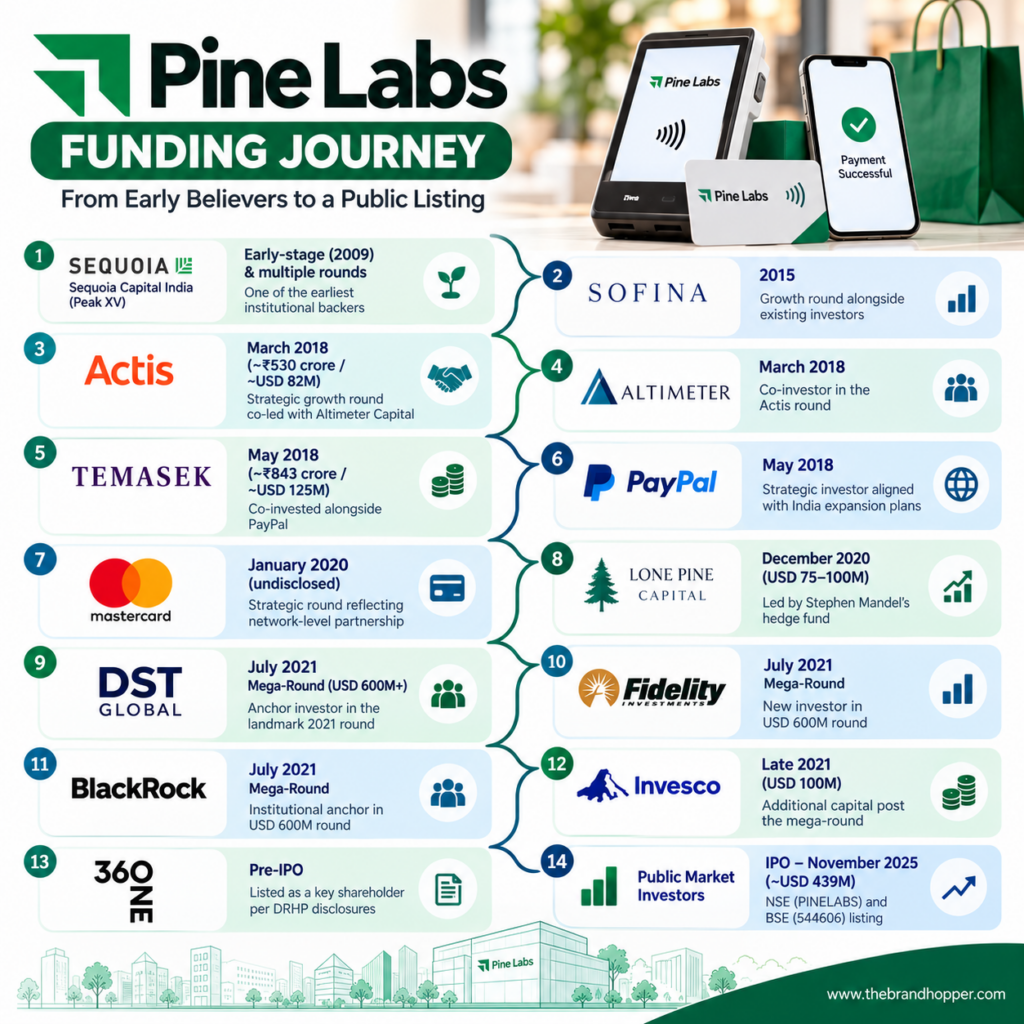
Pine Labs raised substantial capital before its IPO, attracting institutional investors and strategic partners over multiple funding rounds. The funding supported its expansion into payment infrastructure, merchant services and adjacent fintech offerings.
Its investors over time have included Peak XV Partners, Temasek, PayPal, Mastercard, Actis, Altimeter Capital, Lone Pine Capital, DST Global, Fidelity and other institutional investors. The exact investment amount and ownership held by each investor depend on the transaction and reporting date.
The November 2025 IPO combined a fresh issue with an offer for sale by existing shareholders. The prospectus and subsequent shareholding disclosures are the appropriate sources for verifying the details of individual investors and their current holdings.
Geographic Expansion of Pine Labs: A Regional Footprint
Pine Labs began in India and expanded internationally as its payment and commerce technology became relevant to businesses in other markets. Its international operations include activity across Southeast Asia, the Middle East and additional geographies.
In its Q1 FY2026–27 investor presentation, the company reported operating across more than 22 countries. This is a broader footprint than the six countries listed in older descriptions of its business.
International expansion allows Pine Labs to pursue relationships with multinational merchants, brands and financial institutions. Each market, however, has different payment systems, regulations, customer behaviours and competitive conditions, so expansion does not automatically translate into higher profitability.
Competitive Landscape of Pine Labs
Pine Labs competes across several connected areas, including physical payment acceptance, online payment gateways, affordability solutions and merchant technology. The relevant competitors differ by product, customer segment and geography.
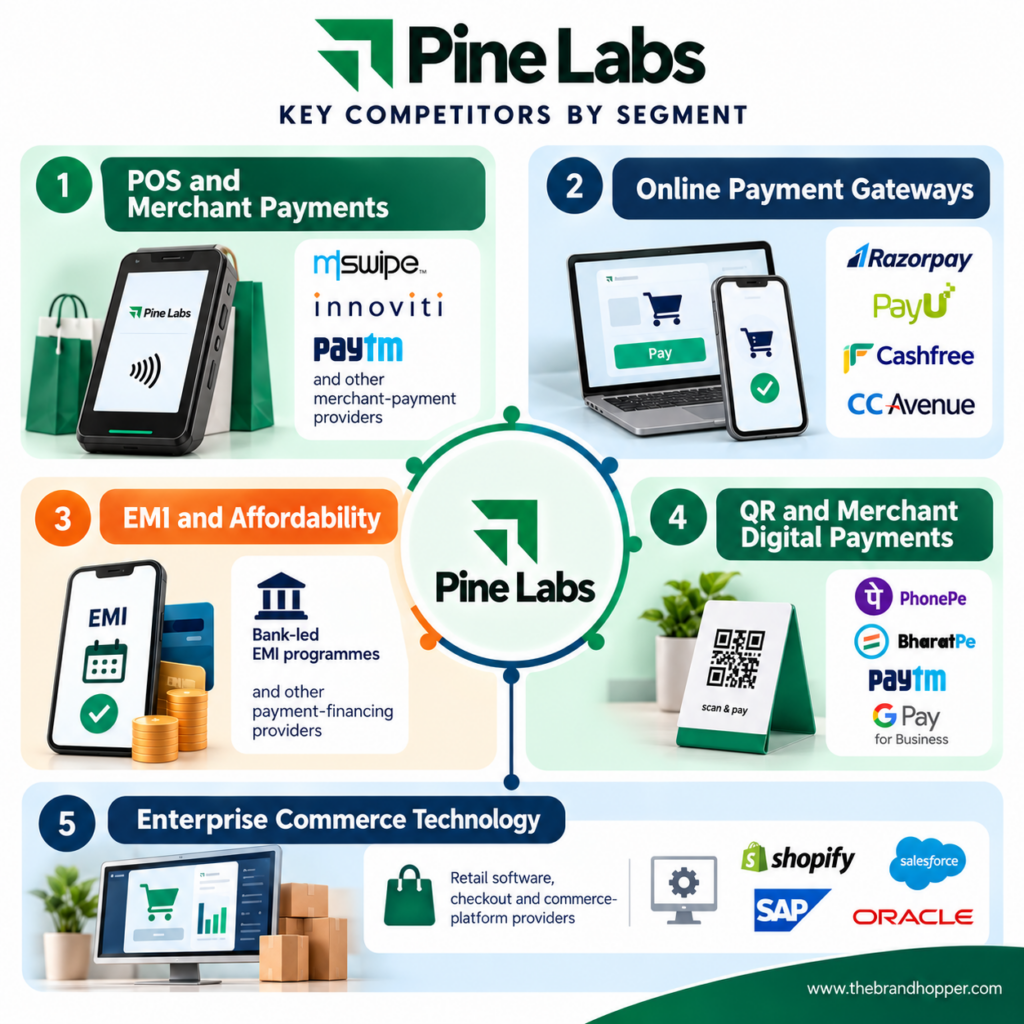
These examples are not a ranking of market share and do not imply that each company competes with Pine Labs in every product category.
Pine Labs’ competitive proposition comes from combining payment acceptance with affordability, prepaid services, issuing and acquiring capabilities, and digital commerce technology. Whether this creates a durable advantage depends on product quality, pricing, transaction success rates, merchant relationships and the economics of each service.
Leadership Team of Pine Labs
Pine Labs is led by Amrish Rau, who joined the company as CEO in 2020 after leading PayU India. He has overseen the company’s development into a broader merchant commerce and fintech infrastructure business.

The company’s leadership and senior-management responsibilities may change over time. Current titles and executive appointments should therefore be verified against the company’s latest official disclosures rather than relying solely on historical IPO documents.
Lokvir Kapoor, one of the company’s co-founders, has also been associated with Pine Labs since its early development. Current shareholding percentages and executive roles should be checked against the latest exchange filings.
Growth Strategy and What’s Next
Pine Labs’ FY2026 results and Q1 FY2026–27 investor presentation highlight several areas relevant to its next stage of development.
1. Expanding the Merchant and Checkout Network
Pine Labs reported approximately 11 lakh merchants and 20.3 lakh digital checkout points at the end of FY2026. By Q1 FY2026–27, the company reported approximately 11.5 lakh merchants and 21.7 lakh digital checkout points.
Expanding the network creates opportunities to offer more services to existing customers. The financial benefit depends on merchant activity, transaction volumes, product adoption and the cost of acquiring and servicing each relationship.
2. Deepening the Affordability Ecosystem
Pine Labs continues to develop EMI and affordability products for participating merchants and financial institutions. These offerings can support higher-value purchases and extend payment options to categories beyond traditional electronics retail.
Growth will depend on consumer demand, lender partnerships, merchant participation and the economics of promotional offers. The company must also operate within applicable lending, payments and consumer-protection requirements.
3. Building an Omnichannel Commerce Platform
Pine Labs has broadened its offering beyond physical payment terminals to include online checkout, payment links, subscriptions, prepaid products and other digital commerce services. This allows it to pursue relationships with merchants that operate across physical stores and digital channels.
The company has also been investing in AI-related capabilities and agentic payment technology, including its P3P agentic payment protocol built on UPI. These initiatives represent areas of product development; their long-term financial contribution will depend on adoption, reliability, regulatory requirements and commercial execution.
4. Accelerating International Expansion
Pine Labs’ reported footprint of more than 22 countries provides a broader base for serving international merchants, brands and financial institutions. Its international strategy includes developing local partnerships and extending payment and issuing capabilities across markets.
Expansion requires investment in technology, compliance, distribution and local operations. The company’s ability to convert international growth into sustained profitability will be an important measure of success.
Frequently Asked Questions (FAQs)
Q1. Who founded Pine Labs, and when?
A: Pine Labs was founded in 1998 by Lokvir Kapoor, Rajul Garg and Tarun Upadhyay. The company initially focused on loyalty and payment solutions for petroleum retailers before expanding into the broader merchant payments and commerce technology market.
Q2. When did Pine Labs go public, and at what price?
A: Pine Labs’ IPO opened for subscription from November 7 to November 11, 2025, with a price band of ₹210–₹221 per share. The final issue price was ₹221, and the shares listed on the NSE and BSE on November 14, 2025.
The total issue size was approximately ₹3,899.91 crore, comprising a fresh issue and an offer for sale by existing shareholders.
Q3. What is Pine Labs’ annual revenue?
A: Pine Labs reported revenue from operations of ₹2,710.59 crore in FY2026, up approximately 19% from ₹2,274.27 crore in FY2025. The company also returned to annual profitability, reporting profit after tax of approximately ₹113 crore for FY2026.
Q4. What is Pine Labs’ GTV, and why does it matter?
A: Gross transaction value represents the value of transactions processed or facilitated through the company’s platform under its reporting methodology. It indicates the scale of payment activity but is not equivalent to the revenue Pine Labs earns.
In FY2026, Pine Labs reported platform GTV of approximately ₹17.15 lakh crore and around 7.40 billion transactions.
Q5. Is Pine Labs profitable?
A: Yes, Pine Labs reported annual profit after tax of approximately ₹113 crore in FY2026, compared with a loss of around ₹145 crore in FY2025. In Q1 FY2026–27, it reported consolidated net profit of ₹19.57 crore on revenue from operations of ₹736.92 crore.
These results show an improvement in reported profitability, but future performance will depend on revenue growth, operating costs, market expansion and the sustainability of margins.
Q6. Who are Pine Labs’ major investors?
A: Pine Labs has received investment from institutional and strategic investors including Peak XV Partners, Temasek, PayPal, Mastercard, Actis, Altimeter Capital, Lone Pine Capital, DST Global and others. Investor ownership changes over time as a result of funding rounds, share sales and the IPO.
The company’s prospectus and latest exchange-filed shareholding pattern are the best sources for verifying current holdings.
Q7. What is Plural, and how does it fit into Pine Labs?
A: Plural is part of Pine Labs’ online payment and checkout offering. It supports digital merchants through payment gateway and related checkout capabilities, extending the company’s business beyond physical payment acceptance.
The wider online portfolio includes payment links, forms, subscriptions and other services designed for digital commerce.
Q8. In which countries does Pine Labs operate?
A: Pine Labs reported operating across more than 22 countries in its Q1 FY2026–27 investor presentation. Its international activities extend beyond the six markets listed in some older company profiles.
The specific markets and services available may vary, so the latest company disclosures should be consulted for a complete current country list.
Conclusion
Pine Labs’ evolution from a specialised petroleum-retail software business into a publicly listed commerce and fintech infrastructure company reflects a long-term expansion beyond its original product category. Its current offering spans physical and online payment acceptance, affordability solutions, prepaid services, issuing and acquiring, and related merchant technology.
The company’s FY2026 results show revenue growth and a return to annual profitability, alongside a substantial increase in platform GTV and the size of its merchant network. Its Q1 FY2026–27 results also indicate continued revenue growth and positive net profit.
The next phase will depend on how effectively Pine Labs turns its expanding network and product portfolio into durable earnings. International execution, product adoption, transaction growth, technology investment and disciplined cost management will all influence its long-term performance.
Also Read: Who Challenges Medtronic? 16 Competitors Reshaping MedTech
To read more content like this, subscribe to our newsletter