
Last Updated on August 5, 2026 by Team TBH
Converse is one of the most recognisable and emotionally resonant brands in global fashion. A name synonymous with authenticity, creative rebellion, and timeless style, the brand has transcended its origins as a rubber shoe company to become a cultural institution worn by rock musicians, Olympic athletes, fashion designers, and everyday individuals across more than 160 countries. Its signature Chuck Taylor All Star—essentially unchanged in design since 1917—remains one of the best-selling sneakers ever made, with more than one billion pairs sold since the company’s founding.
What makes Converse’s marketing story uniquely compelling is how the brand has maintained cultural relevance across more than a century without abandoning what makes it Converse. This article delivers a comprehensive analysis of Converse’s marketing strategy, its 4Ps Marketing Mix, collaboration philosophy, digital presence, and sustainability approach—backed by the latest data and campaign examples.
Converse: Brand at a Glance
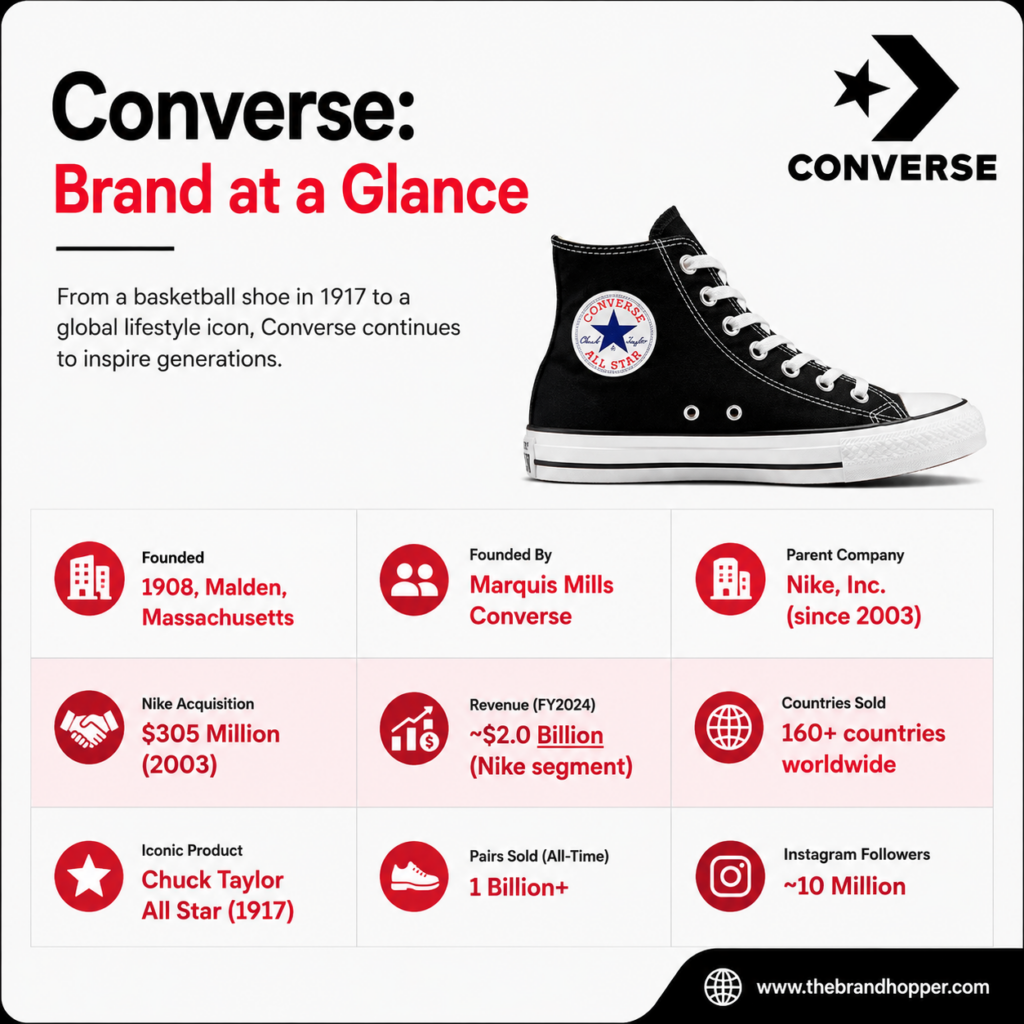
Converse has operated as a wholly owned subsidiary of Nike, Inc. since Nike’s
Converse operates as a wholly owned subsidiary of Nike, Inc. since Nike’s $305 million acquisition in 2003. Despite operating under Nike’s umbrella, Converse maintains a deliberately distinct brand identity, design language, and marketing voice—one that deliberately differentiates itself from Nike’s performance-first messaging. In Nike’s FY2024 results, Converse contributed approximately $2.0 billion to group revenues, though the brand faced headwinds from softer demand in key markets and ongoing competition from the broader lifestyle sneaker segment.
| Converse’s $2.0 billion annual revenue from a sneaker whose core design has been unchanged for over 100 years is perhaps the most compelling marketing case study in all of footwear. |
The Story Behind the Star: Converse’s Heritage
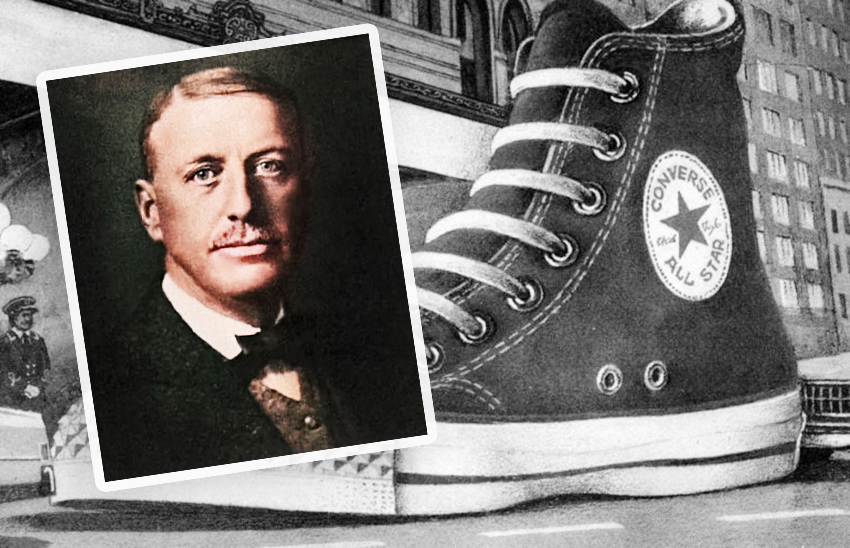
Converse’s founding in 1908 by Marquis Mills Converse in Malden, Massachusetts, established a rubber shoe company primarily making galoshes and winter boots. The commercial trajectory changed permanently in 1917 when Converse introduced its ‘Non-Skid’ basketball shoe—the design that would evolve into the Chuck Taylor All Star.
In 1921, semi-professional basketball player Charles ‘Chuck’ Taylor walked into Converse’s offices complaining of sore feet—and walked out with a job. As a brand ambassador, player-coach, and travelling evangelist for the shoe, Taylor spent decades hosting basketball clinics and selling the sneaker across America. His name was added to the ankle patch in 1932, creating the Chuck Taylor All Star—a name and design that has endured for more than 90 years. It is this human origin story, rooted in a real player’s authentic advocacy, that underpins Converse’s entire modern brand identity.
Marketing Strategies of Converse
Converse’s marketing has evolved significantly over the past decade, moving from traditional advertising toward a community-first, culture-driven model. Below are the eight core pillars of Converse’s marketing strategy.
1. Brand Positioning: Celebrating Individuality Over Performance
Converse’s brand positioning is fundamentally different from most footwear brands. While competitors like Nike, Adidas, and New Balance position themselves primarily around athletic performance, technology, or innovation, Converse positions itself as the antithesis of conformity—a brand for people who refuse to fit in. Its positioning statement can be summarised as: ‘Converse is for people who express themselves, not perform for others.’
This positioning is operationalised through three consistent brand pillars: (1) Authenticity—the Chuck Taylor’s unchanged design is its own statement of confidence, immune to trends; (2) Creativity—Converse consistently aligns with artists, musicians, and makers rather than athletes; and (3) Inclusivity—the brand intentionally represents a wide diversity of self-expression across gender, age, culture, and style.
The most powerful evidence of this positioning’s durability: Converse has never needed to update the Chuck Taylor’s silhouette to remain relevant. The shoe sells because it doesn’t look like it’s trying to sell anything. That anti-marketing quality is itself a marketing strategy—and one that has proven impossible to copy.
2. Target Audience: Youth Culture, Creatives, and the Culturally Curious
Converse’s primary target audience is teenagers and young adults aged 15–30 who sit at the intersection of music, art, street culture, and fashion. But importantly, the brand has never made this targeting exclusive—its positioning of ‘for everyone who wants to be themselves’ means a 16-year-old skateboarder and a 45-year-old art director can both be Converse’s ideal customer simultaneously.
The brand targets this audience through channels they naturally inhabit: Instagram (where Converse has approximately 10 million followers), TikTok (where Converse has run Branded Hashtag Challenge Plus campaigns with creative UGC activation), and YouTube. Converse also maintains a significant presence at music and arts festivals—partnering with events like Coachella and Lollapalooza—where its target audience congregates organically.
Converse’s targeting is deliberately culture-first, not demographic-first. Rather than targeting by age or income, Converse targets by aesthetic affinity: people who value creative self-expression over conspicuous consumption. This psychographic targeting approach has enabled the brand to remain relevant across multiple generational cohorts—from Baby Boomers who wore Chucks in the 1960s counterculture to Gen Z discovering them through TikTok’s streetwear community.
3. The ‘Love, Chuck’ Campaign: Converse’s Boldest Cultural Statement
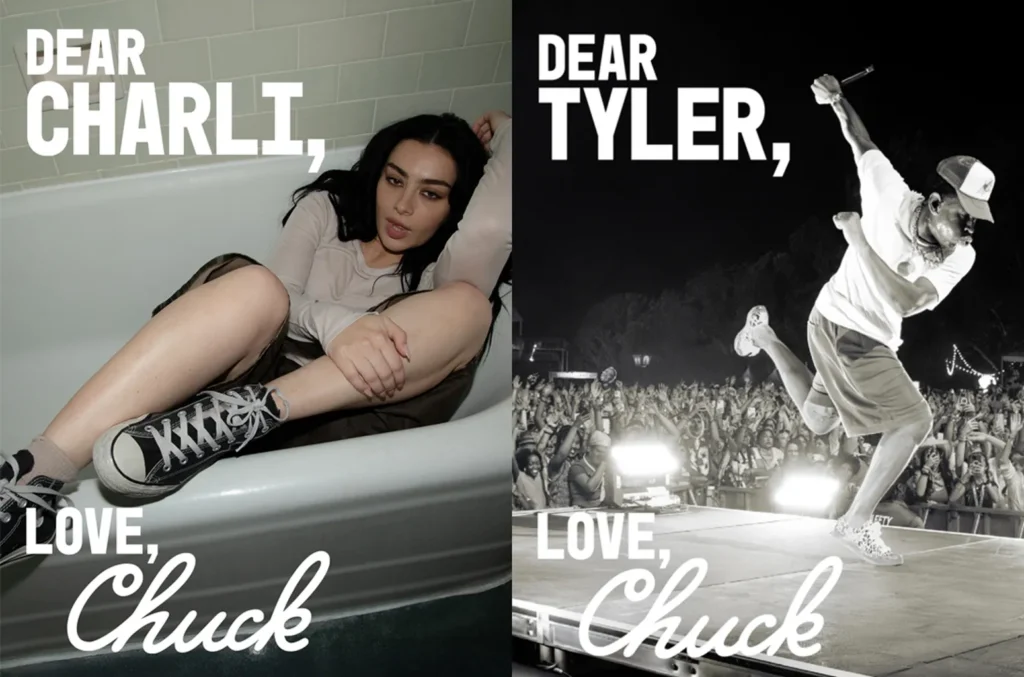
In early 2025, Converse released its most star-studded campaign to date: ‘Love, Chuck’—a 30-second short film narrated by Tyler, the Creator that serves as a love letter to the Chuck Taylor sneaker and the creative communities who have made it iconic over more than a century.
The campaign features Charli XCX (Converse partner since October 2024), Tyler, the Creator, Lil Yachty, Vince Staples, NBA star Shai Gilgeous-Alexander, Olympic skateboarder Alexis Sablone, Chinese singer-songwriter Roy Wang, and skateboarder Zion Effs—a lineup that simultaneously represents music, sport, street culture, and global pop. The campaign’s tagline ‘Go Do That’ is a call to creative action, positioning the Chuck Taylor as the shoe you put on before you make something happen.
The ‘Love, Chuck’ campaign exemplifies Converse’s marketing philosophy: let culturally credible collaborators do the storytelling, and ensure the sneaker is the quiet thread connecting their diverse worlds. There is no performance claim, no technological feature, and no limited-time offer—just a celebration of the people who choose Chuck.

4. Influencer & Celebrity Collaboration Strategy
Converse’s collaboration strategy is one of the most sophisticated in the footwear industry, built on the principle that the right cultural collaborator can do more for the brand than any advertising spend. Rather than signing traditional celebrity endorsement deals, Converse structures its partnerships around creative co-creation—where the collaborator genuinely designs, directs, or inspires the product.
Key ongoing collaborator relationships include: Tyler, the Creator (whose Golf le Fleur × Converse collections have sold out repeatedly and generated significant secondary market premiums); Charli XCX (signed as Converse partner in October 2024 with a holiday campaign photographed by Sharna Osborne); and a continuous pipeline of fashion, music, and art collaborators that keeps the brand in cultural conversation without a fixed celebrity roster.
Converse also executes pop-culture IP collaborations that generate headline coverage—including the Back to the Future × Converse Chuck Taylor collection (2024), and Billie Eilish × Converse ‘Chuck Taylor By You’ customisable editions (2024) retailing at $100–$110. These collaborations serve a dual purpose: generating sales through exclusivity scarcity, and generating media coverage that reaches far beyond paid advertising budgets.

5. Product Innovation: Limited Editions, Customisation, and Collaboration Drops
Converse’s product strategy elegantly solves the paradox of being a brand whose most iconic product never changes: it keeps the silhouette constant while endlessly varying the surface. Limited-edition drops, collaboration capsules, and material experiments create perpetual novelty within a recognisable frame—giving collectors and fashion-forward consumers reason to re-buy a shoe they already own.
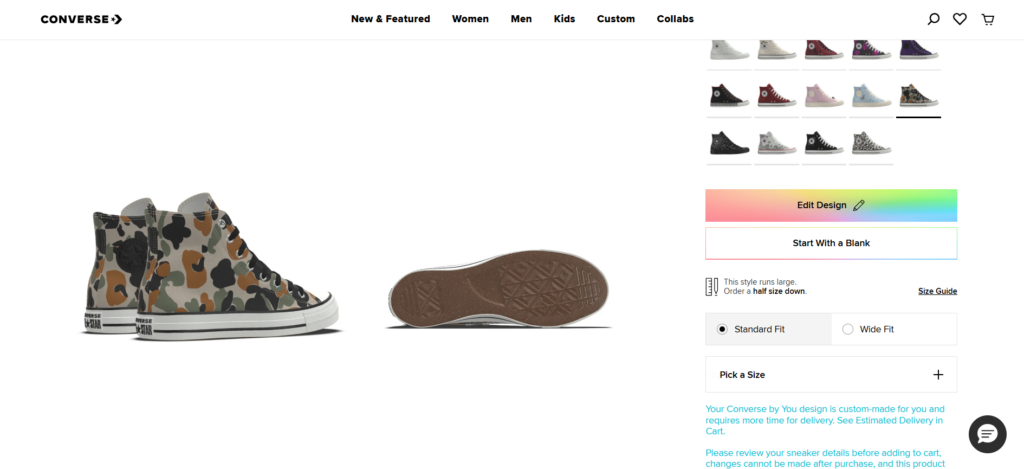
The brand’s custom platform—available at converse.com/c/custom—enables customers to design their own Chuck Taylors, selecting materials, colours, patterns, lace colours, and embroidery. This personalisation capability transforms a $65 standard shoe into an $80–$110 bespoke product while creating deep emotional ownership that drives brand loyalty and social sharing.
Recent material and design innovations include the Converse Renew line (using recycled polyester, upcycled denim, and reclaimed canvas waste), experimental collaborations like Converse × Vaquera (featuring hidden wedge soles and above-the-knee silhouettes, 2025), and the First String premium leather series introducing snake-print and croc-print leather textures. These push the Chuck Taylor’s boundaries without breaking them.
6. Content Marketing and Social-First Storytelling
Converse’s content marketing strategy is built around community amplification rather than brand broadcasting. Rather than using social media primarily to push product, Converse uses it to platform creators—showcasing the people who wear Chucks and what they create in them. This approach transforms followers into participants rather than audience.
On TikTok, Converse has run Branded Hashtag Challenge Plus campaigns—including the ‘Creative All Star Series’ that partnered with UK TikTok creators including James Lewis (2.1M followers), SurFace (5.7M followers), and TootyMcNooty (4M followers)—generating massive UGC amplification and platform-native content that performs far better than branded advertising.
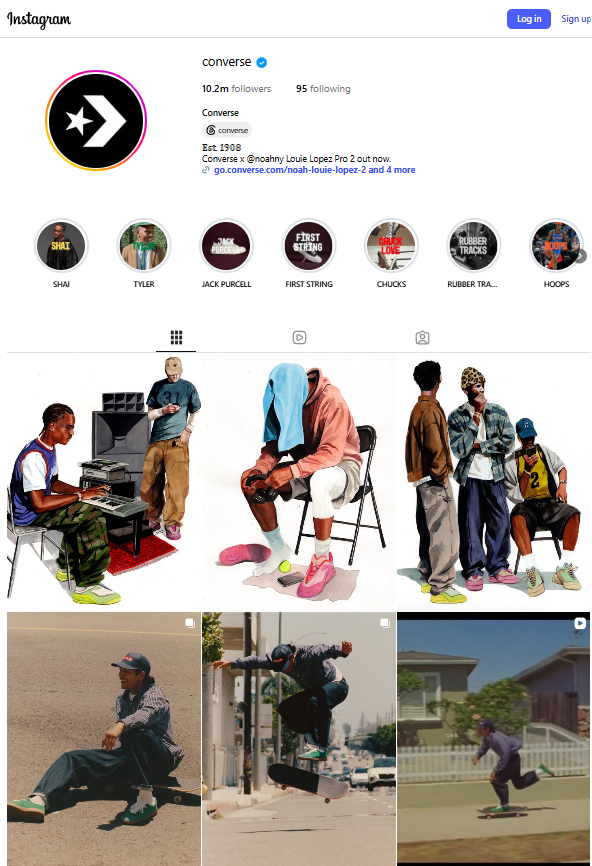
On Instagram, Converse’s @converse account (approximately 10 million followers) curates a feed that mixes product imagery with creator content, street photography, and collaboration announcements. The brand actively reposts and amplifies user-generated content, reinforcing its community-first values while generating authentic social proof that resonates with its target audience of creatives and style-conscious young consumers.
Converse also publishes long-form editorial content on its website and through partnerships with culture platforms—profiling musicians, artists, and skateboarders who wear the brand. This creates SEO value while building the cultural context that makes Converse more than just a shoe company in its audience’s mind.
7. Retail Experience: Immersive Brand Spaces and Pop-Up Culture
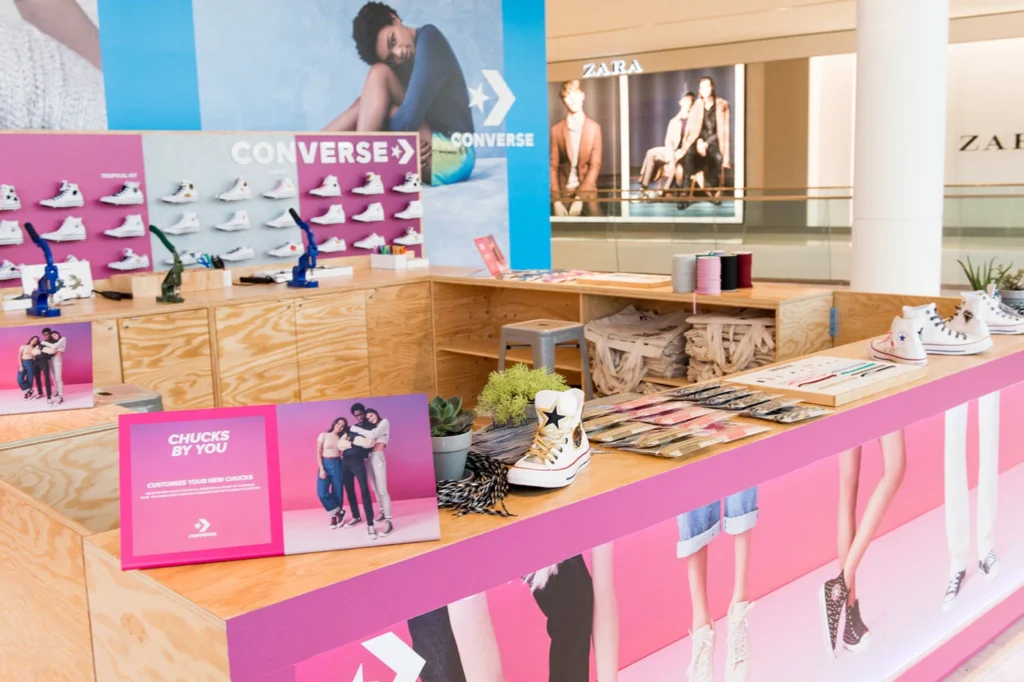
Converse’s retail strategy extends far beyond transactional store design. Its flagship stores in major cities are designed as cultural destinations—featuring exposed brick, vintage advertising archives, curated art installations, and live music events—that invite visitors to spend time rather than just shop. The physical store serves as the brand’s most immersive expression of its values.
The brand has pioneered pop-up retail as a brand-building tool. Its New York City pop-up shops have featured customisation stations where customers can design their own shoes in real time (with dyes, patches, and embroidery), live DJ sets, and photo experiences that generate organic social content from attendees. These experiential retail events consistently generate media coverage and social sharing that extends their reach far beyond the attendees present.
In addition to brand-owned stores, Converse maintains strategic wholesale distribution through department stores (Nordstrom, Macy’s), specialty footwear retailers (Foot Locker, Finish Line), and independently owned streetwear boutiques—ensuring the brand’s physical accessibility matches its cultural credibility. The multi-channel approach reflects the brand’s belief that its customers should be able to find Converse wherever they discover it, whether online or in the most curated streetwear shop in Tokyo.
8. Global Localisation: Thinking Global, Acting Local
Converse’s global marketing strategy is built on a tension between universal brand values and local cultural resonance. The brand maintains consistent global positioning—creativity, self-expression, authenticity—while executing locally relevant campaigns, collaborations, and activations that feel native to specific markets.
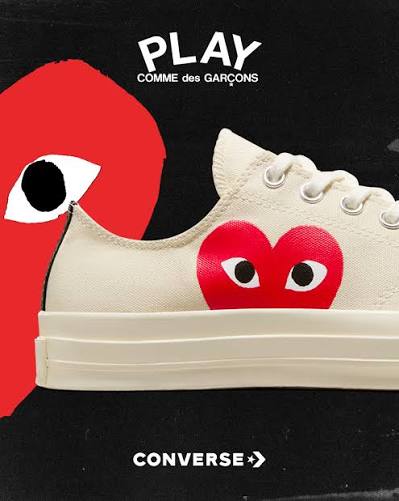
Iconic global collaborations demonstrate this: Converse × Comme des Garçons Play (Japan)—one of the longest-running and most successful fashion collaborations in sneaker history, producing the heart-logo Chuck Taylor sold at premium prices globally. Converse × Sacai (Japan)—merging Japanese luxury streetwear sensibility with Converse’s casual heritage. In India, Converse partnered with Priyanka Chopra Jonas for a collection inspired by Indian cultural aesthetics, building meaningful brand presence in a high-growth market.
Converse’s global reach now spans 160+ countries, supported by a combination of company-owned stores, licensed distribution, and e-commerce channels. The brand’s digital-first approach to international expansion has been particularly effective—allowing it to build brand heat in markets where physical retail presence is limited, through localised social media content and country-specific collaboration partnerships.
Marketing Mix of Converse: The 4Ps Deep Dive
The Marketing Mix framework (Product, Price, Place, Promotion) provides a structured lens to understand how Converse translates its marketing strategy into commercial execution. Below is a detailed analysis of each element.
1. Product
Converse’s product portfolio is anchored by the Chuck Taylor All Star but extends across a broader lifestyle ecosystem:
Core Footwear: The Chuck Taylor All Star (high-top and low-top) remains the brand’s commercial and cultural centrepiece. The Chuck 70—a premium, higher-cushion version of the original—has become a secondary hero product, particularly popular with fashion-forward consumers willing to pay a premium for enhanced comfort without visual change.
Lifestyle Extensions: Converse produces apparel (T-shirts, hoodies, joggers), accessories (bags, hats, socks), and seasonal collections that allow fans to extend their brand relationship beyond footwear.
Collaboration Products: Limited-edition collaborations with designers (Comme des Garçons, Sacai, Vaquera, Missoni), musicians (Tyler, the Creator, Charli XCX), celebrities (Billie Eilish), and cultural properties (Back to the Future) generate disproportionate media attention and secondary market activity relative to the volume sold.
Custom Products: The ‘Chuck Taylor By You’ custom platform allows consumers to create personalised editions, converting a commoditised product into a premium, emotionally unique one.
Sustainable Products: The Renew collection uses recycled polyester canvas, upcycled denim, and reclaimed material waste—addressing growing consumer demand for sustainable options within the classic silhouette.
2. Price
Converse’s pricing architecture spans a wide range, making the brand simultaneously accessible and aspirational:
| Product Category | Price Range (USD) | Strategic Purpose |
| Standard Chuck Taylor (canvas) | $55–$65 | Mass accessibility; volume driver |
| Chuck 70 (premium version) | $80–$95 | Premiumisation of core silhouette |
| Collaboration editions (Billie Eilish, Back to Future) | $98–$130 | Cultural currency; media ROI |
| Designer collabs (CDG Play, Rick Owens) | $100–$200+ | Fashion credibility; margin driver |
| Custom “By You” platform | $75–$120 | Personalisation premium; engagement |
| Renew sustainable collection | $65–$85 | ESG positioning; emerging demographic |
Converse’s pricing philosophy reflects a deliberate ladder: the $65 base price is intentionally below Nike’s and Adidas’ mass price points, maintaining the brand’s accessibility and ‘anti-elitist’ positioning, while premium collaborations allow margin expansion and cultural prestige without altering the base brand’s accessibility credentials.
3. Place
Converse’s distribution strategy balances global accessibility with brand-appropriate selectivity:
Direct-to-Consumer (DTC): Converse.com is the brand’s primary DTC channel globally, offering the full product range including exclusive drops and the custom platform. DTC generates higher margins and provides direct customer data insights.
Converse Flagship Stores: Located in major cultural capitals (New York, London, Paris, Tokyo, Seoul), flagship stores function as brand embassies—immersive retail experiences that reinforce the brand identity while generating revenue.
Nike Channels: As a Nike subsidiary, Converse products are available through Nike.com, Nike retail stores, and Nike Factory Outlets—dramatically expanding distribution reach through Nike’s global infrastructure.
Wholesale Retail Partners: Converse distributes through department stores (Nordstrom, Macy’s), sportswear retailers (Foot Locker, JD Sports, Finish Line), and independent streetwear boutiques globally—ensuring broad consumer accessibility across price segments and cultural contexts.
Global E-Commerce Partners: Converse operates through third-party e-commerce platforms including ASOS, Zalando (Europe), Flipkart (India), and regional marketplaces—extending digital reach into markets where direct DTC infrastructure is limited.
4. Promotion
Converse’s promotional strategy is deliberately media-agnostic and culture-led:
Collaboration Drops: The brand’s primary promotional engine is the limited-edition collaboration drop—a product release structured around cultural credibility and artificial scarcity that generates organic media coverage, secondary market activity, and social discussion.
Campaign Films: Converse invests in short-form campaign films (the ‘Love, Chuck’ campaign, SS25 Sport Heritage campaign) featuring culturally relevant talent across music, sport, and art—distributed primarily through digital channels and designed for social sharing.
Festival and Live Event Sponsorship: Converse maintains a significant presence at music and arts festivals (Coachella, Lollapalooza), where its target audience congregates and where the brand’s live music heritage is most resonant.
Social and Creator Marketing: TikTok Branded Hashtag Challenges, Instagram creator partnerships, and YouTube creator collaborations generate platform-native content that reaches young consumers in their natural digital habitats.
Out-of-Home and Print: Converse uses selective outdoor and print advertising for major launches, typically in urban markets with high youth culture density—New York, London, Tokyo, Seoul, Los Angeles.
PR and Cultural Events: The brand hosts intimate cultural events—gallery shows, live music sessions, pop-up experiences—that generate earned media coverage from culture and style publications including Hypebeast, Complex, and i-D Magazine.
Converse’s Digital Marketing Strategy
Social Media Ecosystem
Converse’s social media strategy is built on three platforms: Instagram (approximately 10 million followers), TikTok (brand account with dedicated creator partnership programme), and YouTube (Converse channel for campaign films and brand content). The brand’s social approach prioritises creator content over polished brand advertising—matching the authentic, unfiltered aesthetic of its target audience.
On TikTok specifically, Converse’s ‘Creative All Star Series’ demonstrated sophisticated platform-native marketing: rather than running traditional advertisements, Converse collaborated with platform-native creators to produce content that felt organic to TikTok’s culture. The Branded Hashtag Challenge Plus format—with a dedicated Discover page banner, product carousel, and interactive features—generated significant UGC volume and brand awareness among Gen Z audiences.
E-Commerce and Digital Experience
Converse.com serves as the primary digital storefront and brand experience platform. The website’s most strategically important feature is the ‘Chuck Taylor By You’ customisation tool—an interactive platform where customers select base styles, colours, materials, laces, and personal embroidery to create bespoke shoes. By inviting users to create something unique, Converse turns a transaction into a creative act, deepening brand engagement and generating shareable outcomes as customers post their custom designs.
Converse also executes limited-edition digital drops through its website and app, using product scarcity and countdown timers to create anticipation and drive traffic. Collaboration releases (Tyler, the Creator, Charli XCX, Billie Eilish) are typically launched as digital-first drops before wider retail distribution, rewarding brand loyalists with early access and driving email list and app download growth.
Sustainability and Purpose-Driven Marketing
The Converse Renew Programme
Converse launched its Renew initiative to introduce sustainable materials into its iconic product line—a critical evolution given the growing importance of environmental credentials among its young, conscious target audience. The Renew range includes:
- Renew Canvas: Made from recycled polyester derived from plastic bottles
- Renew Denim: Crafted from second-hand and waste denim sourced from manufacturing off-cuts
- Renew Cotton: Sourced from manufacturing waste fibres
Converse has committed to a 30% reduction in emissions from its direct operations by 2030 compared to 2020 levels, and is transitioning its store estate to renewable energy sources. Beginning in 2024, Converse stores in seven European countries (UK, Germany, Austria, France, Spain, Italy, Portugal) introduced a €0.35 charge for paper bags, with all proceeds donated to environmental initiatives.
| Sustainability insight: While the Renew programme represents genuine progress, the majority of Converse’s volume still uses conventional materials. The brand’s credibility here is contingent on scaling sustainable materials across the broader product range. |
Community and Cultural Investment
Converse’s purpose extends beyond environmental sustainability to community investment. The brand’s partnership with WeForest on reforestation initiatives and its long-standing support of creative education programmes reflect a broader commitment to the communities that have built the Converse brand over decades. Converse’s community-first positioning is not simply a marketing message—it is reflected in how the brand structures its collaborations (always co-created with authentic cultural partners) and how it uses its platforms (amplifying emerging creators alongside established names).
Converse’s Collaboration Strategy: A Deep Dive
No marketing element has been more central to Converse’s relevance over the past two decades than its collaboration programme. The brand’s ability to partner with culturally credible designers, musicians, brands, and IP properties while keeping the Chuck Taylor recognisable is a masterclass in co-branding discipline.
| 01 | Converse × Comme des Garçons Play
Year: 2009–present | Product: Heart-logo Chuck Taylor All Star One of the longest-running and highest-grossing fashion collaborations in sneaker history; the heart ankle patch has become an icon in its own right. |
| 02 | Converse × Tyler, the Creator (Golf le Fleur)
Year: 2017–present | Product: Golf le Fleur × Chuck Taylor One Star Recurring partnership across multiple seasons; consistently sold out; secondary market premiums of 200–400%. Tyler also appeared in the “Love, Chuck” campaign (2025). |
| 03 | Converse × Charli XCX
Year: 2024–present (Holiday campaign) | Product: Chuck Taylor campaign partnership Charli XCX announced as Converse partner in October 2024; holiday campaign photographed by Sharna Osborne; featured in “Love, Chuck” short film (2025). |
| 04 | Converse × Billie Eilish
Year: 2024 | Product: Chuck Taylor By You custom editions Billie Eilish × Converse customisation platform drop; retail prices $100–$110; capitalised on Eilish’s Gen Z cultural moment post-“Hit Me Hard and Soft.” |
| 05 | Converse × Sacai
Year: 2021 | Product: Sacai × Converse Chuck 70 Reflected Japanese luxury streetwear aesthetic while maintaining Converse casual identity; internationally distributed through Sacai retail network. |
| 06 | Converse × Vaquera
Year: 2025 | Product: XXXHi (above-the-knee) and XHi (slouch wedge) Among the most experimental Chuck Taylor silhouettes ever produced; features hidden wedge soles and textile-heavy construction—testing brand boundaries while generating fashion editorial coverage. |
| 07 | Converse × Back to the Future (IP)
Year: 2024 | Product: Chuck Taylor All Star Back to the Future collection Pop-culture IP collaboration retailing at $98; broad consumer appeal driven by franchise nostalgia; strong media pickup in entertainment press alongside footwear media. |
| 08 | Converse × Metallica / AC-DC (Music)
Year: Recurring | Product: Band-licensed Chuck Taylor prints Band licensing collaborations reach music fan demographics; Metallica and AC-DC Converse editions are perennial bestsellers in rock and metal communities. |
Frequently Asked Questions (FAQs)
Q: What is Converse’s marketing strategy in simple terms?
A: Converse’s marketing strategy is built on three core pillars: (1) Culture-first brand positioning that celebrates creativity and individuality over athletic performance; (2) Collaboration as the primary product innovation and publicity engine—partnering with artists, musicians, designers, and cultural properties to create limited-edition drops that generate media attention and scarcity demand; and (3) Community amplification through social media, creator partnerships, and experiential retail rather than traditional push advertising. The goal is for Converse to feel like it belongs to its community, not to a corporation.
Q: Who is Converse’s target audience?
A: Converse’s primary target audience is teenagers and young adults aged 15–30 who identify with creative self-expression—music fans, artists, skateboarders, streetwear enthusiasts, and anyone who values authenticity over trend-chasing. However, the brand’s open positioning means it also resonates with older consumers (30–50) who have had lifelong relationships with the Chuck Taylor, and with fashion-forward consumers at all ages who appreciate the brand’s history of designer collaborations. Psychographic targeting (by values and aesthetic sensibility) is more central to Converse’s strategy than demographic targeting.
Q: How does Converse differentiate itself from Nike, its parent company?
A: Despite being a Nike subsidiary, Converse maintains a deliberately separate brand identity. Nike positions itself around performance, innovation, and athletic achievement—’Just Do It.’ Converse positions itself around self-expression, creativity, and cultural authenticity—’Go Do That’ (from the Love, Chuck campaign). Nike targets athletes and aspirational performance seekers; Converse targets artists and creative individuals. The two brands have different visual languages, different marketing tones, and different distribution strategies, allowing them to coexist without cannibalising each other’s audience.
Q: What is the Chuck Taylor By You platform?
A: The Chuck Taylor By You platform (available at converse.com/c/custom) is Converse’s online customisation tool that allows customers to design their own pair of Chuck Taylor All Stars from scratch. Users select the base model (hi-top or low-top), canvas material and colour, accent colours, lace colour, and can add personal embroidery or text. Custom shoes typically retail between $75–$120 depending on configuration. The platform converts a commodity sneaker purchase into a creative act, deepening brand engagement and generating social-shareable outcomes.
Q: What are Converse’s most important recent campaigns?
A: Converse’s most significant recent campaign is ‘Love, Chuck’ (early 2025)—a 30-second short film narrated by Tyler, the Creator and starring Charli XCX, Lil Yachty, Vince Staples, NBA star Shai Gilgeous-Alexander, and Olympic skateboarder Alexis Sablone. The campaign celebrates the Chuck Taylor’s connection to creative communities with the tagline ‘Go Do That.’ Prior to this, Converse’s SS25 Sport Heritage campaign blended athletic and cultural storytelling, and the Charli XCX holiday 2024 partnership (photographed by Sharna Osborne) generated significant fashion media attention.
Q: Is Converse’s revenue declining?
A: In Nike’s fiscal year 2024, Converse revenues were approximately $2.0 billion, down from approximately $2.3 billion in the prior year. The brand has faced headwinds from softer consumer demand in lifestyle footwear, increased competition in the canvas sneaker category, and challenging macroeconomic conditions in key markets including Western Europe and North America. However, Converse remains one of the most globally recognised sneaker brands, with its core Chuck Taylor design holding its position as one of the best-selling shoes in history across over 160 countries.
Q: How does Converse use sustainability in its marketing?
A: Converse uses sustainability primarily through its Renew product line and its commitment to operational decarbonisation. The Renew range incorporates recycled polyester, upcycled denim, and reclaimed cotton into classic Chuck Taylor silhouettes—addressing growing demand from environmentally conscious consumers. Converse has set a 30% emissions reduction target from direct operations by 2030 and has introduced a paper bag charge in European stores with proceeds donated to environmental causes. Sustainability is currently positioned as a product line and operational commitment rather than a central brand messaging pillar.
Q: What makes Converse’s collaboration strategy unique?
A: Converse’s collaboration strategy is distinctive for three reasons: (1) Longevity—partnerships like Comme des Garçons Play (running since 2009) are maintained for years or decades, building genuine cultural depth rather than one-off hype; (2) Creative authenticity—collaborators genuinely co-create products, not just put their name on existing styles; and (3) Breadth—Converse collaborates across fashion (Sacai, Vaquera, Missoni), music (Tyler, the Creator, Charli XCX, Metallica), celebrities (Billie Eilish), and cultural IP (Back to the Future)—ensuring the brand stays relevant across multiple cultural conversations simultaneously.
Conclusion: The Marketing Genius of Never Changing
Converse’s marketing story is a profound lesson in the commercial power of authenticity. In an industry obsessed with the next technological innovation, the next performance claim, and the next design revolution, Converse has built one of the world’s most valuable shoe brands by doing the opposite: standing still.
The Chuck Taylor All Star is essentially the same shoe it was in 1917. Its genius is that this constancy has become the brand’s most powerful marketing asset—a physical embodiment of the principle that some things are too good to improve. Every collaboration, campaign, customisation platform, and influencer partnership Converse executes is ultimately in service of that unchanging core—a shoe that says, with complete confidence, ‘Be yourself. We’ll be the canvas.’
As Converse navigates the challenge of reigniting revenue growth while maintaining cultural credibility, its enduring strengths—the most recognisable sneaker silhouette on earth, a century of authentic cultural history, and a community of loyal wearers spanning every generation—provide a foundation that no competitor can easily replicate. The brand’s future lies in executing its community-first, culture-led model with even greater precision: deeper local collaborations, bolder digital experiences, and an expanded sustainability commitment that matches its audience’s values.
Also Read: Just Do It Right: Analyzing Nike’s Timeless Marketing Strategies
To read more content like this, subscribe to our newsletter