Last Updated on August 13, 2026 by Team TBH
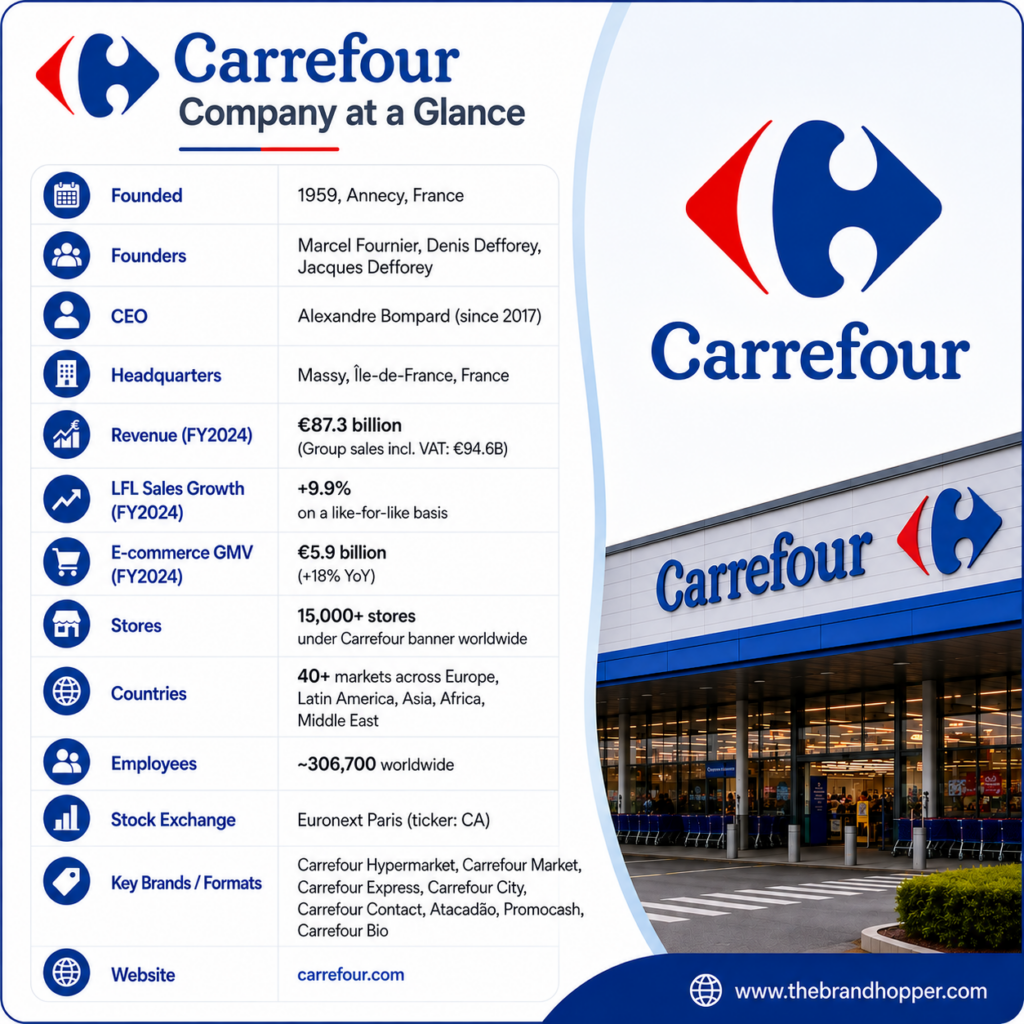
In the ever-evolving landscape of global retail, Carrefour stands as one of its most enduring architects. The word carrefour means ‘crossroads’ in French — and the name has proved prophetic: for more than six decades, Carrefour has been the point where food, non-food, convenience, digital commerce, and sustainability converge under one retail brand. Founded in 1959 in Annecy, France, Carrefour grew from a single regional supermarket into a global retail empire operating in more than 40 countries, with over 15,000 stores and €87.3 billion in annual revenue. It invented the hypermarket format that defined modern retail, and today it is reinventing itself as a digital-first, sustainability-led business for the next decade.
| Annual Revenue (FY2024)
€87.3 Billion |
Countries
40+ |
Stores Worldwide
15,000+ |
Employees
306,700+ |
Founding History of Carrefour – Origins of the European Retail Giant
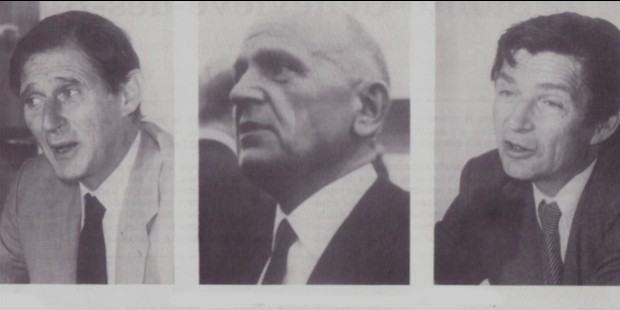
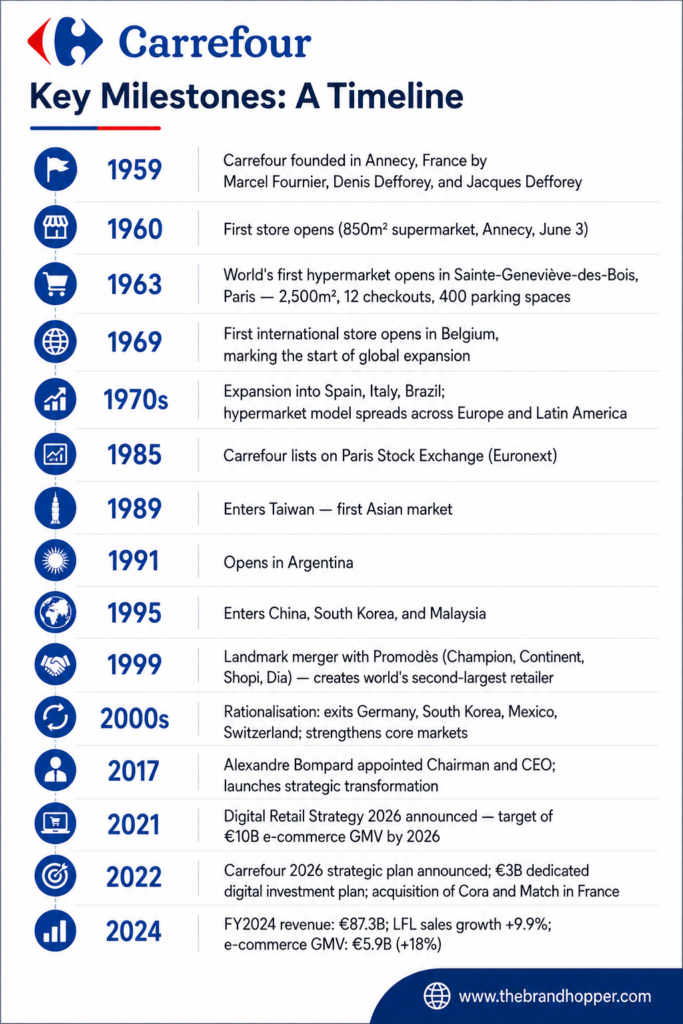
Carrefour’s story began in the aftermath of post-war France, when rising living standards were creating demand for a new kind of retail experience. In 1959, Marcel Fournier — owner of a novelties shop in Annecy — partnered with Denis Defforey and Jacques Defforey, members of a food wholesaler family from Lagnieu, to create a retail concept unlike anything France had seen before. Their vision was simple but radical: instead of small, specialised shops scattered across a neighbourhood, why not bring everything together under one large roof?
On June 3, 1960, the first Carrefour store opened its doors in Annecy — an 850m² supermarket at the crossroads of Avenue Parmelan and Avenue André Theuriet. It was an immediate success. Customers were drawn to the breadth of choice and the novel experience of finding groceries and household goods side by side.
But the founders had a bigger idea still. In 1963, inspired by large retail formats emerging in the United States, Carrefour opened the world’s first true hypermarket in Sainte-Geneviève-des-Bois, in the southern suburbs of Paris. The store covered 2,500 square metres of retail floor — enormous for its time — featured 12 checkout counters and 400 parking spaces, and stocked not just groceries but clothing, electronics, hardware, and household appliances. The concept was revolutionary: one destination for everything. Shoppers drove to it, filled large trolleys, and returned home for the week. The hypermarket was born.
| The Hypermarket: Carrefour’s Greatest Innovation
Carrefour did not simply open a large shop in 1963 — it invented a retail format that would reshape the global industry. The hypermarket concept spread from France to Spain, Germany, Brazil, China, and beyond, and remains the template for mass-market retail in dozens of countries. The success of this format is what turned a small regional grocer into a global enterprise. |
Carrefour Key Milestones: A Timeline
Carrefour’s Global Footprint: Stores by Key Market
Carrefour operates in 40+ countries across Europe, Latin America, the Middle East, Africa, and Asia — serving millions of customers through its multi-format store network. The group’s largest markets by store count include:
| Market | Stores | Key Presence |
| France | 6,468 | Largest single market; all formats from hypermarkets to Carrefour Express; acquired Cora/Match in 2022 |
| Spain | 1,474 | Strong hypermarket and supermarket network; significant Carrefour Market presence |
| Belgium | 792 | Includes integrated hypermarkets, supermarkets, and convenience; acquired by LBO France consortium in 2023 |
| Brazil | 508 | Operates as Carrefour Brasil (Grupo Carrefour Brasil); includes Atacadão cash & carry; leading food retailer in Brazil |
| Italy | 1,200 | Wide convenience and supermarket network; operated through franchise and partnership models |
| Poland | 900 | Growing convenience store format particularly strong |
| Romania | 600 | Hypermarkets and supermarkets across urban and suburban markets |
| Argentina | 300 | Hypermarkets and supermarkets; long-standing market since 1991 |
| Middle East / Egypt / Saudi Arabia | Franchise | Operated through franchise partnerships; hypermarket-led format |
| Taiwan / Asia | Various | Ongoing presence through partnerships and operated stores |
Carrefour: Revolutionizing Retail with Diverse Store Formats
One of Carrefour’s defining competitive strengths is its multi-format retail strategy. Rather than committing to a single store size or shopping occasion, Carrefour operates across the full spectrum of retail — from vast hypermarkets to neighbourhood convenience stops to pure-play e-commerce — allowing it to follow the customer across every shopping mission. Below is a comprehensive breakdown of all Carrefour’s active retail formats.
1. Carrefour Hypermarket — The Flagship Format
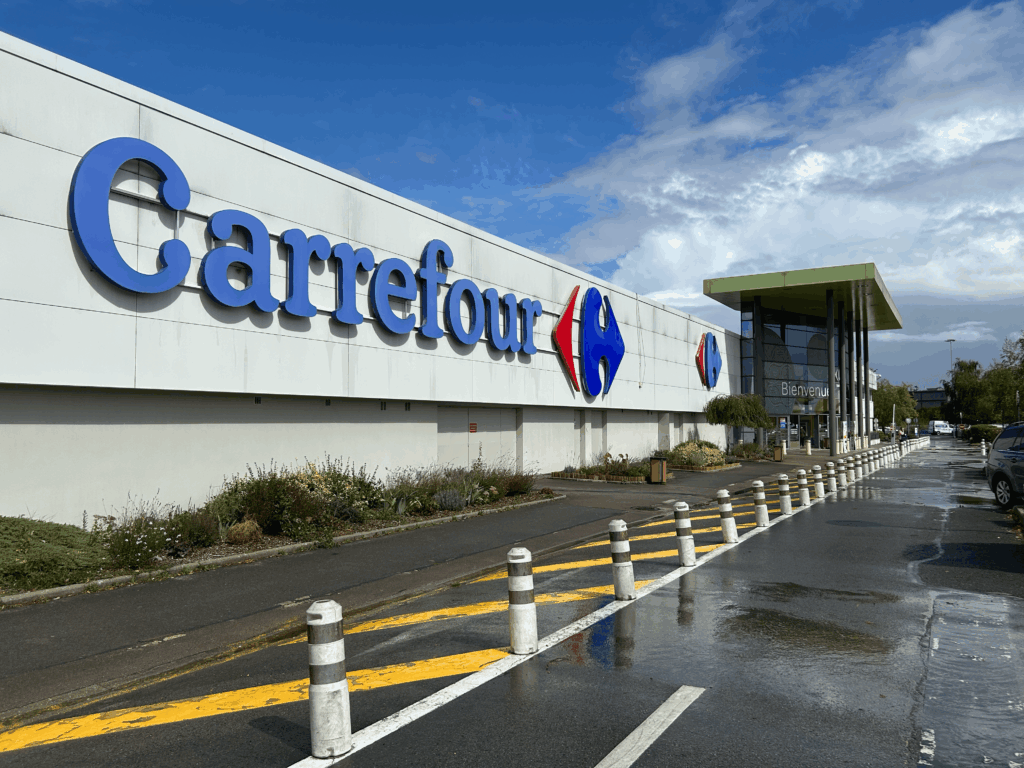
The hypermarket is Carrefour’s founding format and remains the most recognised expression of the brand globally. A Carrefour hypermarket typically covers 2,500 to 20,000+ square metres of retail floor, stocking between 40,000 and 80,000 SKUs across food (fresh produce, packaged grocery, deli, bakery, butchery, fish counter) and non-food (clothing, electronics, household appliances, sports equipment, beauty, pharmacy, and seasonal items).
Hypermarkets are typically located in suburban retail parks with large car parks, designed to attract the weekly or monthly large-basket shopping trip. They feature in-store restaurants or food courts, banking services (Carrefour Banque in France), photo printing, travel desks, petrol stations, and optical or pharmacy counters in many locations. Carrefour operates approximately 230+ hypermarkets in France alone, with thousands more across Europe, Latin America, Asia, and the Middle East.
| Hypermarket: The One-Stop Shop Standard
Carrefour’s hypermarket invented the concept of “everything under one roof” — combining grocery supermarket and department store into a single large space. Despite pressure from e-commerce and smaller-format competitors, the hypermarket retains strong performance in markets where car ownership is high and price-led shopping is valued, particularly in France, Spain, Brazil, and Romania. |
2. Carrefour Market — The Mid-Size Supermarket
Carrefour Market is the Group’s supermarket format, covering approximately 1,000 to 4,000 square metres and focused primarily on food — fresh produce, packaged grocery, deli, bakery, and an edited selection of non-food essentials. Carrefour Market stores are designed for the mid-week top-up shop: smaller than a hypermarket, more convenient to park and navigate, but with enough range to cover a weekly food shop for a family.
Carrefour Market locations are typically situated in urban and suburban residential areas, market towns, and town centres, serving local communities who may not make the trip to an out-of-town hypermarket. The format was rebranded from ‘Champion’ to ‘Carrefour Market’ following the 1999 Promodès merger, unifying the Group’s supermarket operations under a single brand. Carrefour operates approximately 1,020+ Carrefour Market supermarkets globally.
3. Carrefour Express / Carrefour City / Carrefour Contact — Convenience Stores
Recognising the massive growth in convenience and urban on-the-go shopping, Carrefour developed a portfolio of small-format urban convenience stores under multiple sub-brands. These stores range from 100 to 900 square metres and are positioned in high-traffic urban locations: city centres, residential streets, transport hubs, campuses, and petrol stations. Carrefour operates 2,000+ convenience stores globally under this cluster.
- Carrefour Express: The primary convenience sub-brand in most markets; focused on ready meals, fresh produce, snacks, beverages, and essential grocery in compact urban formats. Typically open extended hours, often 7am–midnight.
- Carrefour City: An urban convenience format targeting city-centre workers and residents seeking quick lunch and grocery purchases; curated range with strong fresh and prepared food emphasis.
- Carrefour Contact: Primarily found in smaller towns and rural communities in France where there is no full-size supermarket; serves as the community food store with a core range of grocery, fresh, and household essentials.
- Carrefour Montagne: Specialised convenience format for ski resorts and mountain areas in France, adjusted for seasonal tourism demand.
- Carrefour Proximité: The franchise umbrella under which independent retailers in France operate convenience stores using the Carrefour brand; allows rapid scale without direct capital deployment.
4. Atacadão and Promocash — Cash & Carry / Wholesale Format
Carrefour’s cash-and-carry wholesale format allows the Group to serve small businesses, restaurateurs, hotels, and caterers who need to purchase in bulk at competitive prices. This B2B-oriented format delivers higher basket sizes per visit and attracts a different customer profile from the B2C supermarket formats.
- Atacadão (Brazil): Brazil’s leading cash & carry operator and one of Grupo Carrefour Brasil’s most successful formats. Atacadão stores are warehouse-style, offering bulk grocery, dry goods, beverages, and non-food items at wholesale prices to small business owners and consumers alike. Atacadão is a key driver of Carrefour Brasil’s market leadership in Brazilian food retail.
- Promocash (France): France’s cash & carry format targeting the HoReCa (hotel, restaurant, café) and catering sector; offers a wide range of bulk-packed food, beverages, cleaning supplies, and professional kitchen equipment.
5. Carrefour Bio — Organic and Sustainability-Focused Format
Carrefour Bio is the Group’s dedicated organic product range and, in some markets, a stand-alone store format. All Carrefour Bio products carry certified organic labelling and meet strict standards for ingredient sourcing, production methods, and environmental impact. The Carrefour Bio range spans fresh fruit and vegetables, dairy, bakery, meat, packaged grocery, and baby food — targeting the health-conscious and environmentally aware consumer segment.
Carrefour’s sustainability targets include generating €8.5 billion in revenue from organic and certified sustainable products by 2030, reflecting the strategic importance of organic and sustainability-labelled products to its long-term growth plan.
6. E-Commerce and Digital Retail — Carrefour’s Fastest-Growing Channel
Carrefour’s e-commerce operations have grown dramatically, reaching a Gross Merchandise Value (GMV) of €5.9 billion in its latest fiscal year, up 18% year-on-year. Food e-commerce was particularly strong, growing 34% within the digital channel. The Group’s Carrefour 2026 strategic plan targets a GMV of €10 billion — roughly triple its 2021 level — making e-commerce one of the Group’s most significant growth drivers.
Customers can access Carrefour’s e-commerce offer through multiple digital touchpoints:
- com / national e-commerce sites: Full grocery range with home delivery and click-and-collect (drive) options; available in all major markets.
- Mobile app: The Carrefour app enables shopping, loyalty card management, digital promotions, and order tracking; available across platforms.
- Click & Collect (Drive): A hugely popular format in France — customers order online and collect pre-packed orders from a dedicated ‘drive-through’ collection point at or near a store, without entering the shop.
- Same-day and express delivery: Partnerships with Uber Eats, Cajoo, and Bringo enable express delivery in under 3 hours; the Group is also investing in quick commerce (under 15 minutes) for urban markets.
- Carrefour Sprint / Quick Commerce: The sub-15-minute delivery format, using dark stores and micro-fulfilment hubs, targeting urban consumers who need immediate grocery delivery.
7. Franchise and Partnership Format
In markets where Carrefour does not operate directly — particularly in the Middle East (Saudi Arabia, UAE, Qatar, Bahrain), North Africa (Egypt, Morocco, Tunisia), and parts of Asia — the brand is present through master franchise and licensing agreements. Franchise partners build and operate stores under the Carrefour brand, sourcing some products directly from Carrefour and following Group brand standards. This capital-light model gives Carrefour presence in fast-growing markets without the balance-sheet risk of direct investment.
Carrefour Retail Formats: Summary Overview
| Format | Typical Size | Range | Shopping Occasion |
| Hypermarket | 2,500–20,000+ m² | Full food + non-food (40,000–80,000 SKUs) | Weekly large-basket; destination shopping |
| Carrefour Market | 1,000–4,000 m² | Full food, limited non-food | Weekly top-up; neighbourhood grocery |
| Carrefour Express | 200–900 m² | Core grocery, fresh, snacks, ready meals | Daily convenience; on-the-go; top-up |
| Carrefour City | 100–500 m² | Urban daily essentials, fresh, prepared foods | Lunchtime; city commuter; immediate needs |
| Carrefour Contact | 200–800 m² | Community grocery essentials | Local community; smaller towns |
| Atacadão (Brazil) | Warehouse format | Bulk food, beverage, non-food (B2B + B2C) | Bulk wholesale; business purchasing |
| Promocash (France) | Warehouse format | Food service and catering bulk | HoReCa / professional catering |
| Carrefour Bio | Varies | Certified organic across all categories | Health-conscious weekly shopping |
| E-commerce / Drive | Online + dark store | Full grocery range | Delivery, click-and-collect, quick commerce |
| Franchise / Partners | Market-dependent | Hypermarket and supermarket formats | International markets under licensed brand |
The Carrefour 2026 Strategic Plan
In 2022, CEO Alexandre Bompard unveiled the Carrefour 2026 strategic plan — a comprehensive roadmap for transforming the Group into a digital-first, food-transition-led retail leader. The plan is built around five strategic pillars and represents a total digital investment of €3 billion between 2022 and 2026.
| Strategic Pillar | Key Target / Initiative |
| 1. E-commerce acceleration | Triple e-commerce GMV to €10 billion by end of 2026 (from ~€3.3B in 2021); scale quick commerce and same-day delivery |
| 2. Data & Retail Media | Monetise Carrefour’s first-party customer data through targeted advertising for FMCG brands; build a leading retail media network |
| 3. Financial services digitalisation | Grow Carrefour Banque and insurance products digitally; expand digital payment solutions across markets |
| 4. Operational cost savings via digital | €4 billion in cumulative cost savings by 2026 through AI, automation, supply chain optimisation, and workforce efficiency |
| 5. Food transition leadership | Reach €8.5B in organic/certified sustainable product revenue by 2030; €1B in plant-based alternatives; 40% private label food share by end-2025 |
FY2024 results demonstrated solid progress: e-commerce GMV reached €5.9 billion (+18%), LFL sales growth hit +9.9% (one of the strongest in the Group’s history), and cost savings of €1.24 billion were delivered in the year. Net free cash flow stood at €1.46 billion. The Group is on trajectory to meet its 2026 digital targets.
Carrefour’s Private Label Strategy
Private label (own-brand) products are central to Carrefour’s competitive positioning and financial model. Carrefour’s own-brand strategy operates across multiple tiers:
Carrefour (standard own label): The core private label range offering comparable quality to category-leading brands at a discount of 20–30%. The range covers virtually every food and non-food category. Carrefour is targeting private label to reach 40% of food sales by end-2025.
Carrefour Bio: Certified organic products; the premium-wellness tier of Carrefour’s own brand portfolio; part of the Group’s food transition commitment.
Carrefour Reflets De France: Products sourced from and labelled as French origin; taps into strong consumer preference for local sourcing; resonates particularly with the French customer base.
Carrefour Selection: A premium tier of Carrefour own-brand products, comparable to national premium brands; used in charcuterie, specialty cheese, wine, and confectionery categories.
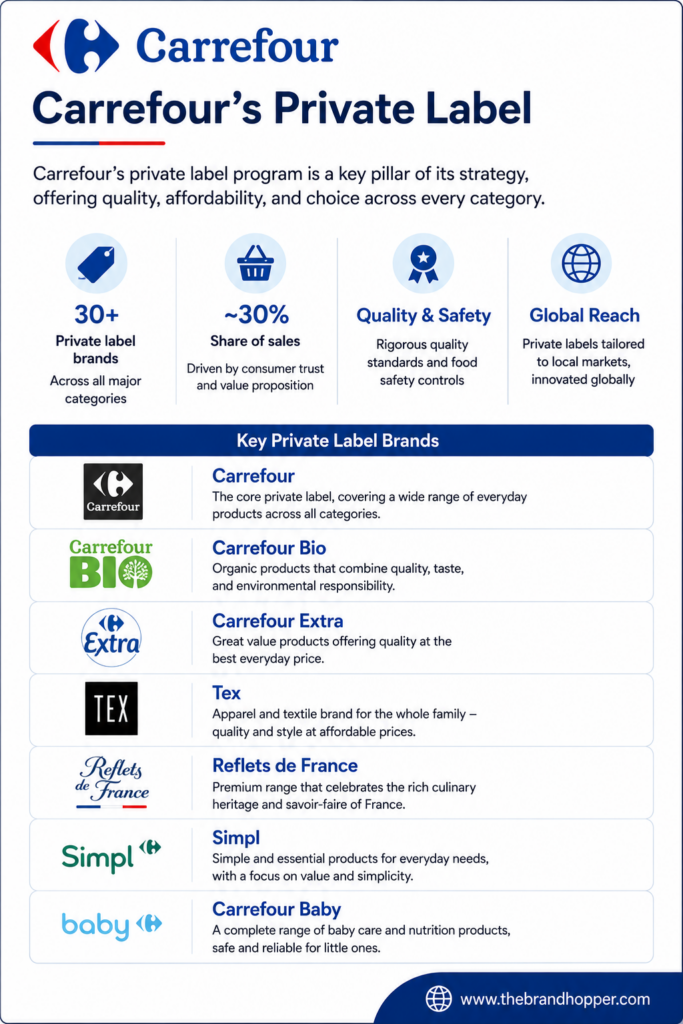
Private label products typically deliver higher gross margins than branded equivalents, making Carrefour’s private label penetration target both a customer value initiative (lower shelf price for shoppers) and a profitability initiative for the Group. During periods of consumer price sensitivity, strong own-brand ranges allow retailers to capture switching customers without compromising margin.
Sustainability Strategy: Act For Food and the Climate Plan
Carrefour has positioned sustainability not as a bolt-on CSR activity but as a core strategic differentiator. Its flagship sustainability initiative, Act For Food, encompasses commitments across the food system — from organic farming and product traceability to reducing ultra-processed ingredients and fighting food waste. Its climate commitments are equally ambitious:
| Commitment | Target |
| Greenhouse gas reduction (direct operations) | 60% reduction by 2030 vs. 2019 baseline |
| GHG reduction (full value chain) | 70% reduction by 2040 vs. 2019 baseline |
| Carbon neutrality | Group target of carbon neutrality by 2040 |
| SBTi validation | 1.5°C-aligned trajectory; validated by Science Based Targets initiative |
| Organic / certified sustainable product revenue | €8.5 billion by 2030 |
| Plant-based alternatives revenue | €1 billion by 2030 |
| Private label food penetration | 40% of food sales by end-2025 |
| Act For Food commitments | Reducing pesticides in products, improving recipes, promoting seasonal and local sourcing across all markets |
| Carrefour’s Food Transition Leadership
Carrefour is one of the few major global retailers to have its climate targets validated by the Science Based Targets initiative (SBTi) at the 1.5°C threshold — the most ambitious alignment standard. Its Act For Food programme covers 28 commitments across nutritional quality, sustainable sourcing, food waste reduction, and empowering farmers to adopt regenerative practices. |
Digital Transformation: Carrefour as a Data and Retail Media Business
Carrefour’s digital transformation goes beyond simply enabling online grocery orders. The Group has invested in becoming a data-driven retail platform that monetises customer insight through personalised marketing and retail media advertising.
Retail Media: Carrefour has built one of Europe’s most advanced retail media networks, allowing FMCG brands to place targeted digital advertising on Carrefour’s owned channels — its website, app, and in-store digital screens — using Carrefour’s first-party loyalty data for precision targeting. This is a high-margin revenue stream that is growing rapidly across the industry.
Data platform: Carrefour Links is the Group’s retail media and data platform, enabling brands to plan, buy, and measure digital advertising campaigns against Carrefour’s customer dataset.
AI in supply chain: Carrefour is deploying artificial intelligence for demand forecasting, inventory optimisation, markdown pricing, and food waste reduction — with the goal of delivering €4 billion in cumulative cost savings through the 2026 plan.
Digital financial services: Carrefour Banque (consumer banking and insurance) is being expanded digitally, with the goal of growing its financial services customer base as a recurring revenue and loyalty driver.
Quick commerce partnerships: Partnerships with Uber Eats, Bringo, and other last-mile delivery platforms enable sub-3-hour grocery delivery from Carrefour stores and dark stores in urban markets.
SWOT Analysis of Carrefour
| SWOT | Factors |
| STRENGTHS | World’s second-largest food retailer and largest hypermarket operator | Multi-format portfolio across all shopping occasions | 15,000+ stores in 40+ countries with truly global scale | €5.9B e-commerce GMV growing at 18% YoY | Strong private label penetration (target 40% of food) | Deep first-party customer data via loyalty programmes | Established in fast-growing markets (Brazil #1 food retailer) | SBTi-validated 1.5°C climate targets — sustainability leadership |
| WEAKNESSES | Hypermarket format under structural pressure from e-commerce and convenience formats | Revenue and profit volatility across geographies (FX, inflation) | Net income declined from €1.66B to €723M in FY2024 | Highly leveraged operational footprint requiring intensive capex | Historic exit from multiple markets (Germany, South Korea) demonstrates limits of the global rollout model |
| OPPORTUNITIES | Retail media is a high-margin, fast-growing revenue stream for retailers with first-party data | Quick commerce and last-mile delivery market is growing rapidly in all urban markets | Plant-based and organic food categories have secular growth tailwinds | Digital financial services (BNPL, Carrefour Banque) could drive significant recurring revenue | Expansion in Africa and Middle East through franchise model |
| THREATS | Competition from Amazon Fresh, local e-grocers, and dark store specialists in urban markets | Discount grocery chains (Lidl, Aldi) taking share in price-sensitive markets | Consumer spending pressure from inflation and cost-of-living squeezes basket size | Regulatory complexity across 40+ markets (food safety, labour, data privacy) | Hypermarket visitor frequency declining as consumers fragment shopping across more touchpoints |
Frequently Asked Questions (FAQs)
Q: Who founded Carrefour and when?
A: Carrefour was founded in 1959 in Annecy, France, by Marcel Fournier, Denis Defforey, and Jacques Defforey. The founders opened their first store — an 850m² supermarket — on June 3, 1960. The name “Carrefour” means “crossroads” in French, reflecting the founders’ vision of creating a central hub where customers could find all their shopping needs in one location.
Q: What does Carrefour mean in English?
A: “Carrefour” is a French word meaning “crossroads” — a meeting point where multiple roads or paths converge. The founders chose the name to symbolise their vision of a retail destination where customers could find everything they needed under one roof, at the intersection of food, non-food, and services.
Q: How many stores does Carrefour have worldwide?
A: Carrefour operates more than 15,000 stores under its various banners worldwide, across 40+ countries. The largest single market is France, with approximately 6,468 stores. Other major markets include Spain (1,474 stores), Belgium (792 stores), and Brazil (508 directly operated stores, plus extensive Atacadão network). The Group serves millions of customers globally across its hypermarket, supermarket, convenience, cash & carry, and e-commerce formats.
Q: What is Carrefour’s annual revenue?
A: Carrefour reported total revenues of €87.3 billion for its most recent fiscal year, with Group sales including VAT reaching €94.6 billion. Like-for-like sales growth was +9.9%, one of the strongest performances in the Group’s recent history. E-commerce GMV reached €5.9 billion, growing 18% year-on-year, reflecting the success of the Group’s digital transformation strategy.
Q: What are Carrefour’s different store formats?
A: Carrefour operates across seven main retail formats: (1) Hypermarkets — the original flagship format, 2,500–20,000+ m²; (2) Carrefour Market — mid-size supermarkets of 1,000–4,000m²; (3) Convenience stores — Carrefour Express, Carrefour City, and Carrefour Contact in urban and local community settings; (4) Cash & Carry — Atacadão (Brazil) and Promocash (France) for wholesale buyers; (5) Carrefour Bio — organic-certified product range and stores; (6) E-commerce — carrefour.com, click & collect, same-day delivery, and quick commerce; (7) Franchise — operated by licensed partners in the Middle East, North Africa, and parts of Asia.
Q: What is the Carrefour 2026 strategic plan?
A: The Carrefour 2026 plan, announced in 2022 by CEO Alexandre Bompard, is a five-pillar strategy focused on: (1) accelerating e-commerce GMV to €10 billion by 2026; (2) building a leading retail media and data business; (3) digitalising financial services; (4) delivering €4 billion in cost savings through AI and digital operational transformation; and (5) leading the food transition to organic and sustainable products. The plan involves €3 billion of dedicated digital investment between 2022 and 2026.
Q: Is Carrefour the biggest supermarket in the world?
A: Carrefour is the world’s second-largest food retailer by revenue, after Walmart. It is the largest hypermarket operator in the world and the largest food retailer in Europe. Carrefour pioneered the hypermarket format in 1963 and remains the benchmark for the format globally. In Brazil, it is the largest food retailer in the country through its Carrefour Brasil (Grupo Carrefour Brasil) subsidiary and Atacadão cash & carry network.
Q: What is Carrefour doing for sustainability?
A: Carrefour’s sustainability strategy includes: (1) a carbon neutrality target by 2040, with a 60% reduction in direct operations by 2030 (vs. 2019) — validated by the Science Based Targets initiative (SBTi) at the 1.5°C level; (2) the Act For Food programme committing to reduce pesticides, improve product recipes, promote organic and local sourcing; (3) a target of €8.5 billion in revenue from organic and certified sustainable products by 2030; (4) €1 billion target in plant-based alternatives revenue by 2030; and (5) a private label penetration target of 40% to provide consumers with more sustainable, lower-cost product options.
Conclusion
Carrefour’s journey from a 850-square-metre supermarket in Annecy to a €87 billion global retail group is one of the defining stories of modern commerce. It invented the hypermarket, took that format around the world, and built one of the most recognisable retail brands on the planet. Today, the company faces a challenge familiar to all established retailers: how to stay relevant in a world where e-commerce, quick commerce, and discount grocery are pulling consumer spending in new directions.
The answer Carrefour is betting on — the Carrefour 2026 plan — is to use its unrivalled first-party customer data, its vast physical store footprint, and its multi-format diversity as complementary assets rather than legacy liabilities. The physical store becomes a fulfilment hub for e-commerce. The loyalty card becomes a data platform for retail media. The private label range becomes a tool for both consumer value and margin management. And the hypermarket, rather than fading away, evolves into a hybrid format where digital and physical experiences converge.
With 15,000+ stores, 40+ markets, a growing e-commerce business, SBTi-validated climate targets, and a management team executing on a clear strategic plan, Carrefour is not just surviving the retail revolution — it is shaping it.
For more information about Carrefour’s global operations, visit: www.carrefour.com
Also Read: Hitting The Bullseye: Target Corporation’s Trailblazing Journey in Retail