Last Updated on July 29, 2026 by Team TBH
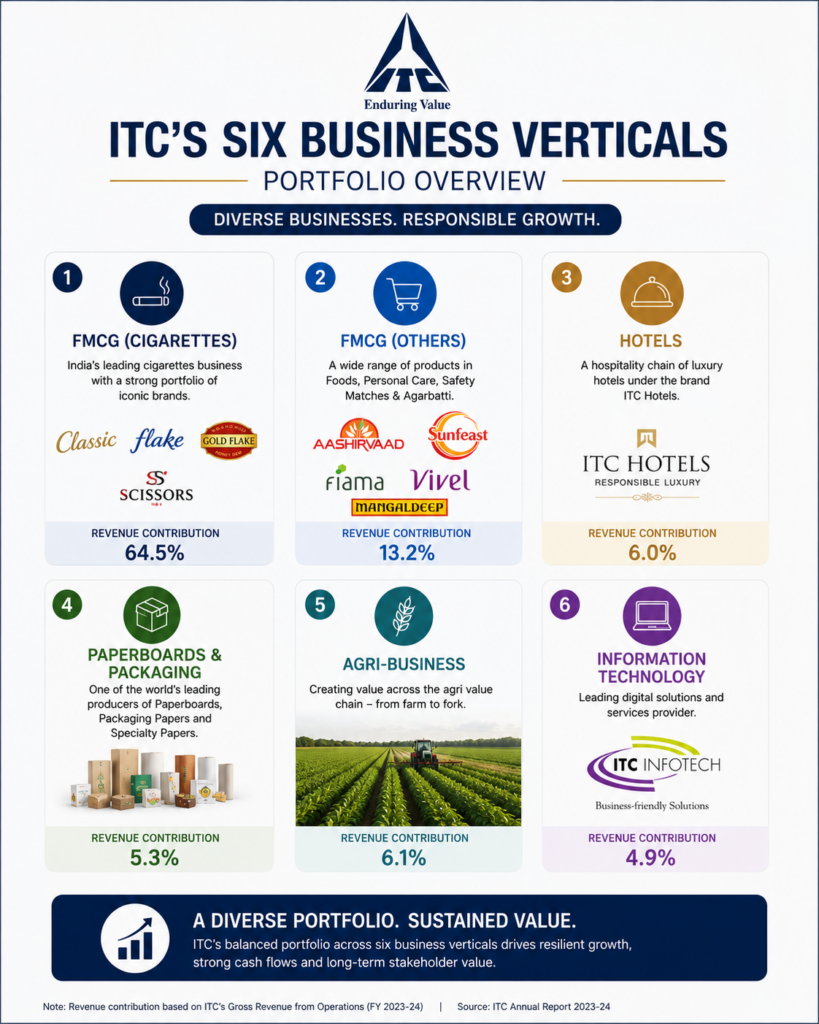
ITC Limited is one of India’s foremost private sector conglomerates — a company that has, over more than a century, reinvented itself from a single-product tobacco business into one of the most diversified and admired corporate groups in Asia. Founded in 1910 as the Imperial Tobacco Company of India Limited and headquartered in Kolkata, ITC today operates across six distinct business verticals: FMCG (cigarettes and non-tobacco consumer goods), Hotels, Paperboards & Packaging, Agri-Business, and Information Technology.
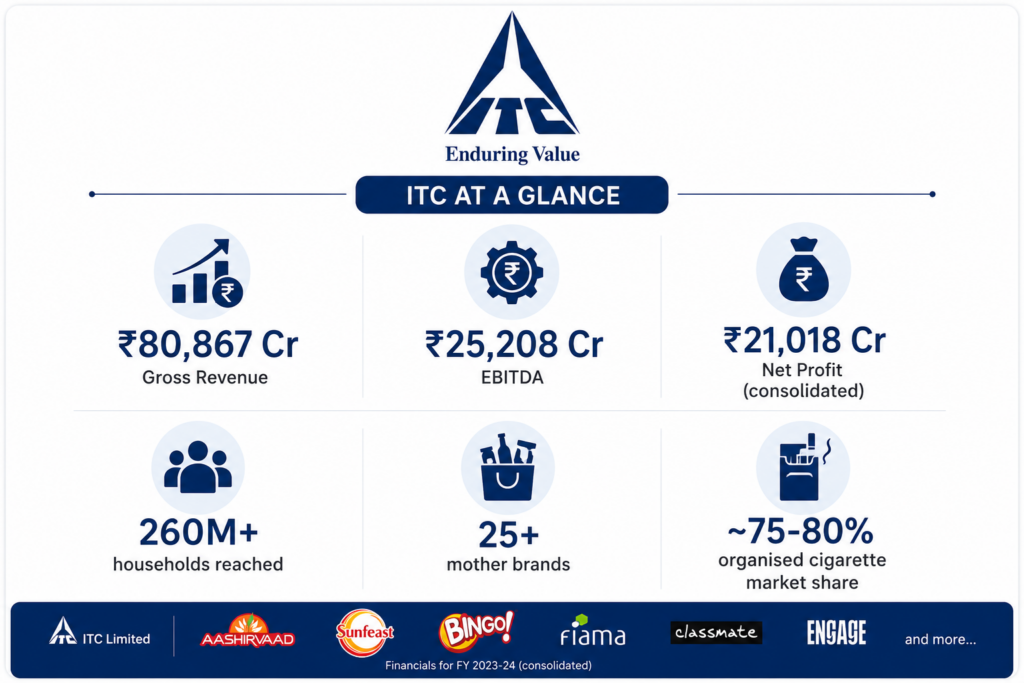
The scale is striking. ITC recorded a Gross Revenue of ₹80,867 crore and EBITDA of ₹25,208 crore for the financial year ended March 31, 2026, with consolidated net profit reaching ₹21,018 crore. Its FMCG portfolio reaches more than 260 million households across India, encompassing over 25 mother brands — including Aashirvaad, Sunfeast, Bingo!, Fiama, Savlon, Classmate and Mangaldeep — that collectively represent an annual consumer spend exceeding ₹34,000 crore. In cigarettes, ITC commands approximately 75-80% of India’s organised market. In paperboards, it is the country’s largest player. In agribusiness, its e-Choupal network has created the world’s largest rural digital infrastructure, reaching tens of millions of farmers.
This article provides the most comprehensive and current overview of ITC’s business portfolio available — updated to reflect the landmark demerger of ITC Hotels into a separately listed entity, the continued scale-up of key FMCG brands, and the company’s evolution toward becoming a future-ready, diversified consumer goods and services conglomerate.
A Brief History of ITC Limited
The story of ITC Limited is one of the most remarkable corporate journeys in Indian business history. The company was registered on August 24, 1910, as the Imperial Tobacco Company of India Limited in Kolkata, beginning operations as a cigarette manufacturer and distributor for British-American Tobacco (BAT). Its early brands — India Kings and Bristol — established it as the dominant player in India’s nascent tobacco market.
In the post-independence era, as India’s economic and regulatory environment transformed, ITC began a deliberate and disciplined diversification strategy. The 1970s were particularly pivotal: the company entered the hospitality sector, the paperboards and packaging industry, and launched its first branded packaged food products. The name was formally changed to ‘ITC Limited’ in 1974, signalling a broader corporate identity that would transcend tobacco.
The 1990s and 2000s brought ITC’s most ambitious expansion. The FMCG segment was aggressively built out — Sunfeast biscuits launched in 2003, Bingo! snacks in 2007, and a succession of personal care and hygiene brands established ITC as a genuine challenger to Hindustan Unilever in the Indian consumer goods landscape. The e-Choupal rural digital platform, launched in 2000, set a global benchmark for tech-enabled agribusiness.
Most recently, ITC executed a landmark structural transformation: the demerger of its hotels business into a separately listed entity, ITC Hotels Limited (ITCHL), effective January 1, 2026, with ITC Hotels shares listing on BSE and NSE on January 29, 2026. ITC retained a 40% stake in the new entity, with the remaining 60% distributed directly to ITC shareholders. This demerger unlocked significant value and allowed both entities to pursue capital-efficient growth strategies independently.
Businesses and Business Units of ITC Limited
ITC’s diversified business portfolio is structured across six primary verticals. Each operates as a distinct strategic business unit with its own brand architecture, competitive positioning, and growth trajectory. Together they form one of the most complex and admired conglomerate structures in Indian corporate history.
BUSINESS 1: FMCG — CIGARETTES
Cigarettes: India’s Dominant Tobacco Franchise
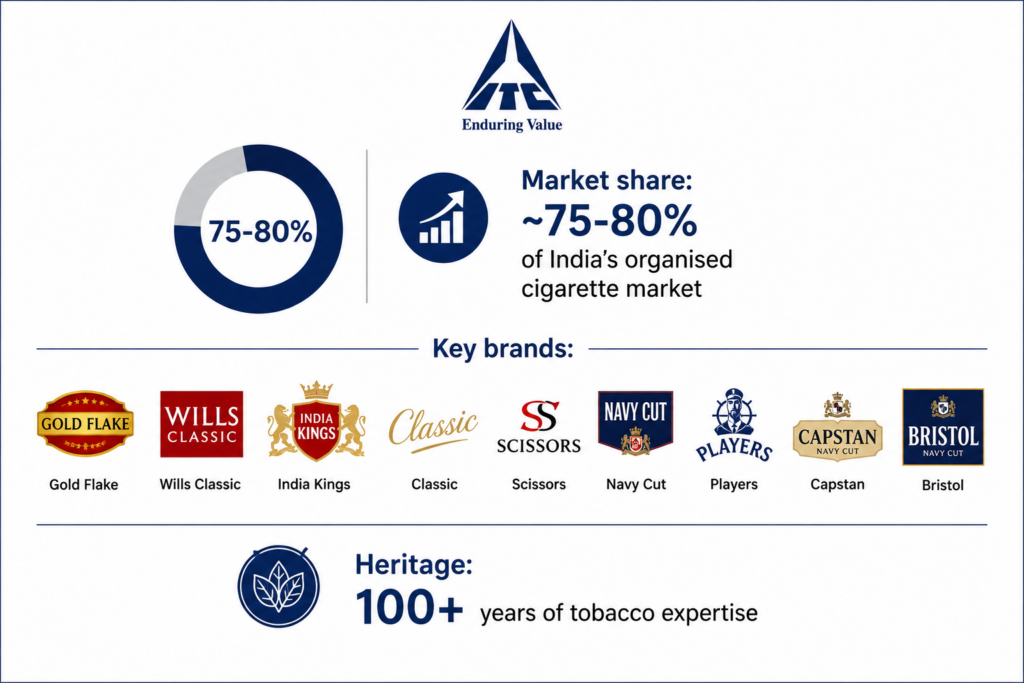
ITC’s cigarettes business is the oldest and, by operating margin, the most profitable division within the group. With a portfolio spanning more than a dozen brands across all price segments — from premium India Kings and Classic to mid-range Gold Flake (which alone commands approximately 29% of total cigarette market share) to mass-market Scissors and Capstan — ITC commands approximately 75-80% of India’s organised cigarette market. Nowadays, you can also buy cigarette online from various sources, something which ITC doesn’t engage in currently.
The breadth of the brand architecture is its competitive moat. At the premium end, India Kings targets the luxury smoker; Wills Classic serves the premium segment; Gold Flake and its sub-brands (Gold Flake Kings, Gold Flake Lights) dominate the mid-market; while Scissors, Navy Cut, Players and Bristol address price-sensitive segments. This portfolio architecture allows ITC to compete across virtually every consumer segment and price point, making market share erosion structurally difficult for competitors.
ITC’s tobacco expertise extends beyond brand management. The company cultivates and procures tobacco from over 50,000 farmers across Andhra Pradesh, Telangana, Karnataka, and West Bengal — an integrated farm-to-factory supply chain that underpins product quality and cost efficiency. Its cigarette manufacturing facilities in Bangalore, Kolkata, Munger, Saharanpur, and Pune represent some of the most technologically advanced tobacco processing plants in Asia.
Key Brands: India Kings, Classic (including Classic Menthol), Wills Classic, Wills Navy Cut, Gold Flake (Kings, Premium Lights), Players, Scissors, Navy Cut, Capstan, Bristol, Berkeley
BUSINESS 2: FMCG — NON-TOBACCO CONSUMER GOODS
FMCG (Non-Tobacco): Building India’s Most Ambitious Consumer Portfolio
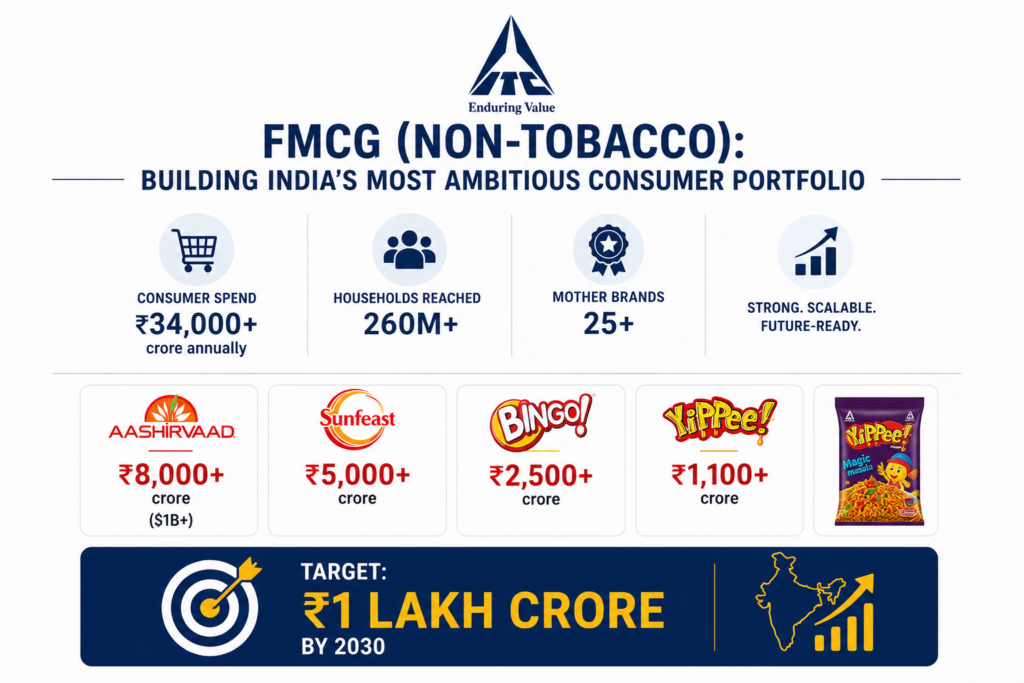
ITC’s non-tobacco FMCG segment is arguably its most exciting growth story — and one of the most ambitious brand-building initiatives in Indian corporate history. Launched effectively from scratch in the early 2000s and built entirely through organic investment, ITC’s FMCG portfolio now generates consumer spend of over ₹34,000 crore annually and reaches more than 260 million Indian households. The long-term target is ₹1 lakh crore in consumer spend by 2030 — a scale that would make it one of India’s top two or three consumer goods companies.
What makes this achievement particularly remarkable is the speed and category breadth involved. In just over two decades, ITC built genuinely market-leading positions across branded atta (Aashirvaad), cream biscuits (Sunfeast Dark Fantasy), bridges snacks (Bingo!), noodles (YiPPee!), education notebooks (Classmate), personal wash (Fiama), and agarbattis (Mangaldeep) — categories that were previously dominated by entrenched multinational and domestic incumbents.
Branded Packaged Foods
ITC’s packaged foods business is the engine of the FMCG segment. Aashirvaad, its branded atta (wheat flour) and staples platform, has crossed ₹8,000 crore in annual revenue and has become one of India’s largest food brands in absolute terms — recently surpassing the $1 billion revenue mark. Aashirvaad leads the branded atta segment and has extended successfully into spices, iodised salt, and premium atta variants targeting health-conscious consumers.
Sunfeast, ITC’s biscuits and cookies brand, has crossed ₹5,000 crore in annual revenue. Its Dark Fantasy Choco Fills variant is a category benchmark in premium cream biscuits, and the Mom’s Magic and Bounce sub-brands address adjacent consumer needs. Bingo!, the snacks platform, has grown into a ₹2,500+ crore brand and is the market leader in the ‘bridges’ snack segment. YiPPee! — ITC’s noodles brand competing directly with Maggi — has crossed ₹1,100 crore and holds approximately 22% market share, making it the clear number-two player nationally.
Other significant food brands include Candyman (confectionery), Fabelle (premium chocolates and gifting), ITC Master Chef (ready-to-eat and cooking products), Kitchens of India (premium Indian cooking sauces), and B Natural (100% fruit beverages).
- Aashirvaad: ₹8,000+ crore revenue; market leader in branded atta; now a $1 billion brand
- Sunfeast: ₹5,000+ crore; leader in cream biscuits; Dark Fantasy is a cult product
- Bingo!: ₹2,500+ crore; market leader in bridges snacks
- YiPPee!: ₹1,100+ crore; 22% national market share in noodles
- Candyman / Fabelle: Confectionery and premium chocolate platforms
Personal Care Products
ITC’s personal care segment operates under a multi-brand architecture targeting different consumer needs and price points. Fiama (premium beauty and personal wash), Vivel (mid-market personal care), Engage (deodorants and fragrances), Savlon (health and hygiene), Nimyle (floor care), and Dermafique (premium skincare) collectively address the personal care needs of Indian consumers from mass to premium.
Savlon, acquired from Johnson & Johnson in 2015, has become ITC’s most dynamic personal care brand, growing aggressively in antiseptic, handwash, sanitiser, and healthcare hygiene categories. Fiama’s gel shower gels and Dark Fantasia range have sustained strong growth, and Engage remains among India’s leading deodorant brands.
- Fiama: Premium beauty and personal wash; gel bars and shower gels
- Vivel: Mid-market soap and personal care
- Engage: Deodorants and fragrances; among India’s top deodorant brands
- Savlon: Health, hygiene and antiseptic; fastest-growing ITC personal care brand
- Nimyle: Natural floor cleaners
- Dermafique: Premium skincare range
Education & Stationery
ITC’s Education & Stationery business, anchored by the Classmate brand and supplemented by Paperkraft premium office paper, has built an extraordinary position in India’s stationery market. Classmate is the country’s leading notebooks brand — at ₹1,400+ crore in annual revenue, one of the largest FMCG brands ITC has built from scratch. The brand has extended from core notebooks into instruments, craft items, and college accessories, establishing deep brand loyalty among school and college students.
Agarbattis, Matches & Safety Products
Mangaldeep, ITC’s agarbattis (incense sticks) and dhoop brand, is among the country’s leading brands in the spiritual and home fragrance segment, having crossed ₹1,000 crore in annual revenue. Following ITC’s merger of Wimco (the former Western India Match Company) as a wholly-owned subsidiary, the safety matches portfolio — which includes Aim and i Kno — is now fully integrated into the ITC FMCG structure.
BUSINESS 3: HOTELS (NOW SEPARATELY LISTED — ITC HOTELS LIMITED)
ITC Hotels: The Landmark Demerger and What It Means
| Key update: ITC Hotels Limited (ITCHL) demerged effective January 1, 2026 and listed on BSE & NSE on January 29, 2026. ITC retains 40% stake. Shareholders received 1 ITC Hotels share for every 10 ITC shares. Revenue: ₹3,333 crore | Properties: 140 hotels | Rooms: 13,000+ | Brands: 6 | Asset-light model: 45% owned, 55% managed |
The most significant recent development in ITC’s corporate history is the demerger of its hotels business. ITC Hotels Limited (ITCHL) was spun off as an independent listed entity effective January 1, 2026, with shares listing on BSE and NSE on January 29, 2026 (opening at ₹188 on BSE). Under the scheme, ITC shareholders received one share of ITC Hotels for every ten ITC shares held, while ITC Limited retained a 40% stake in the new entity. The demerger was designed to unlock shareholder value by allowing the hotels business to pursue an asset-light, management contract-heavy growth strategy independently.
ITC Hotels Limited, now India’s second-largest hotel chain by revenue, brings together 140 properties across 13,000+ rooms operating under six distinct brands. The company generated ₹3,333 crore in revenue for the most recent full year — a record for the business — with 30 new hotel openings and 54 new property signings in the same period. The asset-light strategic direction (55% of properties operated through management contracts, 45% owned) provides a capital-efficient platform for the ambitious target of 200+ hotels in the medium term.
Each ITC Hotels property carries a LEED® Platinum (Leadership in Energy and Environmental Design) certification — the highest green building standard globally — making ITC Hotels the world’s largest chain of LEED Platinum rated hotels. This “Responsible Luxury” positioning sets it apart from every domestic and most international competitors.
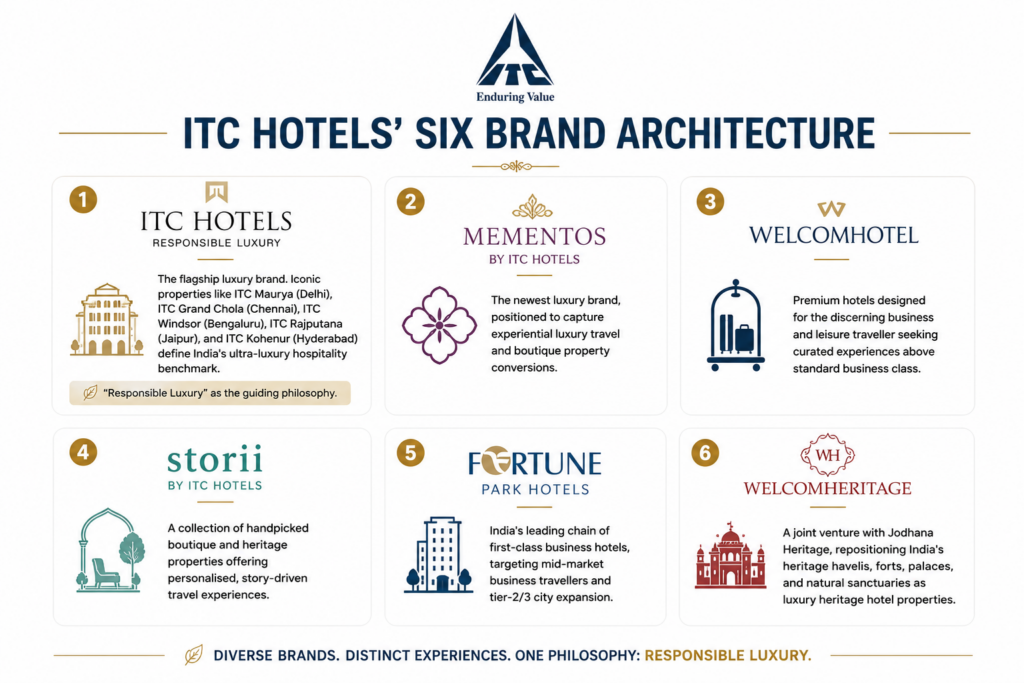
ITC Hotels’ Six Brand Architecture
- ITC Hotels — The flagship luxury brand. Iconic properties like ITC Maurya (Delhi), ITC Grand Chola (Chennai), ITC Windsor (Bengaluru), ITC Rajputana (Jaipur), and ITC Kohenur (Hyderabad) define India’s ultra-luxury hospitality benchmark. “Responsible Luxury” as the guiding philosophy.
- Mementos by ITC Hotels — The newest luxury brand, positioned to capture experiential luxury travel and boutique property conversions.
- Welcomhotel — Premium hotels designed for the discerning business and leisure traveller seeking curated experiences above standard business class.
- Storii by ITC Hotels — A collection of handpicked boutique and heritage properties offering personalised, story-driven travel experiences.
- Fortune Park Hotels — India’s leading chain of first-class business hotels, targeting mid-market business travellers and tier-2/3 city expansion.
- WelcomHeritage Hotels — A joint venture with Jodhana Heritage, repositioning India’s heritage havelis, forts, palaces, and natural sanctuaries as luxury heritage hotel properties.
ITC Hotels’ Culinary Excellence
Beyond accommodation, ITC Hotels has built an award-winning culinary brand ecosystem recognised as India’s finest collection of restaurant concepts:
- Bukhara — Globally recognised; North West Frontier cuisine; consistently ranked among Asia’s finest restaurants
- Dum Pukht — Regal Awadhi cuisine; the tradition of slow cooking preserved
- Dakshin — Award-winning South Indian fine dining; established 1989; consistently rated India’s best South Indian restaurant
- Avartana — Modern South Indian cuisine with an avant-garde open kitchen format
- Royal Vega — India’s finest pure vegetarian fine dining experience
- Kebabs & Kurries — Signature North Indian specialties
- Ottimo Cucina Italiana — Authentic Italian fine dining
BUSINESS 4: PAPERBOARDS, PAPER & PACKAGING
Paperboards & Packaging: India’s Largest
| Position: India’s largest paperboards and packaging business | Plant: Bhadrachalam, Telangana (largest single-location paper mill in India) | Products: Coated boards, specialty papers, cartons, flexible packaging, eco-friendly paper solutions |
ITC’s Paperboards, Paper and Packaging division is a B2B powerhouse that is the largest in India by volume, product range, and market reach. Operating its flagship Bhadrachalam paper mill in Telangana — the largest single-location paper manufacturing facility in the country — the division produces coated paperboards, specialty papers, cartons, flexible packaging, and sustainable packaging solutions for a vast cross-section of Indian industries.
The division serves clients across FMCG carton packaging, food service packaging, pharma and healthcare packaging, consumer electronics, retail, and premium gifting. Its product range spans recycled and virgin fibre paperboards, coated duplex boards, folding box boards, and specialty papers used in high-end printing, publishing, and industrial applications. A defining feature is its integration with ITC’s sustainability commitments: the Bhadrachalam complex operates one of India’s most sophisticated effluent treatment systems, and ITC’s paperboard products increasingly incorporate recycled fibre and FSC-certified sustainable fibre sources.
ITC’s packaging business — operating through ITC’s Packaging and Printing Business — is a premium packaging manufacturer producing high-quality folding cartons, holographic products, and flexible laminates primarily for the FMCG and cigarette industries. Its in-house packaging capability reduces lead times, improves quality control, and enables the rapid product launches that ITC’s consumer brands require.
BUSINESS 5: AGRI-BUSINESS
Agri-Business: The e-Choupal Revolution and India’s Agricultural Export Engine
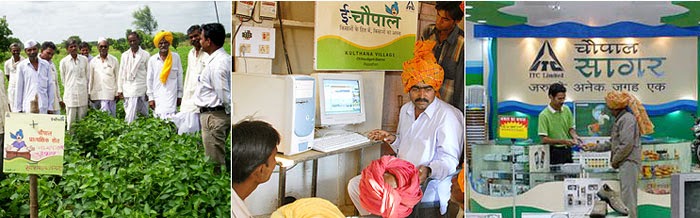
| e-Choupal: World’s largest rural digital infrastructure | Reach: 70,000+ villages | Revenue contribution: ~27% of ITC group revenues | Position: India’s second-largest exporter of agri-products | e-Choupal 4.0: Next-gen agri-services aggregator platform now in pilot |
ITC’s Agri-Business division is one of the most strategically significant and socially impactful businesses in its portfolio — and one of the most studied examples of private sector rural development in the world. The division’s activities span the sourcing, processing, trading, and export of agricultural commodities including wheat, rice, soya, spices, coffee, and aqua products, as well as agri-services and inputs to millions of Indian farmers. It is India’s second-largest exporter of agricultural products, a position built on decades of deep agricultural supply chain development across major crop-producing states.
At the heart of the agribusiness division’s farmer engagement model is the e-Choupal — ITC’s landmark rural digital platform, launched in 2000 and now recognised globally as the world’s largest rural Internet-based intervention. The e-Choupal network deploys Internet kiosks in villages to provide farmers with real-time weather information, market prices, best agricultural practices, and access to quality inputs at competitive prices through Choupal Saagar rural service centres. Each Choupal Saagar serves approximately 40 e-Choupal kiosks and acts as an integrated rural retail and services hub.
The evolution of e-Choupal into its fourth generation — e-Choupal 4.0, now in pilot phase — is designed to make the platform an aggregator for a comprehensive suite of agri-services integrated with ITC’s on-ground presence across 70,000 villages. e-Choupal 4.0 aims to address the full farming value chain: from soil testing and crop advisory to credit and insurance access, from fair price discovery to post-harvest supply chain integration.
The agribusiness division also benefits from ITC’s structural consolidation: Sresta Natural Bioproducts (India’s leading organic food brand, operating under the 24 Mantra Organic label) and Wimco were both merged as wholly-owned subsidiaries into ITC, simplifying the group structure. Agri-business revenues grew approximately 25% in FY2025 year-on-year, reflecting commodity price tailwinds and ITC’s expanding export volumes.
BUSINESS 6: INFORMATION TECHNOLOGY
Information Technology: ITC Infotech’s Global IT Services Play
| Entity: ITC Infotech India Limited (wholly-owned subsidiary) | Revenue: ₹3,330 crore (FY2025) | CAGR: 13% | Target: $1 billion revenue | Sectors: BFSI, Healthcare, Manufacturing, Consumer Goods, Travel & Hospitality |
ITC ventured into Information Technology in the late 1990s, establishing ITC Infotech India Limited as a wholly-owned subsidiary to offer IT solutions and services to clients worldwide. What began as a captive IT capability has evolved into a mid-tier global IT services company generating ₹3,330 crore in revenue for the financial year ended March 31, 2025 and growing at a 13% compound annual rate. ITC Infotech’s MD & CEO has publicly affirmed the company’s $1 billion revenue target, indicating ambition for continued double-digit growth.
ITC Infotech operates across five key industry verticals: Banking, Financial Services & Insurance (BFSI); Healthcare & Life Sciences; Manufacturing; Consumer Goods & Retail; and Travel & Hospitality. The company serves global clients across North America, Europe, Asia, and the Middle East, operating through delivery centres in India and onshore offices in key client markets.
ITC Infotech’s competitive positioning rests on deep industry vertical specialisation, proprietary technology frameworks, and the ITC group’s ability to provide industry reference clients in sectors like consumer goods, hospitality, and agribusiness where the group itself operates at scale. While it competes against larger players like TCS, Infosys, and Wipro, its agility and sector depth in verticals like consumer goods IT and hospitality technology provide differentiated positioning for mid-market and enterprise clients.
ITC’s Sustainability Vision: A Triple Bottom Line Leader
ITC’s approach to sustainability is embedded in the business model across divisions and is among the most comprehensive corporate sustainability programmes in Asia. ITC is one of the very few companies globally that is simultaneously carbon positive (sequestering more carbon than it emits), water positive (conserving more water than it consumes), and solid waste recycling positive.
Carbon Positive: ITC’s forestry programmes have created a green cover of over 500,000 acres, sequestering carbon at a rate that exceeds ITC’s total operational emissions.
Water Positive: ITC’s watershed development programmes have created rainwater harvesting potential of over 54 million kilolitres per year.
Waste Positive: ITC’s Zero Solid Waste to Landfill status reflects comprehensive waste recycling across key manufacturing sites.
LEED Platinum Hotels: All ITC Hotels properties carry LEED Platinum certification — making ITC Hotels the world’s most decorated sustainable luxury hotel chain.
Social Investment: ITC’s rural development programmes have reached over 6 million farmers, created 39 million person days of employment, and empowered approximately 900,000 women.
ITC Brand Portfolio at a Glance
| Business Segment | Key Brands | Market Position | Scale |
| FMCG — Cigarettes | Gold Flake, Wills Classic, India Kings, Classic, Scissors | ~75-80% organised cigarette market share | Largest profit contributor to ITC group |
| FMCG — Packaged Foods | Aashirvaad, Sunfeast, Bingo!, YiPPee!, Candyman, Fabelle | Leader: atta, cream biscuits, bridges snacks | Consumer spend >₹34,000 cr; 260M+ households |
| FMCG — Personal Care | Fiama, Vivel, Engage, Savlon, Nimyle, Dermafique | Top-3 in body wash, deodorants | Growing double-digit; premiumisation led |
| FMCG — Stationery | Classmate, Paperkraft | #1 notebooks brand in India | ₹1,400+ crore (Classmate) |
| FMCG — Agarbattis & Matches | Mangaldeep, Aim (Wimco) | Leading agarbatti brand | ₹1,000+ crore (Mangaldeep) |
| Hotels (ITCHL — listed) | ITC Hotels, Mementos, Welcomhotel, Storii, Fortune, WelcomHeritage | India’s 2nd largest hotel chain | ₹3,333 crore; 140 hotels; 13,000+ rooms |
| Paperboards & Packaging | ITC Paperboards, ITC Packaging | India’s largest paperboard business | B2B; Bhadrachalam flagship plant |
| Agri-Business | e-Choupal, 24 Mantra Organic | India’s 2nd largest agri-product exporter | ~27% of ITC revenues |
| Information Technology | ITC Infotech | Mid-tier global IT services | ₹3,330 crore (FY2025); target $1B |
Also Read:Exploring the Brand Architecture of HUL
Frequently Asked Questions
Q: What are ITC’s main businesses?
A: ITC operates across six primary business segments: (1) FMCG — Cigarettes, commanding approximately 75-80% of India’s organised market; (2) FMCG — Non-Tobacco, covering packaged foods (Aashirvaad, Sunfeast, Bingo!), personal care (Fiama, Savlon), stationery (Classmate), and agarbattis (Mangaldeep); (3) Hotels, now operated as separately listed ITC Hotels Limited after the January 2026 demerger; (4) Paperboards & Packaging, where it is India’s largest player; (5) Agri-Business, including the iconic e-Choupal rural platform; and (6) Information Technology, through ITC Infotech India Limited.
Q: What is the latest ITC Limited revenue?
A: For the financial year ended March 31, 2026, ITC Limited recorded a Gross Revenue of ₹80,867 crore and EBITDA of ₹25,208 crore. On a consolidated basis, revenue was ₹89,913 crore and net profit was ₹21,018 crore. The FMCG segment (excluding cigarettes) generates consumer spend of over ₹34,000 crore annually and reaches 260 million+ households.
Q: What happened to ITC Hotels? Has it been demerged?
A: Yes. ITC Hotels was demerged from ITC Limited into a new independently listed entity — ITC Hotels Limited (ITCHL) — effective January 1, 2026. The shares listed on BSE and NSE on January 29, 2026, opening at ₹188 on BSE. ITC shareholders received one ITC Hotels share for every ten ITC shares held. ITC Limited retained a 40% stake. ITC Hotels Limited now operates 140 properties with over 13,000 rooms across six brands and generated ₹3,333 crore in revenue.
Q: What is Aashirvaad and how big is it?
A: Aashirvaad is ITC’s flagship branded packaged foods platform, best known for its market-leading branded atta (wheat flour). It has crossed ₹8,000 crore in annual revenue — surpassing the $1 billion revenue mark, a milestone achieved by very few Indian FMCG brands. Aashirvaad has expanded beyond atta into spices, salt, vermicelli, and premium flour variants. It is one of the most trusted food brands in Indian households.
Q: What is ITC e-Choupal and why is it significant?
A: ITC’s e-Choupal is a rural digital platform launched in 2000 and now recognised as the world’s largest rural Internet-based intervention. It provides Internet kiosks in villages to give farmers access to real-time weather forecasts, market prices, crop best practices, and quality agri-inputs at competitive prices. The network currently covers 70,000+ villages and is evolving into e-Choupal 4.0 — a comprehensive agri-services aggregator. It is widely studied as a benchmark for private sector rural development globally.
Q: Is ITC only a cigarette company?
A: No — and this is one of the most common misconceptions about ITC. While cigarettes remain ITC’s most profitable segment, they represent only one of six business segments. ITC’s non-tobacco FMCG portfolio generates consumer spend exceeding ₹34,000 crore annually from brands like Aashirvaad, Sunfeast, Bingo!, Classmate, Fiama, and Savlon. ITC is also India’s largest paperboard manufacturer, a major agri-products exporter, the owner of one of India’s finest hotel chains (now separately listed), and a mid-tier global IT services provider.
Q: What is ITC’s target for its non-tobacco FMCG business?
A: ITC has set an ambitious target of ₹1 lakh crore (₹100,000 crore) in annual consumer spend from its non-tobacco FMCG portfolio by 2030. This represents approximately 3x growth from the current ₹34,000+ crore base. The target is to be achieved through market share gains, new product launches across premium segments, and geographic expansion of existing brands.
Q: What brands does ITC Hotels operate?
A: ITC Hotels Limited operates six distinct brands: (1) ITC Hotels — flagship ultra-luxury (ITC Maurya, ITC Grand Chola, ITC Rajputana etc.); (2) Mementos by ITC Hotels — new luxury experiential brand; (3) Welcomhotel — premium business and leisure hotels; (4) Storii by ITC Hotels — boutique and heritage property collection; (5) Fortune Park Hotels — first-class business hotels in tier-1 and tier-2 cities; and (6) WelcomHeritage Hotels — luxury heritage properties. ITC Hotels also operates award-winning culinary brands including Bukhara, Dum Pukht, Dakshin, and Avartana.
Conclusion
ITC Limited’s story is one of the most compelling examples of successful conglomerate diversification in emerging market corporate history. From a single-product British tobacco company founded in 1910 to one of India’s most diverse and valuable private sector groups, ITC has demonstrated a rare capacity to build genuine market leadership positions across completely unrelated industries — cigarettes, packaged foods, personal care, luxury hotels, paperboard manufacturing, agricultural commodities, and IT services — all through patient, long-term investment in brand building, manufacturing excellence, and supply chain development.
The strategic direction is clear: progressively reduce the group’s dependence on tobacco while building an FMCG portfolio capable of competing with Hindustan Unilever and Nestlé, unlock the value of the hotels business as a separately listed entity, and deepen ITC’s farmer relationships through the e-Choupal 4.0 platform. With a Gross Revenue of ₹80,867 crore, EBITDA of ₹25,208 crore, and an ambitious ₹1 lakh crore FMCG target for 2030, ITC enters the next chapter of its history from a position of genuine financial strength and strategic clarity.
For investors, analysts, consumers, and students of Indian business alike, ITC Limited remains one of the most fascinating and instructive corporate case studies in the country — a company whose current diversified identity is shaped as much by its century-long heritage as by its vision for a consumer-goods-led future.
To read more content like this, explore The Brand Hopper
Subscribe to our newsletter