Last Updated on August 19, 2026 by Team TBH
Over 3.4 billion people worldwide use a Unilever product every single day—that’s nearly half the global population reaching for Dove soap, Hellmann’s mayonnaise, Knorr stock cubes or Comfort fabric softener. With full-year revenue of €50.5 billion in FY2025 and a portfolio of 400+ brands spanning Beauty & Wellbeing, Personal Care, Home Care, Foods, and Ice Cream (currently being divested), Unilever is one of the most pervasive companies on Earth. Yet in the hyper-competitive world of Fast-Moving Consumer Goods (FMCG), even giants face fierce challengers.
This comprehensive guide examines Unilever’s most significant competitors—from century-old household names like Procter & Gamble and Nestlé to focused specialists like Haleon and Beiersdorf. For each rival, we provide verified FY2024 revenues, a breakdown of direct brand rivalries, strategic positioning, and what makes them a genuine threat to Unilever’s market share. All financial data is drawn from official annual reports and investor disclosures.
Understanding this competitive landscape matters not just to investors and strategists, but to anyone curious about why the products on supermarket shelves look the way they do, cost what they cost, and continue to evolve. Behind every brand war is a story of innovation, sustainability ambition, and relentless competition for consumer loyalty.
The Global Consumer Goods Landscape
The global consumer goods market—encompassing packaged foods, beverages, personal care, home care, and health products—is valued at over $15 trillion, making it one of the world’s largest economic sectors. Within this vast arena, competitive analysis reveals that no single company dominates across all categories. Unilever, with roughly 2% of the overall market, holds leading positions in multiple segments while facing sector-specific specialists who outgun it in focused areas.
Five macro-trends are reshaping every competitor’s playbook: (1) the relentless shift to e-commerce and direct-to-consumer channels; (2) mounting pressure to deliver genuine sustainability credentials across the entire value chain; (3) the premiumization of everyday categories from shampoo to laundry detergent; (4) rapid growth in health and wellness products, blurring the line between consumer goods and healthcare; and (5) intense price sensitivity in emerging markets, where the next billion consumers are being won or lost. Every company profiled below is navigating all five simultaneously.
Top Competitors of Unilever
1. Nestlé
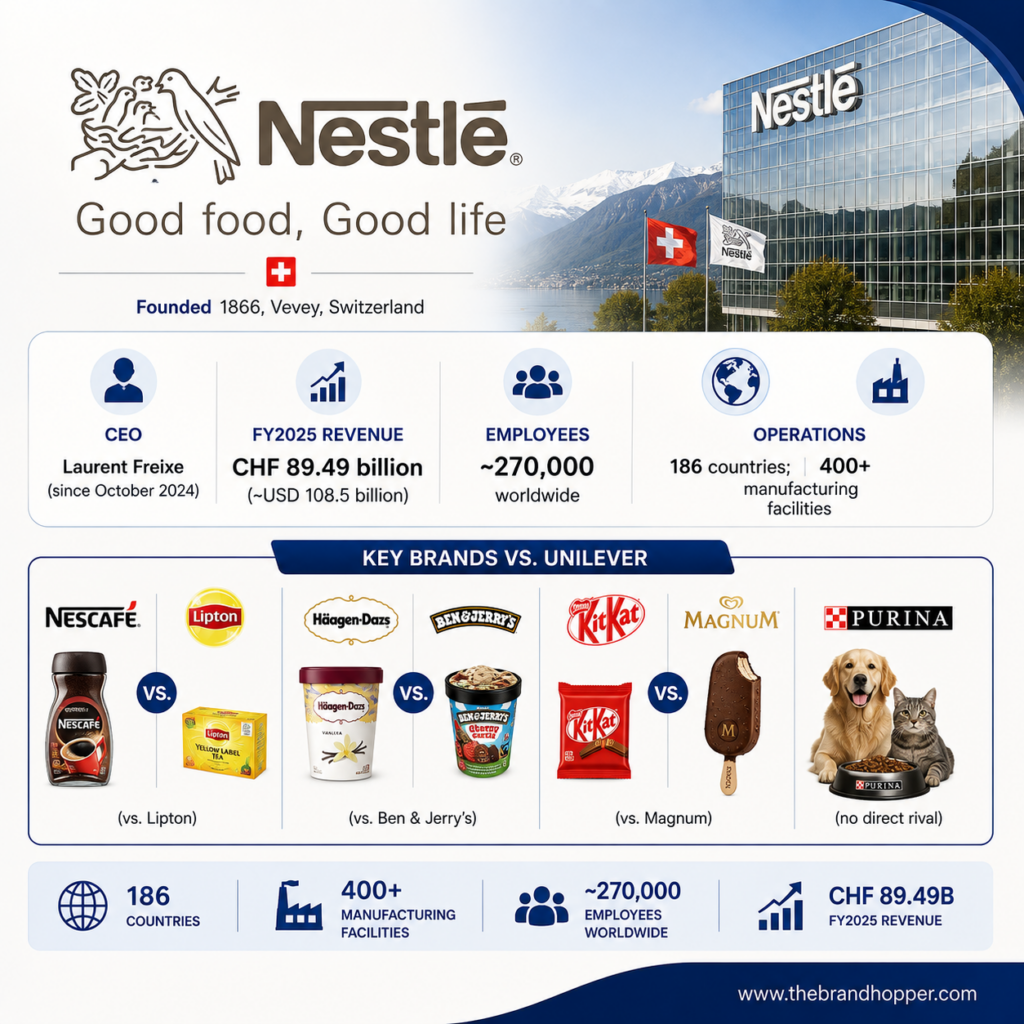
Nestlé, headquartered in Vevey, Switzerland, is the world’s largest food and beverage company by revenue and Unilever’s most formidable overall rival. Founded in 1866 by Henri Nestlé—who created a life-saving infant formula as his first product—the company today operates in 186 countries with a portfolio spanning over 2,000 brands.
While Nestlé is primarily a food company, it competes directly with Unilever in ice cream (Häagen-Dazs vs. Ben & Jerry’s), beverages (Nescafé vs. Lipton), and adjacent nutrition categories. In FY2025, Nestlé reported revenues of CHF 89.49 billion (approximately $100 billion), reflecting a modest -2% reported decline.
Brand Portfolio & Category Rivalry
Nestlé and Unilever overlap most directly in beverages and frozen desserts. Nescafé and Nespresso command the instant and premium coffee segments, competing for consumer attention with Unilever’s Lipton and PG Tips teas.
In ice cream, Häagen-Dazs squares off against Ben & Jerry’s in premium supermarket freezers globally. Nestlé’s confectionery giants—KitKat, Smarties, Aero—do not have direct Unilever equivalents, giving Nestlé a structural advantage in impulse snacking.
Meanwhile Nestlé’s Purina pet care division (Pro Plan, Felix, Whiskas) is an area Unilever has no presence in, representing a high-margin business with no competitive friction between the two companies.
Strategy & Recent Moves
New CEO Laurent Freixe, who replaced Mark Schneider in October 2024, has prioritized a return to fundamental strength: restoring volume growth, rebuilding margin discipline, and pruning the portfolio of low-growth, capital-intensive businesses. Nestlé sold its North American water brands (Poland Spring, Deer Park, Zephyrhills) to One Rock Capital in 2021, divested its Palforzia allergy treatment business, and exited Good Food meal kits.
The company is doubling down on its five strategic categories: coffee, pet care, nutrition (including infant formula and medical nutrition), confectionery, and frozen food. Coffee alone contributed the largest share of organic growth in 2024, powered by Nescafé Gold in emerging markets and Nespresso’s continued premiumization in Europe and North America.
Sustainability & Outlook
Nestlé’s “Creating Shared Value” framework targets net zero greenhouse gas emissions by 2050, 100% recyclable or reusable packaging by 2025, and the planting of 200 million trees. The company is investing heavily in regenerative agriculture across its supply chains—particularly cocoa, dairy, and coffee. Halal certification and fortified nutrition products are key growth levers in high-population markets including Indonesia, Pakistan, and West Africa. With strong brand equity and a disciplined new leadership team, Nestlé remains Unilever’s most comparable peer in scale, geographic reach, and consumer trust.
2. Procter & Gamble
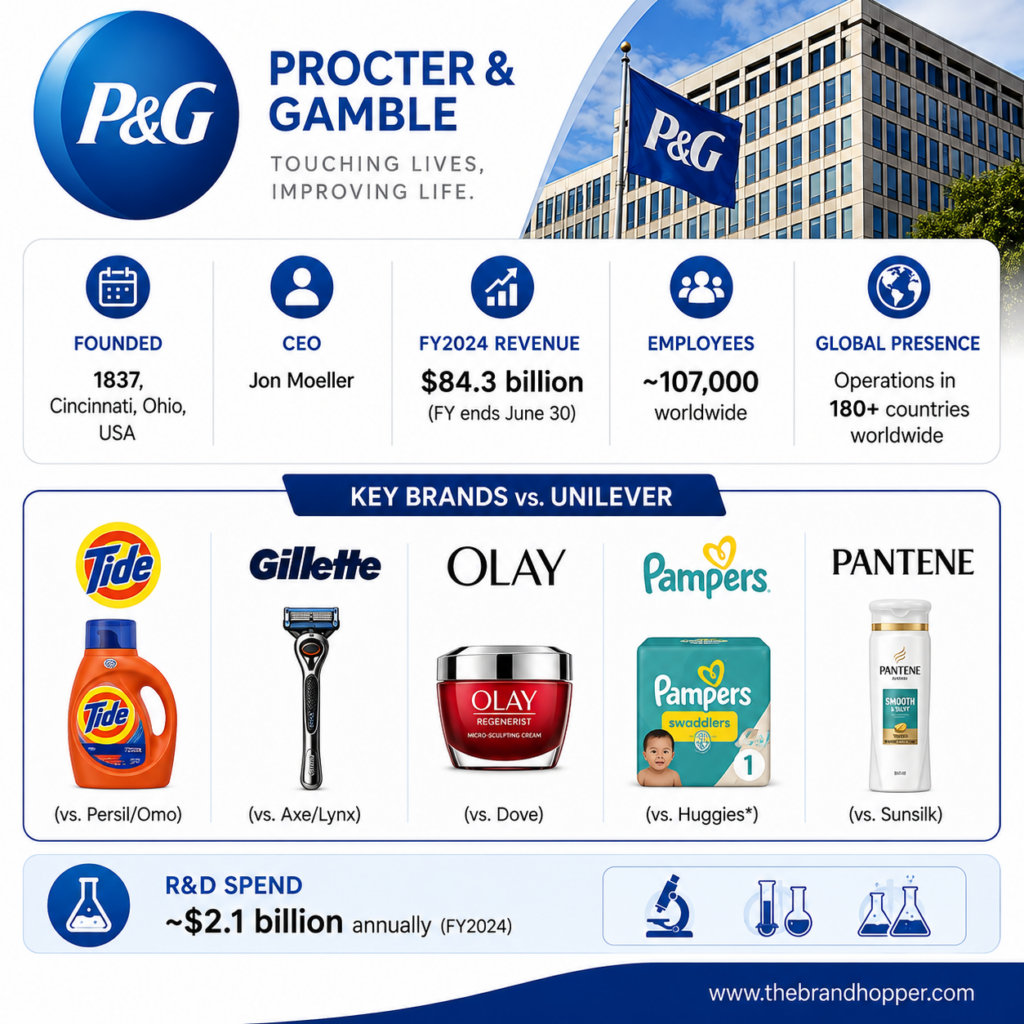
Procter & Gamble (P&G), founded in Cincinnati, Ohio in 1837—four years before Unilever’s oldest predecessor—is the defining rival that has shaped Unilever’s competitive identity for over a century. The two companies compete head-to-head across laundry, personal care, beauty, oral care, baby care, and household cleaning in virtually every major market worldwide.
P&G reported net sales of $84.3 billion in FY2025 (fiscal year ending June 2025). P&G also increased its dividend for the 68th consecutive year, underscoring the durability of its branded portfolio model.
Brand Portfolio & The Age-Old Rivalry
The P&G vs. Unilever contest is one of business history’s most enduring rivalries. In laundry, Tide (P&G) and Persil/Omo (Unilever) have fought for global market share for decades.
In personal care, Gillette dominates men’s shaving while Unilever’s Axe/Lynx leads men’s body care. P&G’s Olay faces Unilever’s Dove in mass-market skincare.
In premium skincare, P&G has invested heavily in SK-II (a luxury Japanese brand) to compete in a space where Unilever has Murad, Kate Somerville, and Hourglass. P&G’s Pantene and Head & Shoulders are formidable in haircare, where they compete directly with Unilever’s Sunsilk, Dove, and TRESemmé brands.
Strategy & Recent Moves
P&G’s “Irresistibly Superior” strategy focuses on delivering products that are measurably better than the competition at delivering consumer-desired results—not just marginally better, but definitively so.
The company has been aggressively premiumizing its portfolio: Olay Vitamin C and Retinol serums, Gillette Labs exfoliating razors, and Tide PODS innovations all target higher price points with stronger margins. P&G is also a leader in e-commerce and direct-to-consumer channels, having grown its online business significantly post-pandemic.
On the cost side, the “Integrated Growth Strategy” focuses productivity savings back into brand investment and shareholder returns through dividends and buybacks.
Sustainability & Outlook
P&G’s “Ambition 2030” sustainability plan targets 100% renewable electricity, 100% recyclable or reusable packaging, and a 35% reduction in water consumption at manufacturing sites. The company has made notable progress on concentrated formulas (Tide Evo, a compostable sheet) and has partnered with recycling infrastructure companies to close the plastics loop. With its scale, R&D muscle, and century-long brand equity, P&G remains the competitor Unilever benchmarks itself against most directly in strategy presentations and investor calls.
3. The Coca-Cola Company
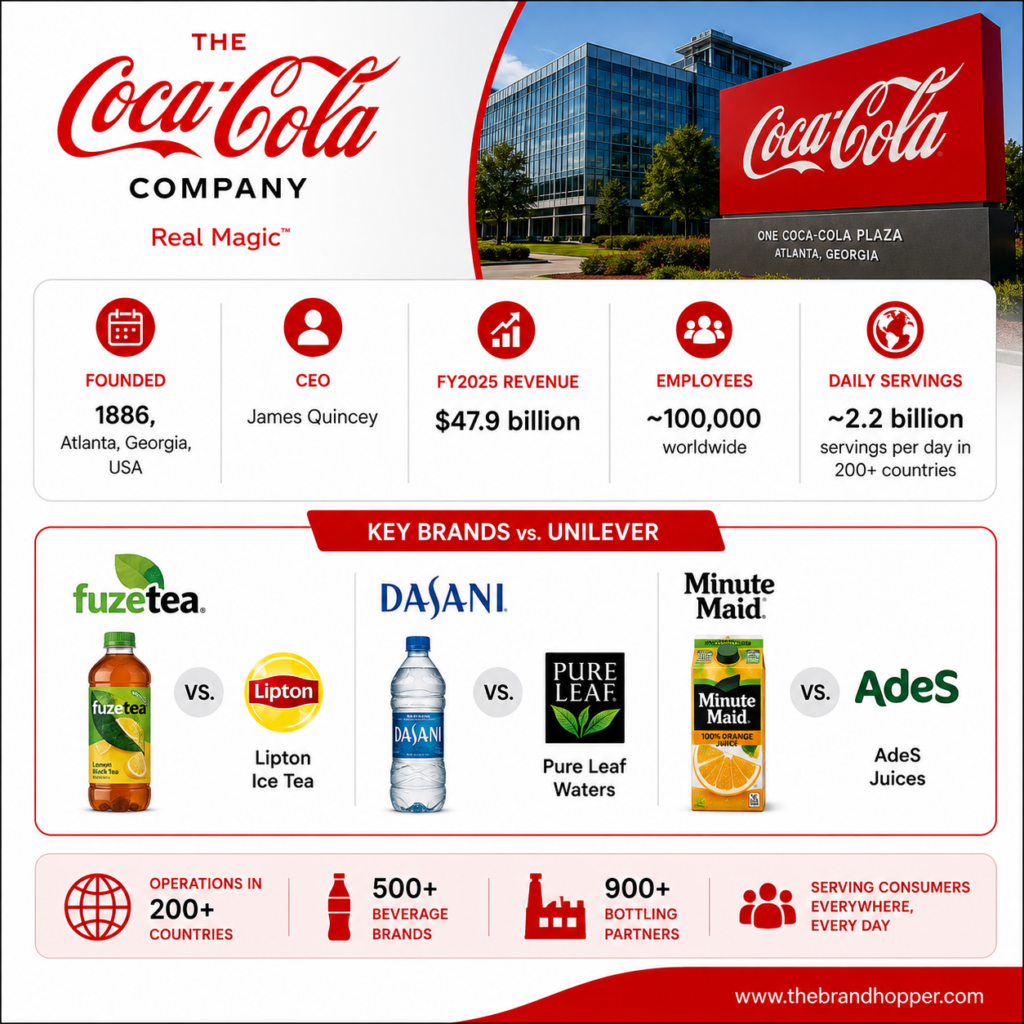
The Coca-Cola Company, founded in Atlanta, Georgia in 1886 by pharmacist John Pemberton, is the world’s most recognized beverage brand.
Though primarily a beverages business, Coca-Cola competes with Unilever in the tea, juice, water, and functional beverage segments—categories where Unilever’s Lipton (now licensed to PepsiCo in many markets), Pure Leaf, and AdeS brands operate. Coca-Cola reported full-year 2025 net revenues of $47.9 billion, representing 2% reported growth and 5% organic growth (driven largely by price/mix), confirming the brand’s extraordinary pricing power.
Overlap & Competition with Unilever
The Unilever–Coca-Cola rivalry exists primarily in the ready-to-drink tea and juice categories. Coca-Cola’s Fuze Tea and Honest Tea brands directly compete with Unilever’s Lipton brand (though Unilever has been licensing Lipton to PepsiCo in many developed markets post-2021 divestiture of its tea business to CVC Capital Partners, now operating as ekaterra).
In bottled water, Dasani competes with Unilever-adjacent brands, while Minute Maid overlaps with Unilever’s juice offerings. Coca-Cola’s “Total Beverage Company” strategy—accelerating into coffee (Costa), sports drinks (Powerade), alcohol-ready-to-drink (Jack & Coke), and dairy (Fairlife)—brings it into an ever-wider range of adjacencies.
Strategy & Recent Moves
Coca-Cola’s acquisition of Fairlife (valued at approximately $5 billion) has given it a major presence in premium dairy-based protein drinks—a high-growth, high-margin category.
The company also acquired BODYARMOR (sports drinks) and expanded its Monster Energy relationship.
AI-driven marketing (“Create Real Magic” campaign) and dynamic pricing through freestyle vending machines demonstrate Coca-Cola’s embrace of digital consumer engagement. In emerging markets, small-pack affordability and local distribution partnerships remain central to volume growth.
Sustainability & Outlook
Coca-Cola’s “World Without Waste” initiative targets collecting and recycling a bottle or can for every one sold by 2030. In 2024, the company made progress in transitioning to 100% recycled PET packaging in key markets and expanding the use of aluminum cans.
While beverages remain Unilever’s smallest exposure, the category is growing in importance via functional waters, plant-based drinks, and wellness-oriented beverages—all areas where Coca-Cola’s distribution reach gives it a structural advantage.
4. L’Oréal
When it comes to beauty and personal care, L’Oréal is the one competitor that consistently outpaces Unilever in focused category expertise.
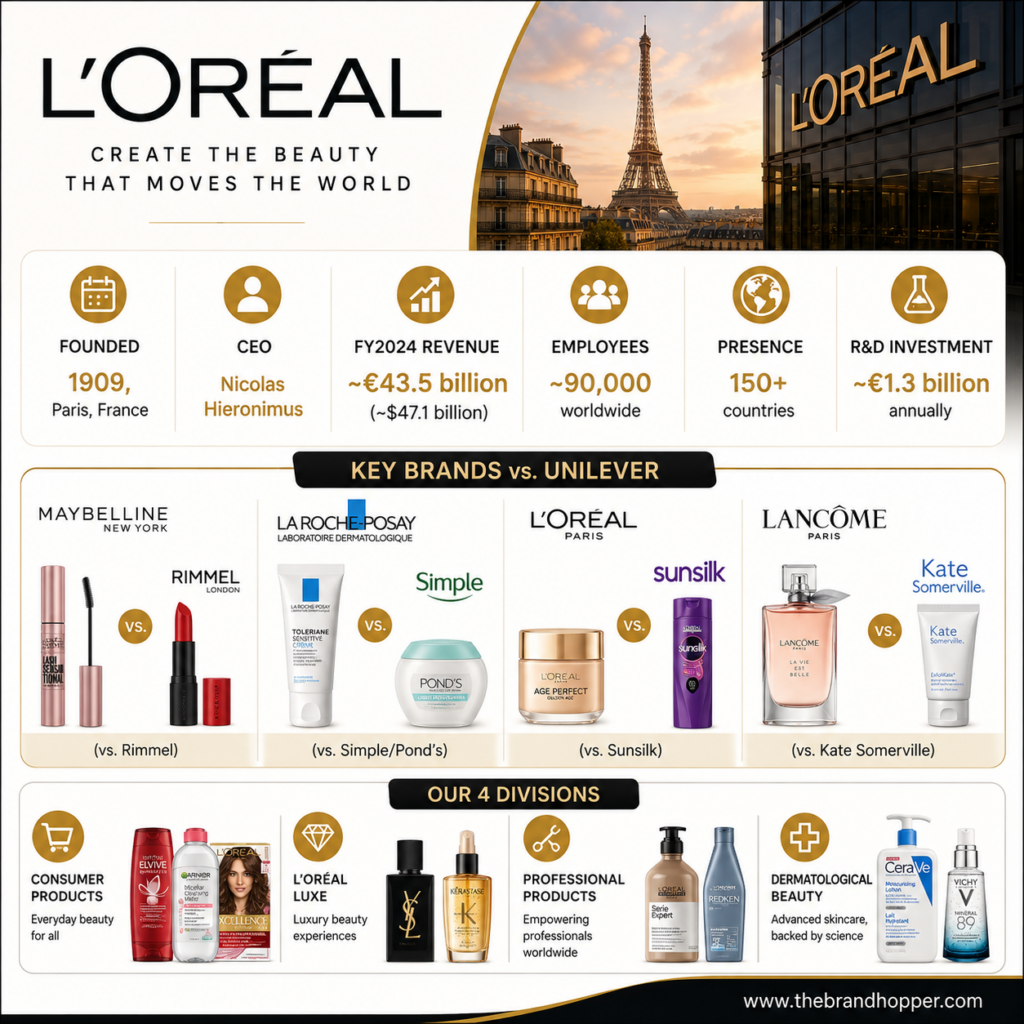
Founded in 1909 by chemist Eugène Schueller with a single hair dye formula, L’Oréal has grown into the world’s largest cosmetics company, with FY2025 revenues of approximately €44.05 billion (approximately $47.1 billion)—all of it in beauty and personal care.
That laser focus, combined with the broadest brand architecture in beauty (37 brands across consumer, luxury, professional, and active categories), makes L’Oréal Unilever’s most formidable rival in its most profitable personal care segment.
Brand Portfolio & The Beauty Battle
L’Oréal competes with Unilever across skincare, haircare, makeup, and fragrance—but from a position of pure-play specialist expertise. In mass-market skincare, L’Oréal Paris and Garnier compete with Unilever’s Pond’s, Simple, and Dove.
In dermocosmetics—a fast-growing category where prescription-strength efficacy meets consumer accessibility—L’Oréal’s La Roche-Posay, Vichy, and CeraVe have outpaced Unilever’s equivalent brands significantly.
L’Oréal’s acquisition of Aesop (Australian luxury skincare) for $2.5 billion in 2023 and its integration of Kering Beauté brands strengthens its luxury portfolio, where Unilever competes via Hourglass and Tatcha.
Innovation & Digital Leadership
L’Oréal is widely regarded as the most digitally sophisticated company in beauty. Its Modiface augmented reality platform allows consumers to virtually try on makeup and hair color in real time—a capability now embedded in Amazon, Instagram, and Snapchat.
The company invests over €1.1 billion annually in R&D and holds more than 6,000 active patents. “Skin Longevity” is the overarching innovation platform for the coming years: products addressing biological skin aging, rather than merely cosmetic correction, represent a premium, high-growth opportunity that L’Oréal is uniquely positioned to exploit through its dermatology and biotech capabilities.
Sustainability & Outlook
L’Oréal for the Future targets 95% bio-sourced or circular ingredients by 2030, 100% refillable or recyclable packaging, and carbon neutrality across its sites and distribution.
The company aims to help 100,000 people from disadvantaged communities access employment by 2030. North Asia—particularly China—has faced demand headwinds following the slowdown in luxury spending, but L’Oréal’s broad price-point architecture and e-commerce penetration provide resilience.
As consumers globally trade up in beauty even while cutting back elsewhere, L’Oréal’s specialist positioning is a structural advantage.
5. Danone
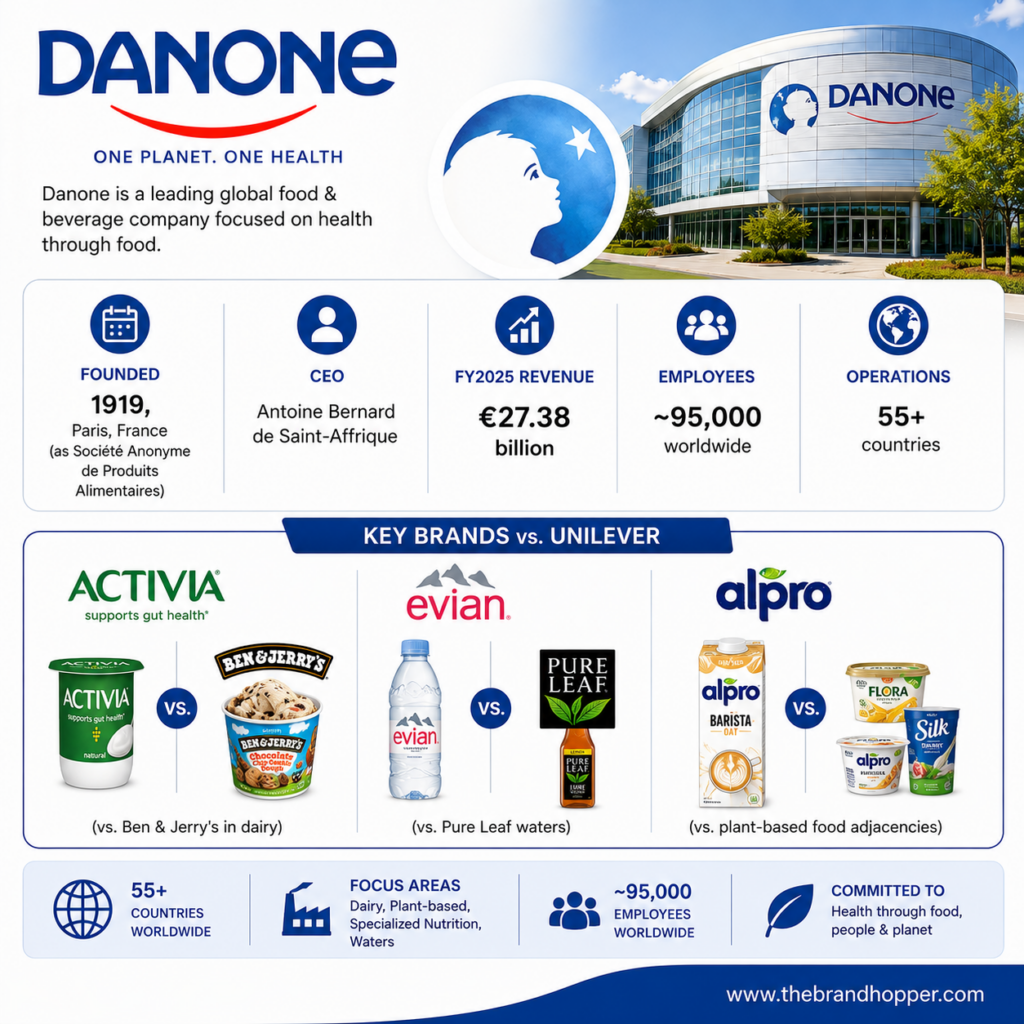
Danone, founded in Barcelona in 1919 and now headquartered in Paris, competes with Unilever primarily in foods, dairy, plant-based alternatives, and bottled water.
Though a smaller company by market capitalization, Danone’s Activia, Evian, Aptamil, and Alpro brands directly address consumer trends that also drive Unilever’s Foods division.
Danone reported FY2025 revenues of €27.38 billion, an important milestone demonstrating that volume recovery was underway after two years of inflation-driven pricing.
Portfolio & Category Overlap
Danone and Unilever’s competitive overlap is sharpest in the increasingly blurred zone between dairy, plant-based food, and functional nutrition. Danone’s Alpro (plant-based milks, yogurts, creams) and Silk compete directly with emerging Unilever plant-based plays.
In specialized nutrition, Danone’s Aptamil infant formula and Fortimel medical nutrition serve categories Unilever has largely vacated. The company also operates Volvic, evian, and Badoit in premium waters.
Danone has zero meaningful presence in home care, beauty, or personal care—areas where it presents no threat to Unilever.
Strategy: “Renew” with Discipline
CEO Antoine Bernard de Saint-Affrique’s “Renew Danone” strategy focuses on three pillars: portfolio premiumization, digital capability building, and ruthless cost efficiency. The company divested its Russian dairy operations and sold its Aqua water business in Indonesia, narrowing geographic exposure to higher-profitability markets.
Danone has also reorganized into two business units: Essential Dairy & Plant-Based (EDP) and Specialized Nutrition, plus Waters. The shift toward evidence-based nutrition—linking probiotic research to gut health outcomes—is a key differentiator that allows Danone to charge premium prices and build clinical credibility.
Sustainability & Outlook
Danone’s “One Planet. One Health” framework targets carbon neutrality across its full value chain by 2050, 100% recyclable or reusable packaging by 2025, and regenerative agriculture across 100% of its key ingredient supply chains by 2025.
The company was one of the first major food corporations to earn “B Corp” certification in 2021—though the certification was later suspended while it revisited its governance structure.
With volume recovery underway, a leaner portfolio, and a credible health positioning, Danone is poised to close the growth gap with Nestlé and challenge Unilever more directly in premium foods.
6. Henkel
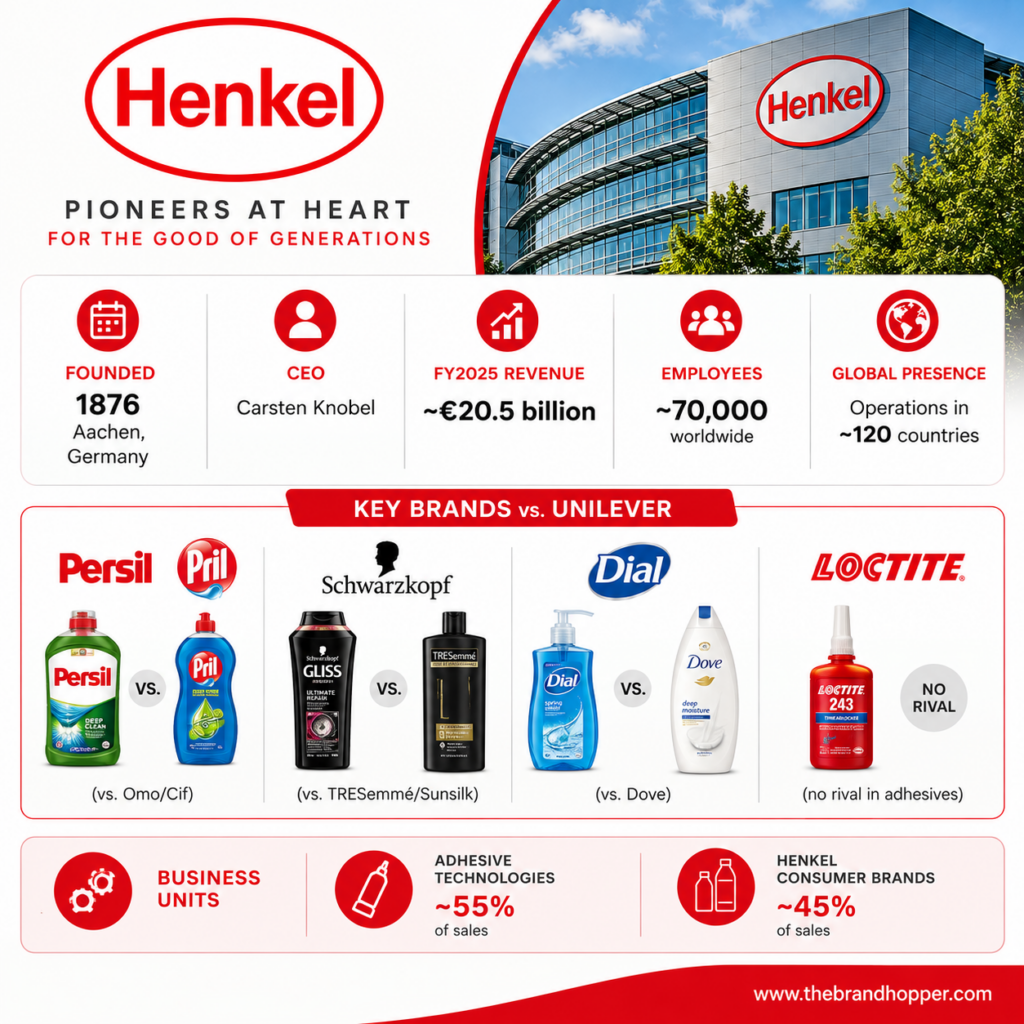
Henkel, founded in Aachen, Germany in 1876 by Fritz Henkel, is one of the most distinctive players in the competitive landscape—a company whose business spans industrial adhesives and consumer goods simultaneously.
Henkel competes with Unilever in laundry care (Persil vs. Omo), haircare (Schwarzkopf vs. Dove/TRESemmé/Sunsilk), and body care (Dial vs. Dove).
In FY2025, Henkel reported consolidated sales of approximately €20.5 billion with solid organic sales growth of +0.9%, record gross margin, and strong emerging market performance—a demonstration of the company’s operational resilience amid a complex macro environment.
Consumer Brands vs. Unilever
Within Henkel’s consumer brands portfolio, the competition with Unilever is most intense in laundry and haircare. Persil (Henkel) and Omo (Unilever) are both premium laundry brands fighting for shelf space in Europe, Latin America, and the Middle East. Schwarzkopf—a professional salon heritage brand—competes with Unilever’s TRESemmé in the mass-prestige haircare tier and with Dove in everyday haircare.
Henkel has been expanding its premium digital hair color systems under Syoss and schwarzkopf.de, directly targeting the growing at-home coloring market that Unilever has not yet dominated.
In adhesives—Henkel’s largest division by revenue—there is no Unilever rivalry; Loctite and Technomelt serve industrial and DIY markets that Unilever has no presence in.
Strategy & Recent Moves
Henkel merged its former Laundry & Home Care and Beauty Care consumer divisions into a unified “Henkel Consumer Brands” business unit in 2022, accelerating cross-portfolio efficiencies and enabling a more agile go-to-market structure.
The company’s “Purposeful Growth Agenda” prioritizes winning in its ten highest-potential emerging markets, digital acceleration (D2C platforms, e-commerce, social commerce), and portfolio concentration on its strongest power brands.
Henkel has also invested in “Love Nature”—an eco-friendly laundry and cleaning brand—to capture growing demand for plant-derived, sustainably packaged household products.
Sustainability & Outlook
Henkel’s “Sustainability Ambition 2030” commits to becoming climate-positive by 2040 (net positive impact on the climate beyond its own value chain), 100% recyclable or reusable packaging by 2025, and sourcing 100% renewable electricity by 2030.
Henkel is a pioneer in waterless and concentrated cleaning formulations—an area where both Unilever and P&G are following Henkel’s lead. Record gross margin performance in 2024 demonstrates that Henkel’s premiumization and efficiency programs are delivering tangible results.
7. Colgate-Palmolive
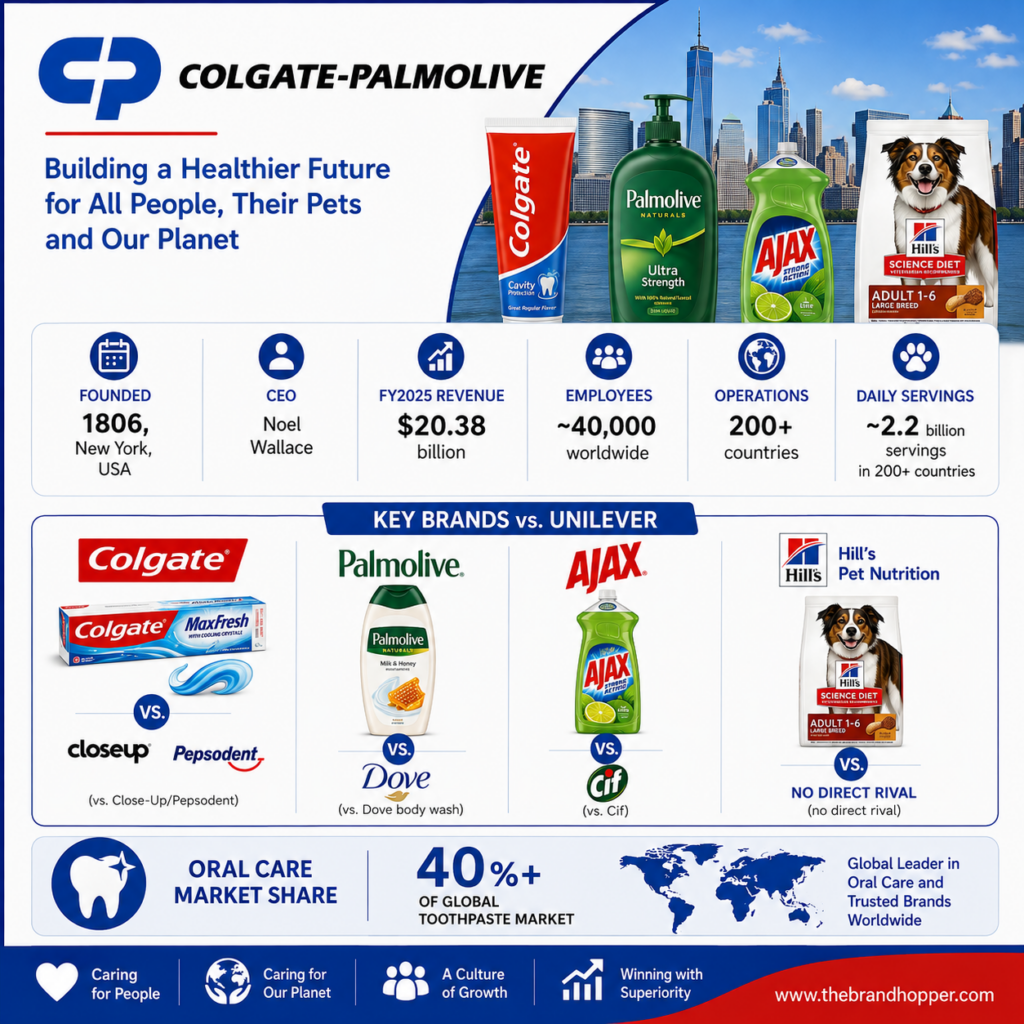
Colgate-Palmolive, founded in 1806 and headquartered in New York, is the quintessential category leader—holding a 40%+ share of the global toothpaste market, making it the clear #1 in oral care worldwide.
It also competes with Unilever in personal care (Palmolive body wash vs. Dove) and home care (Ajax vs. Cif).
The company achieved a major milestone in FY2025: net sales crossed $20.38 billion, with organic sales growth of 1.4%—one of the strongest growth profiles among major FMCG companies. Hill’s Pet Nutrition, Colgate’s premium pet food division, has been a significant growth engine.
Oral Care Dominance & Category Expansion
Colgate’s oral care franchise is simply unmatched globally. The Colgate brand covers toothpaste, toothbrushes, mouthwash, and whitening strips, competing with Unilever’s Close-Up and Pepsodent at the mass-market level and with P&G’s Crest and Oral-B in premium developed markets.
The company’s Colgate Optic White Pro Series, Sensitive Pro-Relief (partnered with dentists globally), and smart electric toothbrush line (Colgate Connect E1 with AI coaching) represent successful premiumization that is expanding the category’s average selling price.
Hill’s Science Diet and Prescription Diet, sold through veterinary channels, generate exceptional margins and have grown at double-digit rates as pet humanization drives increased health spending on animals.
Strategy & Emerging Market Growth
Colgate sells its products in over 200 countries and territories—more than virtually any other FMCG company—and derives over 50% of net sales from emerging markets.
In Latin America, Africa/Eurasia, and Asia Pacific, Colgate’s oral care brands carry enormous brand equity and serve as consumers’ first premium purchase.
The company’s “Nourish to Flourish” strategy focuses on naturalness, efficacy, and sustainability credentials in a category that is seeing rapid premiumization. Digital dentistry partnerships (tele-dentistry platforms and AI-powered oral health apps) extend Colgate’s consumer relationship far beyond the toothpaste purchase.
Sustainability & Outlook
Colgate pioneered the first recyclable toothpaste tube—long a significant source of plastic waste—and has been expanding this innovation across its global markets.
The company targets net zero carbon by 2040, 100% renewable electricity by 2030, and zero manufacturing waste to landfill. Hill’s Pet Nutrition continues to be a key growth driver, and Colgate’s oral care category benefits from structural tailwinds as dental health awareness rises in developing markets.
Colgate’s focused category expertise gives it a durable competitive moat that Unilever’s broader portfolio cannot easily replicate.
8. Kimberly-Clark
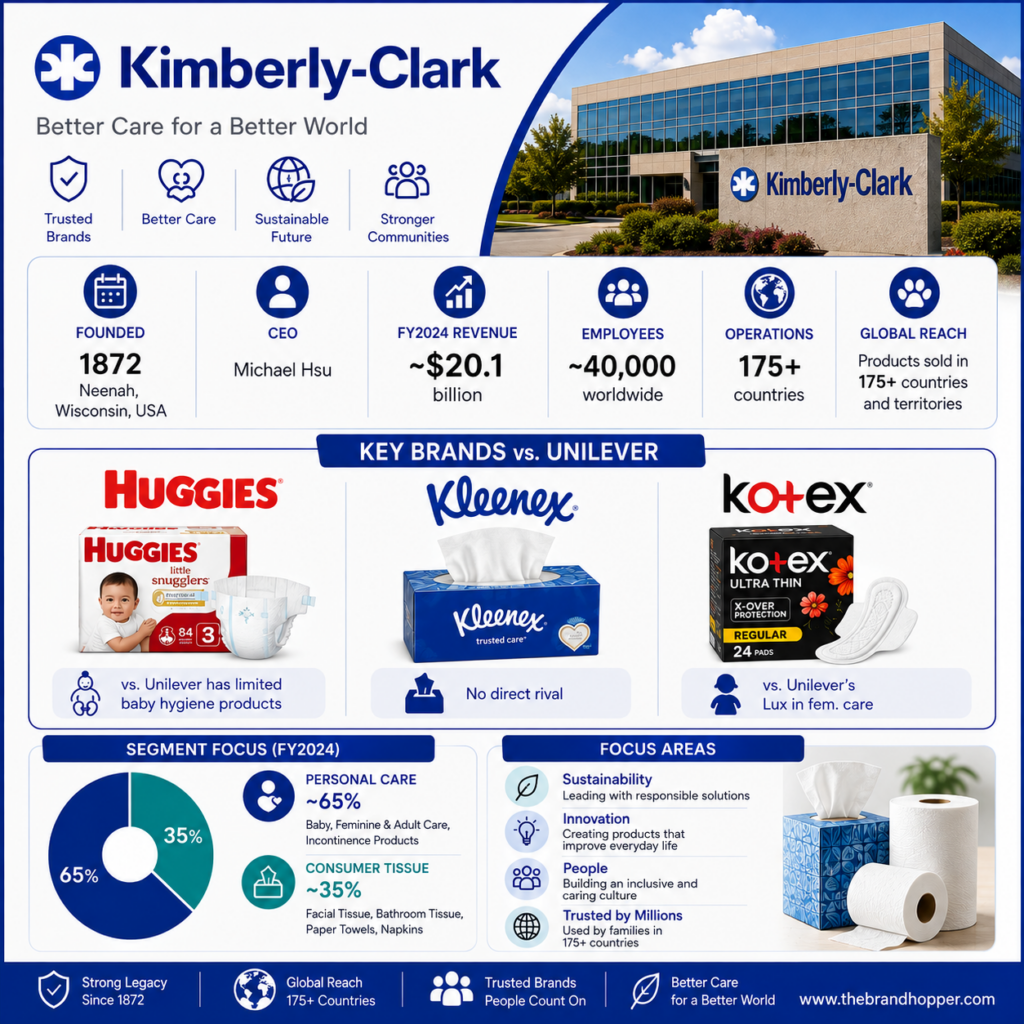
Kimberly-Clark, founded in Neenah, Wisconsin in 1872, is one of the world’s largest producers of personal care consumer products, competing with Unilever in hygiene, baby care, and household categories.
Its iconic brands—Huggies, Kleenex, Scott, Kotex, Depend—serve billions of consumers in 175+ countries.
Kimberly-Clark reported FY2025 net sales of approximately $16.47 billion, reflecting a -2.13% reported decline. Organic growth remained positive, demonstrating underlying brand health.
Category Overlap & Competitive Position
Kimberly-Clark competes with Unilever most directly in feminine care (Kotex vs. Unilever’s Lux Fleur, Carefree—the latter now owned by Edgewell), baby care (Huggies vs. Unilever’s limited baby portfolio), and household hygiene.
However, the overlap is less intense than Unilever’s rivalry with P&G or Henkel—K-C’s strengths in tissue (Kleenex, Scott, Cottonelle) and incontinence care (Depend, Poise) are categories where Unilever has minimal presence.
The most direct battlefield is in developing markets: both companies compete aggressively for diaper market share in Asia, Latin America, and Africa, where Huggies (K-C) fights P&G’s Pampers and local brands.
Strategy: “Powering Care” Transformation
K-C’s “Powering Care” strategy, launched in 2023, is a multi-year transformation encompassing a new organizational design (simpler, faster decision-making), a $3 billion gross savings program by 2027, and portfolio optimization.
A key element of this transformation is the announced separation of K-C’s North America Professional Products business (sold as K-C Professional—Kleenex, Scott, WypAll products in away-from-home markets) into an independent company, expected to be completed during 2025-2026.
This would sharpen K-C’s focus on consumer-facing brands and emerging market growth where personal care penetration is still in early innings.
Sustainability & Outlook
Kimberly-Clark’s sustainability commitments include achieving net zero carbon emissions by 2050, sourcing 100% renewable electricity by 2030, and eliminating fossil-fuel-based plastics from consumer packaging by 2030.
The company has made significant investments in bamboo-based tissue production—a faster-growing raw material that reduces pressure on forest fiber supply chains.
In personal care, Huggies’ eco-friendly line (plant-based materials, reduced packaging) represents K-C’s response to growing parent demand for sustainable baby products.
9. Reckitt
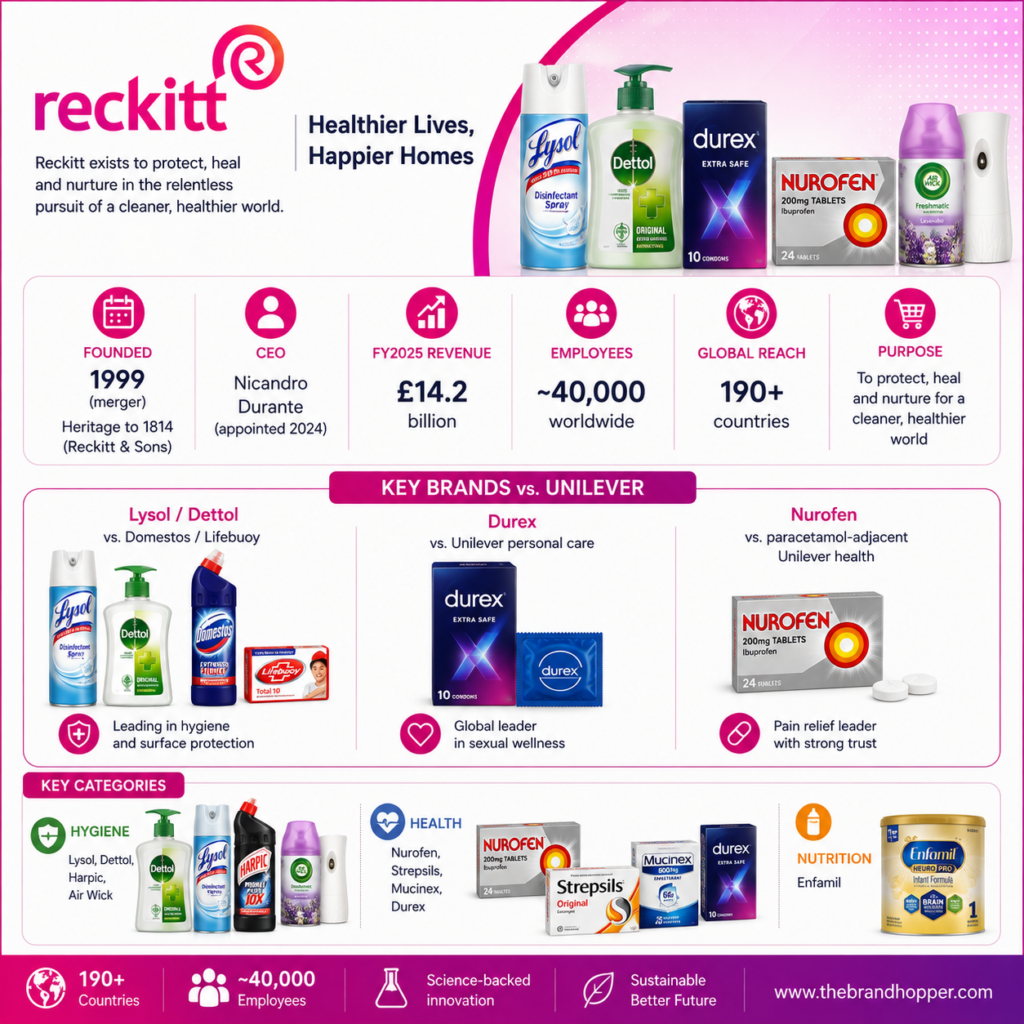
Reckitt (formerly Reckitt Benckiser, rebranded 2021) is a British multinational focused on three purpose-led categories: Hygiene, Health, and Nutrition.
Formed in 1999 by the merger of UK-based Reckitt & Colman and Netherlands-based Benckiser, it competes with Unilever across household hygiene (Lysol vs. Domestos, Dettol vs. Lifebuoy) and personal care (Durex vs. Unilever’s selected personal care products).
Reckitt reported full-year 2025 net revenues of £14.2 billion, reflecting ongoing challenges in its Nutrition division and strategic portfolio management. The company is exploring a potential separation of its Hygiene and Health businesses.
Hygiene Competition with Unilever
Reckitt’s competitive overlap with Unilever is sharpest in household disinfection and personal hygiene. Lysol and Dettol (Reckitt) compete globally with Unilever’s Domestos and Lifebuoy brands for bathroom, kitchen, and surface cleaning market share.
Dettol’s “anti-bacterial” positioning in personal washes and soaps directly challenges Unilever’s Lifebuoy in Asian and African markets. Air Wick air care products compete in a category where Unilever has a limited presence.
Reckitt’s portfolio of OTC health brands (Nurofen, Strepsils, Mucinex, Clearasil) spans categories that Unilever has traditionally not competed in, giving Reckitt structural differentiation.
Strategy & Portfolio Evolution
Reckitt’s most consequential strategic move in recent years was the announced potential separation of its Health and Hygiene businesses—recognizing that the two operate with very different growth dynamics, margin profiles, and acquisition logics.
The company sold its Chinese infant formula business (Mead Johnson China) and acquired Biofreeze (topical pain relief) to strengthen its OTC health portfolio.
The appointment of Nicandro Durante as CEO in 2024 (formerly CEO of British American Tobacco) signals a focus on operational discipline, portfolio simplification, and shareholder returns. Reckitt’s ability to protect Lysol, Dettol, and Nurofen’s pricing power in inflationary environments has been a key financial strength.
Sustainability & Outlook
Reckitt’s “Fight For Access” purpose framework focuses on making hygiene, health, and nutrition available to more people globally—particularly the 3+ billion who currently lack adequate access to these basics.
Environmental commitments include 100% recyclable/reusable plastics by 2025 and a 65% reduction in carbon from operations by 2030. Reckitt’s flagship innovation—plant-based Lysol formulations and concentrated refills—reduces plastic waste and appeals to sustainability-conscious consumers while protecting margins through premiumization.
10. Kenvue
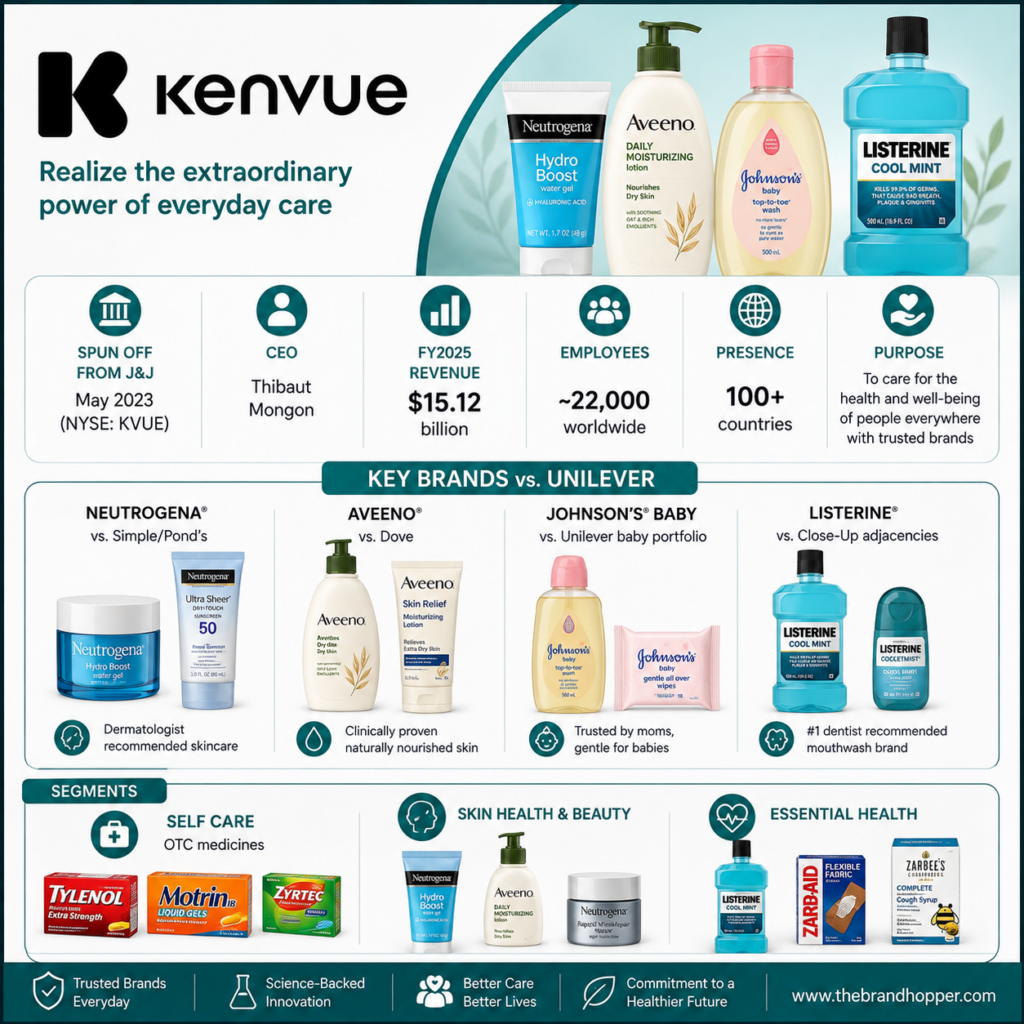
Kenvue represents one of the most significant corporate separations in recent FMCG history: in May 2023, Johnson & Johnson spun off its entire Consumer Health division as an independent publicly traded company, creating a $15+ billion pure-play consumer health and personal care business.
Formerly the J&J Consumer segment that competed with Unilever’s Dove, TRESemmé, and other personal care brands, Kenvue now operates as an independent entity with iconic global brands.
Kenvue reported full-year 2025 net sales of $15.12 billion, lower 2.2% reported, as the company worked through a challenging first full year as an independent public company amid weak North American OTC cold & flu market conditions.
Competing with Unilever in Skin & Personal Care
Kenvue’s Skin Health & Beauty segment—encompassing NEUTROGENA, AVEENO, CLEAN & CLEAR, and OGX—competes directly with Unilever’s personal care portfolio.
NEUTROGENA’s dermatologist-recommended positioning challenges Unilever’s Simple and Pond’s at the mass-premium level.
AVEENO (oat-based ingredients, sensitive skin focus) competes head-to-head with Dove’s Sensitive skin range.
Johnson’s Baby has a long-standing rivalry with various Unilever baby care initiatives.
Kenvue’s OTC health portfolio—TYLENOL, BENADRYL, PEPCID, MOTRIN, ZYRTEC—represents categories Unilever has no presence in, providing Kenvue with a high-margin, low-cyclicality revenue base.
Strategy: “Built to Outperform”
Kenvue’s “Built to Outperform” strategic framework centers on: (1) accelerating its 15 most powerful brands (“Power Brands”), which collectively account for over 80% of revenue; (2) winning in digital and e-commerce channels where HCP recommendation-driven brands like NEUTROGENA and LISTERINE can translate trust into online conversion; and (3) expanding in high-growth emerging markets, particularly Southeast Asia and Latin America.
The company has aggressively paid down debt since its IPO—the largest US IPO of 2023—and is investing in marketing to convert J&J’s historic brand awareness into independent-brand loyalty for Kenvue.
Sustainability & Outlook
Kenvue’s sustainability framework, “Our Credo in Action,” builds on J&J’s historic ESG leadership, targeting science-based emissions reductions, responsible ingredient sourcing (including ending the use of parabens, formaldehyde-releasing preservatives, and animal testing in cosmetics), and sustainable packaging.
As an independent company navigating its first years in the market, Kenvue has the potential to be a more focused and agile competitor to Unilever in personal care than J&J’s combined entity ever was.
11. Haleon
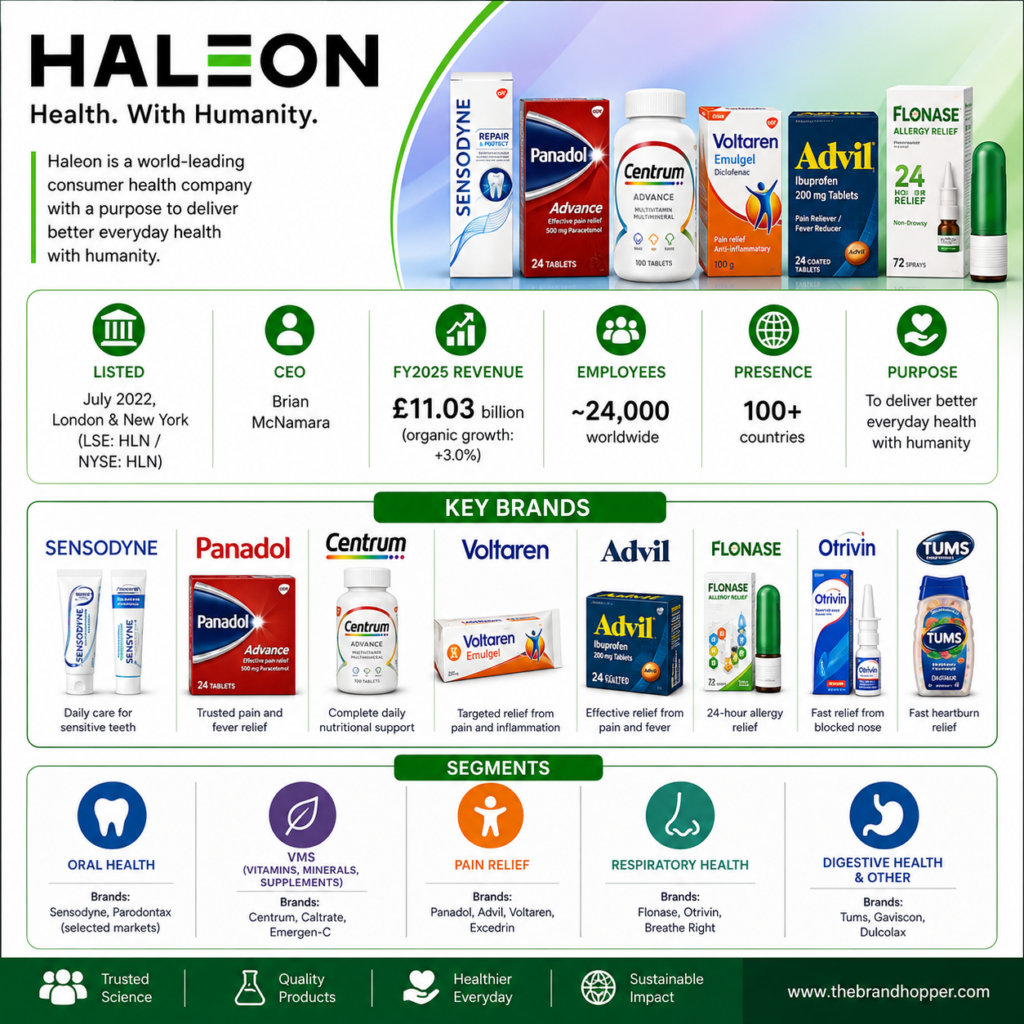
Haleon, listed on the London and New York stock exchanges in July 2022 as the largest UK IPO in a decade, is the world’s largest standalone consumer healthcare company.
Created from the consumer health joint venture between GSK and Pfizer (and originally including Novartis Consumer Health), Haleon competes with Unilever in oral health (Sensodyne vs. Unilever’s oral care adjacencies) and in the broader preventative wellness space.
Haleon reported FY2025 revenues of £11.03 billion (reported growth of -1.8%; organic growth of +3.0%), with Power Brands growing ahead of the overall market.
Overlap with Unilever’s Health Ambitions
Haleon’s competitive overlap with Unilever is most relevant in the preventative health and oral hygiene spaces. Sensodyne—the world’s #1 sensitivity toothpaste brand, recommended by dentists in over 130 countries—positions premium oral health as a form of everyday healthcare.
Centrum (multivitamins) and Emergen-C (vitamin supplements) compete in the wellness category that Unilever has been building through brands like Liquid I.V. (acquired 2020). Voltaren (topical pain relief gel) is a premium OTC brand with clinical credibility that Unilever does not match in pain management.
As Unilever’s Health & Wellbeing segment grows, the competitive tension with Haleon will intensify.
Strategy & Differentiation
Haleon’s differentiation lies in its “Human Science” positioning—combining healthcare clinical evidence with consumer marketing insight.
The company invests significantly in health professional engagement (dentists, pharmacists, GPs) to build recommendation-led demand, a model that is structurally difficult for pure FMCG companies like Unilever to replicate at scale. Haleon’s “Power Brands” strategy focuses investment on its 15 biggest brands, which represent approximately 80% of revenues.
The company also has significant emerging market exposure in Asia Pacific, Latin America, and EMEA—regions where the shift from traditional remedies to branded OTC healthcare is a multi-decade structural opportunity.
Sustainability & Outlook
Haleon’s ambition is to “Deliver better everyday health with humanity”—which includes ESG goals of 100% renewable electricity by 2030, net zero Scope 1 and 2 emissions by 2030, and responsible responsible ingredient sourcing.
With Pfizer’s stake now fully divested, Haleon operates as a truly independent company free to pursue acquisitions and partnerships.
Given its focus on high-growth healthcare adjacencies and premium brand architecture, Haleon is likely to be a growing competitive threat to Unilever’s Health & Wellbeing division over the coming years.
12. Kao Corporation
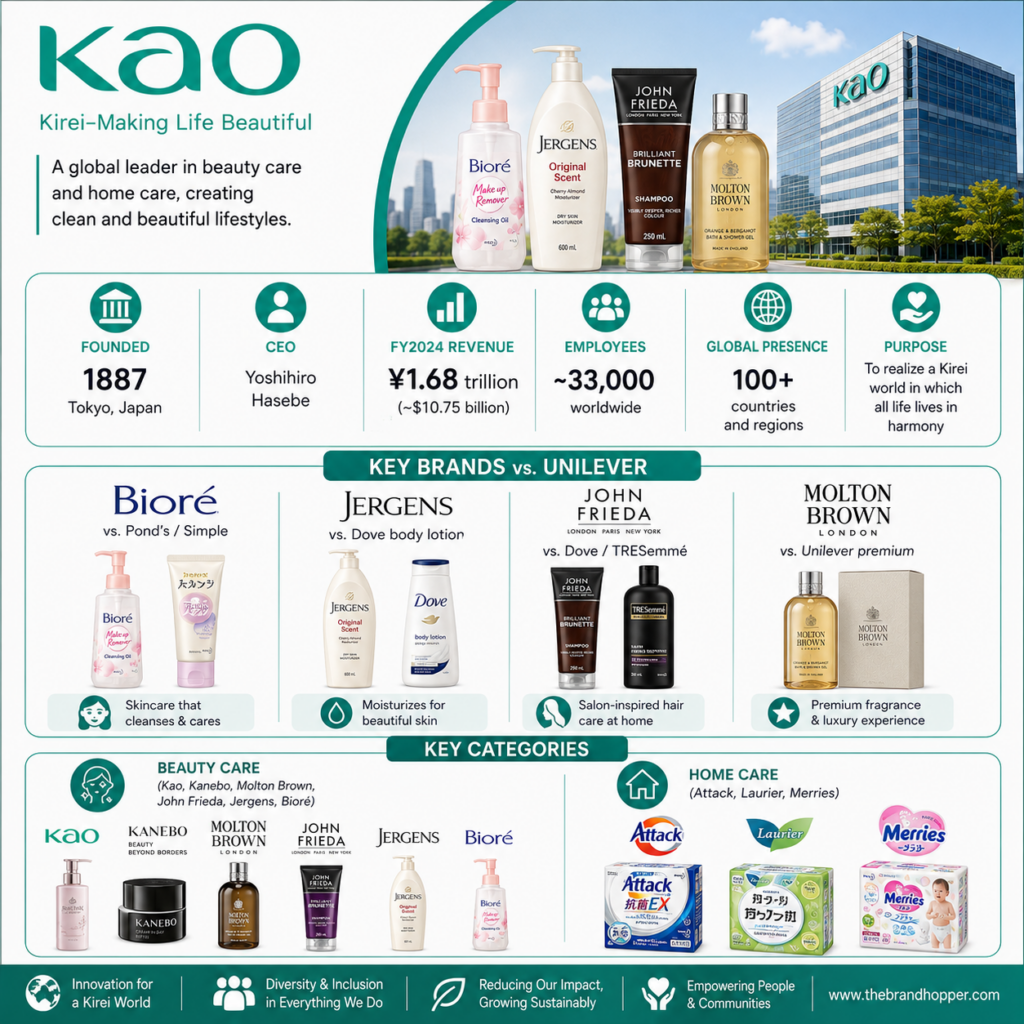
Kao Corporation, founded in Tokyo in 1887, is Japan’s largest consumer goods company and one of the most respected FMCG players in Asia.
Kao competes with Unilever across beauty care (hair color, hair care, skincare), personal care (body washes, deodorants), and home care (laundry and dishwashing), with particular strength in Japan, China, Southeast Asia, and Australia.
Kao reported FY2025 revenues of ¥1.68 trillion (approximately $10.75 billion USD), an increase of 3.7% year-on-year, reflecting both organic growth and favorable currency effects. Kao is a company Unilever watches closely as it expands its Asia-Pacific beauty and personal care operations.
Premium Brand Architecture & Innovation
Kao operates a multi-tiered brand architecture that mirrors Unilever’s own approach but with a distinctly Japanese craft aesthetic. At the premium end, Molton Brown (luxury bath and body, acquired 2015) competes with Unilever’s premium beauty acquisitions.
John Frieda and Curel represent evidence-led haircare and skincare respectively. Bioré (pore strips, UV skincare) has become a global phenomenon in Asia and Western markets.
Jergens moisturizing body lotion competes directly with Unilever’s Dove and Vaseline. Kao’s Oribe (ultra-premium haircare) targets the same salon-derived luxury segment as Unilever’s recently divested prestige hair portfolio.
In home care, Attack Zero ultra-concentrated laundry detergent demonstrates Kao’s innovation leadership in sustainability-aligned, high-efficacy formats.
R&D Prowess & Yoki-Monozukuri Philosophy
Kao invests approximately 3.4% of net sales in R&D—among the highest ratios in the global FMCG industry. The company’s “Yoki-Monozukuri” (artful craftsmanship in creating excellent products that satisfy and enrich the lives of consumers) philosophy permeates product development.
Kao’s K25 medium-term management plan focuses on structural growth in beauty and health, expansion of premium brands internationally, and sustainability as a source of competitive advantage.
The company’s AI-powered hair color analysis platform (in Japan) and biofermentation technology for sustainable ingredients position Kao as a technology leader in its categories.
Sustainability & Outlook
Kao has earned consistent top rankings in sustainability indices including the Dow Jones Sustainability Index (Asia Pacific) and the CDP Climate A List.
The company’s “Kirei Lifestyle Plan” (kirei = clean, beautiful in Japanese) sets 2030 targets for zero CO2 emissions from offices and plants, full switchover to renewable energy, and 100% use of sustainably certified palm oil.
As Unilever pushes deeper into Asia’s premium beauty space, Kao’s established distribution, regulatory expertise, and brand trust in the region will make it one of the most challenging local competitors to displace.
13. SC Johnson
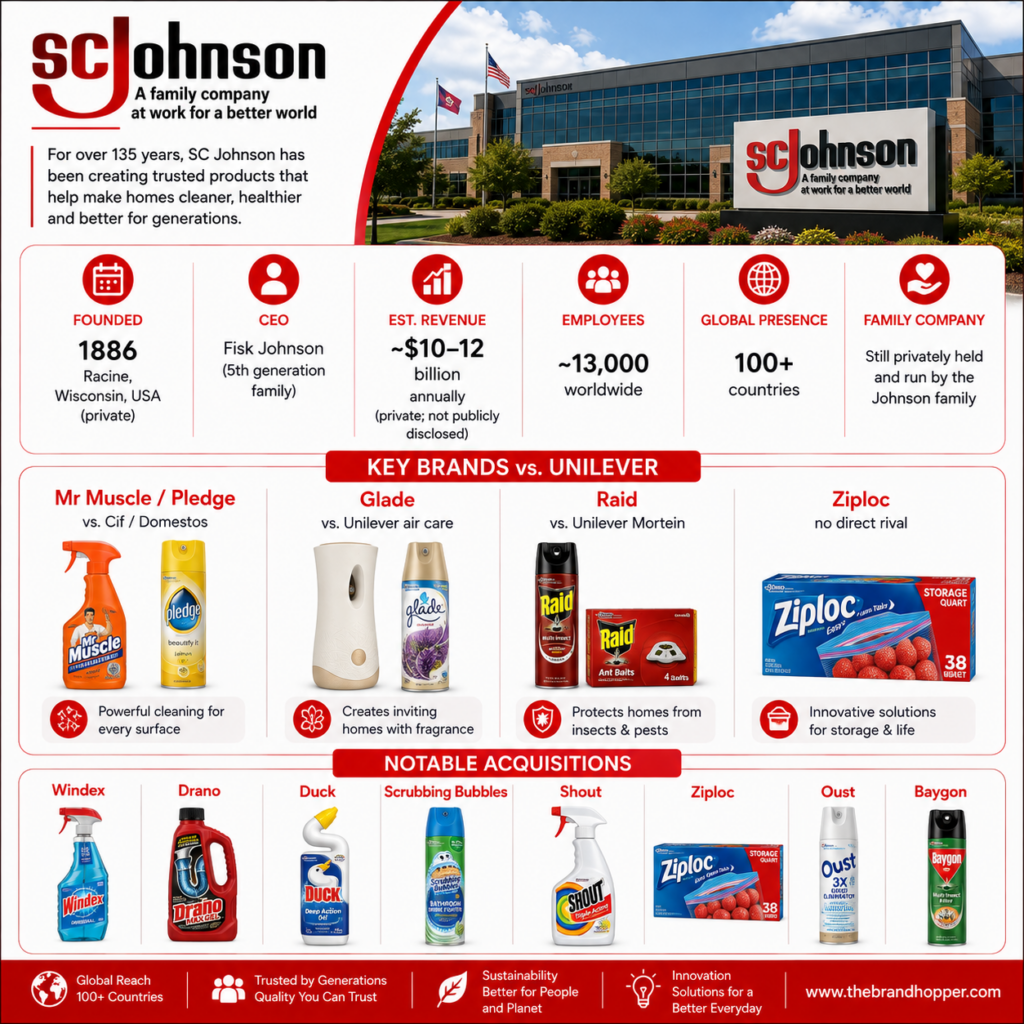
SC Johnson (SC Johnson & Son, Inc.), founded in Racine, Wisconsin in 1886, is one of the largest private consumer goods companies in the world, remaining family-owned across five generations under CEO Fisk Johnson.
Because SC Johnson is privately held, it does not publish audited financials; the company is broadly estimated to generate revenues of $10–12 billion annually.
SC Johnson competes directly with Unilever in home care (Mr Muscle vs. Cif/Vim), air fresheners (Glade vs. Unilever adjacencies), and household pest control (Raid vs. Unilever’s Mortein)—and in insect repellent (OFF! vs. Unilever’s former Autan brand) in many markets.
Home Care Competition with Unilever
SC Johnson’s portfolio is built around household cleaning, pest control, air care, and food storage—categories that overlap significantly with Unilever’s Home Care division. Mr Muscle (bathroom, kitchen, drain cleaners) competes with Unilever’s Cif, Jif, and Domestos across Europe, Asia, and Australia.
Pledge (furniture care) and Windex (glass cleaners) address household surface care categories where Unilever has a smaller footprint.
In pest control, Raid and Baygon are global leaders, competing with Unilever’s Mortein brand (the latter owned by Reckitt in some markets and Unilever in others, depending on geography).
Glade’s air fresheners—plug-ins, sprays, and solid gel formats—compete with Air Wick (Reckitt) and indirectly with Unilever’s cleaning-as-freshening philosophy in products like Comfort.
Sustainability: Leading From a Private Platform
SC Johnson’s private status gives it the freedom to invest in long-term sustainability initiatives without quarterly earnings pressure—an advantage it has used deliberately.
The company launched “Ziploc Recyclable” films and has partnered with TerraCycle to create drop-off recycling for its packaging. SC Johnson’s “Greenlist” ingredient selection process—which assigns every ingredient a sustainability rating—has been a model for responsible formulation and has influenced regulatory frameworks globally.
The “Windex with Vinegar” line represents SC Johnson’s mass-market natural product push, directly competing with Unilever’s own cleaning portfolio reformulations.
As a family-owned business, SC Johnson is able to think in decades rather than quarters—a competitive dynamic Unilever and its publicly listed rivals must always navigate carefully.
14. Beiersdorf
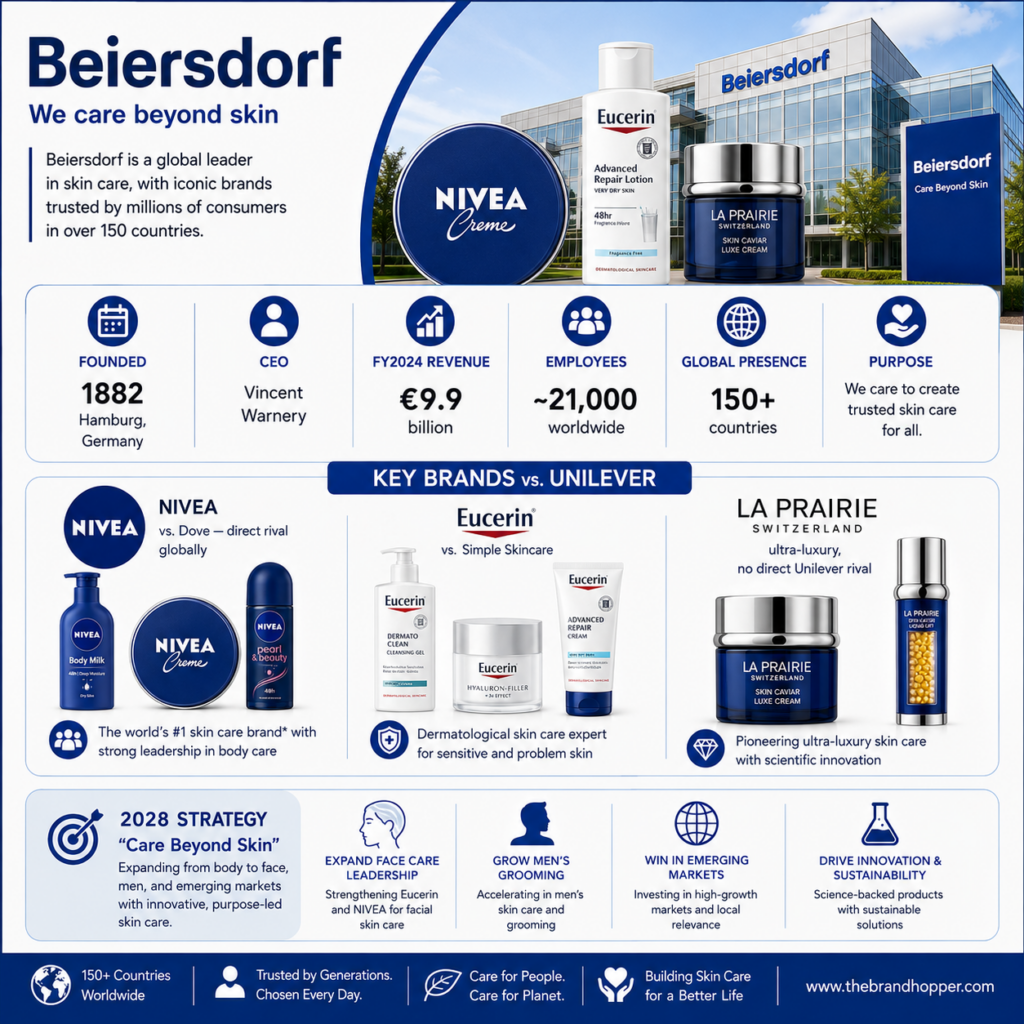
Beiersdorf AG, founded in Hamburg in 1882, is a German consumer goods company whose consumer division is built almost entirely around skincare—most famously through the NIVEA brand, which is the world’s most recognized skincare brand by volume.
Beiersdorf also operates Eucerin (dermatological skincare), La Prairie (ultra-luxury), Hansaplast/Elastoplast (wound care), and the tesa adhesive division (B2B, automotive, electronics).
In FY2025, Beiersdorf reported revenues of €9.9 billion, driven by strong performance of NIVEA in emerging markets and continued growth at La Prairie in selective luxury retail channels.
NIVEA vs. Dove: The Global Skincare Rivalry
The NIVEA (Beiersdorf) vs. Dove (Unilever) competition is one of the most closely watched brand rivalries in global personal care. Both brands compete for the #1 position in mass-market body moisturizers, skin cleansers, and deodorants across every major market worldwide.
NIVEA’s blue tin has been a cultural icon for over 110 years—an asset that Dove, despite its successful “Real Beauty” campaign, has found difficult to replicate in brand heritage terms.
Beiersdorf has been aggressively expanding NIVEA’s facial skincare range (NIVEA Luminous, NIVEA Cellular, NIVEA Sun) to compete more directly with the facial care segments where Dove and Pond’s operate.
Eucerin’s dermatological credibility (clinically proven for sensitive and atopic skin) competes with Unilever’s Simple brand in the evidence-led skincare segment.
Strategy: “Care Beyond Skin” 2028
Beiersdorf’s 2028 strategic plan targets sustained organic sales growth of 6–8% annually, driven by: (1) expansion of NIVEA into facial skincare and men’s grooming; (2) accelerating La Prairie in high-net-worth consumer markets in Asia and the Middle East; (3) digital-first consumer engagement leveraging AI-personalized skincare recommendations; and (4) disciplined emerging market expansion in Brazil, India, and Sub-Saharan Africa where NIVEA’s affordable premium positioning resonates strongly.
The tesa adhesive division (30%+ margins) provides a stable, high-quality cash flow stream that funds Beiersdorf’s consumer brand investment.
Sustainability & Outlook
Beiersdorf’s “We care” sustainability program targets climate neutrality of its production by 2025, 100% recyclable consumer packaging by 2025, and full sustainable sourcing of palm oil and other key raw materials. NIVEA’s transition to recycled-content packaging across its top markets is ahead of many peers.
Given NIVEA’s unique combination of deep emotional brand equity, affordable pricing, and documented efficacy, Beiersdorf’s “Care Beyond Skin” strategy positions it as an increasingly formidable challenger to Unilever’s Dove in the most valuable skincare battleground.
15. The Clorox Company
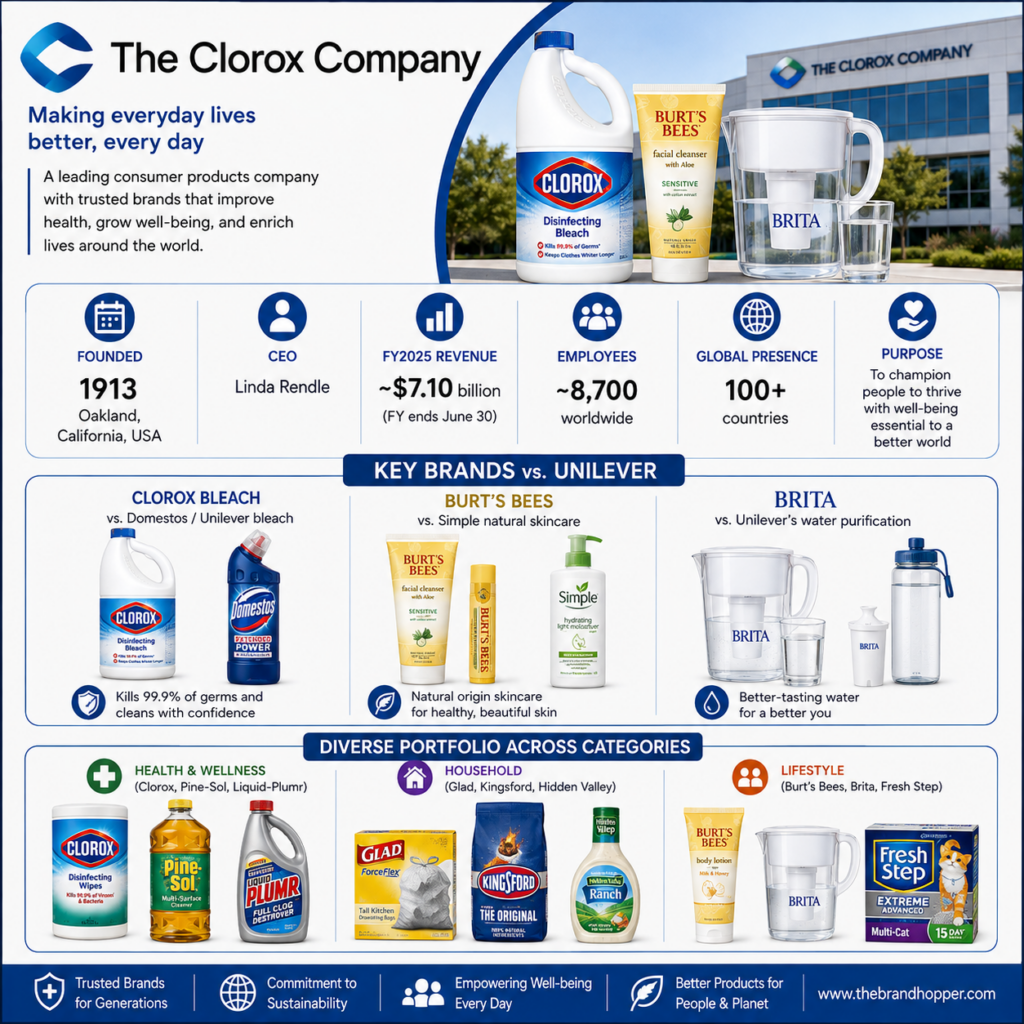
The Clorox Company, founded in Oakland, California in 1913, is an American household brand powerhouse competing with Unilever in household cleaning, personal care, and natural beauty.
Clorox’s portfolio of Clorox disinfectants, Brita water filtration, Burt’s Bees natural personal care, Hidden Valley dressings, and Kingsford charcoal spans a surprisingly diverse range of consumer needs.
Clorox reported FY2025 revenues of approximately $7.10 billion (fiscal year ending June 30, 2025), up 0.16% from FY2024—the company was still recovering operationally and financially from a major cybersecurity attack in August 2023 that disrupted its order management and manufacturing systems for several weeks.
Cleaning & Natural Beauty Overlap with Unilever
Clorox’s most direct competition with Unilever centers on household disinfection. Clorox bleach and Domestos (Unilever) compete for bathroom and kitchen disinfection leadership across North America, Latin America, and selected European markets.
Pine-Sol (Clorox) competes with Cif and Flash (Unilever) in multipurpose cleaning. Burt’s Bees—a natural personal care brand acquired by Clorox in 2007 for $913 million—competes with Unilever’s Simple, St. Ives, and Love Beauty & Planet natural beauty brands.
In water filtration, Brita (licensed in North America by Clorox from Brita GmbH) competes in a category that Unilever has addressed through Pureit in India and developing markets. Hidden Valley Ranch and KC Masterpiece dressings are unique to Clorox with no Unilever parallel.
Post-Cyberattack Recovery & Strategy
The August 2023 cyberattack was the most significant operational disruption in Clorox’s 110-year history, forcing the company to revert to manual ordering systems and causing widespread out-of-stock situations across retail partners.
Recovery through FY2024 was largely complete, with the company reinvesting in supply chain resilience, cybersecurity infrastructure, and retailer partnership rebuilding. Clorox’s “IGNITE” strategy focuses on four pillars: fuel growth (portfolio investment), innovate & evolve (new product development), reimagine work (operational efficiency), and evolve the portfolio (mix optimization).
The company has been exiting commodity categories to focus on branded, higher-margin lines.
Sustainability & Outlook
Clorox’s ESG commitments include 100% renewable electricity by 2030, 50% reduction in carbon emissions by 2030, and purpose-driven product development.
Burt’s Bees continues to lead in natural formulations and sustainable packaging, having achieved 100% natural origin ingredients across its full line.
Glad trash bags are transitioning to increased recycled content.
As Clorox completes its post-cyberattack recovery, it is positioned to compete more aggressively with Unilever in natural personal care and household cleaning—two categories where both companies see structural growth opportunity.
16. Church & Dwight
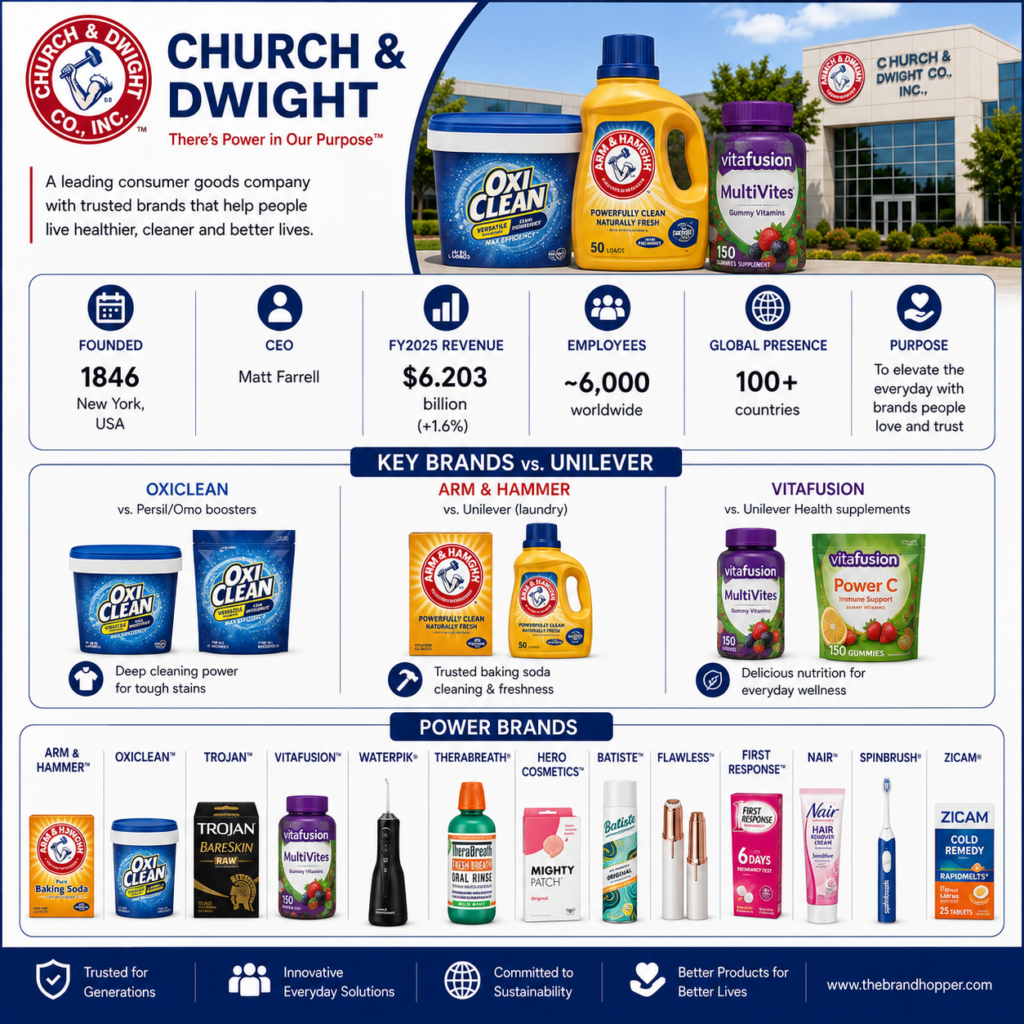
Church & Dwight, founded in New York in 1846 and built around the iconic Arm & Hammer baking soda brand, has evolved into a diversified $6+ billion consumer goods company competing with Unilever across laundry care, personal care, oral health, vitamins and supplements, and sexual wellness.
Church & Dwight reported FY2024 net sales of $6.203 billion, a 1.6% increase from FY2024, driven by organic growth in its international segment and strong performance from power brands including Vitafusion, Waterpik, TheraBreath, and HERO Cosmetics.
The company’s acquisition track record is one of the most admired in FMCG—consistently acquiring brands at reasonable valuations and growing them with its operational platform.
Laundry & Personal Care Rivalry
Church & Dwight competes with Unilever most directly in laundry care—OxiClean and Arm & Hammer laundry detergents fight for shelf space against Unilever’s Persil and Omo brands in North America and select international markets.
In the vitamins and supplements category (Vitafusion gummy vitamins—the #1 selling adult gummy vitamin brand in the US), Church & Dwight competes with Unilever’s Health & Wellbeing segment brands including Liquid I.V. TheraBreath clinical-grade oral rinses compete with Colgate and Unilever’s oral care adjacencies.
HERO Cosmetics (acne patches, acquired 2022) competes with Unilever’s Clearasil and other skincare brands in the rapidly growing Gen Z skin health category. Batiste dry shampoo is a dominant market leader in its niche, with limited direct Unilever competition.
Acquisition Strategy & Growth Model
Church & Dwight’s “acquisition-and-build” model is a defining competitive characteristic. The company targets acquisitions of $200M–1B+ in brand revenue with strong market positions, proprietary formulations, or category-creating innovations.
Recent acquisitions include HERO Cosmetics (acne care), TheraBreath (clinical oral health), and Waterpik (water flossers)—all businesses with strong e-commerce profiles that Church & Dwight has leveraged through its digital marketing capabilities.
This model of premium category entry via acquisition is directly comparable to Unilever’s own approach with brands like Liquid I.V., Ren Skincare, and Love Beauty & Planet.
Sustainability & Outlook
Church & Dwight’s ESG commitments focus on product sustainability (removing sulfates, parabens, and phosphates from formulations), packaging reduction (lightweighting, post-consumer recycled content), and responsible ingredient sourcing.
Arm & Hammer’s baking soda—naturally derived, biodegradable, and versatile—is itself a sustainability asset that the company leverages in laundry, toothpaste, and deodorizing products.
With strong brand momentum across its 13 power brands and a disciplined M&A approach, Church & Dwight is one of the most consistent value creators in FMCG.
17. Edgewell Personal Care
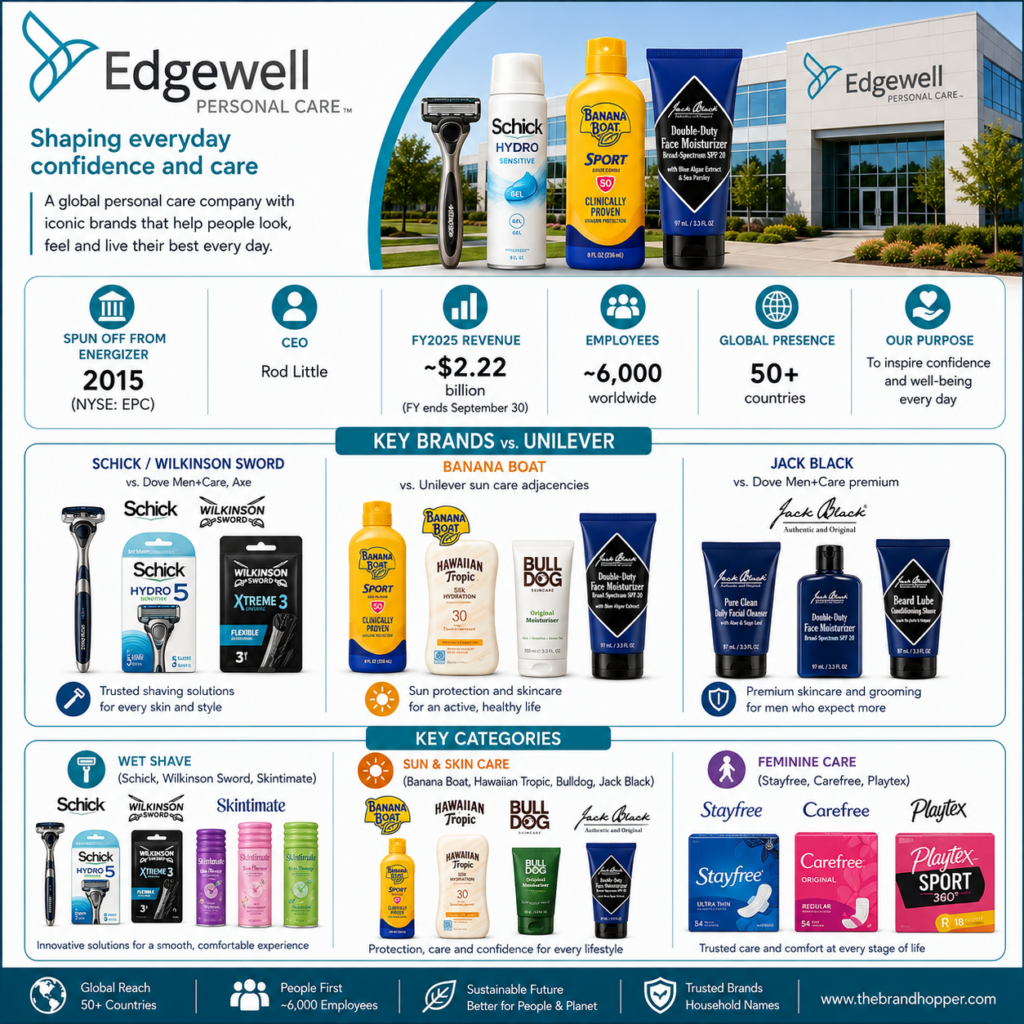
Edgewell Personal Care, spun off from Energizer Holdings in 2015 and headquartered in Shelton, Connecticut, competes with Unilever in men’s grooming (Schick vs. Dove Men+Care), feminine care, and sun and skin care.
Edgewell reported fiscal year 2025 net sales of approximately $2.22 billion (fiscal year ending September 30, 2025), a marginal decrease of 1.3% reported, reflecting the competitive challenges of its razor category amid P&G’s Gillette dominance and Unilever’s push into male grooming through Dove Men+Care and Axe.
Male Grooming & Skin Care Rivalry with Unilever
Edgewell’s primary competition with Unilever centers on the male grooming category. Schick (Hydro and Xtreme lines) and Wilkinson Sword compete with Unilever’s Axe/Lynx and Dove Men+Care for men’s shaving and grooming attention—though P&G’s Gillette dominates this space, relegating both Edgewell and Unilever to secondary positions.
Edgewell’s Jack Black (prestige men’s skincare and grooming) competes with Unilever’s more recent premium grooming acquisitions. Banana Boat and Hawaiian Tropic sun care products occupy a category where Unilever has been growing through its Skinsei and acquired sun protection lines.
Bulldog (natural men’s skincare, acquired by Edgewell in 2016) competes directly with Unilever’s Dove Men+Care natural range and Simple for Men adjacencies.
Strategy & Portfolio Evolution
Edgewell has been diversifying away from the declining wet shave category, which faces structural headwinds from the growing trend toward beard grooming and less frequent shaving—particularly among Millennials and Gen Z.
The company acquired Cremo (men’s multi-purpose grooming) and has been investing heavily in Bulldog’s expansion in the natural men’s skincare segment.
Feminine care under Stayfree, Carefree, and Playtex addresses a large global market where Unilever has minimal branded presence, providing Edgewell with category diversification and a resilient revenue stream.
Sustainability & Outlook
Edgewell’s sustainability focus centers on razor blade recyclability (partnering with TerraCycle for blade collection), transition to renewable energy at manufacturing facilities, and responsible ingredient sourcing in its sun and skin care portfolio.
Banana Boat’s Reef Protect range and Hawaiian Tropic’s commitment to reef-safe SPF formulations reflect growing consumer demand for sun protection that does not harm marine ecosystems.
As an independent, focused personal care company, Edgewell lacks the scale of Unilever but compensates with specialist category expertise and faster-moving brand innovation cycles in shaving and skin care.
18. Energizer Holdings
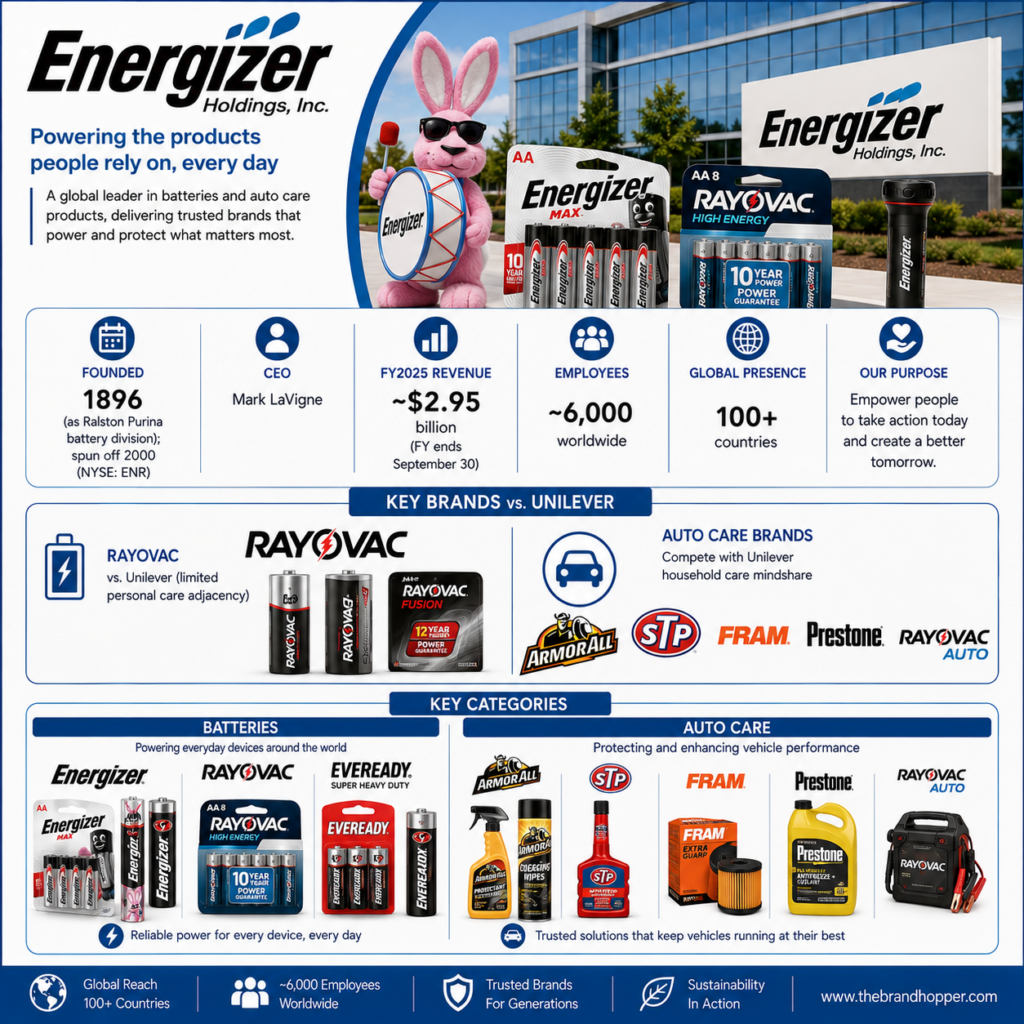
Energizer Holdings, spun off from Ralston Purina in 2000 and headquartered in St. Louis, Missouri, is best known for its flagship battery brand—the Energizer Bunny is one of the most recognizable brand mascots in consumer goods.
Beyond batteries (Energizer, Rayovac, Varta), the company operates a significant Auto Care division (Armor All, STP, Fram, Rayovac auto accessories).
While Energizer competes with Unilever primarily at the periphery of the household goods category, its Rayovac brand in Latin America and its household battery presence in retail channels where Unilever cleaning products are also sold create meaningful indirect competitive dynamics. Energizer reported fiscal year 2025 revenues of approximately $2.95 billion (fiscal year ending September 30, 2024).
Household Goods Overlap & Category Adjacency
Energizer’s overlap with Unilever is primarily at the category-adjacency level: both companies compete for household budget and retail shelf space in adjacent aisles.
In Latin America, Rayovac’s personal care line (razors, hearing aid batteries, flashlights) creates category overlap with Unilever’s personal care portfolio in markets like Brazil, where both command strong consumer mindshare.
Auto Care products (Armor All dashboard care, STP engine treatments) are sold through the same mass-market retail channels as Unilever home care brands, competing for consumer attention and promotional support from retailers.
Energizer has also moved into smart home batteries (rechargeables, USB batteries) as connected device usage grows.
Strategy & Debt Management
Energizer has been focused on debt reduction following its transformative acquisition of Rayovac, Varta (Americas and Asia), and Auto Care brands from Spectrum Brands in 2019.
The company’s “Project Momentum” efficiency program targets $100 million in annual savings through manufacturing footprint consolidation, SKU rationalization, and supply chain simplification.
Energizer has been carefully managing category dynamics as battery volumes in traditional alkaline categories mature, pivoting investment toward high-performance lithium batteries (Energizer Ultimate Lithium), rechargeable batteries, and expanding Auto Care margins through premiumization of Armor All and STP.
Sustainability & Outlook
Energizer’s sustainability commitments include transitioning to 100% renewable electricity across its manufacturing operations, achieving carbon neutrality for Scope 1 and 2 emissions by 2030, and making all primary packaging recyclable or reusable by 2025.
The company’s investment in lithium battery recycling partnerships addresses the growing regulatory pressure around battery end-of-life management across Europe and North America.
As consumer electronics proliferate and the global EV transition creates new battery demand paradigms, Energizer’s core category is evolving—and the company’s ability to diversify into adjacent household and auto care categories will determine its long-term competitive trajectory.
Unilever vs. 18 Competitors: Revenue & Category Comparison
The table below provides a quick-reference comparison of Unilever and its 18 key competitors by FY2024 revenue, headquarters, and primary overlapping categories. All revenue figures are drawn from official company disclosures (annual reports, press releases, SEC filings) and reflect the most recently completed fiscal year as of the date of this analysis.
| Company | FY2024 Revenue | Headquarters | Key Competing Categories | Key Brands |
| UNILEVER (Reference) | €60.8B | Rotterdam/London | Beauty, Personal Care, Home Care, Foods, Ice Cream | Dove, Axe, Persil, Knorr, Magnum, Lipton, Domestos |
| 1. Nestlé | CHF 91.35B | Vevey, Switzerland | Food, Beverages, Ice Cream, Pet Care, Infant Nutrition | Nescafé, Häagen-Dazs, KitKat, Purina, Evian |
| 2. Procter & Gamble | $84.0B | Cincinnati, USA | Home Care, Beauty, Personal Care, Baby Care, Oral Care | Tide, Gillette, Olay, Pantene, Pampers, SK-II |
| 3. The Coca-Cola Company | $47.1B | Atlanta, USA | Beverages (Tea, Juice, Water, Sports) | Coca-Cola, Sprite, Fuze Tea, Minute Maid, Dasani, Fairlife |
| 4. L’Oréal | ~€43.5B | Paris, France | Beauty, Skincare, Haircare, Makeup, Fragrance | L’Oréal Paris, Garnier, Lancme, Maybelline, La Roche-Posay, CeraVe |
| 5. Danone | €27.38B | Paris, France | Dairy, Plant-Based, Specialized Nutrition, Waters | Activia, Aptamil, Alpro, evian, Volvic, Nutrilon |
| 6. Henkel | ~€21.6B | Düsseldorf, Germany | Laundry, Home Care, Hair Care, Body Care, Adhesives | Persil, Schwarzkopf, Dial, Fa, Loctite |
| 7. Colgate-Palmolive | $20.10B | New York, USA | Oral Care, Personal Care, Home Care, Pet Nutrition | Colgate, Palmolive, Hill’s Pet Nutrition, Ajax, Tom’s of Maine |
| 8. Kimberly-Clark | ~$20.1B | Dallas, USA | Baby Care, Tissue & Hygiene, Feminine Care | Huggies, Kleenex, Scott, Kotex, Depend, Poise |
| 9. Reckitt | £14.2B | Slough, UK | Hygiene, Health OTC, Nutrition | Lysol, Dettol, Nurofen, Durex, Air Wick, Enfamil |
| 10. Kenvue (ex-J&J Consumer) | $15.5B | Summit, NJ, USA | Skincare, Hair Care, OTC Health, Baby Care | NEUTROGENA, AVEENO, LISTERINE, TYLENOL, Johnson’s Baby |
| 11. Haleon | £11.2B | Weybridge, UK | Oral Health, OTC Pain Relief, Vitamins & Supplements | Sensodyne, Panadol, Centrum, Voltaren, Advil, Flonase |
| 12. Kao Corporation | ¥1.63T (~$11B) | Tokyo, Japan | Beauty Care, Personal Care, Home Care | NIVEA (via JV?), Bioré, Jergens, John Frieda, Molton Brown, Attack |
| 13. SC Johnson (private) | ~$10–12B est. | Racine, USA | Home Care, Pest Control, Air Care, Food Storage | Mr Muscle, Raid, Glade, Ziploc, Windex, Pledge, OFF! |
| 14. Beiersdorf | €9.85B | Hamburg, Germany | Skincare, Body Care, Wound Care | NIVEA, Eucerin, La Prairie, Hansaplast, tesa |
| 15. The Clorox Company | ~$7.09B | Oakland, USA | Home Cleaning, Natural Beauty, Food, Water Filtration | Clorox, Pine-Sol, Burt’s Bees, Brita, Glad, Hidden Valley |
| 16. Church & Dwight | $6.107B | Ewing, NJ, USA | Laundry, Personal Care, Oral Health, Vitamins | Arm & Hammer, OxiClean, Vitafusion, Waterpik, TheraBreath, HERO |
| 17. Edgewell Personal Care | ~$2.25B | Shelton, CT, USA | Men’s Grooming, Sun Care, Feminine Care | Schick, Wilkinson Sword, Banana Boat, Jack Black, Bulldog |
| 18. Energizer Holdings | ~$2.89B | St. Louis, USA | Batteries, Auto Care (household adjacency) | Energizer, Rayovac, Armor All, STP, Fram |
How Unilever Competes: Strengths, Challenges & Strategic Positioning
Across its 18 major competitors, Unilever operates with a distinctive model: breadth and balance. While P&G matches it in household brand diversity and L’Oréal outguns it in beauty expertise, no single competitor replicates Unilever’s blend of five major category segments (Beauty & Wellbeing, Personal Care, Home Care, Foods, and soon to be redefined as Ice Cream is divested), presence in 190+ countries, and genuine emerging market depth. Unilever’s Power Brands strategy—focusing on 30 high-growth, high-margin brands including Dove, Axe, Persil, Domestos, Knorr, Magnum, Ben & Jerry’s, and Liquid I.V.—seeks to concentrate investment where Unilever can be category leader or a strong #2.
The ice cream divestiture, announced in January 2024 and expected to complete in H2 2025, is Unilever’s most consequential portfolio decision in a decade. By separating Magnum, Ben & Jerry’s, Cornetto, Walls, and Breyers into a standalone business listed on the Amsterdam, London, and New York exchanges, Unilever is simplifying its portfolio to focus on higher-growth, higher-margin everyday essential categories. This directly reduces Nestlé’s competitive overlap with Unilever (less ice cream competition) and allows Unilever to redeploy capital into Beauty & Wellbeing—where growth rates and margins are significantly higher.
Unilever’s competitive advantage in emerging markets is perhaps its most durable structural advantage. With decades-long presence in India (Hindustan Unilever Limited, 75% owned, listed on BSE), Sub-Saharan Africa, Southeast Asia, and Latin America, Unilever has built distribution networks, supplier relationships, and government partnerships that take decades to replicate. Companies like Nestlé, P&G, and Colgate-Palmolive are also deeply embedded in these markets, but in health and hygiene categories specifically, Unilever’s Lifebuoy, Domestos, and Pureit brands have a scale advantage that is difficult to displace. Sustainability increasingly plays a role here too: Unilever’s “Bright Future” framework and its history of purpose-led brands (Lifebuoy handwashing campaigns reaching hundreds of millions) give it a social license to operate that pure-commercial competitors struggle to match.
Conclusion
The global consumer goods industry is not a market where one winner takes all—it is an ecosystem of category specialists, geographic champions, and diversified conglomerates, each bringing unique strengths to the competition. Unilever’s 18 major rivals span the full spectrum: from Nestlé’s food-and-beverage scale to L’Oréal’s beauty expertise, from Reckitt’s hygiene focus to SC Johnson’s private company freedom. What they share is a relentless commitment to brand investment, innovation, and distribution excellence—the same three pillars that have sustained Unilever’s own €60+ billion revenue for decades.
For Unilever, the competitive pressures are real but manageable: the ice cream divestiture sharpens focus, the Power Brands strategy concentrates investment, and emerging market depth provides a growth runway that most competitors cannot easily access. For investors, analysts, marketers, and consumers alike, understanding who Unilever competes with—and how—is essential context for understanding the forces that shape the products we use every day.
Also Read: Top Inditex Competitors Dominating Global Fashion Retail — a similarly detailed analysis of the fashion retail competitive landscape.
Frequently Asked Questions About Unilever’s Competitors
Q: Who is Unilever’s biggest competitor?
A: By revenue, Nestlé (CHF 91.35 billion in FY2024) is the largest company that competes with Unilever, though the two overlap primarily in food, beverages, and ice cream. By breadth of competitive overlap across categories, Procter & Gamble ($84.0 billion FY2024) is Unilever’s most direct and long-standing rival—competing head-to-head in home care, personal care, baby care, and beauty across virtually every major global market.
Q: How does P&G compare to Unilever in revenue?
A: In FY2024, Procter & Gamble reported net sales of $84.0 billion versus Unilever’s €60.8 billion (approximately $65 billion at average exchange rates)—making P&G approximately 30% larger by revenue. However, Unilever has a stronger relative presence in emerging markets and competes in food and beverages categories where P&G has no presence.
Q: Is Nestlé bigger than Unilever?
A: Yes. Nestlé reported revenues of CHF 91.35 billion (approximately $100 billion) in FY2024, making it significantly larger than Unilever (€60.8 billion). However, Nestlé is primarily a food and beverage company and does not compete with Unilever in home care, personal care, or beauty—so in those specific categories Unilever is often the larger player.
Q: What is Unilever’s annual revenue?
A: Unilever reported full-year FY2024 revenues of €60.8 billion, representing +1.9% reported growth and +4.2% underlying sales growth. The breakdown by segment was: Personal Care (€13.6B), Beauty & Wellbeing (€13.2B), Home Care (€12.3B), Foods (€13.4B), and Ice Cream (€8.3B, being divested). Power Brands grew +5.3%, volume +2.9%, and price +1.3%.
Q: Who are Unilever’s main competitors in beauty and personal care?
A: In beauty and personal care, Unilever’s primary competitors are: (1) L’Oréal—the world’s largest cosmetics company (€43.5B), which outguns Unilever in makeup, luxury beauty, and dermatological skincare; (2) Procter & Gamble, competing in skincare (Olay vs. Dove), haircare (Pantene vs. Dove/Sunsilk), and deodorants; (3) Beiersdorf, whose NIVEA brand is the direct rival to Dove globally; (4) Kenvue (NEUTROGENA, AVEENO); and (5) Henkel (Schwarzkopf vs. TRESemmé/Sunsilk).
Q: What are Unilever’s key competitive advantages?
A: Unilever’s most durable competitive advantages include: (1) Emerging market depth—Unilever has decades-long distribution, supplier relationships, and government partnerships in India, Africa, and Southeast Asia that are extremely difficult to replicate; (2) Portfolio breadth across five major FMCG categories that enables cross-brand efficiencies; (3) Purpose-led brand equity—Dove’s Real Beauty, Lifebuoy handwashing, and Sustainable Living brands have built cultural resonance that pure commercial rivals struggle to match; (4) Scale in R&D and manufacturing; (5) Strong private-label resistance through brand investment.
Q: Which Unilever competitor is strongest in Asia?
A: Kao Corporation (Japan) is the most formidable Asian competitor to Unilever, with deep distribution and brand trust across Japan, China, Southeast Asia, and Australia in beauty care and home care. In China specifically, L’Oréal has strong luxury and mass-market positions. In India—Unilever’s largest single market via Hindustan Unilever Limited (HUL)—Godrej Consumer Products, ITC, and Marico are significant regional competitors not included in this global analysis due to their primarily domestic focus.
Q: Is Haleon a Unilever competitor?
A: Yes. Haleon, spun off from GSK in 2022 and listed independently (NYSE/LSE: HLN), competes with Unilever’s growing Health & Wellbeing segment through oral health (Sensodyne), vitamins and supplements (Centrum), and OTC pain management (Panadol, Voltaren). As Unilever has been expanding into health-adjacent categories through acquisitions like Liquid I.V. and Welly, the competitive overlap with Haleon is expected to grow.
Q: How is Unilever different from its FMCG competitors?
A: Unilever is unique in combining truly large-scale operations across five distinct FMCG super-categories (beauty, personal care, home care, food, and ice cream until divestiture), operating in 190+ countries including deep presence in emerging markets, and having a decades-long commitment to sustainability embedded in its brand positioning. P&G matches it in category breadth but has a more developed-market bias. Nestlé matches it in emerging market presence but is focused on food. L’Oréal matches it in beauty investment but has no food or home care presence. Unilever’s breadth is its distinctive market position.
Q: What is Unilever doing with its ice cream business?
A: In January 2024, Unilever announced the separation of its Ice Cream division—including Magnum, Ben & Jerry’s, Cornetto, Walls, and Breyers—into a standalone public company. The new entity is expected to be listed on the Amsterdam, London, and New York stock exchanges by end of 2025. This move reflects Unilever’s strategic decision to focus on faster-growing, higher-margin categories in Beauty & Wellbeing, Personal Care, and Home Care, while allowing the Ice Cream business to operate with the dedicated focus and capital structure best suited to a food and frozen desserts business.
To read more content like this, subscribe to our newsletter