Last Updated on November 12, 2026 by Team TBH
Personal injury law firms handle large volumes of case information long before a claim reaches settlement negotiations or trial. Medical records, accident reports, insurance correspondence, witness statements, deposition transcripts, and discovery documents all contain information attorneys need to prepare a case.
A single injury claim can involve hundreds or thousands of pages of medical records, several healthcare providers, multiple insurance communications, and months of treatment. Attorneys and paralegals must turn those materials into accurate timelines, settlement demands, discovery documents, and litigation arguments.
Consider a personal injury firm preparing a demand letter after a serious car accident. The legal team needs to reconstruct the client’s treatment history, identify diagnoses and procedures, document medical expenses, and explain how the injuries affected the claimant’s daily life. If negotiations fail, much of that information will also be needed for pleadings, interrogatories, depositions, and mediation.
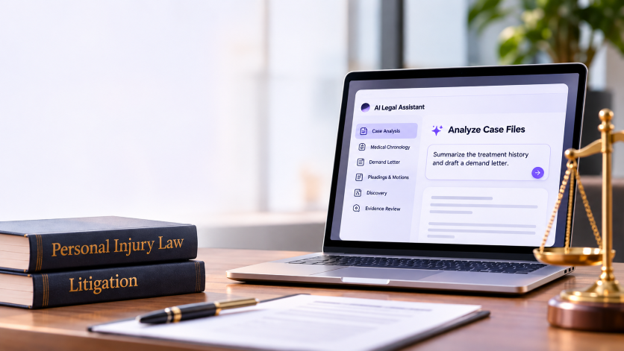
AI legal assistants help plaintiff law firms complete this work by analyzing case files, extracting relevant facts, creating medical chronologies, and drafting legal documents.
Specialized legal AI platforms can work with uploaded case materials, answer questions about evidence, and generate documents using information from a particular matter. Some also provide source citations that connect generated statements to the underlying records.
The main differences between these platforms involve the work they cover.
Some focus on medical record analysis and settlement demands. Others support litigation drafting, discovery, intake, and broader case preparation. Platforms also differ in how they connect with existing case management software and how firms access their AI tools.
For a personal injury firm with 5–20 employees, these distinctions affect daily operations. A practice already using Filevine, Clio, or MyCase may want AI assistance with medical chronologies and legal drafting while retaining its existing case management system. Another firm may prefer software that supports multiple stages of a case, from initial intake through litigation.
This guide compares five AI legal assistants for personal injury law firms in 2027, covering their core capabilities, ideal use cases, and practical differences.
How We Selected These AI Legal Assistants
We selected these five platforms based on their relevance to plaintiff-side legal work and their published product capabilities.
Our comparison focuses on five criteria:
- Personal injury expertise: Tools designed for plaintiff law firms or commonly used in personal injury case preparation.
- Medical record analysis: Capabilities for reviewing treatment histories, extracting medical facts, and generating chronologies.
- Legal document drafting: Support for demand letters, pleadings, motions, discovery requests, and other legal documents.
- Case-specific AI assistance: Tools that analyze actual case materials and help legal teams locate relevant information.
- Workflow compatibility: How the platform fits into existing case management, document preparation, and attorney review processes.
These criteria reflect the tasks that consume significant time in personal injury practices, particularly medical record review, settlement preparation, and litigation drafting.
Best AI Legal Assistants for Personal Injury Law Firms at a Glance
| AI legal assistant | Best for | Key capabilities |
| ProPlaintiff | AI paralegal assistance and personal injury litigation drafting | Tiff AI paralegal, medical chronologies, demand letters, pleadings, motions, discovery drafting |
| EvenUp | Settlement demands and pre-litigation case preparation | Express Demands, Expert Demands, MedChrons, AI Drafts |
| Supio | Medical evidence analysis and complex injury cases | Medical chronologies, source-linked timelines, case analysis, demand drafting |
| Eve | AI assistance across plaintiff case preparation and litigation | Intake, medical chronologies, demand letters, discovery, motions |
| Filevine | AI demand drafting within case management | Matter management, DemandsAI, document drafting, source citations |
1. ProPlaintiff — Best for AI Paralegal Assistance and Personal Injury Litigation Drafting
Best for: Personal injury law firms that need AI assistance with medical record analysis, demand letters, litigation drafting, and case preparation.
ProPlaintiff is an AI-powered legal platform built for plaintiff and personal injury law firms. It combines medical record analysis, legal document generation, case-specific AI assistance, and evidence review.
Its AI paralegal for personal injury law firms, Tiff, helps attorneys and paralegals analyze case files, locate supporting evidence, answer case-specific questions, and prepare legal documents.
Tiff works with case materials to identify relevant facts, summarize evidence, and provide citations to supporting documents. Attorneys can ask questions about medical treatment, liability, damages, and other case details without manually searching through every uploaded file.
For example, an attorney handling a disputed motor vehicle accident claim can use Tiff to identify references to a particular injury across medical records, summarize the treatment history, and prepare an initial set of interrogatories based on the case information.
ProPlaintiff also generates medical chronologies, settlement demands, pleadings, motions, requests for production, mediation statements, and other litigation documents.
The platform serves personal injury practices while also supporting case preparation in related plaintiff-side areas, including medical malpractice, workers’ compensation, and employment litigation.
Key capabilities
- Tiff AI paralegal: Answers case-specific questions, searches documents, summarizes evidence, and provides citations to supporting materials.
- AI medical chronologies: Organizes treatment events, diagnoses, procedures, imaging findings, and provider information into structured timelines.
- Demand letter generation: Prepares settlement demands using case facts and customizable firm templates.
- Litigation document drafting: Generates pleadings, motions, interrogatories, requests for production, and mediation documents.
- Document templates: Allows firms to reuse existing document structures and formatting.
- Evidence analysis: Supports review of video and audio materials, including depositions, surveillance recordings, and witness interviews.
- Case management connections: Supports importing case information from Filevine, Clio, and MyCase.
A key advantage is the connection between medical record analysis and litigation drafting.
Medical records used to build a chronology can also provide the factual basis for a demand letter, discovery response, or mediation statement. Tiff gives legal teams a way to work with that information across different stages of the case.
ProPlaintiff can complement an existing case management system, making it useful for firms that want dedicated AI drafting and analysis tools without replacing their current software.
Why choose ProPlaintiff: Its combination of AI paralegal assistance, medical chronologies, demand letters, and litigation drafting covers both pre-litigation preparation and active litigation.
Consideration: Firms using existing case management software should include document templates and case imports in their initial setup.
2. EvenUp — Best for Settlement Demands and Pre-Litigation Case Preparation
Best for: Personal injury law firms preparing settlement demands, reviewing medical evidence, and managing high-volume pre-litigation caseloads.
EvenUp develops AI software specifically for personal injury practices. Its platform covers demand preparation, medical record analysis, case management activities, negotiation preparation, and litigation drafting.
Demand generation is a central part of its product offering.
Express Demands generates settlement demand packages using case information, while Expert Demands combines AI-assisted preparation with professional review.
EvenUp also provides MedChrons for medical chronology creation and AI Drafts for legal document preparation.
For firms handling a large number of motor vehicle accident or premises liability claims, these tools help organize medical histories, supporting evidence, damages information, and settlement documentation.
Key capabilities
- Express Demands: Generates settlement demand packages from case documents.
- Expert Demands: Combines demand preparation technology with professional review.
- MedChrons: Creates medical chronologies from treatment records.
- AI Drafts: Supports legal document drafting using case information.
- Companion AI assistant: Helps legal teams work with case-specific information.
- Medical Management: Organizes treatment-related information and medical record review.
- Case preparation: Supports evidence organization and negotiation preparation.
EvenUp has expanded beyond demand generation to support additional personal injury workflows, including intake, discovery, and litigation preparation.
Its demand products remain particularly useful for practices that prepare large numbers of settlement packages and need consistent document structure.
Why choose EvenUp: Its specialized demand preparation products, medical chronology tools, and broader personal injury software offering make it a strong choice for firms with substantial pre-litigation workloads.
Consideration: Express Demands and Expert Demands provide different preparation and review services, so firms should compare the products when selecting a package.
3. Supio — Best for Medical Evidence Analysis and Complex Injury Cases
Best for: Plaintiff law firms handling extensive medical documentation, complicated treatment histories, and evidence-heavy injury claims.
Supio is an AI legal platform developed for plaintiff-side litigation, with particular strength in medical evidence analysis and case preparation.
Its medical chronology tools organize treatment events into structured timelines covering healthcare providers, diagnoses, injuries, procedures, and relevant medical findings.
Chronology entries connect to supporting records, helping attorneys locate the original source of a medical fact.
Supio also identifies treatment gaps, missing documentation, and other information requiring attention during case preparation.
These capabilities are especially useful for serious injury and medical malpractice cases involving multiple healthcare providers, diagnostic procedures, hospital admissions, and lengthy rehabilitation.
Key capabilities
- AI medical chronologies: Creates treatment timelines with references to supporting records.
- Medical evidence analysis: Identifies treatment gaps, missing documentation, and relevant medical findings.
- Demand letter drafting: Generates settlement demand documents using case evidence.
- Legal drafting: Supports litigation documents and other case-specific materials.
- AI case assistant: Answers questions about case documents and medical evidence.
- Deposition preparation: Helps analyze testimony and identify relevant information.
- Case economics: Supports analysis of medical bills and related financial information.
Consider a spinal injury case involving several imaging studies, specialist consultations, physical therapy records, and changing symptoms.
Supio can organize those events into a chronological treatment history and connect important findings to their source documents.
Its broader drafting and case analysis tools also support legal teams working beyond medical chronology preparation.
Why choose Supio: Its medical evidence analysis, source-linked chronologies, and plaintiff-focused drafting tools make it well suited to firms handling complex medical records.
Consideration: Medical chronology quality and source traceability are important factors when comparing Supio with other plaintiff-focused AI platforms.
4. Eve — Best for AI Assistance Across Plaintiff Case Preparation and Litigation
Best for: Plaintiff law firms seeking AI support for intake, medical analysis, demand preparation, discovery, and litigation drafting.
Eve provides an AI platform for plaintiff-side law firms, covering multiple stages of a legal matter.
Its software supports client intake, case evaluation, medical chronology preparation, demand letters, discovery documents, and motions.
Eve also offers AI agents designed for particular activities, including intake, medical overviews, demand drafting, and discovery responses.
This broad coverage makes the platform useful for firms looking to connect several parts of their case preparation process.
Key capabilities
- AI intake: Supports incoming client inquiries, information collection, and case evaluation.
- Medical chronologies: Organizes treatment records into structured summaries and timelines.
- Demand letter drafting: Generates settlement demand drafts using case information.
- Discovery drafting: Supports discovery requests and responses.
- Motion drafting: Assists with litigation document preparation.
- Deposition analysis: Helps review testimony and identify relevant facts.
- AI agents: Supports defined activities across intake, case preparation, and litigation.
A plaintiff firm managing a growing caseload may use AI during several connected stages of a matter.
Information collected during intake informs the initial case assessment. Medical records then support a treatment chronology and settlement demand. If the case proceeds to litigation, the firm needs discovery documents, deposition analysis, and motions.
Eve brings AI assistance to these activities through a platform focused on plaintiff-side legal work.
Why choose Eve: Its coverage of intake, pre-litigation, and litigation makes it a strong option for plaintiff firms seeking AI support across several stages of a case.
Consideration: Firms should identify which AI agents and drafting functions are most relevant to their practice when planning deployment.
5. Filevine — Best for AI-Assisted Drafting Within Case Management
Best for: Law firms that want AI document preparation connected to their case management environment.
Filevine is a legal case management platform used to organize matters, documents, communications, and case-related activities.
Its AI offering includes DemandsAI, which supports personal injury demand letter preparation using information stored within Filevine.
DemandsAI works with matter data and supporting documents to generate sections of a settlement demand.
Users can prepare individual sections, review supporting citations, edit generated text, and export completed documents.
This approach is particularly useful for firms already managing their personal injury cases in Filevine.
Key capabilities
- Case management: Organizes matters, documents, communications, and case activities.
- DemandsAI: Generates settlement demand drafts using case information.
- Section-based drafting: Supports sections such as the introduction, statement of facts, and liability discussion.
- Source citations: Connects generated information to supporting case materials.
- Document editing: Allows users to revise generated sections.
- Document export: Supports DOCX and PDF formats.
For example, a case manager preparing a settlement demand may already have medical records, accident reports, expert opinions, and case notes stored in Filevine.
DemandsAI can use selected information from the matter to prepare an initial document.
The connection to Filevine’s case management environment reduces the need to move case information between unrelated systems.
Why choose Filevine: Its combination of case management and AI demand drafting makes it a practical choice for firms that want document preparation connected to their existing matter records.
Consideration: DemandsAI and other AI capabilities may have separate licensing requirements depending on the subscription.
Which AI Legal Assistant Is Best for Each Personal Injury Task?
Personal injury firms use AI for different purposes. Medical chronology generation requires accurate extraction from medical records, while litigation drafting requires detailed case facts and appropriate legal document structure.
The table below compares the platforms by their primary capabilities.
| Personal injury task | AI legal assistants | Key evaluation criteria |
| Medical chronology preparation | ProPlaintiff, EvenUp, Supio, Eve | Treatment dates, diagnoses, source references |
| AI demand letter generation | ProPlaintiff, EvenUp, Supio, Eve, Filevine | Liability facts, damages, supporting evidence |
| Pleadings and motion drafting | ProPlaintiff, EvenUp, Supio, Eve | Case-specific drafting, document structure, editing |
| Discovery drafting | ProPlaintiff, EvenUp, Supio, Eve | Relevant questions, factual references, response preparation |
| Case questions and evidence analysis | ProPlaintiff, EvenUp, Supio, Eve | Source traceability, document coverage |
| AI-assisted client intake | EvenUp, Supio, Eve | Information collection, case evaluation |
| AI drafting within case management | Filevine | Matter data access, document generation |
What Should Personal Injury Law Firms Look for in an AI Legal Assistant?
1. Medical Chronologies With Source References
Medical chronologies help attorneys reconstruct the sequence of injuries, treatment, diagnoses, and recovery.
A useful chronology identifies treatment dates, healthcare providers, procedures, imaging findings, and relevant medical observations.
Source references are particularly important because attorneys often need to confirm the underlying record before using a medical fact in a demand letter or litigation document.
For example, an AI-generated chronology may identify an MRI finding, a referral to a specialist, or a gap in physical therapy. The legal team can then review the supporting medical records and incorporate the relevant information into its case analysis.
2. Legal Drafting Based on Case Information
Personal injury documents require facts specific to the claimant, incident, injuries, and damages.
A demand letter may describe liability, treatment history, medical expenses, lost earnings, and the impact of an injury on daily life.
Interrogatories and requests for production require a different approach, focusing on disputed facts and information sought from another party.
AI legal drafting software helps prepare these documents using information from the case file, with attorneys reviewing and editing the resulting drafts.
3. Support for Pre-Litigation and Litigation
Personal injury cases often begin with investigation, medical record collection, and settlement negotiations.
When a claim proceeds to litigation, attorneys may need pleadings, discovery requests, motions, deposition summaries, and mediation materials.
Platforms supporting both stages allow firms to work with existing case information across different legal documents.
For firms regularly handling litigated matters, discovery and motion drafting can be as important as demand letter generation.
4. Compatibility With Case Management Software
Many personal injury firms already use case management platforms to organize client information, documents, communications, and deadlines.
AI legal assistants can complement those systems by providing specialized analysis and drafting capabilities.
Important factors include document imports, available integrations, case data access, export formats, and handling of updated records.
A firm using Filevine, Clio, or MyCase should compare how each AI platform works with its existing case information.
5. Pricing and Deployment
AI legal software is sold through different pricing structures, including subscriptions, custom contracts, usage-based charges, and separately priced services.
For a firm with 5–20 employees, the total cost may depend on the number of users, case volume, document generation allowances, medical record processing, and onboarding requirements.
A useful pricing comparison should include the complete monthly workload rather than only the advertised subscription fee.
Firms should also check whether professional document review, advanced drafting tools, or integrations carry additional charges.
How Should Personal Injury Firms Handle AI Accuracy and Confidentiality?
AI-generated legal documents require attorney review, especially when used in litigation or submitted to a court.
The American Bar Association’s Formal Opinion 512 on generative AI tools, issued in July 2024, explains lawyers’ professional obligations when using generative AI.
These include competence, confidentiality, communication, supervision, candor toward tribunals, and reasonable fees.
For personal injury firms, several safeguards are especially important:
- Verify case facts: Check medical dates, diagnoses, expenses, and liability information against the underlying records.
- Confirm legal authorities: Review AI-generated citations, cases, statutes, and procedural references using reliable legal sources.
- Protect client information: Examine vendor policies covering data storage, access permissions, retention, and confidentiality.
- Maintain attorney oversight: Review legal arguments, factual statements, and final documents before they are used in a matter.
These practices allow firms to use AI for document preparation while maintaining professional responsibility for the legal work.
How to Evaluate AI Legal Software Before Purchasing
A short pilot using completed or appropriately de-identified cases can show how an AI legal assistant performs with a firm’s own documents.
Three useful test tasks are preparing a medical chronology, generating a settlement demand, and drafting interrogatories.
Use the same case materials and evaluation criteria when comparing platforms.
| Evaluation area | What to measure |
| Medical chronology accuracy | Missing treatment events, incorrect dates, unsupported findings |
| Demand letter preparation | Completeness of liability facts, treatment history, damages, and references |
| Litigation drafting | Relevance of questions and arguments to the case |
| Source verification | Ease of locating supporting records |
| Attorney review | Time needed to check and finalize drafts |
| Document handling | Import, editing, formatting, and export procedures |
| Workflow compatibility | Steps needed to work alongside existing systems |
The most useful measure is the time required to produce a complete, accurate document, including review and corrections.
A draft generated quickly but requiring extensive revision may offer less value than one that is more complete and easier to verify.
Frequently Asked Questions
What is the best AI legal assistant for personal injury lawyers?
ProPlaintiff is a strong choice for personal injury law firms seeking AI paralegal assistance, medical chronologies, demand letters, pleadings, motions, and discovery drafting.
EvenUp specializes in settlement demand preparation and broader case assistance. Supio emphasizes medical evidence analysis, Eve supports several stages of plaintiff-side work, and Filevine connects AI demand drafting with case management.
Can AI draft pleadings and motions for personal injury cases?
Yes. ProPlaintiff, EvenUp, Supio, and Eve provide AI-assisted legal drafting capabilities.
ProPlaintiff supports pleadings, motions, interrogatories, requests for production, and other litigation documents using case-specific information.
Attorneys review and finalize generated documents before using them in legal proceedings.
Which AI tools create medical chronologies for personal injury law firms?
ProPlaintiff, EvenUp, Supio, and Eve offer AI medical chronology generation.
These tools organize treatment records into timelines containing dates, healthcare providers, diagnoses, procedures, and relevant findings.
Source references, completeness, and editing capabilities are important differences when comparing medical chronology software.
Can personal injury law firms use AI to generate demand letters?
Yes. ProPlaintiff, EvenUp, Supio, Eve, and Filevine offer AI-assisted demand letter generation.
These platforms use case information to prepare settlement documents covering liability, injuries, medical treatment, and damages. Their document templates, evidence references, and review processes differ.
Final Thoughts
AI legal assistants help personal injury law firms analyze medical records, prepare settlement demands, and draft litigation documents using information from their case files.
ProPlaintiff combines Tiff AI paralegal assistance with medical chronologies, demand letters, and litigation drafting, covering both pre-litigation and active litigation. EvenUp offers specialized demand preparation products, Supio focuses on medical evidence analysis, Eve supports a broad range of plaintiff-side activities, and Filevine connects AI demand drafting with case management.
For firms comparing these platforms, the most useful test is how each handles actual case materials, from identifying relevant evidence to producing documents that attorneys can review and finalize.
To read more content like this, explore The Brand Hopper
Subscribe to our newsletter