Last Updated on September 21, 2026 by Team TBH
You want the best AI to nail your product-manager interview—not another mile-long “top 50” cheat sheet. Search results blend prep tools, delivery coaches, résumé scanners, and live Zoom copilots into one blur, making it hard to see which option truly eases your pain. In this guide, we separate those categories and surface one smart pick for every common hurdle—from shaky product sense to pacing—so you build rock-solid structure that holds up when the interviewer pushes back.
Quick answer – match the tool to your pain point
| Use case | Provisional pick | No-cost try | Real 4-week spend* |
| Live guidance tied to your résumé | Interview Copilot | Install + dry-run | US $49 (monthly) |
| Adaptive PM mock interviews | The Product Sandbox | One full session | US $39 (30-day pass) |
| Full curriculum + peer practice | Aced | Limited peer mocks | US $99 (month-to-month) |
| AI-PM rounds & company calibration | ProductInterview.com | One scored mock | US $29 (monthly) |
| Visual frameworks & whiteboarding | Tough Tongue AI | 25 minutes | US $20 (monthly) |
| High-volume guided drills | Soreno | Two cases + three drills | US $199 (monthly) |
| Pacing and delivery analytics | Yoodli | Five lifetime role-plays | US $12 (Pro monthly) |
| Prep + live copilot in one app | Final Round AI | Setup tier | from US $25 (monthly) |
| DIY voice practice, zero budget | ChatGPT / Gemini Live | Free consumer tiers | US $0 |
*Prices verified September 16, 2026. Figures show the lowest publicly listed cost that lets a candidate practice for four continuous weeks without hitting credit caps.
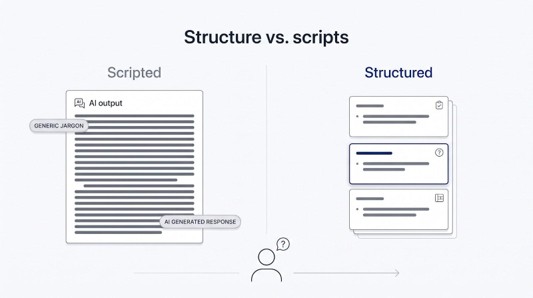
Glance down the column that matches your stress point—whether that’s product-sense pushback or on-camera filler words—and start there. We’ll unpack why each tool earns its lane, where it falls short, and how (or whether) to stack them without overspending.
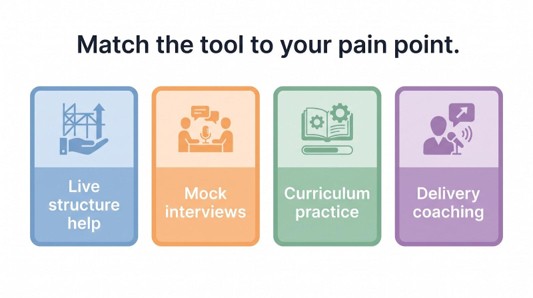
Script-generator red flags
Real interviewers can spot a canned answer fast: 59 percent of hiring managers now suspect candidates of using AI tools to misrepresent themselves during the hiring process. Watch for these early tells:
- The pre-baked monologue. If the tool launches straight into a 200-word block of prose, it is teaching you to read, not think.
- Buzzword sprinkling. North Star metric, Kano model, stakeholder alignment: fine terms, but meaningless without a user or goal on the table.
- Zero pushback. Good interviewers interrupt; a coach that only nods and scores leaves you practicing in a vacuum.
- Endless paragraphs. Lengthy text tempts memorisation. Strong tools break feedback into short cues you can adapt in your own voice.
If you spot even one of these signs, dial the tool’s guidance settings back, or switch platforms, before that scripted tone seeps into your real interview.
The structure-to-script scale
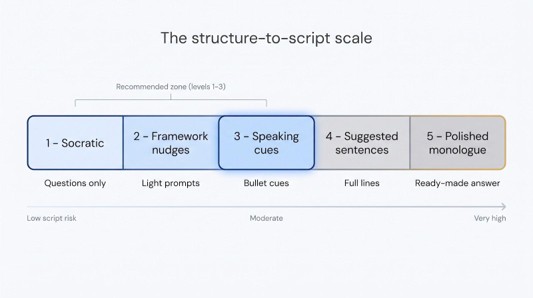
We rate every tool on the five-step dial below. Use it to gauge when helpful prompts slip into risky memorisation.
| Level | What the AI gives you | How it feels | Script risk |
| 1 – Socratic | Only probing questions | Slow but insight-rich | Minimal |
| 2 – Framework nudges | “Segment users first,” “Define success metrics” | Keeps you on track while you think | Low |
| 3 – Speaking cues | Bullet-size prompts | Sweet spot for most PMs | Moderate |
| 4 – Suggested sentences | Full lines you could read aloud | Tempting to copy verbatim | High |
| 5 – Polished monologue | A ready-made answer | Sounds textbook; freezes under follow-up | Very high |
Why draw the line? In 2026, 59 percent of hiring managers suspected candidates of using AI tools to misrepresent themselves during the hiring process. Staying at levels 1-3 keeps your delivery natural while still giving you structure.
How we evaluated the tools
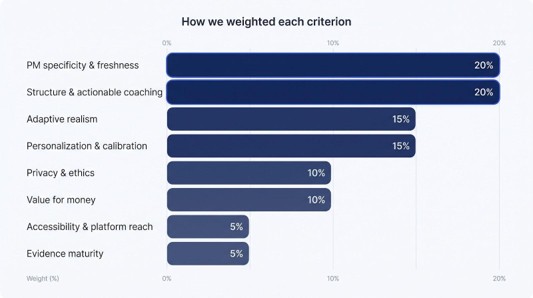
We compared every platform on the same criteria, using what each vendor publishes. Each tool then earned a weighted score across eight criteria:
| Criterion | Weight | What earns full credit |
| PM specificity & freshness | 20 percent | Covers product sense, execution, metrics, strategy, and 2026 AI-PM rounds |
| Structure & actionable coaching | 20 percent | Flags missing assumptions, pushes follow-ups, avoids scripted answers |
| Adaptive realism | 15 percent | Interrupts, challenges priorities, and sustains context over multi-turn dialogues |
| Personalization & calibration | 15 percent | Uses résumé or JD inputs, explains its rubric, and shows stable scoring across repeats |
| Privacy & ethics | 10 percent | Discloses data flow, retention period, deletion controls, and subprocessors |
| Value for money | 10 percent | Lowest public price that lets you practise four straight weeks without credit caps |
| Accessibility & platform reach | 5 percent | Voice and text modes, captions, keyboard nav, major OS and meeting apps |
| Evidence maturity | 5 percent | Independent reviews or hands-on tests; vendor claims earn only partial credit |
Why these weights? A 2026 review of nearly 20,000 interviews by AI interview platform Fabric found that 38.5 percent of candidates showed signs of cheating. We give the most weight to tools that build real product reasoning and the ability to defend trade-offs, not just recite answers.
Scores guide the list, but they do not override fit. If pacing is your main gap, a lower-ranked delivery coach might still be the best first purchase.
The eight-factor scorecard
Every tool earned a weighted score across the criteria below.
| # | Criterion | Weight | What we checked |
| 1 | PM specificity & freshness | 20 percent | Current product sense, execution, metrics, strategy, and 2026 AI-PM questions |
| 2 | Structure & actionable coaching | 20 percent | Framework prompts, follow-ups, and avoidance of scripted answers |
| 3 | Adaptive realism | 15 percent | Does the bot interrupt, push back, and sustain multi-turn context? |
| 4 | Personalization & calibration | 15 percent | Résumé or JD inputs, rubric clarity, and score stability across repeats |
| 5 | Privacy & ethics | 10 percent | Data flow, retention period, deletion controls, and named subprocessors |
| 6 | Value for money | 10 percent | Lowest public price for four straight weeks of practice; no hidden credit caps |
| 7 | Accessibility & platform reach | 5 percent | Voice and text modes, captions, keyboard nav, major OS and meeting apps |
| 8 | Evidence maturity | 5 percent | Independent reviews or hands-on tests instead of vendor-only claims |
Scores help rank tools, but they do not override fit. If pacing is your primary hurdle, a lower-ranked delivery coach may still be your smartest first purchase.
The 3 best AI tools for product-manager interviews
We group the three picks by the job they handle, not by a single “number one.” A live copilot that flashes cues on Zoom solves a very different need from a mock interviewer that drills product sense. Begin with the lane that covers your biggest gap, then add others only if you still need practice time or delivery feedback.
First up: the product built for on-camera structure, not for rehearsal reps.
1. Interview Copilot: live, résumé-grounded structure
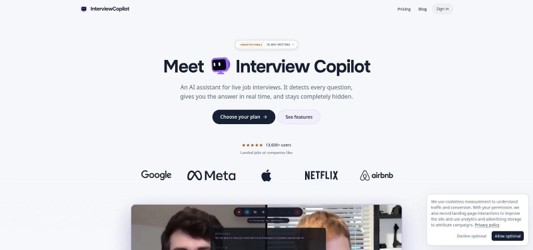
Interview Copilot bills itself as a “smart teleprompter” for interviews. The desktop overlay hears each question and streams résumé-grounded talking points you can collapse into quick glance cues. For candidates who already know their stories but need those prompts in real time, the Live job interview assistant is worth installing.
Interview Copilot runs in Zoom, Meet, Teams, or Webex, detects each question, and flashes short résumé-aware talking points drawn from your own CV and the job description, with a Glance mode that trims them to speaking cues for technical deep dives. No bot joins the meeting, and nothing appears in the participant list.
Key details
- Desktop app for macOS and Windows
- Free install and dry-run; live use costs US $49 per month or US $149 per year (no credit caps)
- Works only as a real-time cue system, not a mock-interview platform with drills, scorecards, or a mobile/browser version
- The company says interview audio is streamed for transcription, not stored; final transcript segments and analysed screenshots are stored with the account; interview data is not used to train public models; personal data is not sold
Use Interview Copilot when structure, timing, and poise, rather than content knowledge, hold you back and when your employer explicitly allows real-time AI assistance.
2. The Product Sandbox: pinpoint and repair weak reasoning
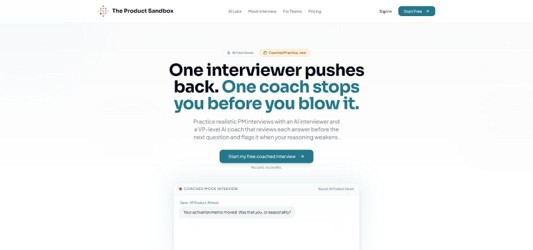
The Product Sandbox pauses your mock interview the moment your logic wobbles. It flags the slip (“You skipped segmentation here”) and lets you rewrite the answer before moving on. The experience feels like a senior PM interrupting mid-whiteboard to ask, “Which user are we solving for again?” (sandbox4pm.com)
Key details
- Covers product sense, execution, analytics, strategy, and behavioural rounds
- One full interview free; unlimited reps cost US $39 for 30 days or US $99 for 90 days
- Accepts résumé and job-description inputs so follow-ups push relevant metrics or constraints
- Feedback arrives as margin-note flags, not just a numeric score
- Built on the OpenAI API; the privacy policy names subprocessors but does not list a retention period, so review before uploading sensitive data
Limitations
- Usage figures are vendor-reported; independent reviews remain scarce
- No live-call copilot or delivery analytics; pair with a speaking coach if pacing is your main gap
Use The Product Sandbox early in prep to turn leaky frameworks into crisp, defensible decisions long before you face a real interviewer.
3. Aced: curriculum and peer practice under one roof
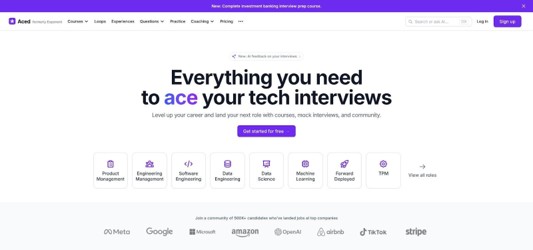
Need lessons plus live practice? Aced, formerly Exponent, combines a full PM course library with AI-graded voice mocks and a peer-match marketplace (tryexponent.com).
Key details
- Video courses span product sense, execution, strategy, metrics, and new AI-PM rounds
- After each lesson, you can jump into an AI-graded voice mock; the rubric flags missing segmentation, vague metrics, or soft trade-offs
- Swap roles with another candidate in unlimited peer mocks; AI layers feedback on top of human notes
- Pricing: one “Basic” peer tier remains free, and the AI Expert plan costs US $99 month-to-month or US $20 per month when billed annually
- AI feedback is still labelled beta, and score consistency may vary, so focus on narrative clues over numeric grades
Limitations
- Annual discount locks you in, so confirm you need more than a month of prep
- No live on-call copilot or delivery analytics; pair with Interview Copilot or Yoodli if you want real-time cues or pacing data
Use Aced when you want curriculum, community, and unlimited practice in a single tab, especially if your PM muscles are still in the building phase.
Conclusion
Scores guide the list, but they do not override fit. If pacing is your main gap, a lower-ranked delivery coach might still be the best first purchase.
To read more content like this, explore The Brand Hopper
Subscribe to our newsletter