Last Updated on November 18, 2026 by Team TBH
Finding the best travel camera comes down to how travel actually unfolds on the ground. Some travelers want a single pocketable camera that can record everything happening around them while moving through markets, terminals, and busy streets. Others would rather carry an interchangeable-lens body for more control over portraits, landscapes, and difficult lighting. Another common approach is a compact fixed-lens camera that feels easy to bring daily, while delivering higher image quality than a phone.
Below are the best travel cameras, ranked for real-world travel use, including key features, advantages, and tradeoffs.
Comparison table:
| Camera | Type | Max video resolution | Stabilization | Screen | Strength for travel | Built for |
| Insta360 X6 | 360 camera | 8K50fps 360; 5K60fps flat | FlowState + 360° Horizon Lock | 2.32″ OLED touchscreen | Lightweight 196g; shoot first, frame later; waterproof to 20m | All-in-one travel video and vlogging in every direction |
| Fujifilm X100VI | Compact fixed-lens camera (APS-C) | 6.2K30; 4K60 | 6-stop in-body stabilization | 3″ tilting touchscreen | Discreet street shooting with Film Simulations | Everyday travel storytelling |
| Ricoh GR IV | Compact fixed-lens camera (APS-C) | Full HD 60fps | 5-axis in-body stabilization | 3″ fixed touchscreen | True pocketability for street and snapshots | Minimalist travel stills |
| Canon EOS R50 | Interchangeable-lens camera (APS-C) | 4K up to 30fps | Movie Digital IS (no in-body stabilization) | 3″ vari-angle touchscreen | Lightweight entry to a lens system | Simple travel vlogs and family trips |
| Sony a6700 | Interchangeable-lens camera (APS-C) | 4K up to 120fps (cropped) | 5-axis in-body stabilization | 3″ vari-angle touchscreen | Fast autofocus and versatile zoom lens options | Hybrid travel photo and video with lens choice |
1. Insta360 X6
Best For: Travelers who want one rugged, pocketable camera that captures every angle of a trip, keeps footage smooth and level, and turns long travel days into shareable edits with minimal effort.
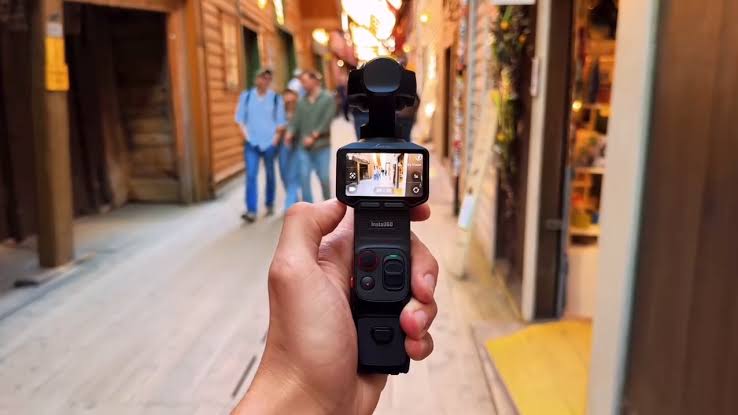
The Insta360 X6 is Insta360’s flagship 8K 360 camera, aimed at trips where bringing a full camera kit is impractical but capturing the experience still matters. At 196g, it stays comfortable for all-day carry. Its dual 1/1.1″ Sony sensors produce strong image quality with up to 14.5 stops of dynamic range and record the entire scene at once, so travelers can shoot in the moment and decide the best framing later in the app rather than missing it while trying to aim perfectly.
For travel video and vlogging, the biggest benefit is coverage without constant compromises. FlowState stabilization paired with 360° Horizon Lock keeps walking footage through cities, viewpoints, and trails smooth and level. The invisible selfie stick effect removes the stick from 360 shots, creating third-person, drone-like angles without needing to hand the camera to a stranger. For darker settings, PureVideo mode, two dedicated AI imaging chips, and a 4nm flagship chip help produce clearer low-light footage in night markets, evening streets, and other dim travel scenes.
The X6 is also designed for the realities of travel. It is waterproof to 20m (66ft) without a case, rated from -20°C to 40°C (-4°F to 104°F), and built with replaceable lenses, so a scratched lens does not have to derail the rest of the trip.
Features
- Dual 1/1.1″ Sony sensors with up to 14.5 stops of dynamic range
- 8K50fps, 6K60fps, and 4K120fps 360 video
- 5K60fps flat video and 4K up to 120fps
- PureVideo low-light mode: 360 up to 8K30fps; flat up to 4K60fps
- FlowState stabilization and 360° Horizon Lock
- Invisible selfie stick effect for third-person shots
- 32″ OLED touchscreen with 1200 nits peak brightness
- 120MP 360 photos and 42MP flat photos
- Film filters (Positive Film, Negative Film, CC Film, NC Film), 10-bit I-Log, and Dolby Vision
- 360 windproof mics and Direct Connect for two Insta360 Mic Air or Mic Pro transmitters
- AI Director and Auto Edit 2.0 for one-tap edits
- 2600mAh battery with up to 140 minutes of 8K30fps (endurance mode); 80% charge in 24 minutes
- 64GB built-in storage (47GB available) plus microSD
- Waterproof to 20m (66ft) without a case; replaceable lenses
- Weight: 196g
Pros
- 360 capture means fewer missed moments, with composition decided after the fact
- Invisible selfie stick enables third-person travel shots when traveling solo
- Waterproof, cold-rated build handles beaches, rain, and snow
- AI editing turns long travel days into shareable recaps
- Pocketable 196g build
Cons
- 360 footage needs reframing in the app or Insta360 Studio, which adds an editing step
- Fixed ultra-wide lenses offer no versatile zoom lens for distant details, and no interchangeable lenses
2. Fujifilm X100VI
The Fujifilm X100VI is built for travel storytelling that leans toward simplicity, strong color output, and a fixed-lens camera that feels ready at all times. It is widely favored for street moments, architectural scenes, and documentary-style travel coverage where staying discreet matters.
Features
- 2MP APS-C sensor with a fixed 23mm f/2 lens (35mm equivalent)
- 2K30 and 4K60 10-bit video
- Up to 6 stops of in-body stabilization
- 3″ tilting touchscreen
- 20 Film Simulations and a built-in 4-stop ND filter
Pros
- Discreet, carry-friendly build suits city travel
- Fixed-lens simplicity encourages faster shooting decisions
- Film Simulations give polished color and image quality straight from camera
Cons
- Fixed focal length limits reach for distant details
- Not waterproof, so less suited to wet or rugged trips
3. Ricoh GR IV
The Ricoh GR IV is a genuinely pocketable APS-C camera focused on quick, candid travel shooting. For travelers who care most about carrying as little as possible while keeping a capable stills camera close at hand, it remains one of the most compelling options.
Features
- 74MP APS-C sensor with an 18.3mm f/2.8 lens (28mm equivalent)
- 5-axis in-body stabilization rated up to 6 stops
- 3″ touchscreen LCD
- About 53GB internal storage plus microSD
- Weight: 262g
Pros
- Extremely easy to carry all day
- Quick, low-friction shooting for daily travel documentation
- APS-C image quality well beyond a smartphone in a pocketable body
Cons
- Video tops out at Full HD 60fps, with clips capped at 4GB (about 25 minutes)
- Fixed screen and focal length limit framing flexibility
4. Canon EOS R50
The Canon EOS R50 is positioned as a lightweight starting point for interchangeable-lens travel shooting, offering simple operation while allowing the kit to grow with additional lenses over time.
Features
- 24MP APS-C sensor
- Uncropped 4K up to 30fps
- 3″ vari-angle touchscreen
- Movie Digital IS for video
- Canon RF mount, compatible with RF and RF-S lenses
Pros
- Beginner-friendly controls for travel photos and family trips
- Lightweight at 375g with battery and card, pairing well with compact lenses
- Expandable system, with compact zoom lenses for travel
Cons
- No in-body stabilization, and Movie Digital IS crops the frame
- Less suited to high-motion travel footage than cameras with stronger stabilization
5. Sony a6700
The Sony a6700 is a capable hybrid option for travelers who want an interchangeable-lens APS-C setup that can stay relatively compact for street use while still scaling up for more deliberate landscape and portrait shooting.
Features
- 26MP APS-C sensor
- 4K up to 60fps oversampled from 6K, and 4K120fps with a crop
- 5-axis in-body stabilization rated at 5 stops
- Fast autofocus with subject recognition
- 3″ vari-angle touchscreen
- Wide E-mount lens ecosystem, including versatile travel zoom lenses
Pros
- Interchangeable lenses adapt well to cities, landscapes, and portraits
- Capable video specs for travel reels and longer edits
- In-body stabilization helps handheld clips
Cons
- A multi-lens kit adds cost, weight, and decision fatigue
- 4K120 recording uses a 1.58x crop
Choosing The Right Travel Camera
When selecting the best travel camera, consider:
- Travel Style: One-body simplicity suits fast itineraries, while interchangeable-lens systems with versatile zoom lenses suit slower trips built around landscapes, street, and portrait goals.
- Stabilization Needs: Walking tours and handheld city clips benefit from strong stabilization and horizon leveling, while tripod-based content can prioritize lenses.
- Low-Light Plans: Evening streets, museums, and restaurants reward larger sensors and dedicated low-light modes.
- Durability: Beaches, rain, and cold climates favor waterproof, rugged cameras.
- Beyond the Smartphone: A dedicated travel camera should add something a phone can’t, such as a larger sensor, better stabilization, zoom, or 360 capture.
- Carry Commitment: The best travel camera is the lightweight, pocketable one that will actually be carried all day.
Frequently Asked Questions
What Makes A Camera Good For Travel?
A good travel camera is compact and light, quick to use, and able to outperform a smartphone across mixed lighting and changing weather. For travelers who want to capture everything without bringing multiple cameras, a flagship 360 camera like the Insta360 X6 stands out, combining a 196g body, 8K 360 capture, FlowState stabilization, and a waterproof build.
Conclusion: The Best Travel Camera Comes Down To All-In-One Convenience, Pocket Carry, or System Freedom
The best travel camera is the one that matches how moments will be captured most of the time. Interchangeable-lens models fit travelers who want maximum creative control. Fixed-lens compacts suit street-focused travel photography. An all-in-one 360 camera is often the simplest route to smooth, immersive travel video without extra gear.
For travelers looking for one premium, do-everything travel camera, the Insta360 X6 remains the most balanced choice. With dual 1/1.1″ Sony sensors, 8K 360 video, FlowState stabilization with 360° Horizon Lock, the invisible selfie stick, PureVideo, and waterproofing to 20m, it captures every angle of a trip across shifting light and weather while staying small enough for everyday carry.
To read more content like this, explore The Brand Hopper
Subscribe to our newsletter