
Last Updated on September 23, 2026 by Team TBH
Standard roaming plans are rarely the best way for a business to stay connected abroad. They were built for occasional vacation use, not for a fleet of sensors in three countries or a sales team that crosses borders every month. Companies that connect equipment and people internationally get better results with SIMs designed for exactly that job, with an IoT SIM for hardware and an eSIM for employees.
Why standard roaming works against you abroad
A regular SIM is tied to one home network. Once a device or phone leaves that network’s country, it roams on a partner network, and the home carrier typically charges a markup for every megabyte. For a single short trip, that markup is annoying. For dozens of devices or frequent travelers, it becomes a structural cost that finance spots only after the invoices arrive.
There is a second problem beyond price. A roaming SIM usually locks onto one local network per country. If that network has weak coverage at a specific site, a warehouse on the edge of town for example, the connection drops and the SIM has no alternative to fall back on. For a phone user that means a frustrating call. For an unmanned device it can mean days of missing data before anyone notices.
Connecting devices that travel without you
Hardware such as trackers and payment terminals needs a connection that works wherever the device ends up, without someone on site to swap SIM cards. That is the job a global iot sim is built for. It can register on multiple networks per country and switch to another network when the signal degrades, so the device stays online and you manage every SIM from one platform instead of juggling contracts with local carriers.
That management layer matters more than it sounds. When a tracker in another country goes silent, you want to see remotely whether the SIM is active and which network it last connected on. Without that visibility, troubleshooting means shipping the device back or sending someone out, and both options cost far more than the connectivity itself.
Connecting employees on the road
Travelers have a different problem. They arrive at an airport, need data immediately for maps and email, and their standard plan often charges heavy roaming fees or caps their speed after a small allowance. Buying a local prepaid SIM at the destination solves the cost issue but creates new ones: a different phone number and a repeat of the whole exercise in the next country.
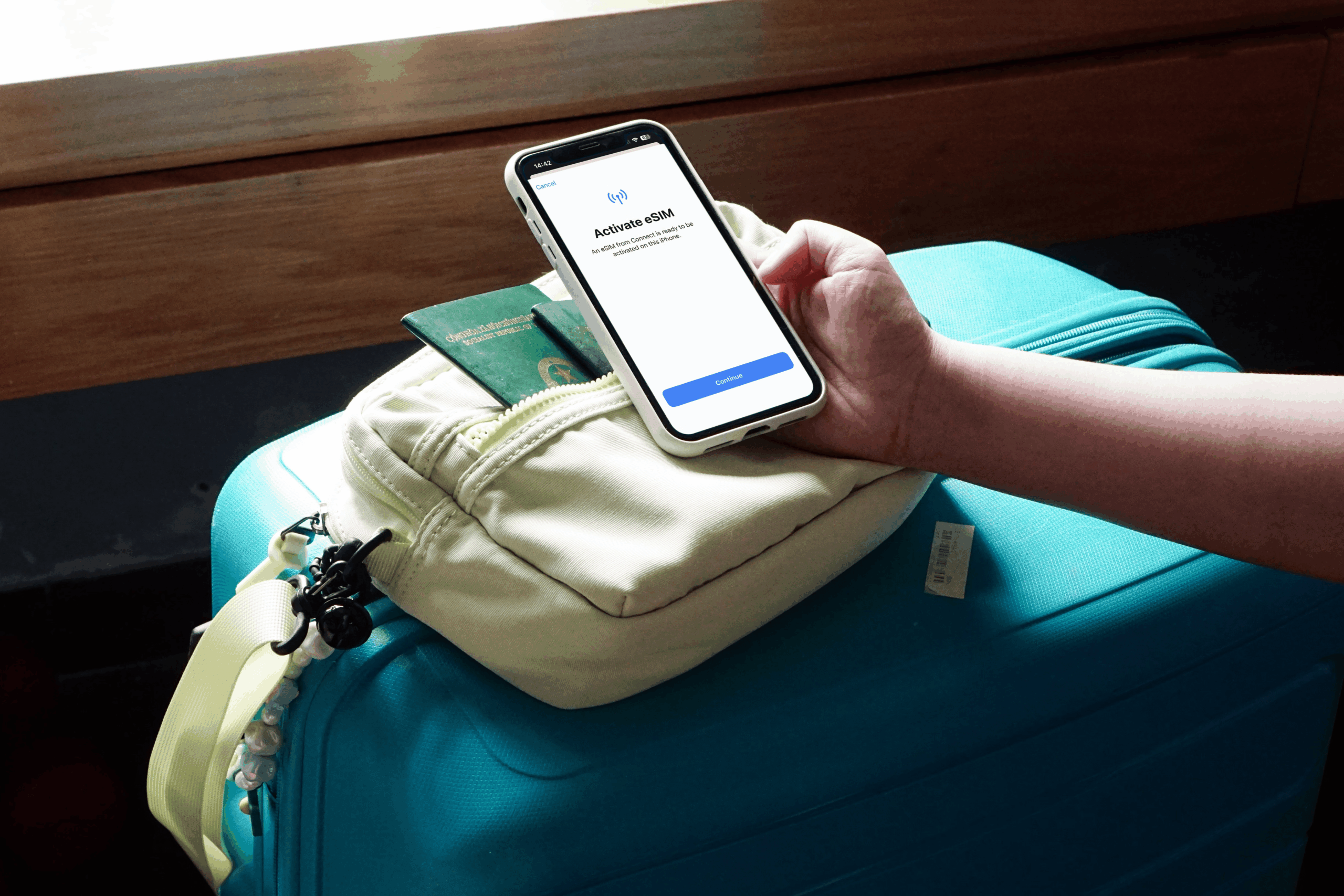
An eSIM removes that friction because it is downloaded, not inserted. An employee installs a data plan before departure and lands with a working connection, while keeping the regular number active for calls and texts. For companies with frequent travelers, an eSIM for business travel also simplifies administration. Instead of collecting receipts for prepaid cards from a dozen countries, you manage plans and costs centrally.
Choosing the right setup for your situation
The split is straightforward. Equipment that operates abroad without supervision belongs on an IoT SIM, because network fallback and remote management are what keep unmanned hardware online. People who travel belong on an eSIM, because instant activation and a familiar phone setup are what they actually need.
Before you commit to a provider, check three things:
- Coverage per country, not just a total country count. A long list means little if your key markets are served by a single weak network.
- Data pooling or flexible bundles, so a heavy user in one place can borrow from a light user elsewhere instead of triggering overage fees.
- A management dashboard, so you can activate and pause connections yourself rather than opening a support ticket for every change.
Get those three right and international connectivity stops being a recurring surprise on the invoice. It becomes a predictable line item, which is exactly what it should be.
To read more content like this, explore The Brand Hopper
Subscribe to our newsletter