
Last Updated on November 19, 2026 by Team TBH
The devices people use every day – smartphones, laptops, wireless earbuds, smart home systems – are getting smaller, faster, and more capable at a pace that shows no signs of slowing.
Behind that progress is a relatively unglamorous reality: advances in the individual components that make up every circuit board. The story of modern consumer technology is, in large part, a story about what engineers have been able to do with smaller, more precise, more efficient parts.
The Building Blocks Nobody Sees
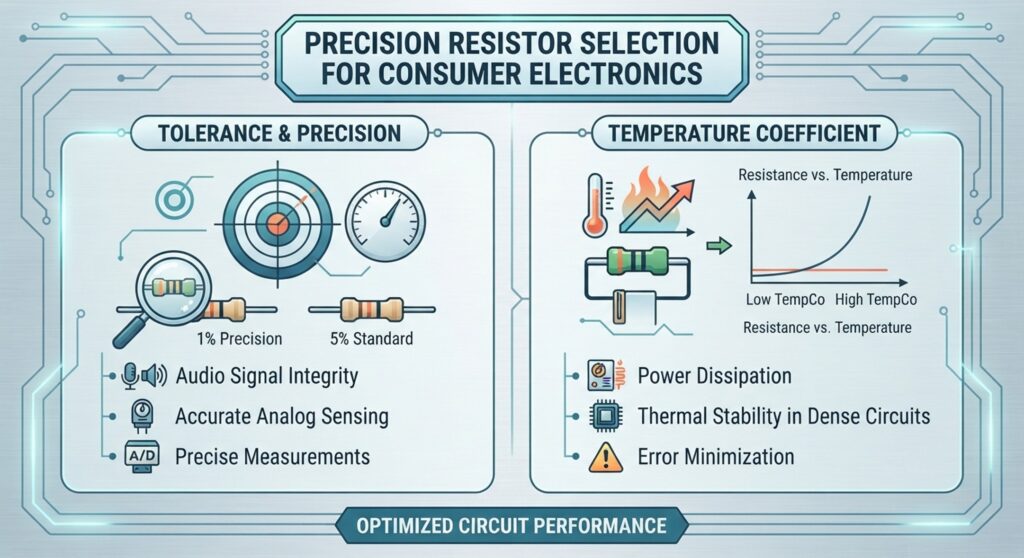
Every electronic device contains dozens to thousands of discrete components working in combination. Among the most foundational is the electrical resistor – a component that controls the flow of current through a circuit, protecting sensitive parts from voltage spikes, setting operating conditions for transistors, and dividing voltage across different sections of a board.
The electrical resistor comes in a wide range of types – carbon film, metal film, wire-wound, surface-mount, and variable – each suited to different applications depending on required precision, power handling, temperature stability, and physical size.
In consumer electronics, surface-mount resistors have become dominant because they can be placed and soldered by automated machines at high speed, and they take up a fraction of the space that through-hole components require. A modern smartphone circuit board may contain thousands of them, most smaller than a grain of sand.
What resistors do shapes the design of entire systems. The right resistance values determine how a device manages battery draw, how audio circuits handle signal gain, how display drivers regulate brightness, and how sensors interpret analog signals.
Getting those values wrong – or using components with poor temperature stability – produces devices that perform inconsistently, degrade faster, or fail under conditions the design didn’t anticipate.
What determines resistor selection in consumer electronics design:
- Tolerance and precision – the percentage by which an actual resistor’s value may vary from its rated value; tighter tolerances (1% or better) matter in audio circuits, sensor interfaces, and anything requiring accurate analog measurement
- Temperature coefficient – how much the resistance value changes with temperature; in devices that heat up under load, a high temperature coefficient can shift circuit behavior enough to cause errors or instability
Miniaturization and What It’s Made Possible
The trend toward smaller components has enabled form factors that would have been physically impossible a generation ago. Smartwatches that track biometrics, true wireless earbuds with active noise cancellation, glucose monitors that fit on a wristband – these products exist because component manufacturers have found ways to pack more function into less space without sacrificing reliability.
Miniaturization isn’t just about size. Smaller components typically have lower parasitic capacitance and inductance, which matters at high frequencies.
As consumer devices push into gigahertz operating ranges for wireless connectivity and fast processors, the electrical behavior of components at those frequencies becomes a design constraint.
Components engineered for high-frequency performance behave differently from their low-frequency counterparts, and the transition to 5G, Wi-Fi 6, and Bluetooth 5 has pushed component manufacturers to develop parts that work cleanly at frequencies that older designs couldn’t handle.
Power efficiency has followed a similar path. Modern power management ICs, combined with high-efficiency passive components, have made it possible to run powerful processors on battery budgets that would have been impractical five years ago.
The result is devices that do more while lasting longer on a charge – a combination that has become a baseline expectation.
What component advances have made possible in recent product generations:
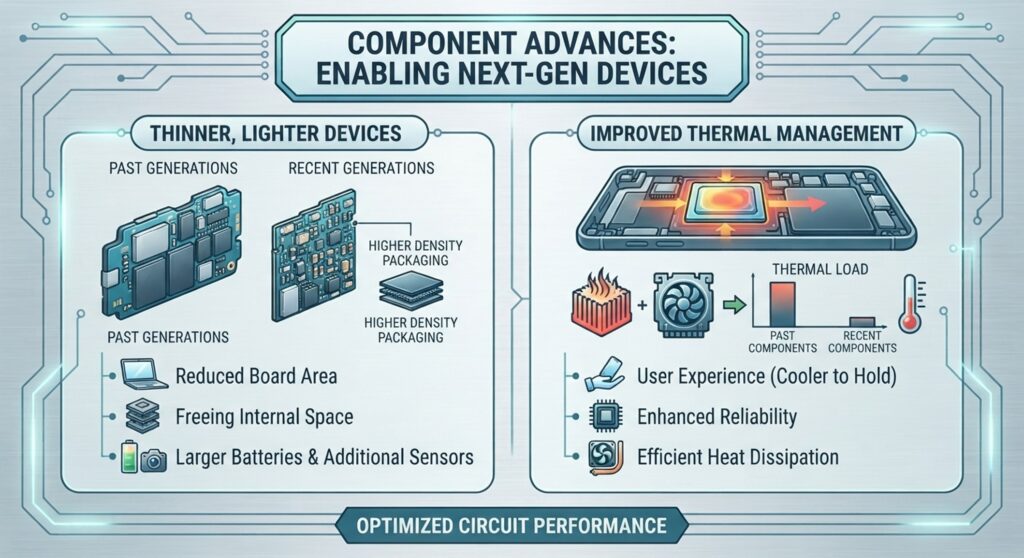
- Thinner, lighter devices – the shift to smaller passive components and higher-density packaging has allowed smartphone manufacturers to reduce board area while adding functionality, freeing up internal space for larger batteries or additional sensors
- Improved thermal management – components engineered for lower self-heating reduce the thermal load inside a device, which matters both for reliability and for the user experience of holding something that doesn’t get uncomfortably warm
Where Component Innovation Is Heading
The next wave of consumer technology – foldable displays, implantable health monitors, augmented reality glasses, flexible electronics – places demands on components that existing designs weren’t built to meet. Flexible substrates require passive components that can bend without cracking.
Implantable devices need components that remain stable in biological environments over years. Augmented reality optics require ultra-low-power processing that can run continuously without draining a small battery in an hour.
Component manufacturers are working ahead of these demands. New materials – gallium nitride for power devices, silicon carbide for high-temperature applications, wew dielectric materials for capacitors – are producing components that handle higher voltages, dissipate heat more efficiently, and hold up under conditions that would degrade conventional parts.
For engineers designing next-generation products, component selection is as much a design constraint as a supply chain decision. The parts available define what’s buildable, and what’s buildable defines what consumers will use.
The gap between a concept and a product often comes down to whether the right component exists at the right price, in the right package, in sufficient volume.
That’s what makes the component industry so central to the trajectory of consumer technology – not visible, but inseparable from every device that reaches someone’s hand.
To read more content like this, explore The Brand Hopper
Subscribe to our newsletter