Last Updated on November 27, 2026 by Team TBH
What is the No. 1 thing that disturbs the sleep of maintenance engineers? You can bet that it isn’t some foreign notion.What do maintenance engineers say is their No. 1 problem that keeps them up at night? You can bet it isn’t some foreign notion. At 2 a.m., then, a production line halts and it’s revealed that the problem is a broken jacket on a $40 cable. Then it’s everybody’s business.
The autoplant’s nervous system consists of cables carrying power, signals and data from sensors to drives, controllers and machines. If they fail, it doesn’t matter. One of the least expensive methods to ensure uptime is to choose them carefully. Here are some things to consider before making a purchase.
Start With What the Cable Actually Has to Do
A lot of poor cable decisions start by using a non-specific brief. Get specific before making comparisons:
- Power or signal? The requirements for a motor feed are very different from those of a sensor line.
- Voltage and current? But conductors are wasted if they are too small, because they heat up; and heat shortens the life of a cable.
- Data speed? Each of the three signals (Industrial Ethernet, fieldbus and analog) requires its own type of conductor and shielding.
- Run length? Loss of voltage and loss of signal increases with distance.
Record these first. It makes subsequent decisions easier and provide a supplier with something tangible to work on.
Think About the Environment, Not Just the Spec Sheet
The same cable that fits like a dream in a clean control cabinet can fail in just a few months on a factory floor.
Temperature.
Ordinary PVC can become hard and crack near welders or molding machines, or near furnaces. Silicone, PTFE or some thermoplastics elastomers are more resistant to heat. The reverse is true for cold storage – jackets stiffening and splitting.
Oils and chemicals.
Jackets are not for machine shops. Polyurethane is resistant to oils and abrasion, but consult with the fluids used in your plant.
Moisture and washdown.
Water is used in a variety of applications, such as food processing, packaging, and outdoor equipment. If these types of environments are in use, a well-sealed Waterproof Cable Assembly is more than the investment, as moisture that sneaks into a connector will cause intermittent faults which are frustrating to diagnose.
Abrasion and impact.
Jacket toughness is more important than almost anything else in cables that are likely to be dragged, stepped on or rubbed against metal edges.
Electrical Noise Is the Silent Troublemaker
Variations in a frequency are caused by variable frequency drives, large motors, welders, which can interfere with a nearby signal cable. It causes irritating problems, such as random sensor misreads, communication failures, and a machine that behaves erratically when other machines turn on. There are no obvious issues, so people go out to hunt for ghosts, and hunt for days.
The primary protection is to shield. The braided shields are tough and elastic, and foil is more surface for less money—so it’s used in demanding applications. It’s the same for proper grounding too: ground a great shield terminated the wrong way, and it does little good. Wherever possible, keep power and signal cables apart. It is also worth finally testing under real conditions, as a cable that works on the bench can not work next to a large drive.
Will It Move? Flex Life Changes Everything
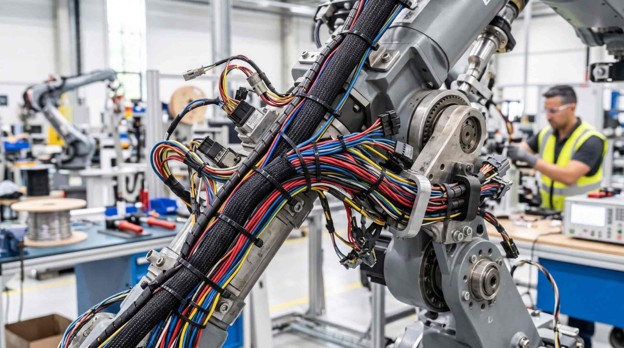
Just because a cable looks like another cable, it is not the same cable. A finely stranded conductor and jackets designed to handle continuous flexing are required for drag chains, rotating joints and moving axes. A normal fixed installation cable in a drag chain can last weeks.
The most difficult case is robotics. Arms move twist, bend and extend all day, every day. In this type of movement, don’t just purchase a part from a Robotics Cable Harness Supplier, he or she must know how to deal with torsion and bend radius. Inquire about rated flex cycles and watch out for claims without test information.
Don’t Overlook Connectors and Assembly Quality
Cables do not often go out of order in the middle. They do not work at the connector, termination or strain relief point. A poor crimp or a poor soldered joint can ruin a good cable. A pre-assembled harness may be preferable to on-site harnesses for complex machines: it is tested before the machine is shipped, installs faster and decreases wiring errors. Don’t just take quality on faith – request test reports like continuity and pull strength checks.
The wiring systems in the vehicle industry are built to resist vibration, heat cycles and rough handling and some of the best lessons in harness reliability come from the automotive industry. Having a good Automotive Wiring Harness Supplier brings that discipline to industrial work and the testing is the same as with the car and the consistent assembly.
Check Standards and Fire Behavior
Flame retardance, low smoke emission, halogen-free construction or hazardous area approval may be required, depending on your region and industry. UL, CE and RoHS markings are not merely paper stamps but proof that someone has tested the product. Halogen-free jackets generate significantly less toxic smoke in enclosed areas in case of an accident.
Balance Cost With the Cost of Failure
One of the most tempting things to do is to go with the cheapest cable that works for your needs, at least for the time being. But, an hour of downtime is generally much more expensive than the difference in cost between a budget cable and an appropriate one. Ask the question: What is it worth to be incorrect? In areas where the cable is hard to reach, such as critical areas, or where there is increased motion, such as uneven terrain, spend more time, and in places where there is not much motion or stress, such as flat runs, don’t over engineer.
A Quick Checklist Before You Order:
- Explain voltage, current, signal type and length.
- Name the factors of temperature, chemical, moisture and abrasion.
- Determine if the cable is stationary or moving.
- Use your plan to shield and keep quiet lines away from sensitive lines.
- Ensure connectors are good quality, and look into pre-assembled harnesses.
- Verify required certifications.
- Compare failure cost with purchase price.
Wrapping Up
While choosing industrial cables isn’t a glamorous affair, it involves some thought beforehand to avoid a lot of grief. Know what the job is, take care of the environment, account for movement and interference and don’t overlook the connections at both ends.
Don’t give a price unless you are sure, talk to a supplier who asks about the application. The right cable is the one that does its job quietly and effectively over a period of years, so nobody need think about it at 2 am.
To read more content like this, explore The Brand Hopper
Subscribe to our newsletter