Last Updated on August 7, 2026 by Team TBH
**This post is sponsored by Semrush. When you purchase through links in this article, we may earn an affiliate commission from Semrush.**
When I started my business, I thought marketing would eventually become easier.
I imagined there would be a point where I could follow a simple checklist every week, publish a few articles, check my website traffic, and watch things gradually improve. Instead, every new challenge seemed to introduce another tool I was supposed to learn.
One platform promised better keyword research. Another specialized in competitor analysis. A different one focused on website audits. Then AI search started changing how people discovered businesses online, adding another layer of complexity that I wasn’t prepared for.
As a small business owner without a dedicated marketing team, I wasn’t looking for more advice. I needed one place where I could understand what was working and what needed attention.
That search eventually led me to Semrush, and it completely changed the way I approached my weekly marketing routine.
Starting With One Simple Workflow
The first lesson I learned was that trying to master every marketing tactic at once was exhausting.
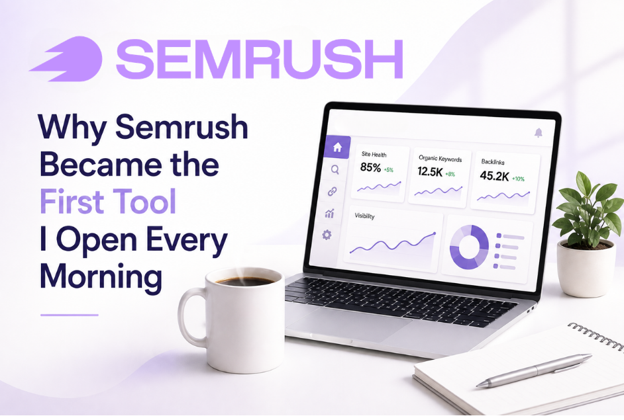
Instead, I created a simple routine every Monday morning. Rather than opening half a dozen browser tabs, I started with Semrush to understand the bigger picture before deciding what deserved my attention.
The first thing I checked was keyword performance. It gave me a quick snapshot of how my most important pages were performing and whether new opportunities had appeared.
Next, I reviewed competitor activity. Seeing which topics others were covering often sparked ideas I hadn’t considered, while also showing me where I could create something more useful instead of simply copying what everyone else was publishing.
Finally, I reviewed my site’s overall health to catch issues before they became bigger problems.
What surprised me wasn’t that these features existed. It was how much easier the entire process became when everything lived inside the same platform instead of being scattered across multiple subscriptions.
If you’re completely new to the platform, I also found the Getting Started with Semrush: A Tutorial for Navigating the Essentials guide especially useful. It walks through the basics in a practical way and makes the learning process much less intimidating before you begin building your own workflow.
Adapting to a New Era of Search
As my routine became more consistent, another challenge started becoming impossible to ignore.
People weren’t only searching on Google anymore.
Customers were increasingly finding information through AI generated answers, which meant traditional SEO alone no longer told the full story. My rankings could remain stable while my overall visibility changed because search itself was evolving.
That was when I discovered Semrush One.
One detail that’s worth understanding is that Semrush offers different solutions depending on what you’re trying to accomplish. The traditional SEO Toolkit focuses on established SEO workflows, while the AI Visibility Toolkit focuses specifically on monitoring how brands appear across AI platforms.
Semrush One brings those capabilities together into one connected solution, combining traditional SEO with AI Visibility in a single workflow.
That distinction mattered because I didn’t want to repeat the same mistake of managing disconnected tools all over again.
Being able to monitor rankings while also understanding how my business appeared in AI generated responses helped me think differently about the content I was creating. Instead of chasing rankings alone, I focused on producing articles that genuinely answered customer questions wherever they searched.
The workflow remained familiar, but the insights became much broader.
Another thing I appreciated about Semrush was that it encouraged better decisions instead of simply producing more reports. The data felt connected, making it easier to move naturally from researching opportunities to planning content and measuring results without constantly switching contexts.
Of course, I still use other specialized tools when a particular project calls for them. No single platform can replace every resource, and I don’t think it should. The best marketing workflows combine tools that complement one another rather than relying on popularity alone.
For me, though, Semrush became the foundation because it eliminated unnecessary complexity while helping me see how different parts of my marketing fit together.
Looking back, I realize I wasn’t overwhelmed because marketing was too difficult.
I was overwhelmed because I was trying to assemble a complete strategy from disconnected pieces.
Having one platform where I could research keywords, understand competitors, monitor performance, and eventually expand into AI Visibility through Semrush One made my weekly routine far more manageable.
It also gave me something I hadn’t expected.
Confidence.
Instead of wondering whether I was working on the right priorities, I had a repeatable process that helped me make decisions based on real data instead of assumptions.
If your marketing routine feels scattered and every new challenge seems to require another subscription, it may be time to simplify the way you work. Explore Semrush, follow the getting started tutorial to build your foundation, and see how Semrush One can help you connect traditional SEO and AI Visibility into one practical workflow that grows alongside your business.
To read more content like this, explore The Brand Hopper
Subscribe to our newsletter