Last Updated on November 20, 2026 by Team TBH
Bluehost vs SiteGround is one of the most searched comparisons in web hosting, and for good reason. Both companies have hosted WordPress websites for more than two decades, offer affordable shared and WordPress hosting, and include features such as free SSL certificates, a first-year domain on eligible plans, and website migration tools.
However, the two companies have taken different approaches to their platforms. Bluehost is a mass-market hosting brand owned by Newfold Digital, a group backed by private-equity firms Clearlake Capital and Siris Capital, and has adopted Oracle Cloud Infrastructure for a growing part of its hosting operations.
SiteGround is a privately owned company founded in Bulgaria that operates its hosting infrastructure on Google Cloud. In this guide, we compare Bluehost and SiteGround on pricing and renewals, features, performance, security, customer support, AI tools, ownership, and suitability for Indian website owners, so you can choose the right hosting provider.
Who Owns Bluehost and SiteGround?
Bluehost
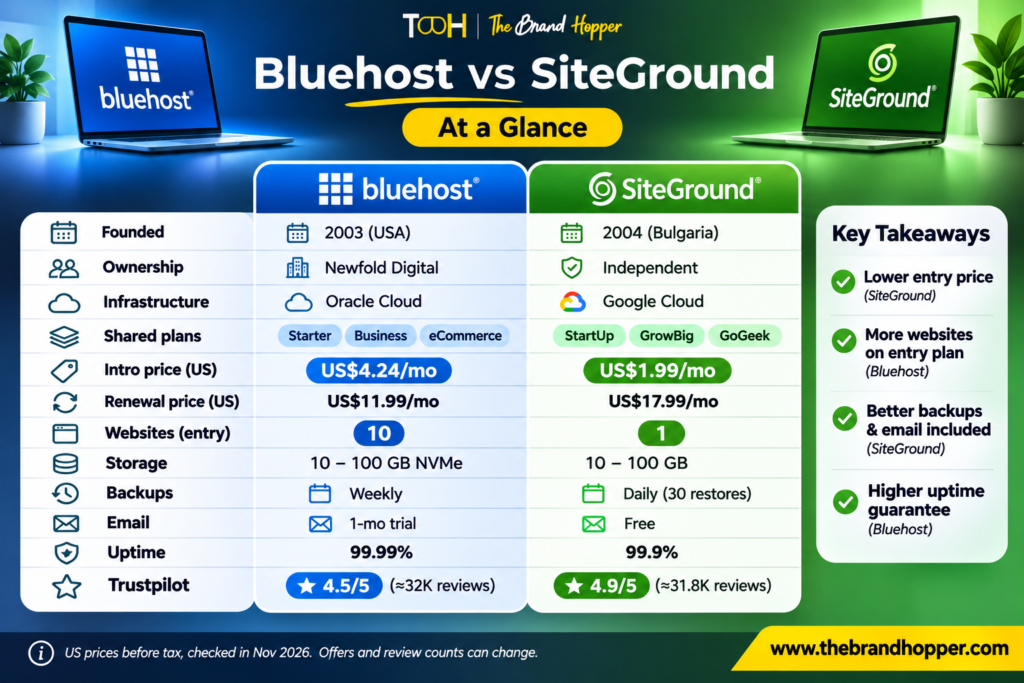
Bluehost was founded in Utah in 2003 and has been recommended by WordPress.org since 2005, making it the platform’s longest-running recommended hosting provider. Today, it belongs to Newfold Digital, a Jacksonville, Florida-based web services group formed in 2021 and backed by private-equity firms Clearlake Capital Group and Siris Capital Group.
Newfold Digital’s portfolio includes Bluehost, HostGator, Network Solutions, Crazy Domains, Yoast, YITH and other web services brands. In September 2026, the company described itself as serving approximately 6 million customers across more than 200 countries.
Newfold has been reshaping its business and financial structure. In December 2025, it announced an agreement with its existing financial sponsors and lenders that included US$100 million in new financing to strengthen its balance sheet and support investment in its core brands.
The company also completed the sale of its corporate domain business, Markmonitor, to Com Laude on 31 December 2025. The transaction was part of Newfold’s strategy to focus more heavily on Bluehost and Network Solutions.
On 1 October 2026, Sachin Puri became Newfold Digital’s CEO. Puri had previously led Bluehost Group and Network Solutions Group, while former CEO Sharon Rowlands transitioned to the position of Executive Chair.
SiteGround
SiteGround was founded in 2004 in Sofia, Bulgaria, by a group of IT graduates. The company describes itself as independently owned since its founding and continues to operate as a privately held business.
SiteGround now has more than 500 employees and operates through a group of companies registered in the USA, UK, Spain, Cyprus and Bulgaria. It reports that its platform powers more than 3 million domains.
Its leadership information identifies Nikolay Todorov and Tenko Nikolov as CEOs in different company materials. Both are long-standing figures in the organisation, with Tenko Nikolov having been associated with the company’s leadership since its early years.
Bottom line: Bluehost is a hosting brand within a larger private-equity-backed technology group, while SiteGround remains a privately owned hosting and technology company with a strong focus on its own platform and infrastructure.
Pricing and Renewal Costs
Pricing is where most buyers make mistakes. Both hosting providers advertise low introductory prices that apply only to the initial subscription period, after which the plans renew at significantly higher regular rates.
The renewal price, rather than the promotional headline, determines what you will actually pay over the long term. The comparisons below use US-dollar prices and separate 12-month and 36-month billing terms.
Bluehost shared hosting plans

Bluehost also offers lower introductory prices when customers select a 36-month term. Starter costs US$3.99/month, Business US$6.99/month and eCommerce Essentials US$14.99/month under the published promotional pricing.
The corresponding 36-month renewal prices are US$9.99/month for Starter, US$13.99/month for Business and US$21.99/month for eCommerce Essentials. These are different from the 12-month renewal rates shown in the table.
Bluehost periodically runs additional promotional campaigns, including multi-product discounts. Such offers are time-sensitive and may depend on the products selected and the checkout date.
SiteGround shared hosting plans

SiteGround’s promotional prices can vary depending on the campaign and the location from which you purchase. The regular 12-month rates are US$17.99 for StartUp, US$29.99 for GrowBig and US$44.99 for GoGeek.
SiteGround’s promotional pricing can therefore look extremely attractive during the first year, but the renewal increase is substantial. For example, StartUp’s US$1.99 introductory rate is followed by a US$17.99 monthly renewal rate on a 12-month term.
What you really pay over two years
The following comparison estimates the cost of purchasing a 12-month introductory subscription and then renewing for another 12 months. It excludes taxes, domain renewals and optional add-ons.
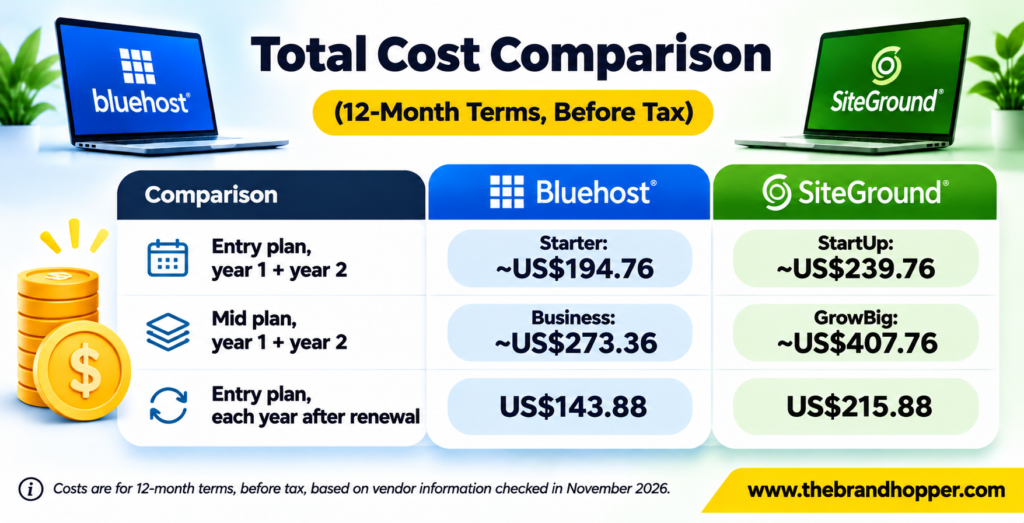
TheBrandHopper calculations based on the introductory and 12-month renewal prices published by Bluehost and SiteGround in November 2026. The calculations assume the promotional price remains available at checkout.
Winner, price: Bluehost. It is cheaper over two years under the prices compared here and allows more websites on each equivalent entry-level plan.
Features Compared
Both hosts include the essential features required by most beginners: a free domain for the first year on eligible hosting plans, free SSL certificates, a CDN, WordPress installation, website migration tools and customer support.
The main differences are in the backup frequency, email hosting, staging tools, security features and ecommerce functionality.
- Backups: SiteGround automatically creates daily backups and retains up to 30 daily restore points on shared hosting. It also offers five free manual backup slots on GrowBig and higher plans. Bluehost’s shared hosting plans include weekly automatic website backups.
- Email: SiteGround includes free email accounts on all shared hosting plans, with unlimited mailboxes subject to the account’s combined storage allowance. Bluehost provides a one-month Pro Email trial, after which the service renews at the applicable paid rate unless cancelled.
- Staging and developer tools: SiteGround offers staging on GrowBig and GoGeek, with Git, white-label client access and private DNS on GoGeek. It also provides SSH and WP-CLI access across its hosting plans.
- Ecommerce: Bluehost’s eCommerce Essentials plan bundles WooCommerce and tools for accepting payments, offering subscriptions, managing memberships, selling online courses and running affiliate programmes. This makes it a more complete out-of-the-box package for businesses that want to sell online.
- Phone support: Bluehost provides 24/7 chat support across its plans, but phone support is not included on the Starter plan. Business and eCommerce Essentials include phone support. SiteGround offers 24/7 customer support through its available support channels, including chat and tickets, with phone support available.
- Security: Bluehost includes malware scanning and protection, while its higher-tier plans add AI-powered malware detection and removal, a web application firewall and DDoS protection. SiteGround uses account isolation, proactive security updates, anti-bot systems and its own security technology to protect hosted websites.
Winner, features: SiteGround for daily backups, free email and developer tools; Bluehost for the number of websites supported and its ecommerce bundles.
Performance, Infrastructure and Uptime
SiteGround has used Google Cloud infrastructure since 2020 and operates a hosting stack built around its own software and performance technologies. These include NGINX-based delivery, caching, database optimisation and a customised PHP implementation that SiteGround says can make pages up to 30% faster.
It currently reports 11 data centres across North America, Europe, Asia and Australia, supported by a CDN with more than 170 edge locations. Its data centre locations include Singapore, which is particularly relevant for websites targeting visitors in India and other parts of Asia.
SiteGround publishes a 99.9% uptime commitment for its hosting services. Its infrastructure is designed to provide redundancy, availability and performance across geographically distributed locations.
Bluehost has been upgrading its infrastructure through the adoption of Oracle Cloud Infrastructure (OCI). In November 2025, the company reported that nearly one million customers had already migrated to OCI, with those migrated customers experiencing 4–5 times faster median response times according to Bluehost’s own measurements.
This should not be interpreted as confirmation that every Bluehost customer has migrated to OCI. The announcement described an ongoing infrastructure adoption rather than a completed migration of the entire customer base.
In October 2025, Bluehost also announced seven additional data centre locations: Frankfurt, Mumbai, São Paulo, Paris, Sydney, London and Madrid. Its current published data centre list also includes Toronto, Arizona and Virginia in the United States.
Bluehost’s shared hosting plans use NVMe SSD storage and include a 99.99% uptime guarantee. If the measured uptime falls below that threshold, eligible customers may request a credit of up to 5% of the monthly hosting fee, subject to the company’s conditions and claim process.
Independent monitoring by WPShout provides a useful, but limited, comparison. Its test accounts recorded 100% uptime for SiteGround in August, September and October 2026, compared with 100%, 100% and 99.99% for Bluehost over the same months.
WPShout’s measured Mumbai loading times were approximately 1.94 seconds for SiteGround and 1.97 seconds for Bluehost. This is a very small difference in that particular test, not proof that one provider will always be faster for every website.
Winner, performance: There is no universal winner. SiteGround has a mature Google Cloud-based platform and a strong global data centre network, while Bluehost offers a 99.99% shared-hosting uptime guarantee and has been expanding its cloud infrastructure. Actual performance depends on server location, plan resources, website configuration, caching and traffic patterns.
Ease of Use and Control Panel
Bluehost is designed with first-time website owners in mind. Its dashboard guides users through WordPress installation, domain configuration and website setup, reducing the technical steps required to launch a site.
Its AI website creation tools can generate a starting website from a prompt and information about the business. Bluehost also provides managed WordPress updates and tools for managing plugins and website content.
SiteGround uses its own control panel, Site Tools, which is clean and relatively straightforward once users become familiar with it. It also offers managed WordPress updates, its SiteGround Website Builder and an AI Agent for WordPress.
The AI Agent can assist with WordPress management tasks, but it requires the relevant plugin and an active SiteGround AI Studio plan. It is not simply an unrestricted feature automatically included with every hosting subscription.
Winner, ease of use: Bluehost for complete beginners who want guided website creation; SiteGround for users who prefer more detailed hosting controls and are comfortable learning Site Tools.
Customer Support and Reputation
SiteGround’s customer support is one of its strongest selling points. It currently has a Trustpilot rating of approximately 4.9 out of 5 from more than 31,000 reviews, with customers frequently praising the responsiveness and technical knowledge of its support team.
Bluehost also scores well on Trustpilot, with a rating of approximately 4.5 out of 5 from more than 32,000 reviews. Its support team received three Silver Stevie Awards in the 2026 Stevie Awards for Sales & Customer Service.
Bluehost’s WordPress hosting pages advertise 24/7 chat support, with phone support available on selected plans. SiteGround also provides round-the-clock support through its customer support channels.
Trustpilot ratings are useful indicators of customer feedback, but they are not controlled technical benchmarks. They can change over time and should be considered alongside independent performance tests and the features included in each plan.
Winner, support: SiteGround, based on its higher current Trustpilot rating and strong customer feedback.
AI Tools and What’s New in 2026
Both hosting providers are expanding beyond traditional web hosting and positioning themselves as broader AI-powered platforms for small businesses.
- Bluehost introduced GatorClaw in April 2026, a visual platform for building and running AI agents on its VPS infrastructure. In May, it launched the AI All-Access Pack, a subscription that brings together multiple AI tools. In July 2026, it expanded its AI business platform with AI Site, AI Store and an AI Front Desk Agent, designed to help businesses build websites, manage online stores, respond to customer questions and capture leads.
- SiteGround announced its broader all-in-one platform direction in January 2026, bringing hosting together with website creation, ecommerce, email marketing and AI products. Its AI Studio provides access to multiple AI models and more than 15 specialised agents for business tasks, while its Coderick AI platform helps users build websites and web applications through natural-language prompts.
SiteGround also introduced Coderick AI Import Design in October 2026. The feature allows users to import designs created with Claude Design or Google Stitch and turn them into working websites or web applications, including functional forms and backend capabilities.
Winner, AI tools: A tie, depending on the use case. Bluehost has a stronger emphasis on AI agents for small-business operations and ecommerce, while SiteGround’s AI Studio and Coderick AI are attractive for content creators, WordPress users and developers building websites and applications.
WordPress.org Recommendation
For many WordPress users, the WordPress.org hosting page is an important trust signal. As of November 2026, it lists three hosting providers: Pressable, Bluehost and Hostinger.
Bluehost describes itself as WordPress.org’s longest-running recommended host, with the relationship dating back to 2005. SiteGround has appeared on the recommendation page in the past but is not currently listed.
A WordPress.org recommendation is not a guarantee that a host will be the best option for every website. The directory itself explains that its selection process considers factors such as contributions to WordPress.org, customer base, ease of installation and upgrades, and other hosting-related criteria.
Winner, WordPress.org endorsement: Bluehost.
Bluehost vs SiteGround: Which Should You Choose?
The Bottom Line
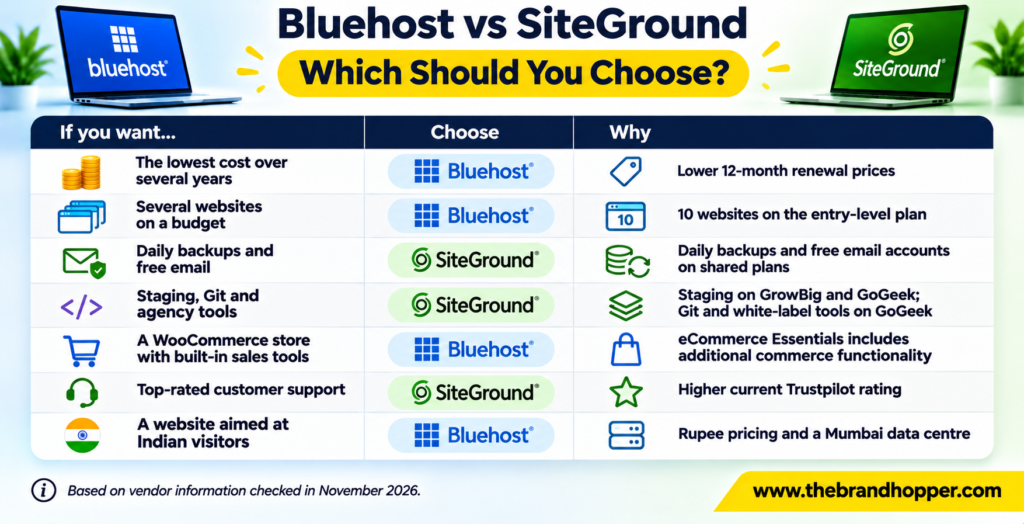
Bluehost is the better choice for many beginners, bloggers and small businesses watching their budget, thanks to its lower renewal prices, multiple websites on the entry-level plan, 99.99% uptime guarantee, ecommerce bundles and WordPress.org recommendation.
SiteGround is the better choice if you value daily backups, free email, strong customer support and developer-friendly tools, and are comfortable paying higher renewal prices. Its Google Cloud infrastructure and global CDN also make it a strong option for businesses serving international audiences.
Whichever provider you choose, compare the full initial payment and renewal cost rather than focusing only on the promotional monthly price. Check the server location, backup policy, email limits, renewal term and optional add-ons before completing your purchase.
Frequently Asked Questions
Q: Is Bluehost or SiteGround better?
A: Bluehost is generally better for value, beginners and users who need multiple websites on a budget. SiteGround is better for users who prioritise customer support, daily backups, free email and developer-oriented hosting features.
Q: Which is cheaper, Bluehost or SiteGround?
A: SiteGround can offer a lower first-year price during promotions, but Bluehost is generally cheaper over two years or more because its 12-month renewal prices are lower. For example, Bluehost Starter renews at US$11.99 per month on a 12-month term, compared with US$17.99 for SiteGround StartUp.
Q: Who owns Bluehost?
A: Bluehost is owned by Newfold Digital, which is backed by private-equity firms Clearlake Capital Group and Siris Capital Group. Sachin Puri became Newfold Digital’s CEO on 1 October 2026.
Q: Who owns SiteGround?
A: SiteGround is privately and independently owned. It was founded in Bulgaria in 2004, and its company materials identify Nikolay Todorov and Tenko Nikolov as CEOs.
Q: Is SiteGround faster than Bluehost?
A: SiteGround’s Google Cloud infrastructure, caching technology and global data centre network give it a strong performance profile. However, neither provider is universally faster for every website; performance depends on server location, plan resources, caching, website configuration and traffic.
Q: Is Bluehost still recommended by WordPress.org?
A: Yes. As of November 2026, Bluehost appears on WordPress.org’s hosting page alongside Pressable and Hostinger. It describes itself as WordPress.org’s longest-running recommended host, with the relationship dating back to 2005.
Q: Do Bluehost and SiteGround offer a money-back guarantee?
A: Yes. Both providers offer a 30-day money-back guarantee on shared hosting. Bluehost may deduct the regular domain registration fee if you cancel and want to retain a domain included free with the hosting plan. SiteGround’s refund policy also excludes certain items, including domain fees and third-party services.
Also Read: Slack vs Microsoft Teams: Which Is Better?
To read more content like this, subscribe to our newsletter