Last Updated on September 8, 2026 by Team TBH
Canon and Nikon have been trading blows in the camera world for nearly nine decades, and the rivalry has only intensified as both companies raced to reinvent themselves for the mirrorless era.
Both are Japanese optical giants with roots in pre-war Tokyo, both make some of the best cameras and lenses on the planet, and both are fighting the same long-term battle against smartphone photography and a shrinking but increasingly premium camera market.
Here’s a complete, grounded comparison of Canon and Nikon — history, financials, technology, lens ecosystems, and which brand actually deserves your money in 2026.
How Canon Began: A Buddhist Goddess and a Race to Catch Leica
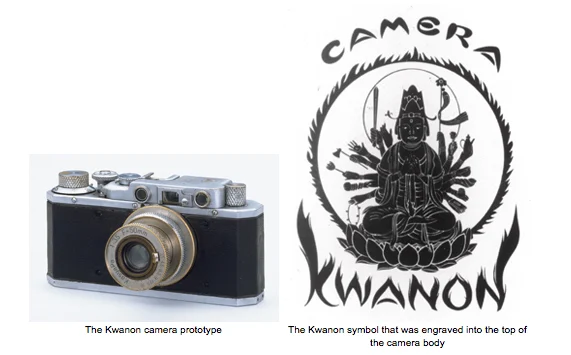
Canon’s story starts in 1933 as the Precision Optical Instruments Laboratory, a small Tokyo startup founded by Takeshi Mitarai, Goro Yoshida, Saburo Uchida, and Takeo Maeda with an audacious goal: build a Japanese camera capable of matching Germany’s dominant Leica.
Their first prototype, unveiled in 1934, was named the “Kwanon” after the Buddhist goddess of mercy, and the company later adopted the more marketable “Canon” name for its commercial products.
Because the fledgling company had no capability to manufacture its own optical glass, it turned to Nippon Kogaku — the company that would eventually become Nikon — to supply lenses and rangefinder optics, and the two rivals-to-be jointly produced the Hansa Canon in 1936, widely regarded as the first Japanese-made 35mm camera.
Canon was officially incorporated on August 10, 1937, under first president Takeshi Mitarai, and spent the following decades expanding from rangefinders into SLRs, calculators, printers, and eventually the full digital imaging and office-equipment empire it is today.
How Nikon Began: A National Optics Project Turned Camera Giant
Nikon’s roots run even deeper and started from a very different place than Canon’s camera-focused ambitions.
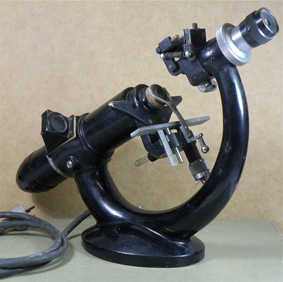
Nippon Kogaku K.K. (Japan Optical Industries Co., Ltd.) was founded on July 25, 1917, in Tokyo, formed by merging the optical instruments division of Tokyo Keiki with the mirror division of Iwaki Glass and Fujii Lens Manufacturing, under the guidance of Mitsubishi president Koyata Iwasaki.
The company’s founding was treated as a matter of national strategic importance for Japan, which needed domestic optical manufacturing capability for military rangefinders, binoculars, and microscopes rather than consumer cameras.
Nippon Kogaku began producing optical glass in 1918 and even attempted a technical partnership with Germany’s Carl Zeiss before eventually building its own independent expertise, later supplying lenses to Canon’s earliest rangefinder cameras.
The company didn’t formally rebrand as Nikon Corporation until April 1988, even though its “Nikon” camera brand name had been in commercial use since the late 1940s, meaning the company had operated under the Nippon Kogaku name for over 70 years before the corporate identity finally caught up with the brand everyone already knew.
Canon vs Nikon: Ownership and Corporate Structure
Both Canon Inc. and Nikon Corporation are publicly traded Japanese companies listed on the Tokyo Stock Exchange, and neither is controlled by a single founding family or dominant individual shareholder today.
Canon (TYO: 7751) is the far larger and more diversified of the two, generating the bulk of its revenue not from cameras but from office imaging and business solutions — printers, copiers, and network cameras — with its dedicated Imaging Business Unit (cameras and related products) representing a meaningful but secondary segment of overall sales.
Nikon (TYO: 7731), by contrast, is a smaller, more camera-concentrated company, though it has diversified over the decades into precision equipment (semiconductor lithography systems), healthcare, and industrial metrology, alongside a 2020 acquisition of cinema camera maker RED Digital Cinema.
This structural difference matters enormously for understanding why the two companies’ financial fortunes have diverged so sharply in recent years.
Canon vs Nikon: FY2025 Financial Results Compared
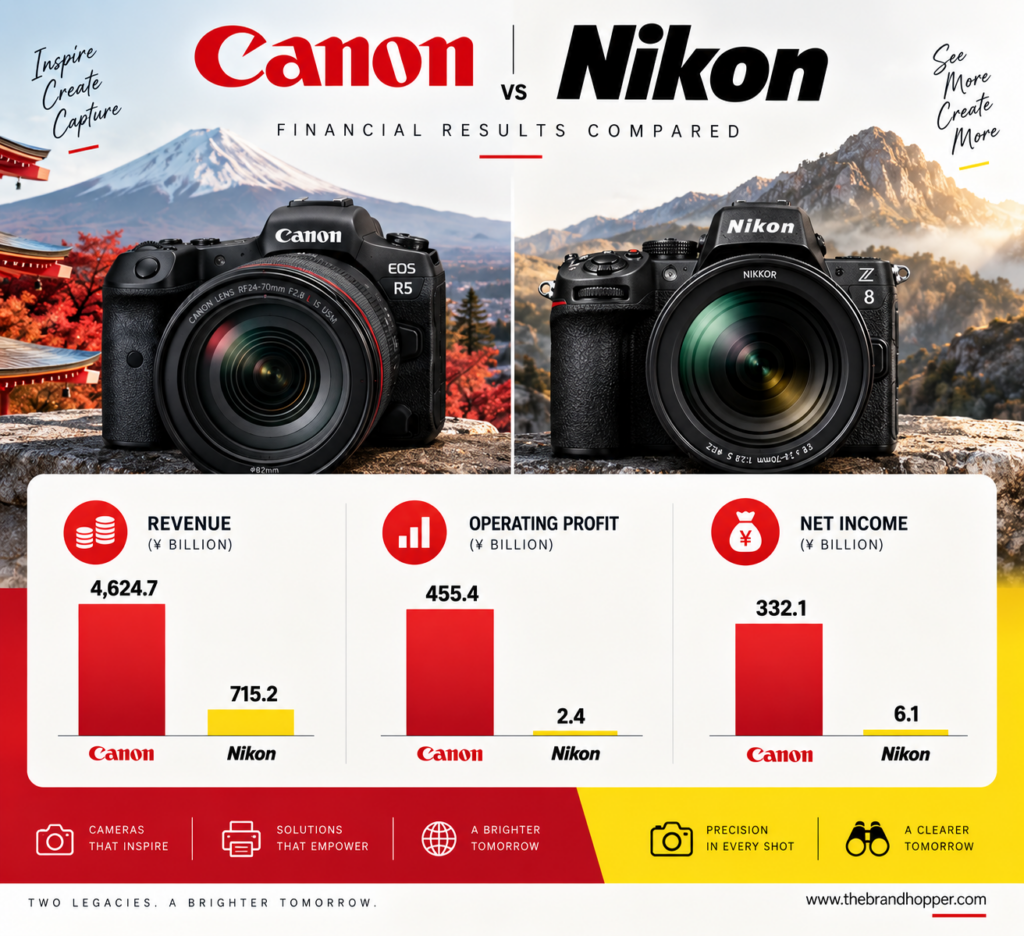
Canon’s FY2025 (calendar year 2025, reported January 2026) results were genuinely strong across the board: consolidated net sales rose 2.5% to a record ¥4,624.7 billion, operating profit surged 62.8% to ¥455.4 billion, and net income attributable to Canon Inc. more than doubled, up 107.5% year-over-year to ¥332.1 billion.
Within that total, Canon’s Imaging Business Unit — the camera and lens division most relevant to this comparison — posted total sales up 12.5% to ¥1,054.9 billion, with a record-high operating profit of ¥32.8 billion driven by cost-reduction efforts, while Canon shipped 2.88 million digital interchangeable-lens cameras for the year, up 2% versus the prior year.
Nikon’s FY2025 (fiscal year ended March 31, 2025) results were far more modest: consolidated revenue came in at ¥715.2 billion, operating profit was just ¥2.4 billion, and profit attributable to owners of the parent was only ¥6.1 billion, weighed down by roughly ¥27.2 billion in one-time costs.
Nikon’s Imaging Products segment, encouragingly, actually grew revenue 5.6% to ¥295.4 billion on strong sales of the Z50II, Z6III, and other new mirrorless models, though segment operating profit still fell 11.3% due to losses at RED and impairment charges elsewhere in the business.
The gap widened further in Nikon’s subsequent fiscal year ending March 2026, when the company posted a full-year operating loss of ¥112.4 billion and a net loss of ¥86.1 billion, driven overwhelmingly by massive goodwill and intangible-asset impairments in its non-camera Digital Manufacturing (semiconductor equipment) segment rather than any failure of its camera business.
Camera Market Share: Canon’s Commanding Lead
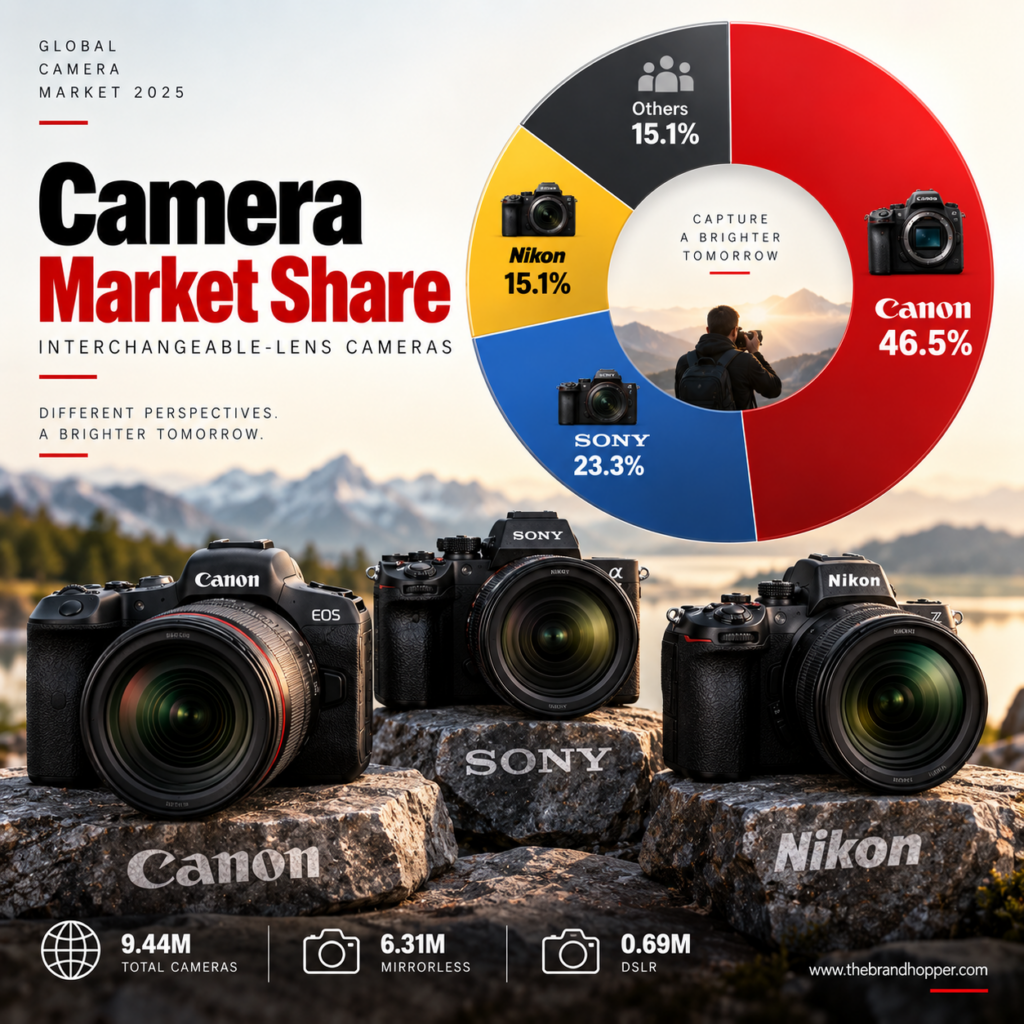
By volume and value, Canon remains the dominant force in the global camera market. Canon holds roughly 46.5% share across the interchangeable-lens camera segment overall, according to BCN retail data, while in the specific mirrorless category, Sony actually leads with about 29.9% ahead of Canon’s 27.4%, with Nikon trailing in third at roughly 15.1%.
Looking at raw shipment numbers, Canon shipped approximately 2.05 million mirrorless cameras in the most recent full comparison year versus Sony’s 1.63 million and Nikon’s roughly 760,000 units, though Nikon did post about a 21% year-over-year increase in mirrorless sales, showing real momentum even from a smaller base.
Across the broader digital camera market, global shipments totaled roughly 9.44 million units in 2025, with mirrorless models accounting for about 6.31 million of those units and traditional DSLRs shrinking to just 691,000 units worldwide — a stark illustration of how completely mirrorless technology has taken over the interchangeable-lens category that both Canon and Nikon now compete in almost exclusively.
Lens Ecosystems and Mounts: RF vs Z
Both companies have fully committed to mirrorless-native lens mounts, abandoning further meaningful investment in their legacy DSLR mount lineups (Canon EF and Nikon F).
Canon’s RF mount, introduced in 2018, now boasts one of the largest and fastest-growing native lens catalogs in the industry, spanning affordable RF-S APS-C options through exotic supertelephoto primes, and Canon has also built out a robust RF-mount cinema lens lineup that pairs with its Cinema EOS camera systems.
Nikon’s Z mount, also launched in 2018, is frequently praised by optical engineers for its unusually large diameter and short flange distance, which in theory allows for optically superior lens designs, and Nikon has steadily filled out its own Z-mount lineup with acclaimed primes and zooms, including collaborations with cinema lens specialist RED following that 2020 acquisition.
In practice, Canon’s ecosystem is simply larger and more mature at this point, with more third-party lens support gradually opening up (Canon has historically been stricter about licensing RF mount to outside lens makers than Nikon has been with Z mount), giving Nikon shooters somewhat easier access to affordable Sigma, Tamron, and Viltrox third-party glass.
Flagship Cameras: Canon EOS R1 and R5 Mark II vs Nikon Z8 and Z6III
At the top end, Canon’s EOS R1 ($6,300) is a purpose-built sports and action flagship with elite autofocus tracking, while the EOS R5 Mark II ($4,299) pairs a 45-megapixel sensor with up to 30 frames-per-second shooting, excellent autofocus, and 8K video, and is widely regarded as offering some of the best overall handling and ergonomics in the mirrorless category.
Nikon’s answer comes primarily through the Z8 (roughly $3,796), which packs nearly all of the capability of Nikon’s range-topping Z9 into a smaller, lighter body, giving up only dual CFexpress slots, built-in GPS, and Ethernet connectivity as trade-offs, making it a favorite among wildlife and event photographers who don’t need the full Z9’s bulk.
Further down the lineup, the Nikon Z6III brings much of the same advanced autofocus system found in the Z8 and Z9 down to a more affordable, enthusiast-friendly price point, though its 24-megapixel sensor resolution trails Canon’s R5 Mark II and Sony’s competing models.
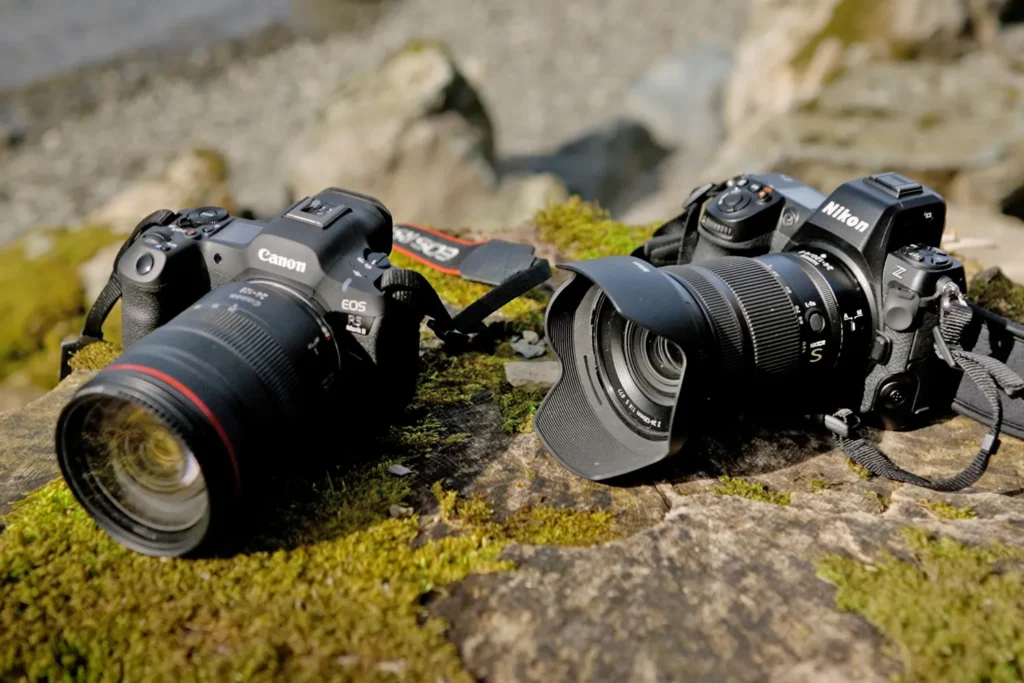
Across this flagship tier, independent reviewers have generally found Canon’s R5 Mark II edges out both the Z8 and Sony’s a1 II specifically on handling and ergonomics, while all three brands now offer broadly comparable image quality and autofocus performance at the very top of the market.
Sensors, Autofocus, and Video: Where the Real Differences Live
Canon designs and manufactures the vast majority of its own image sensors in-house, giving it tight control over color science and processing pipeline optimization that many photographers describe as producing a distinctive, flattering “Canon color” straight out of camera.
Nikon, by contrast, has historically sourced many of its sensors from Sony Semiconductor, though it applies its own proprietary image-processing engine (EXPEED) on top, resulting in image quality that’s frequently praised for dynamic range and low-light performance, particularly in landscape and studio work.
On autofocus, both companies have made enormous strides in AI-driven subject detection and tracking in recent generations, largely closing the gap that once favored Sony in this area, though Canon’s Dual Pixel CMOS AF II system remains a particular strength in fast-action and wildlife scenarios.
For video, Canon’s Cinema EOS line and RF-mount video features give it a slight edge with working filmmakers and hybrid shooters, while Nikon’s 2020 acquisition of RED has begun paying dividends in high-end cinema camera technology, even though that acquisition has also been a source of financial drag due to a sluggish broader cinema industry.
Which Brand Is Best for You? A Practical Breakdown
If you’re a wildlife, sports, or action photographer who needs the fastest, most reliable autofocus and the widest native lens selection, Canon’s RF ecosystem and market-leading scale make it the safer long-term bet.
If you’re a landscape, portrait, or studio photographer who prioritizes dynamic range, color depth, and slightly more affordable access to excellent third-party lenses, Nikon’s Z-mount system remains a genuinely outstanding and often better-value choice.
If you’re an investor or industry watcher rather than a buyer, Canon is simply the financially stronger company by a wide margin, with record sales, surging profit, and a far more diversified business insulating its camera division from the kind of volatility that hit Nikon’s bottom line through its semiconductor equipment struggles.
Beginners and hybrid content creators, meanwhile, will likely find either brand’s mid-range mirrorless bodies (Canon’s EOS R6 series or Nikon’s Z6 series) more than capable, making the choice more about lens ecosystem preference and handling feel than any decisive technical gap.
Canon vs Nikon at a Glance (FY2025)
| Fact | Canon | Nikon |
| Founded | 1933 (incorporated 1937), Tokyo | 1917 (as Nippon Kogaku), Tokyo |
| Founders | Takeshi Mitarai, Goro Yoshida, Saburo Uchida, Takeo Maeda | Formed via merger under Mitsubishi’s Koyata Iwasaki |
| Stock listing | Tokyo Stock Exchange: 7751 | Tokyo Stock Exchange: 7731 |
| Company structure | Publicly traded, diversified (imaging, office, medical) | Publicly traded, camera-concentrated + precision equipment |
| FY2025 net sales/revenue | ¥4,624.7 billion (+2.5%, record high) | ¥715.2 billion |
| FY2025 operating profit | ¥455.4 billion (+62.8%) | ¥2.4 billion |
| FY2025 net income | ¥332.1 billion (+107.5%) | ¥6.1 billion |
| Camera segment revenue | Imaging Business Unit: ¥1,054.9 billion (+12.5%) | Imaging Products: ¥295.4 billion (+5.6%) |
| Interchangeable-lens market share | ~46.5% (overall segment) | ~15.1% (mirrorless segment) |
| Native lens mount | RF (2018) | Z (2018) |
| Flagship cameras | EOS R1, EOS R5 Mark II | Z9, Z8 |
| Known strength | Autofocus speed, lens ecosystem breadth | Sensor dynamic range, mount engineering |
Key Takeaways
Canon enters 2026 as the financially dominant player in this rivalry, posting record FY2025 net sales of ¥4,624.7 billion and more than doubling net income to ¥332.1 billion, while commanding the largest overall share of the global interchangeable-lens camera market at roughly 46.5%.
Nikon, though a much smaller company by revenue at ¥715.2 billion in FY2025, continues to punch above its weight in camera quality and innovation, with the Z8 and Z6III winning consistent praise and imaging segment revenue actually growing 5.6% even as the parent company’s non-camera semiconductor equipment business dragged overall profitability sharply lower, including a steep operating loss in the subsequent fiscal year.
For photographers, the real-world decision still comes down to genre and ecosystem fit rather than which company is winning on a balance sheet — Canon’s breadth and autofocus speed suit action and wildlife shooters, while Nikon’s sensor performance and mount engineering continue to win over landscape, portrait, and studio photographers.
Frequently Asked Questions
Q: Which is better, Canon or Nikon?
A: Neither brand is objectively “better” for every use case, but Canon leads in market share, autofocus speed, and lens ecosystem breadth, making it the stronger overall choice for most photographers, while Nikon remains excellent for landscape, portrait, and studio work thanks to its sensor performance and lens engineering.
Q: Which company is bigger, Canon or Nikon?
A: Canon is significantly larger. In FY2025, Canon reported consolidated net sales of ¥4,624.7 billion compared to Nikon’s ¥715.2 billion, and Canon is also far more diversified beyond cameras into printers, copiers, and network cameras.
Q: Who founded Canon and Nikon?
A: Canon was founded in 1933 (incorporated 1937) by Takeshi Mitarai, Goro Yoshida, Saburo Uchida, and Takeo Maeda. Nikon traces back to Nippon Kogaku, founded in 1917 in Tokyo, and didn’t formally adopt the Nikon Corporation name until 1988.
Q: Does Canon or Nikon have more camera market share?
A: Canon holds the largest overall interchangeable-lens camera market share at roughly 46.5%. In the mirrorless-specific category, Sony actually leads at about 29.9%, followed by Canon at 27.4% and Nikon at approximately 15.1%.
Q: Is Nikon losing money?
A: Nikon’s core Imaging Products (camera) business remains profitable and grew revenue in FY2025, but the parent company posted a steep overall operating loss in its fiscal year ended March 2026 due to major impairment charges in its unrelated semiconductor equipment business, not its camera division.
Q: Which brand has better lenses, Canon RF or Nikon Z?
A: Canon’s RF mount currently offers a larger and more mature native lens catalog with growing third-party support, while Nikon’s Z mount is praised by engineers for its wider diameter and short flange distance, which can enable optically excellent lens designs; both systems are considered excellent by working photographers.
Q: What are Canon and Nikon’s flagship cameras?
A: Canon’s flagships are the sports-focused EOS R1 and the versatile 45-megapixel EOS R5 Mark II. Nikon’s comparable flagships are the Z9 and the smaller, lighter Z8, along with the more affordable enthusiast-focused Z6III.
Q: Did Canon or Nikon make more profit in FY2025?
A: Canon was far more profitable, with net income attributable to Canon Inc. more than doubling to ¥332.1 billion in FY2025, compared to Nikon’s profit attributable to owners of the parent of just ¥6.1 billion for the same period.
Also Read: GoPro vs DJI: Best Action Camera Brand?
To read more content like this, subscribe to our newsletter