Last Updated on July 16, 2026 by Team TBH
Every time a diner orders a Caesar salad, a grilled salmon, or a simple cup of soup at a restaurant in the United States — or in France, the United Kingdom, Canada, Ireland, or six other countries — there is a roughly one-in-six chance that every ingredient on that plate was delivered by Sysco Corporation. Not cooked by Sysco. Not branded by Sysco. Simply delivered, in the right quantities, at the right temperature, on the right morning, to the back door of a restaurant that might not survive a single week if that delivery failed.
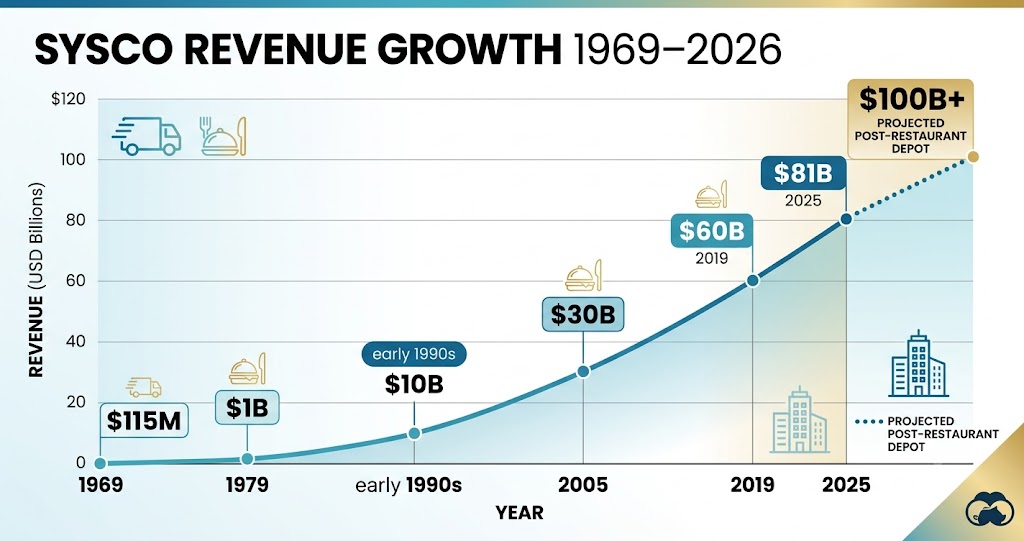
This is the quiet, essential business that Sysco has built over 57 years: the world’s largest foodservice distribution company, with $81.37 billion in revenue in its fiscal year 2025, 337 distribution centres across 10 countries, 75,000 employees, and 730,000 customer locations served. It is a business with no consumer brand recognition — most diners have never heard of Sysco — but with an iron grip on the supply chain that keeps the global restaurant industry fed.
In March 2026, Sysco made the biggest bet in its 57-year history: a $29.1 billion agreement to acquire Jetro Restaurant Depot, a cash-and-carry warehouse chain serving 725,000 independent restaurant operators across 35 US states. If approved by regulators, this will be the largest acquisition in the US foodservice distribution industry’s history, adding $16 billion in annual revenue and fundamentally transforming Sysco’s model from delivery-only to delivery-plus-self-serve.
This comprehensive guide covers Sysco’s full 57-year history — from John Baugh’s nine-company merger in 1969 to today — its business model, product portfolio, Recipe for Growth strategy, digital transformation, key acquisitions, competitive landscape, financial performance, and what the Restaurant Depot deal means for the future of food distribution.
The History of Sysco Corporation: 1969 to 2026
The Founding Vision: John Baugh’s Big Bet (1969)
The story of Sysco begins with a visionary entrepreneur named John F. Baugh and a simple but audacious idea: that the fragmented, regionalised US foodservice distribution industry was ripe for consolidation.

Baugh grew up on a ranch near Waco, Texas, and entered the food industry as a teenager with a part-time job at a local A&P grocery store. He later founded Zero Foods Company of Houston, a regional food distributor. By the late 1960s, Baugh recognised that the foodservice industry — restaurants, hospitals, schools, hotels — was served by hundreds of small, local distributors with no scale advantages, no buying power, and no ability to serve customers across regional boundaries.
In 1969, Baugh persuaded the owners of eight other regional food distributors to merge their businesses into a single national foodservice distribution company. The nine founding companies, with combined 1969 revenues of $115 million, were:
- Zero Foods Company (Houston, Texas) — Baugh’s own company
- Frost-Pack Distributing Company (Grand Rapids, Michigan)
- Global Frozen Foods, Inc. (New York)
- Houston’s Food Service Company (Houston, Texas)
- Louisville Grocery Company (Louisville, Kentucky)
- Plantation Foods (Miami, Florida)
- Texas Wholesale Grocery Corporation (Dallas, Texas)
- Thomas Foods, Inc. and its Justrite Food Service subsidiary (Cincinnati, Ohio)
- Wicker, Inc. (Chicago, Illinois)
Sysco Corporation — an acronym for Systems and Services Company — was incorporated on March 3, 1969. The company went public on the New York Stock Exchange in 1970 and made its first acquisition, Arrow Food Distributor, in the same year. The acquisition engine that would come to define Sysco had ignited.
Complete History Timeline: 1969–2026
| 1969 | John Baugh merges nine regional food distributors to create Sysco Corporation on March 3, 1969. Combined revenue of founding companies: $115 million. |
| 1970 | Sysco goes public (NYSE). Makes first acquisition: Arrow Food Distributor. The acquisition growth model is established from day one. |
| 1979 | Annual revenues surpass $1 billion — a milestone reached in just 10 years, driven by a steady cadence of regional distributor acquisitions. |
| 1981 | Sysco becomes the largest US foodservice distribution company by revenue — a position it has never relinquished in the 45 years since. |
| 1983 | John E. Woodhouse takes over as CEO; Baugh remains as Chairman. The second generation of leadership continues the acquisition-driven growth strategy. |
| 1988 | Acquires CFS Continental for $750 million — the country’s third largest food distributor at the time. Adds 4,500 employees; expands service area to 148 of the top 150 US metro areas. First truly transformative acquisition. |
| 1990 | Revenue exceeds $6 billion. Sysco now operates in virtually every major US market, serving restaurants, hospitals, schools, and hotels. |
| 1991 | Creates the SYGMA Network, Inc. — a dedicated subsidiary to consolidate chain restaurant distribution. SYGMA specialises in serving large quick-service and casual dining chains. |
| 1995 | Launches the ‘fold-out’ expansion strategy: establishing sales operations in new markets before building distribution infrastructure, reducing capital risk in new geographic expansion. |
| 2000 | Acquires FreshPoint Holdings — a major specialty produce distributor. Marks Sysco’s entry into fresh produce specialisation, broadening beyond canned/dry/frozen goods. |
| 2002 | Vastly expands Canadian operations through the acquisition of Serca Foodservice. International expansion accelerates. |
| 2005 | First Sysco regional redistribution centres open. Revenue exceeds $30 billion for the first time. 29th consecutive year of increased revenue — a remarkable consistency record. |
| 2009-12 | Global financial crisis and restaurant industry downturn slow Sysco’s growth for the first time in decades. The company focuses on operational efficiency and margin improvement. |
| 2015 | Attempted $8.2 billion acquisition of US Foods blocked by the Federal Trade Commission on antitrust grounds — the most significant regulatory setback in Sysco’s history. Company sells Smart Foodservice Warehouse Stores (a cash-and-carry business) to complete the required divestitures (ultimately irrelevant as deal fails). |
| 2016 | Tom Bené becomes CEO. Sysco refocuses on organic growth, customer experience, and operational excellence rather than transformative M&A following the US Foods failure. |
| 2019 | Acquires Brakes Group, a major UK and European foodservice distributor, for approximately $3.1 billion. Transforms Sysco’s international profile — now a genuine European food distribution player with operations in France, UK, Sweden, Ireland, Belgium. |
| 2020 | Kevin P. Hourican becomes CEO (February 2020), replacing Tom Bené. COVID-19 pandemic devastates the restaurant industry. Sysco’s revenues drop from $60B to $52B. Company demonstrates resilience through cost management, supply chain stability, and customer support programmes. |
| 2021 | Launches ‘Recipe for Growth’ — a multi-year strategic roadmap targeting 4–6% annual sales growth, 1.5x market growth, and expanded operating margins. Five strategic pillars: digital, customer experience, supply chain, portfolio expansion, international. |
| 2022 | Revenue recovers strongly to $68.6 billion as restaurant industry rebounds post-pandemic. Acquires Greco and Sons (specialty Italian food) and The Coastal Companies (specialty produce) in H1. Kevin Hourican elevated to Chair of the Board. |
| 2023 | Revenue reaches $76.3 billion. Acquires BIX Produce (Minnesota, August 2023) and Edward Don & Company ($965M, November 2023) — a leading distributor of foodservice equipment and supplies. |
| 2024 | FY2024 revenue: $78.8 billion. Acquires Campbells Prime Meat (Scotland). Sysco Shop platform made available in Spanish. Launches long-term strategic plan at May 2024 Investor Day projecting 4–6% annual growth to FY2027. |
| 2025 | Record FY2025 revenue: $81.37 billion (+3.2% YoY). Adjusted EBITDA: $4.29 billion. Acquires Ginsberg’s Foods (December 2025). Kevin Hourican named Chair of the Board (April 2024) — holds both Chair and CEO roles. 75,000 employees serving 730,000 customer locations. |
| 2026 | March 30, 2026: Announces $29.1 billion acquisition of Jetro Restaurant Depot — the largest acquisition in Sysco history and in US foodservice distribution. Deal expected to close ~Q3 FY2027 pending regulatory approval. Adds $16B revenue, 725K customers, 166 warehouse stores, $2.1B EBITDA, and entry into the fast-growing cash-and-carry channel. |
Sysco’s Business Model: How the World’s Largest Food Distributor Works
Sysco’s business model is deceptively simple: buy food and related products in enormous quantities from manufacturers and producers, store them in temperature-controlled distribution centres, and deliver them — on time and at the right temperature — to the kitchens of restaurants, hospitals, schools, hotels, and every other type of foodservice operation. The complexity lies entirely in execution at scale across hundreds of thousands of customer relationships, 337 distribution centres, and 10 countries.
The Distribution Model
| Component | Description | Scale (2026) |
| Procurement | Sysco purchases from thousands of food manufacturers, farmers, and processors globally. Scale gives it significant buying power — negotiating prices that smaller distributors cannot access. | ~400,000 SKUs; buys from thousands of suppliers globally |
| Storage | Temperature-controlled distribution centres hold ambient, refrigerated, and frozen products. Multi-temperature facilities handle the full product range. | 337 DCs across 10 countries; 207 in USA alone |
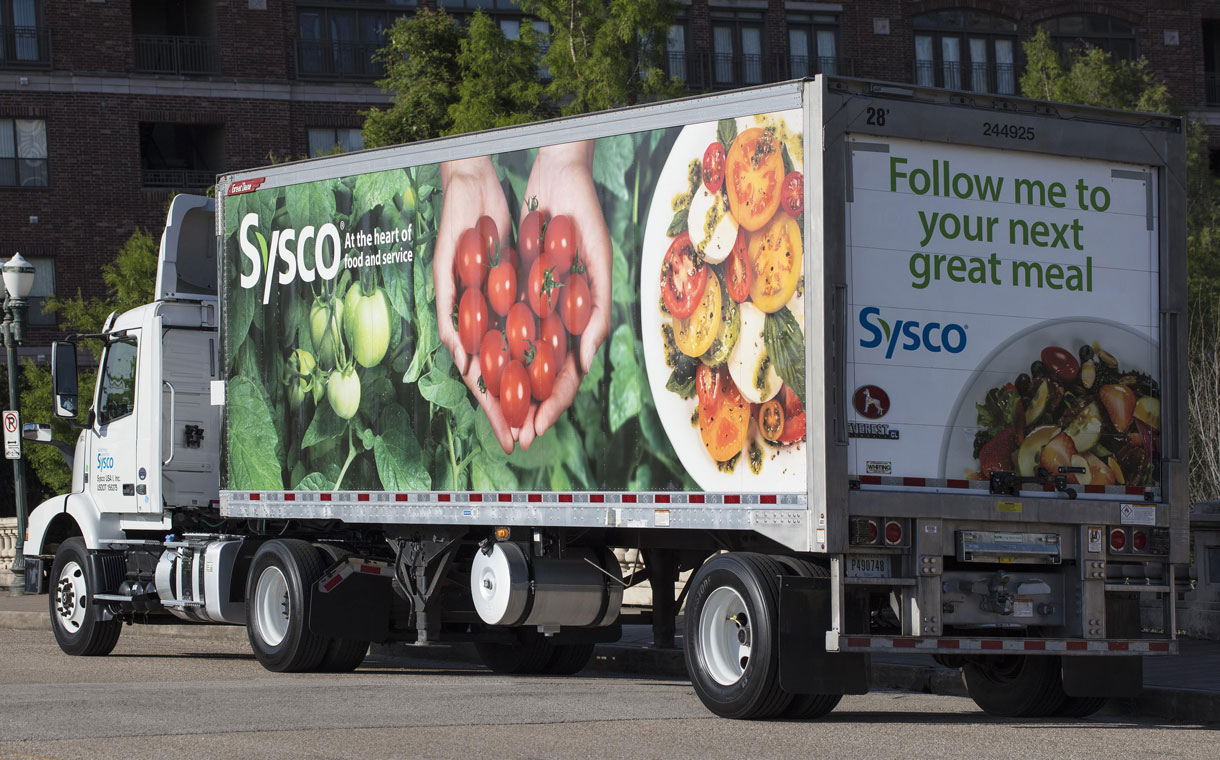
| Route Delivery | Sysco’s delivery fleet — one of the largest in North America — makes daily or weekly deliveries to customer back doors on multi-stop routes. | ~13,000 delivery vehicles; 730,000 customer locations |
| Sales Force | Dedicated Marketing Associates (MAs) serve as consultants to customers — helping with menu planning, new product discovery, and cost management. | ~7,000+ Marketing Associates globally |
| Customer Technology | Sysco Shop (e-commerce platform), recipe tools, menu cost calculators, nutritional databases, and ordering apps. | Sysco Shop available in English and Spanish |
| Private Label | Sysco’s own-brand products (Sysco Brand, Imperial, Arrezzio, etc.) are manufactured to Sysco’s specifications and typically offer higher margins than national brands. | Multiple private label tiers across all product categories |
Customer Segments
| Segment | % of Revenue (est.) | Key Needs | What Sysco Provides |
| Restaurants (independent) | ~60% | Daily ingredient delivery, value, menu support | Full broadline delivery, Sysco Brand, MA consulting, digital ordering |
| Chain Restaurants (via SYGMA) | ~15% | High-volume, standardised SKUs, supply chain reliability | Dedicated SYGMA Network subsidiary; contracts with QSR and casual dining chains |
| Healthcare (hospitals, care homes) | ~8% | Regulatory compliance, nutritional accuracy, consistency | Healthcare-specific product ranges; nutritional databases; compliance support |
| Education (schools, colleges) | ~5% | Cost management, compliance (USDA nutrition standards), volume | Competitive pricing; USDA-approved items; nutritional analysis tools |
| Lodging (hotels, resorts) | ~5% | Broad product range, consistency, seasonal flexibility | Full product catalogue; beverage; amenity supplies |
| Catering & Leisure | ~4% | Volume flexibility, event-specific sourcing | Large-format ordering; event planning support |
| Other (healthcare facilities, government) | ~3% | Specialised products, compliance | Specialty distributors; FreshPoint produce; specialty protein |
Products & Service Portfolio of Sysco
Sysco distributes approximately 400,000 stock-keeping units (SKUs) across a comprehensive range of food and non-food categories. Its industry-leading portfolio is organised across six core categories:
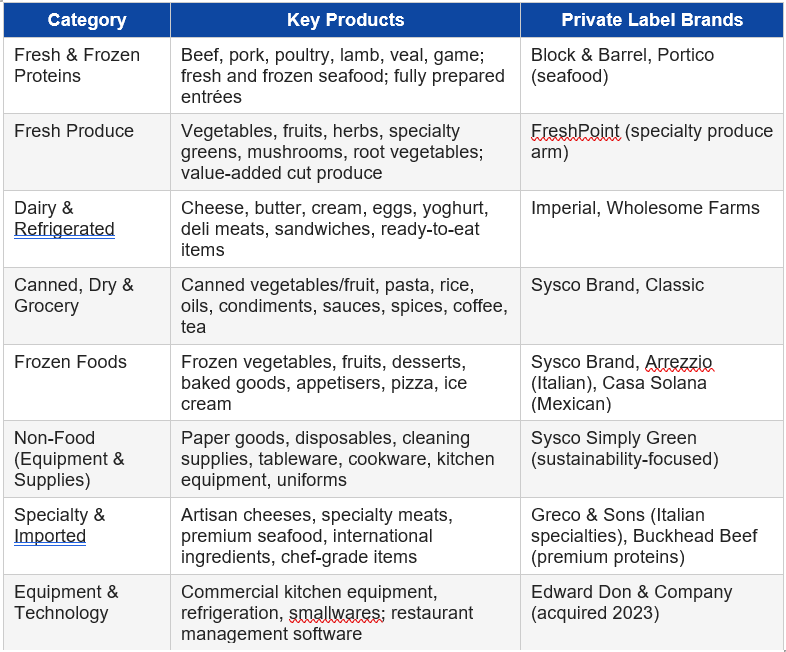
Private Label Power: Sysco’s own-brand products (sold under Sysco Brand, Imperial, Arrezzio, and other labels) represent a significant share of total revenue and carry higher gross margins than national branded equivalents. Private label penetration is a key metric in Sysco’s Recipe for Growth strategy, as higher private label mix directly improves profitability.
Recipe for Growth: Sysco’s Multi-Year Strategy
‘Recipe for Growth is not a catchy tagline — it is a disciplined, five-pillar framework that has guided every major Sysco decision since 2021. The target: grow 1.5x faster than the overall foodservice market, consistently, over a multi-year horizon.’ — Kevin Hourican, CEO
Launched at Sysco’s May 2021 Investor Day, Recipe for Growth is the strategic roadmap that has driven Sysco’s post-pandemic recovery and positioned the company for its next decade of growth. At its May 2024 Investor Day, Sysco affirmed and extended the framework with a target of 4–6% annual sales growth through FY2027.
| Pillar | Strategic Goal | Key Initiatives & Progress (2025) |
| 1. Winning the Customer | Grow share of wallet with existing customers; attract new independent restaurant operators as primary focus | Sysco Marketing Associates as foodservice consultants; new product introduction programme; digital tools reducing ordering friction; B2B sales growing |
| 2. Digital Transformation | Make Sysco the easiest foodservice distributor to do business with, digitally | Sysco Shop e-commerce platform (available in English and Spanish); personalised product recommendations; digital menu planning tools; AI-assisted order optimisation |
| 3. Supply Chain Excellence | Improve delivery reliability, reduce food waste, lower cost-to-serve | Route optimisation technology; smart warehouse systems; multi-temperature distribution investment; fresh supply chain investment (BIX Produce acquisition) |
| 4. Portfolio Expansion | Grow specialty and equipment revenue faster than broadline; capture more of customers’ total spend | Edward Don & Company (equipment); Greco & Sons (Italian specialty); Campbells Prime Meat (Scotland); specialty produce via FreshPoint expansion |
| 5. International Growth | Leverage European platform (UK, France, Sweden, Ireland, Belgium) for profitable growth | Campbells Prime Meat (Scotland, Q2 FY2025); ongoing expansion in UK/France; international business growing double-digit in FY2025 |
Recipe for Growth Financial Targets
| Metric | Target (through FY2027) | FY2025 Actuals | Status |
| Annual Revenue Growth | 4–6% per year | $81.37B (+3.2%) | On track; Q4 FY2025 accelerating |
| Adj. Operating Income Growth | Growing faster than revenue | $3.52B | Strong margin management |
| Adj. EBITDA Growth | Consistent expansion | $4.29B (+2.4%) | Solid progress |
| Adj. EPS Growth | FY2026: +1–3% YoY; FY2027: +8.9% | $1.48 (Q4); full year growth | Guidance maintained |
| Market Share | Grow 1.5x market rate | ~17% of $370B US market | Holding leadership |
| Private Label Penetration | Increase mix across all categories | Not publicly disclosed | Improving |
| International Growth | Outpace US organic growth | Double-digit international | Exceeded |
Digital Transformation of Sysco: Making Ordering Effortless
For a company that distributes $81 billion in products annually across 730,000 customer locations, digital ordering and supply chain technology are not optional enhancements — they are existential necessities. Sysco’s digital transformation agenda, a core pillar of Recipe for Growth, has three primary objectives: make it easier for customers to order, make it easier for customers to discover new products, and reduce the operational cost of serving each customer.
Sysco Shop
Sysco Shop is the company’s B2B e-commerce platform — a digital ordering system available to Sysco’s restaurant, healthcare, and educational customers. Key features and progress:
- Available in both English and Spanish (Spanish version launched in FY2024 — a critical capability for the US restaurant market, where a significant proportion of independent operators are Spanish-speaking)
- Personalised product recommendations based on each customer’s purchasing history and menu type
- Integrated recipe tools and menu cost calculators that help operators understand the cost impact of ingredient choices
- Digital product discovery — surfacing new Sysco Brand items, seasonal specials, and specialty products that customers might not discover through traditional sales rep channels
- Mobile app ordering for on-the-go purchase management
Sysco to Go Pilot
Sysco’s ‘Sysco to Go’ pilot programme explores a hybrid click-and-collect model for smaller operators who want to order digitally but prefer to collect product rather than waiting for scheduled delivery. This bridges the gap between Sysco’s delivery model and the cash-and-carry warehouse format — and provides important context for understanding the strategic logic of the Restaurant Depot acquisition.
Supply Chain Technology
Behind the customer-facing digital tools, Sysco has invested significantly in supply chain technology:
- Route optimisation software that dynamically plans delivery routes to minimise miles driven, fuel consumption, and delivery time windows
- Predictive analytics for demand forecasting — reducing food waste in distribution centres by better aligning inventory to expected orders
- Smart warehouse systems with temperature monitoring, RFID tracking, and automated inventory management
- Real-time delivery tracking for customers, reducing ‘Where is my order?’ customer service contacts
BREAKING: THE $29.1 BILLION RESTAURANT DEPOT ACQUISITION (MARCH 2026)
Sysco announced the acquisition of Jetro Restaurant Depot on March 30, 2026 — a $29.1 billion deal that is the largest acquisition in Sysco’s 57-year history and the biggest transaction in US foodservice distribution. Subject to regulatory approval, it is expected to close approximately Q3 FY2027.
The Transformative Restaurant Depot Acquisition
On March 30, 2026, Sysco announced a definitive agreement to acquire Jetro Restaurant Depot — a cash-and-carry warehouse chain that serves independent restaurant operators across the United States — for approximately $29.1 billion. The deal reshapes the US foodservice distribution landscape and, if approved by regulators, creates a company with combined revenues exceeding $97 billion annually.
Deal Structure
| Deal Metric | Details |
| Total Enterprise Value | $29.1 billion (14.6x Restaurant Depot’s Operating Income) |
| Cash Component | $21.6 billion in cash paid to Jetro Restaurant Depot shareholders |
| Equity Component | 91.5 million Sysco shares (valued at ~$7.5B at $81.80/share as of March 27, 2026) |
| Expected Synergies | $250 million net cost synergies from combined purchasing efficiencies |
| Expected Close | Approximately Q3 FY2027, subject to regulatory approvals |
| Deal Type | Definitive agreement — subject to customary closing conditions and regulatory review |
What is Restaurant Depot?
Restaurant Depot (formally Jetro Restaurant Depot) is the leading cash-and-carry wholesale food chain serving the foodservice industry. Unlike Sysco’s delivery-based model, Restaurant Depot operates large-format warehouse stores where independent restaurant operators drive to the location, browse the shelves, and load their own vehicles — similar to Costco or Sam’s Club, but exclusively for foodservice professionals.
| Restaurant Depot Metric | Data |
| Format | Large-format cash-and-carry warehouse stores |
| Locations | 166 warehouse stores across 35 US states |
| Annual Revenue | $16 billion |
| Annual EBITDA | $2.1 billion (13.1% margin) |
| Customers Served | ~725,000 independent restaurant operators annually |
| Founded | 1990 (as Jetro Cash & Carry); Restaurant Depot brand established later |
| Business Model | Self-service: customers purchase goods directly and transport them |
| Typical Savings | 15–20% lower prices than Sysco’s delivered product (due to no-delivery cost) |
Strategic Rationale: Why Restaurant Depot Is a Game Changer
- New channel access: Cash-and-carry is a distinct and growing channel in US foodservice. Many independent restaurant operators shop both delivery AND cash-and-carry — Sysco currently serves only the delivery portion. Restaurant Depot gives Sysco access to the full purchasing wallet of these customers.
- Customer overlap opportunity: Restaurant Depot serves ~725,000 independent restaurant operators; Sysco’s core strategic focus is also independent restaurant operators. Sysco estimates significant cross-selling potential — introducing Sysco’s specialty products and private labels to Restaurant Depot’s customer base.
- Geographic expansion: Restaurant Depot’s 166 stores across 35 states represent 125+ potential new locations where Sysco can open additional stores — dramatically expanding the physical footprint in markets where delivery-only coverage is insufficient.
- Scale and purchasing synergies: Combined $250M in annual cost synergies from combined purchasing volume — giving the merged entity even greater buying power over food manufacturers.
- Revenue scale milestone: Combined revenues of approximately $97 billion would bring Sysco within range of $100 billion — a symbolic and strategic threshold.
Regulatory Risk Note: Sysco’s 2015 attempt to acquire US Foods was blocked by the FTC on antitrust grounds. The Restaurant Depot acquisition faces similar scrutiny — Restaurant Depot’s $16B revenue in the cash-and-carry channel (distinct from broadline delivery) may be viewed differently by regulators, but the outcome is not certain.
Key Acquisitions: Sysco’s M&A Engine (2019–2026)
| Year | Acquisition | Value | Strategic Impact |
| 2019 | Brakes Group (UK & Europe) | ~$3.1B | Transformed Sysco into a genuine European food distribution player; added UK, France, Sweden, Ireland, Belgium operations |
| 2022 | Greco and Sons (USA) | Undisclosed | Strengthened Italian specialty food distribution — pasta, olive oil, meats, cheese; serves high-end Italian restaurants |
| 2022 | The Coastal Companies (USA) | Undisclosed | Expanded FreshPoint specialty produce capabilities in the Southeast US |
| 2023 | BIX Produce (Minnesota) | Undisclosed | Added specialty produce, fresh-cut produce, grab-and-go sandwiches, and value-added produce in the Midwest |
| 2023 | Edward Don & Company (USA) | $965M | Leading US distributor of foodservice equipment, supplies and disposables; expands Sysco’s non-food revenue significantly |
| 2024 | Campbells Prime Meat (Scotland) | Undisclosed | Specialty meat business in Scotland; enables total team selling in that region; strengthens UK specialty portfolio |
| 2025 | Ginsberg’s Foods (New York) | Undisclosed | Broadline distributor serving restaurants, schools, healthcare in eastern NY; adds new customers and procurement efficiencies |
| 2026 | Restaurant Depot / Jetro (USA) | $29.1B | Largest in Sysco history; adds $16B revenue, 725K customers, 166 warehouse stores; enters cash-and-carry channel (pending regulatory approval) |
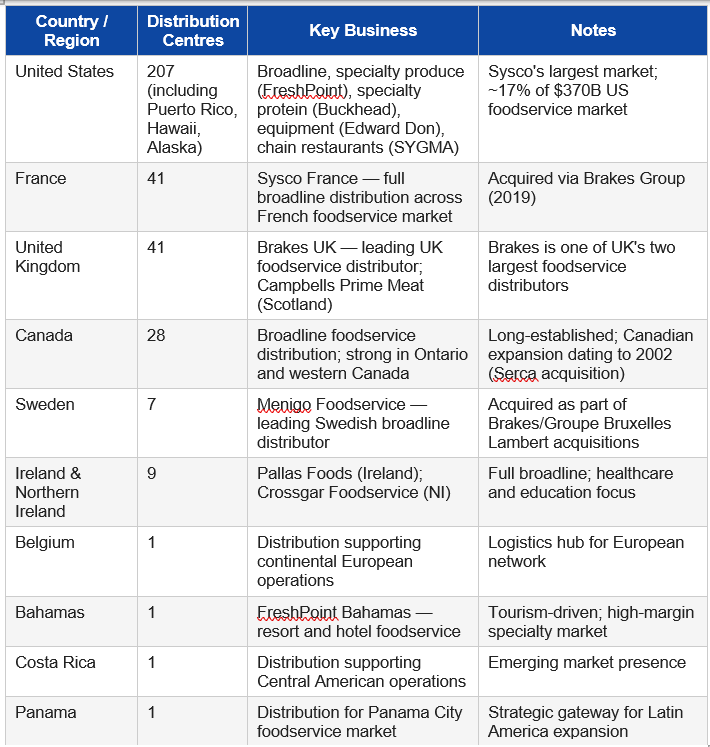
Global Footprint: 337 Distribution Centres Across 10 Countries
Sysco’s global distribution network is the largest in the foodservice industry — and it is this scale that creates the structural advantages in procurement, logistics, and customer service that smaller distributors cannot replicate.
Competitive Landscape of Sysco: Sysco vs the Foodservice Distribution Industry
The US foodservice distribution market is approximately $370 billion annually, with three major broadline distributors — Sysco, US Foods, and Performance Food Group — collectively controlling approximately 38–50% of the market. The remainder is served by hundreds of smaller regional and specialty distributors.
| Company | Revenue (FY2025 est.) | Distribution Centres | Market Focus | Key Differentiator vs Sysco |
| Sysco Corporation | $81.37 billion | 337 (10 countries) | Global broadline + specialty + equipment | Scale leader; most diverse portfolio; international presence |
| US Foods | ~$37.9 billion | ~80 (USA only) | Broadline US | Chef’Store cash-and-carry format; strong restaurant tech tools |
| Performance Food Group (PFG) | ~$60 billion | ~150 (USA) | Broadline + specialty + convenience | Convenience distribution (Vistar div.); foodservice + retail dual channel |
| Gordon Food Service (GFS) | ~$14 billion (est.) | ~180 (US + Canada) | Broadline; privately owned | Customer-owned model; strong in Southeast and Midwest |
| Reinhart Foodservice (part of PFG) | Included in PFG revenue | ~40 distribution centres | Regional broadline (Midwest/Southeast) | Acquired by PFG 2019 |
| Regional Independents | Collective: $100B+ | Thousands | Local and regional markets | Flexibility; local relationships; niche specialisation |
Financial Performance: FY2023–FY2026
| Metric | FY2023 | FY2024 | FY2025 | FY2026 Guidance |
| Revenue | $76.3 billion | $78.8 billion | $81.4 billion (record) | $84–85 billion (+3–5%) |
| YoY Revenue Growth | ~14% (post-COVID rebound) | ~3.3% | ~3.2% | 3–5% |
| Adj. EBITDA | ~$4.1 billion | ~$4.19 billion | $4.29 billion | Growing |
| Adj. Operating Income | ~$3.3 billion | ~$3.4 billion | $3.52 billion | Growing |
| Adj. EPS (Q4) | N/A | N/A | $1.48 (+6.5% YoY) | $4.50–4.60 (full year FY26) |
| Q4 Gross Profit | N/A | N/A | $4.0 billion (+3.9% YoY) | Growing |
| Dividend | Growing annually | Growing annually | Growing annually | Continued growth |
FY2025 Achievement: $81.37 billion represents Sysco’s highest-ever annual revenue, achieved in a year of modest restaurant industry volume growth. The result demonstrates that Sysco is gaining market share — growing faster than the overall US foodservice market of approximately 2–3% in the same period.
Why Sysco Is Recession-Resilient
Sysco has grown its revenue in all but a handful of years since 1969 — including through recessions, inflation shocks, and most dramatically, the COVID-19 pandemic (which caused the first significant revenue decline since the early 1980s). The structural reasons for this resilience:
- People eat regardless of economic conditions — foodservice volumes decline in recessions but do not collapse; people trade down from restaurants to fast food, but food distribution continues
- Healthcare and education customers (approximately 13% of Sysco revenue) are counter-cyclical or a-cyclical — hospital meals and school lunches are not discretionary
- Sysco’s scale lets it absorb food cost inflation better than smaller distributors — it can renegotiate supplier contracts faster and more effectively
- Long-term customer relationships (average restaurant tenure with Sysco is 7+ years) provide revenue predictability
Leadership: Kevin P. Hourican
Kevin P. Hourican became Sysco’s President and CEO in February 2020, taking the reins as the COVID-19 pandemic was about to devastate the global restaurant industry. His background — Executive Vice President of CVS Health and President of CVS Pharmacy before Sysco — was that of a retail and operations turnaround specialist, not a traditional foodservice executive. This outsider’s perspective proved valuable: Hourican responded to the pandemic crisis with decisive cost-cutting, supply chain stabilisation, and accelerated digital investment.
In April 2024, Hourican was elevated to Chair of the Board and CEO — a dual role that gives him exceptional authority to execute the long-term Recipe for Growth strategy. His signature strategic moves include launching Recipe for Growth (2021), acquiring Edward Don & Company (2023), and announcing the Restaurant Depot acquisition (2026) — each representing a material expansion of Sysco’s addressable market.
| CEO | Tenure | Key Contribution |
| John F. Baugh | 1969–1983 | Founded Sysco; built the acquisition-driven growth model; took company to $1B revenue |
| John E. Woodhouse | 1983–1995 | Led CFS Continental acquisition ($750M, 1988); expanded to 148 of top 150 US metros |
| Bill Dowd / Others | 1995–2000 | Continued fold-out expansion strategy; FreshPoint acquisition (2000) |
| Richard Schnieders | 2000–2009 | Revenue grew from $20B to $37B; Canadian expansion; first regional redistribution centres |
| Bill DeLaney | 2009–2016 | Navigated 2008 financial crisis; attempted US Foods acquisition (blocked 2015) |
| Tom Bené | 2016–2020 | Refocused on organic growth post-US Foods; built digital foundation |
| Kevin P. Hourican | 2020–present | COVID response; Recipe for Growth (2021); $81B revenue record; Restaurant Depot deal (2026) |
ESG & Sustainability at Sysco
Sysco’s scale creates both significant environmental responsibility and exceptional leverage for positive impact. As a company that distributes $81 billion in food products annually — including vast quantities of fresh produce, proteins, and perishables — Sysco’s decisions about sourcing, transportation, and packaging have material effects on global food systems and carbon emissions.
Key Sustainability Commitments
- Greenhouse gas reduction targets: Sysco has committed to science-based emissions reduction targets aligned with the Paris Agreement; published its 2025 Sustainability Report showing significant progress
- Food waste reduction: Programmes to divert surplus and near-expiry products to food banks and charitable organisations rather than disposal; working with FareShare in the UK and Feeding America in the US
- Sustainable sourcing: Responsible sourcing standards for seafood, palm oil, and other high-impact commodities; working with suppliers on animal welfare standards
- Fleet electrification: Investment in electric and alternative-fuel delivery vehicles to reduce transportation emissions from its ~13,000-vehicle fleet
- Packaging reduction: Transitioning private label products to reduced-packaging designs; increasing use of recycled and recyclable materials
- Diversity and inclusion: Programmes targeting diverse supplier procurement; leadership development programmes for underrepresented groups within Sysco’s 75,000-person workforce
Sysco also operates the Sysco Simply Green product line — a private label sustainability-focused range of eco-friendly cleaning products, compostable disposables, and sustainably sourced food items, allowing restaurant operators to meet their own sustainability commitments through their Sysco purchasing.
Frequently Asked Questions (FAQs)
Q: What does Sysco Corporation do?
A: Sysco Corporation is the world’s largest foodservice distribution company. It purchases food and related products from thousands of manufacturers and producers worldwide, stores them in temperature-controlled distribution centres, and delivers them to approximately 730,000 customer locations — including restaurants, hospitals, schools, hotels, and other foodservice operations — across 10 countries. Sysco does not operate restaurants; it is the invisible supply chain infrastructure that keeps professional kitchens stocked. With $81.37 billion in FY2025 revenue and 337 distribution centres, Sysco holds approximately 17% of the US foodservice distribution market.
Q: How big is Sysco Corporation?
A: Sysco is the world’s largest foodservice distributor by revenue. In fiscal year 2025 (ended June 28, 2025), Sysco reported record revenue of $81.37 billion — a 3.2% increase from FY2024’s $78.84 billion. The company employs approximately 75,000 people, operates 337 distribution centres across 10 countries, and serves approximately 730,000 customer locations globally. Its market capitalisation is approximately $33 billion. If the pending $29.1 billion Restaurant Depot acquisition closes (expected approximately Q3 FY2027), combined revenues would exceed $97 billion.
Q: Who founded Sysco, and when was it established?
A: Sysco Corporation was founded by John F. Baugh, who merged nine regional food distributors to create the company on March 3, 1969. Baugh, who had previously founded Zero Foods Company of Houston, recognised that the fragmented US foodservice distribution industry needed scale and national reach. The nine founding companies had combined 1969 revenues of $115 million. Sysco went public on the NYSE in 1970 and has been the largest US foodservice distributor since 1981 — a position it has held for 45 consecutive years.
Q: Who are Sysco’s biggest competitors?
A: Sysco’s three largest competitors in US broadline foodservice distribution are: (1) US Foods, with approximately $37.9 billion in FY2024 revenue — the second-largest US foodservice distributor; (2) Performance Food Group (PFG), with approximately $60 billion in revenue — the third largest, with operations spanning foodservice and convenience distribution; and (3) Gordon Food Service, a private company with estimated revenues of approximately $14 billion, strong in the Midwest and Southeast. Together, Sysco, US Foods, and PFG control approximately 38–50% of the US foodservice distribution market. A significant competitive development in 2025–2026 is the potential US Foods and Performance Food Group merger, which, if completed, would create a rival approaching Sysco in US revenue scale.
Q: What is Sysco’s Recipe for Growth strategy?
A: Recipe for Growth is Sysco’s multi-year strategic framework, launched at its May 2021 Investor Day and reaffirmed at the May 2024 Investor Day. It sets a target of 4–6% annual revenue growth — approximately 1.5x the rate of the overall foodservice market — through five pillars: (1) Winning the customer through enhanced sales and service; (2) Digital transformation via Sysco Shop and personalised digital tools; (3) Supply chain excellence through route optimisation and warehouse technology; (4) Portfolio expansion into specialty and equipment; (5) International growth via the European platform (UK, France, Sweden, Ireland, Belgium). Sysco reported $81.37 billion in FY2025 revenue under this strategy, with FY2026 guidance of $84–85 billion.
Q: What is the Restaurant Depot acquisition?
A: On March 30, 2026, Sysco announced an agreement to acquire Jetro Restaurant Depot — the leading US cash-and-carry wholesale food chain for foodservice professionals — for $29.1 billion. This is the largest acquisition in Sysco’s 57-year history. Restaurant Depot operates 166 large-format warehouse stores in 35 states, generates $16 billion in annual revenue, has $2.1 billion in EBITDA, and serves approximately 725,000 independent restaurant operators annually. The deal is structured as $21.6 billion in cash plus 91.5 million Sysco shares. Sysco expects $250 million in cost synergies and plans to open 125+ additional Restaurant Depot locations. The transaction is expected to close approximately Q3 FY2027, subject to regulatory approval — with antitrust review representing the key risk given Sysco’s 2015 experience when its US Foods acquisition was blocked by the FTC.
Q: What products does Sysco sell?
A: Sysco distributes approximately 400,000 SKUs across a comprehensive range of food and non-food categories. Food products include fresh produce, fresh and frozen proteins (beef, poultry, seafood, pork), dairy, eggs, canned and dry goods, beverages, desserts, and imported specialty items. Non-food products include paper goods, disposables, cleaning supplies, cookware, tableware, and restaurant equipment. Sysco also distributes commercial kitchen equipment and supplies through Edward Don & Company (acquired November 2023). Own-brand products — sold under Sysco Brand, Imperial, Arrezzio, Block & Barrel, Portico, and other labels — represent a significant portion of revenue and carry higher margins than national brands.
Q: What is the SYGMA Network?
A: The SYGMA Network, Inc. is a wholly owned Sysco subsidiary established in 1991 to consolidate Sysco’s chain restaurant distribution systems. While Sysco’s core broadline division serves independent restaurants and institutional customers, SYGMA specialises in serving large quick-service restaurant (QSR) chains and casual dining operators — clients like major fast food brands that require highly standardised, high-volume delivery of specific product specifications across hundreds or thousands of restaurant locations simultaneously. SYGMA operates as a separate, dedicated supply chain optimised for the consistency and volume requirements of chain restaurant accounts, allowing Sysco to serve both the independent restaurant operator market and the chain restaurant market without operational compromise.
Q: How does Sysco compare to Amazon Fresh or food delivery apps?
A: Sysco and Amazon Fresh serve entirely different markets and do not directly compete. Sysco is a B2B foodservice distributor — it sells to businesses (restaurants, hospitals, schools) in bulk quantities, typically on credit accounts, with scheduled delivery. Amazon Fresh and grocery delivery apps (Instacart, DoorDash Grocery) serve individual consumers buying household quantities. Sysco’s restaurant customers might buy 50 pounds of chicken breast; a consumer on Amazon Fresh might buy 2 pounds. The closest analogy to Sysco in the consumer world would be a wholesale club like Costco or Sam’s Club — which is why the Restaurant Depot acquisition (a cash-and-carry warehouse model) is strategically significant; it introduces a more self-service, warehouse-format channel that has some structural similarities to consumer wholesale clubs.
Conclusion: Sysco’s Next Chapter
Sysco Corporation is, by virtually every measure, one of the most quietly dominant companies in the global economy. It does not make consumer products, does not operate a single restaurant, and is not a household name — yet it is responsible for feeding millions of people every day through the restaurants, hospitals, schools, and hotels it supplies across 10 countries.
The company’s 57-year journey from John Baugh’s nine-distributor merger in 1969 to an $81 billion revenue machine in 2026 is a masterclass in disciplined acquisitive growth, operational scale, and strategic adaptability. From the first acquisition of Arrow Food Distributor in 1970 to the $29.1 billion Restaurant Depot deal in 2026, Sysco has consistently used M&A to extend its reach, broaden its portfolio, and consolidate a fragmented industry around itself.
The Restaurant Depot acquisition is the most consequential decision in Sysco’s history. If regulators approve the deal, Sysco will enter a new channel (cash-and-carry), add $16 billion in revenue, serve an additional 725,000 restaurant operators, and operate 166 warehouse stores that can be expanded to 291+. Combined revenues of approximately $97 billion would approach the symbolic $100 billion threshold. If, as happened with the 2015 US Foods attempt, regulators block the deal, Sysco returns to its organic-plus-tuck-in-acquisitions growth model — still well-positioned by the Recipe for Growth framework to deliver 3–5% annual revenue growth.
Either way, Sysco’s structural advantages — scale, network density, purchasing power, private label depth, digital capabilities, and a 57-year relationship base with 730,000 customers — remain formidable. The invisible giant that feeds the world’s restaurants is not going away anytime soon.
Also Read: Marketing Strategies, Marketing Mix and STP of Sysco
To read more content like this, subscribe to our newsletter