
Last Updated on November 5, 2026 by Team TBH
The Walt Disney Company operates across several major entertainment markets, including film and television production, streaming, sports broadcasting, theme parks, resorts, gaming partnerships, and consumer products. Its competitive position is built around an extensive portfolio of intellectual property, globally recognized brands, and the ability to extend successful franchises across multiple platforms.
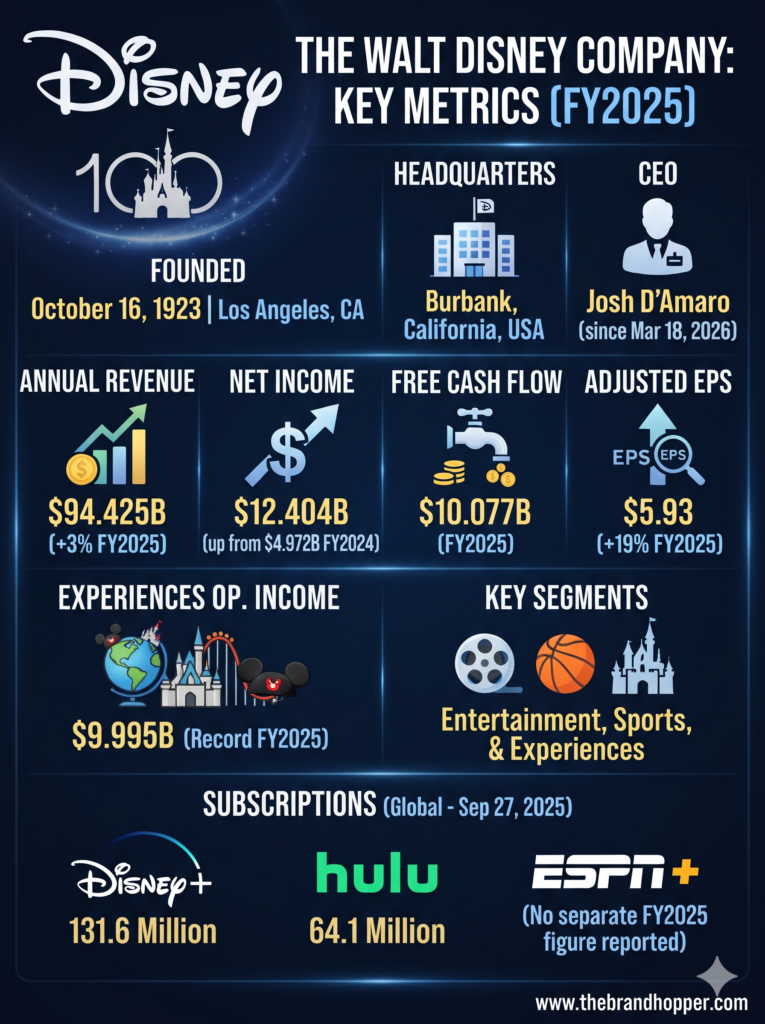
Disney reported $94.4 billion in revenue for FY2025, up 3% year over year. Its Experiences segment generated approximately $36 billion in revenue, while operating income for the segment reached nearly $10 billion. These results demonstrate the importance of Disney’s theme parks, resorts, cruise operations, and consumer experiences alongside its media businesses.
However, Disney faces competition from companies with very different business models. Netflix and Amazon challenge its streaming services, Comcast competes through Universal Studios and theme parks, while Hasbro, Mattel, Nintendo, and gaming platforms compete for franchise licensing, consumer spending, and audience attention.
This guide examines significant competitors and adjacent rivals across Disney’s major business segments.
The Walt Disney Company: Competitive Overview
Disney’s business is organized around three major reporting segments: Entertainment, Sports, and Experiences. Entertainment includes film and television studios, broadcast networks, and streaming services; Sports is led by ESPN; and Experiences includes theme parks, resorts, cruise operations, and consumer products.
Disney’s FY2025 revenue reached $94.4 billion, compared with $91.4 billion in FY2024. Net income attributable to Disney increased to $12.4 billion from $5.0 billion, while free cash flow reached $10.08 billion and adjusted diluted EPS rose 19% to $5.93.
Disney’s Experiences segment generated approximately $36 billion in FY2025 revenue and nearly $10 billion in operating income. Its parks, resorts, cruise ships, and consumer products provide a physical and commercial extension of the company’s film and television franchises.
Disney’s competitive advantage comes from combining intellectual property, storytelling, distribution, licensing, and physical experiences. A successful franchise can generate revenue through theatrical releases, streaming subscriptions, merchandise, games, and theme park attractions.
However, the company faces competitors with stronger positions in individual markets. Netflix has a larger standalone streaming business, Universal is expanding its theme park footprint, and companies such as Nintendo and Mattel have established franchises that compete for consumer attention and spending.
17 Major Disney Competitors
1. Comcast Corporation (NBCUniversal and Universal Parks)
Comcast is one of Disney’s most comprehensive competitors because its NBCUniversal division operates across film production, television, streaming, and theme parks. Comcast reported $123.7 billion in consolidated revenue for 2025, although this figure includes its broadband and connectivity businesses and should not be compared directly with Disney’s entertainment operations alone.
Universal Pictures competes with Disney’s film studios through franchises such as Jurassic World, Fast & Furious, and Despicable Me. NBCUniversal also owns DreamWorks Animation and Illumination, which produce major animated franchises including Shrek, How to Train Your Dragon, Minions, and The Super Mario Bros. Movie.
Universal’s theme park business is another significant competitive advantage. Epic Universe opened at Universal Orlando on May 22, 2025, adding five themed worlds and expanding Universal’s ability to compete for multi-day family vacations in the Orlando market.
Peacock competes with Disney+, Hulu, and other streaming platforms through original programming, films, news, and live sports. Comcast reported 44 million paid Peacock subscribers at the end of 2025, illustrating the platform’s growing role in its entertainment strategy.
2. Skydance Corporation (Warner Bros., HBO, and Paramount)

Skydance is now one of Disney’s most significant competitors following its acquisition of Warner Bros. Discovery, completed on October 6, 2026. The combined company brings together Warner Bros. Pictures, Paramount Pictures, HBO, Max, Paramount+, CBS, Nickelodeon, CNN, and an extensive portfolio of film and television franchises.
The combined studio portfolio includes major properties such as Harry Potter, DC, Mission: Impossible, Top Gun, Transformers, and SpongeBob SquarePants. These franchises compete with Disney’s Marvel, Star Wars, Pixar, and Disney Animation properties across theatrical releases, streaming, licensing, and consumer products.
The combination also brings together two major streaming services: Max and Paramount+. This creates a larger content and distribution operation, although the combined company’s subscriber totals should not be treated as a single consolidated subscriber figure without accounting for overlapping users and reporting definitions.
For Disney, Skydance represents a broader competitive threat than either Warner Bros. Discovery or Paramount could independently. Its combined film studios, premium television brands, sports assets, and children’s entertainment properties give it exposure across several of Disney’s core markets.
3. Netflix
Netflix is Disney’s most direct competitor in subscription streaming. The company reported $45.2 billion in revenue for 2025, an increase of 16% year over year, and operating income of approximately $13.3 billion.
Netflix’s strength lies in its broad content strategy. Unlike Disney+, which relies heavily on family entertainment and established franchises, Netflix produces and licenses programming across drama, comedy, documentaries, reality television, international content, and children’s entertainment.
Netflix has also expanded beyond traditional on-demand programming into advertising, live events, and sports-related content. Its advertising business creates another source of competition for Disney’s advertising-supported streaming services and television networks.
Disney’s advantage is its ability to connect streaming content with films, merchandise, and physical experiences. Netflix, however, has built a much larger standalone streaming business with strong global reach and significant operating profitability.
4. Amazon (Prime Video and MGM Studios)
Amazon competes with Disney through Prime Video, Amazon MGM Studios, and its growing investments in live sports. Unlike Disney, Amazon operates entertainment within a much larger commerce, advertising, and cloud computing ecosystem.
Amazon’s acquisition of MGM brought franchises such as James Bond and Rocky into its entertainment portfolio. Its original productions, including The Boys, Reacher, and The Lord of the Rings: The Rings of Power, strengthen Prime Video’s position in premium streaming.
Live sports are another important area of competition. Prime Video holds exclusive rights to Thursday Night Football in the United States and has secured major sports packages in several international markets. These rights put Amazon in direct competition with ESPN and other sports broadcasters.
Amazon’s business model gives it a different financial position from Disney. Prime Video can support the broader Prime membership ecosystem, while Disney’s streaming services are more directly tied to its media and entertainment economics.
5. Apple TV+

Apple competes with Disney through Apple TV+, its premium subscription streaming service. Apple does not regularly disclose standalone subscriber or revenue figures for the service, so widely circulated subscriber estimates should be treated as third-party estimates rather than official company data.
Apple TV+ focuses on original programming, including Severance, The Morning Show, Slow Horses, Ted Lasso, and Shrinking. Its strategy emphasizes premium productions and a curated catalogue rather than the extensive library approach used by Netflix and Disney+.
Apple’s distribution ecosystem is a major advantage. Apple TV+ is available across Apple devices and is included in Apple One bundles, allowing the company to promote its entertainment service alongside hardware, software, and other subscriptions.
Apple is a more focused competitor to Disney in premium streaming than in theme parks or consumer products. Its financial resources and distribution reach nevertheless make it an important rival for content talent, audience attention, and subscription spending.
6. Sony Group Corporation (Sony Pictures and PlayStation)

Sony Group competes with Disney through Sony Pictures Entertainment, its television production operations, and PlayStation’s gaming ecosystem. Its entertainment portfolio includes franchises such as Spider-Man, Jumanji, Bad Boys, Ghostbusters, and Venom.
Spider-Man is particularly important to Sony’s relationship with Disney. Sony retains the film rights to the character and produces its standalone films, while its agreement with Marvel Studios allows Spider-Man to appear in selected Marvel Cinematic Universe productions.
Sony Pictures also produces films and television content for third-party streaming platforms. This makes Sony both a competitor and a content supplier in the entertainment industry.
PlayStation adds another competitive dimension. Game franchises such as The Last of Us demonstrate how interactive entertainment properties can expand into television and film, competing with Disney’s franchise-development model for audience attention and licensing opportunities.
7. Nintendo
Nintendo is an important Disney competitor in family entertainment, character-based intellectual property, and interactive experiences. Its portfolio includes globally recognized franchises such as Super Mario, The Legend of Zelda, Pokémon (through The Pokémon Company), Animal Crossing, and Donkey Kong.
Nintendo’s characters compete with Disney properties for children’s attention, merchandise spending, licensing opportunities, and family entertainment time. The success of The Super Mario Bros. Movie demonstrated the commercial potential of translating video game franchises into major theatrical releases.
Nintendo also operates a distinctive hardware and software ecosystem through its gaming consoles and first-party titles. This gives it a direct relationship with consumers that differs from Disney’s film, streaming, and theme park model.
The companies also have areas of collaboration and shared commercial interest. Nevertheless, Nintendo’s ability to build long-lasting characters and extend them across games, films, merchandise, and attractions makes it a relevant competitor to Disney’s franchise strategy.
8. Six Flags Entertainment Corporation

Six Flags became North America’s largest regional amusement park operator by park count following its merger with Cedar Fair, which closed on July 1, 2024. Its portfolio includes parks such as Six Flags Magic Mountain, Cedar Point, Knott’s Berry Farm, and Kings Island.
The combined company operates a large network of regional amusement parks, water parks, and resort properties. Its business model is different from Disney’s destination-focused theme park strategy, with a stronger emphasis on regional visitors, thrill rides, season passes, and accessible entertainment.
Six Flags reported $3.10 billion in revenue for 2025, with attendance of approximately 47.4 million guests. However, the company also reported a substantial net loss, including a non-cash impairment charge, so revenue alone does not reflect its financial performance.
Six Flags competes with Disney for family leisure spending, particularly among consumers seeking lower-cost alternatives to major destination vacations. Its regional footprint and season-pass model provide a different proposition from Disney’s premium resort experiences.
9. United Parks & Resorts (SeaWorld and Busch Gardens)

United Parks & Resorts operates SeaWorld, Busch Gardens, Aquatica, Discovery Cove, and other attractions. Its portfolio competes with Disney’s parks and resorts for family entertainment spending, particularly in Florida and California.
The company reported $1.66 billion in revenue for FY2025, down 3.6% from the previous year. Attendance was approximately 21.2 million guests, while net income declined 26% to $168.4 million.
United Parks differentiates itself through marine-life attractions, animal rescue and conservation programmes, aquatic experiences, and major roller coasters. Discovery Cove, for example, offers premium experiences such as swimming with dolphins and snorkeling.
Its scale and financial resources are considerably smaller than Disney’s, but it competes for visitors who want alternative theme park experiences in the same travel destinations. Its focus on marine attractions and thrill rides also provides a different positioning from Disney’s character-led parks.
10. Merlin Entertainments

Merlin Entertainments operates a global portfolio of attractions, including LEGOLAND parks, Madame Tussauds, SEA LIFE aquariums, Alton Towers, and other family entertainment destinations.
Merlin reported £1.999 billion in revenue for 2025, compared with £2.057 billion in 2024. It welcomed approximately 60.5 million visitors during the year, while underlying EBITDA reached £571 million.
LEGOLAND is one of Merlin’s most relevant businesses in its competition with Disney. Its parks target families with younger children and use LEGO’s established brand and products to create interactive attractions and themed experiences.
Merlin also competes for tourist spending through Madame Tussauds and SEA LIFE attractions in major cities and travel destinations. Although its operating model differs from Disney’s large destination resorts, its international footprint makes it a significant player in family entertainment.
11. Hasbro

Hasbro competes with Disney through toys, games, licensing, entertainment properties, and digital gaming. Its portfolio includes Transformers, G.I. Joe, My Little Pony, Nerf, Play-Doh, Monopoly, Magic: The Gathering, and Dungeons & Dragons.
Hasbro reported approximately $4.7 billion in revenue for 2025. Its Wizards of the Coast and Digital Gaming business is particularly important, with Magic: The Gathering generating approximately $1.72 billion in revenue, up 59% year over year.
Hasbro competes with Disney for consumer products spending and franchise licensing opportunities. It also has a commercial relationship with Disney through licensed products based on Disney-owned properties, making the relationship both competitive and collaborative.
The company’s gaming portfolio gives it an additional presence in interactive entertainment. Magic: The Gathering and Dungeons & Dragons compete for the leisure time and spending of audiences that also consume Disney films, series, and merchandise.
12. Mattel

Mattel is a major competitor to Disney in toys, character licensing, and entertainment based on established intellectual property. Its best-known brands include Barbie, Hot Wheels, Fisher-Price, American Girl, and UNO.
Mattel reported $5.35 billion in net sales for 2025, down 1% year over year. North American sales declined 5%, while international sales increased 6%.
The success of the Barbie movie, which grossed more than $1.4 billion worldwide in 2023, demonstrated Mattel’s ability to turn a toy brand into a major entertainment franchise. The company continues to develop film and television projects based on its portfolio, including Hot Wheels and Masters of the Universe.
Mattel competes with Disney for toy retail placement, licensing deals, family spending, and the development of characters with long-term commercial value. Its entertainment strategy is increasingly focused on extending its brands beyond physical products into films, digital games, and other media.
13. Lionsgate Studios

Lionsgate is an independent film and television studio that competes with Disney for theatrical audiences, content licensing agreements, and franchise development. Its portfolio includes John Wick, The Hunger Games, Saw, and Now You See Me.
The studio operates across theatrical distribution, television production, and content licensing. Unlike Disney, which increasingly distributes its own content through its streaming platforms, Lionsgate licenses programming to multiple streaming services and distribution partners.
Lionsgate’s franchise strategy is concentrated in genres such as action, horror, and young-adult entertainment. These categories allow it to compete for audiences that may not be the primary focus of Disney’s family-oriented franchise portfolio.
Its smaller scale can also support a different production strategy, with genre-focused films and franchises that do not always require the budgets associated with Disney’s major theatrical releases.
14. YouTube (Alphabet)

YouTube competes with Disney for audience attention, advertising revenue, and children’s entertainment consumption. Unlike Disney+, YouTube operates primarily as a user-generated and creator-led video platform supported by advertising and subscriptions.
Alphabet reported $40.4 billion in YouTube advertising revenue for 2025. This figure represents advertising revenue only and excludes other YouTube-related income that may be reported in different parts of Alphabet’s business.
YouTube Kids and creator-led channels compete with Disney’s children’s programming for viewing time. Channels featuring animation, educational videos, music, and family entertainment attract audiences that might otherwise watch Disney Junior or Disney+.
YouTube also competes with Disney through YouTube TV and its subscription offerings. At the same time, Disney uses YouTube to distribute trailers, promotional clips, and marketing content, making the relationship both competitive and commercially complementary.
15. TikTok (ByteDance)

TikTok competes with Disney in the attention economy, particularly among younger audiences. Its short-form video format and recommendation algorithm have changed how consumers discover entertainment, follow creators, and engage with popular franchises.
TikTok is not a direct substitute for Disney+ or a traditional film studio. However, it competes for the time that audiences might otherwise spend watching films, television series, or longer-form streaming content.
The platform also influences entertainment discovery. Clips, trends, creator reactions, and fan communities can increase awareness of Disney films, characters, merchandise, and theme park attractions.
Disney uses TikTok as a marketing channel while competing with it for audience engagement. This dual relationship makes TikTok an important indirect competitor in the broader entertainment market.
16. Roblox Corporation

Roblox competes with Disney in interactive entertainment, virtual experiences, and youth engagement. Its platform allows users to create, share, and play games and experiences, while also providing opportunities for brands to reach younger audiences.
Roblox has developed a large ecosystem of user-generated experiences, virtual events, digital items, and branded activations. This creates competition with Disney’s efforts to extend its intellectual property into interactive and digital experiences.
The platform’s business model is different from Disney’s subscription and content-distribution model. Roblox relies heavily on user-generated content and virtual transactions, while Disney builds experiences around its owned franchises and licensed properties.
For Disney, Roblox represents competition for younger audiences’ time and digital spending. It also offers a potential distribution and marketing environment for branded experiences, illustrating how entertainment companies can be both competitors and partners.
17. Epic Games

Epic Games is a major competitor in gaming, digital entertainment, and interactive intellectual property. Its best-known property, Fortnite, has evolved beyond a traditional video game into a platform for live events, creator experiences, digital collaborations, and entertainment partnerships.
Fortnite’s collaborations with major entertainment franchises demonstrate how games can become powerful platforms for brand engagement. Its digital events and licensed character appearances compete with Disney’s efforts to connect audiences with its own franchises across films, games, and experiences.
Epic Games also develops Unreal Engine, a widely used real-time 3D creation technology. This technology has applications across gaming, film production, virtual production, and other digital experiences, giving Epic a role in the wider entertainment ecosystem.
Epic is therefore an indirect but important Disney competitor. It competes for audience attention and franchise engagement while also providing technology that can support the production of entertainment content.
Disney vs. 17 Competitors: At-a-Glance Comparison
| Company | Latest annual revenue or financial metric | Primary overlap with Disney |
|---|---|---|
| Disney | $94.4B (FY2025) | Reference company |
| Comcast | $123.7B (2025) | Film, streaming, television, theme parks |
| Skydance | Combined company; standalone comparable annual figure not yet established | Film studios, streaming, television, sports |
| Netflix | $45.2B (2025) | Streaming and original content |
| Amazon | Prime Video revenue not separately disclosed | Streaming, live sports, film |
| Apple | Apple TV+ revenue not separately disclosed | Premium streaming |
| Sony Group | Group revenue not directly comparable with Pictures alone | Film, television, gaming |
| Nintendo | Latest company financials should be used for a gaming-specific comparison | Gaming and franchise IP |
| Six Flags | $3.10B (2025) | Regional theme parks |
| United Parks & Resorts | $1.66B (2025) | Theme parks and family attractions |
| Merlin Entertainments | £1.999B (2025) | LEGOLAND and global attractions |
| Hasbro | Approximately $4.7B (2025) | Toys, games, licensing, IP |
| Mattel | $5.35B (2025) | Toys, films, character IP |
| Lionsgate | Use studio-only reporting; historical figures may include Starz | Film and television production |
| YouTube / Alphabet | $40.4B YouTube advertising revenue (2025) | Video, advertising, audience attention |
| TikTok / ByteDance | TikTok revenue not separately disclosed | Short-form video and audience attention |
| Roblox | Use company-reported bookings or revenue for the relevant period | Interactive entertainment and virtual experiences |
| Epic Games | Private company; comparable current revenue not publicly reported | Gaming and digital entertainment |
Note: The financial figures above refer to different fiscal years and reporting periods. Some are consolidated company revenue, while others are segment-specific revenue or advertising revenue. They should not be interpreted as directly comparable measures of competitive scale.
How Disney Navigates the Competitive Landscape
Disney’s competitive strategy is built around its integrated entertainment ecosystem. The company can develop a character through film or television, extend it into streaming, license it for consumer products, and build physical attractions around the same intellectual property.
This model differentiates Disney from streaming-focused companies such as Netflix and technology platforms such as YouTube. It also creates opportunities to generate revenue from a successful franchise across multiple business lines.
In streaming, Disney competes through its portfolio of Disney+, Hulu, and ESPN-related services. Its challenge is to maintain subscriber engagement and profitability while competing with platforms that offer broader content libraries, different pricing strategies, and extensive global distribution.
In theme parks, Disney continues to invest in new attractions, resorts, cruise ships, and themed lands. Universal’s Epic Universe and the expanded Six Flags network demonstrate that the company faces competition from both premium destination operators and more accessible regional parks.
Disney also faces competition for the next generation of audiences. TikTok, YouTube, Roblox, and Epic Games are changing how younger consumers discover characters, participate in entertainment, and spend their leisure time.
The company’s long-term challenge is to keep its franchises relevant across generations while adapting to new entertainment formats. Its brand portfolio and physical experiences remain major advantages, but maintaining those advantages requires continued investment in content, technology, and customer experiences.
Frequently Asked Questions
1. Who is Disney’s biggest competitor?
Disney’s biggest competitor depends on the business segment being considered. Netflix is its most direct streaming rival, Comcast’s NBCUniversal competes across film, television, streaming, and theme parks, while Skydance has become a major competitor following its acquisition of Warner Bros. Discovery.
2. How does Disney’s revenue compare with Netflix?
Disney reported $94.4 billion in FY2025 revenue, compared with Netflix’s $45.2 billion for calendar year 2025. Disney’s consolidated revenue is therefore more than twice Netflix’s, but the comparison includes Disney’s theme parks, resorts, consumer products, sports, and other businesses, whereas Netflix’s revenue is primarily from streaming entertainment.
3. Is Universal’s Epic Universe a threat to Disney World?
Yes. Epic Universe, which opened on May 22, 2025, expands Universal Orlando’s ability to compete for multi-day family vacations. Its themed worlds and attractions give visitors another major destination option in Orlando, although the long-term effect on Disney’s attendance and spending should be assessed using actual visitor and financial data rather than assumptions.
4. How does Disney compete with TikTok and YouTube?
Disney competes with TikTok and YouTube primarily for audience attention, advertising spending, and children’s entertainment consumption. It also uses both platforms to promote films, streaming releases, merchandise, and theme park experiences.
5. Does Disney compete with Amazon and Apple?
Yes. Disney competes with Amazon Prime Video and Apple TV+ for streaming subscriptions, content talent, and audience engagement. Amazon also competes with ESPN through live sports rights, while Apple benefits from its device ecosystem and subscription bundles.
6. How does Mattel compete with Disney?
Mattel competes with Disney through toys, character licensing, and entertainment based on intellectual property. The success of the Barbie movie demonstrated how a toy brand can become a major film franchise and create opportunities across merchandise and other media.
7. What is Hasbro’s competitive relationship with Disney?
Hasbro is both a competitor and a commercial partner of Disney. It licenses Disney-owned properties for certain toy products, while its own franchises, including Transformers, My Little Pony, Magic: The Gathering, and Dungeons & Dragons, compete for consumer spending and entertainment attention.
8. Is Skydance a competitor to Disney?
Yes. Following its acquisition of Warner Bros. Discovery in October 2026, Skydance controls a combined portfolio that includes Warner Bros., HBO, Max, Paramount Pictures, Paramount+, CBS, and Nickelodeon. Its film, television, streaming, and sports assets make it a major competitor across several Disney business segments.
9. How significant is the Six Flags-Cedar Fair merger for Disney?
The merger created a larger regional amusement park operator with a broad network of attractions across North America. Six Flags competes with Disney for family leisure spending, particularly among visitors looking for regional parks and lower-cost alternatives to destination vacations.
10. What is Disney’s long-term competitive advantage?
Disney’s most significant competitive advantage is its integrated franchise ecosystem. The company can develop intellectual property through films and television, expand it into streaming and games, and monetize it through merchandise, licensing, theme parks, resorts, and other experiences.
Conclusion
Disney operates in one of the most competitive entertainment markets in the world. It faces streaming rivals such as Netflix and Amazon, theme park competitors such as Universal and Six Flags, and franchise-driven companies such as Hasbro, Mattel, and Nintendo.
Competition is also evolving beyond traditional film studios and television networks. YouTube, TikTok, Roblox, and Epic Games compete for audience attention through creator-led content, short-form video, and interactive digital experiences.
Disney’s integrated business model remains a major competitive advantage because it connects content, characters, merchandise, and physical experiences. However, the company must continue investing in its franchises, technology, streaming services, and theme parks to maintain that advantage.
The competitive landscape is therefore not defined by a single rival. Disney’s long-term performance will depend on how effectively it competes across multiple entertainment markets while continuing to turn its intellectual property into experiences that audiences value.
Also Read: Netflix vs Disney+ : Which Streaming Service Wins?
To read more content like this, subscribe to our newsletter